
1 Comprehension and Analysis of AgeAppropriate Text Foundations





- Slides: 32
1 Comprehension and Analysis of Age-Appropriate Text Foundations and Framework Volume 1 © 2012 California Department of Education (CDE) California Preschool Instructional Network (CPIN) 04/12/12
2 Outcomes • Become familiar with the language and literacy – foundations with a focus on the comprehension and analysis of age-appropriate text substrand. – framework strategies with a focus on the comprehension and analysis of age- appropriate text substrand. • Identify the operations by which children demonstrate comprehension and analysis of age-appropriate text. • Consider strategies for fostering comprehension and analysis of age-appropriate text in all children. © 2012 California Department of Education (CDE) California Preschool Instructional Network (CPIN) 04/17/2012
Early Learning Development System © 2012 California Department of Education (CDE) California Preschool Instructional Network (CPIN) 04/17/2012 3
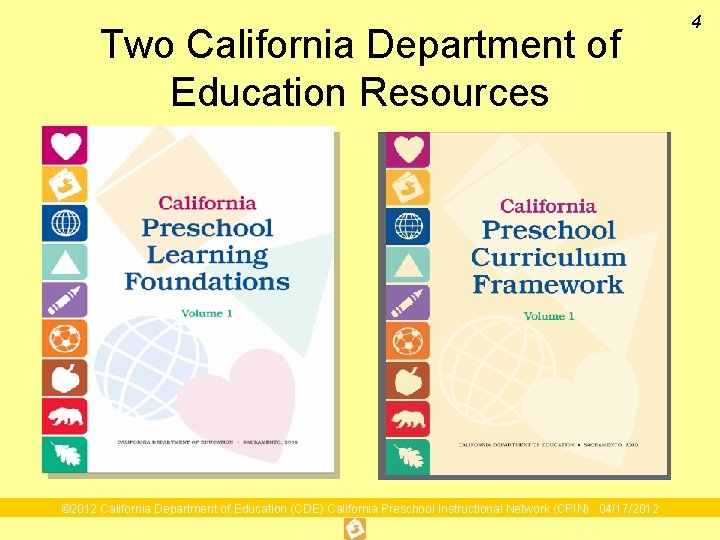
Two California Department of Education Resources © 2012 California Department of Education (CDE) California Preschool Instructional Network (CPIN) 04/17/2012 4
5 Domain Organization Literacy • Language and Literacy – Reading • Comprehension and Analysis of Age Appropriate Writing Reading Text Concepts about Print Phonological Awareness Alphabetic and Word/Print Recognition Comprehension and Analysis of Age. Appropriate Text Literacy Interest and Response Writing Strategies © 2012 California Department of Education (CDE) California Preschool Instructional Network (CPIN) 04/17/2012
6 Using Comprehension Skills • Look at the pictures and short stories on your table with your tablemates. • When was the last time you had a similar experience? • What comprehension and analysis skills did you use? • What experiences do you remember as a small child that may have laid the groundwork for those skills? © 2012 California Department of Education (CDE) California Preschool Instructional Network (CPIN) 04/17/2012
Comprehension and Analysis of Age-Appropriate Text Foundations • Demonstrate knowledge of familiar story details (e. g. , characters, settings, events, and event sequences). PCF, Vol. 1, p. 146 • Demonstrate and use knowledge from information texts (e. g. , label and describe an animal, take on the role of astronaut, explain what a seed needs to grow). PCF, Vol. 1, p. 146 © 2012 California Department of Education (CDE) California Preschool Instructional Network (CPIN) 04/17/2012 7
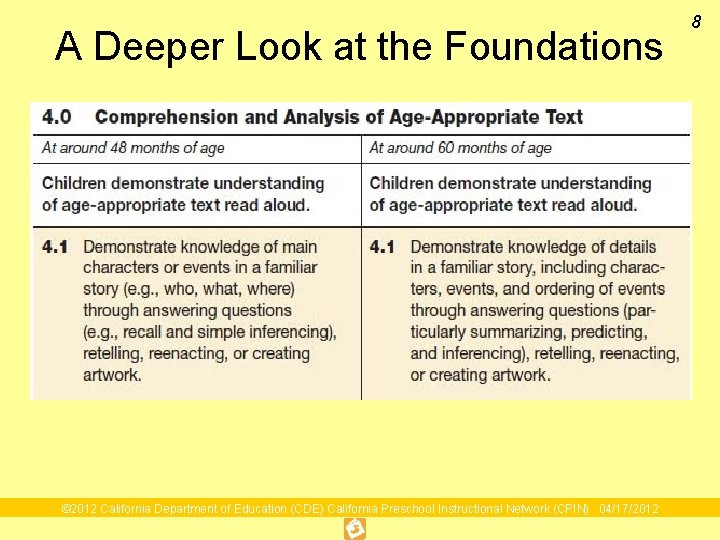
A Deeper Look at the Foundations © 2012 California Department of Education (CDE) California Preschool Instructional Network (CPIN) 04/17/2012 8
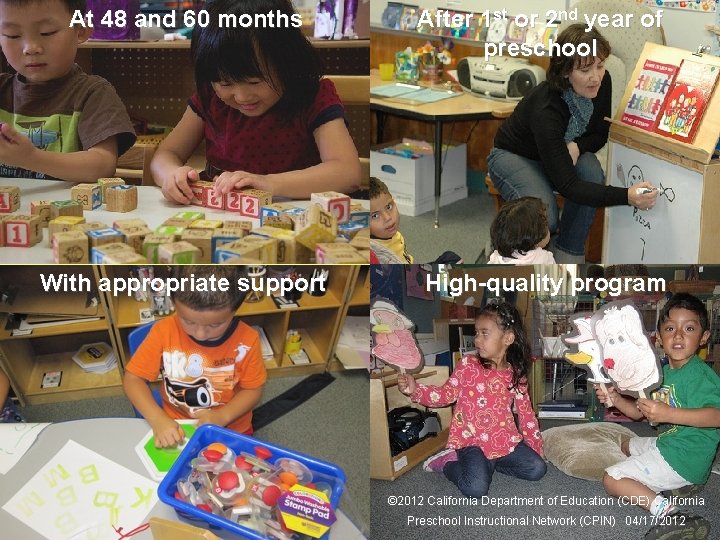
At 48 and 60 months After 1 st or 2 nd year of preschool 9 Foundations With appropriate support High-quality program © 2012 California Department of Education (CDE) California Preschool Instructional Network (CPIN) 04/17/2012
10 Preschoolers’ Series of Stages development of narrative thinking goes through a series of stages that ultimately lead to their making sense of stories and the world around them. PLF, Vol. 1, p. 53 © 2012 California Department of Education (CDE) California Preschool Instructional Network (CPIN) 04/17/2012
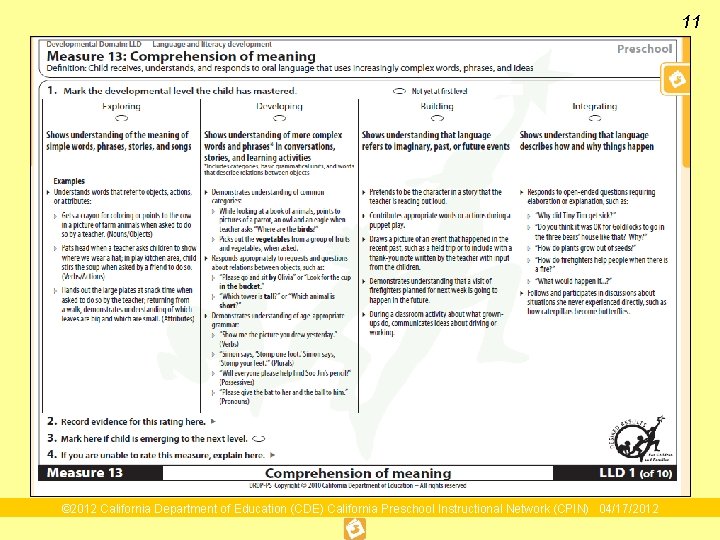
11 DRDP-2010 Measure 13 © 2012 California Department of Education (CDE) California Preschool Instructional Network (CPIN) 04/17/2012
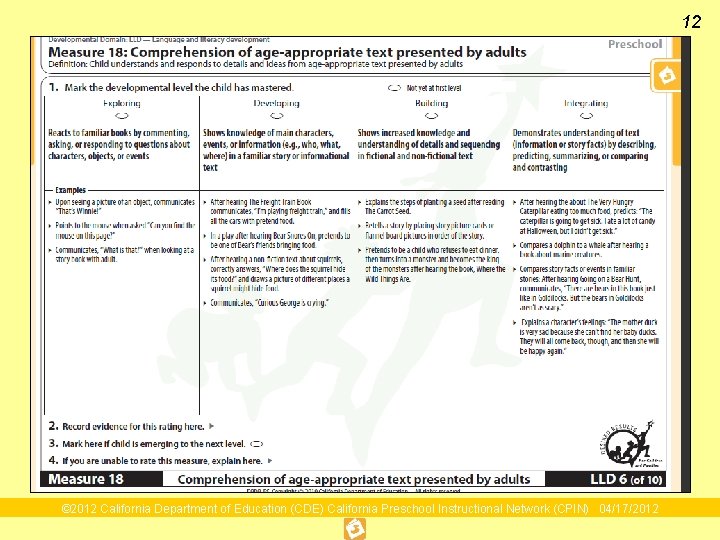
12 DRDP 2010 Measure 18 © 2012 California Department of Education (CDE) California Preschool Instructional Network (CPIN) 04/17/2012
13 ELD Measure 23 © 2012 California Department of Education (CDE) California Preschool Instructional Network (CPIN) 04/17/2012
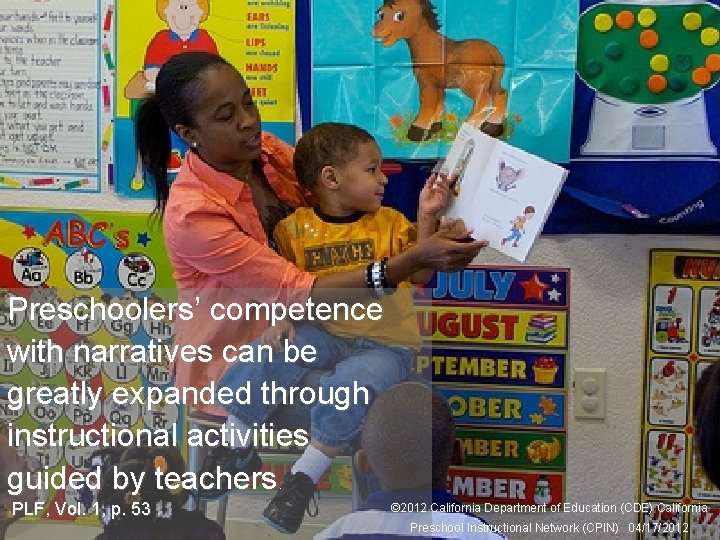
14 Interaction and Strategy Preschoolers’ competence with narratives can be greatly expanded through instructional activities guided by teachers. PLF, Vol. 1, p. 53 © 2012 California Department of Education (CDE) California Preschool Instructional Network (CPIN) 04/17/2012
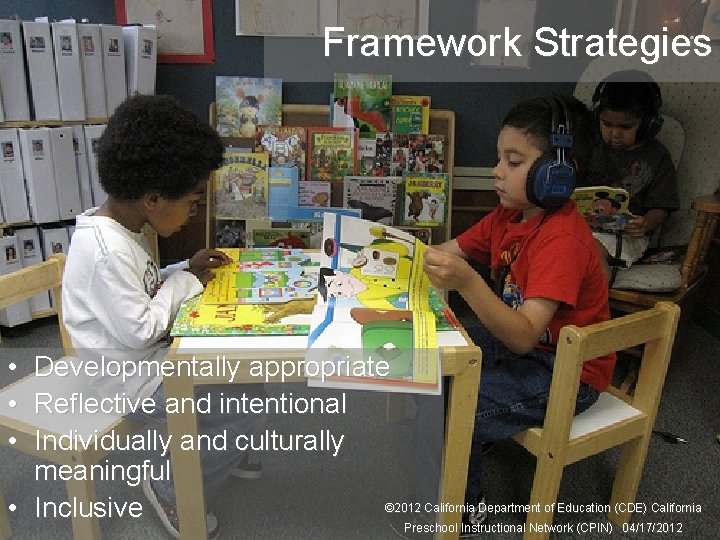
15 Framework Strategies • Developmentally appropriate • Reflective and intentional • Individually and culturally meaningful © 2012 California Department of Education (CDE) California • Inclusive Preschool Instructional Network (CPIN) 04/17/2012
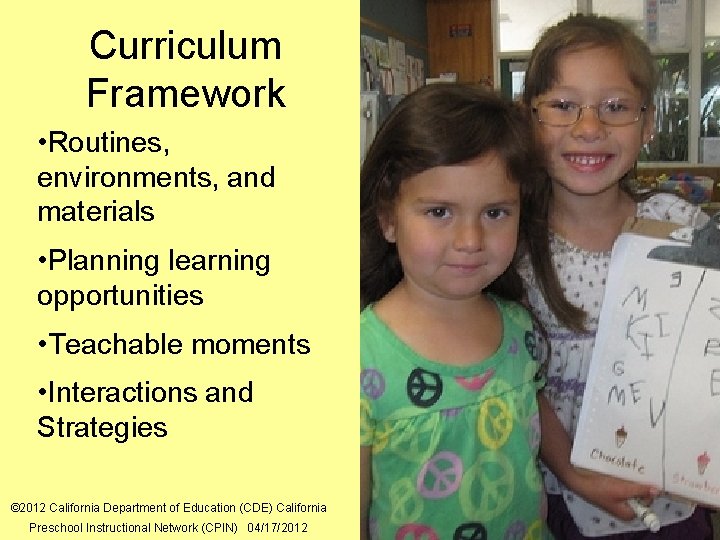
Curriculum Framework • Routines, environments, and materials • Planning learning opportunities • Teachable moments • Interactions and Strategies © 2012 California Department of Education (CDE) California Preschool Instructional Network (CPIN) 04/17/2012 16
17 Environment and Materials • Use Information Texts – Information books, placed in the indoor science area as well as outside in suitable tubs or on a cart, extend children's firsthand science experiences. PCF, Vol. 1, p. 107 © 2012 California Department of Education (CDE) California Preschool Instructional Network (CPIN) 04/17/2012
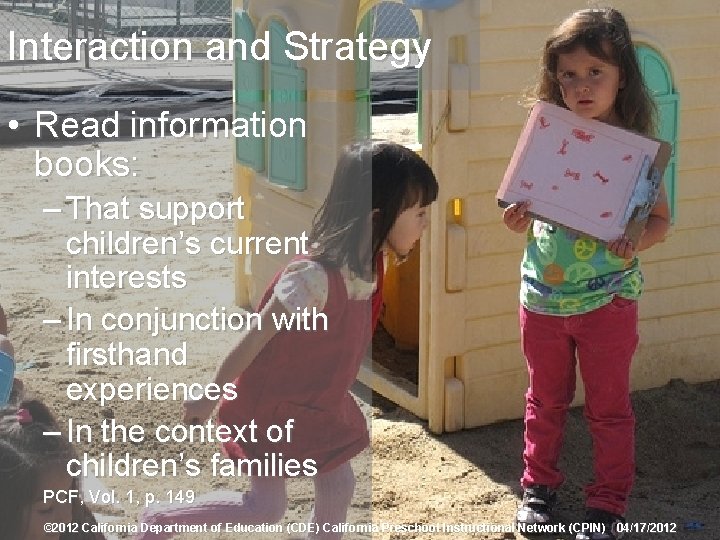
Interaction and Strategy • Read information books: – That support children’s current interests – In conjunction with firsthand experiences – In the context of children’s families PCF, Vol. 1, p. 149 © 2012 California Department of Education (CDE) California Preschool Instructional Network (CPIN) 04/17/2012 18
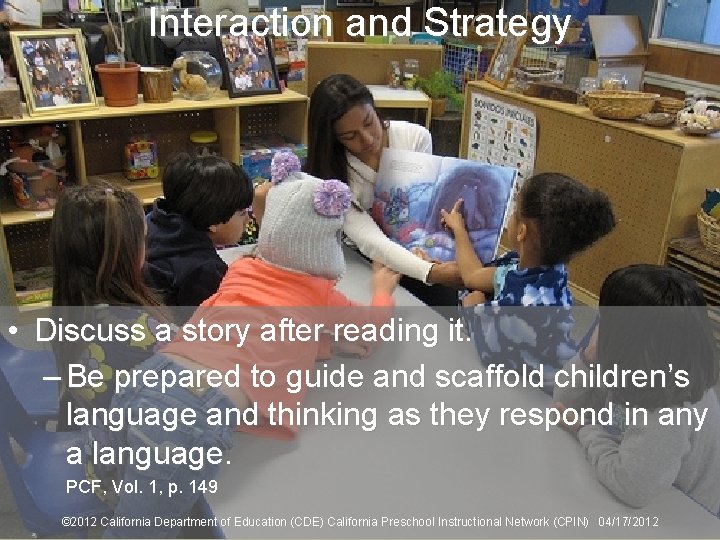
Interaction and Strategy 19 • Discuss a story after reading it. – Be prepared to guide and scaffold children’s language and thinking as they respond in any a language. PCF, Vol. 1, p. 149 © 2012 California Department of Education (CDE) California Preschool Instructional Network (CPIN) 04/17/2012
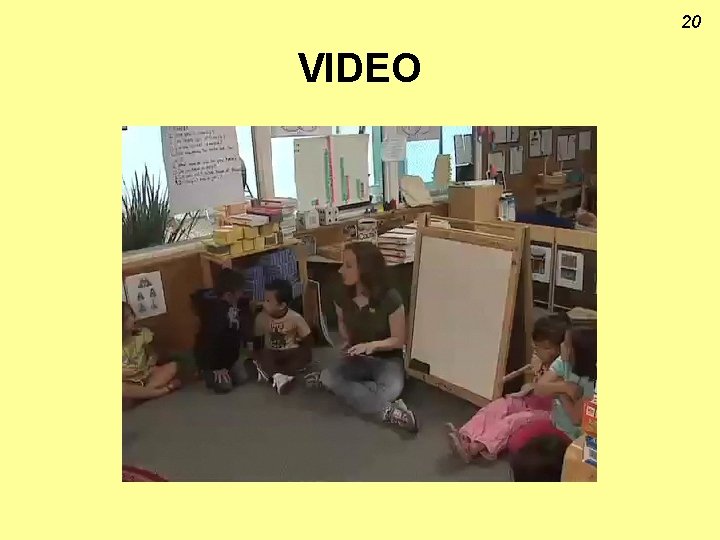
20 VIDEO
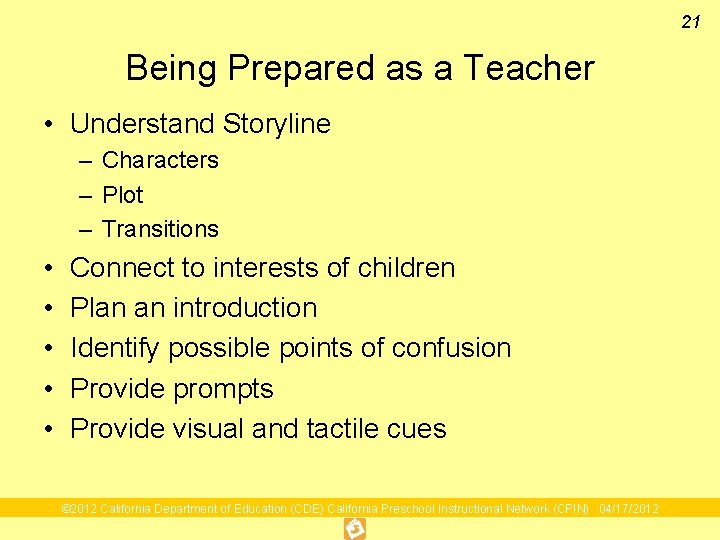
21 Being Prepared as a Teacher • Understand Storyline – Characters – Plot – Transitions • • • Connect to interests of children Plan an introduction Identify possible points of confusion Provide prompts Provide visual and tactile cues © 2012 California Department of Education (CDE) California Preschool Instructional Network (CPIN) 04/17/2012
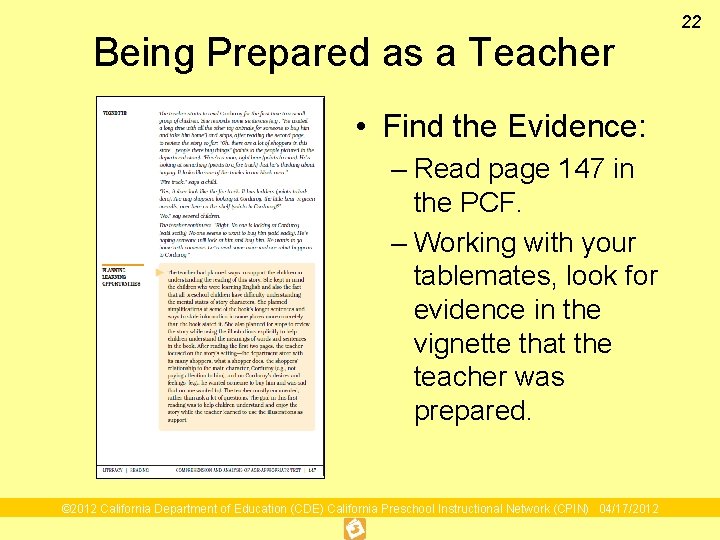
Being Prepared as a Teacher • Find the Evidence: – Read page 147 in the PCF. – Working with your tablemates, look for evidence in the vignette that the teacher was prepared. © 2012 California Department of Education (CDE) California Preschool Instructional Network (CPIN) 04/17/2012 22
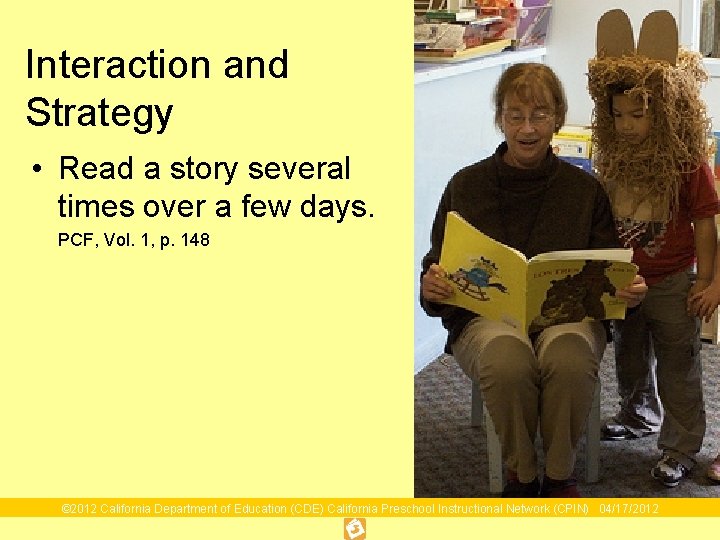
23 Interaction and Strategy • Read a story several times over a few days. PCF, Vol. 1, p. 148 © 2012 California Department of Education (CDE) California Preschool Instructional Network (CPIN) 04/17/2012
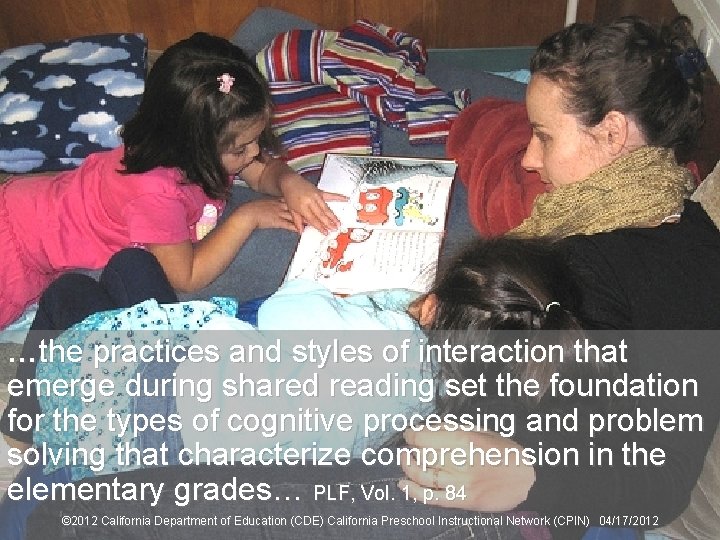
24 Shared Reading …the practices and styles of interaction that emerge during shared reading set the foundation for the types of cognitive processing and problem solving that characterize comprehension in the elementary grades… PLF, Vol. 1, p. 84 © 2012 California Department of Education (CDE) California Preschool Instructional Network (CPIN) 04/17/2012
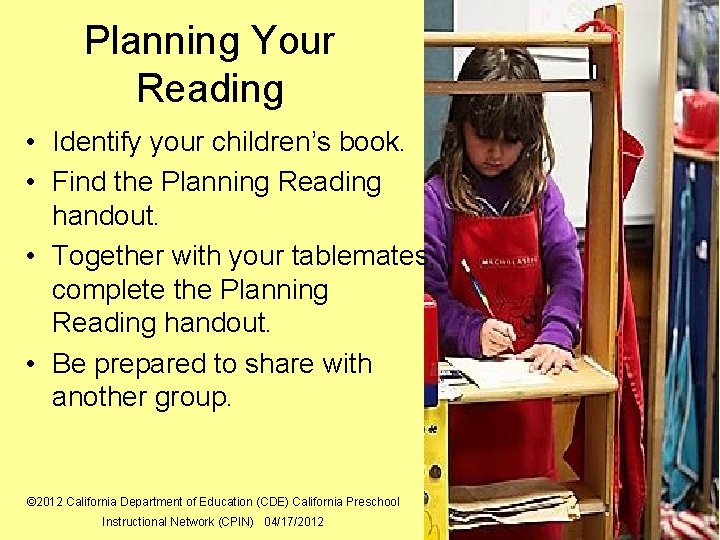
Planning Your Reading • Identify your children’s book. • Find the Planning Reading handout. • Together with your tablemates, complete the Planning Reading handout. • Be prepared to share with another group. © 2012 California Department of Education (CDE) California Preschool Instructional Network (CPIN) 04/17/2012 25
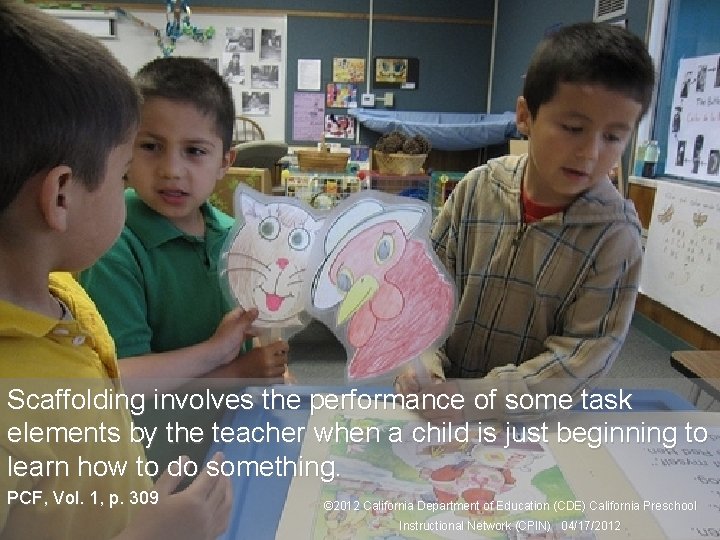
26 Scaffolding for Instruction Scaffolding involves the performance of some task elements by the teacher when a child is just beginning to learn how to do something. PCF, Vol. 1, p. 309 © 2012 California Department of Education (CDE) California Preschool Instructional Network (CPIN) 04/17/2012
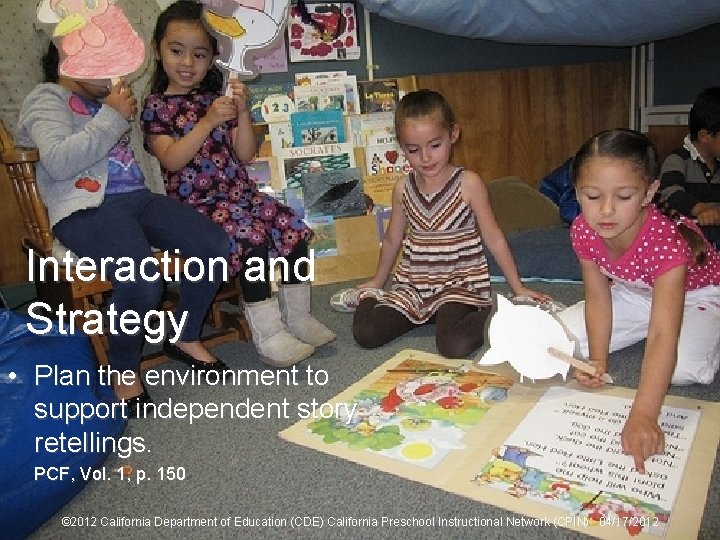
27 Interaction and Strategy • Plan the environment to support independent story retellings. PCF, Vol. 1, p. 150 © 2012 California Department of Education (CDE) California Preschool Instructional Network (CPIN) 04/17/2012
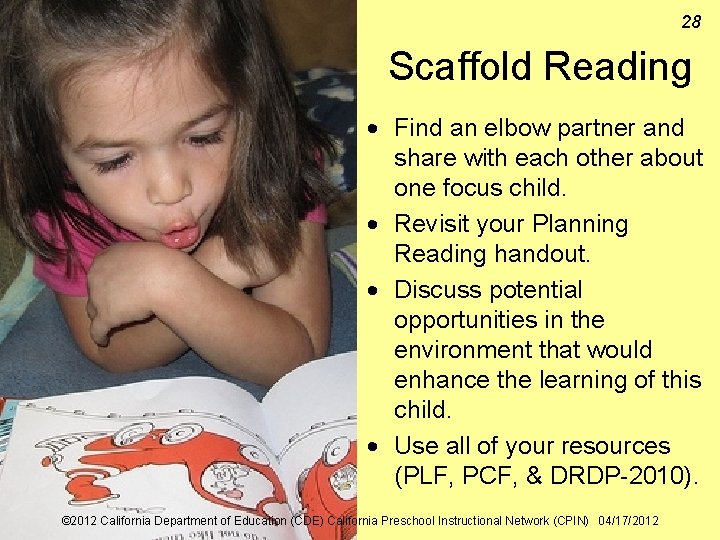
28 Scaffold Reading Find an elbow partner and share with each other about one focus child. Revisit your Planning Reading handout. Discuss potential opportunities in the environment that would enhance the learning of this child. Use all of your resources (PLF, PCF, & DRDP-2010). © 2012 California Department of Education (CDE) California © 2012 Instructional California Department of Education (CDE) California Preschool Instructional Network (CPIN) 04/17/2012 Preschool Network (CPIN) 04/17/2012
29 Video Reflection © 2012 California Department of Education (CDE) California Preschool Instructional Network (CPIN) 04/17/2012
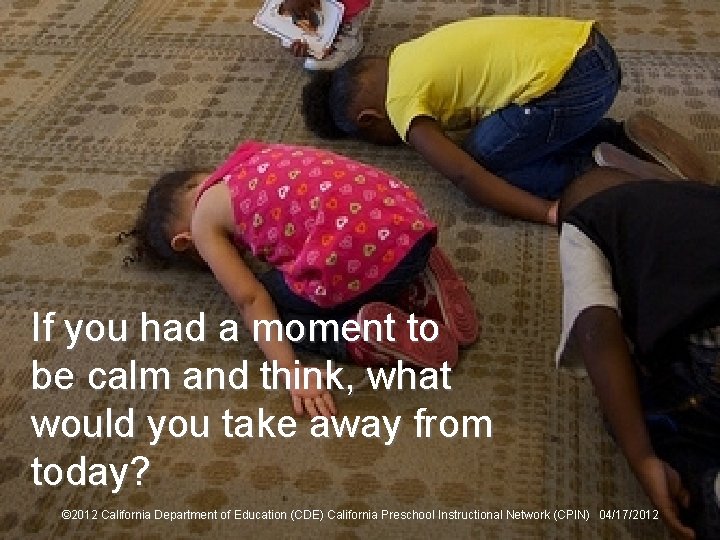
30 If you had a moment to be calm and think, what would you take away from today? © 2012 California Department of of Education (CDE) California Preschool Instructional Network (CPIN) 04/17/2012
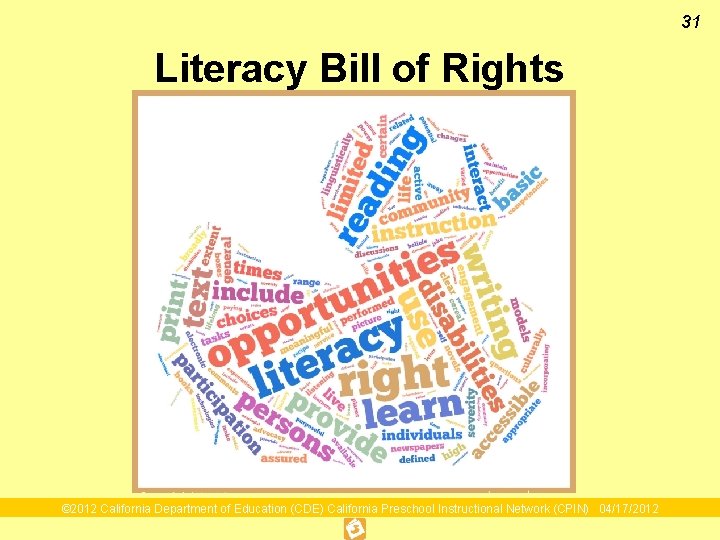
31 Literacy Bill of Rights © 2012 California Department of Education (CDE) California Preschool Instructional Network (CPIN) 04/17/2012
32 Thank you for coming! © 2012 California Department of Education (CDE) California Preschool Instructional Network (CPIN) 04/17/2012