
1 Competencies for SeniorCareer HR Professionals Session 8
- Slides: 30
1 Competencies for Senior-Career HR Professionals Session 8: Leadership and Navigation SHRM Speaker Title Bhavna Dave, PHR Director of Talent SHRM member since 2005 ©SHRM 2016
Due This Session 2 Reading Assignments • Article: “Leadership and Navigation: It’s All About Teams” https: //www. shrm. org/hr-today/news/hrmagazine/pages/leadership-and-navigation-it%E 2%80%99 sall-about-teams. aspx • Report: Workforce Readiness and Skills Shortages https: //www. shrm. org/hr-today/trends-and-forecasting/labormarket-and-economicdata/Documents/Workforce%20 Readiness%20 and%20 Skills %20 Shortages. pdf ©SHRM 2016
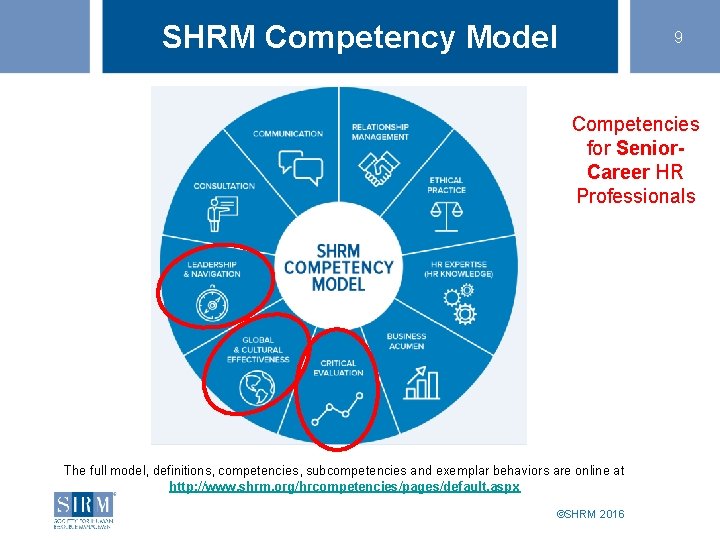
Course Purpose Provide undergraduate- and graduate-level students with an overview of the senior-career components of SHRM’s competency model, and provide focus on the Critical Evaluation, Leadership and Navigation, and Global and Cultural Effectiveness competencies. ©SHRM 2016
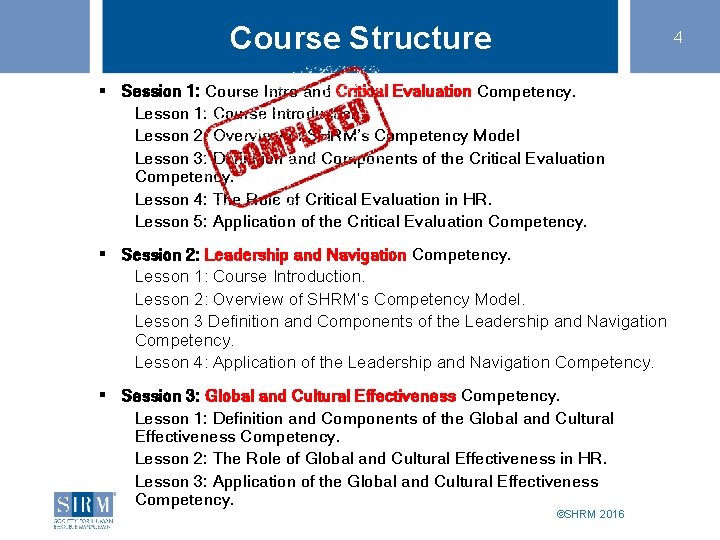
Course Structure 4 § Session 1: Course Intro and Critical Evaluation Competency. Lesson 1: Course Introduction. Lesson 2: Overview of SHRM’s Competency Model Lesson 3: Definition and Components of the Critical Evaluation Competency. Lesson 4: The Role of Critical Evaluation in HR. Lesson 5: Application of the Critical Evaluation Competency. § Session 2: Leadership and Navigation Competency. Lesson 1: Course Introduction. Lesson 2: Overview of SHRM’s Competency Model. Lesson 3 Definition and Components of the Leadership and Navigation Competency. Lesson 4: Application of the Leadership and Navigation Competency. § Session 3: Global and Cultural Effectiveness Competency. Lesson 1: Definition and Components of the Global and Cultural Effectiveness Competency. Lesson 2: The Role of Global and Cultural Effectiveness in HR. Lesson 3: Application of the Global and Cultural Effectiveness Competency. ©SHRM 2016
Session 2: Lessons 5 § Lesson 1: Course Introduction and Leadership and Navigation Competency. § Lesson 2: Overview of SHRM’s Competency Model. § Lesson 3 Definition and Components of the Leadership and Navigation Competency. § Lesson 4: Application of the Leadership and Navigation Competency. ©SHRM 2016
6 LESSON 1: COURSE INTRODUCTION AND LEADERSHIP AND NAVIGATION COMPETENCY ©SHRM 2016
Learning Objectives 7 § Describe three elements of SHRM’s Competency Model most applicable to senior-career level professionals. § Apply the concepts related to the Leadership and Navigation competency to key roles and duties performed by HR professionals. § Explain the relevance of the Leadership and Navigation competency to the job of an HR professional. § Identify and explain the subcompetencies and behaviors that underlie the Leadership and Navigation competency. § Analyze the role that the Leadership and Navigation competency plays in helping HR professionals address realworld issues. § Demonstrate the ability to apply the Leadership and Navigation competency in various contexts. ©SHRM 2016
8 LESSON 2: OVERVIEW OF SHRM’S COMPETENCY MODEL ©SHRM 2016
SHRM Competency Model 9 Competencies for Senior. Career HR Professionals The full model, definitions, competencies, subcompetencies and exemplar behaviors are online at http: //www. shrm. org/hrcompetencies/pages/default. aspx ©SHRM 2016
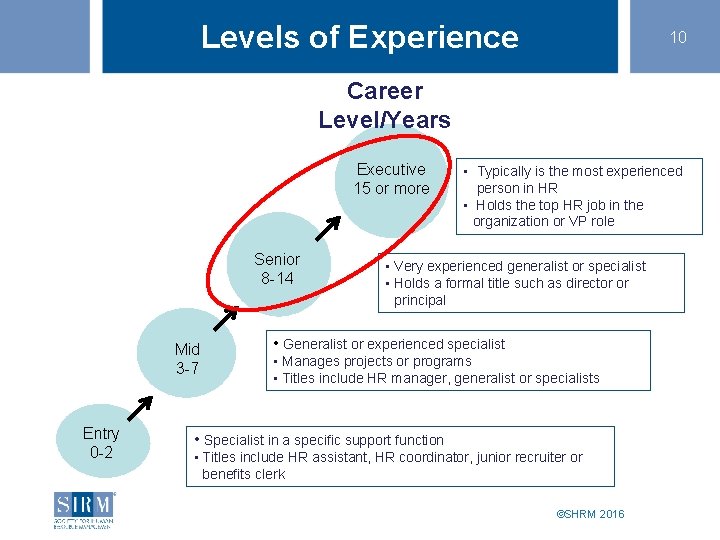
Levels of Experience 10 Career Level/Years Executive 15 or more Senior 8 -14 Mid 3 -7 Entry 0 -2 • Typically is the most experienced person in HR • Holds the top HR job in the organization or VP role • Very experienced generalist or specialist • Holds a formal title such as director or principal • Generalist or experienced specialist • Manages projects or programs • Titles include HR manager, generalist or specialists • Specialist in a specific support function • Titles include HR assistant, HR coordinator, junior recruiter or benefits clerk ©SHRM 2016
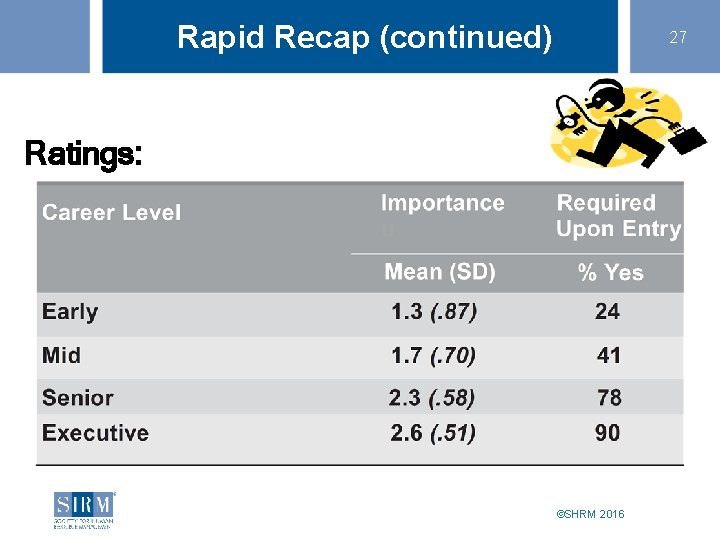
Importance of the Competency § As part of the creation of the new competency model, SHRM surveyed its members. § Over 32, 000 respondents rated the importance of each competency for HR professionals to successfully perform their jobs at the identified career level. § The rating scale ranged from 0 to 3. ©SHRM 2016 11
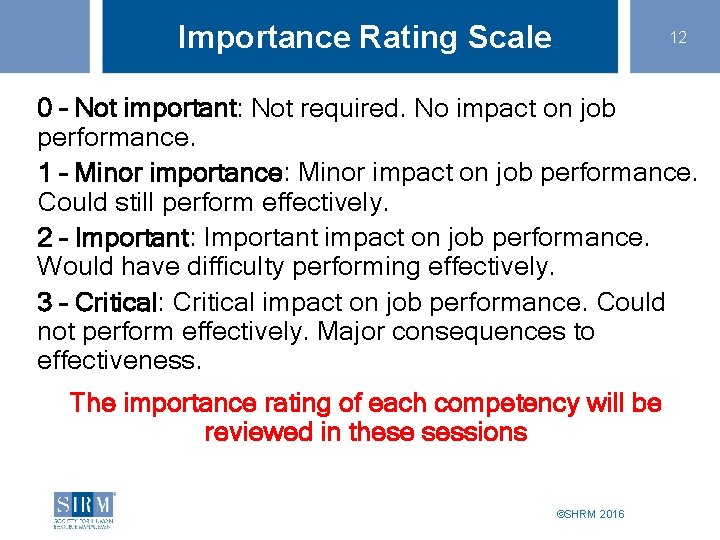
Importance Rating Scale 12 0 – Not important: Not required. No impact on job performance. 1 – Minor importance: Minor impact on job performance. Could still perform effectively. 2 – Important: Important impact on job performance. Would have difficulty performing effectively. 3 – Critical: Critical impact on job performance. Could not perform effectively. Major consequences to effectiveness. The importance rating of each competency will be reviewed in these sessions ©SHRM 2016
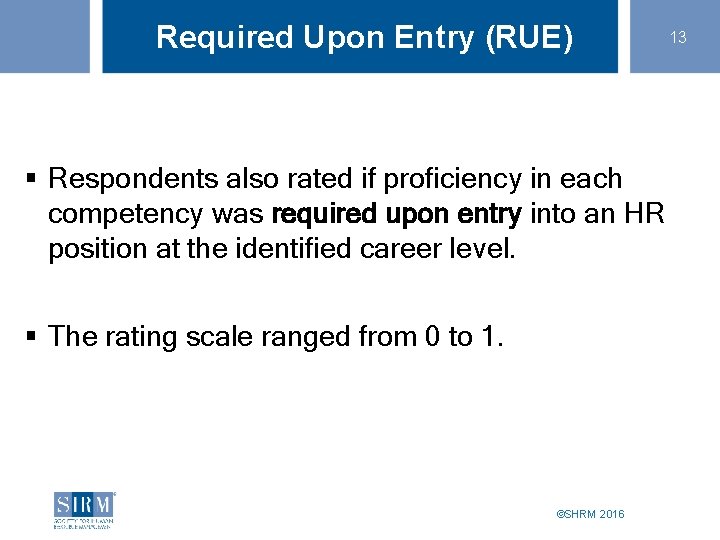
Required Upon Entry (RUE) § Respondents also rated if proficiency in each competency was required upon entry into an HR position at the identified career level. § The rating scale ranged from 0 to 1. ©SHRM 2016 13
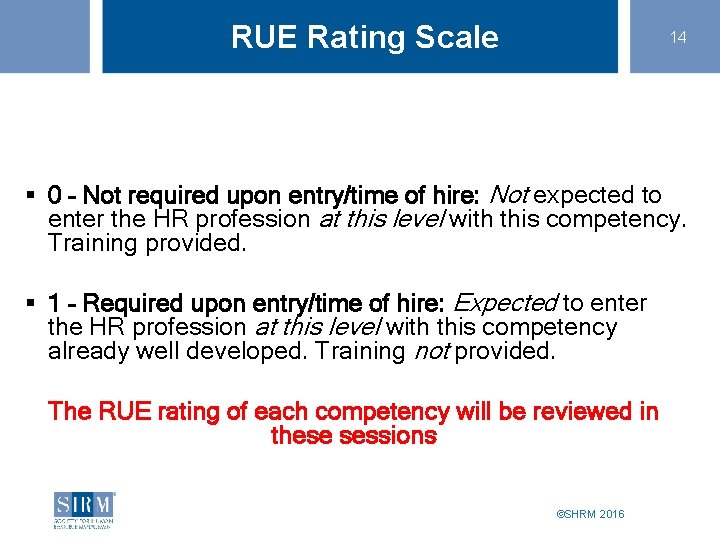
RUE Rating Scale 14 § 0 – Not required upon entry/time of hire: Not expected to enter the HR profession at this level with this competency. Training provided. § 1 – Required upon entry/time of hire: Expected to enter the HR profession at this level with this competency already well developed. Training not provided. The RUE rating of each competency will be reviewed in these sessions ©SHRM 2016
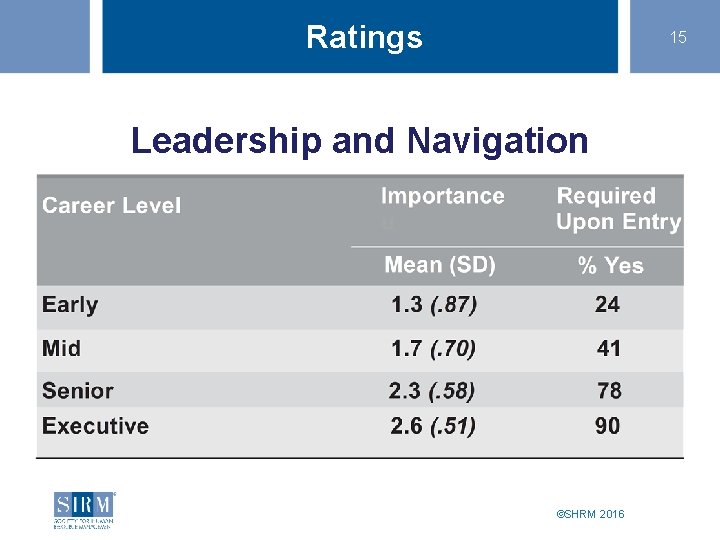
Ratings 15 Leadership and Navigation ©SHRM 2016
16 LESSON 3: DEFINITION AND COMPONENTS OF THE LEADERSHIP AND NAVIGATION COMPETENCY ©SHRM 2016
Leadership and Navigation Definition 17 The ability to direct and contribute to initiatives and processes within the organization. From Defining HR Success: 9 Critical Competencies for HR Professionals, © 2015, SHRM, p. 65 ©SHRM 2016
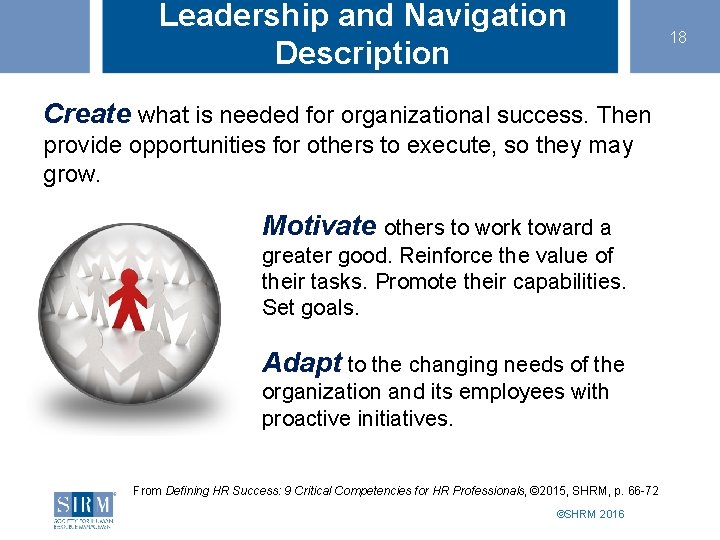
Leadership and Navigation Description Create what is needed for organizational success. Then provide opportunities for others to execute, so they may grow. Motivate others to work toward a greater good. Reinforce the value of their tasks. Promote their capabilities. Set goals. Adapt to the changing needs of the organization and its employees with proactive initiatives. From Defining HR Success: 9 Critical Competencies for HR Professionals, © 2015, SHRM, p. 66 -72 ©SHRM 2016 18
Leadership and Navigation Examples 19 § Facilitate discussions about the culture and future of the organization in which HR managers can develop their skills of visioning and influencing. § Include a coaching component in your high-potential development program. § Create high-profile stretch assignments for high-potential employees. § Encourage job rotation. From Defining HR Success: 9 Critical Competencies for HR Professionals, © 2015, SHRM, p. 41 -43 ©SHRM 2016
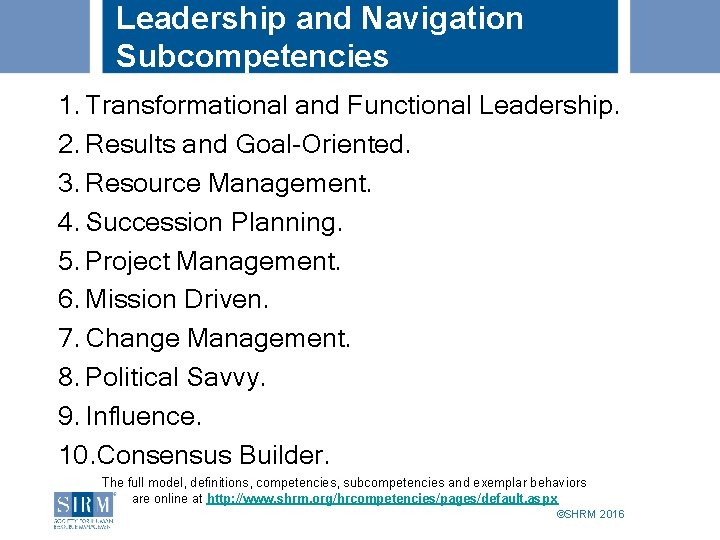
Leadership and Navigation Subcompetencies 1. Transformational and Functional Leadership. Sub Competencies 2. Results and Goal-Oriented. 3. Resource Management. 4. Succession Planning. 5. Project Management. 6. Mission Driven. 7. Change Management. 8. Political Savvy. 9. Influence. 10. Consensus Builder. The full model, definitions, competencies, subcompetencies and exemplar behaviors are online at http: //www. shrm. org/hrcompetencies/pages/default. aspx ©SHRM 2016
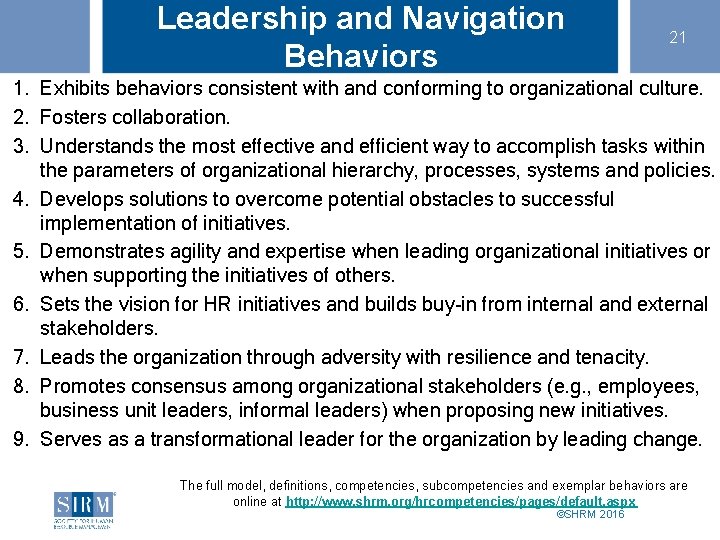
Leadership and Navigation Behaviors 21 1. Exhibits behaviors consistent with and conforming to organizational culture. 2. Fosters collaboration. 3. Understands the most effective and efficient way to accomplish tasks within the parameters of organizational hierarchy, processes, systems and policies. 4. Develops solutions to overcome potential obstacles to successful implementation of initiatives. 5. Demonstrates agility and expertise when leading organizational initiatives or when supporting the initiatives of others. 6. Sets the vision for HR initiatives and builds buy-in from internal and external stakeholders. 7. Leads the organization through adversity with resilience and tenacity. 8. Promotes consensus among organizational stakeholders (e. g. , employees, business unit leaders, informal leaders) when proposing new initiatives. 9. Serves as a transformational leader for the organization by leading change. The full model, definitions, competencies, subcompetencies and exemplar behaviors are online at http: //www. shrm. org/hrcompetencies/pages/default. aspx ©SHRM 2016
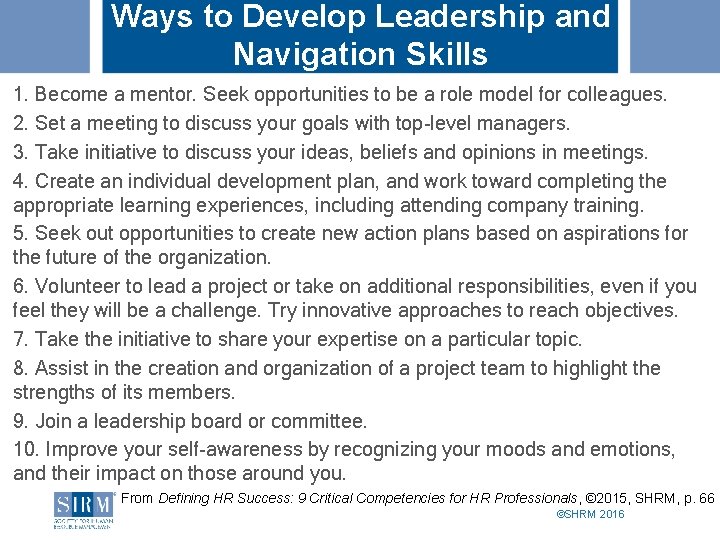
Ways to Develop Leadership and Navigation Skills 1. Become a mentor. Seek opportunities to be a role model for colleagues. 2. Set a meeting to discuss your goals with top-level managers. 3. Take initiative to discuss your ideas, beliefs and opinions in meetings. 4. Create an individual development plan, and work toward completing the appropriate learning experiences, including attending company training. 5. Seek out opportunities to create new action plans based on aspirations for the future of the organization. 6. Volunteer to lead a project or take on additional responsibilities, even if you feel they will be a challenge. Try innovative approaches to reach objectives. 7. Take the initiative to share your expertise on a particular topic. 8. Assist in the creation and organization of a project team to highlight the strengths of its members. 9. Join a leadership board or committee. 10. Improve your self-awareness by recognizing your moods and emotions, and their impact on those around you. From Defining HR Success: 9 Critical Competencies for HR Professionals, © 2015, SHRM, p. 66 ©SHRM 2016
23 LESSON 4: APPLICATION OF THE LEADERSHIP AND NAVIGATION COMPETENCY ©SHRM 2016
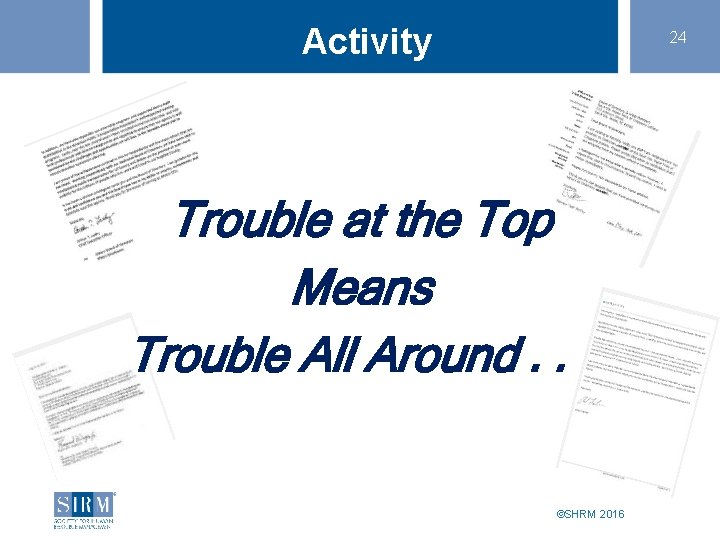
Activity 24 Trouble at the Top Means Trouble All Around. . . ©SHRM 2016
Activity 25 Trouble at the Top Means Trouble all Around. . Debrief ©SHRM 2016
Rapid Recap 26 Definition: The ability to direct and contribute to initiatives and processes within the organization. Description: Create what is needed for organizational success. Then provide opportunities for others to execute, so they may grow. Motivate others to work toward a greater good. Reinforce the value of their tasks. Promote their capabilities. Set goals. Adapt to the changing needs of the organization and its employees with proactive initiatives. ©SHRM 2016
Rapid Recap (continued) 27 Ratings: ©SHRM 2016
Benefits, Challenges and Risks 28 1. What is the greatest benefit of developing this competency for: a. The individual HR practitioner? b. The individual’s HR department? c. The individual’s organization as a whole? 2. What is the greatest challenge to being able to develop it? 3. What is the greatest risk of not developing it? ©SHRM 2016
Weaknesses 29 1. How can a weakness in this area (i. e. , with this competency) affect: a. The individual and his or her career? b. The individual’s HR department? c. The individual’s organization? ©SHRM 2016
Due Next Session 30 Reading Assignments § Article: “Global and Cultural Effectiveness: Recruiting Is Social and Talent Is Local” § Report: Workforce Readiness and Skills Shortages ©SHRM 2016