
1 Competencies for EarlyCareer HR Professionals Session 2



- Slides: 19
1 Competencies for Early-Career HR Professionals Session 2: Relationship Management SHRM Speaker Title Bhavna Dave, PHR Director of Talent SHRM member since 2005 ©SHRM 2015
Due This Session 2 Reading Assignments § Read “How to Get Real Value from Enterprise Social Networks” ©SHRM 2015
Learning Objectives 3 § Explain the relevance of the Relationship Management competency to the job of an HR professional. § Identify and explain the subcompetencies and behaviors that underlie the Relationship Management competency. § Analyze the role that the Relationship Management competency plays in helping HR professionals address realworld issues. § Demonstrate the ability to apply the Relationship Management competency in various contexts. ©SHRM 2015
Session 2 Lessons 4 § Lesson 1: Definition and components of the Relationship Management competency. § Lesson 2: Application of the Relationship Management competency. ©SHRM 2015
5 LESSON 1: DEFINITION AND COMPONENTS OF THE RELATIONSHIP MANAGEMENT COMPETENCY ©SHRM 2015
Relationship Management Definition and Descriptions 6 Definition: §The ability to manage interactions to provide service and to support the organization. Description: §Job success for the HR professional is largely a function of your ability to maintain productive interpersonal relationships and to help others do the same. Examples: §Establishing an effective relationship with your supervisor. §Being aware of how your behavior affects others. §Continuously demonstrating to clients and stakeholders that you are committed to supporting their HR and business needs. §Helping peers to solve problems. §Empathizing with subordinates when they experience personal or professional setbacks. §Encouraging others to treat each other with respect and understanding. §Resolving conflicts between two or more individuals in a fair and meaningful manner. From Defining HR Success: 9 Critical Competencies for HR Professionals, © 2015, SHRM, p. 59 ©SHRM 2015
Relationship Management Subcompetencies 7 § Business networking expertise. § Visibility. Sub Competencies § Customer service (internal and external). § People management. § Advocacy. § Negotiation and conflict management. § Credibility. § Community relationships. § Transparency. § Proactivity. § Responsiveness. § Mentorship. § Influence. § Employee engagement. § Teamwork. § Mutual respect. ©SHRM 2015
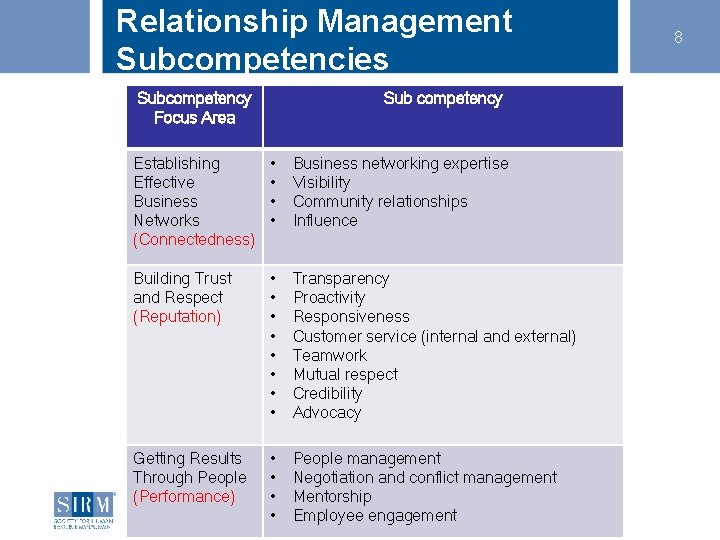
Relationship Management Subcompetencies Subcompetency Focus Area Sub Competencies Sub competency Establishing Effective Business Networks (Connectedness) • • Business networking expertise Visibility Community relationships Influence Building Trust and Respect (Reputation) • • Transparency Proactivity Responsiveness Customer service (internal and external) Teamwork Mutual respect Credibility Advocacy Getting Results Through People (Performance) • • People management Negotiation and conflict management Mentorship ©SHRM 2015 Employee engagement 8
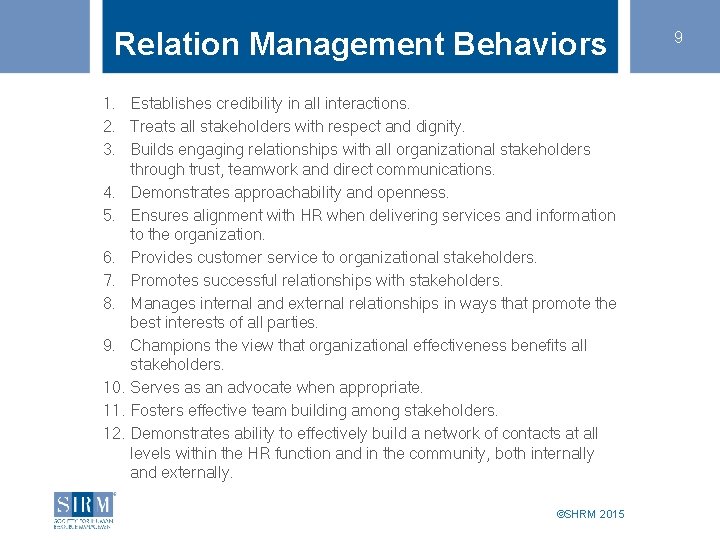
Relation Management Behaviors 1. Establishes credibility in all interactions. 2. Treats all stakeholders with respect and dignity. 3. Builds engaging relationships with all organizational stakeholders through trust, teamwork and direct communications. 4. Demonstrates approachability and openness. 5. Ensures alignment with HR when delivering services and information to the organization. 6. Provides customer service to organizational stakeholders. 7. Promotes successful relationships with stakeholders. 8. Manages internal and external relationships in ways that promote the best interests of all parties. 9. Champions the view that organizational effectiveness benefits all stakeholders. 10. Serves as an advocate when appropriate. 11. Fosters effective team building among stakeholders. 12. Demonstrates ability to effectively build a network of contacts at all levels within the HR function and in the community, both internally and externally. ©SHRM 2015 9
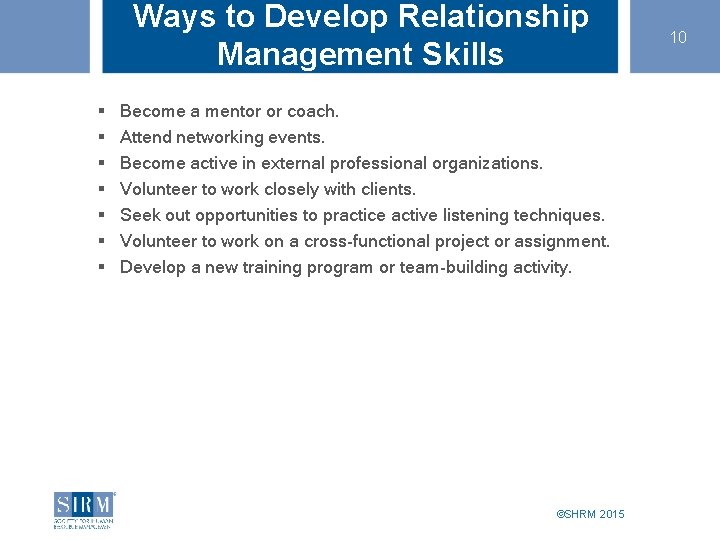
Ways to Develop Relationship Management Skills § § § § Become a mentor or coach. Attend networking events. Become active in external professional organizations. Volunteer to work closely with clients. Seek out opportunities to practice active listening techniques. Volunteer to work on a cross-functional project or assignment. Develop a new training program or team-building activity. ©SHRM 2015 10
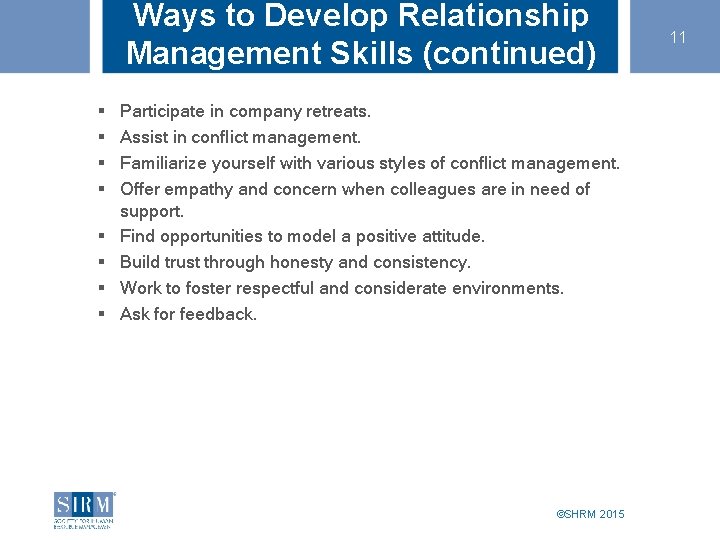
Ways to Develop Relationship Management Skills (continued) § § § § Participate in company retreats. Assist in conflict management. Familiarize yourself with various styles of conflict management. Offer empathy and concern when colleagues are in need of support. Find opportunities to model a positive attitude. Build trust through honesty and consistency. Work to foster respectful and considerate environments. Ask for feedback. ©SHRM 2015 11
12 LESSON 2: APPLICATION OF THE RELATIONSHIP MANAGEMENT COMPETENCY ©SHRM 2015
Why Relationships Matter 13 Research has shown the relationships have the following benefits: § Improved feelings of belonging. § Greater job satisfaction. § Increased performance. § More team cohesion. § Positive work atmosphere. § Increased organizational commitment. § Greater sense of organizational support. § Increased salary. § More promotions. § Greater career mobility. § More involvement. § Enhanced performance. § Increased perceptions of fit. From Defining HR Success: 9 Critical Competencies for HR Professionals, © 2015, pp. 59 -64. ©SHRM 2015
Relationship Managers 14 § § § Deployed to specific business units. Act in a liaison role. Apply HR generalist skills. Get to know the clients and their specific needs. Perform triage on requests for HR services. Often have a matrix reporting relationship to HR and to the business units. § Provide consultation. § Use all of the HR competencies to be successful. ©SHRM 2015
Discussion: How to Get Real Value from Enterprise Social Networks § How could social networking be used to make HR professionals more effective at relationship management? § How could these social networks be used to help HR professionals manage a variety of relationships across the organization? For example: – How could social networks be used for engaging stakeholders? – What types of organizational changes could be best communicated using enterprise social networks? – How could organizations achieve greater openness and transparency using enterprise social networks, without compromising privacy or security? – How could teamwork be fostered using these networks? ©SHRM 2015 15
Situational Judgment Tests § § § Review the scenarios and approaches. List the pros and cons. Circle the best answer. Provide a short rationale for why you chose that answer. Discuss in small groups. Try to reach consensus. ©SHRM 2015 16
Debrief § § § 17 For which scenarios did you agree on an approach? § Which approach did you take? § What was your rationale for taking this approach? § What are the biggest risks? What additional information do you need to make an informed decision? What are the key skills you need in each scenario to be successful? ©SHRM 2015
End-of-Session Discussion § Why is relationship management important as an HR professional? § What are the key differences between the HR Expertise and Relationship Management competencies? § What are some cross-cutting skills that are necessary to be successful in both of these competencies? ©SHRM 2015 18
Due Next Session 19 § Reading Assignments § "When the Boss Doesn’t Like Her” and “Real Sales or Wishful Thinking? ” § Consider the questions at the end of each case, and jot down your thoughts. ©SHRM 2015