
1 Commercial Space Innovation Initiative Ken Davidian Director

- Slides: 27
1 Commercial Space Innovation Initiative Ken Davidian, Director of Research Office of Commercial Space Transportation, FAA Transportation Research Board, Commercial Space Subcommittee Workshop 7 January 2018
2 Commercial Space Innovation Initiative Agenda Assumptions We agree on the definition of “Commercial Space. ” More info We agree on the definition of “Innovation. ” What is the 2 nd "I" in CSII? Coordinating Technology Push *and* Pull CSII value chain diagram of activities Example CSII activity and research questions CSII schedule - notional Conclusion More info
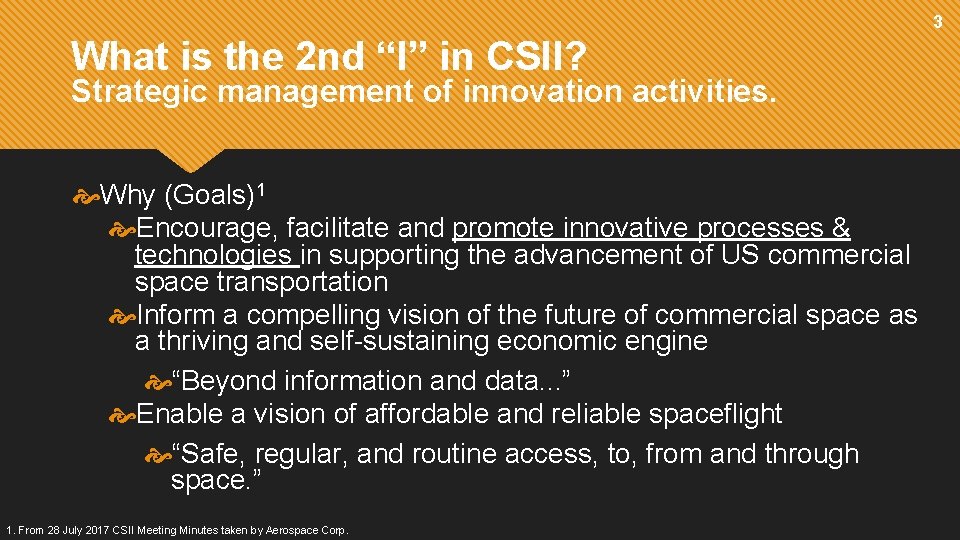
3 What is the 2 nd “I” in CSII? Strategic management of innovation activities. Why (Goals)1 Encourage, facilitate and promote innovative processes & technologies in supporting the advancement of US commercial space transportation Inform a compelling vision of the future of commercial space as a thriving and self-sustaining economic engine “Beyond information and data. . . ” Enable a vision of affordable and reliable spaceflight “Safe, regular, and routine access, to, from and through space. ” 1. From 28 July 2017 CSII Meeting Minutes taken by Aerospace Corp.
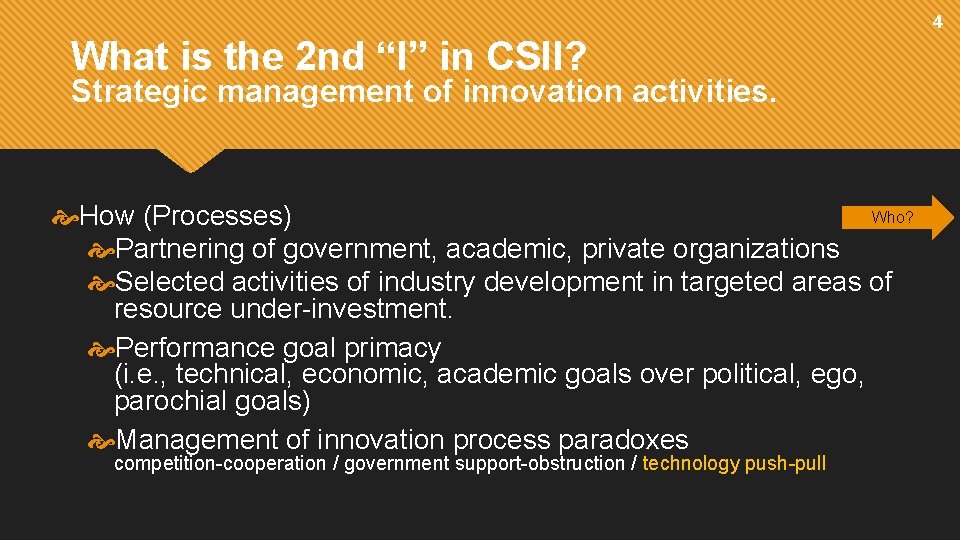
4 What is the 2 nd “I” in CSII? Strategic management of innovation activities. Who? How (Processes) Partnering of government, academic, private organizations Selected activities of industry development in targeted areas of resource under-investment. Performance goal primacy (i. e. , technical, economic, academic goals over political, ego, parochial goals) Management of innovation process paradoxes competition-cooperation / government support-obstruction / technology push-pull
5 Coordinating technology push *and* pull Increased regulatory sophistication (e. g. , streamlining) Increased research in focused areas Maximum effectiveness through coordinated activities “Unless the government coordinates its technology push and pull initiatives through some form of project organization that cuts across several of its agencies and departments, its intervention can never be tailored to the risk context of an emerging industry. ” 2 This is why FAA AST is uniquely situated to lead the CSII. 2. Chakravarthy, B. S. (1985). Business-government partnership in emerging industries: Lessons from the American synfuels experience. Advances in Strategic Management, 3, 257– 275.
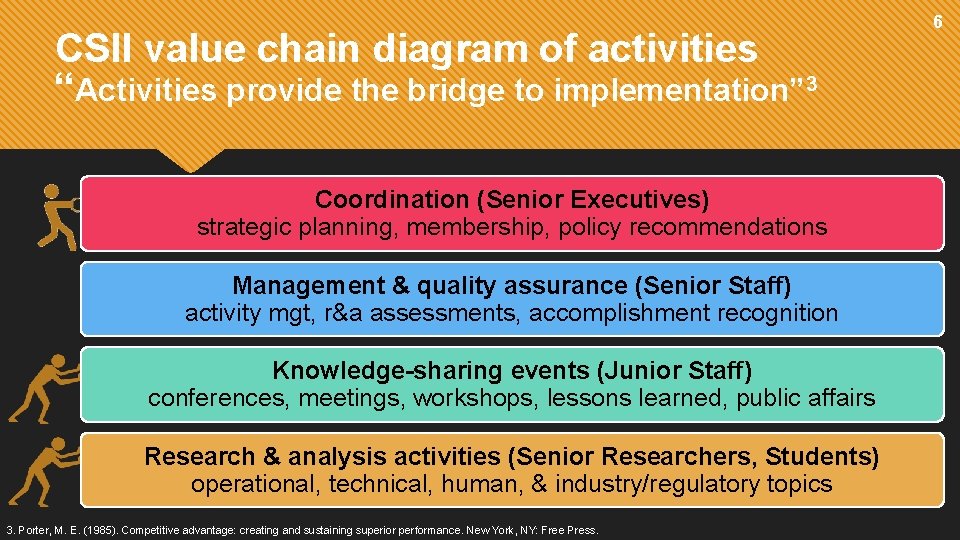
CSII value chain diagram of activities “Activities provide the bridge to implementation” 3 Coordination (Senior Executives) strategic planning, membership, policy recommendations Management & quality assurance (Senior Staff) activity mgt, r&a assessments, accomplishment recognition Knowledge-sharing events (Junior Staff) conferences, meetings, workshops, lessons learned, public affairs Research & analysis activities (Senior Researchers, Students) operational, technical, human, & industry/regulatory topics 3. Porter, M. E. (1985). Competitive advantage: creating and sustaining superior performance. New York, NY: Free Press. 6
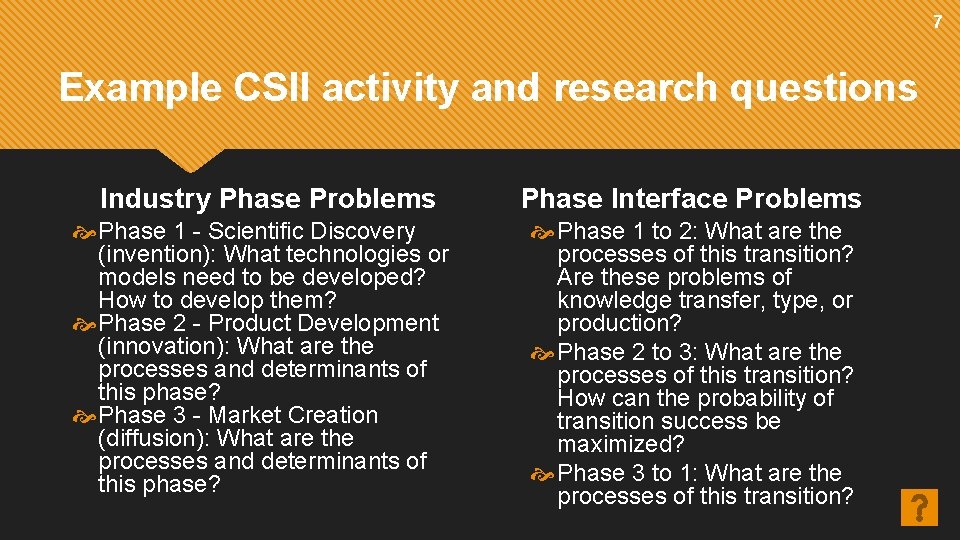
7 Example CSII activity and research questions Industry Phase Problems Phase Interface Problems Phase 1 - Scientific Discovery (invention): What technologies or models need to be developed? How to develop them? Phase 2 - Product Development (innovation): What are the processes and determinants of this phase? Phase 3 - Market Creation (diffusion): What are the processes and determinants of this phase? Phase 1 to 2: What are the processes of this transition? Are these problems of knowledge transfer, type, or production? Phase 2 to 3: What are the processes of this transition? How can the probability of transition success be maximized? Phase 3 to 1: What are the processes of this transition?
8 CSII outcomes Tangible Products New technologies (e. g. , prototypes) New knowledge (e. g. , journal articles) Intangible Products Creating an interdisciplinary research forum Leveraging activities of others Mentoring and developing industry members (incl. faculty, students, employees, managers)
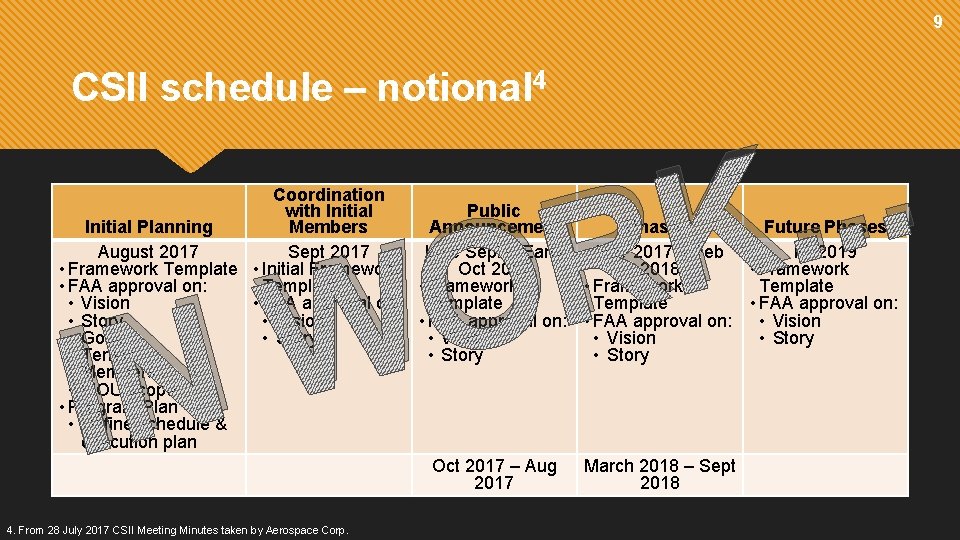
9 CSII schedule – notional 4 . . . K R O W Coordination with Initial Public Initial Planning Members Announcement Phase 1 Future Phases August 2017 Sept 2017 Late Sept – Early Nov 2017 – Feb FY 2019 • Framework Template • Initial Framework Oct 2017 2018 • Framework • FAA approval on: Template • Framework Template • Vision • FAA approval on: Template • FAA approval on: • Story • Vision • FAA approval on: • Vision • Goals • Story • Vision • Story • Tenets • Story • Members • MOU scope • Program Plan • Define schedule & execution plan Oct 2017 – Aug March 2018 – Sept 2017 2018 IN 4. From 28 July 2017 CSII Meeting Minutes taken by Aerospace Corp.
10 Conclusion CSII will draw membership from the commercial space economy, including government, academia, private sector actors. CSII will strategically coordinate activities designed to stimulate commercial space industry innovation. FAA AST is ideally situated to coordinate CSII efforts because of its authority to effect technology push *and* pull activities.
11 Backup Information
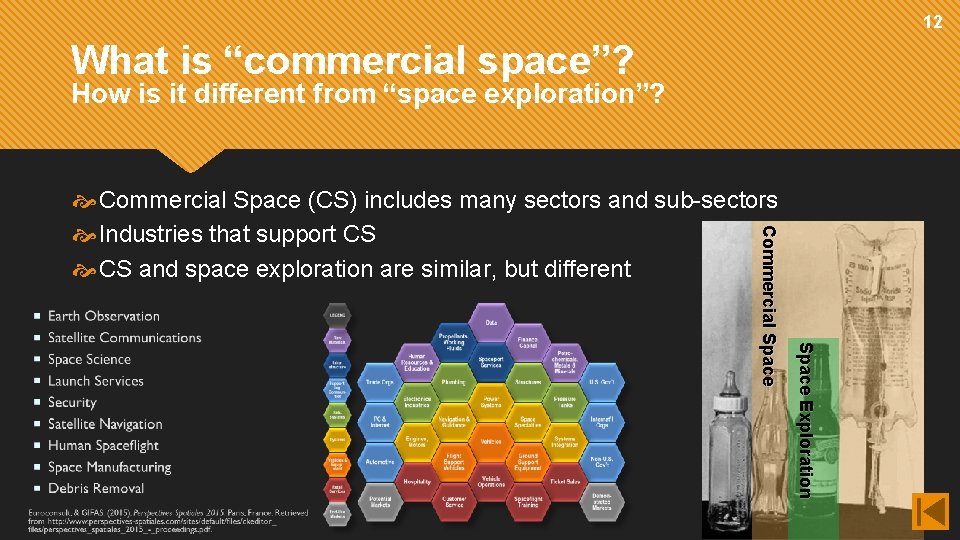
12 What is “commercial space”? How is it different from “space exploration”? Space Exploration Commercial Space (CS) includes many sectors and sub-sectors Industries that support CS and space exploration are similar, but different
13 What is innovation? It is a process. . . (Van de Ven, Angle, and Poole, 2000, p. 9) of motivating and coordinating people. . . to develop and implement new ideas. . . by engaging others in transactions (or relationships) and. . . making the adaptations to achieve desired outcomes. . . within changing institutional and organizational contexts.
14 . . . of motivating & coordinating people. . . People are both contributors and inhibitors of innovation Organizational context enables and motivates innovation Pay (a proxy for recognition) Awards (individual ~ for radical ideas, group ~ for incremental implementation) Three phases of innovative group development euphoric start-up concerns & transitions blame or celebration Another question: How does organizational structure influence innovation?
15 . . . to develop and implement new ideas. . . the process of developing and implementing a new idea. a recombination of old ideas a scheme that challenges the present order a formula or a unique approach that is perceived as new by the individuals involved (Zaltman, et al. , 1973; Rogers 1982) technical innovations (new technologies, products, and services) administrative innovations (new procedures, policies, and organizational forms) Another question: How are innovation ideas developed?
. . . by engaging others in transactions (or relationships). . . Include Collegial and hierarchical relationships Resource allocation proposals and commitments Quid pro quo arrangements with individuals, units, organizations (subcontracts, co-ventures, etc. ) Stages: negotiations, agreements, and administration Progression is non-linear Level of novelty and risk affect transaction trust, cost, complexity, chance of success 16
. . . making the adaptations to achieve desired outcomes. . . 17 successes and mistakes only identifiable ex post based on changing, contradictory, and nonlinear criteria resulting in rational and superstitious learning requiring the “management of paradox” and contradictory organizational reactions resulting in purposely vague and general goals Another question: How do innovation outcomes change?
. . . within changing institutional and organizational context. The institutional environment, the larger industry community Infrastructure resources created by the public sector, aka “public goods” (e. g. norms, knowledge, financing, human resources) Appropriated and converted by the private sector into “private goods” through innovation Paradoxes of competition-cooperation, government supportobstruction, technology push-pull 18
Why and how (by what processes) do innovations develop? How and why do innovations actually develop over time from concept to implemented reality? What innovation processes lead to successful and unsuccessful outcomes? To what extent can knowledge about managing innovation and change processes be generalized from one situation to another? 19
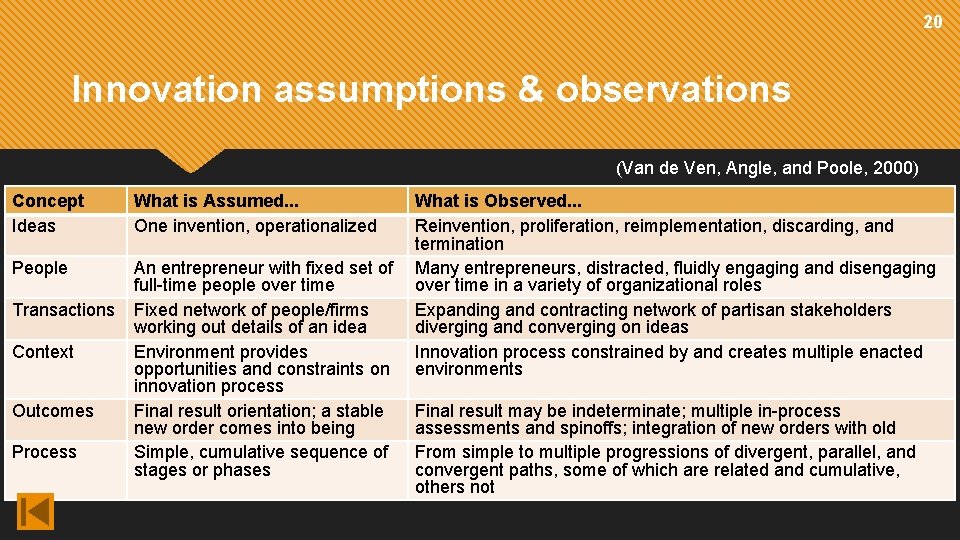
20 Innovation assumptions & observations (Van de Ven, Angle, and Poole, 2000) Concept Ideas People Transactions Context Outcomes Process What is Assumed. . . One invention, operationalized What is Observed. . . Reinvention, proliferation, reimplementation, discarding, and termination An entrepreneur with fixed set of Many entrepreneurs, distracted, fluidly engaging and disengaging full-time people over time in a variety of organizational roles Fixed network of people/firms Expanding and contracting network of partisan stakeholders working out details of an idea diverging and converging on ideas Environment provides Innovation process constrained by and creates multiple enacted opportunities and constraints on environments innovation process Final result orientation; a stable Final result may be indeterminate; multiple in-process new order comes into being assessments and spinoffs; integration of new orders with old Simple, cumulative sequence of From simple to multiple progressions of divergent, parallel, and stages or phases convergent paths, some of which are related and cumulative, others not
21 WHO: CSII Membership Private-sector organizations Firms, trade organizations, market non-profits Public-sector organizations US government departments and agencies (e. g. , DOC, Do. D, NASA, FCC, FFRDCs, etc. ) State and local government departments and agencies Universities to conduct CS research International entities Include external participants to counter "groupthink"
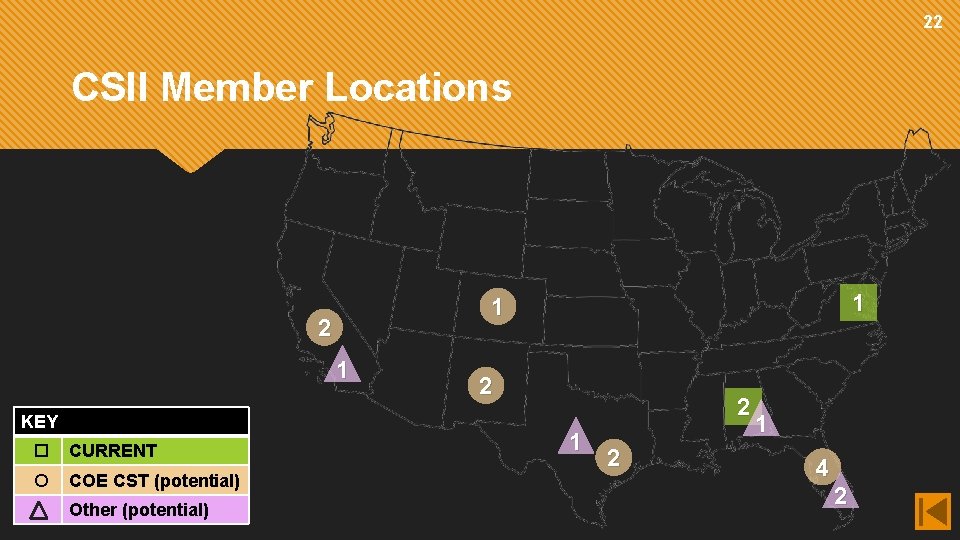
22 CSII Member Locations 2 1 KEY ¨ CURRENT ¡ COE CST (potential) Other (potential) 1 1 2 2 1 4 2
23 Innovation modeled as simple phases or stages Commercial development is built upon three phases: 1 basic research (discovery of scientific knowledge) the creation of a product (the innovation process) offering that product for sale (diffusion). These are three phases of industry development 5 Commercialization can be impacted by different policies, activities, and events, undertaken by all CS economy actors 5. Schumpeter, J. A. (1934). The theory of economic development. Cambridge. MA: Harvard.
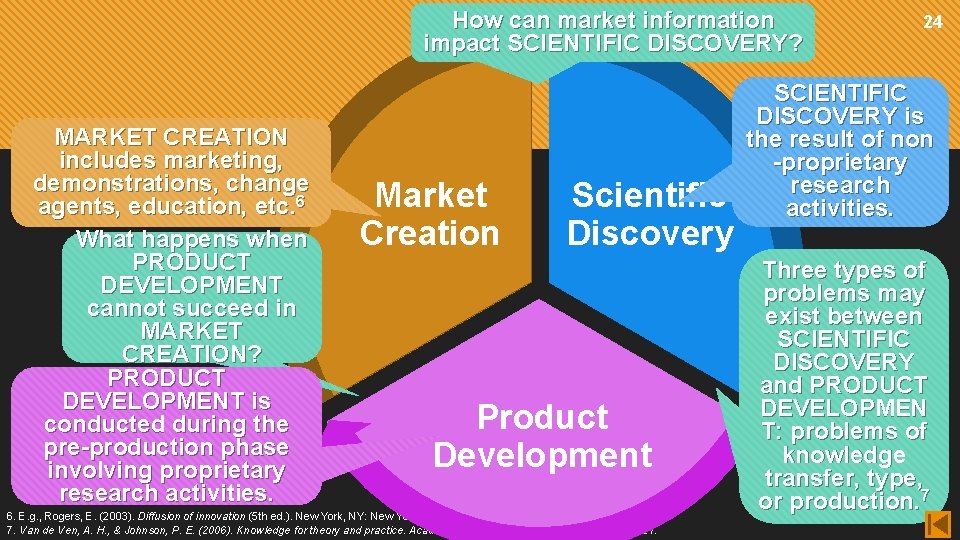
How can market information impact SCIENTIFIC DISCOVERY? MARKET CREATION includes marketing, demonstrations, change agents, education, etc. 6 What happens when PRODUCT DEVELOPMENT cannot succeed in MARKET CREATION? PRODUCT DEVELOPMENT is conducted during the pre-production phase involving proprietary research activities. Market Creation Scientific Discovery Product Development 6. E. g. , Rogers, E. (2003). Diffusion of innovation (5 th ed. ). New York, NY: New York: Free Press. 7. Van de Ven, A. H. , & Johnson, P. E. (2006). Knowledge for theory and practice. Academy of Management Review, 31(4), 802– 821. 24 SCIENTIFIC DISCOVERY is the result of non -proprietary research activities. Three types of problems may exist between SCIENTIFIC DISCOVERY and PRODUCT DEVELOPMEN T: problems of knowledge transfer, type, or production. 7
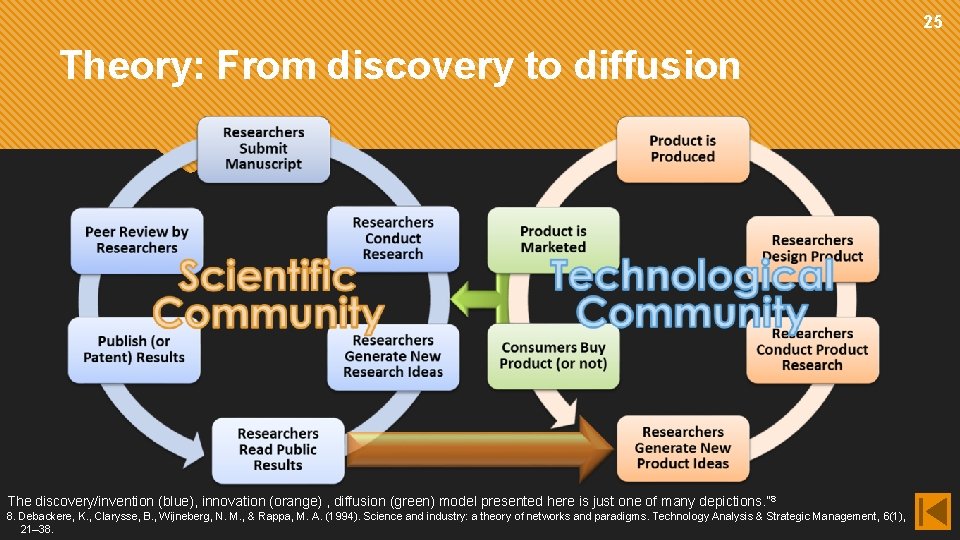
25 Theory: From discovery to diffusion The discovery/invention (blue), innovation (orange) , diffusion (green) model presented here is just one of many depictions. ” 8 8. Debackere, K. , Clarysse, B. , Wijneberg, N. M. , & Rappa, M. A. (1994). Science and industry: a theory of networks and paradigms. Technology Analysis & Strategic Management, 6(1), 21– 38.
26 Final Thoughts. . . Van de Ven, A. H. , & Poole, M. S. (2000). An introduction to the Minnesota innovation research program. In A. H. Van de Ven, H. L. Angle, & M. S. Poole (Eds. ), Methods for studying innovation process (pp. 3– 30). New York, NY: Oxford University Press on Demand. “As Teece (1987: 3) argues, ‘at a time when so much attention is given to innovation and entrepreneurship, it is rather pathetic that a deep understanding of the process is lacking. It is no wonder that firms and governments have difficulty trying to stimulate [and manage] innovation when its fundamental processes are so poorly understood. ’” (p. 1). “Tornatzky et al. (1983) point out that while many studies have examined the antecedents (facilitators/inhibitors) to or consequences (outcomes) of innovation, very few have directly examined how and why innovations actually emerge, develop, grow, or terminate over time” (p. 4).
27 Final Thoughts. . . Van de Ven, A. H. , & Poole, M. S. (2000). An introduction to the Minnesota innovation research program. In A. H. Van de Ven, H. L. Angle, & M. S. Poole (Eds. ), Methods for studying innovation process (pp. 3– 30). New York, NY: Oxford University Press on Demand. “the innovation manager needs a ‘road map’ that indicates how and why the innovating journey unfolds and what paths are likely to lead to success or failure” (p. 4). “Although such a process theory may never reach the precision to tell managers exactly what to do and how an innovation will turn out, it may produce some fundamental ‘laws of innovating’ useful for describing and explaining a broad class of processes, sequences, and performance conditions central to the management of innovation” (p. 4).