
1 Clear your desk except for paperpencil 2
- Slides: 17
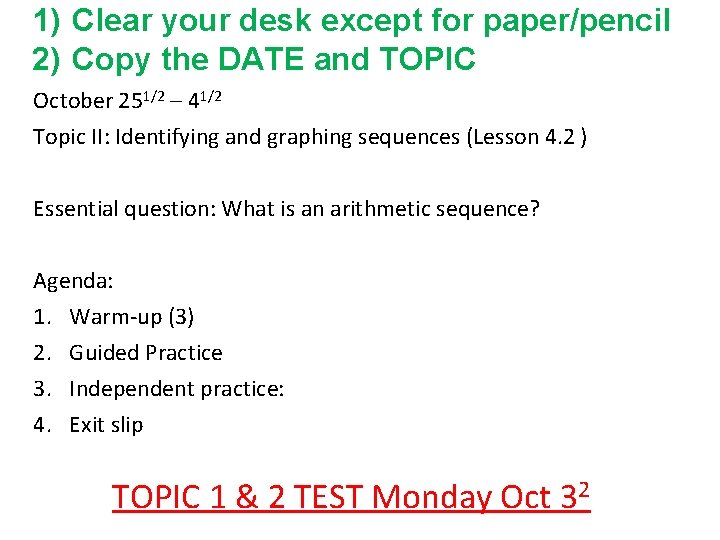
1) Clear your desk except for paper/pencil 2) Copy the DATE and TOPIC October 251/2 – 41/2 Topic II: Identifying and graphing sequences (Lesson 4. 2 ) Essential question: What is an arithmetic sequence? Agenda: 1. Warm-up (3) 2. Guided Practice 3. Independent practice: 4. Exit slip TOPIC 1 & 2 TEST Monday Oct 32
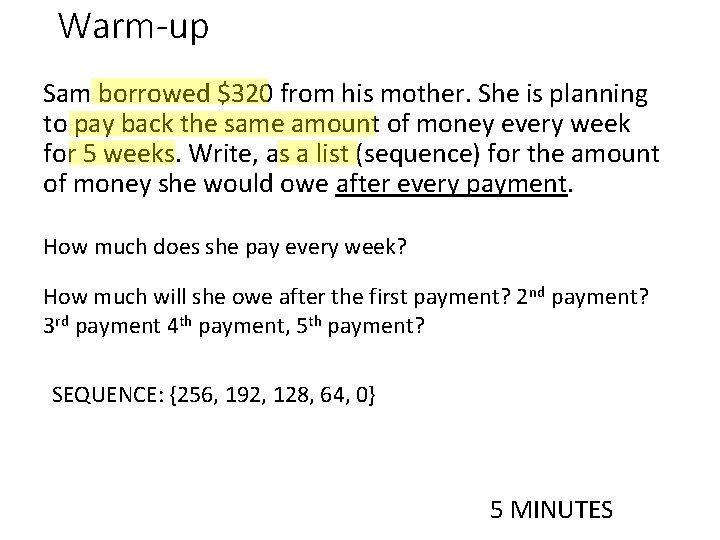
Warm-up Sam borrowed $320 from his mother. She is planning to pay back the same amount of money every week for 5 weeks. Write, as a list (sequence) for the amount of money she would owe after every payment. How much does she pay every week? How much will she owe after the first payment? 2 nd payment? 3 rd payment 4 th payment, 5 th payment? SEQUENCE: {256, 192, 128, 64, 0} 5 MINUTES
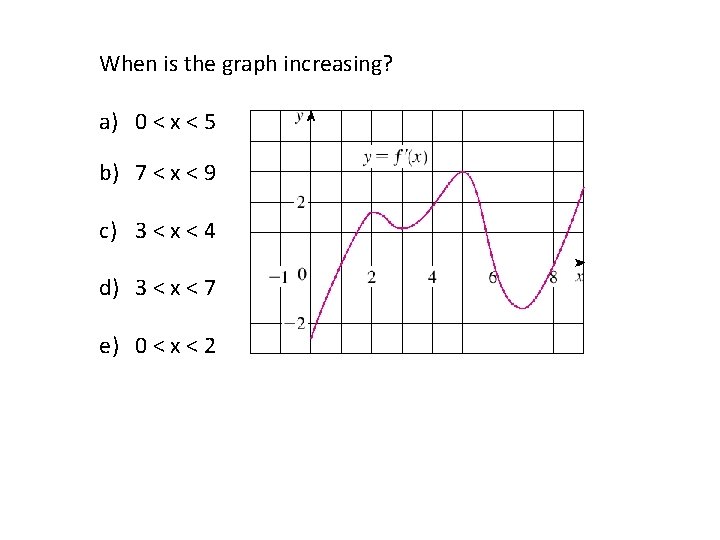
When is the graph increasing? a) 0 < x < 5 b) 7 < x < 9 c) 3 < x < 4 d) 3 < x < 7 e) 0 < x < 2
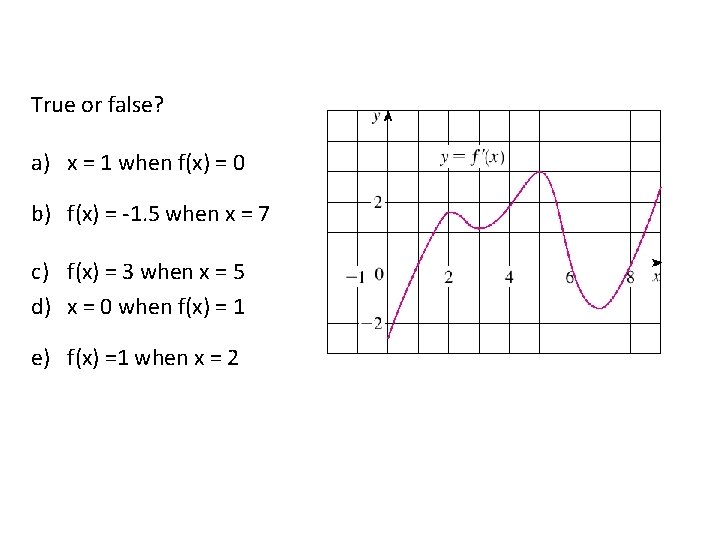
True or false? a) x = 1 when f(x) = 0 b) f(x) = -1. 5 when x = 7 c) f(x) = 3 when x = 5 d) x = 0 when f(x) = 1 e) f(x) =1 when x = 2
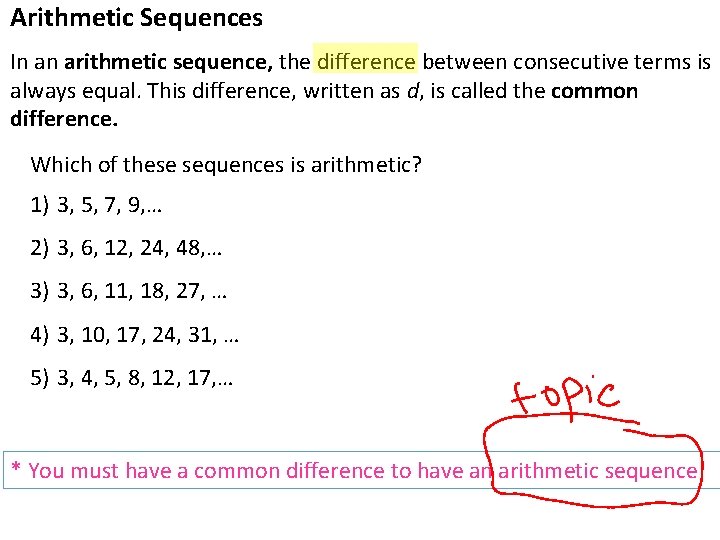
Arithmetic Sequences In an arithmetic sequence, the difference between consecutive terms is always equal. This difference, written as d, is called the common difference. Which of these sequences is arithmetic? 1) 3, 5, 7, 9, … 2) 3, 6, 12, 24, 48, … 3) 3, 6, 11, 18, 27, … 4) 3, 10, 17, 24, 31, … 5) 3, 4, 5, 8, 12, 17, … * You must have a common difference to have an arithmetic sequence
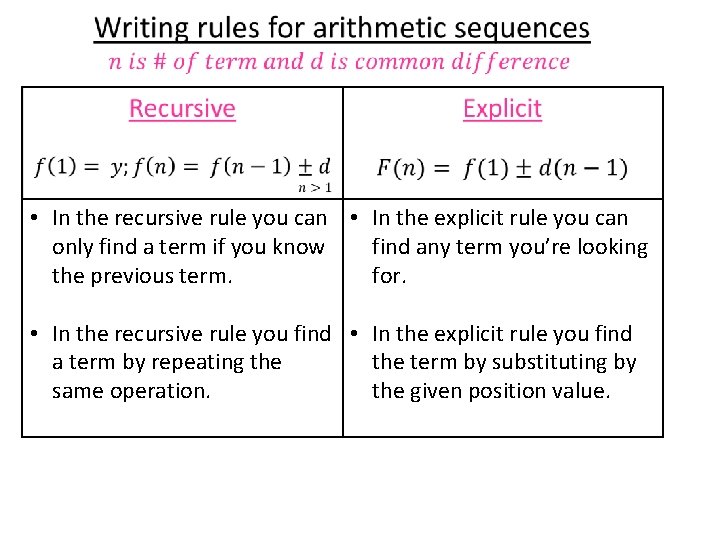
• In the recursive rule you can • In the explicit rule you can only find a term if you know find any term you’re looking the previous term. for. • In the recursive rule you find • In the explicit rule you find a term by repeating the term by substituting by same operation. the given position value.
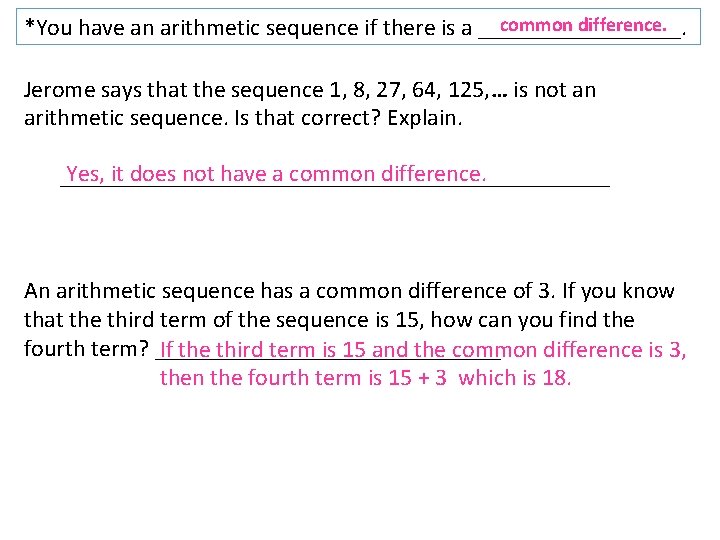
common difference. *You have an arithmetic sequence if there is a _________. Jerome says that the sequence 1, 8, 27, 64, 125, … is not an arithmetic sequence. Is that correct? Explain. Yes, it does not have a common difference. _______________________ An arithmetic sequence has a common difference of 3. If you know that the third term of the sequence is 15, how can you find the fourth term? _______________ If the third term is 15 and the common difference is 3, then the fourth term is 15 + 3 which is 18.
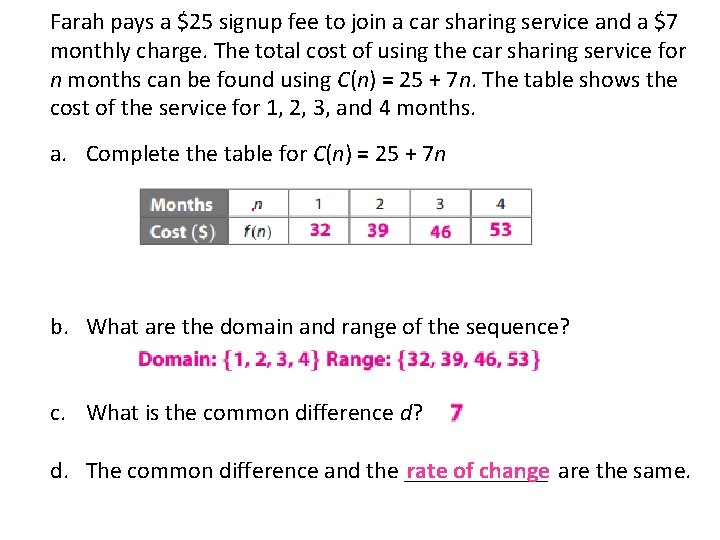
Farah pays a $25 signup fee to join a car sharing service and a $7 monthly charge. The total cost of using the car sharing service for n months can be found using C(n) = 25 + 7 n. The table shows the cost of the service for 1, 2, 3, and 4 months. a. Complete the table for C(n) = 25 + 7 n b. What are the domain and range of the sequence? c. What is the common difference d? d. The common difference and the ______ are the same. rate of change
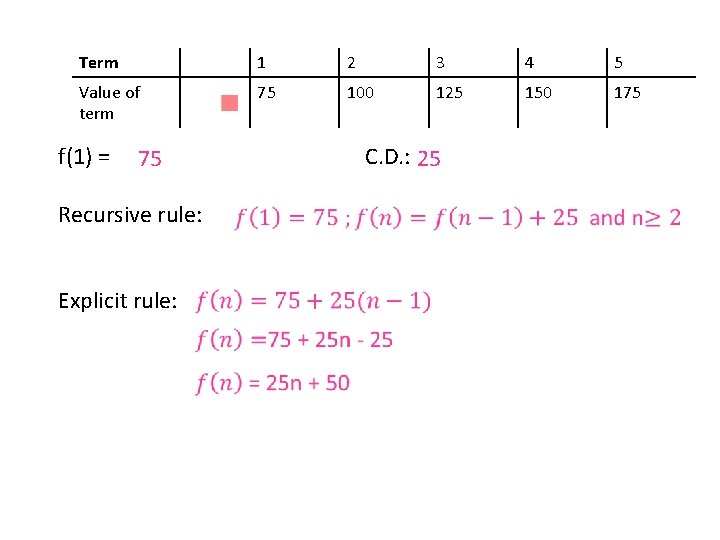
Term 1 2 3 4 5 Value of term 75 100 125 150 175 f(1) = 75 C. D. : 25 Recursive rule: Explicit rule:
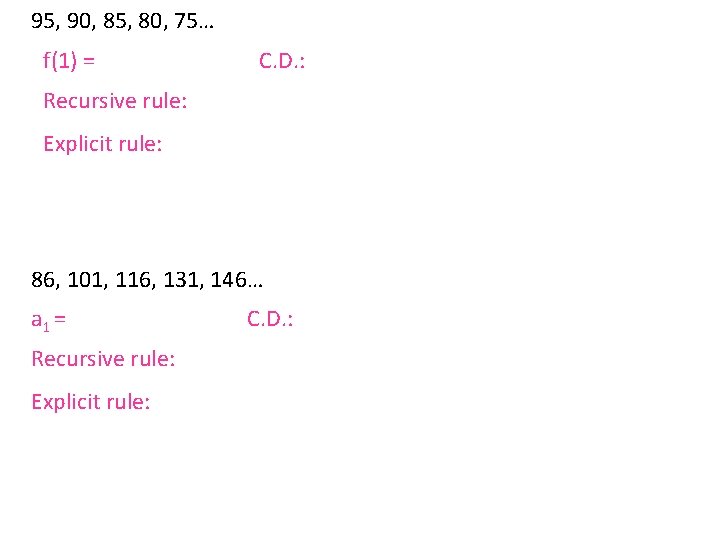
95, 90, 85, 80, 75… f(1) = C. D. : Recursive rule: Explicit rule: 86, 101, 116, 131, 146… a 1 = Recursive rule: Explicit rule: C. D. :
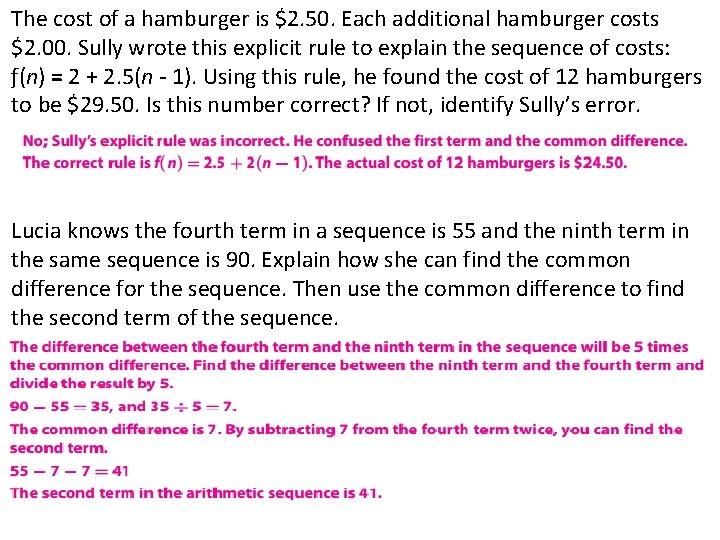
The cost of a hamburger is $2. 50. Each additional hamburger costs $2. 00. Sully wrote this explicit rule to explain the sequence of costs: ƒ(n) = 2 + 2. 5(n - 1). Using this rule, he found the cost of 12 hamburgers to be $29. 50. Is this number correct? If not, identify Sully’s error. Lucia knows the fourth term in a sequence is 55 and the ninth term in the same sequence is 90. Explain how she can find the common difference for the sequence. Then use the common difference to find the second term of the sequence. Page 174
Independent practice
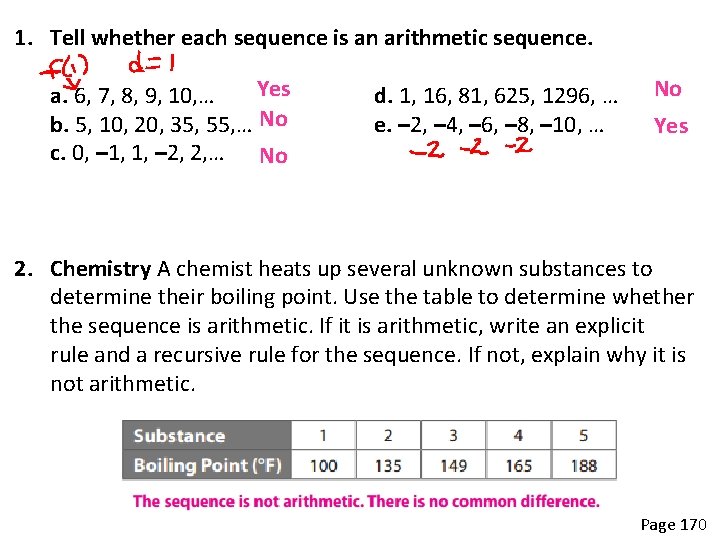
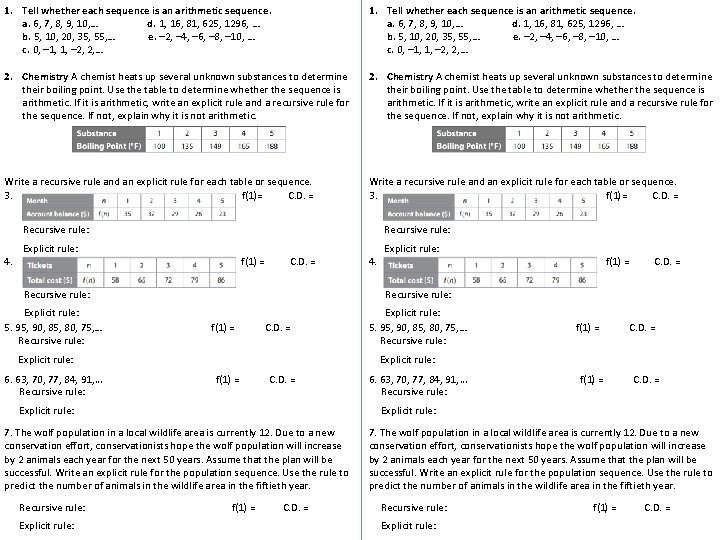
1. Tell whether each sequence is an arithmetic sequence. Yes a. 6, 7, 8, 9, 10, … b. 5, 10, 20, 35, 55, … No c. 0, – 1, 1, – 2, 2, … No d. 1, 16, 81, 625, 1296, … e. – 2, – 4, – 6, – 8, – 10, … No Yes 2. Chemistry A chemist heats up several unknown substances to determine their boiling point. Use the table to determine whether the sequence is arithmetic. If it is arithmetic, write an explicit rule and a recursive rule for the sequence. If not, explain why it is not arithmetic. Page 170
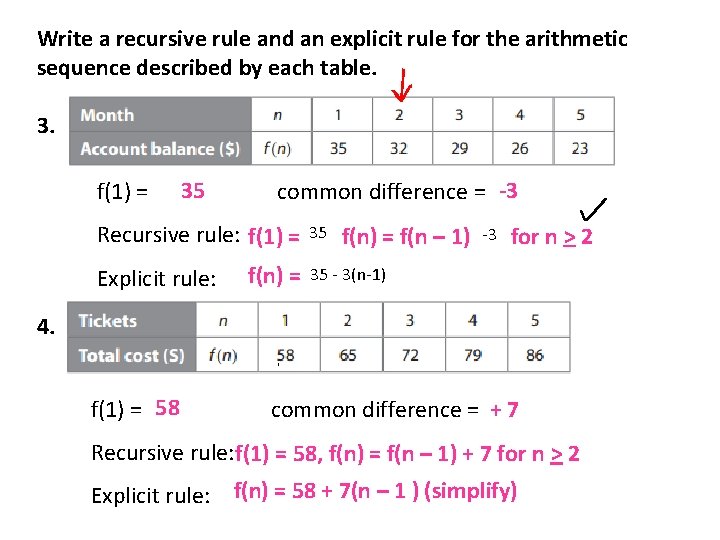
Write a recursive rule and an explicit rule for the arithmetic sequence described by each table. 3. f(1) = 35 common difference = -3 35 f(n) = f(n – 1) –-33 for n > 2 Recursive rule: f(1) = 35, 35 - 3(n-1) – 3(n – 1 ) Explicit rule: f(n) = 35 4. f(1) = 58 common difference = + 7 Recursive rule: f(1) = 58, f(n) = f(n – 1) + 7 for n > 2 Explicit rule: f(n) = 58 + 7(n – 1 ) (simplify)
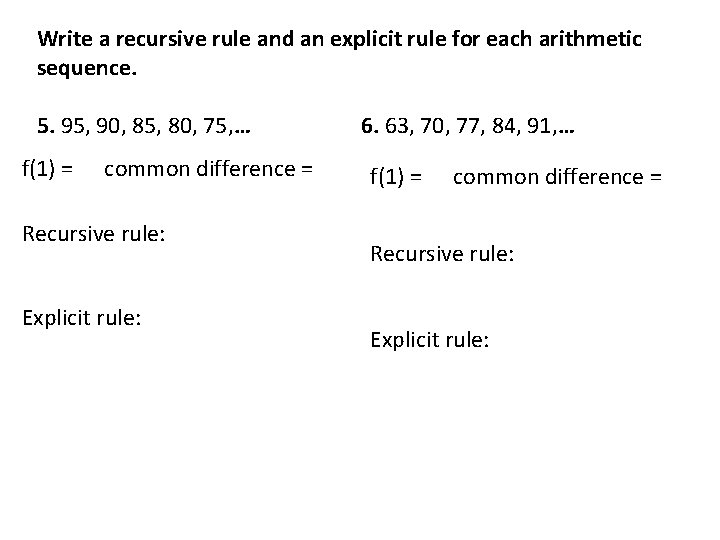
Write a recursive rule and an explicit rule for each arithmetic sequence. 5. 95, 90, 85, 80, 75, … f(1) = common difference = Recursive rule: Explicit rule: 6. 63, 70, 77, 84, 91, … f(1) = common difference = Recursive rule: Explicit rule:
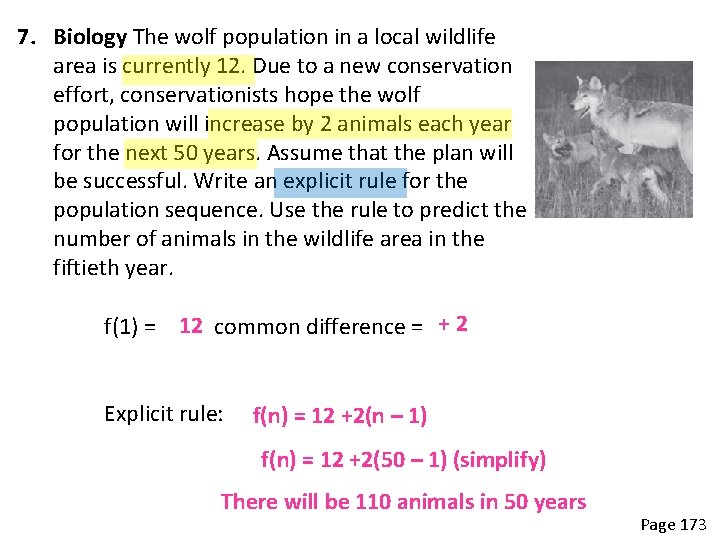
7. Biology The wolf population in a local wildlife area is currently 12. Due to a new conservation effort, conservationists hope the wolf population will increase by 2 animals each year for the next 50 years. Assume that the plan will be successful. Write an explicit rule for the population sequence. Use the rule to predict the number of animals in the wildlife area in the fiftieth year. +2 12 f(1) = common difference = Explicit rule: f(n) = 12 +2(n – 1) f(n) = 12 +2(50 – 1) (simplify) There will be 110 animals in 50 years Page 173
1. Tell whether each sequence is an arithmetic sequence. a. 6, 7, 8, 9, 10, … d. 1, 16, 81, 625, 1296, … b. 5, 10, 20, 35, 55, … e. – 2, – 4, – 6, – 8, – 10, … c. 0, – 1, 1, – 2, 2, … 2. Chemistry A chemist heats up several unknown substances to determine their boiling point. Use the table to determine whether the sequence is arithmetic. If it is arithmetic, write an explicit rule and a recursive rule for the sequence. If not, explain why it is not arithmetic. Write a recursive rule and an explicit rule for each table or sequence. 3. X f(1)= C. D. = Recursive rule: Explicit rule: 4. f(1) = C. D. = Recursive rule: Explicit rule: 5. 95, 90, 85, 80, 75, … f(1) = C. D. = Recursive rule: Explicit rule: 6. 63, 70, 77, 84, 91, … Recursive rule: Explicit rule: 5. 95, 90, 85, 80, 75, … f(1) = C. D. = Recursive rule: Explicit rule: f(1) = C. D. = Explicit rule: 7. The wolf population in a local wildlife area is currently 12. Due to a new conservation effort, conservationists hope the wolf population will increase by 2 animals each year for the next 50 years. Assume that the plan will be successful. Write an explicit rule for the population sequence. Use the rule to predict the number of animals in the wildlife area in the fiftieth year. 6. 63, 70, 77, 84, 91, … Recursive rule: f(1) = C. D. = Explicit rule: 7. The wolf population in a local wildlife area is currently 12. Due to a new conservation effort, conservationists hope the wolf population will increase by 2 animals each year for the next 50 years. Assume that the plan will be successful. Write an explicit rule for the population sequence. Use the rule to predict the number of animals in the wildlife area in the fiftieth year. Recursive rule: f(1) = C. D. = Explicit rule: