
1 Chapter Three Polar Reaction Under Acidic Conditions

- Slides: 35
1 Chapter Three Polar Reaction Under Acidic Conditions a. Carbocations b. Substitution and β-elimination reactions at C(sp 3)-X c. Electrophilic addition to nuclephilic C=C π bonds d. Substitution at nuclephilic C=C π bonds e. Nuclephilic Addition to and substitution at electrophilic π bonds
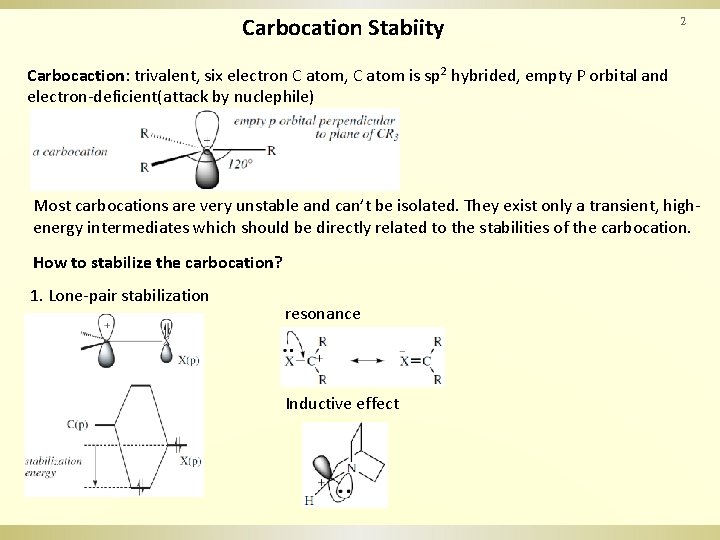
Carbocation Stabiity 2 Carbocaction: trivalent, six electron C atom, C atom is sp 2 hybrided, empty P orbital and electron-deficient(attack by nuclephile) Most carbocations are very unstable and can’t be isolated. They exist only a transient, highenergy intermediates which should be directly related to the stabilities of the carbocation. How to stabilize the carbocation? 1. Lone-pair stabilization resonance Inductive effect
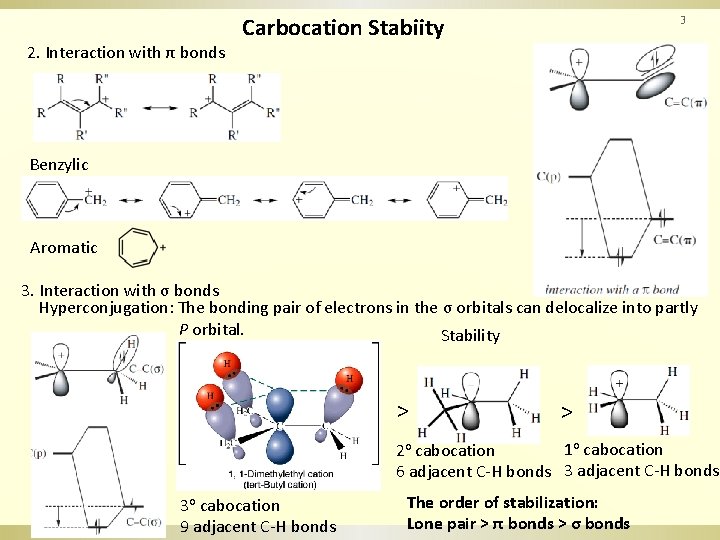
2. Interaction with π bonds Carbocation Stabiity 3 Benzylic Aromatic 3. Interaction with σ bonds Hyperconjugation: The bonding pair of electrons in the σ orbitals can delocalize into partly P orbital. Stability > > 1 o cabocation 2 o cabocation 6 adjacent C-H bonds 3 o cabocation 9 adjacent C-H bonds The order of stabilization: Lone pair > π bonds > σ bonds
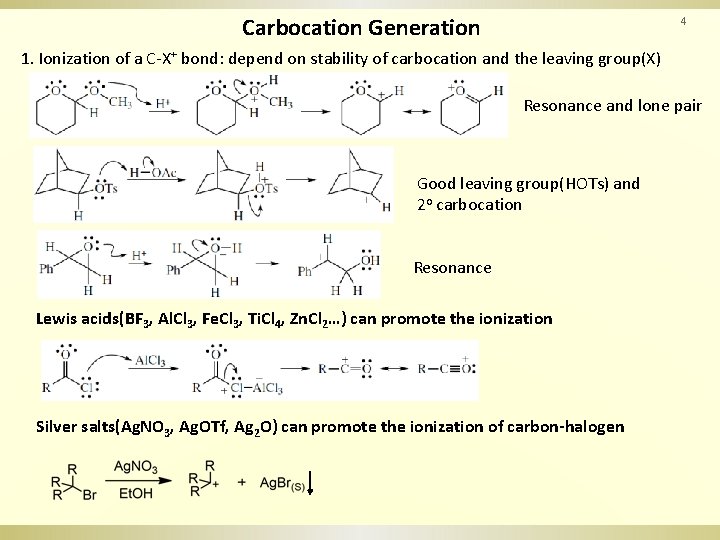
Carbocation Generation 4 1. Ionization of a C-X+ bond: depend on stability of carbocation and the leaving group(X) Resonance and lone pair Good leaving group(HOTs) and 2 o carbocation Resonance Lewis acids(BF 3, Al. Cl 3, Fe. Cl 3, Ti. Cl 4, Zn. Cl 2…) can promote the ionization Silver salts(Ag. NO 3, Ag. OTf, Ag 2 O) can promote the ionization of carbon-halogen
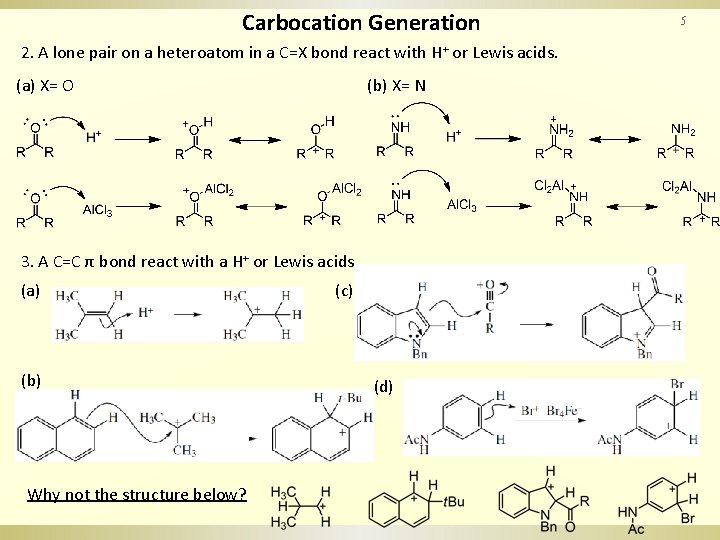
Carbocation Generation 2. A lone pair on a heteroatom in a C=X bond react with H+ or Lewis acids. (a) X= O (b) X= N 3. A C=C π bond react with a H+ or Lewis acids. (a) (b) Why not the structure below? (c) (d) 5
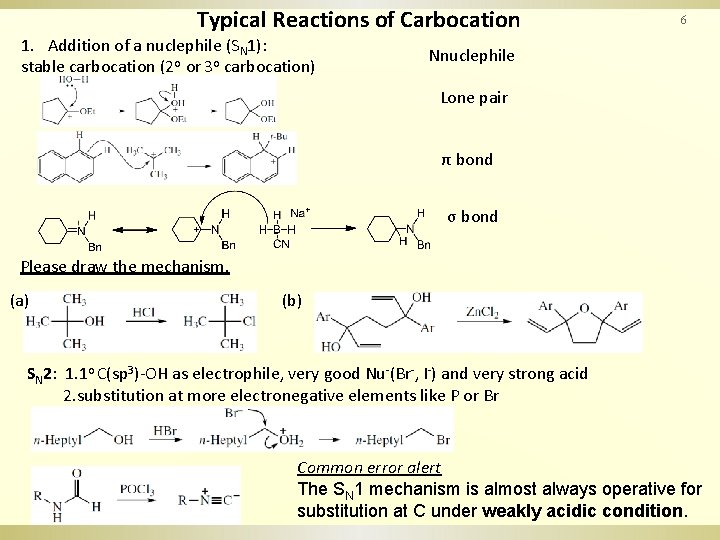
Typical Reactions of Carbocation 1. Addition of a nuclephile (SN 1): stable carbocation (2 o or 3 o carbocation) 6 Nnuclephile Lone pair π bond σ bond Please draw the mechanism. (a) (b) SN 2: 1. 1 o C(sp 3)-OH as electrophile, very good Nu-(Br-, I-) and very strong acid 2. substitution at more electronegative elements like P or Br Common error alert The SN 1 mechanism is almost always operative for substitution at C under weakly acidic condition.
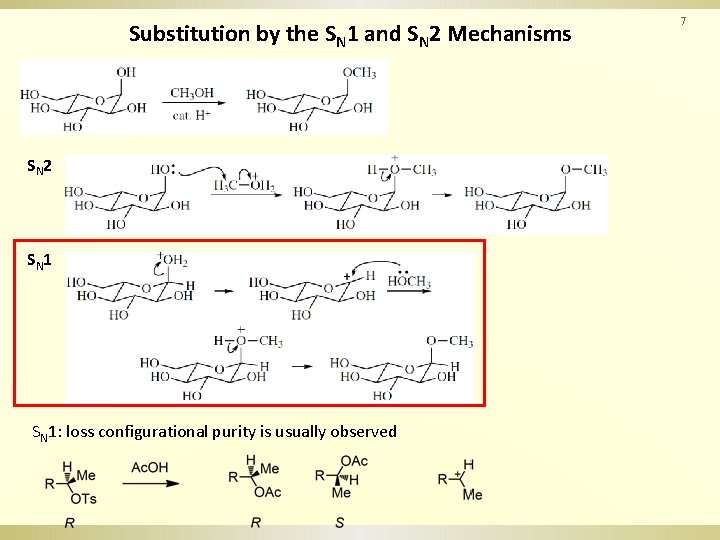
Substitution by the SN 1 and SN 2 Mechanisms SN 2 SN 1: loss configurational purity is usually observed 7
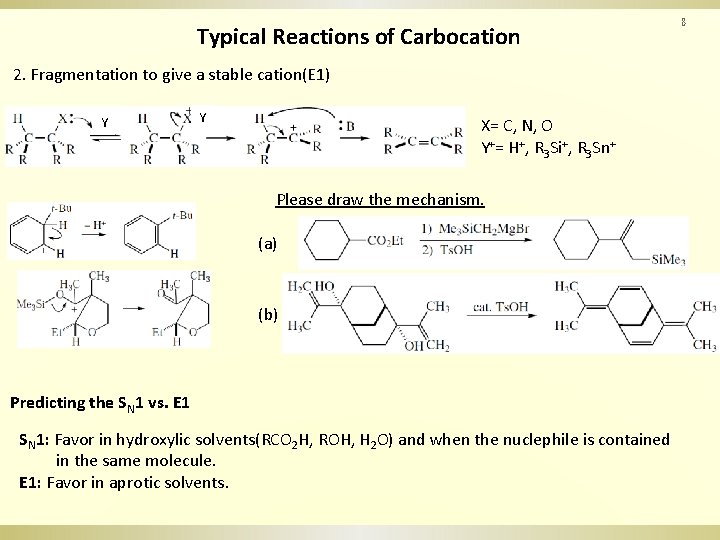
Typical Reactions of Carbocation 2. Fragmentation to give a stable cation(E 1) Y Y X= C, N, O Y+= H+, R 3 Si+, R 3 Sn+ Please draw the mechanism. (a) (b) Predicting the SN 1 vs. E 1 SN 1: Favor in hydroxylic solvents(RCO 2 H, ROH, H 2 O) and when the nuclephile is contained in the same molecule. E 1: Favor in aprotic solvents. 8
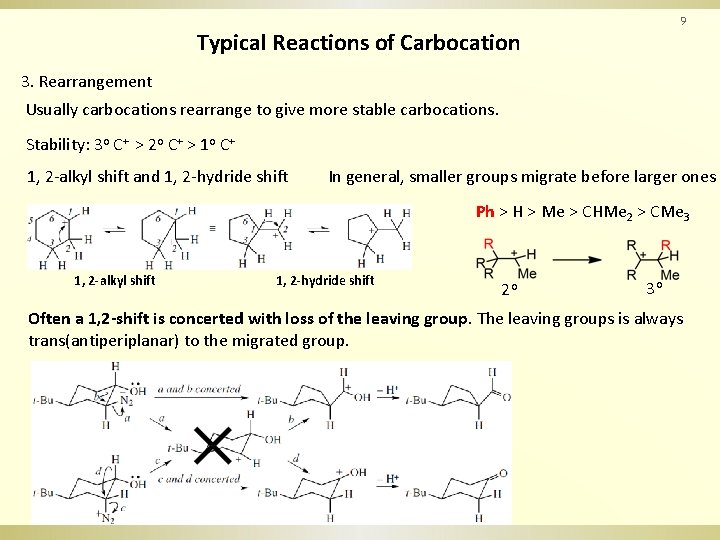
9 Typical Reactions of Carbocation 3. Rearrangement Usually carbocations rearrange to give more stable carbocations. Stability: 3 o C+ > 2 o C+ > 1 o C+ 1, 2 -alkyl shift and 1, 2 -hydride shift In general, smaller groups migrate before larger ones Ph > H > Me > CHMe 2 > CMe 3 1, 2 -alkyl shift 1, 2 -hydride shift 2 o 3 o Often a 1, 2 -shift is concerted with loss of the leaving group. The leaving groups is always trans(antiperiplanar) to the migrated group.
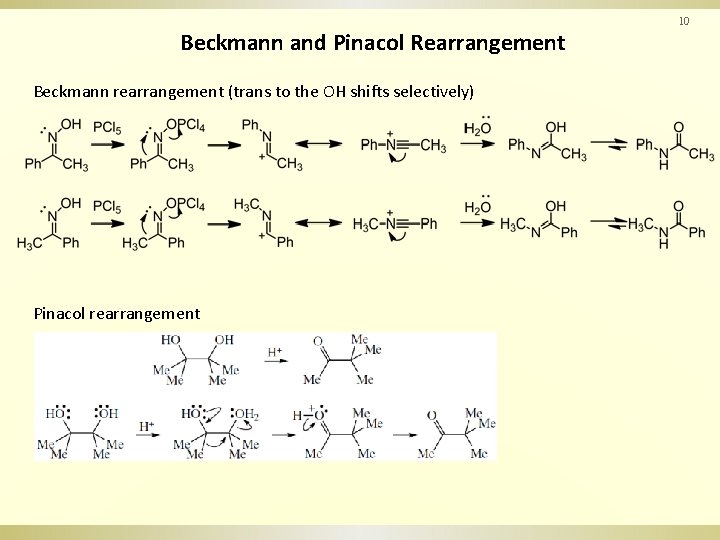
10 Beckmann and Pinacol Rearrangement Beckmann rearrangement (trans to the OH shifts selectively) Pinacol rearrangement
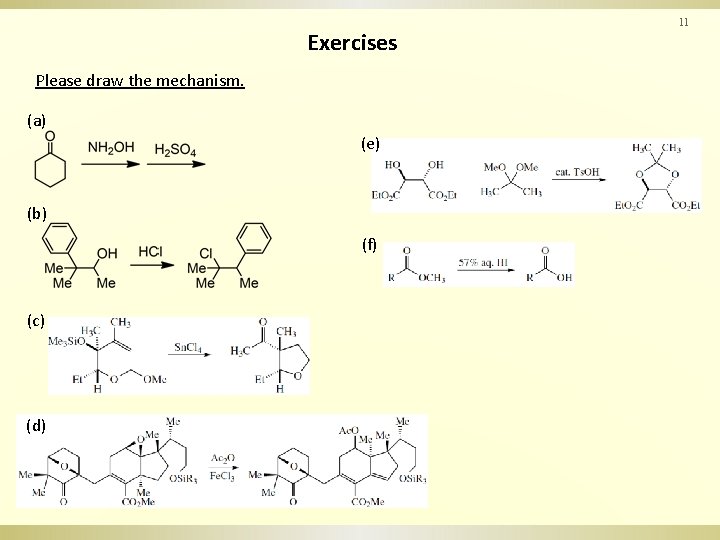
11 Exercises Please draw the mechanism. (a) (e) (b) (f) (c) (d)
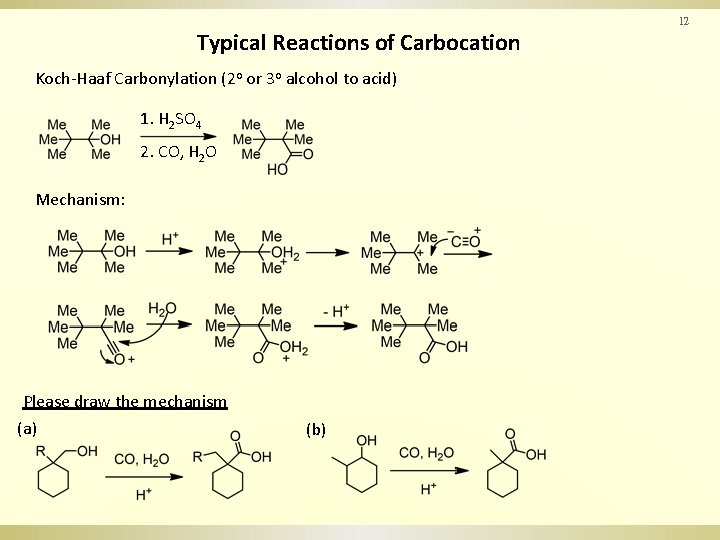
12 Typical Reactions of Carbocation Koch-Haaf Carbonylation (2 o or 3 o alcohol to acid) 1. H 2 SO 4 2. CO, H 2 O Mechanism: Please draw the mechanism (a) (b)
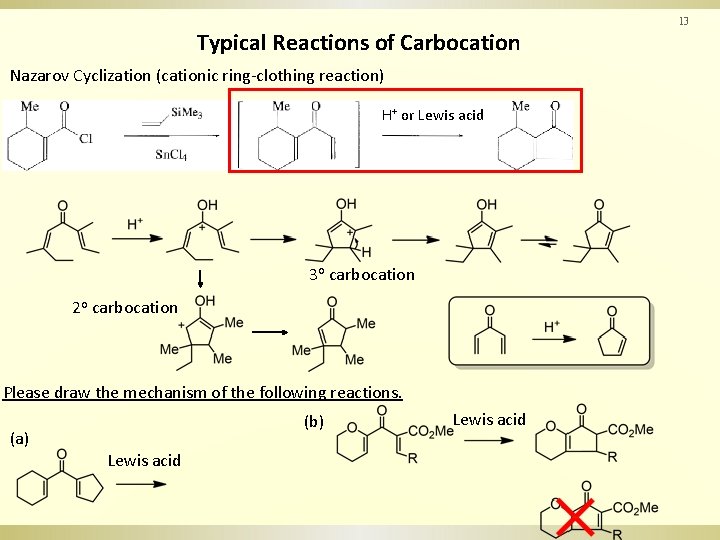
13 Typical Reactions of Carbocation Nazarov Cyclization (cationic ring-clothing reaction) H+ or Lewis acid 3 o carbocation 2 o carbocation Please draw the mechanism of the following reactions. (b) (a) Lewis acid
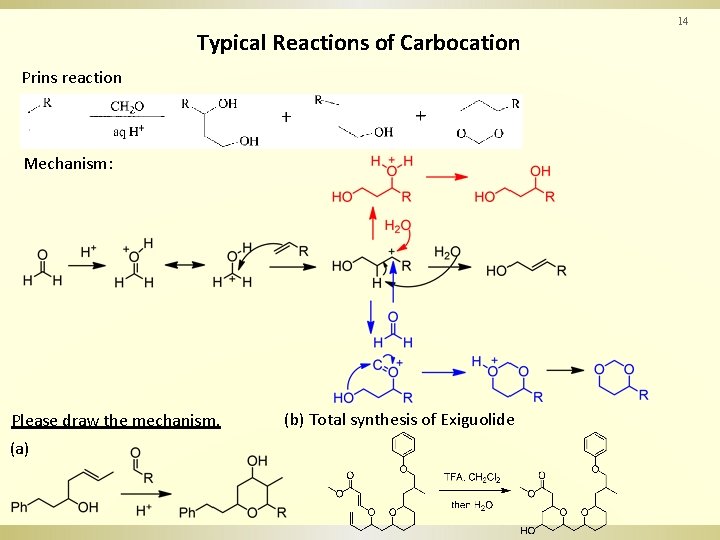
14 Typical Reactions of Carbocation Prins reaction Mechanism: Please draw the mechanism. (a) (b) Total synthesis of Exiguolide
15 Chapter Three Polar Reaction Under Acidic Conditions a. Carbocations b. Substitution and β-elimination reactions at C(sp 3)-X c. Electrophilic addition to nuclephilic C=C π bonds d. Substitution at nuclephilic C=C π bonds e. Nuclephilic Addition to and substitution at electrophilic π bonds
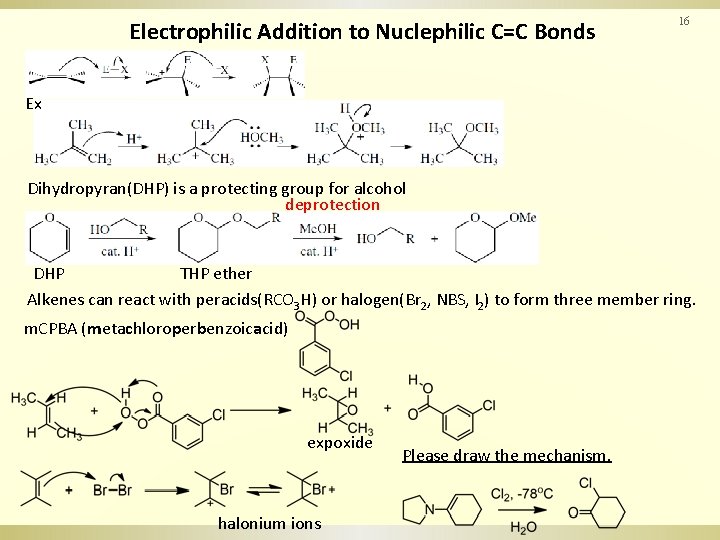
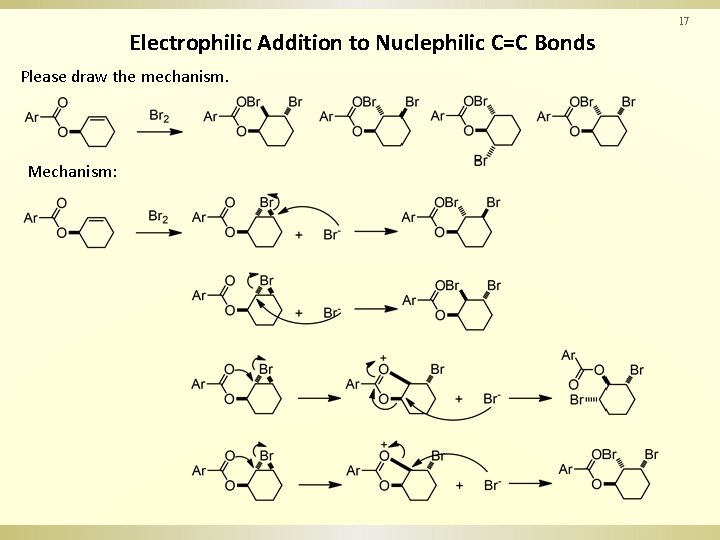
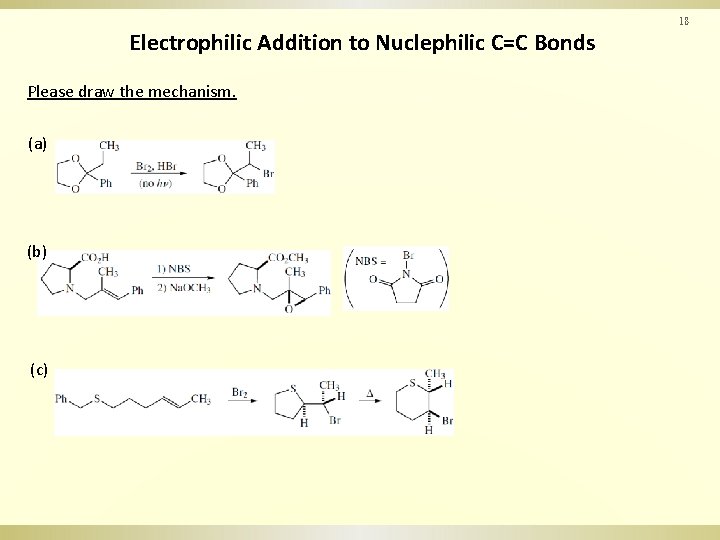
Electrophilic Addition to Nuclephilic C=C Bonds 16 Ex Dihydropyran(DHP) is a protecting group for alcohol deprotection DHP THP ether Alkenes can react with peracids(RCO 3 H) or halogen(Br 2, NBS, I 2) to form three member ring. m. CPBA (metachloroperbenzoicacid) expoxide halonium ions Please draw the mechanism.
17 Electrophilic Addition to Nuclephilic C=C Bonds Please draw the mechanism. Mechanism:
18 Electrophilic Addition to Nuclephilic C=C Bonds Please draw the mechanism. (a) (b) (c)
19 Chapter Three Polar Reaction Under Acidic Conditions a. Carbocations b. Substitution and β-elimination reactions at C(sp 3)-X c. Electrophilic addition to nuclephilic C=C π bonds d. Substitution at nuclephilic C=C π bonds e. Nuclephilic Addition to and substitution at electrophilic π bonds
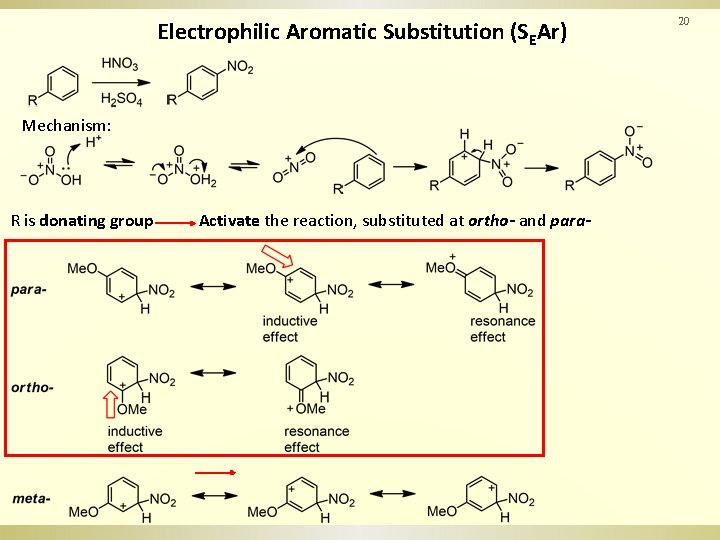
Electrophilic Aromatic Substitution (SEAr) Mechanism: R is donating group Activate the reaction, substituted at ortho- and para- 20
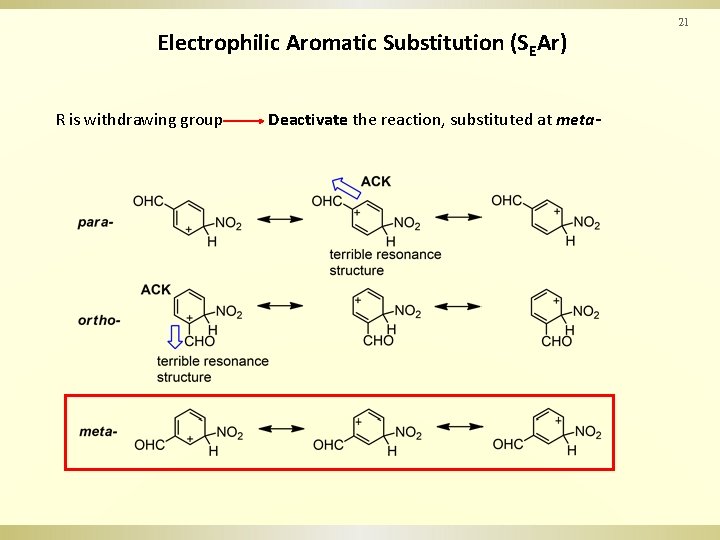
21 Electrophilic Aromatic Substitution (SEAr) R is withdrawing group Deactivate the reaction, substituted at meta-
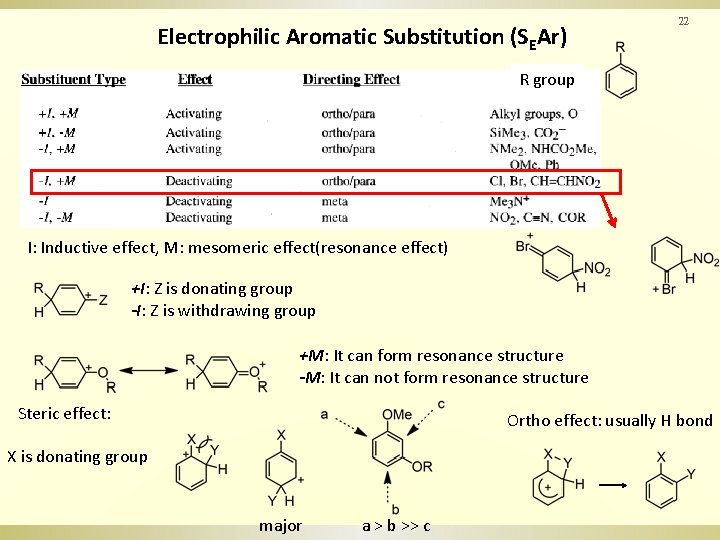
Electrophilic Aromatic Substitution (SEAr) 22 R group I: Inductive effect, M: mesomeric effect(resonance effect) +I: Z is donating group -I: Z is withdrawing group +M: It can form resonance structure -M: It can not form resonance structure Steric effect: Ortho effect: usually H bond X is donating group major a > b >> c
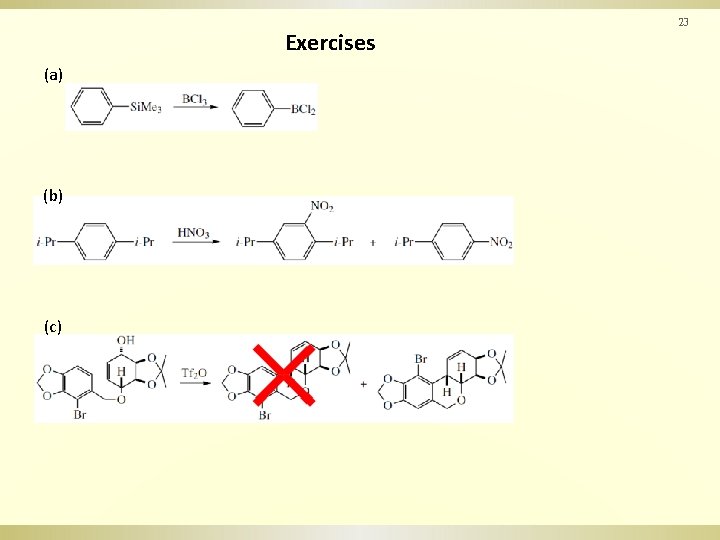
23 Exercises (a) (b) (c)
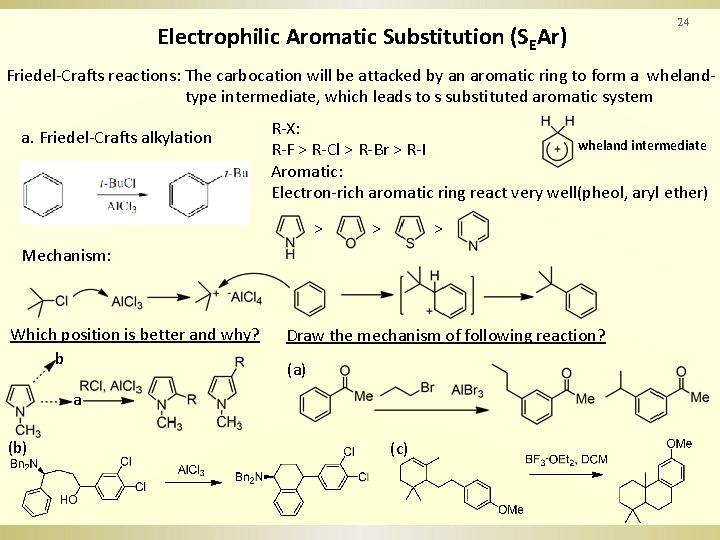
Electrophilic Aromatic Substitution (SEAr) 24 Friedel-Crafts reactions: The carbocation will be attacked by an aromatic ring to form a whelandtype intermediate, which leads to s substituted aromatic system a. Friedel-Crafts alkylation R-X: wheland intermediate R-F > R-Cl > R-Br > R-I Aromatic: Electron-rich aromatic ring react very well(pheol, aryl ether) > > > Mechanism: Which position is better and why? b Draw the mechanism of following reaction? (a) a (b) (c)
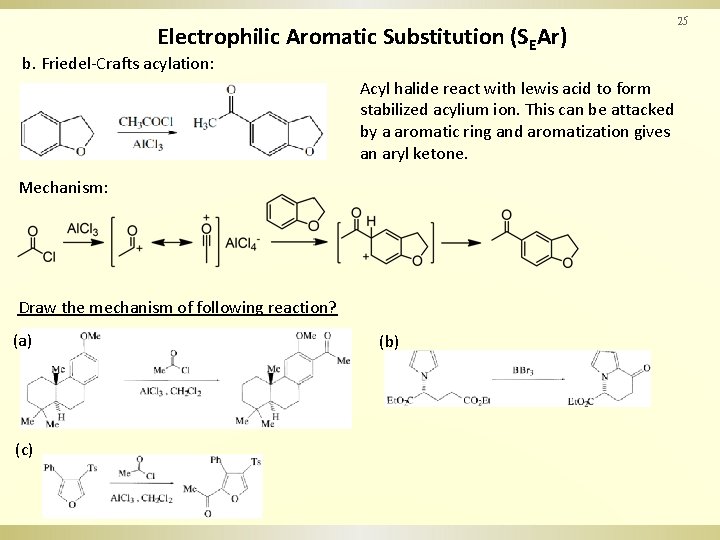
Electrophilic Aromatic Substitution (SEAr) b. Friedel-Crafts acylation: Acyl halide react with lewis acid to form stabilized acylium ion. This can be attacked by a aromatic ring and aromatization gives an aryl ketone. Mechanism: Draw the mechanism of following reaction? (a) (c) (b) 25
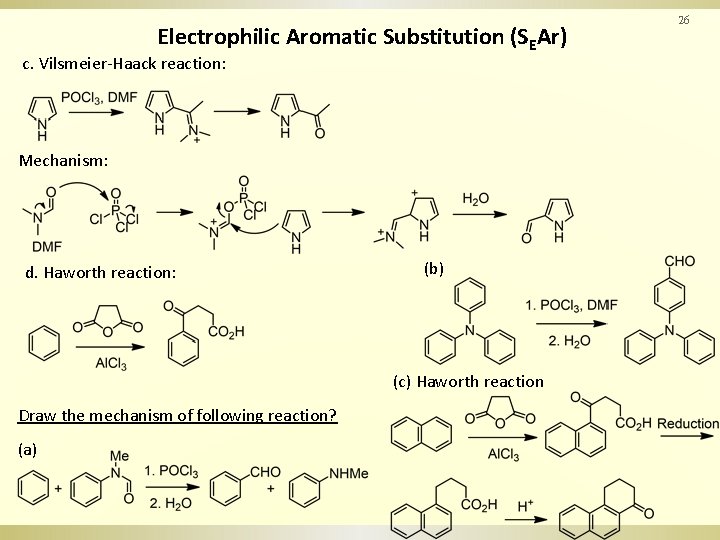
Electrophilic Aromatic Substitution (SEAr) c. Vilsmeier-Haack reaction: Mechanism: d. Haworth reaction: (b) (c) Haworth reaction Draw the mechanism of following reaction? (a) 26
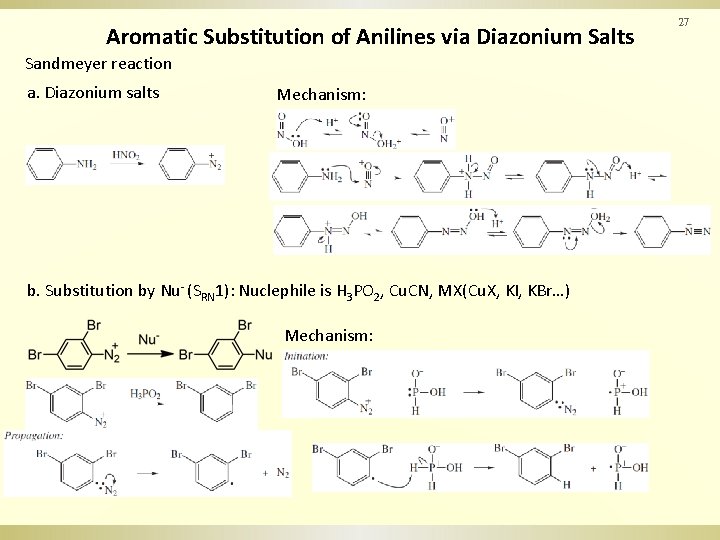
Aromatic Substitution of Anilines via Diazonium Salts Sandmeyer reaction a. Diazonium salts Mechanism: b. Substitution by Nu- (SRN 1): Nuclephile is H 3 PO 2, Cu. CN, MX(Cu. X, KI, KBr…) Mechanism: 27
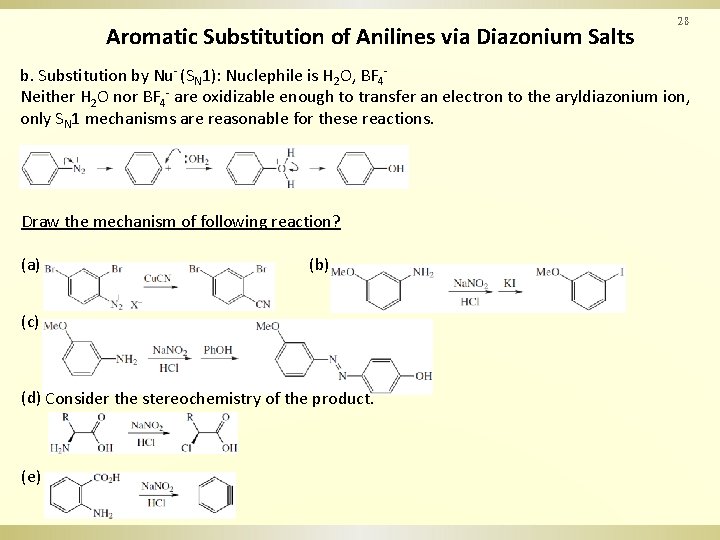
Aromatic Substitution of Anilines via Diazonium Salts 28 b. Substitution by Nu- (SN 1): Nuclephile is H 2 O, BF 4 Neither H 2 O nor BF 4 - are oxidizable enough to transfer an electron to the aryldiazonium ion, only SN 1 mechanisms are reasonable for these reactions. Draw the mechanism of following reaction? (a) (b) (c) (d) Consider the stereochemistry of the product. (e)
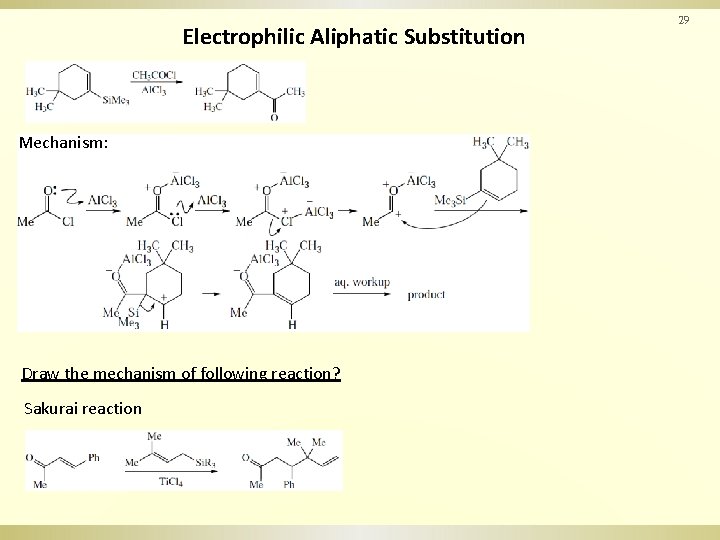
Electrophilic Aliphatic Substitution Mechanism: Draw the mechanism of following reaction? Sakurai reaction 29
30 Chapter Three Polar Reaction Under Acidic Conditions a. Carbocations b. Substitution and β-elimination reactions at C(sp 3)-X c. Electrophilic addition to nuclephilic C=C π bonds d. Substitution at nuclephilic C=C π bonds e. Nuclephilic Addition to and substitution at electrophilic π bonds
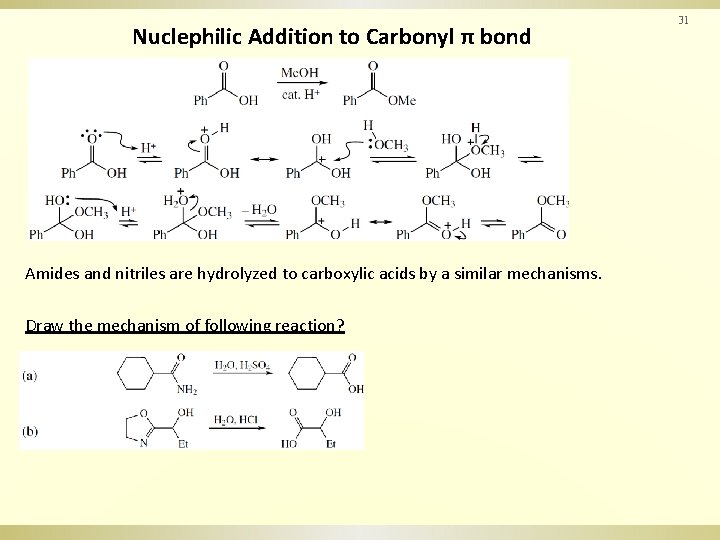
Nuclephilic Addition to Carbonyl π bond Amides and nitriles are hydrolyzed to carboxylic acids by a similar mechanisms. Draw the mechanism of following reaction? 31
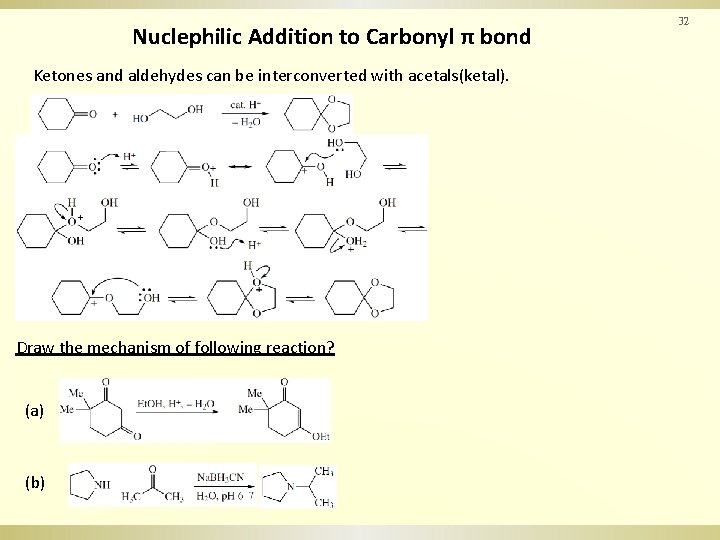
Nuclephilic Addition to Carbonyl π bond Ketones and aldehydes can be interconverted with acetals(ketal). Draw the mechanism of following reaction? (a) (b) 32
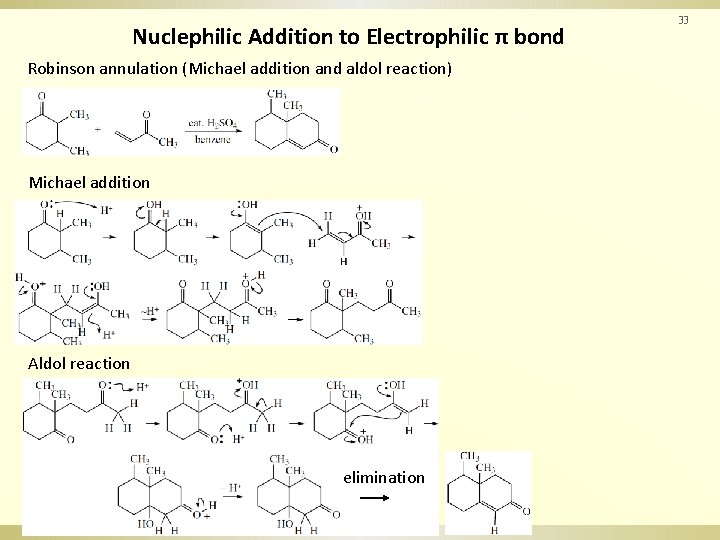
Nuclephilic Addition to Electrophilic π bond Robinson annulation (Michael addition and aldol reaction) Michael addition Aldol reaction elimination 33
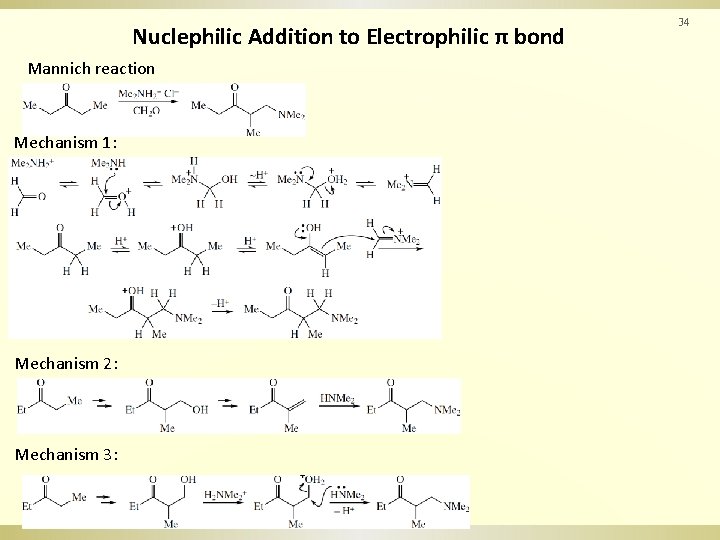
Nuclephilic Addition to Electrophilic π bond Mannich reaction Mechanism 1: Mechanism 2: Mechanism 3: 34
Thanks For Your Attention 35