
1 CHAPTER NINE Ethics In Negotiation Mc GrawHillIrwin
- Slides: 23
1 CHAPTER NINE Ethics In Negotiation Mc. Graw-Hill/Irwin © 2006 The Mc. Graw-Hill Companies, Inc. , All Rights Reserved
2 What Do We Mean by Ethics and Why Do They Matter in Negotiation? Ethics: • Are broadly applied social standards for what is right or wrong in a particular situation, or a process for setting those standards • Grow out of particular philosophies which – Define the nature of the world in which we live – Prescribe rules for living together Mc. Graw-Hill/Irwin © 2006 The Mc. Graw-Hill Companies, Inc. , All Rights Reserved
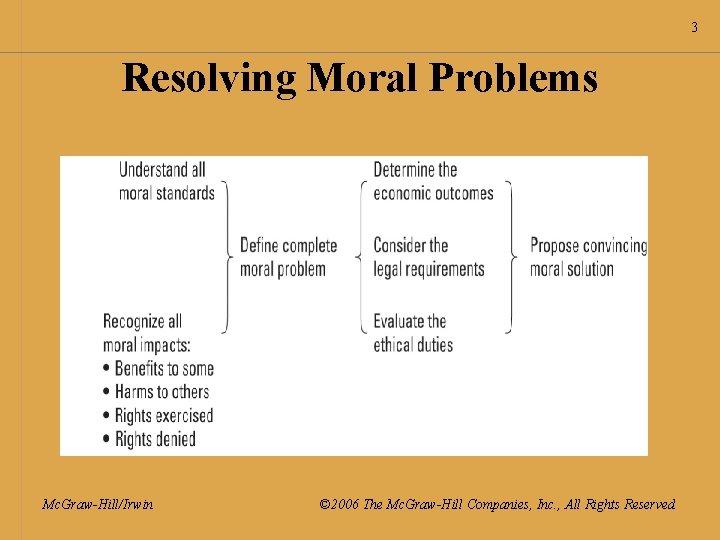
3 Resolving Moral Problems Mc. Graw-Hill/Irwin © 2006 The Mc. Graw-Hill Companies, Inc. , All Rights Reserved
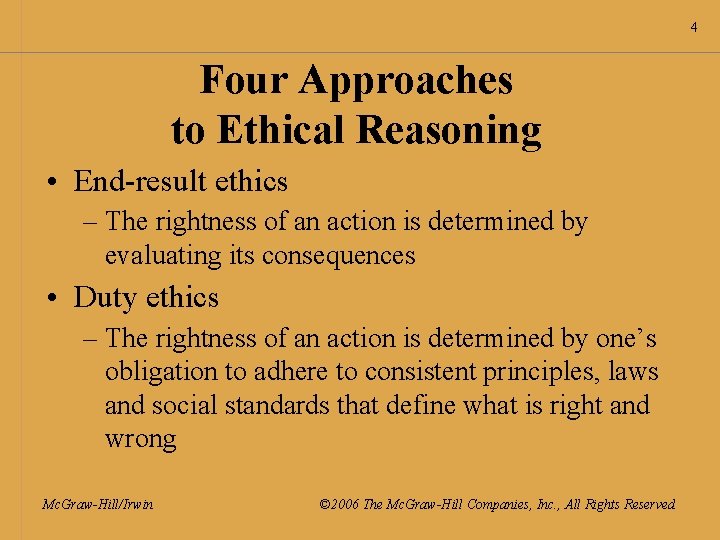
4 Four Approaches to Ethical Reasoning • End-result ethics – The rightness of an action is determined by evaluating its consequences • Duty ethics – The rightness of an action is determined by one’s obligation to adhere to consistent principles, laws and social standards that define what is right and wrong Mc. Graw-Hill/Irwin © 2006 The Mc. Graw-Hill Companies, Inc. , All Rights Reserved
5 Four Approaches to Ethical Reasoning • Social contract ethics – The rightness of an action is based on the customs and norms of a particular society or community • Personalistic ethics – The rightness of the action is based on one’s own conscience and moral standards Mc. Graw-Hill/Irwin © 2006 The Mc. Graw-Hill Companies, Inc. , All Rights Reserved
6 Questions of Ethical Conduct that Arise in Negotiation • Using ethically ambiguous tactics: It’s (mostly) all about the truth • Identifying ethically ambiguous tactics and attitudes toward their use – What ethically ambiguous tactics are there? – Does tolerance for ethically ambiguous tactics lead to their actual use? – Is it okay to use ethically ambiguous tactics? Mc. Graw-Hill/Irwin © 2006 The Mc. Graw-Hill Companies, Inc. , All Rights Reserved
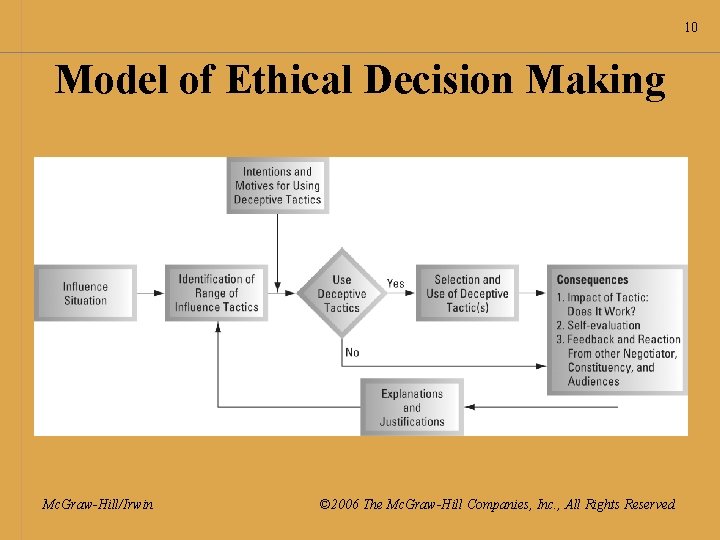
7 Questions of Ethical Conduct that Arise in Negotiation • Deception by omission versus commission – Omission – failing to disclose information that would benefit the other – Commission – actually lying about the common-value issue • The decision to use ethically ambiguous tactics: A model Mc. Graw-Hill/Irwin © 2006 The Mc. Graw-Hill Companies, Inc. , All Rights Reserved
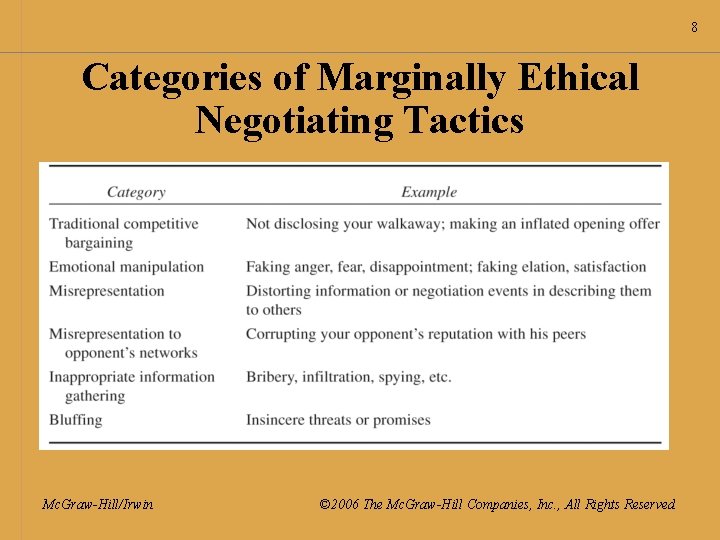
8 Categories of Marginally Ethical Negotiating Tactics Mc. Graw-Hill/Irwin © 2006 The Mc. Graw-Hill Companies, Inc. , All Rights Reserved
9 Why Use Deceptive Tactics? Motives and Consequences • The power motive – The purpose of using ethically ambiguous negotiating tactics is to increase the negotiator’s power in the bargaining environment • Other motives to behave unethically – Negotiators are more likely to see ethically ambiguous tactics as appropriate if they anticipate that the other’s expected motivation would be more competitive Mc. Graw-Hill/Irwin © 2006 The Mc. Graw-Hill Companies, Inc. , All Rights Reserved
10 Model of Ethical Decision Making Mc. Graw-Hill/Irwin © 2006 The Mc. Graw-Hill Companies, Inc. , All Rights Reserved
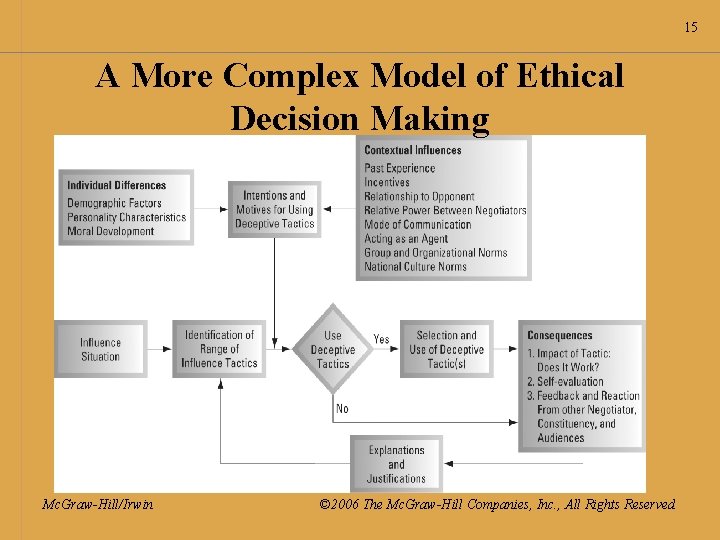
11 The Consequences of Unethical Conduct A negotiator who employs an unethical tactic will experience positive or negative consequences. The consequences are based on: • Effectiveness – whether the tactic is effective • Reactions of others – how the other person, constituencies, and audiences evaluate the tactic • Reactions of self – how the negotiator evaluates the tactic, feels about using the tactic Mc. Graw-Hill/Irwin © 2006 The Mc. Graw-Hill Companies, Inc. , All Rights Reserved
12 Explanations and Justifications The primary purpose of explanations and justifications is: – To rationalize, explain, or excuse the behavior – To verbalize some good, legitimate reason why this tactic was necessary Mc. Graw-Hill/Irwin © 2006 The Mc. Graw-Hill Companies, Inc. , All Rights Reserved
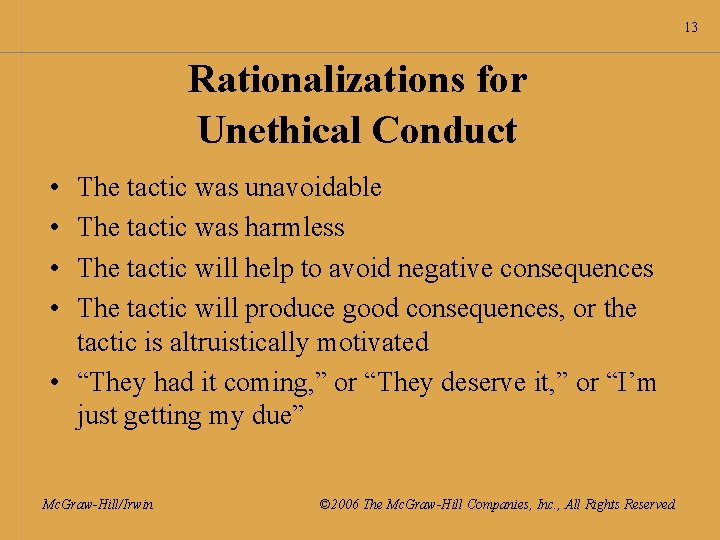
13 Rationalizations for Unethical Conduct • • The tactic was unavoidable The tactic was harmless The tactic will help to avoid negative consequences The tactic will produce good consequences, or the tactic is altruistically motivated • “They had it coming, ” or “They deserve it, ” or “I’m just getting my due” Mc. Graw-Hill/Irwin © 2006 The Mc. Graw-Hill Companies, Inc. , All Rights Reserved
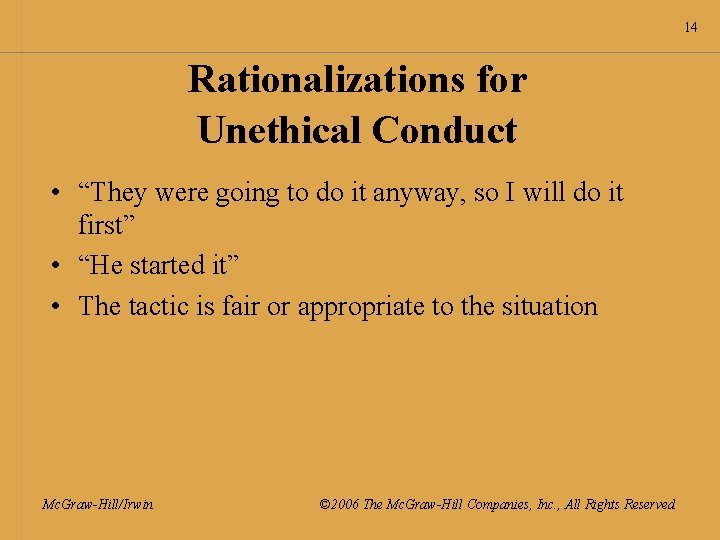
14 Rationalizations for Unethical Conduct • “They were going to do it anyway, so I will do it first” • “He started it” • The tactic is fair or appropriate to the situation Mc. Graw-Hill/Irwin © 2006 The Mc. Graw-Hill Companies, Inc. , All Rights Reserved
15 A More Complex Model of Ethical Decision Making Mc. Graw-Hill/Irwin © 2006 The Mc. Graw-Hill Companies, Inc. , All Rights Reserved
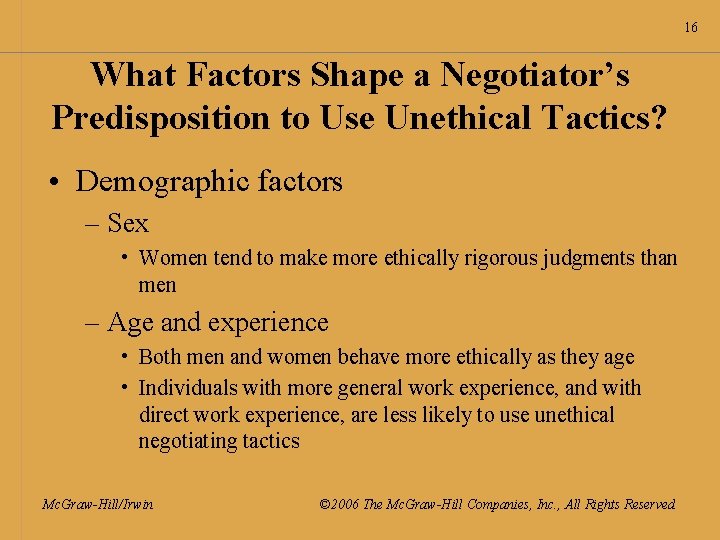
16 What Factors Shape a Negotiator’s Predisposition to Use Unethical Tactics? • Demographic factors – Sex • Women tend to make more ethically rigorous judgments than men – Age and experience • Both men and women behave more ethically as they age • Individuals with more general work experience, and with direct work experience, are less likely to use unethical negotiating tactics Mc. Graw-Hill/Irwin © 2006 The Mc. Graw-Hill Companies, Inc. , All Rights Reserved
17 What Factors Shape a Negotiator’s Predisposition to Use Unethical Tactics? • Demographic factors (cont. ) – Nationality and culture • Significant differences are found across different nationalities and cultural backgrounds – Professional orientation • People in different professions differ on judgments of perceived appropriateness Mc. Graw-Hill/Irwin © 2006 The Mc. Graw-Hill Companies, Inc. , All Rights Reserved
18 What Factors Shape a Negotiator’s Predisposition to Use Unethical Tactics? • Personality differences – Competitiveness versus cooperativeness – Machiavellianism • Some individuals are more willing and able con artists • Are more likely to lie when they need to • Better able to lie without feeling anxious about it • More persuasive and effective in their lies Mc. Graw-Hill/Irwin © 2006 The Mc. Graw-Hill Companies, Inc. , All Rights Reserved
19 What Factors Shape a Negotiator’s Predisposition to Use Unethical Tactics? • Personality differences (cont. ) – Locus of control • The degree to which individuals believe that the outcomes they obtain are largely a result of their own ability and effort (internal control) versus fate or chance (external control) • Individuals who are high in internal control are more likely to do what they think is right Mc. Graw-Hill/Irwin © 2006 The Mc. Graw-Hill Companies, Inc. , All Rights Reserved
20 What Factors Shape a Negotiator’s Predisposition to Use Unethical Tactics? • Moral development and personal values – Preconventional level (Stages 1 and 2) • Individual is concerned with concrete outcomes that meet his or her own immediate needs, particularly external rewards and punishments – Conventional level (Stages 3 and 4) • Individual defines what is right on the basis of what immediate social situation and peer group endorses or what society in general seems to want Mc. Graw-Hill/Irwin © 2006 The Mc. Graw-Hill Companies, Inc. , All Rights Reserved
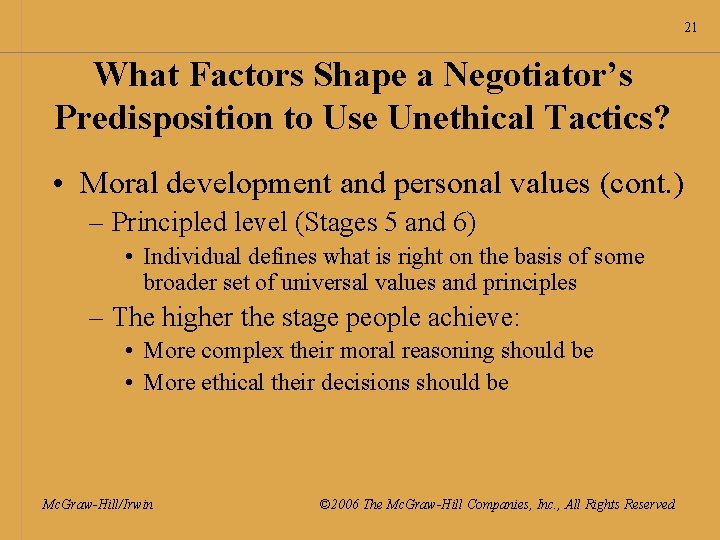
21 What Factors Shape a Negotiator’s Predisposition to Use Unethical Tactics? • Moral development and personal values (cont. ) – Principled level (Stages 5 and 6) • Individual defines what is right on the basis of some broader set of universal values and principles – The higher the stage people achieve: • More complex their moral reasoning should be • More ethical their decisions should be Mc. Graw-Hill/Irwin © 2006 The Mc. Graw-Hill Companies, Inc. , All Rights Reserved
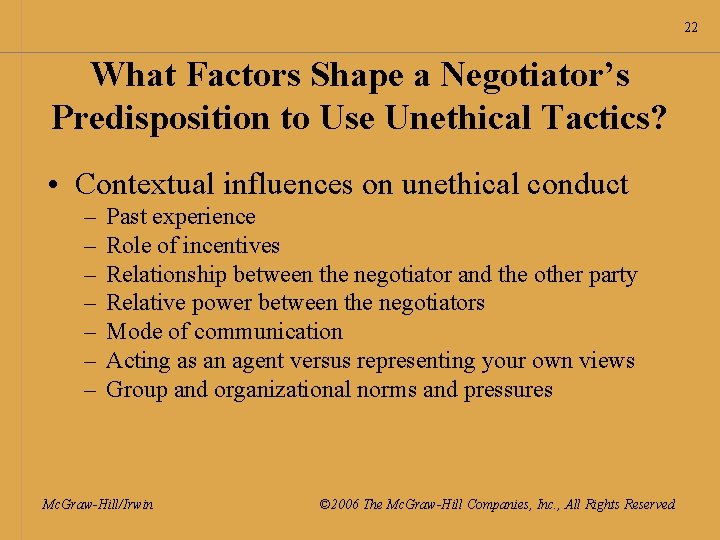
22 What Factors Shape a Negotiator’s Predisposition to Use Unethical Tactics? • Contextual influences on unethical conduct – – – – Past experience Role of incentives Relationship between the negotiator and the other party Relative power between the negotiators Mode of communication Acting as an agent versus representing your own views Group and organizational norms and pressures Mc. Graw-Hill/Irwin © 2006 The Mc. Graw-Hill Companies, Inc. , All Rights Reserved
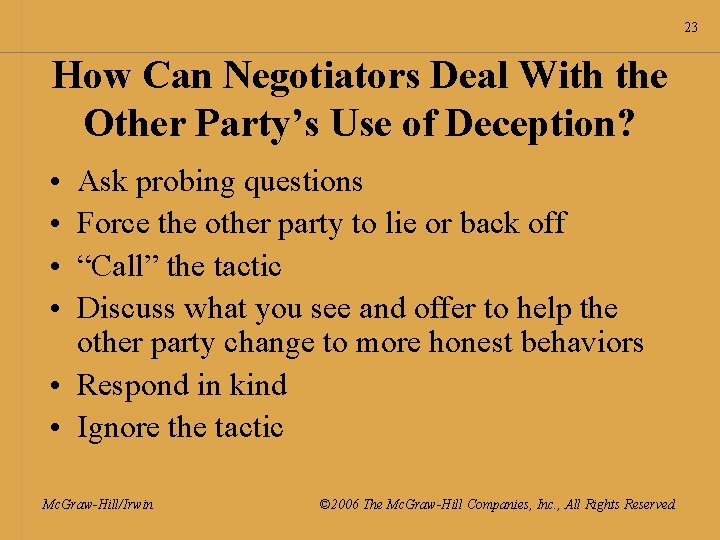
23 How Can Negotiators Deal With the Other Party’s Use of Deception? • • Ask probing questions Force the other party to lie or back off “Call” the tactic Discuss what you see and offer to help the other party change to more honest behaviors • Respond in kind • Ignore the tactic Mc. Graw-Hill/Irwin © 2006 The Mc. Graw-Hill Companies, Inc. , All Rights Reserved