
1 Chapter 9 Key Terms Taxonomy Domain Binomial
1 Chapter 9 Key Terms Taxonomy Domain Binomial Nomenclature Speciation Migration Adaptation Baraminology Derived Character Phylogenetic Tree Geographic Isolation Behavioral Isolation Biological Species Artificial Classification System
2 Biology Chapter 9 CLASSIFICATION OF ORGANISMS
3 Why Classify? Taxonomy The science of classifying organisms into groups We classify organisms by putting them into groups with similar properties Grouping them helps organize information about these organisms
4 Classification Aristotle 2 was the first to attempt classifying organisms major groups: animals and plants Plants were divided into trees, shrubs, herbs Animals Artificial were divided into fish, birds, animals Classification System for classifying organisms based on observable characteristics
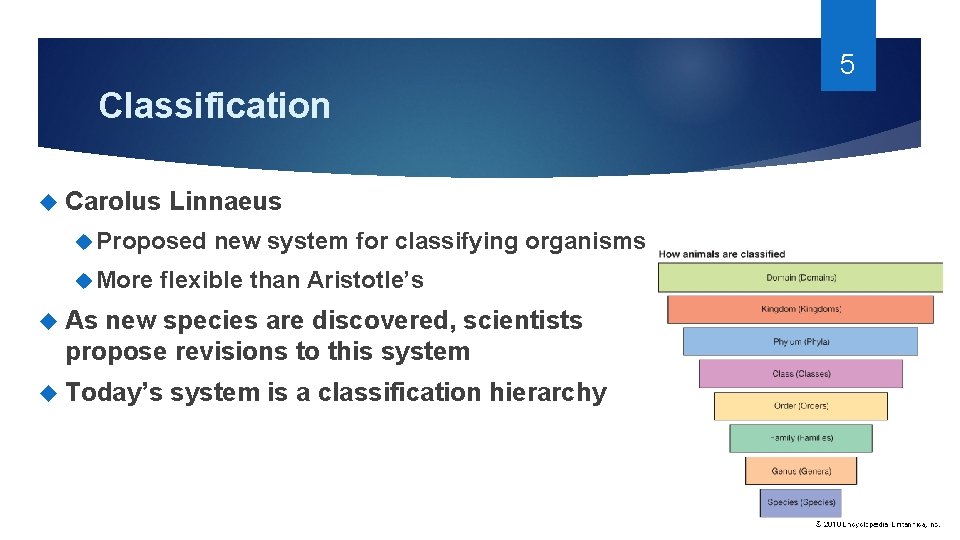
5 Classification Carolus Linnaeus Proposed More new system for classifying organisms flexible than Aristotle’s As new species are discovered, scientists propose revisions to this system Today’s system is a classification hierarchy

6 Classification Each group on one level may be divided into several groups on the next layer 2. Each group in the hierarchy has various characteristics that all levels under the group possess 3. Each level of the hierarchy can be divided into smaller units before reaching the next lower level 1.
7 Kingdoms Kingdom Most Eubacteria abundant organisms on the earth Unicellular Contain Kingdom Also Do prokaryotic organisms peptidoglycan Archaebacteria prokaryotic organisms not contain peptidoglycan Many are considered extremophiles
8 Kingdoms Kingdom Protists Protista are eukaryotic organisms that are not animals, plants, or fungus Algae, protozoans, slime molds Kingdom Fungi Heterotrophic Mushrooms, and feed on dead or decaying organic matter yeasts, mildews, molds
9 Kingdoms Kingdom Most are autotrophic and perform photosynthesis Adults Cells Plantae are usually stationary surrounded by cell walls Kingdom Animalia Heterotrophic, eukaryotic, multicellular organisms Contain some means of locomotion Insects, fish, worms, birds, mammals…
10 Scientific Names A naming system had to be derived because different organisms can have the same name, and one organism can have several names Binomial Nomenclature Proposed 2 by Carolus Linnaeus name, naming system Each organism is given a genus and species name specific to that organism Uses Latin for names
11 Scientific Names The scientific name for an organism uses the genus and species names Name is always italicized if printed, underlined if hand written Genus Ex. name is capitalized, species name is not the genus for horse is Equus caballus is the common name for the common horse
12 Species “A group of similar organisms” Members of a species are structurally similar but do have a degree of variation Members of a species can interbreed and produce viable and fertile offspring under natural conditions Biological species A group of individuals that resemble each other and can generally interbreed to produce fertile, viable offspring Still does not give a complete definition for every species
13 Species Speciation Formation Does not create new information Migration Moving of organisms from one area to another Geographic Isolation Inability of new species of organisms to breed due to physical separation Behavioral Isolation Inability of organisms to reproduce due to conflicting reproductive behaviors
14 Kinds Biblical Kind Organisms that are able to reproduce Linnaeus thought he was using the same classification when referring to a species Baraminology Study of classification based on the idea of biblical kinds
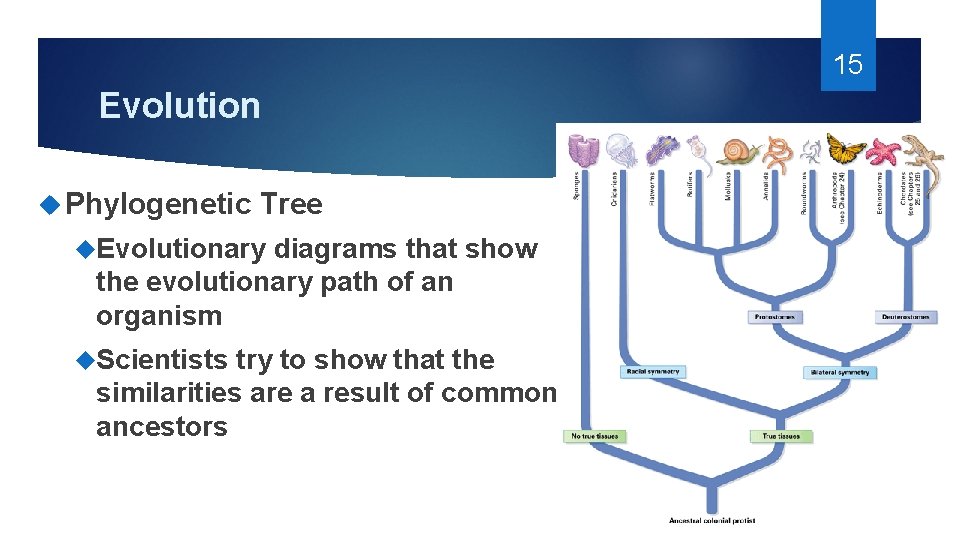
15 Evolution Phylogenetic Tree Evolutionary diagrams that show the evolutionary path of an organism Scientists try to show that the similarities are a result of common ancestors
- Slides: 15