
1 Chapter 8 Dispersion and anisotropic media EMLAB
1 Chapter 8. Dispersion and anisotropic media EMLAB
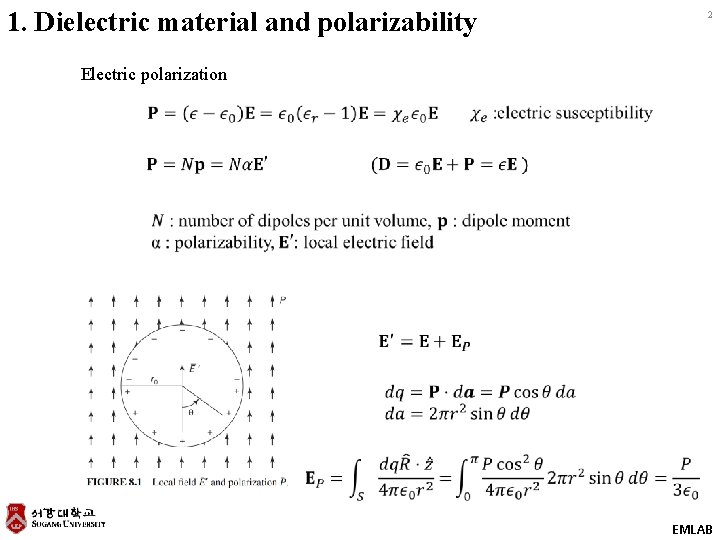
1. Dielectric material and polarizability 2 Electric polarization EMLAB

3 (Clausius–Mossotti formula) EMLAB
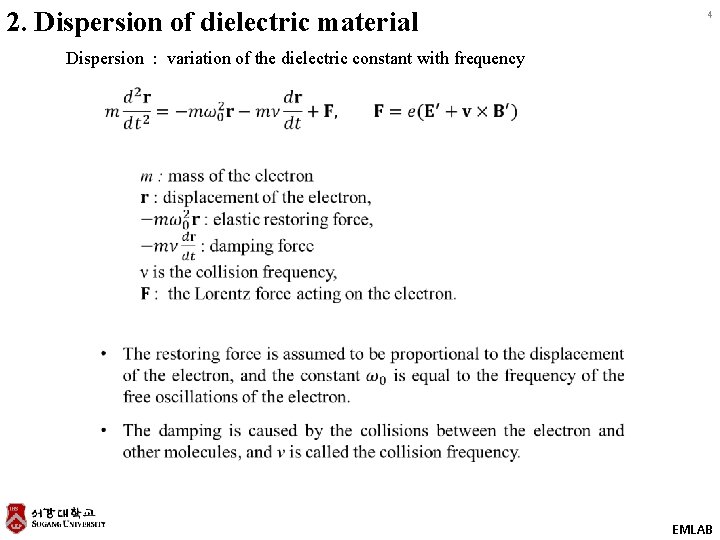
2. Dispersion of dielectric material 4 Dispersion : variation of the dielectric constant with frequency EMLAB
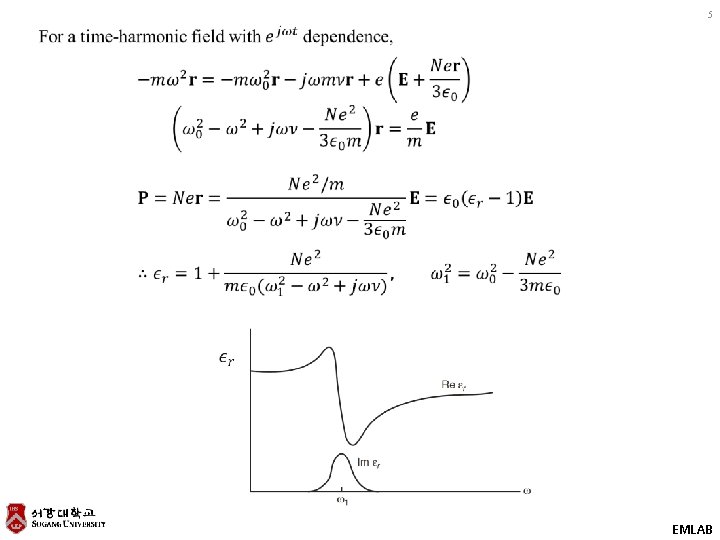
5 EMLAB

6 If there is more than one resonance, For lossless material, (Sellmeier equation) EMLAB
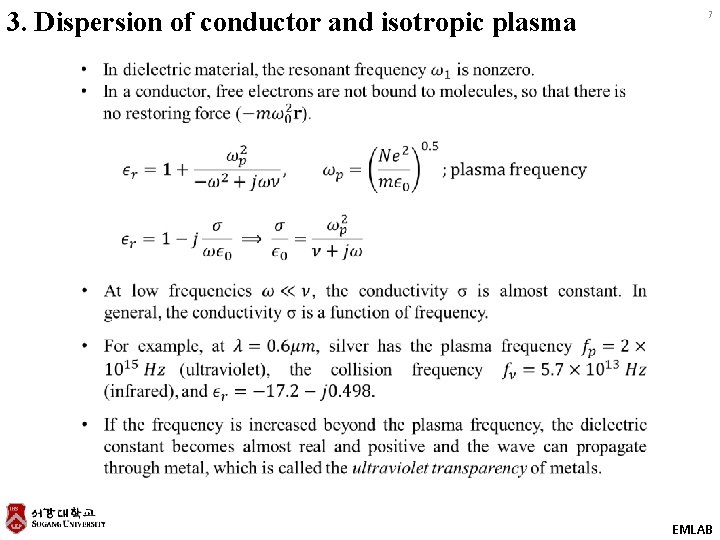
3. Dispersion of conductor and isotropic plasma 7 EMLAB
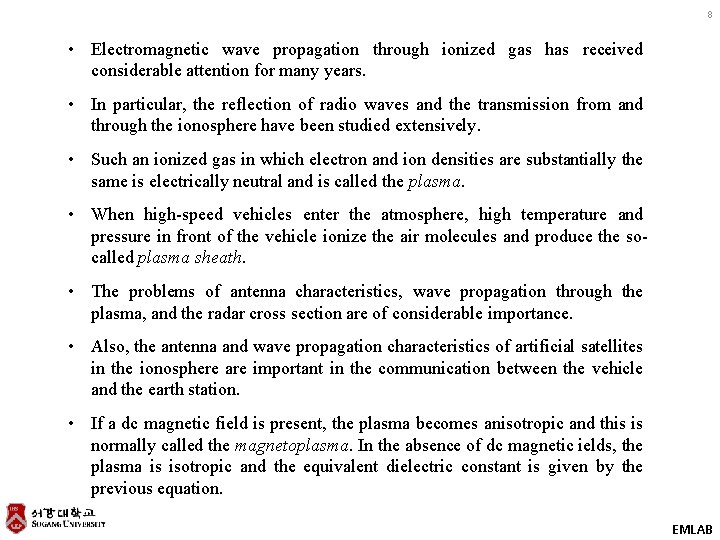
8 • Electromagnetic wave propagation through ionized gas has received considerable attention for many years. • In particular, the reflection of radio waves and the transmission from and through the ionosphere have been studied extensively. • Such an ionized gas in which electron and ion densities are substantially the same is electrically neutral and is called the plasma. • When high-speed vehicles enter the atmosphere, high temperature and pressure in front of the vehicle ionize the air molecules and produce the socalled plasma sheath. • The problems of antenna characteristics, wave propagation through the plasma, and the radar cross section are of considerable importance. • Also, the antenna and wave propagation characteristics of artificial satellites in the ionosphere are important in the communication between the vehicle and the earth station. • If a dc magnetic field is present, the plasma becomes anisotropic and this is normally called the magnetoplasma. In the absence of dc magnetic ields, the plasma is isotropic and the equivalent dielectric constant is given by the previous equation. EMLAB
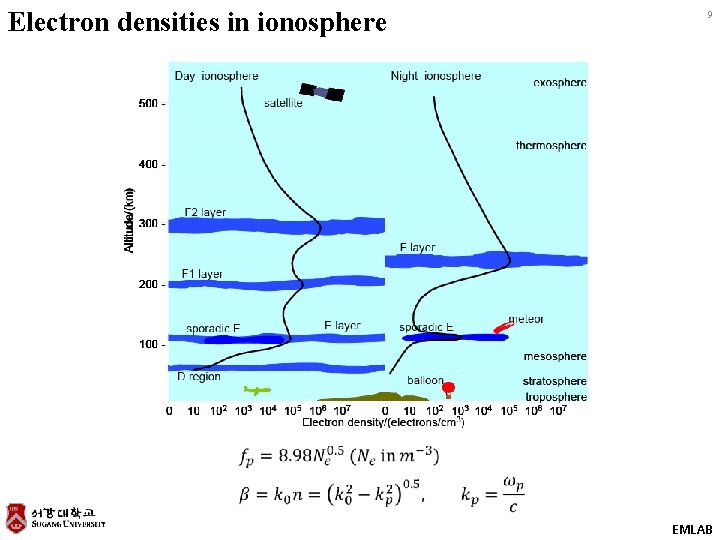
Electron densities in ionosphere 9 EMLAB
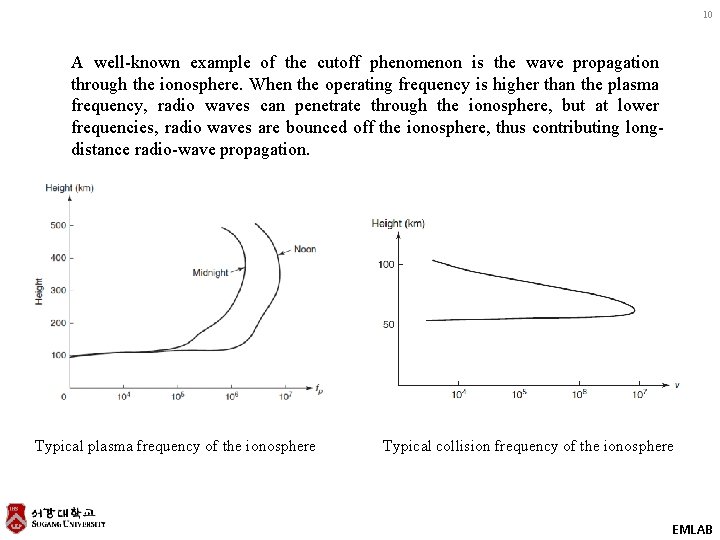
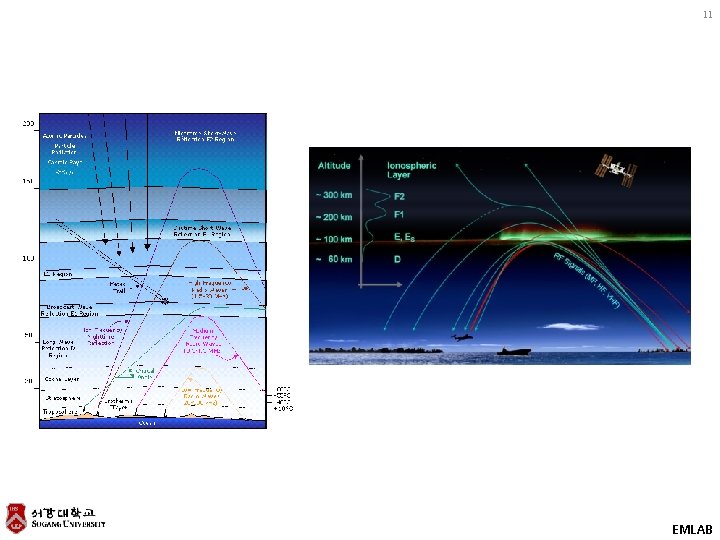
10 A well-known example of the cutoff phenomenon is the wave propagation through the ionosphere. When the operating frequency is higher than the plasma frequency, radio waves can penetrate through the ionosphere, but at lower frequencies, radio waves are bounced off the ionosphere, thus contributing longdistance radio-wave propagation. Typical plasma frequency of the ionosphere Typical collision frequency of the ionosphere EMLAB
11 EMLAB
13 EMLAB
Eikonal equation 14 EMLAB
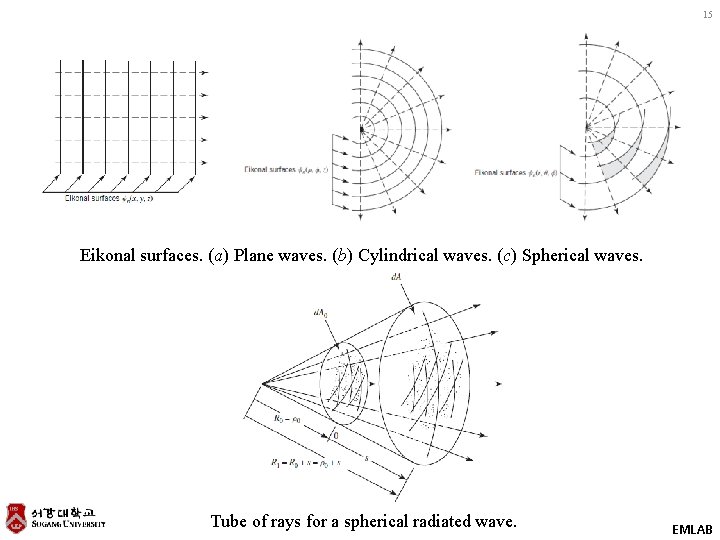
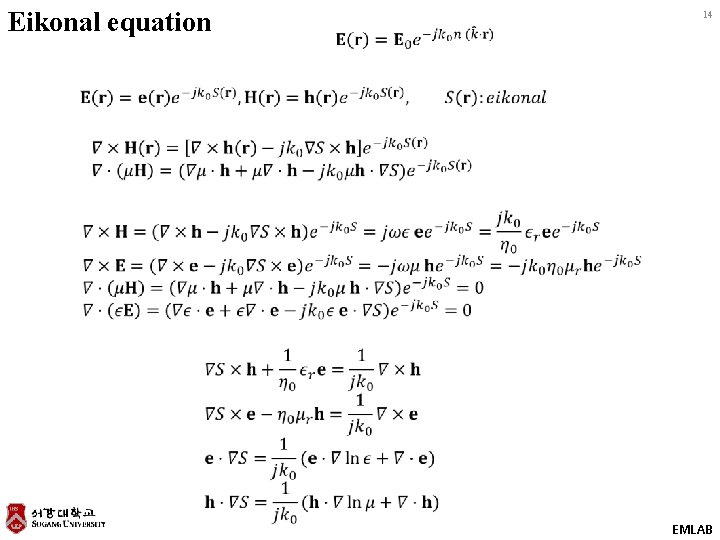
15 Eikonal surfaces. (a) Plane waves. (b) Cylindrical waves. (c) Spherical waves. Tube of rays for a spherical radiated wave. EMLAB
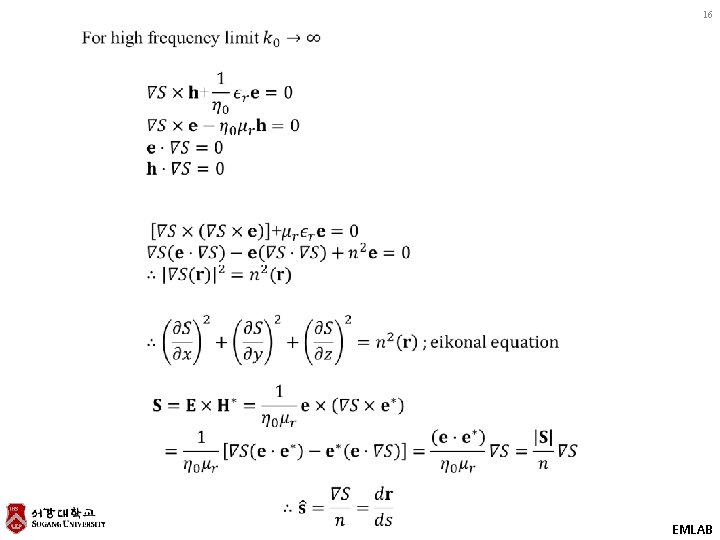
16 EMLAB
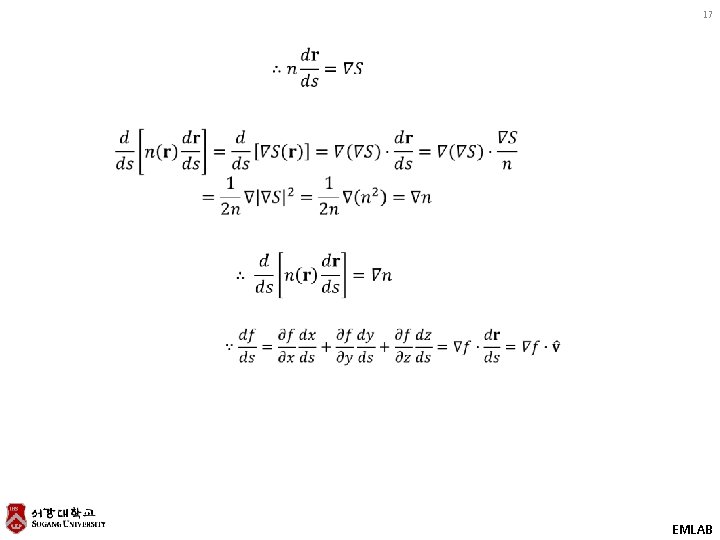
17 EMLAB
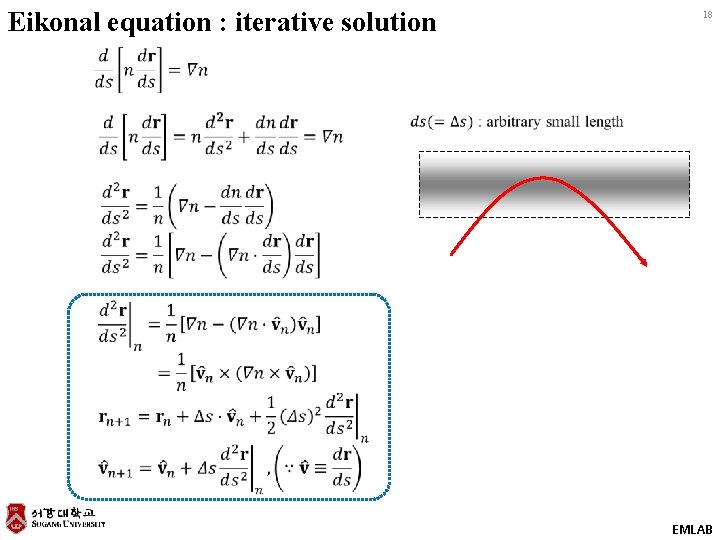
Eikonal equation : iterative solution 18 EMLAB
![19 clear; clf; H = [0, 50, 70, 200]; N = [320, 310, 300,](http://slidetodoc.com/presentation_image_h/a1a8a68993b8da4add6cd25b6e0b8890/image-19.jpg "19 clear; clf; H = [0, 50, 70, 200]; N = [320, 310, 300,")
19 clear; clf; H = [0, 50, 70, 200]; N = [320, 310, 300, 316]; n = 1+N*1 e-6; G_n = zeros(1, 4); for p = 1: 3 G_n(p) = (n(p+1)-n(p))/(H(p+1)-H(p)); end Np = 10000; theta = 0. 1*pi/180; v = [cos(theta), 0, sin(theta)]; r = [0, 0, 50]; a = [0, 0, 0]; gn = [0, 0, 0]; delta = 1; delta 2 = delta*0. 5; x = zeros(Np, 1); z = zeros(Np, 1); for p=1: Np x(p) = r(1); z(p) = r(3); gn(3) = interp 1(H, G_n, r(3), 'nearest', 0); nn = interp 1(H, n, r(3), 'pchip', 1); a = 1/nn*(gn-dot(gn, v)*v); r = r+delta*v+delta 2*a; v = v+delta*a; end plot(x, z); EMLAB
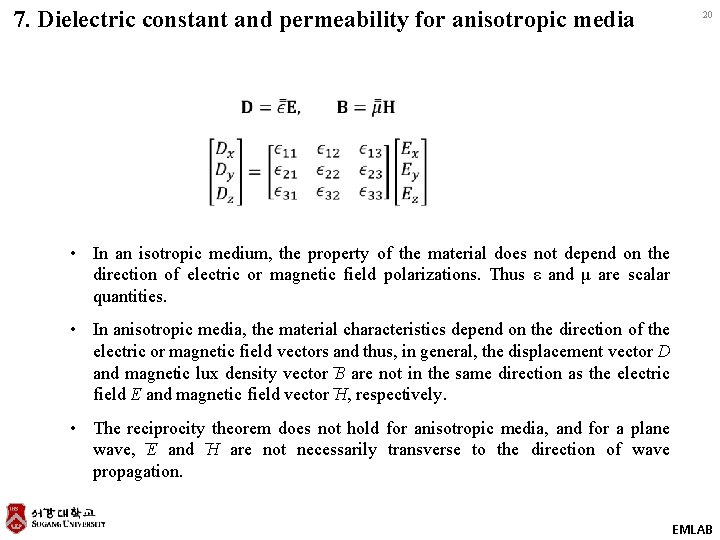
7. Dielectric constant and permeability for anisotropic media 20 • In an isotropic medium, the property of the material does not depend on the direction of electric or magnetic field polarizations. Thus ε and μ are scalar quantities. • In anisotropic media, the material characteristics depend on the direction of the electric or magnetic field vectors and thus, in general, the displacement vector D and magnetic lux density vector B are not in the same direction as the electric field E and magnetic field vector H, respectively. • The reciprocity theorem does not hold for anisotropic media, and for a plane wave, E and H are not necessarily transverse to the direction of wave propagation. EMLAB
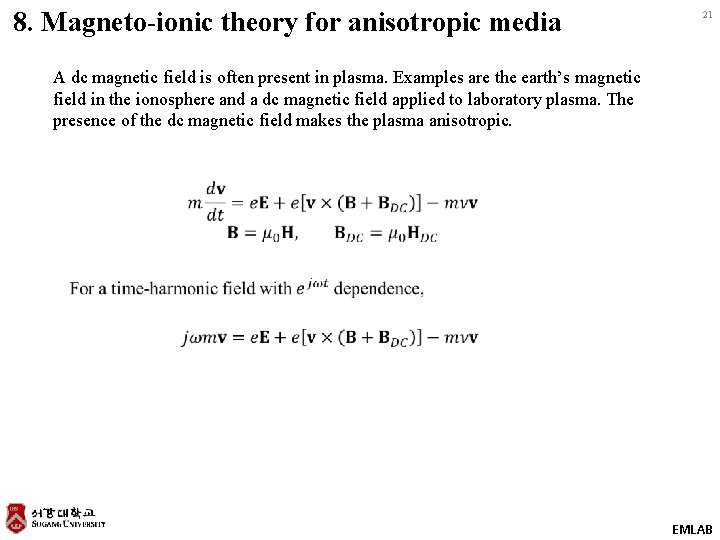
8. Magneto-ionic theory for anisotropic media 21 A dc magnetic field is often present in plasma. Examples are the earth’s magnetic field in the ionosphere and a dc magnetic field applied to laboratory plasma. The presence of the dc magnetic field makes the plasma anisotropic. EMLAB
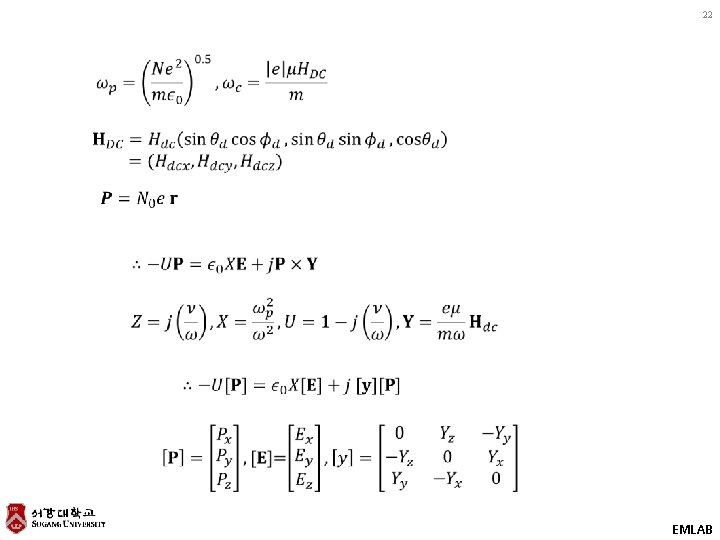
22 EMLAB
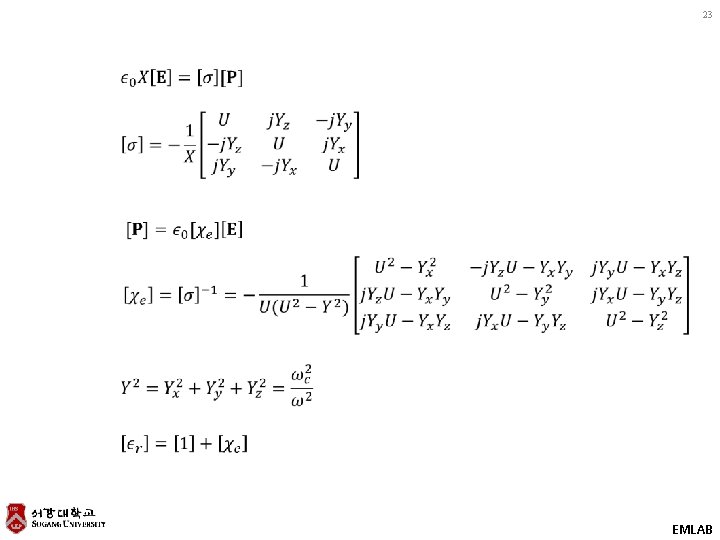
23 EMLAB
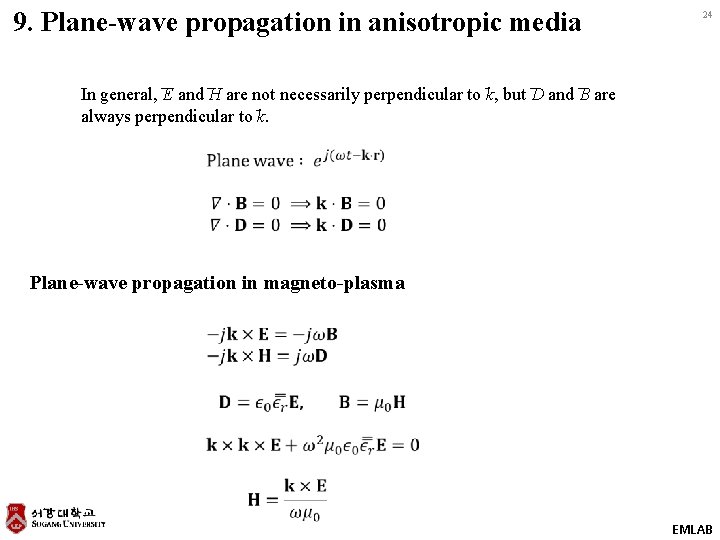
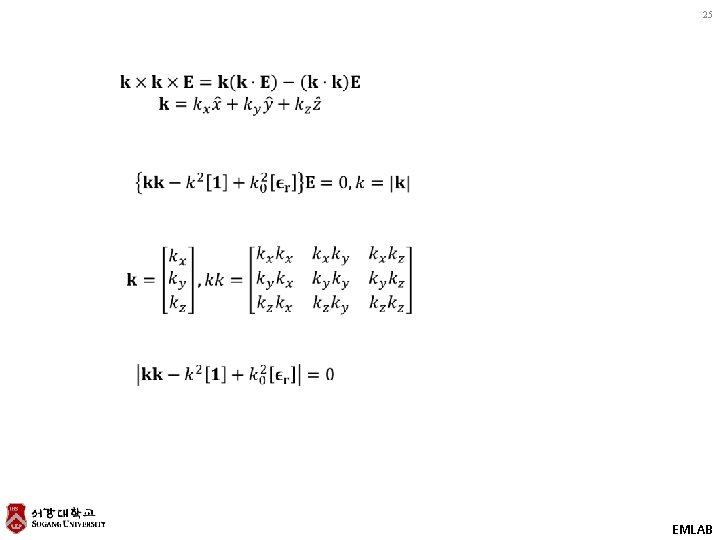
9. Plane-wave propagation in anisotropic media 24 In general, E and H are not necessarily perpendicular to k, but D and B are always perpendicular to k. Plane-wave propagation in magneto-plasma EMLAB
25 EMLAB
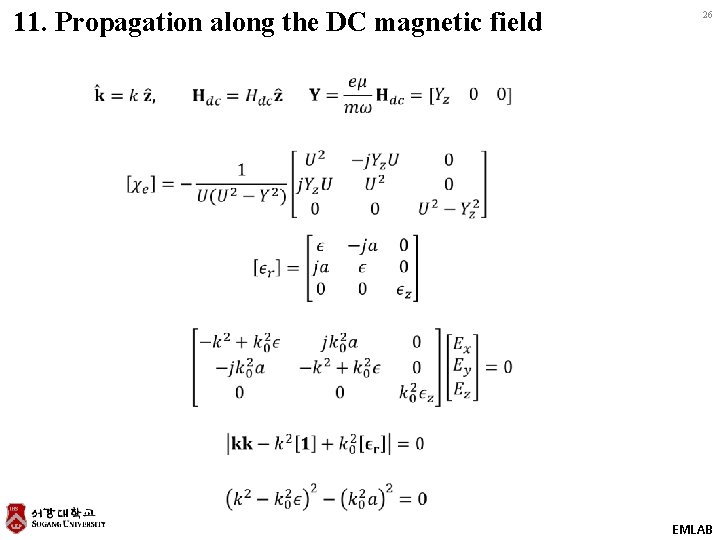
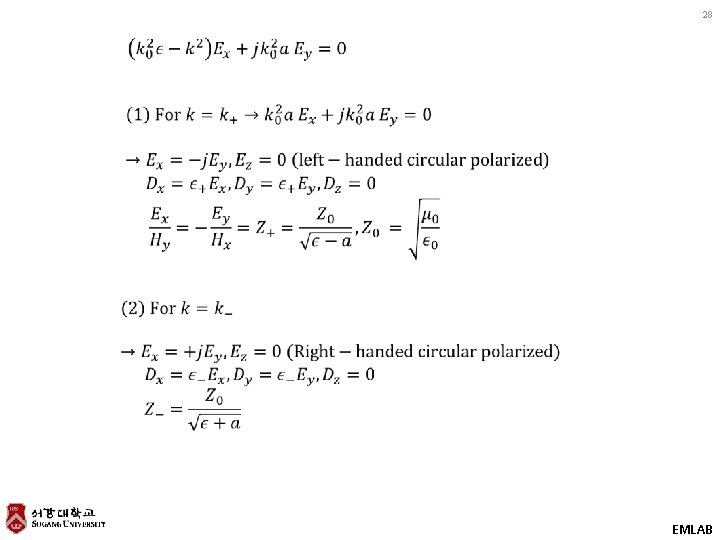
11. Propagation along the DC magnetic field 26 EMLAB
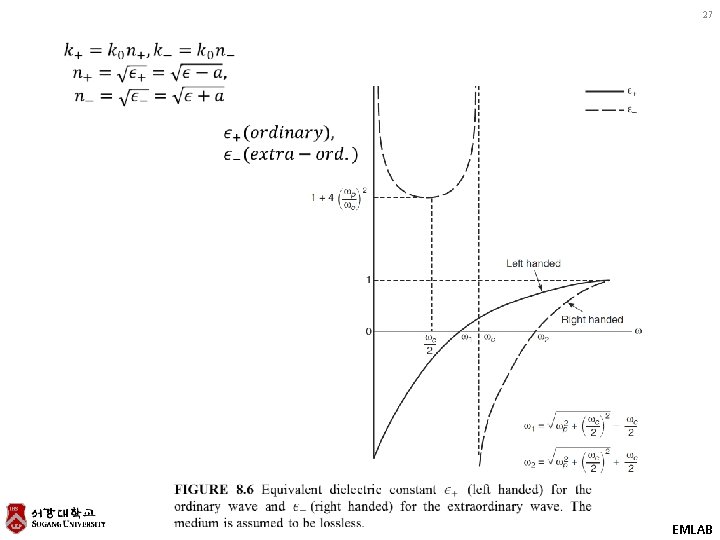
27 EMLAB
28 EMLAB
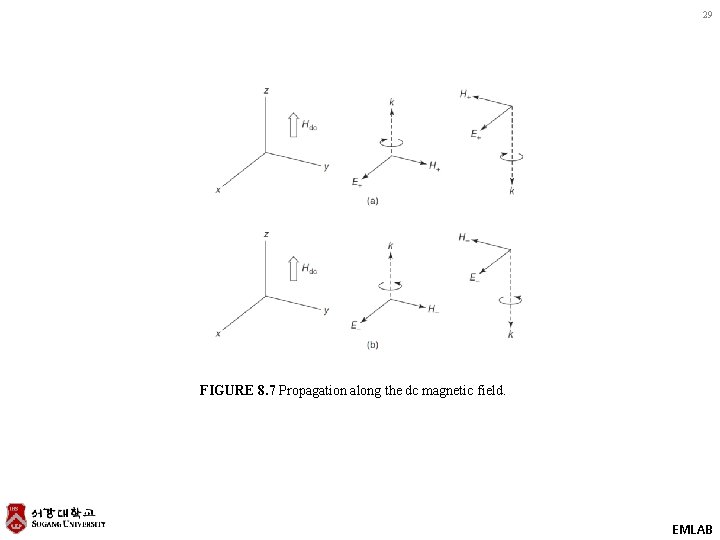
29 FIGURE 8. 7 Propagation along the dc magnetic field. EMLAB
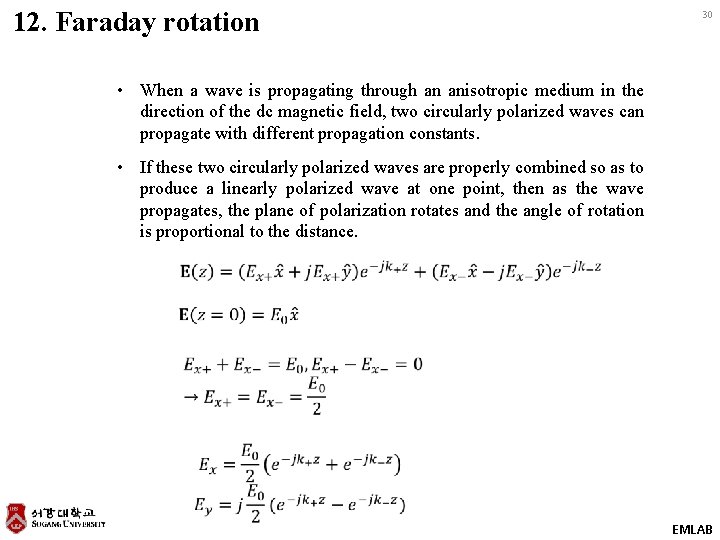
12. Faraday rotation 30 • When a wave is propagating through an anisotropic medium in the direction of the dc magnetic field, two circularly polarized waves can propagate with different propagation constants. • If these two circularly polarized waves are properly combined so as to produce a linearly polarized wave at one point, then as the wave propagates, the plane of polarization rotates and the angle of rotation is proportional to the distance. EMLAB
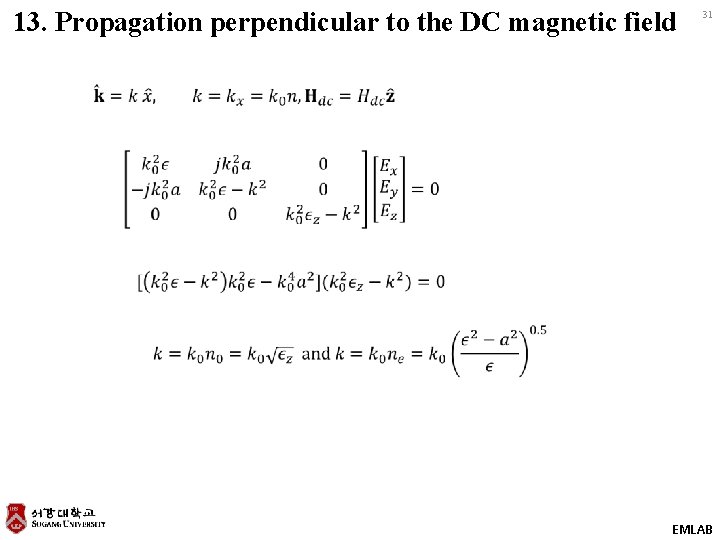
13. Propagation perpendicular to the DC magnetic field 31 EMLAB
- Slides: 31