
1 CHAPTER 5 PRIMARY FORMS OF REAL ESTATE

- Slides: 15
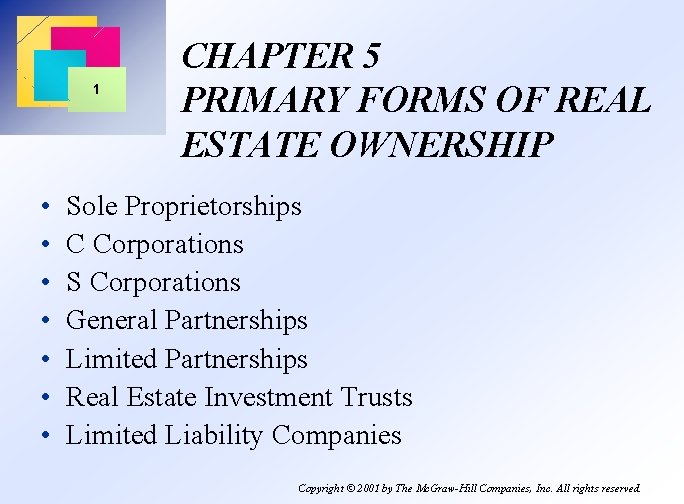
1 • • CHAPTER 5 PRIMARY FORMS OF REAL ESTATE OWNERSHIP Sole Proprietorships C Corporations S Corporations General Partnerships Limited Partnerships Real Estate Investment Trusts Limited Liability Companies Copyright © 2001 by The Mc. Graw-Hill Companies, Inc. All rights reserved.
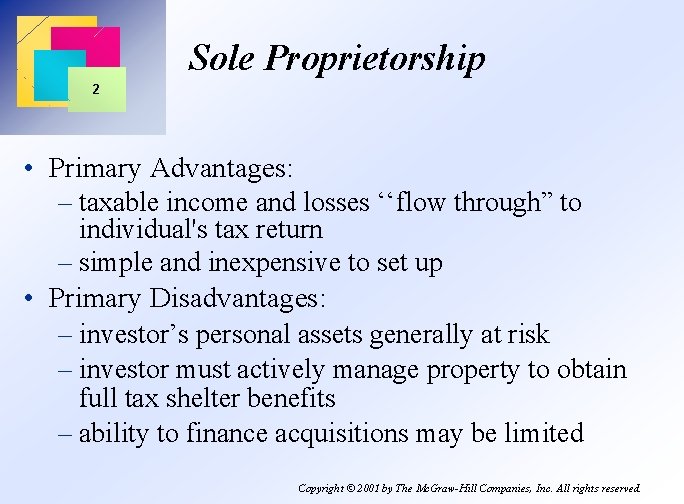
Sole Proprietorship 2 • Primary Advantages: – taxable income and losses ‘‘flow through” to individual's tax return – simple and inexpensive to set up • Primary Disadvantages: – investor’s personal assets generally at risk – investor must actively manage property to obtain full tax shelter benefits – ability to finance acquisitions may be limited Copyright © 2001 by The Mc. Graw-Hill Companies, Inc. All rights reserved.
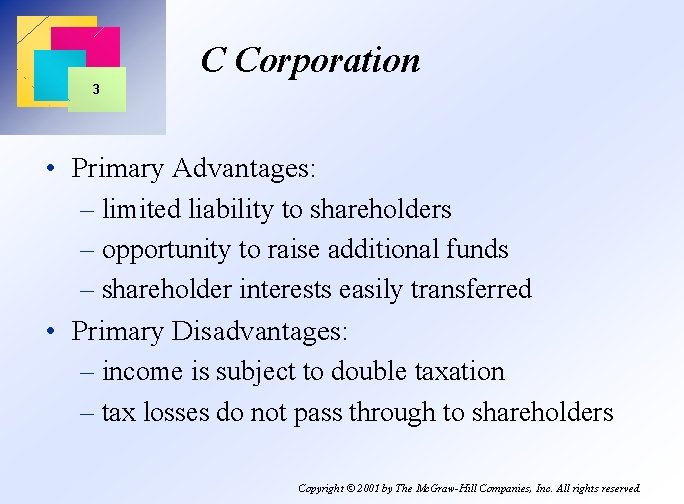
C Corporation 3 • Primary Advantages: – limited liability to shareholders – opportunity to raise additional funds – shareholder interests easily transferred • Primary Disadvantages: – income is subject to double taxation – tax losses do not pass through to shareholders Copyright © 2001 by The Mc. Graw-Hill Companies, Inc. All rights reserved.
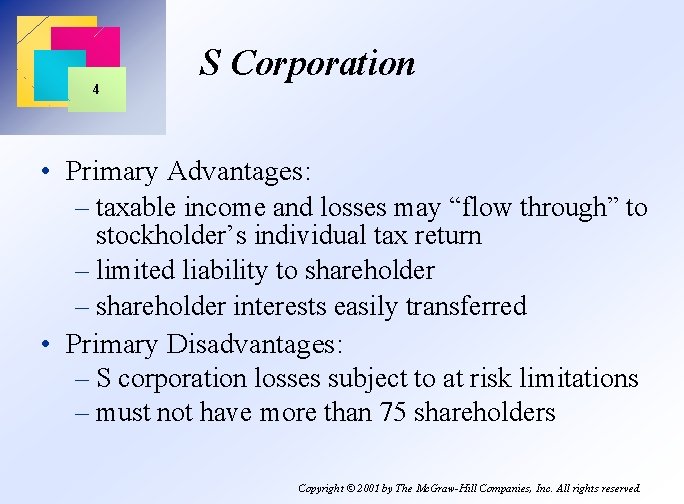
4 S Corporation • Primary Advantages: – taxable income and losses may “flow through” to stockholder’s individual tax return – limited liability to shareholder – shareholder interests easily transferred • Primary Disadvantages: – S corporation losses subject to at risk limitations – must not have more than 75 shareholders Copyright © 2001 by The Mc. Graw-Hill Companies, Inc. All rights reserved.
5 General Partnership • Primary Advantages: – taxable income and losses “flow through” to partner’s individual tax return • Primary Disadvantages: – tax losses are subject to passive loss restrictions – each partner is jointly and severally liable – partnership interest are difficult to transfer Copyright © 2001 by The Mc. Graw-Hill Companies, Inc. All rights reserved.
Limited Partnership 6 • Primary Advantages: – taxable income and losses “flow through” to partners individual tax returns – allows limited partners to limited their liability • Primary Disadvantages: – tax losses are subject to passive loss restrictions – ownership interests are difficult to transfer Copyright © 2001 by The Mc. Graw-Hill Companies, Inc. All rights reserved.
7 Real Estate Investment Trusts (REITs) • Primary Advantages: – REITs are not subject to double taxation – limited liability to shareholders – REITs allow investors liquidity and diversification • Primary Disadvantages: – income is portfolio income – tax losses do not pass through to the shareholders – REITs must meet substantial operating restrictions Copyright © 2001 by The Mc. Graw-Hill Companies, Inc. All rights reserved.
8 A Closer Look at Limited Partnership Syndication A real estate syndicate is a business organized to perform real estate activities (i. e. , development, investment, lending, etc. ). • History • Role • Regulation Copyright © 2001 by The Mc. Graw-Hill Companies, Inc. All rights reserved.
9 A Closer Look at Real Estate Investment Trusts (REIT) A (REIT) is a corporate form of ownership engaged in real estate investment, but with no taxation at the corporate level. • Basic operations – REITs invest primarily in real property and mortgages. Copyright © 2001 by The Mc. Graw-Hill Companies, Inc. All rights reserved.
10 REIT Ownership Restrictions • Must have 100 or more shareholders. • Cannot have less than six shareholders with > 50% of the REITs shares. • > 90% of income must be paid in dividends. • > 75% of assets must be real estate, cash, or securities. • > 75% of income must come from real estate assets. Copyright © 2001 by The Mc. Graw-Hill Companies, Inc. All rights reserved.
11 REIT Types • REITs can be classified by their assets – Equity REITs, Mortgage REITs, and Hybrid REITs • pre-1990: “diversification plays” • post-1990: “management plays” Copyright © 2001 by The Mc. Graw-Hill Companies, Inc. All rights reserved.
12 REIT Valuation • Discounted Cash Flow used by REITs to evaluate properties • Net Asset Value (NAV) v. Total Stock Market Capitalization • Price/Income ratio • Funds from Operations (FFO) Copyright © 2001 by The Mc. Graw-Hill Companies, Inc. All rights reserved.
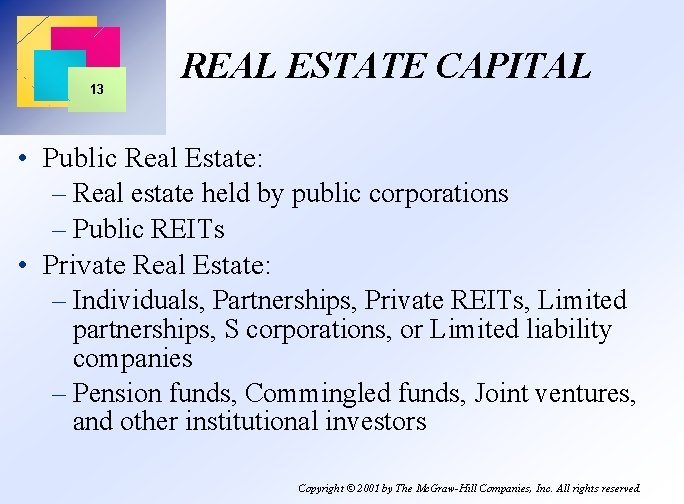
13 REAL ESTATE CAPITAL • Public Real Estate: – Real estate held by public corporations – Public REITs • Private Real Estate: – Individuals, Partnerships, Private REITs, Limited partnerships, S corporations, or Limited liability companies – Pension funds, Commingled funds, Joint ventures, and other institutional investors Copyright © 2001 by The Mc. Graw-Hill Companies, Inc. All rights reserved.
14 REAL ESTATE CAPITAL • Public Real Estate: – Commercial real estate equity: $1. 72 trillion – Commercial mortgage debt: $0. 25 tillion – Residential mortgage debt: $2. 38 trillion • Private Real Estate: – Commercial real estate equity: $1. 79 trillion – Commercial mortgage debt: $1. 03 trillion – Residential real estate equity: $4. 80 trillion – Residential mortgage debt: $1. 96 trillion Copyright © 2001 by The Mc. Graw-Hill Companies, Inc. All rights reserved.
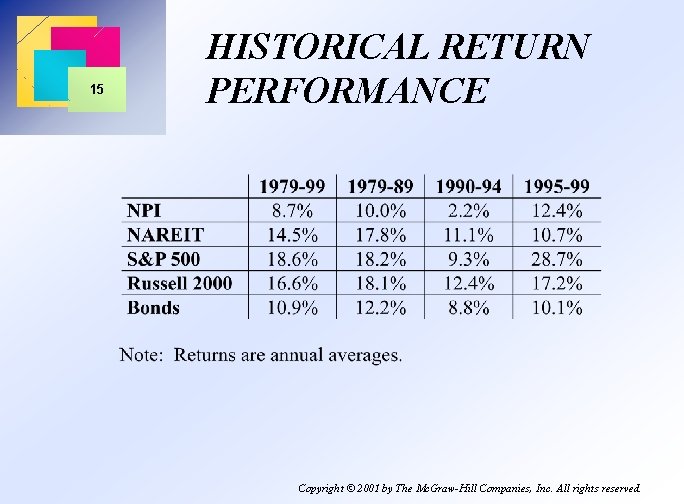
15 HISTORICAL RETURN PERFORMANCE Copyright © 2001 by The Mc. Graw-Hill Companies, Inc. All rights reserved.