
1 Chapter 5 Personnel Planning and Recruiting FIGURE



- Slides: 40
1 Chapter 5 Personnel Planning and Recruiting
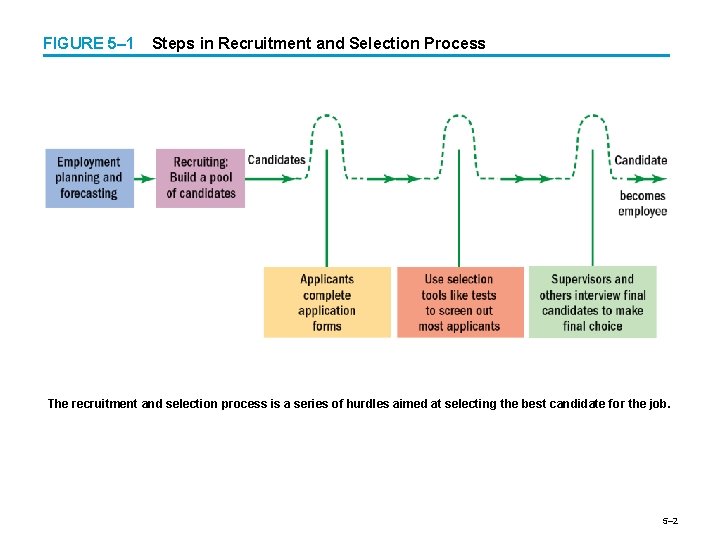
FIGURE 5– 1 Steps in Recruitment and Selection Process The recruitment and selection process is a series of hurdles aimed at selecting the best candidate for the job. 5– 2
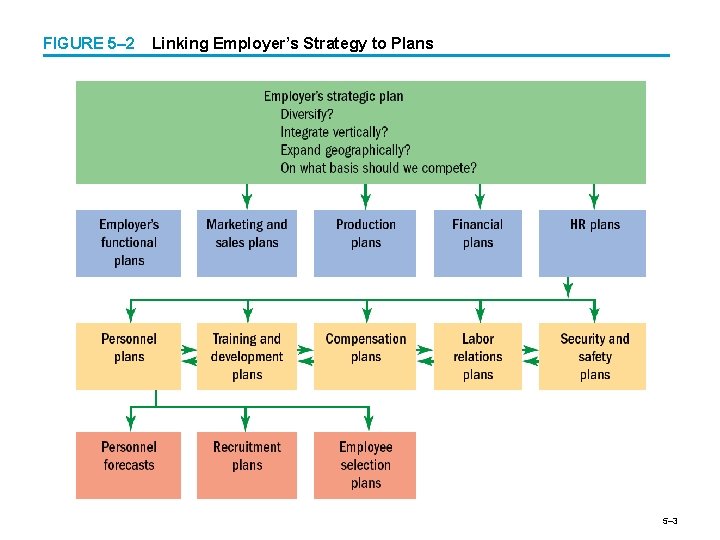
FIGURE 5– 2 Linking Employer’s Strategy to Plans 5– 3
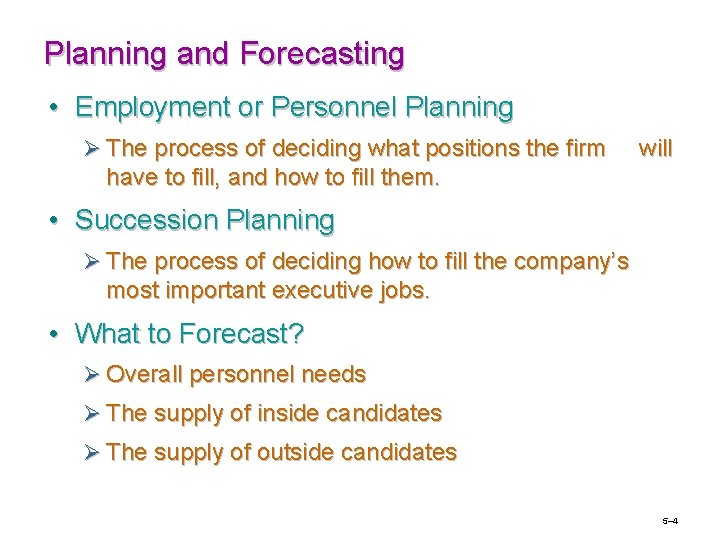
Planning and Forecasting • Employment or Personnel Planning Ø The process of deciding what positions the firm will have to fill, and how to fill them. • Succession Planning Ø The process of deciding how to fill the company’s most important executive jobs. • What to Forecast? Ø Overall personnel needs Ø The supply of inside candidates Ø The supply of outside candidates 5– 4
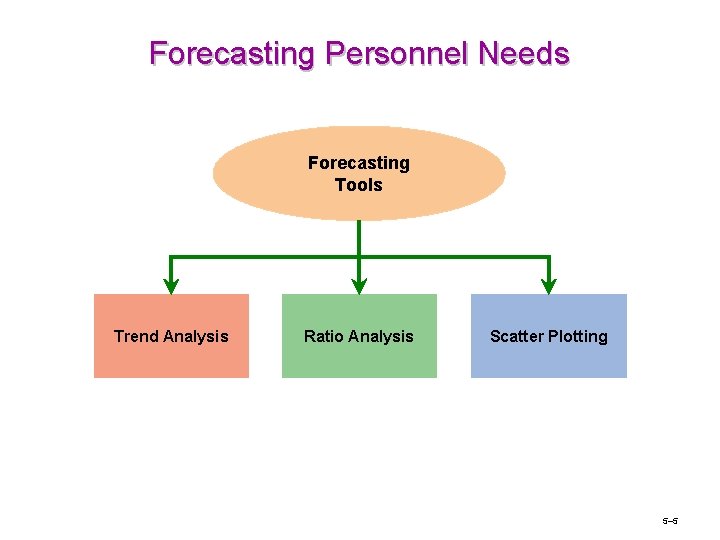
Forecasting Personnel Needs Forecasting Tools Trend Analysis Ratio Analysis Scatter Plotting 5– 5
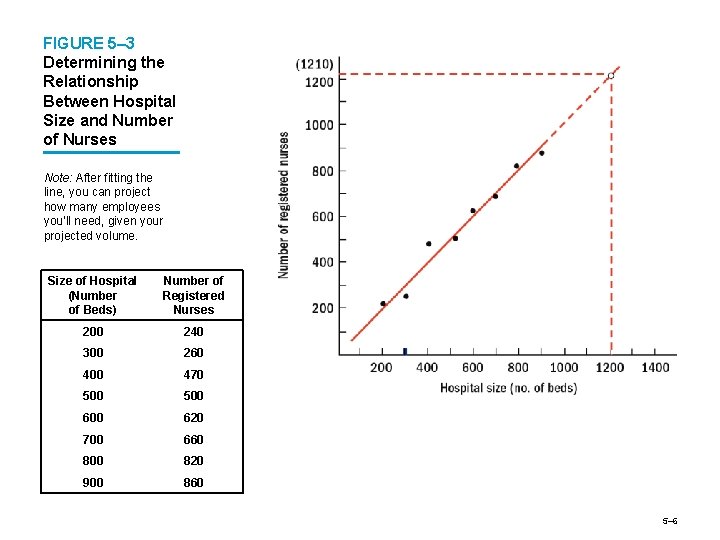
FIGURE 5– 3 Determining the Relationship Between Hospital Size and Number of Nurses Note: After fitting the line, you can project how many employees you’ll need, given your projected volume. Size of Hospital (Number of Beds) Number of Registered Nurses 200 240 300 260 400 470 500 600 620 700 660 800 820 900 860 5– 6
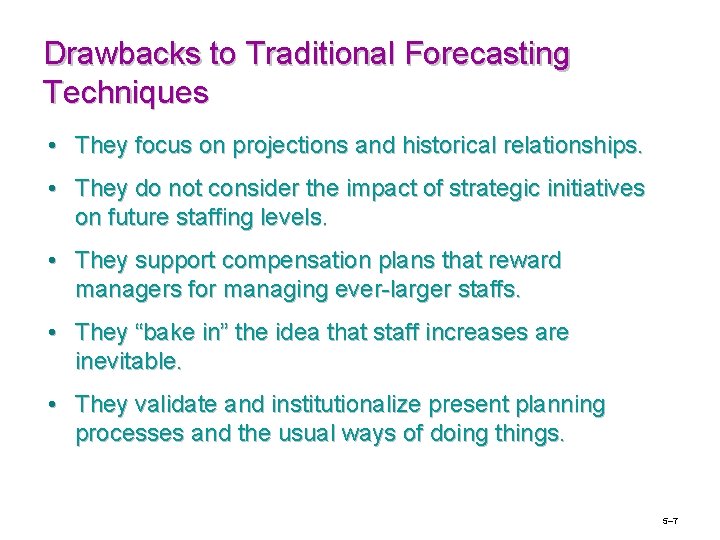
Drawbacks to Traditional Forecasting Techniques • They focus on projections and historical relationships. • They do not consider the impact of strategic initiatives on future staffing levels. • They support compensation plans that reward managers for managing ever-larger staffs. • They “bake in” the idea that staff increases are inevitable. • They validate and institutionalize present planning processes and the usual ways of doing things. 5– 7
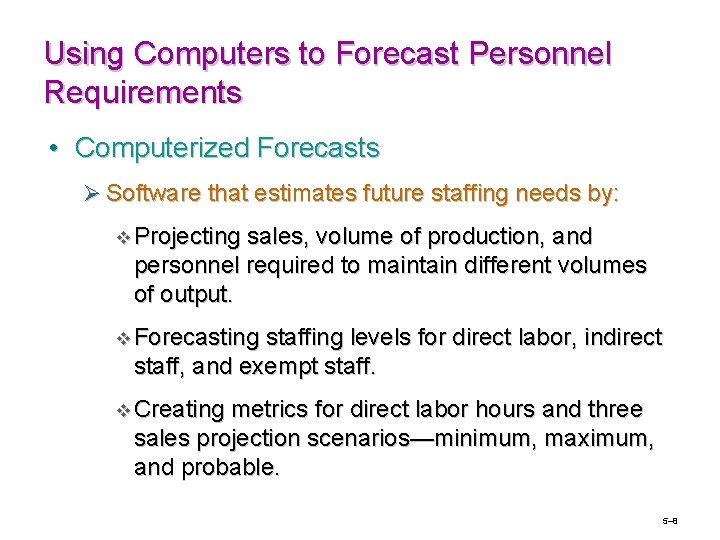
Using Computers to Forecast Personnel Requirements • Computerized Forecasts Ø Software that estimates future staffing needs by: v Projecting sales, volume of production, and personnel required to maintain different volumes of output. v Forecasting staffing levels for direct labor, indirect staff, and exempt staff. v Creating metrics for direct labor hours and three sales projection scenarios—minimum, maximum, and probable. 5– 8
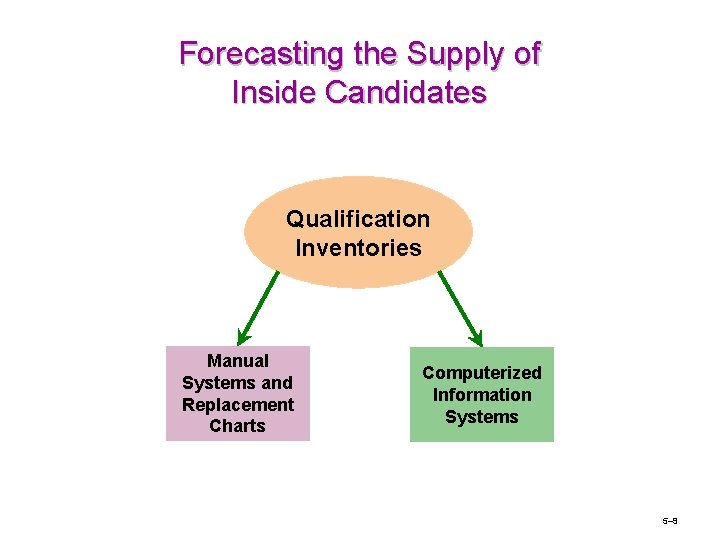
Forecasting the Supply of Inside Candidates Qualification Inventories Manual Systems and Replacement Charts Computerized Information Systems 5– 9
The Matter of Privacy • Ensuring the Security of HR Information Ø Control of HR information through access matrices Ø Access to records and employee privacy • Legal Considerations Ø The Federal Privacy Act of 1974 Ø New York Personal Privacy Act of 1985 Ø HIPAA Ø Americans with Disabilities Act 5– 10
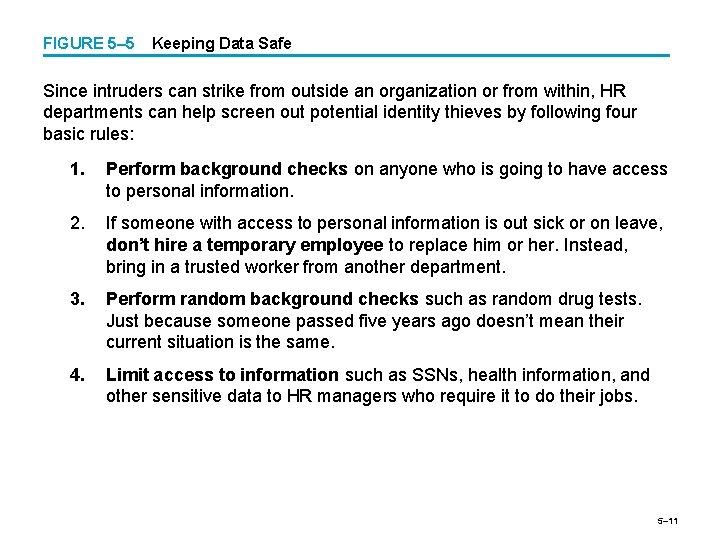
FIGURE 5– 5 Keeping Data Safe Since intruders can strike from outside an organization or from within, HR departments can help screen out potential identity thieves by following four basic rules: 1. Perform background checks on anyone who is going to have access to personal information. 2. If someone with access to personal information is out sick or on leave, don’t hire a temporary employee to replace him or her. Instead, bring in a trusted worker from another department. 3. Perform random background checks such as random drug tests. Just because someone passed five years ago doesn’t mean their current situation is the same. 4. Limit access to information such as SSNs, health information, and other sensitive data to HR managers who require it to do their jobs. 5– 11
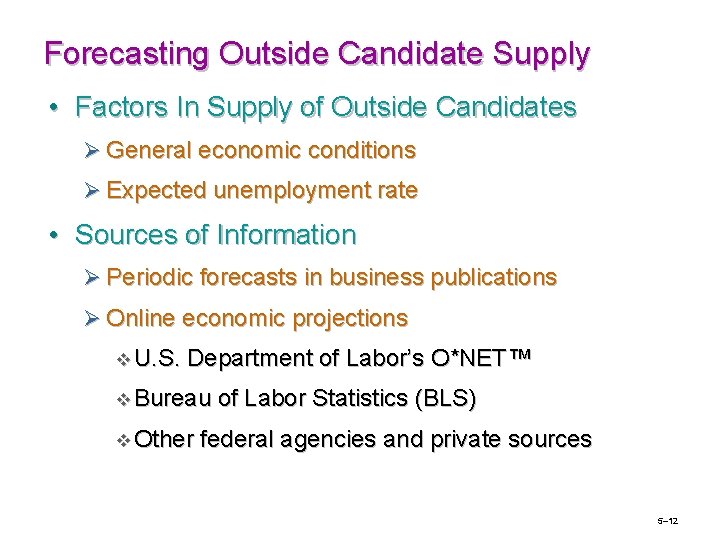
Forecasting Outside Candidate Supply • Factors In Supply of Outside Candidates Ø General economic conditions Ø Expected unemployment rate • Sources of Information Ø Periodic forecasts in business publications Ø Online economic projections v U. S. Department of Labor’s O*NET™ v Bureau v Other of Labor Statistics (BLS) federal agencies and private sources 5– 12
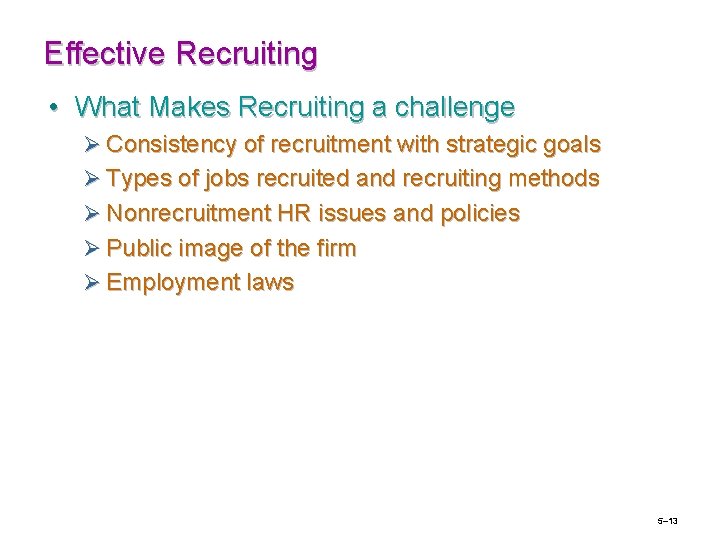
Effective Recruiting • What Makes Recruiting a challenge Ø Consistency of recruitment with strategic goals Ø Types of jobs recruited and recruiting methods Ø Nonrecruitment HR issues and policies Ø Public image of the firm Ø Employment laws 5– 13
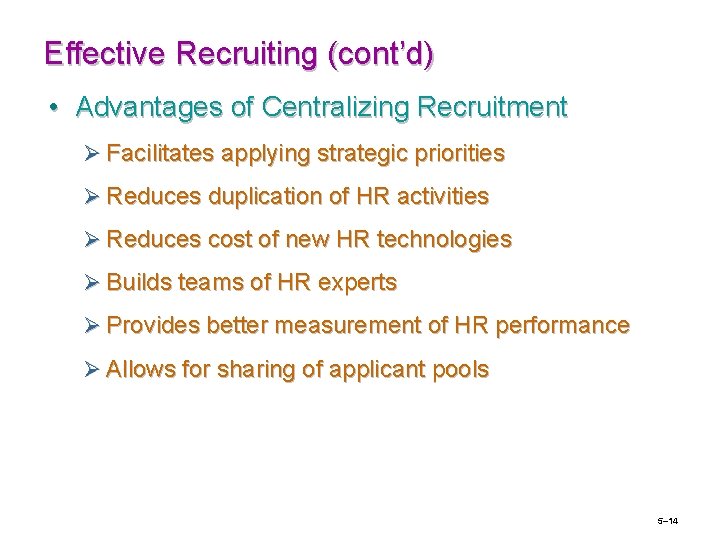
Effective Recruiting (cont’d) • Advantages of Centralizing Recruitment Ø Facilitates applying strategic priorities Ø Reduces duplication of HR activities Ø Reduces cost of new HR technologies Ø Builds teams of HR experts Ø Provides better measurement of HR performance Ø Allows for sharing of applicant pools 5– 14
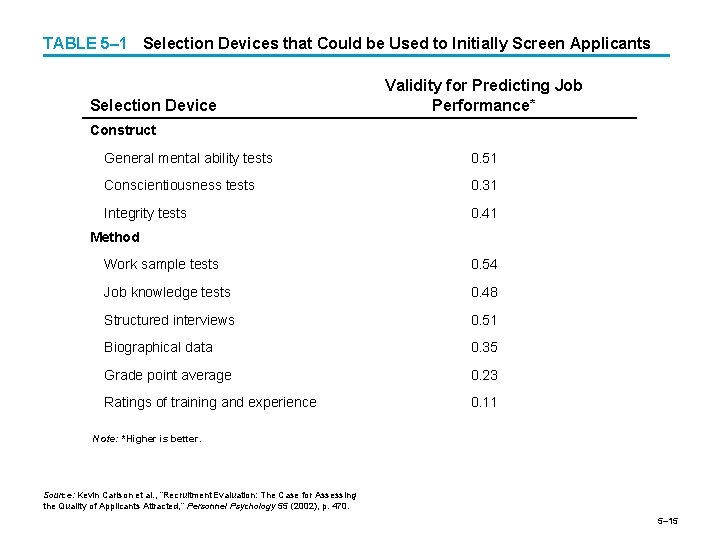
TABLE 5– 1 Selection Devices that Could be Used to Initially Screen Applicants Selection Device Validity for Predicting Job Performance* Construct General mental ability tests 0. 51 Conscientiousness tests 0. 31 Integrity tests 0. 41 Method Work sample tests 0. 54 Job knowledge tests 0. 48 Structured interviews 0. 51 Biographical data 0. 35 Grade point average 0. 23 Ratings of training and experience 0. 11 Note: *Higher is better. Source: Kevin Carlson et al. , “Recruitment Evaluation: The Case for Assessing the Quality of Applicants Attracted, ” Personnel Psychology 55 (2002), p. 470. 5– 15
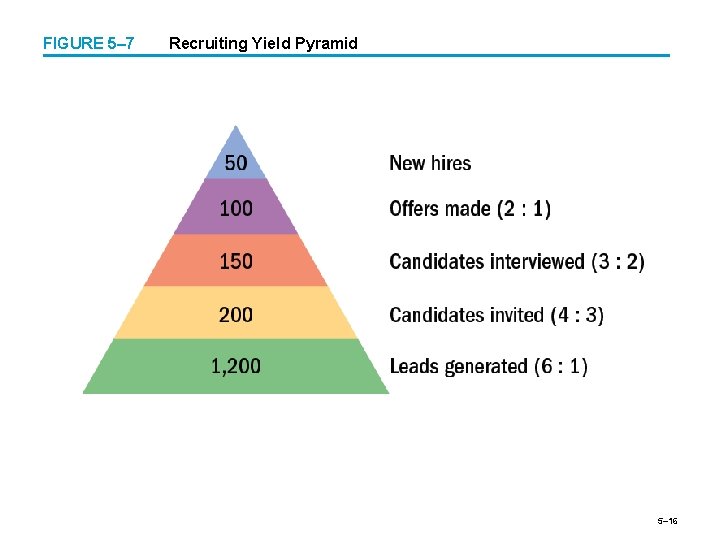
FIGURE 5– 7 Recruiting Yield Pyramid 5– 16
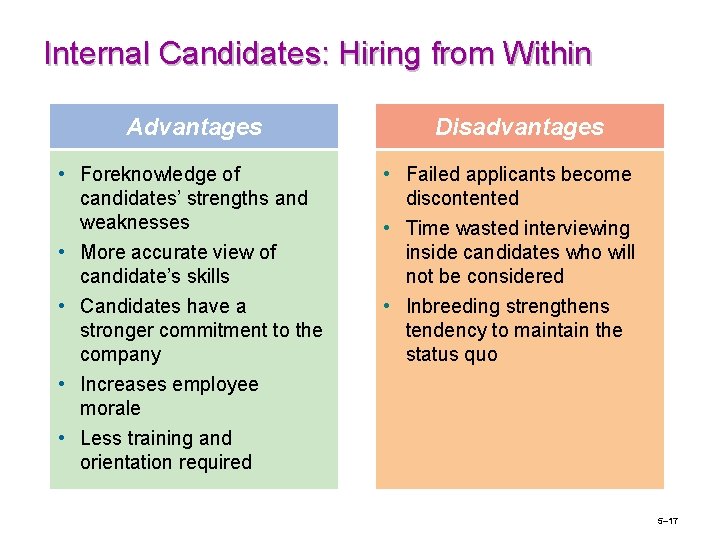
Internal Candidates: Hiring from Within Advantages • Foreknowledge of candidates’ strengths and weaknesses • More accurate view of candidate’s skills • Candidates have a stronger commitment to the company • Increases employee morale • Less training and orientation required Disadvantages • Failed applicants become discontented • Time wasted interviewing inside candidates who will not be considered • Inbreeding strengthens tendency to maintain the status quo 5– 17
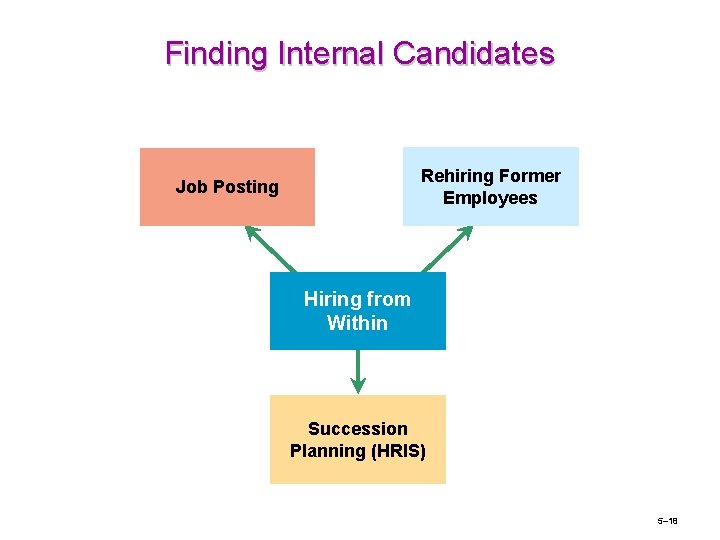
Finding Internal Candidates Rehiring Former Employees Job Posting Hiring from Within Succession Planning (HRIS) 5– 18
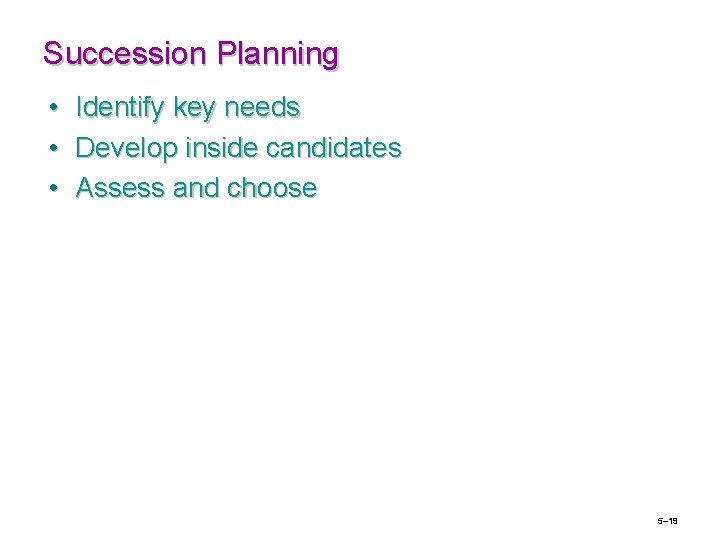
Succession Planning • Identify key needs • Develop inside candidates • Assess and choose 5– 19
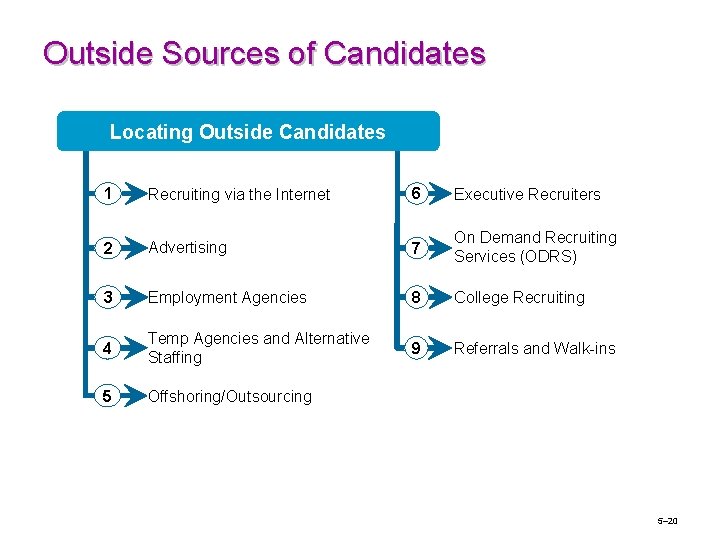
Outside Sources of Candidates Locating Outside Candidates 1 Recruiting via the Internet 6 Executive Recruiters 2 Advertising 7 On Demand Recruiting Services (ODRS) 3 Employment Agencies 8 College Recruiting 4 Temp Agencies and Alternative Staffing 9 Referrals and Walk-ins 5 Offshoring/Outsourcing 5– 20
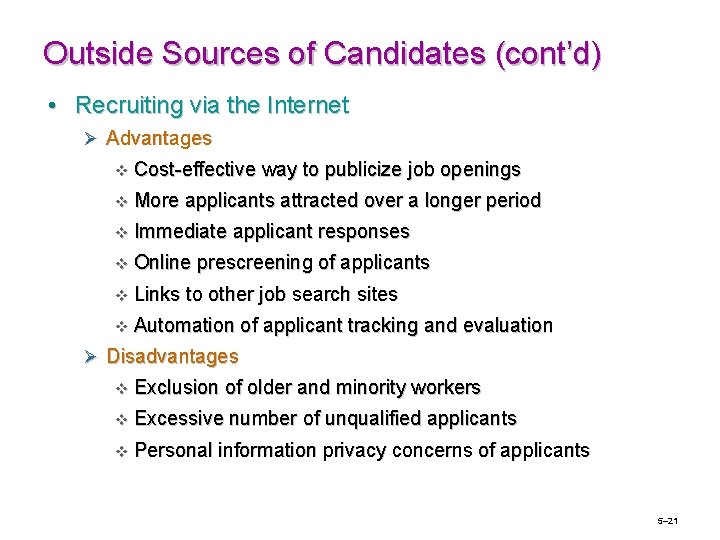
Outside Sources of Candidates (cont’d) • Recruiting via the Internet Ø Advantages v Cost-effective v More applicants attracted over a longer period v Immediate v Online v Links way to publicize job openings applicant responses prescreening of applicants to other job search sites v Automation of applicant tracking and evaluation Ø Disadvantages v Exclusion of older and minority workers v Excessive number of unqualified applicants v Personal information privacy concerns of applicants 5– 21
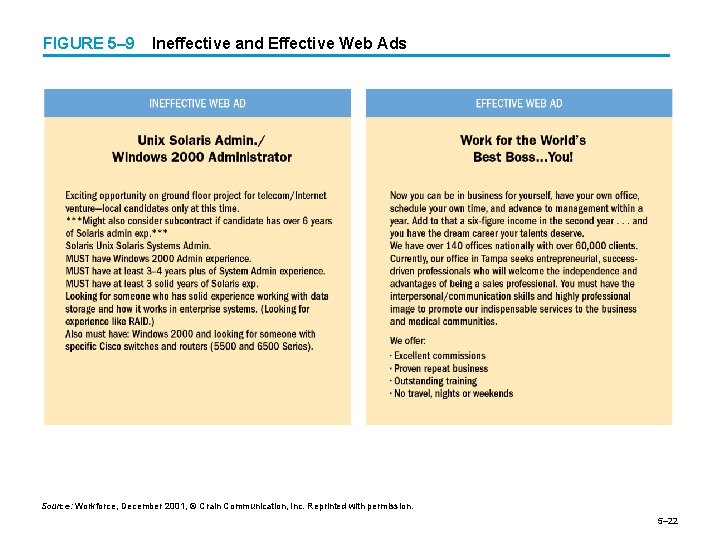
FIGURE 5– 9 Ineffective and Effective Web Ads Source: Workforce, December 2001, © Crain Communication, Inc. Reprinted with permission. 5– 22
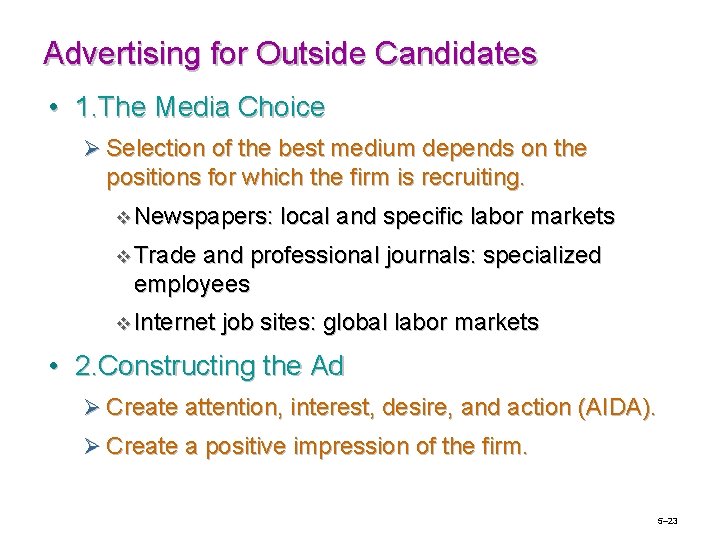
Advertising for Outside Candidates • 1. The Media Choice Ø Selection of the best medium depends on the positions for which the firm is recruiting. v Newspapers: local and specific labor markets v Trade and professional journals: specialized employees v Internet job sites: global labor markets • 2. Constructing the Ad Ø Create attention, interest, desire, and action (AIDA). Ø Create a positive impression of the firm. 5– 23
FIGURE 5– 10 Help Wanted Ad That Draws Attention Source: The New York Times, May 13, 2007, Business p. 18. 5– 24
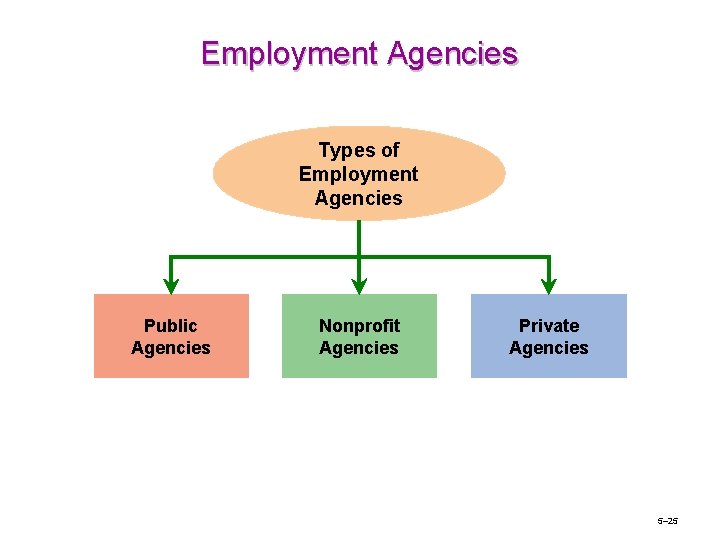
Employment Agencies Types of Employment Agencies Public Agencies Nonprofit Agencies Private Agencies 5– 25
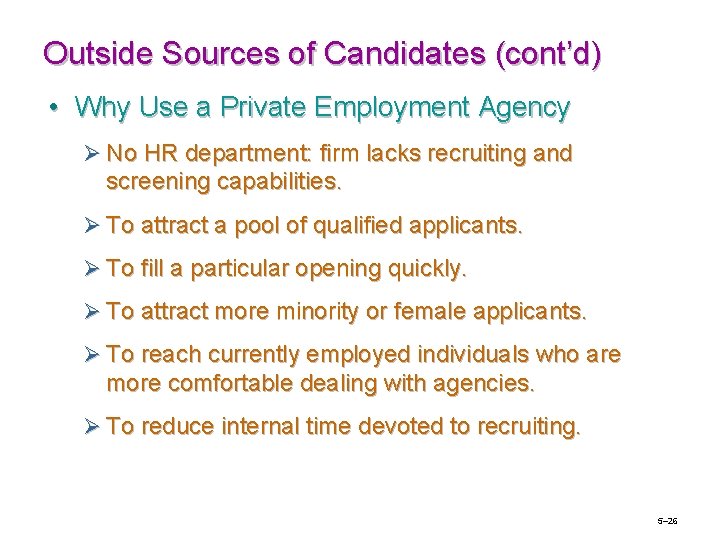
Outside Sources of Candidates (cont’d) • Why Use a Private Employment Agency Ø No HR department: firm lacks recruiting and screening capabilities. Ø To attract a pool of qualified applicants. Ø To fill a particular opening quickly. Ø To attract more minority or female applicants. Ø To reach currently employed individuals who are more comfortable dealing with agencies. Ø To reduce internal time devoted to recruiting. 5– 26
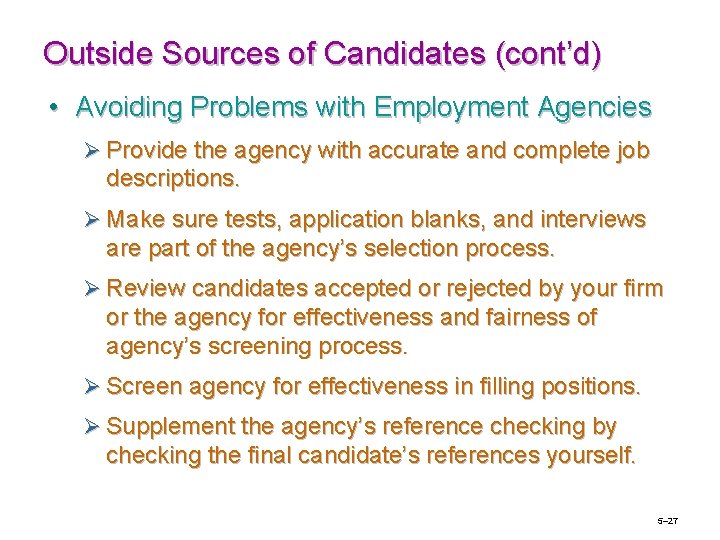
Outside Sources of Candidates (cont’d) • Avoiding Problems with Employment Agencies Ø Provide the agency with accurate and complete job descriptions. Ø Make sure tests, application blanks, and interviews are part of the agency’s selection process. Ø Review candidates accepted or rejected by your firm or the agency for effectiveness and fairness of agency’s screening process. Ø Screen agency for effectiveness in filling positions. Ø Supplement the agency’s reference checking by checking the final candidate’s references yourself. 5– 27
Temp Agencies and Alternative Staffing • Benefits of Temps Ø Increased productivity—paid only when working Ø Allows “trial run” for prospective employees Ø No recruitment, screening, and payroll administration costs • Costs of Temps Ø Increased labor costs due to fees paid to temp agencies Ø Temp employees’ lack of commitment to the firm 5– 28
Concerns of Temp Employees • Dehumanizing, impersonal, and discouraging treatment by employers. • Insecurity about employment and pessimism about the future. • Worry about the lack of insurance and pension benefits. • Being misled about job assignments and whether temporary assignments are likely to become full-time positions. • Being “underemployed” while trying return to the fulltime labor market. • Anger toward the corporate world and its values; expressed as alienation and disenchantment. 5– 29
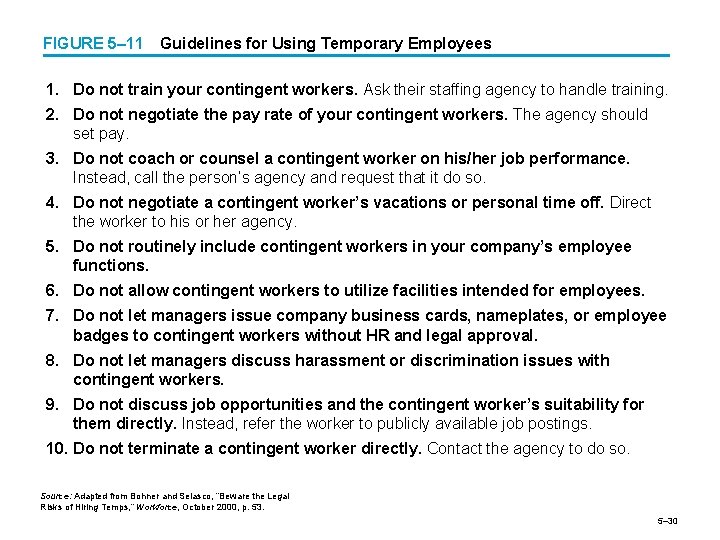
FIGURE 5– 11 Guidelines for Using Temporary Employees 1. Do not train your contingent workers. Ask their staffing agency to handle training. 2. Do not negotiate the pay rate of your contingent workers. The agency should set pay. 3. Do not coach or counsel a contingent worker on his/her job performance. Instead, call the person’s agency and request that it do so. 4. Do not negotiate a contingent worker’s vacations or personal time off. Direct the worker to his or her agency. 5. Do not routinely include contingent workers in your company’s employee functions. 6. Do not allow contingent workers to utilize facilities intended for employees. 7. Do not let managers issue company business cards, nameplates, or employee badges to contingent workers without HR and legal approval. 8. Do not let managers discuss harassment or discrimination issues with contingent workers. 9. Do not discuss job opportunities and the contingent worker’s suitability for them directly. Instead, refer the worker to publicly available job postings. 10. Do not terminate a contingent worker directly. Contact the agency to do so. Source: Adapted from Bohner and Selasco, “Beware the Legal Risks of Hiring Temps, ” Workforce, October 2000, p. 53. 5– 30
Working with a Temp Agency • Invoicing. Make sure the agency’s invoice fits your company’s needs. • Time sheets. The time sheet is a verification of hours worked an agreement to pay the agency’s fees. • Temp-to-perm policy. What is the policy if you want to hire a temp as a permanent employee? • Recruitment of and benefits for temp employees. How does the agency plan to recruit and what sorts of benefits it will it pay? • Dress code. Specify the attire at each of your offices or plants. • Equal employment opportunity statement. Get a statement from the agency that it does not discriminate when filling temp orders. • Job description information. Ensure that the agency understands the job to be filled and the sort of person you want to fill it. 5– 31
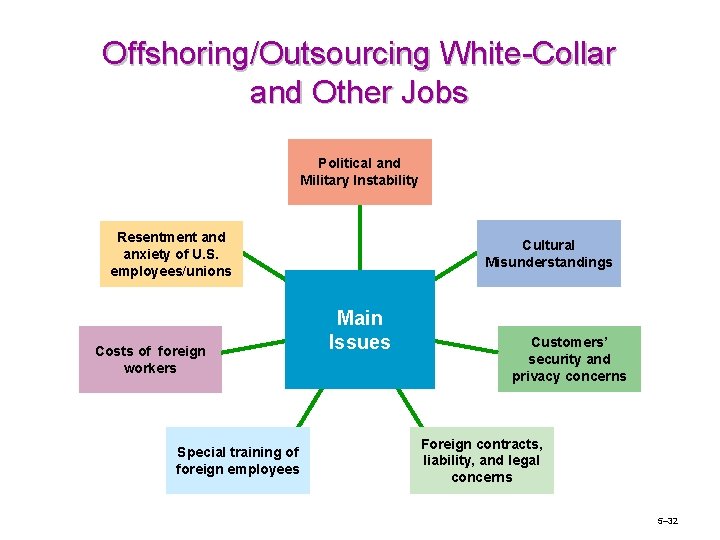
Offshoring/Outsourcing White-Collar and Other Jobs Political and Military Instability Resentment and anxiety of U. S. employees/unions Costs of foreign workers Special training of foreign employees Cultural Misunderstandings Main Issues Customers’ security and privacy concerns Foreign contracts, liability, and legal concerns 5– 32
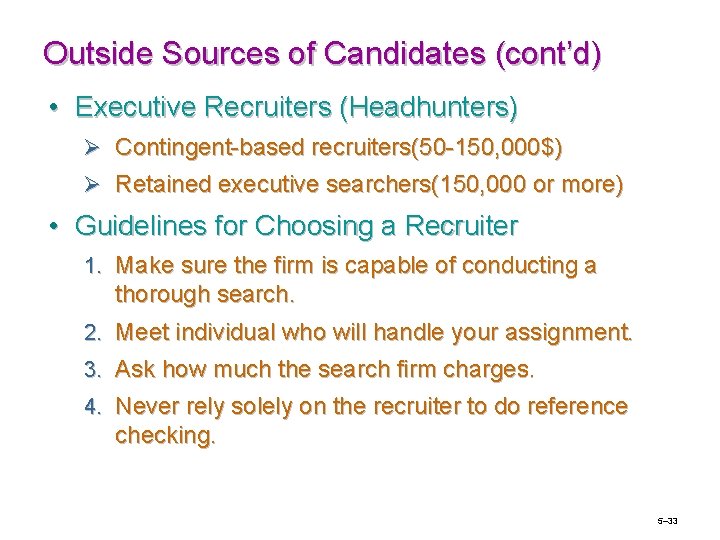
Outside Sources of Candidates (cont’d) • Executive Recruiters (Headhunters) Ø Contingent-based recruiters(50 -150, 000$) Ø Retained executive searchers(150, 000 or more) • Guidelines for Choosing a Recruiter 1. Make sure the firm is capable of conducting a thorough search. 2. Meet individual who will handle your assignment. 3. Ask how much the search firm charges. 4. Never rely solely on the recruiter to do reference checking. 5– 33
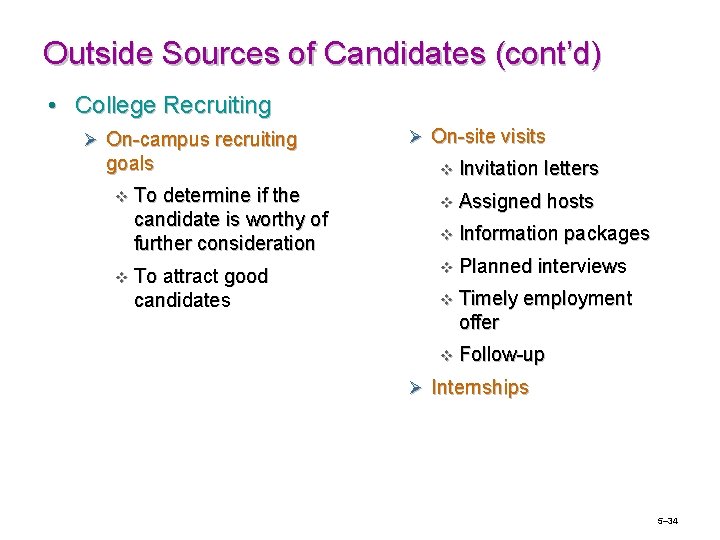
Outside Sources of Candidates (cont’d) • College Recruiting Ø On-campus recruiting Ø On-site visits goals v Invitation letters v To v Assigned hosts determine if the candidate is worthy of further consideration v To attract good candidates v Information v Planned v Timely packages interviews employment offer v Follow-up Ø Internships 5– 34
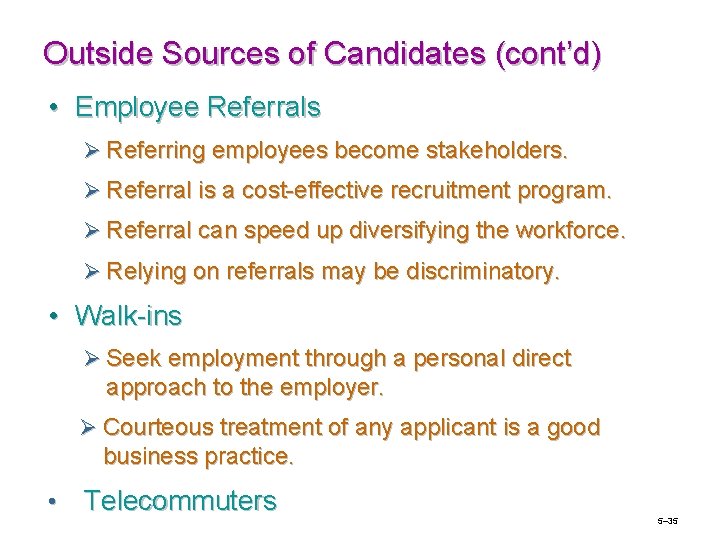
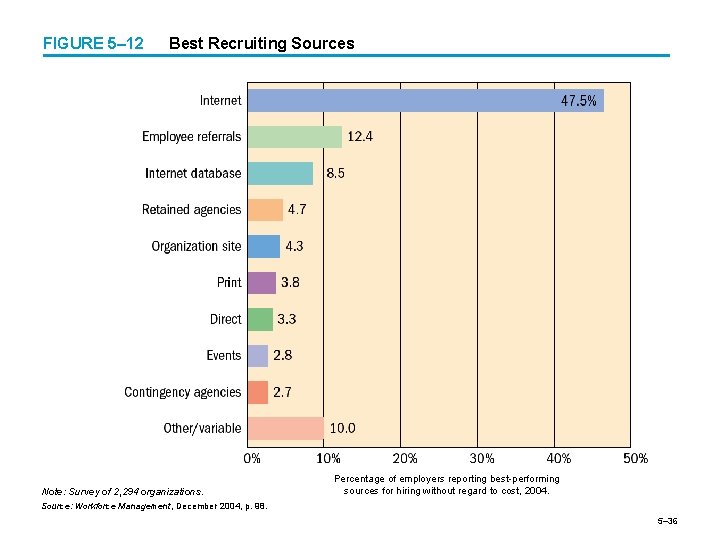
Outside Sources of Candidates (cont’d) • Employee Referrals Ø Referring employees become stakeholders. Ø Referral is a cost-effective recruitment program. Ø Referral can speed up diversifying the workforce. Ø Relying on referrals may be discriminatory. • Walk-ins Ø Seek employment through a personal direct approach to the employer. Ø Courteous treatment of any applicant is a good business practice. • Telecommuters 5– 35
FIGURE 5– 12 Best Recruiting Sources Note: Survey of 2, 294 organizations. Percentage of employers reporting best-performing sources for hiring without regard to cost, 2004. Source: Workforce Management, December 2004, p. 98. 5– 36
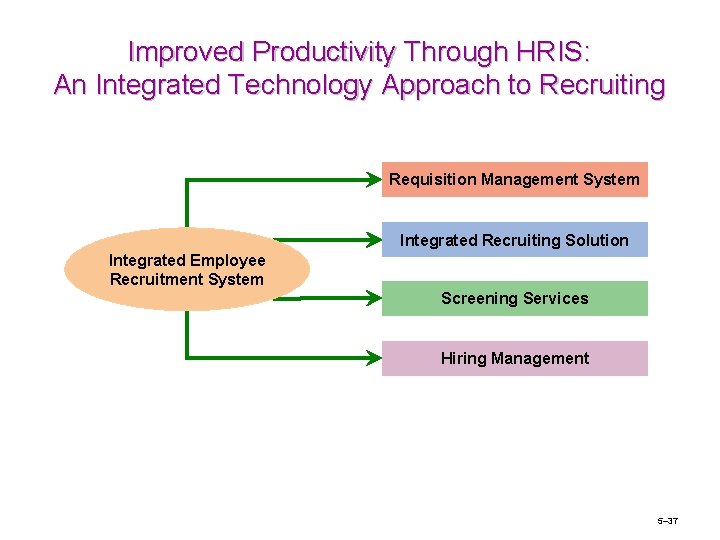
Improved Productivity Through HRIS: An Integrated Technology Approach to Recruiting Requisition Management System Integrated Recruiting Solution Integrated Employee Recruitment System Screening Services Hiring Management 5– 37
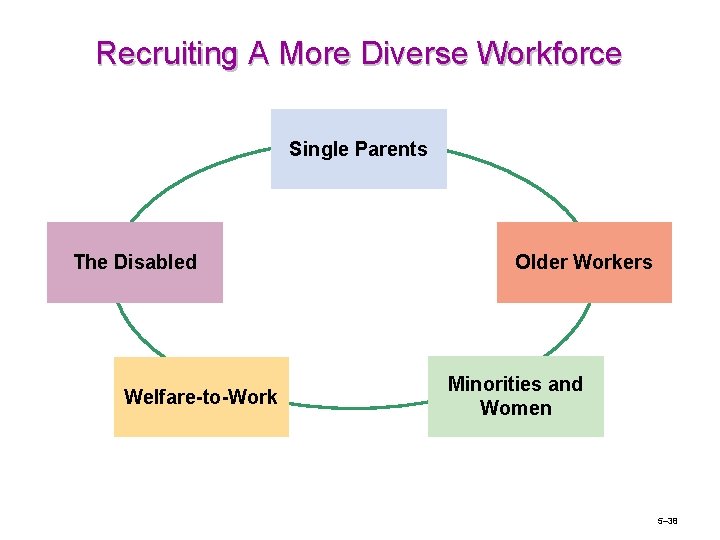
Recruiting A More Diverse Workforce Single Parents The Disabled Welfare-to-Work Older Workers Minorities and Women 5– 38
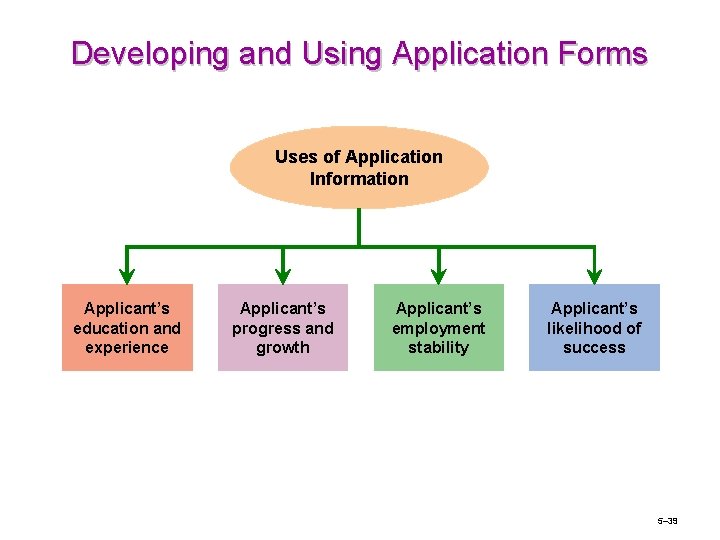
Developing and Using Application Forms Uses of Application Information Applicant’s education and experience Applicant’s progress and growth Applicant’s employment stability Applicant’s likelihood of success 5– 39
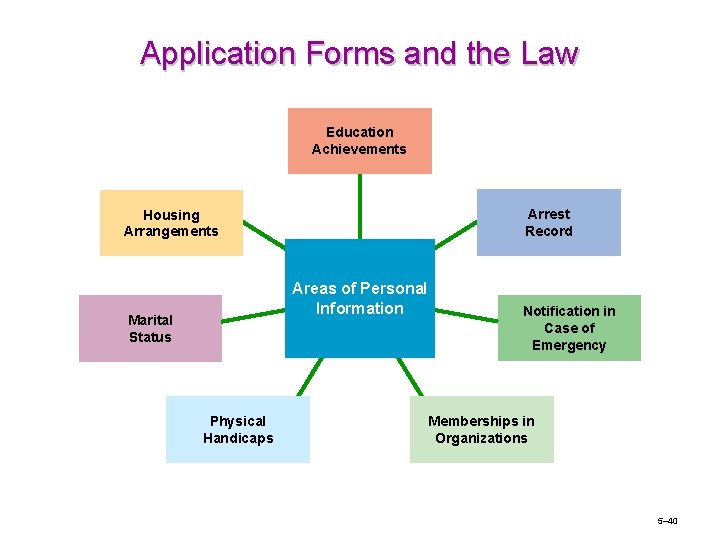
Application Forms and the Law Education Achievements Arrest Record Housing Arrangements Areas of Personal Information Marital Status Physical Handicaps Notification in Case of Emergency Memberships in Organizations 5– 40