
1 Chapter 3 Project Management Definition of Project
- Slides: 41
1 Chapter 3 Project Management · · · Definition of Project Management Work Breakdown Structure Project Control Charts Structuring Projects Critical Path Scheduling – – CPM with a Single Time CPM with Three Activity Time Estimates
2 OBJECTIVES · · · Definition of Project Management Work Breakdown Structure Project Control Charts Structuring Projects Critical Path Scheduling
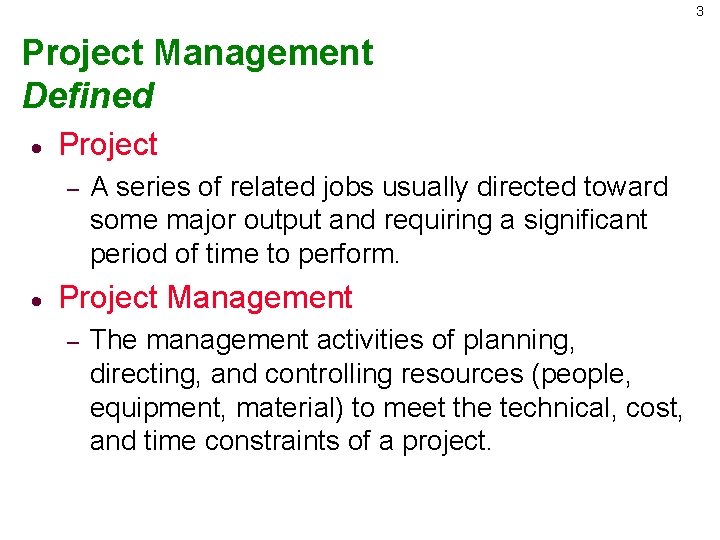
3 Project Management Defined · Project – · A series of related jobs usually directed toward some major output and requiring a significant period of time to perform. Project Management – The management activities of planning, directing, and controlling resources (people, equipment, material) to meet the technical, cost, and time constraints of a project.
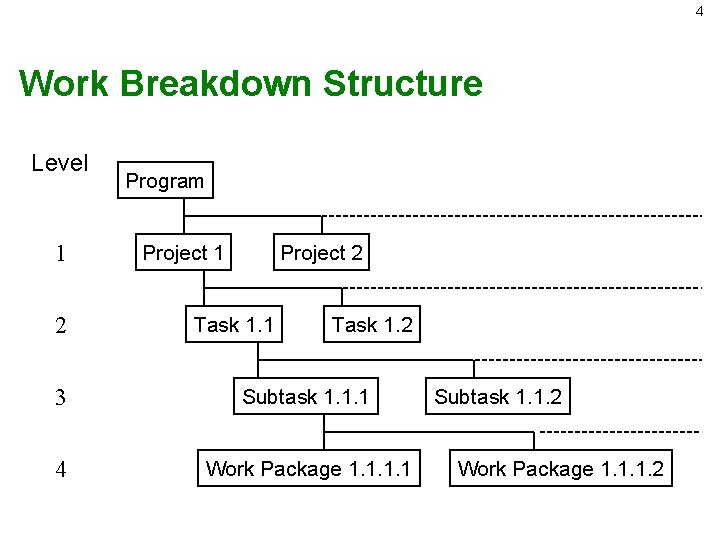
4 Work Breakdown Structure Level 1 2 Program Project 1 Project 2 Task 1. 1 Task 1. 2 3 Subtask 1. 1. 1 4 Work Package 1. 1 Subtask 1. 1. 2 Work Package 1. 1. 1. 2
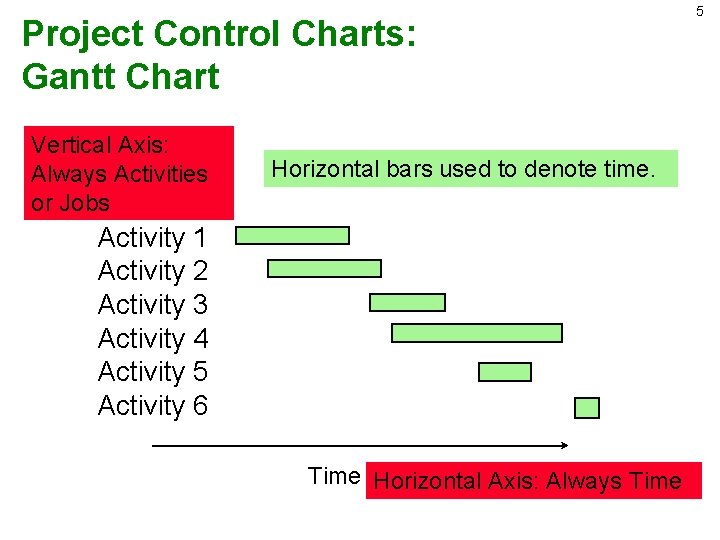
Project Control Charts: Gantt Chart Vertical Axis: Always Activities or Jobs Horizontal bars used to denote time. Activity 1 Activity 2 Activity 3 Activity 4 Activity 5 Activity 6 Time Horizontal Axis: Always Time 5
6 Organization Structures for Projects · · · Pure Functional Matrix
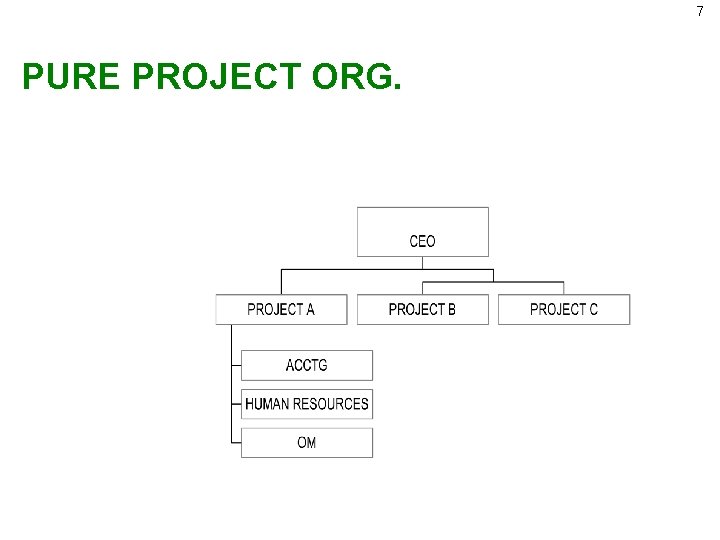
7 PURE PROJECT ORG.
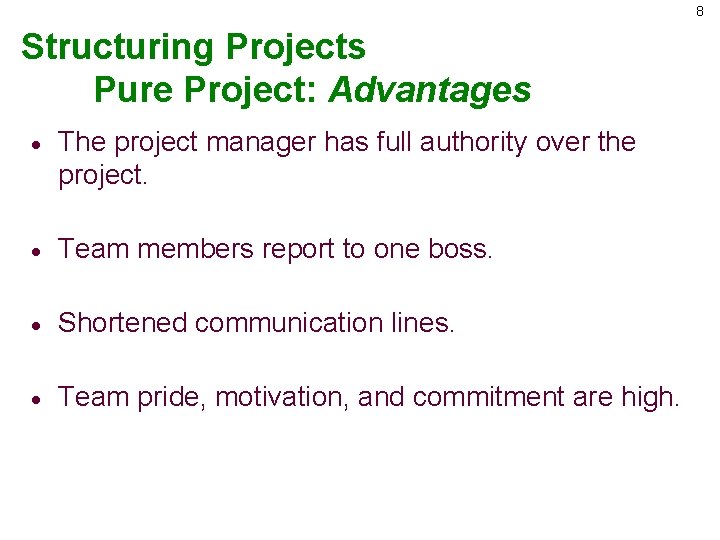
8 Structuring Projects Pure Project: Advantages · The project manager has full authority over the project. · Team members report to one boss. · Shortened communication lines. · Team pride, motivation, and commitment are high.
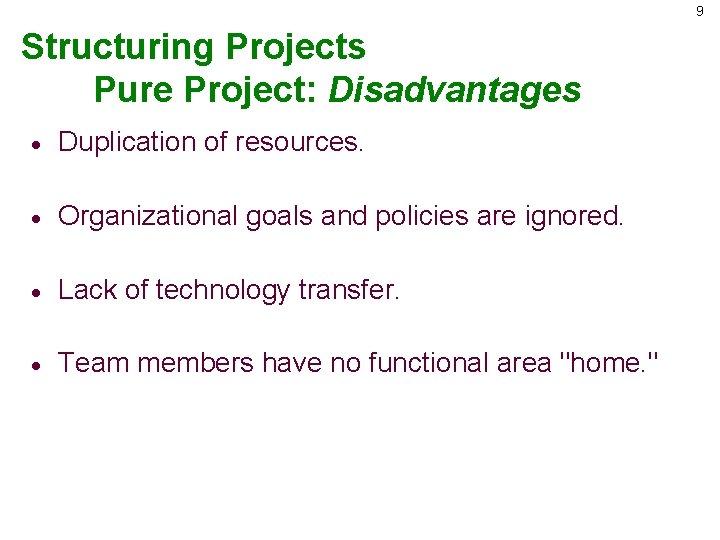
9 Structuring Projects Pure Project: Disadvantages · Duplication of resources. · Organizational goals and policies are ignored. · Lack of technology transfer. · Team members have no functional area "home. "
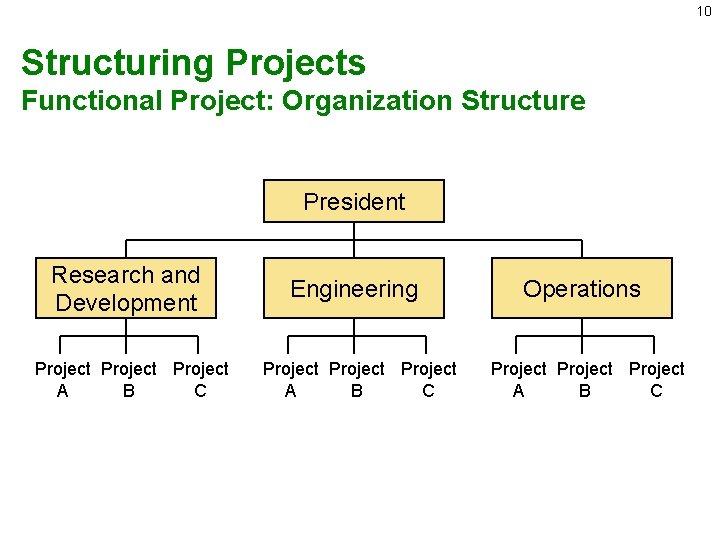
10 Structuring Projects Functional Project: Organization Structure President Research and Development Project A B C Engineering Project A B C Operations Project A B C
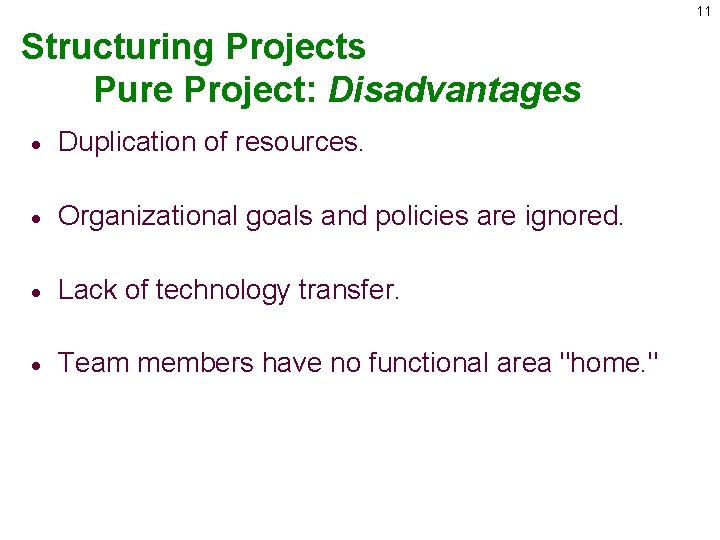
11 Structuring Projects Pure Project: Disadvantages · Duplication of resources. · Organizational goals and policies are ignored. · Lack of technology transfer. · Team members have no functional area "home. "
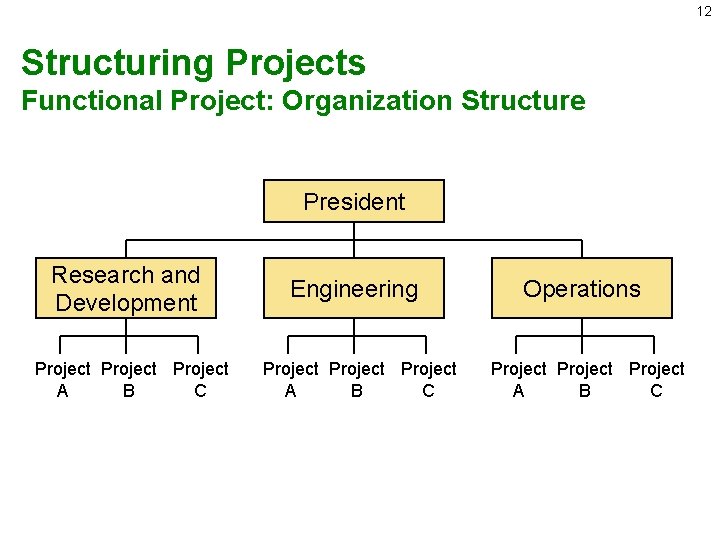
12 Structuring Projects Functional Project: Organization Structure President Research and Development Project A B C Engineering Project A B C Operations Project A B C
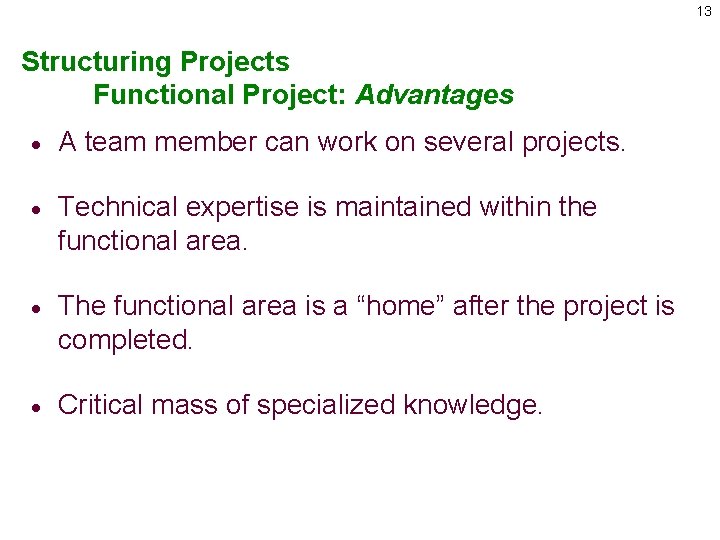
13 Structuring Projects Functional Project: Advantages · A team member can work on several projects. · Technical expertise is maintained within the functional area. · The functional area is a “home” after the project is completed. · Critical mass of specialized knowledge.
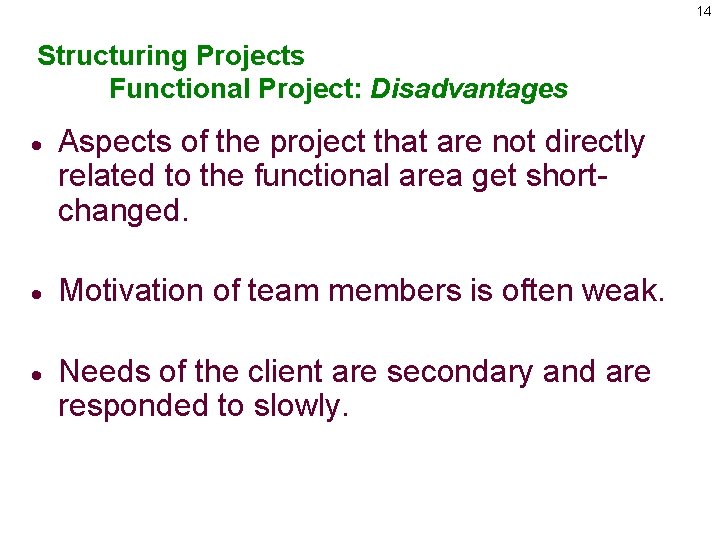
14 Structuring Projects Functional Project: Disadvantages · Aspects of the project that are not directly related to the functional area get shortchanged. · Motivation of team members is often weak. · Needs of the client are secondary and are responded to slowly.
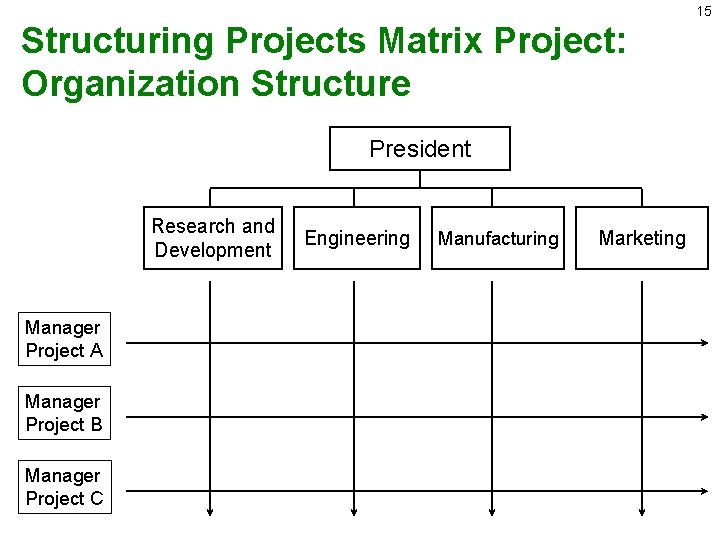
15 Structuring Projects Matrix Project: Organization Structure President Research and Development Manager Project A Manager Project B Manager Project C Engineering Manufacturing Marketing
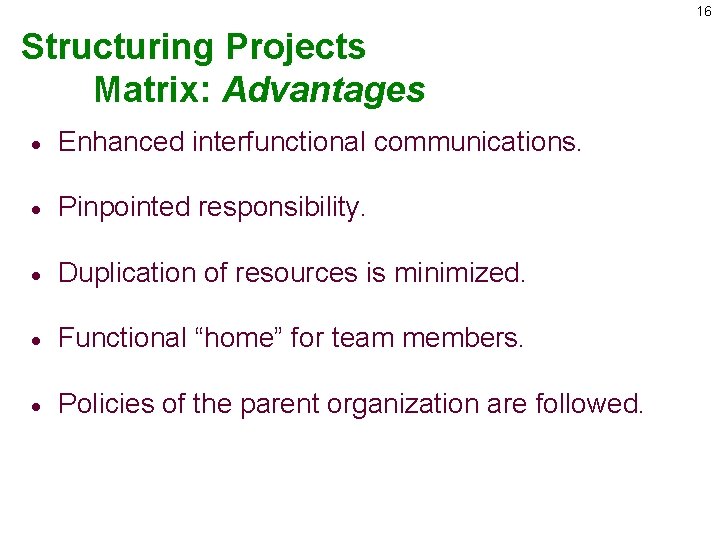
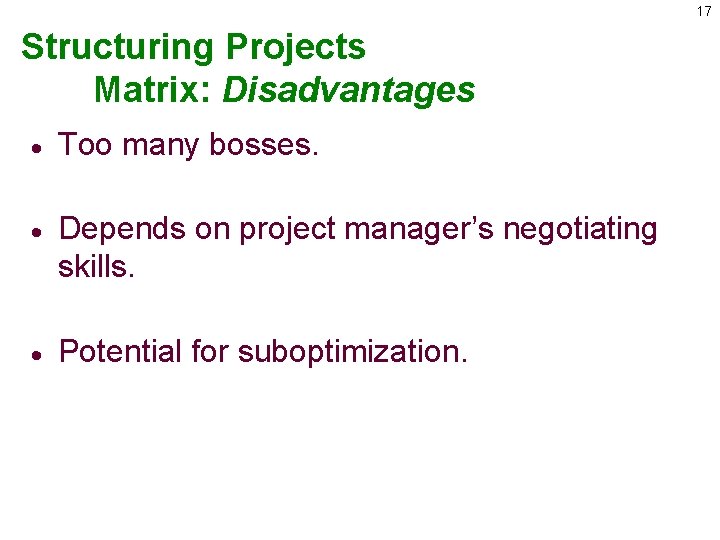
16 Structuring Projects Matrix: Advantages · Enhanced interfunctional communications. · Pinpointed responsibility. · Duplication of resources is minimized. · Functional “home” for team members. · Policies of the parent organization are followed.
17 Structuring Projects Matrix: Disadvantages · Too many bosses. · Depends on project manager’s negotiating skills. · Potential for suboptimization.
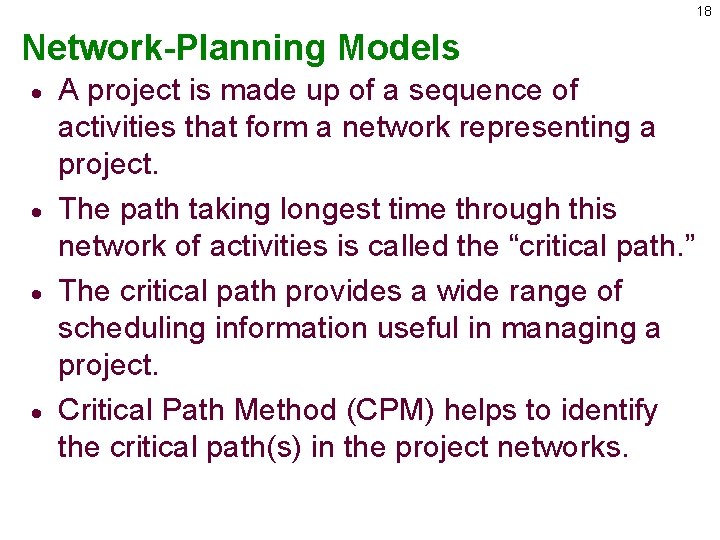
18 Network-Planning Models · · A project is made up of a sequence of activities that form a network representing a project. The path taking longest time through this network of activities is called the “critical path. ” The critical path provides a wide range of scheduling information useful in managing a project. Critical Path Method (CPM) helps to identify the critical path(s) in the project networks.
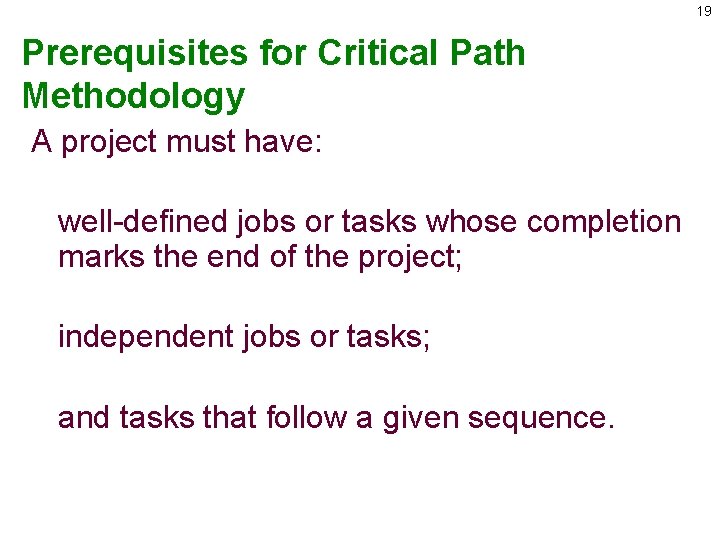
19 Prerequisites for Critical Path Methodology A project must have: well-defined jobs or tasks whose completion marks the end of the project; independent jobs or tasks; and tasks that follow a given sequence.
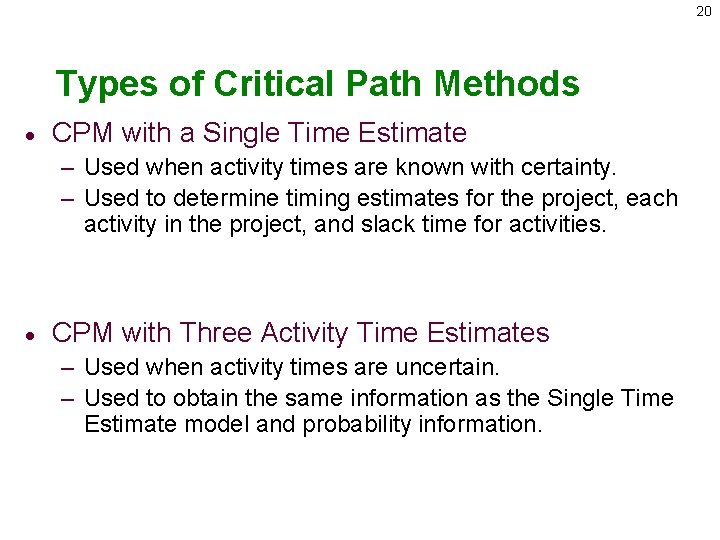
20 Types of Critical Path Methods · CPM with a Single Time Estimate – Used when activity times are known with certainty. – Used to determine timing estimates for the project, each activity in the project, and slack time for activities. · CPM with Three Activity Time Estimates – Used when activity times are uncertain. – Used to obtain the same information as the Single Time Estimate model and probability information.
21 Steps in the CPM with Single Time Estimate · · · 1. Activity Identification. 2. Activity Sequencing and Network Construction. 3. Determine the critical path. – From the critical path all of the project and activity timing information can be obtained.
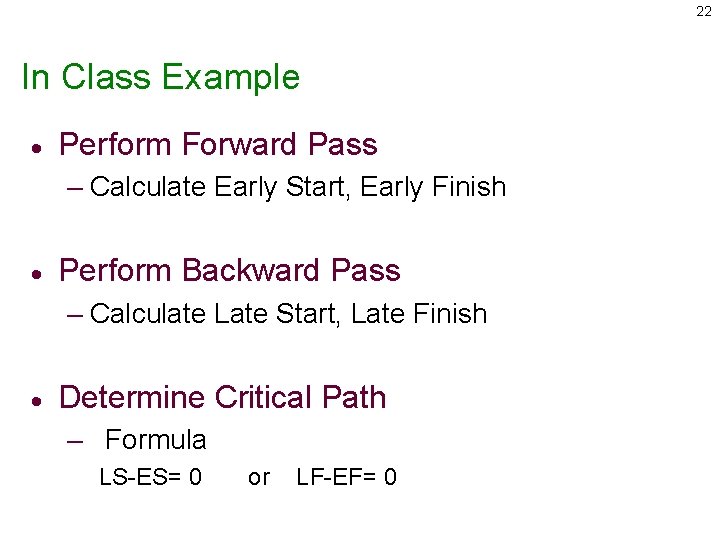
22 In Class Example · Perform Forward Pass – Calculate Early Start, Early Finish · Perform Backward Pass – Calculate Late Start, Late Finish · Determine Critical Path – Formula LS-ES= 0 or LF-EF= 0
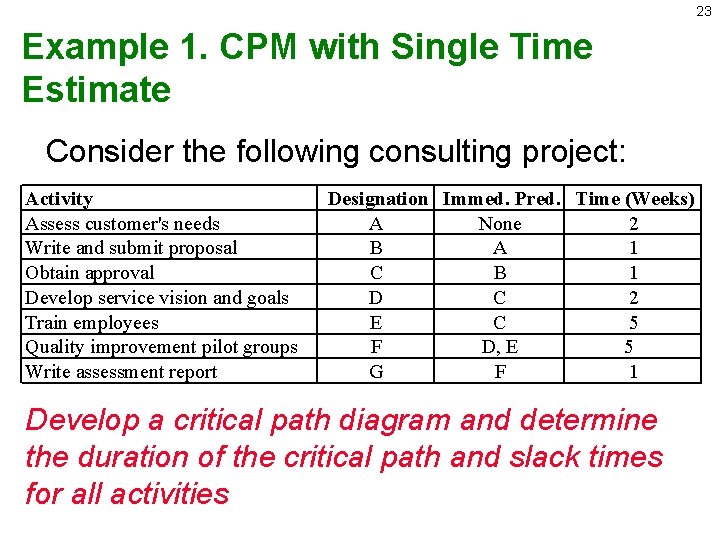
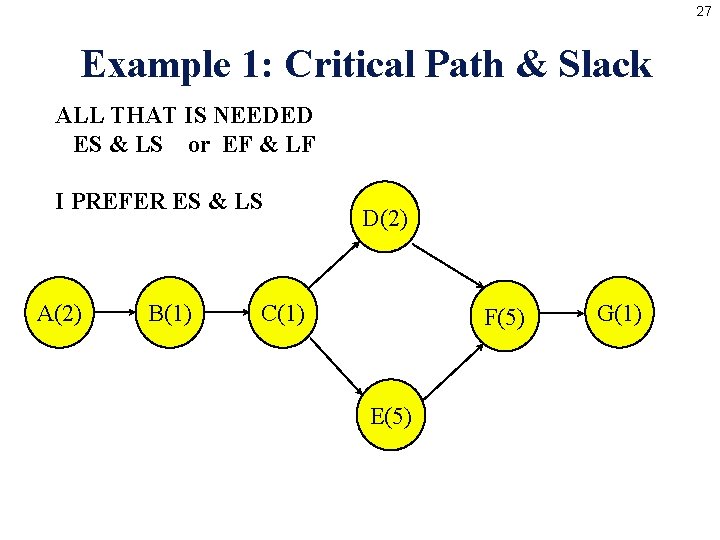
23 Example 1. CPM with Single Time Estimate Consider the following consulting project: Activity Assess customer's needs Write and submit proposal Obtain approval Develop service vision and goals Train employees Quality improvement pilot groups Write assessment report Designation Immed. Pred. Time (Weeks) A None 2 B A 1 C B 1 D C 2 E C 5 F D, E 5 G F 1 Develop a critical path diagram and determine the duration of the critical path and slack times for all activities
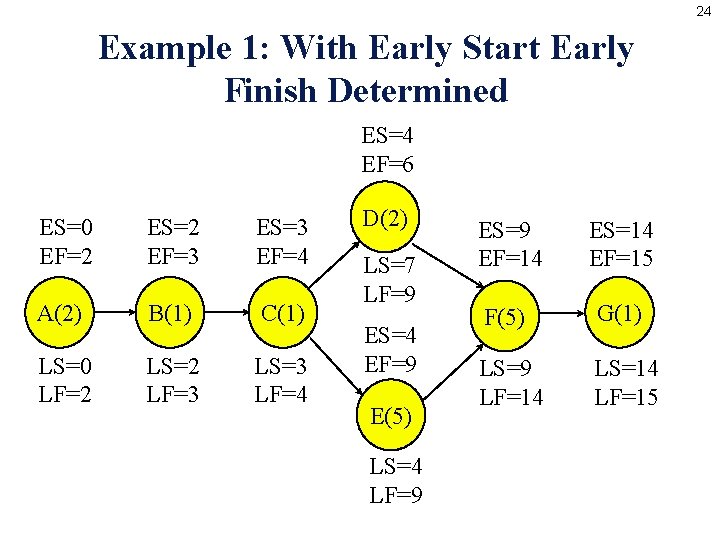
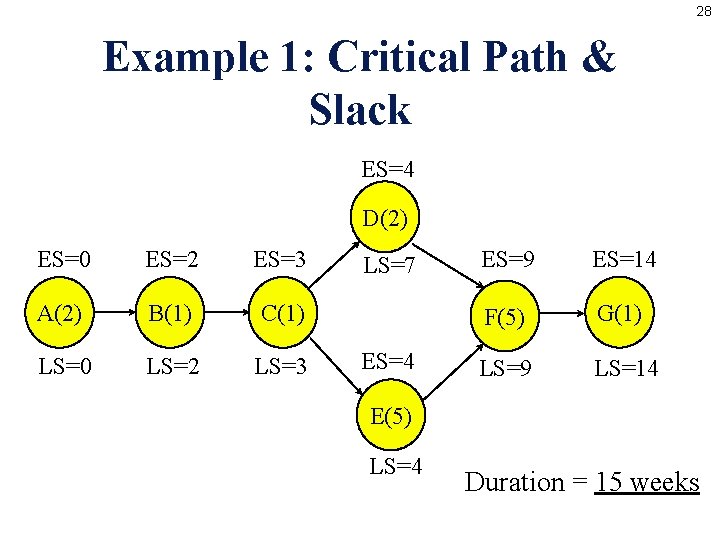
24 Example 1: With Early Start Early Finish Determined ES=4 EF=6 ES=0 EF=2 ES=2 EF=3 ES=3 EF=4 A(2) B(1) C(1) LS=0 LF=2 LS=2 LF=3 LS=3 LF=4 D(2) LS=7 LF=9 ES=4 EF=9 E(5) LS=4 LF=9 ES=9 EF=14 ES=14 EF=15 F(5) G(1) LS=9 LF=14 LS=14 LF=15
25 Demonstration of how to Calculate · In Class Demonstration
26 NOW: : : · FOR CRITICAL PATH
27 Example 1: Critical Path & Slack ALL THAT IS NEEDED ES & LS or EF & LF I PREFER ES & LS A(2) B(1) D(2) C(1) F(5) E(5) G(1)
28 Example 1: Critical Path & Slack ES=4 D(2) ES=0 ES=2 ES=3 A(2) B(1) C(1) LS=0 LS=2 LS=3 LS=7 ES=4 ES=9 ES=14 F(5) G(1) LS=9 LS=14 E(5) LS=4 Duration = 15 weeks
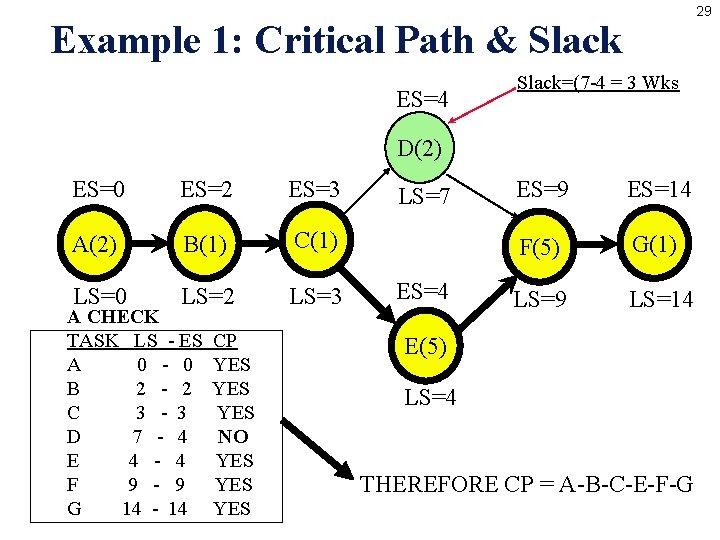
29 Example 1: Critical Path & Slack ES=4 Slack=(7 -4 = 3 Wks D(2) ES=0 ES=2 ES=3 A(2) B(1) C(1) LS=0 LS=2 LS=3 A CHECK TASK LS - ES A 0 - 0 B 2 - 2 C 3 - 3 D 7 - 4 E 4 - 4 F 9 - 9 G 14 - 14 CP YES YES NO YES YES LS=7 ES=4 ES=9 ES=14 F(5) G(1) LS=9 LS=14 E(5) LS=4 THEREFORE CP = A-B-C-E-F-G
30 Three Time Estimate Critical Path · Example
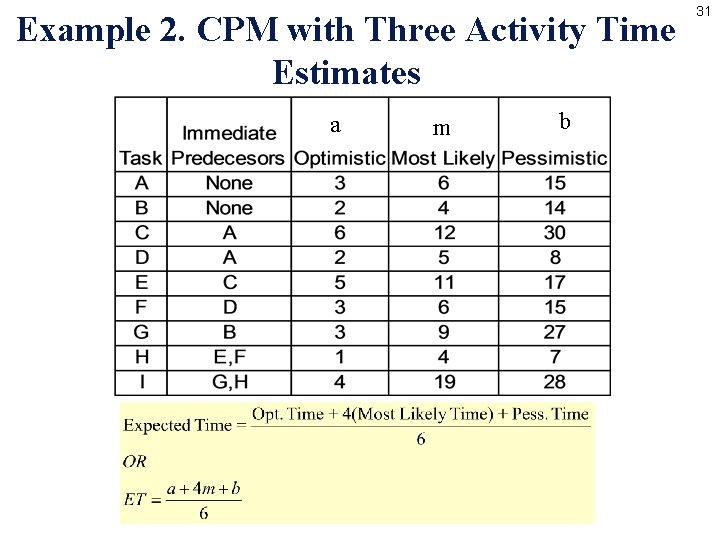
Example 2. CPM with Three Activity Time Estimates a m b 31
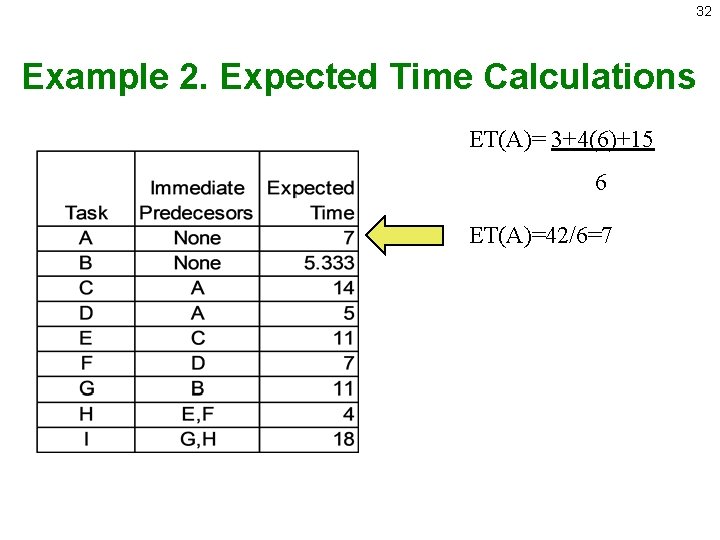
32 Example 2. Expected Time Calculations ET(A)= 3+4(6)+15 6 ET(A)=42/6=7
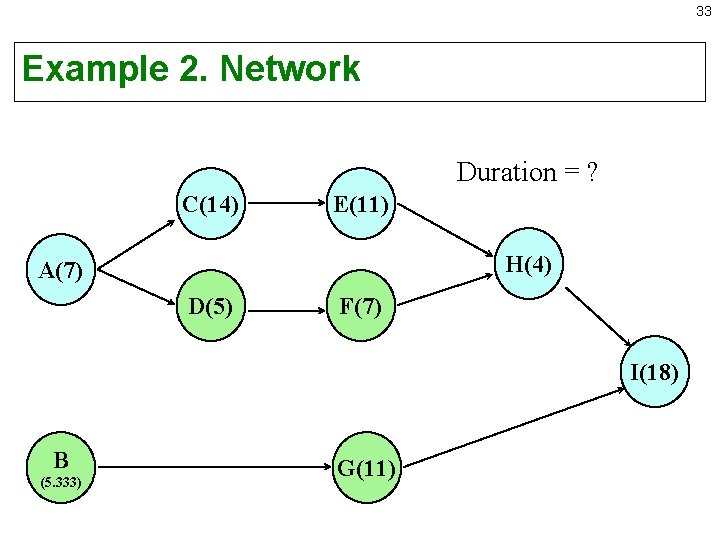
33 Example 2. Network Duration = ? C(14) E(11) H(4) A(7) D(5) F(7) I(18) B (5. 333) G(11)
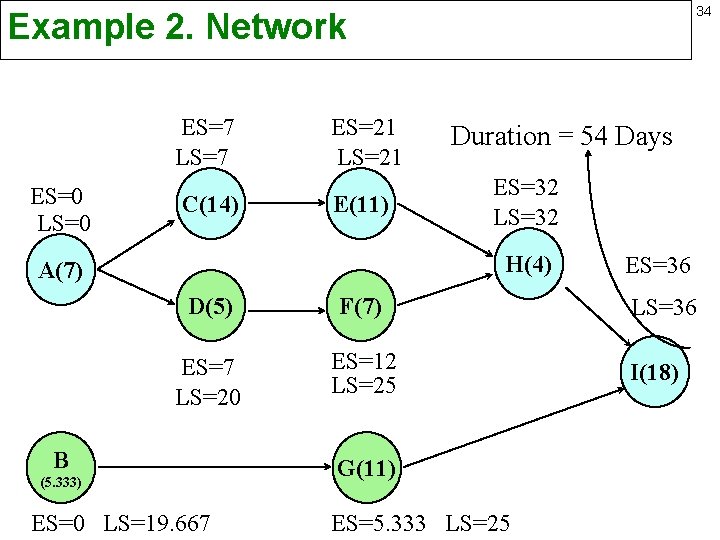
34 Example 2. Network ES=7 LS=7 ES=0 LS=0 C(14) ES=21 LS=21 E(11) Duration = 54 Days ES=32 LS=32 H(4) A(7) D(5) F(7) ES=7 LS=20 ES=12 LS=25 B (5. 333) ES=0 LS=19. 667 G(11) ES=5. 333 LS=25 ES=36 LS=36 I(18)
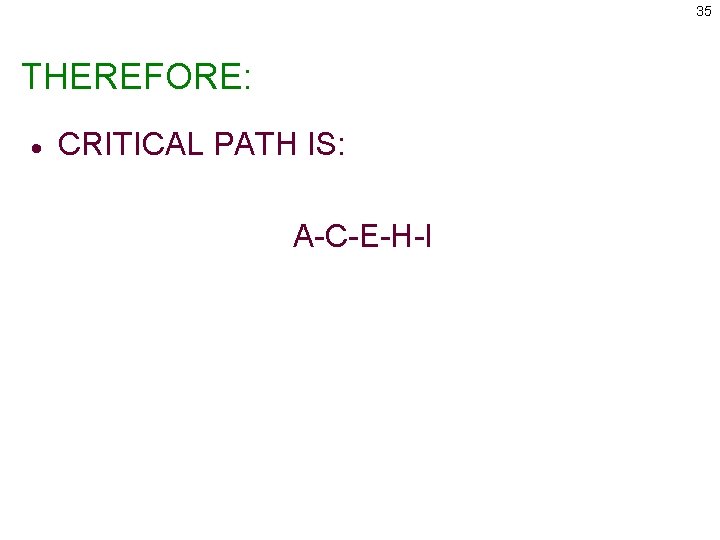
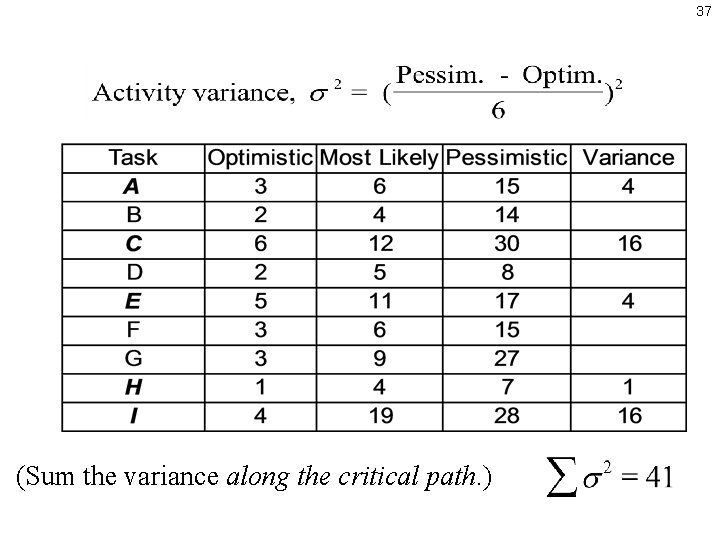
35 THEREFORE: · CRITICAL PATH IS: A-C-E-H-I
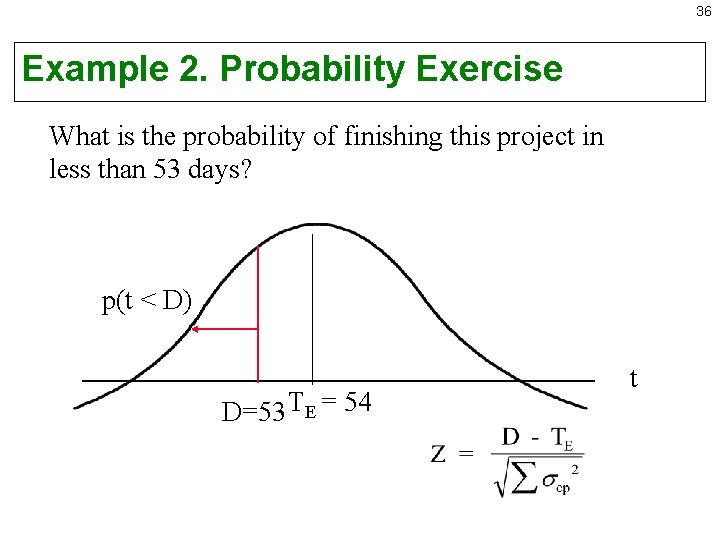
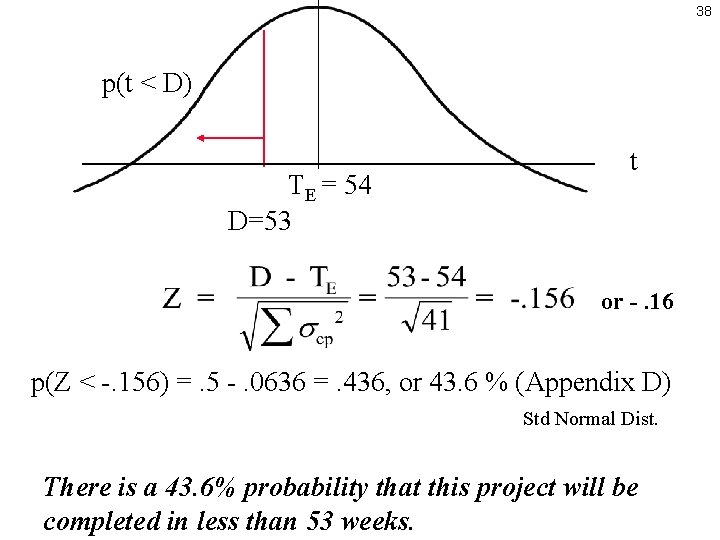
36 Example 2. Probability Exercise What is the probability of finishing this project in less than 53 days? p(t < D) D=53 TE = 54 t
37 (Sum the variance along the critical path. )
38 p(t < D) TE = 54 D=53 t or -. 16 p(Z < -. 156) =. 5 -. 0636 =. 436, or 43. 6 % (Appendix D) Std Normal Dist. There is a 43. 6% probability that this project will be completed in less than 53 weeks.
Example 2. Additional Probability Exercise · What is the probability that the project duration will exceed 56 weeks? · Solution Demonstrated in class 39
40 CPM Assumptions/Limitations · Project activities can be identified as entities. · Project activity sequence relationships can be specified and networked. Project control should focus on the critical path. The activity times follow the beta distribution, with the variance of the project assumed to equal the sum of the variances along the critical path. Project control should focus on the critical path. · ·
41 Ms. Project Demonstration