
1 Chapter 19 The Preprocessor Outline 19 1
- Slides: 18
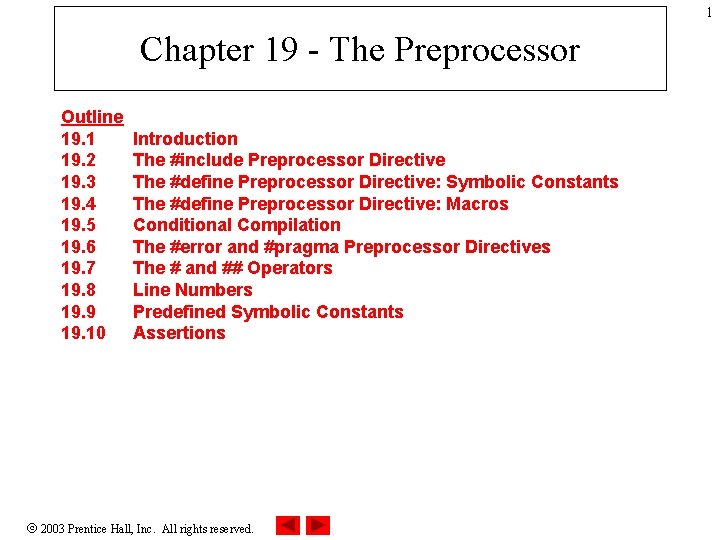
1 Chapter 19 - The Preprocessor Outline 19. 1 19. 2 19. 3 19. 4 19. 5 19. 6 19. 7 19. 8 19. 9 19. 10 Introduction The #include Preprocessor Directive The #define Preprocessor Directive: Symbolic Constants The #define Preprocessor Directive: Macros Conditional Compilation The #error and #pragma Preprocessor Directives The # and ## Operators Line Numbers Predefined Symbolic Constants Assertions 2003 Prentice Hall, Inc. All rights reserved.
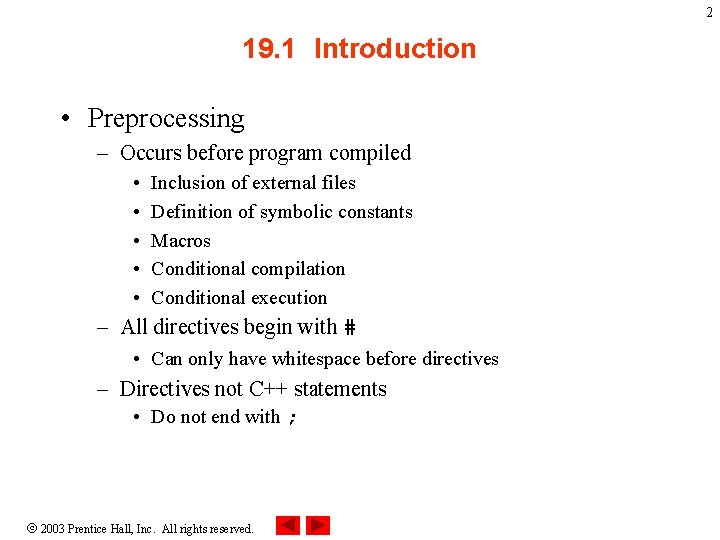
2 19. 1 Introduction • Preprocessing – Occurs before program compiled • • • Inclusion of external files Definition of symbolic constants Macros Conditional compilation Conditional execution – All directives begin with # • Can only have whitespace before directives – Directives not C++ statements • Do not end with ; 2003 Prentice Hall, Inc. All rights reserved.
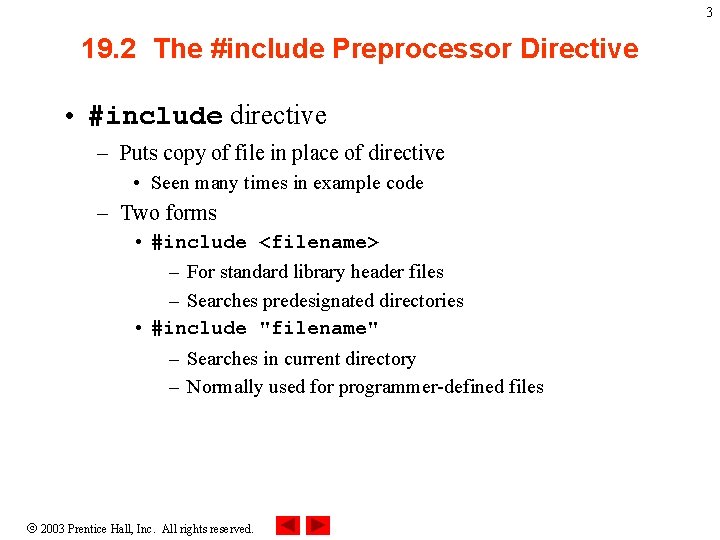
3 19. 2 The #include Preprocessor Directive • #include directive – Puts copy of file in place of directive • Seen many times in example code – Two forms • #include <filename> – For standard library header files – Searches predesignated directories • #include "filename" – Searches in current directory – Normally used for programmer-defined files 2003 Prentice Hall, Inc. All rights reserved.
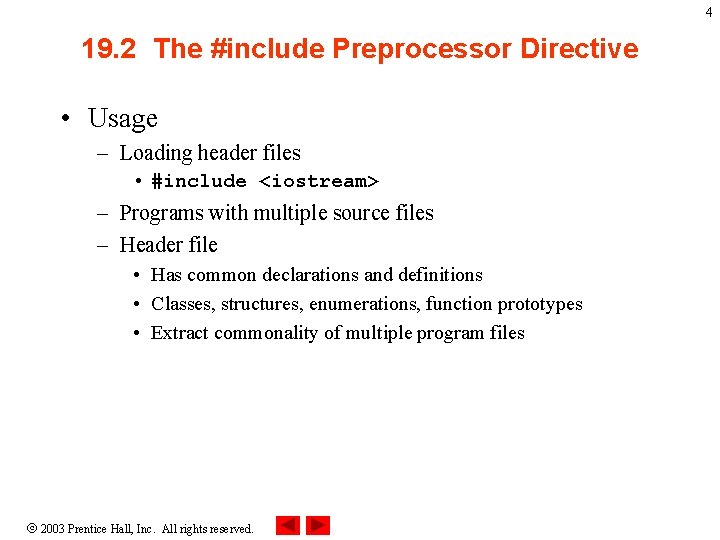
4 19. 2 The #include Preprocessor Directive • Usage – Loading header files • #include <iostream> – Programs with multiple source files – Header file • Has common declarations and definitions • Classes, structures, enumerations, function prototypes • Extract commonality of multiple program files 2003 Prentice Hall, Inc. All rights reserved.
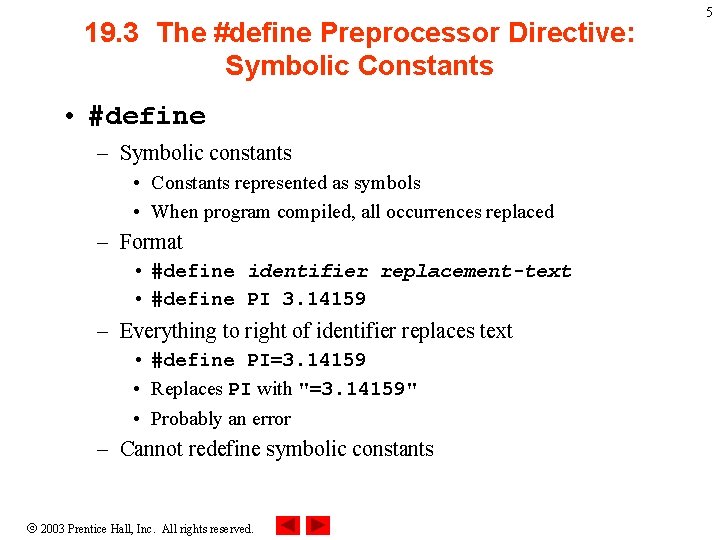
19. 3 The #define Preprocessor Directive: Symbolic Constants • #define – Symbolic constants • Constants represented as symbols • When program compiled, all occurrences replaced – Format • #define identifier replacement-text • #define PI 3. 14159 – Everything to right of identifier replaces text • #define PI=3. 14159 • Replaces PI with "=3. 14159" • Probably an error – Cannot redefine symbolic constants 2003 Prentice Hall, Inc. All rights reserved. 5
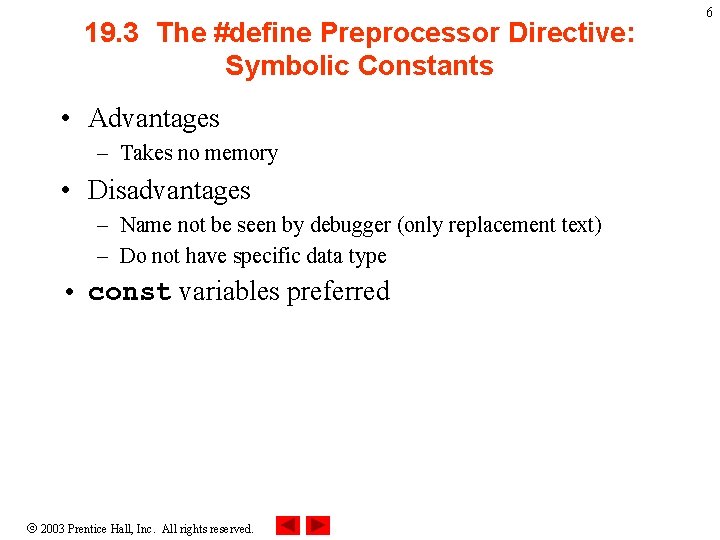
19. 3 The #define Preprocessor Directive: Symbolic Constants • Advantages – Takes no memory • Disadvantages – Name not be seen by debugger (only replacement text) – Do not have specific data type • const variables preferred 2003 Prentice Hall, Inc. All rights reserved. 6
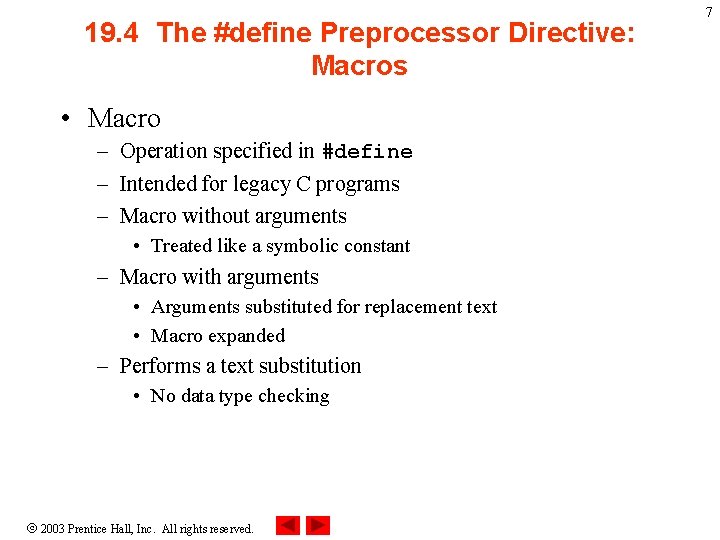
19. 4 The #define Preprocessor Directive: Macros • Macro – Operation specified in #define – Intended for legacy C programs – Macro without arguments • Treated like a symbolic constant – Macro with arguments • Arguments substituted for replacement text • Macro expanded – Performs a text substitution • No data type checking 2003 Prentice Hall, Inc. All rights reserved. 7
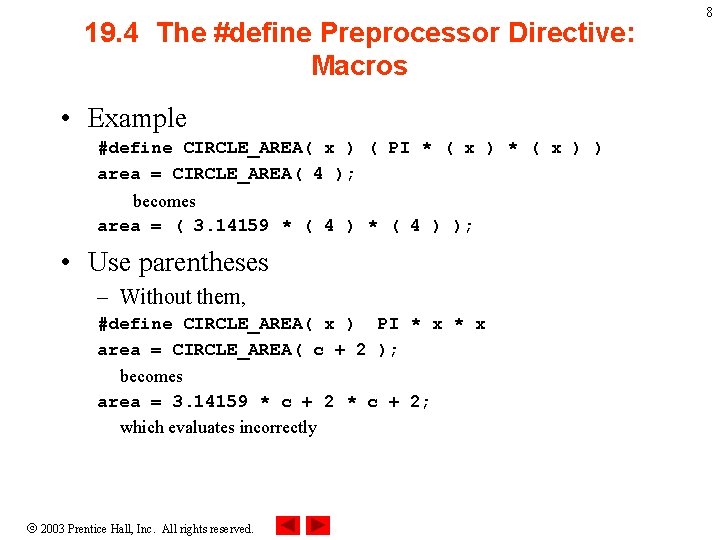
19. 4 The #define Preprocessor Directive: Macros • Example #define CIRCLE_AREA( x ) ( PI * ( x ) ) area = CIRCLE_AREA( 4 ); becomes area = ( 3. 14159 * ( 4 ) ); • Use parentheses – Without them, #define CIRCLE_AREA( x ) PI * x area = CIRCLE_AREA( c + 2 ); becomes area = 3. 14159 * c + 2; which evaluates incorrectly 2003 Prentice Hall, Inc. All rights reserved. 8
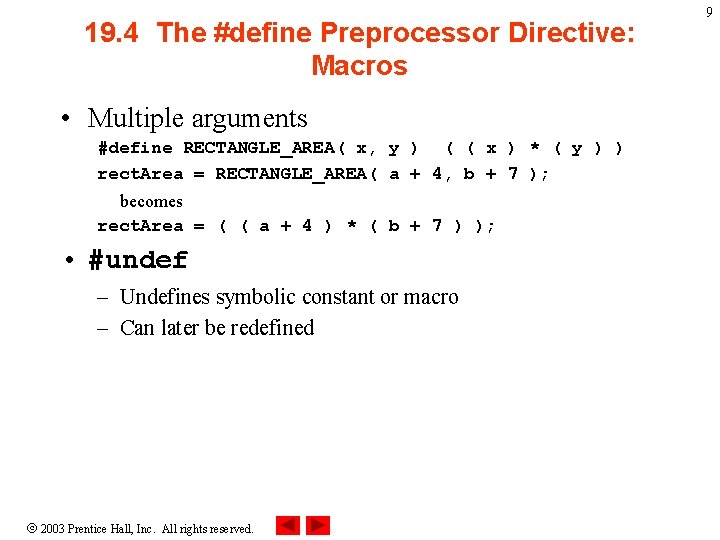
19. 4 The #define Preprocessor Directive: Macros • Multiple arguments #define RECTANGLE_AREA( x, y ) ( ( x ) * ( y ) ) rect. Area = RECTANGLE_AREA( a + 4, b + 7 ); becomes rect. Area = ( ( a + 4 ) * ( b + 7 ) ); • #undef – Undefines symbolic constant or macro – Can later be redefined 2003 Prentice Hall, Inc. All rights reserved. 9
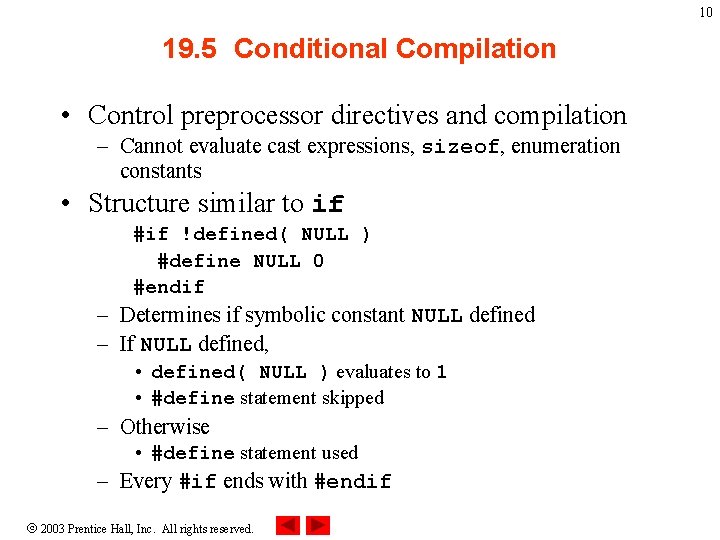
10 19. 5 Conditional Compilation • Control preprocessor directives and compilation – Cannot evaluate cast expressions, sizeof, enumeration constants • Structure similar to if #if !defined( NULL ) #define NULL 0 #endif – Determines if symbolic constant NULL defined – If NULL defined, • defined( NULL ) evaluates to 1 • #define statement skipped – Otherwise • #define statement used – Every #if ends with #endif 2003 Prentice Hall, Inc. All rights reserved.
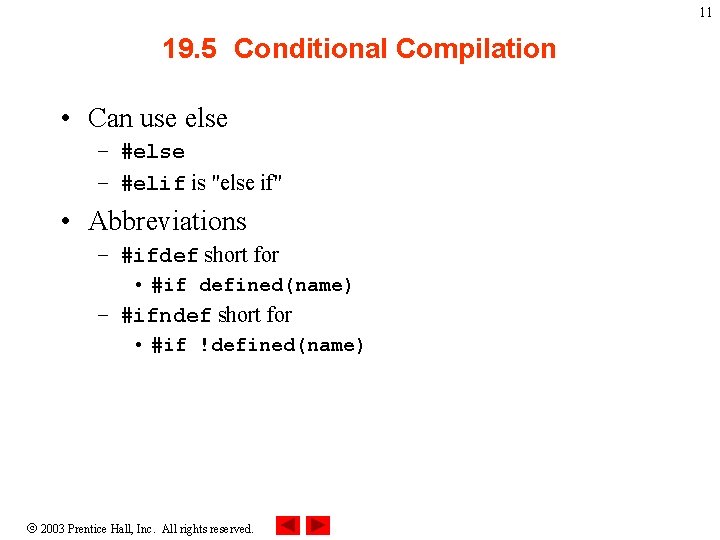
11 19. 5 Conditional Compilation • Can use else – #elif is "else if" • Abbreviations – #ifdef short for • #if defined(name) – #ifndef short for • #if !defined(name) 2003 Prentice Hall, Inc. All rights reserved.
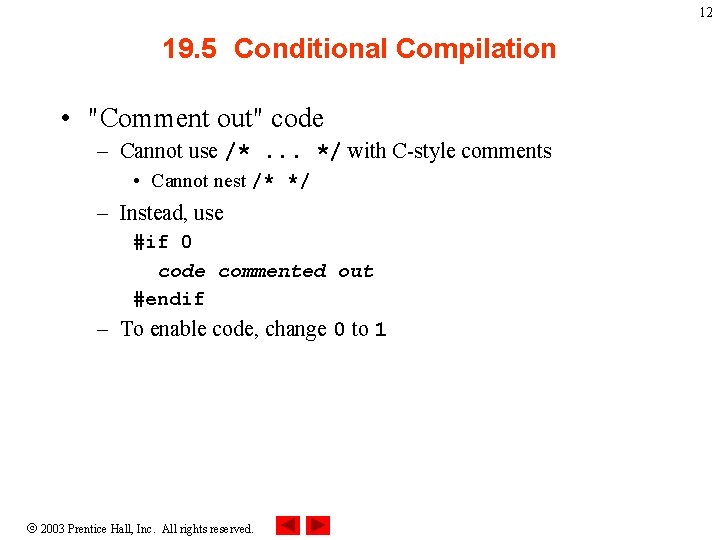
12 19. 5 Conditional Compilation • "Comment out" code – Cannot use /*. . . */ with C-style comments • Cannot nest /* */ – Instead, use #if 0 code commented out #endif – To enable code, change 0 to 1 2003 Prentice Hall, Inc. All rights reserved.
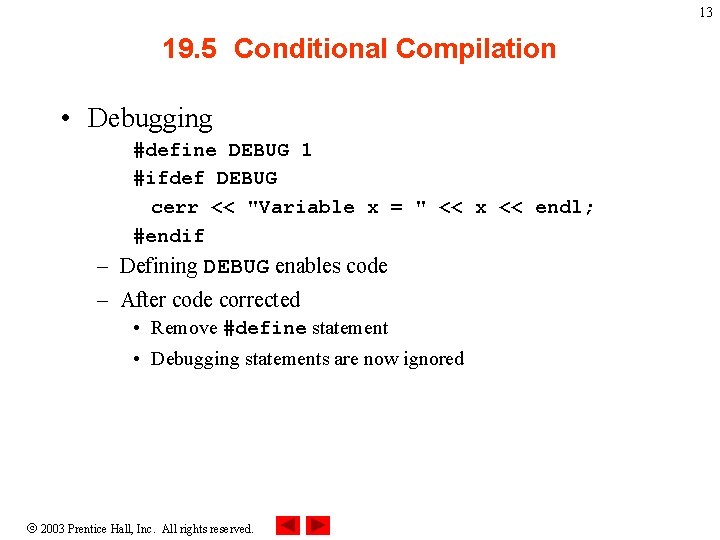
13 19. 5 Conditional Compilation • Debugging #define DEBUG 1 #ifdef DEBUG cerr << "Variable x = " << x << endl; #endif – Defining DEBUG enables code – After code corrected • Remove #define statement • Debugging statements are now ignored 2003 Prentice Hall, Inc. All rights reserved.
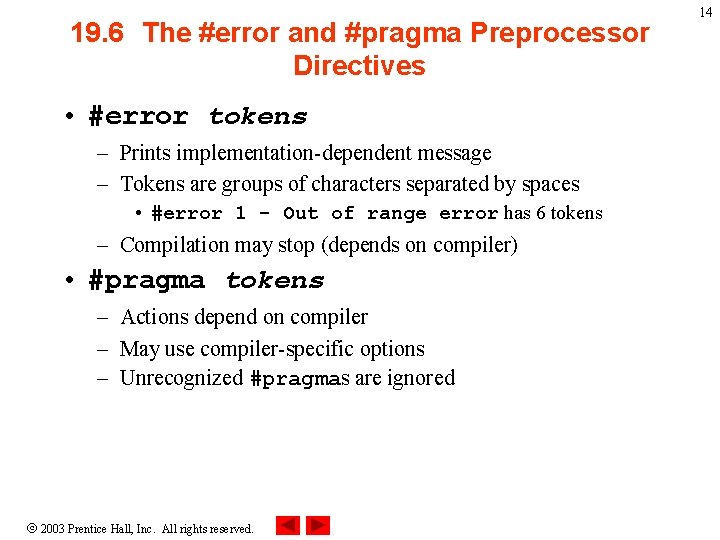
19. 6 The #error and #pragma Preprocessor Directives • #error tokens – Prints implementation-dependent message – Tokens are groups of characters separated by spaces • #error 1 - Out of range error has 6 tokens – Compilation may stop (depends on compiler) • #pragma tokens – Actions depend on compiler – May use compiler-specific options – Unrecognized #pragmas are ignored 2003 Prentice Hall, Inc. All rights reserved. 14
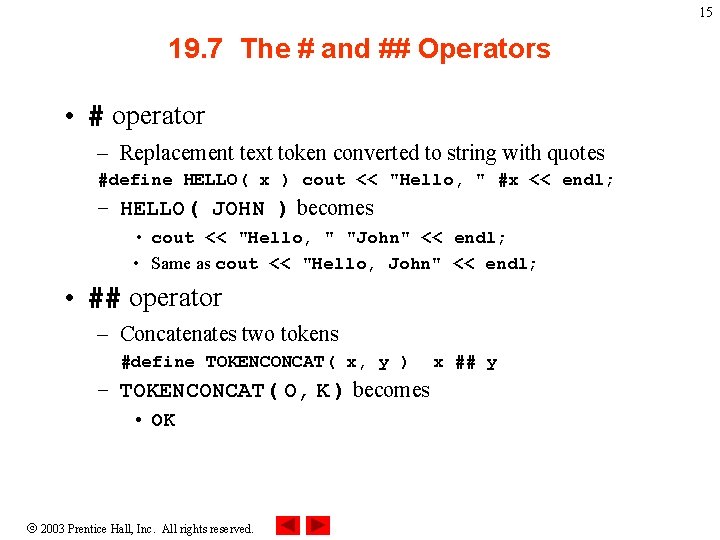
15 19. 7 The # and ## Operators • # operator – Replacement text token converted to string with quotes #define HELLO( x ) cout << "Hello, " #x << endl; – HELLO( JOHN ) becomes • cout << "Hello, " "John" << endl; • Same as cout << "Hello, John" << endl; • ## operator – Concatenates two tokens #define TOKENCONCAT( x, y ) – TOKENCONCAT( O, K ) becomes • OK 2003 Prentice Hall, Inc. All rights reserved. x ## y
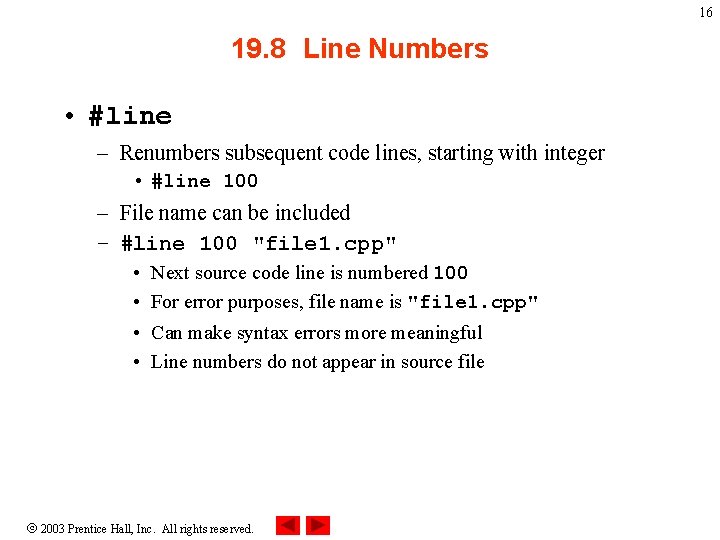
16 19. 8 Line Numbers • #line – Renumbers subsequent code lines, starting with integer • #line 100 – File name can be included – #line 100 "file 1. cpp" • • Next source code line is numbered 100 For error purposes, file name is "file 1. cpp" Can make syntax errors more meaningful Line numbers do not appear in source file 2003 Prentice Hall, Inc. All rights reserved.
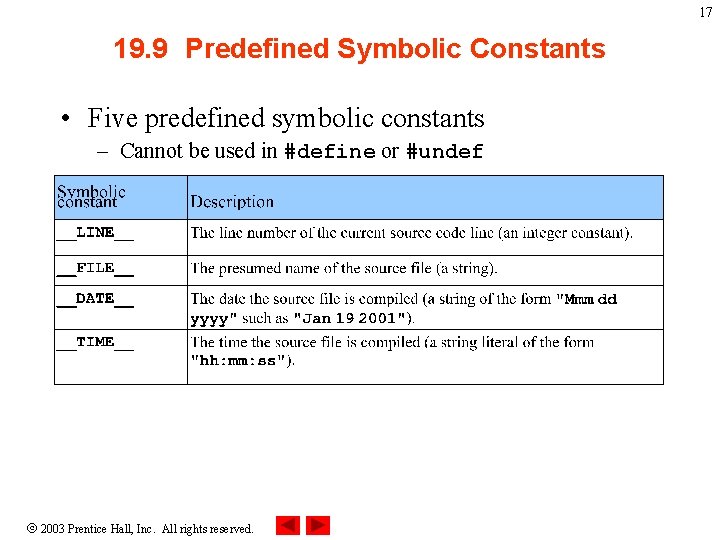
17 19. 9 Predefined Symbolic Constants • Five predefined symbolic constants – Cannot be used in #define or #undef 2003 Prentice Hall, Inc. All rights reserved.
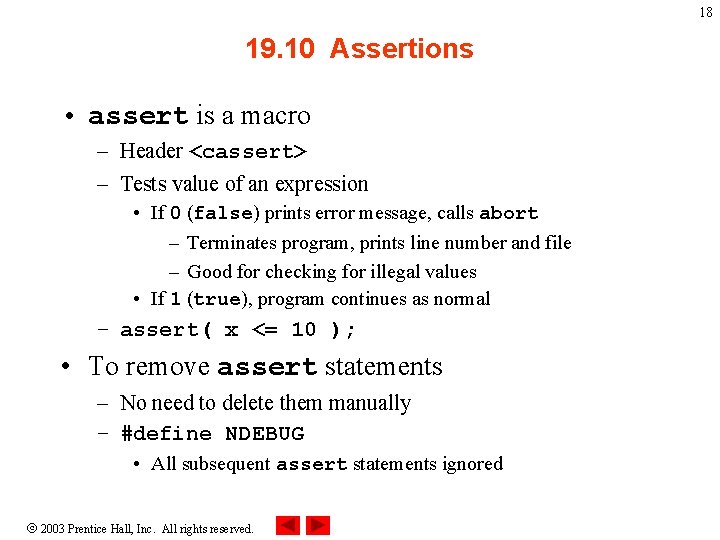
18 19. 10 Assertions • assert is a macro – Header <cassert> – Tests value of an expression • If 0 (false) prints error message, calls abort – Terminates program, prints line number and file – Good for checking for illegal values • If 1 (true), program continues as normal – assert( x <= 10 ); • To remove assert statements – No need to delete them manually – #define NDEBUG • All subsequent assert statements ignored 2003 Prentice Hall, Inc. All rights reserved.