
1 Chapter 14 Aggregate Sales and Operations Planning
- Slides: 16
1 Chapter 14 Aggregate Sales and Operations Planning Mc. Graw-Hill/Irwin © 2006 The Mc. Graw-Hill Companies, Inc. , All Rights Reserved.
2 OBJECTIVES Sales and Operations Planning The Aggregate Operations Plan Examples: Chase and Level strategies Mc. Graw-Hill/Irwin © 2006 The Mc. Graw-Hill Companies, Inc. , All Rights Reserved.
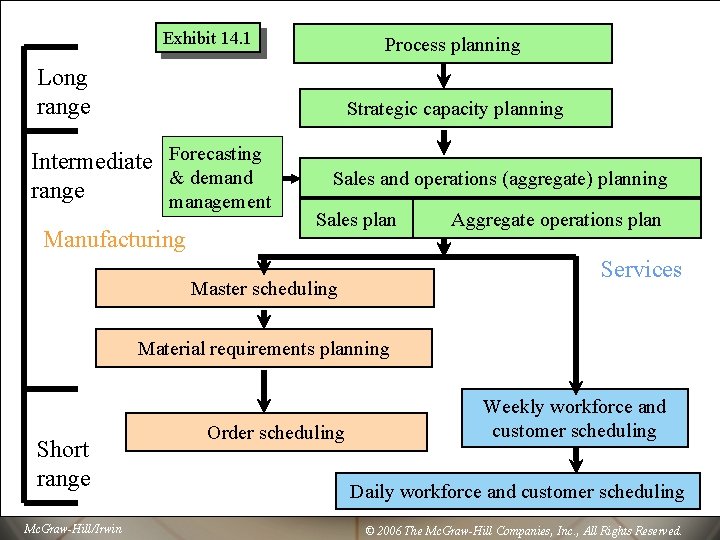
3 Exhibit 14. 1 Process planning Long range Strategic capacity planning Intermediate Forecasting & demand range management Manufacturing Sales and operations (aggregate) planning Sales plan Aggregate operations plan Services Master scheduling Material requirements planning Short range Mc. Graw-Hill/Irwin Order scheduling Weekly workforce and customer scheduling Daily workforce and customer scheduling © 2006 The Mc. Graw-Hill Companies, Inc. , All Rights Reserved.
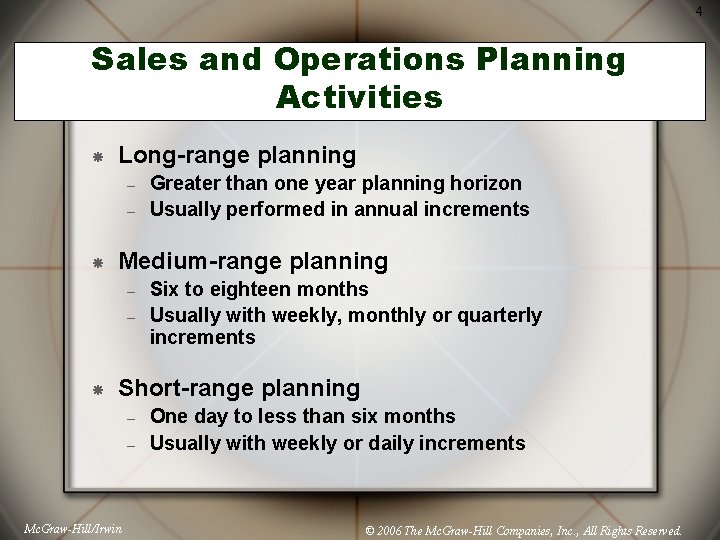
4 Sales and Operations Planning Activities Long-range planning – – Medium-range planning – – Greater than one year planning horizon Usually performed in annual increments Six to eighteen months Usually with weekly, monthly or quarterly increments Short-range planning – – Mc. Graw-Hill/Irwin One day to less than six months Usually with weekly or daily increments © 2006 The Mc. Graw-Hill Companies, Inc. , All Rights Reserved.
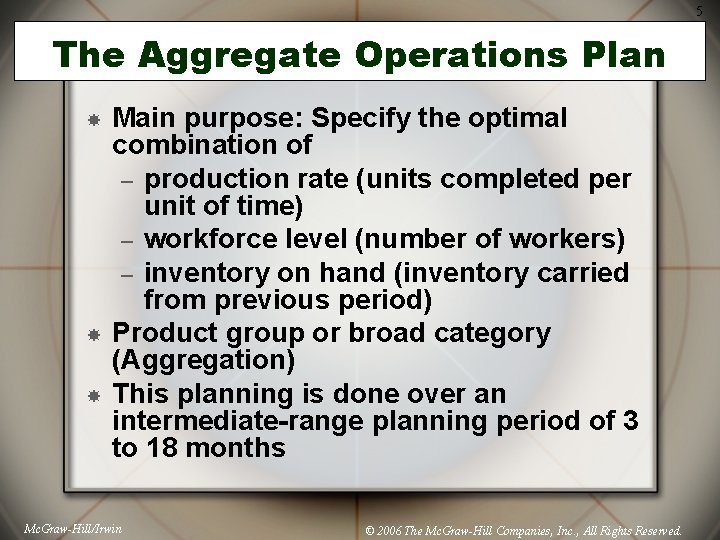
5 The Aggregate Operations Plan Main purpose: Specify the optimal combination of – production rate (units completed per unit of time) – workforce level (number of workers) – inventory on hand (inventory carried from previous period) Product group or broad category (Aggregation) This planning is done over an intermediate-range planning period of 3 to 18 months Mc. Graw-Hill/Irwin © 2006 The Mc. Graw-Hill Companies, Inc. , All Rights Reserved.
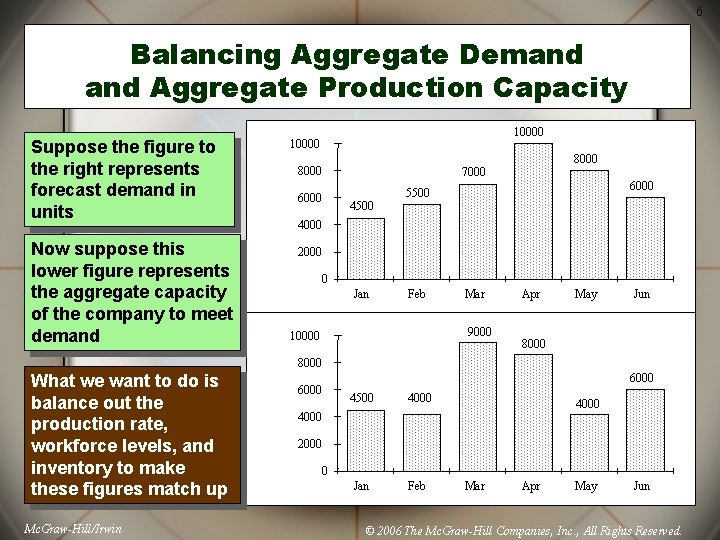
6 Balancing Aggregate Demand Aggregate Production Capacity Suppose the figure to the right represents forecast demand in units Now suppose this lower figure represents the aggregate capacity of the company to meet demand 10000 8000 6000 7000 6000 5500 4000 2000 0 Jan Feb Mar 9000 10000 Apr May Jun 8000 What we want to do is balance out the production rate, workforce levels, and inventory to make these figures match up Mc. Graw-Hill/Irwin 6000 4500 4000 Jan Feb 4000 2000 0 Mar Apr May Jun © 2006 The Mc. Graw-Hill Companies, Inc. , All Rights Reserved.
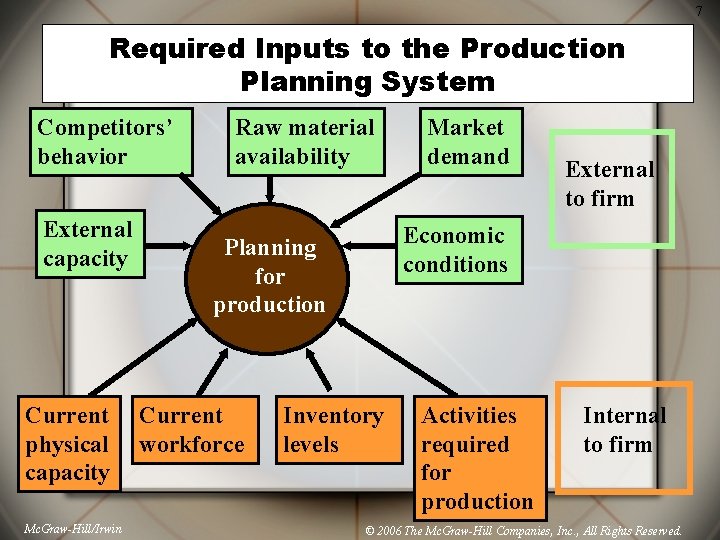
7 Required Inputs to the Production Planning System Competitors’ behavior External capacity Current physical capacity Mc. Graw-Hill/Irwin Raw material availability External to firm Economic conditions Planning for production Current workforce Market demand Inventory levels Activities required for production Internal to firm © 2006 The Mc. Graw-Hill Companies, Inc. , All Rights Reserved.
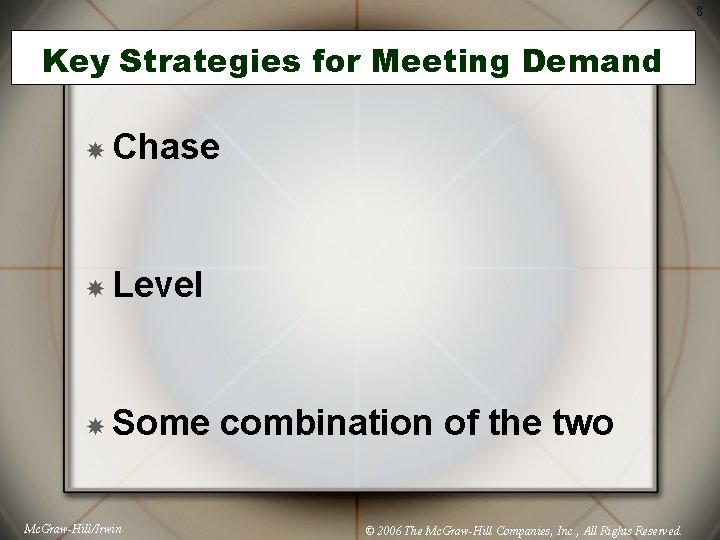
8 Key Strategies for Meeting Demand Chase Level Some Mc. Graw-Hill/Irwin combination of the two © 2006 The Mc. Graw-Hill Companies, Inc. , All Rights Reserved.
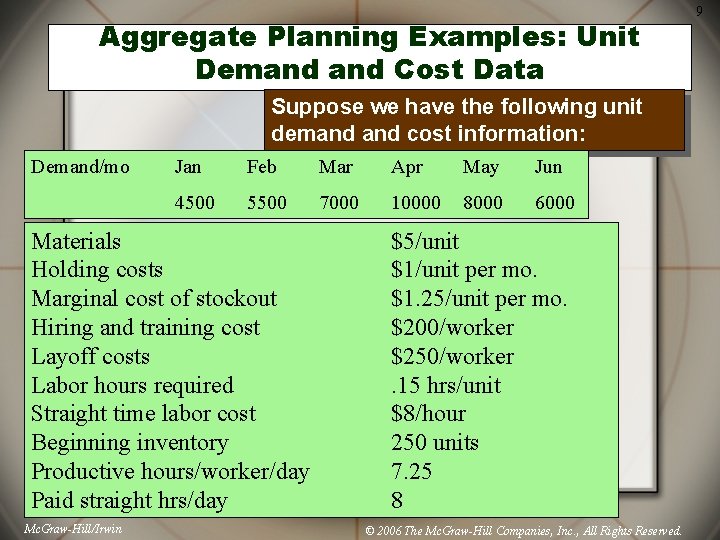
Aggregate Planning Examples: Unit Demand Cost Data Suppose we have the following unit demand cost information: Demand/mo Jan Feb Mar Apr May Jun 4500 5500 7000 10000 8000 6000 Materials Holding costs Marginal cost of stockout Hiring and training cost Layoff costs Labor hours required Straight time labor cost Beginning inventory Productive hours/worker/day Paid straight hrs/day Mc. Graw-Hill/Irwin $5/unit $1/unit per mo. $1. 25/unit per mo. $200/worker $250/worker. 15 hrs/unit $8/hour 250 units 7. 25 8 © 2006 The Mc. Graw-Hill Companies, Inc. , All Rights Reserved. 9
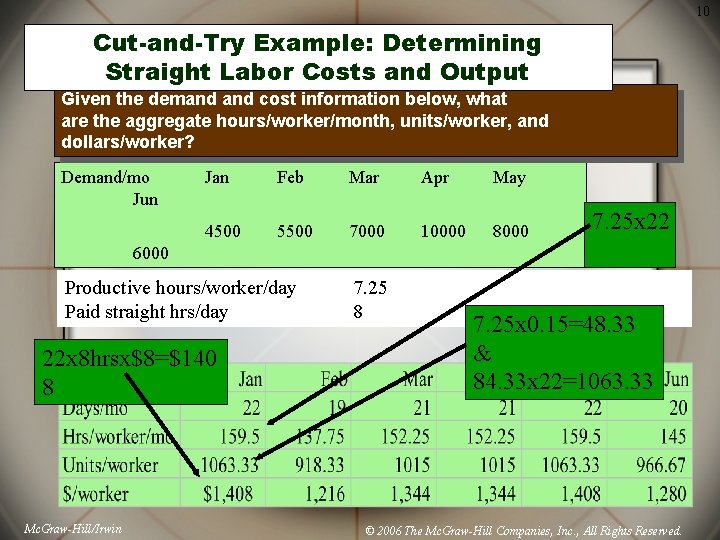
10 Cut-and-Try Example: Determining Straight Labor Costs and Output Given the demand cost information below, what are the aggregate hours/worker/month, units/worker, and dollars/worker? Demand/mo Jun Jan Feb Mar Apr May 4500 5500 7000 10000 8000 7. 25 x 22 6000 Productive hours/worker/day Paid straight hrs/day 22 x 8 hrsx$8=$140 8 Mc. Graw-Hill/Irwin 7. 25 8 7. 25 x 0. 15=48. 33 & 84. 33 x 22=1063. 33 © 2006 The Mc. Graw-Hill Companies, Inc. , All Rights Reserved.
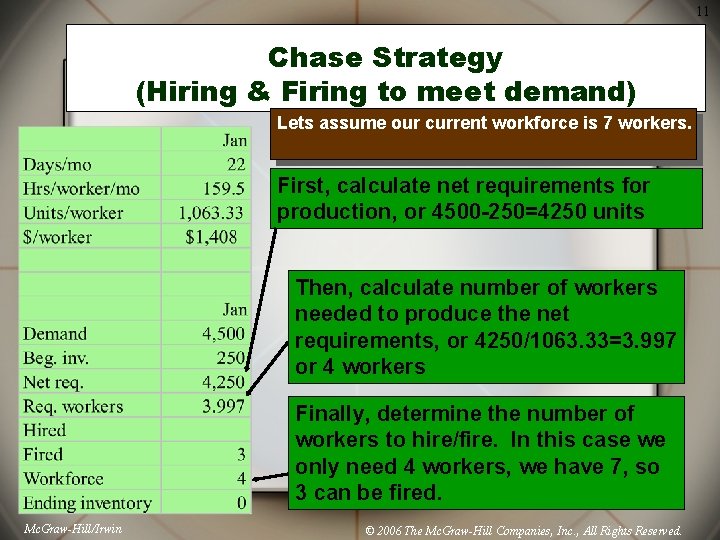
11 Chase Strategy (Hiring & Firing to meet demand) Lets assume our current workforce is 7 workers. First, calculate net requirements for production, or 4500 -250=4250 units Then, calculate number of workers needed to produce the net requirements, or 4250/1063. 33=3. 997 or 4 workers Finally, determine the number of workers to hire/fire. In this case we only need 4 workers, we have 7, so 3 can be fired. Mc. Graw-Hill/Irwin © 2006 The Mc. Graw-Hill Companies, Inc. , All Rights Reserved.
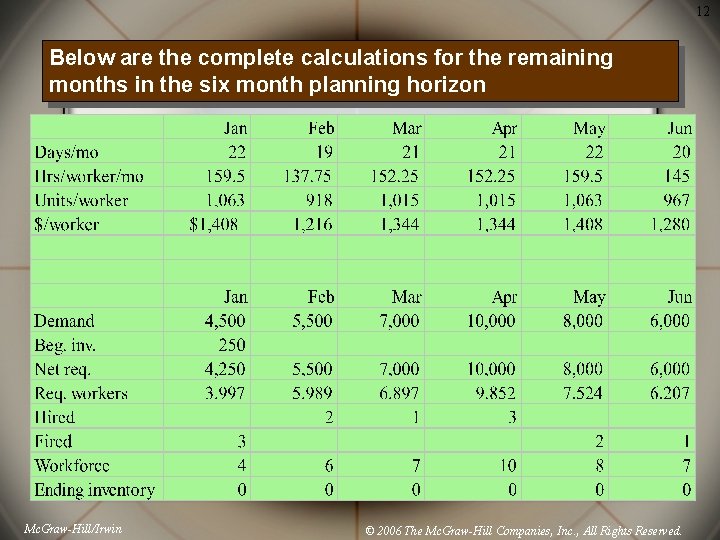
12 Below are the complete calculations for the remaining months in the six month planning horizon Mc. Graw-Hill/Irwin © 2006 The Mc. Graw-Hill Companies, Inc. , All Rights Reserved.
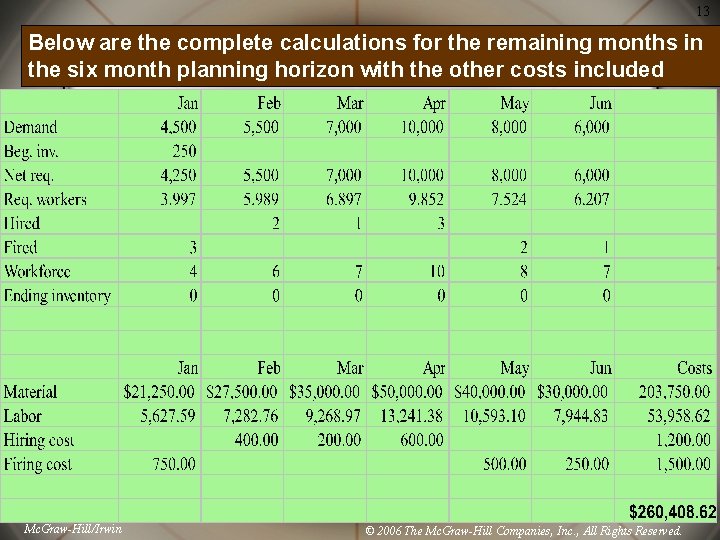
13 Below are the complete calculations for the remaining months in the six month planning horizon with the other costs included Mc. Graw-Hill/Irwin © 2006 The Mc. Graw-Hill Companies, Inc. , All Rights Reserved.
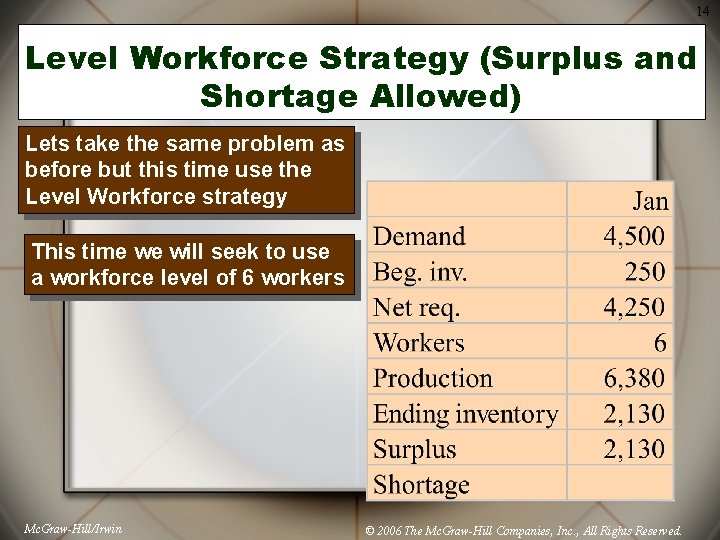
14 Level Workforce Strategy (Surplus and Shortage Allowed) Lets take the same problem as before but this time use the Level Workforce strategy This time we will seek to use a workforce level of 6 workers Mc. Graw-Hill/Irwin © 2006 The Mc. Graw-Hill Companies, Inc. , All Rights Reserved.
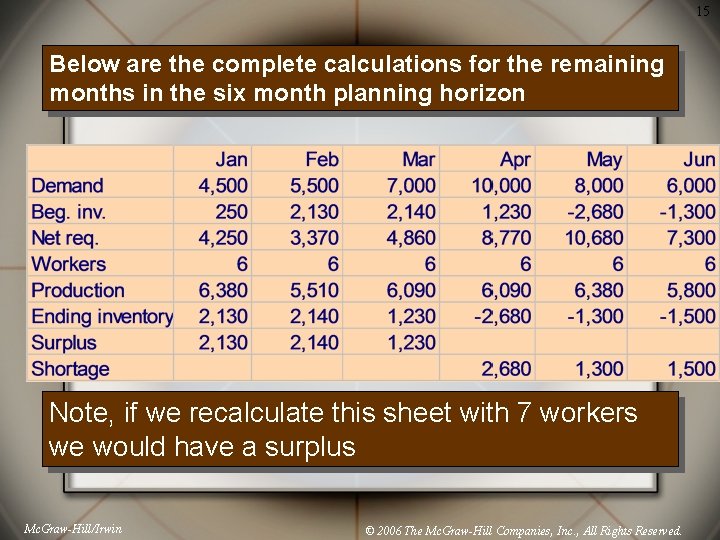
15 Below are the complete calculations for the remaining months in the six month planning horizon Note, if we recalculate this sheet with 7 workers we would have a surplus Mc. Graw-Hill/Irwin © 2006 The Mc. Graw-Hill Companies, Inc. , All Rights Reserved.
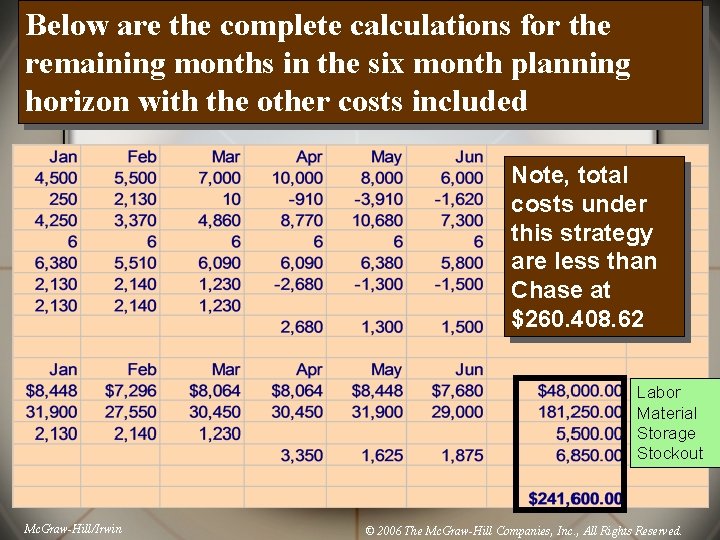
16 Below are the complete calculations for the remaining months in the six month planning horizon with the other costs included Note, total costs under this strategy are less than Chase at $260. 408. 62 Labor Material Storage Stockout Mc. Graw-Hill/Irwin © 2006 The Mc. Graw-Hill Companies, Inc. , All Rights Reserved.