
1 Chapter 10 Chemical Quantities or 2 How


- Slides: 48
1
Chapter 10 Chemical Quantities or 2
How you measure how much? You can measure mass, n or volume, n or you can count pieces. n We measure mass in grams. n We measure volume in liters. n n 3 We count pieces in MOLES.
Moles Defined as the number of carbon atoms in exactly 12 grams of carbon 12. n 1 mole is 6. 02 x 1023 particles. n Treat it like a very large dozen n 6. 02 x 1023 is called Avogadro's number. n 4
Representative particles The smallest pieces of a substance. n For an element it is an atom. – Unless it is diatomic n For a molecular compound it is a molecule. n For an ionic compound it is a formula unit. n 5
Conversion factors Used to change units. n Three questions – What unit do you want to get rid of? – Where does it go to cancel out? – What can you change it into? n 6
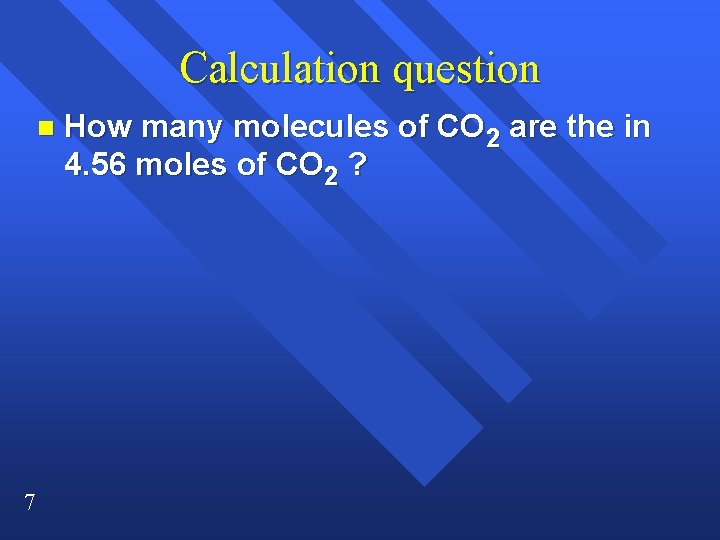
Calculation question n 7 How many molecules of CO 2 are the in 4. 56 moles of CO 2 ?
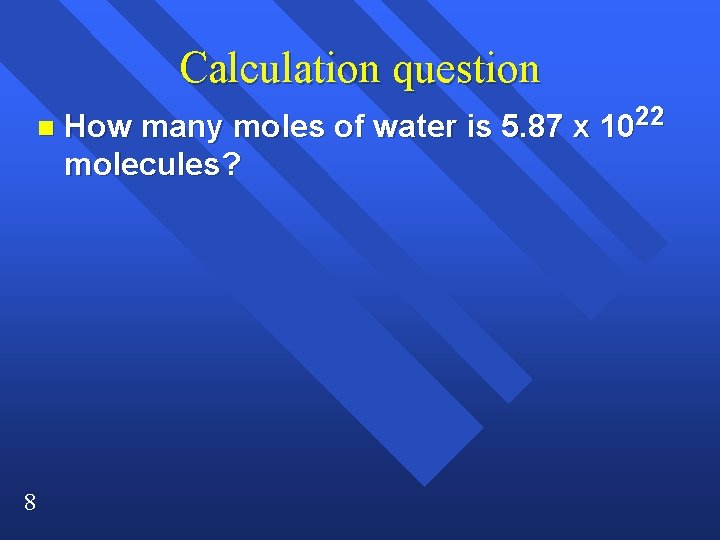
Calculation question n 8 How many moles of water is 5. 87 x 1022 molecules?
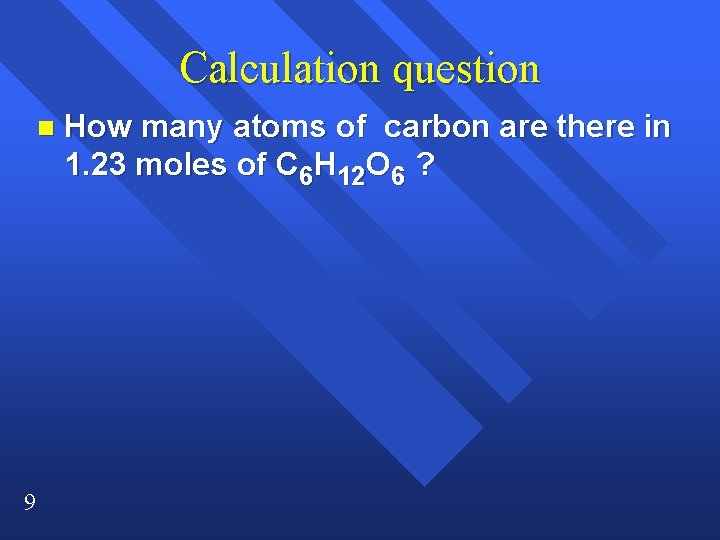
Calculation question n 9 How many atoms of carbon are there in 1. 23 moles of C 6 H 12 O 6 ?
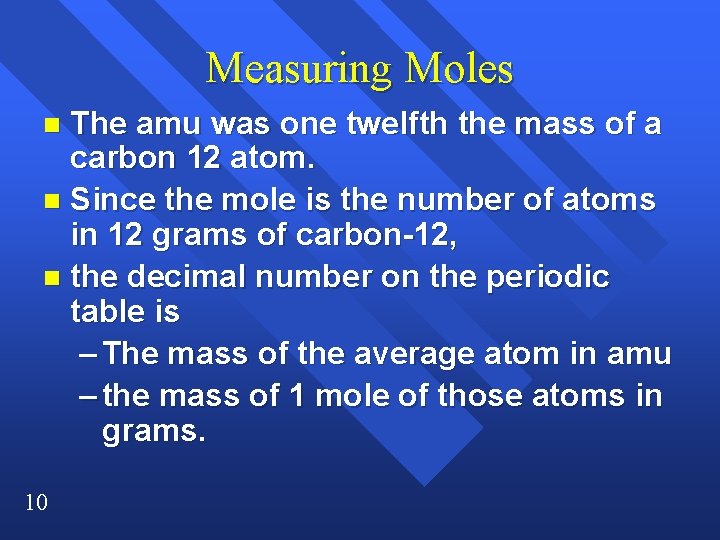
Measuring Moles The amu was one twelfth the mass of a carbon 12 atom. n Since the mole is the number of atoms in 12 grams of carbon-12, n the decimal number on the periodic table is – The mass of the average atom in amu – the mass of 1 mole of those atoms in grams. n 10
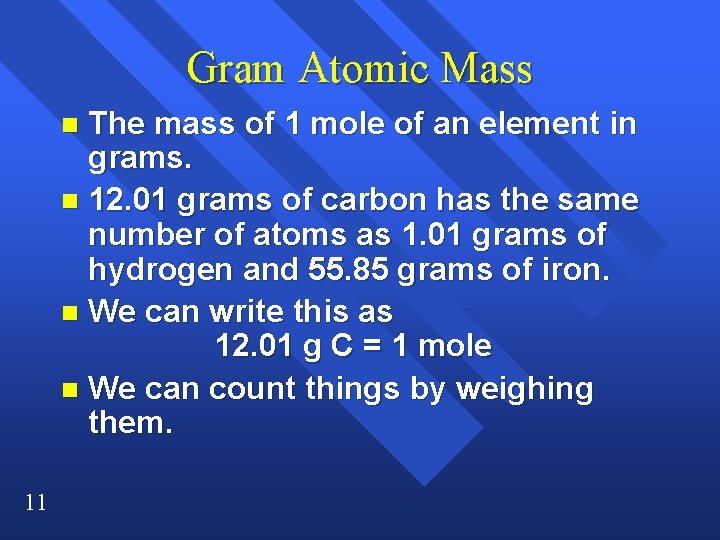
Gram Atomic Mass The mass of 1 mole of an element in grams. n 12. 01 grams of carbon has the same number of atoms as 1. 01 grams of hydrogen and 55. 85 grams of iron. n We can write this as 12. 01 g C = 1 mole n We can count things by weighing them. n 11
Examples n 12 How much would 2. 34 moles of carbon weigh?
Examples n 13 How many moles of magnesium in 4. 61 g of Mg?
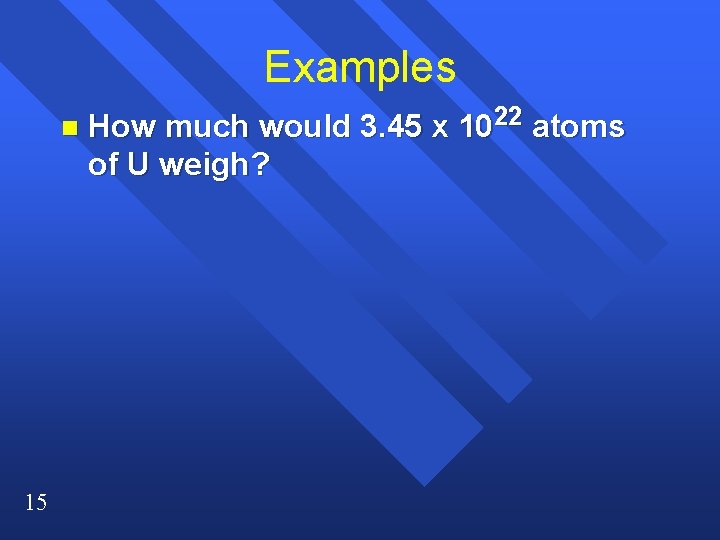
Examples n 15 How much would 3. 45 x 1022 atoms of U weigh?
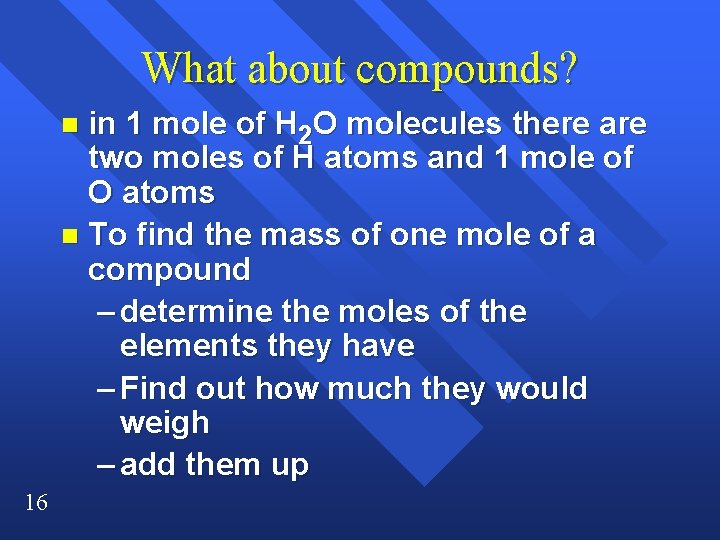
What about compounds? in 1 mole of H 2 O molecules there are two moles of H atoms and 1 mole of O atoms n To find the mass of one mole of a compound – determine the moles of the elements they have – Find out how much they would weigh – add them up n 16
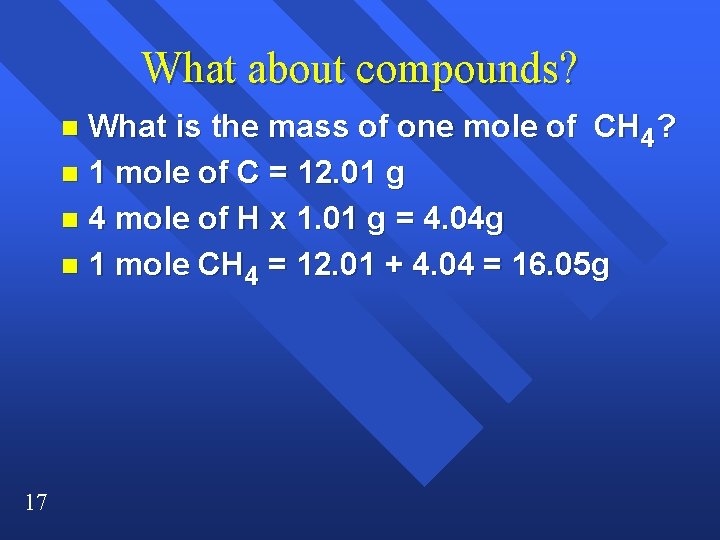
What about compounds? What is the mass of one mole of CH 4? n 1 mole of C = 12. 01 g n 4 mole of H x 1. 01 g = 4. 04 g n 1 mole CH 4 = 12. 01 + 4. 04 = 16. 05 g n 17
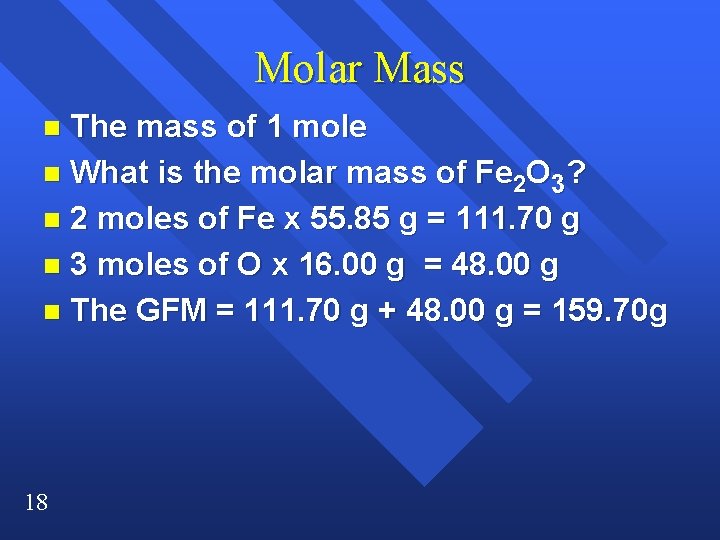
Molar Mass The mass of 1 mole n What is the molar mass of Fe 2 O 3? n 2 moles of Fe x 55. 85 g = 111. 70 g n 3 moles of O x 16. 00 g = 48. 00 g n The GFM = 111. 70 g + 48. 00 g = 159. 70 g n 18
Using Molar Mass Finding moles of compounds Counting pieces by weighing 20
Molar Mass The number of grams in 1 mole of atoms, formula units, or molecules. n We can make conversion factors from these. n To change grams of a compound to moles of a compound. n Or moles to grams n 21
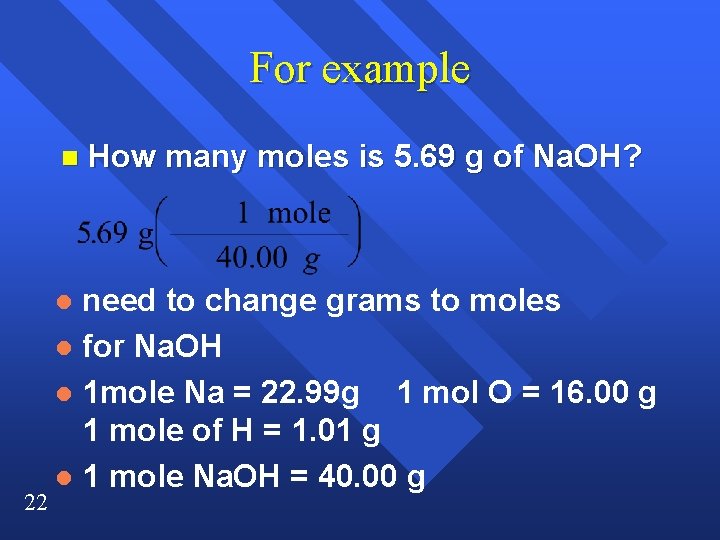
For example n need to change grams to moles l for Na. OH l 1 mole Na = 22. 99 g 1 mol O = 16. 00 g 1 mole of H = 1. 01 g l 1 mole Na. OH = 40. 00 g l 22 How many moles is 5. 69 g of Na. OH?
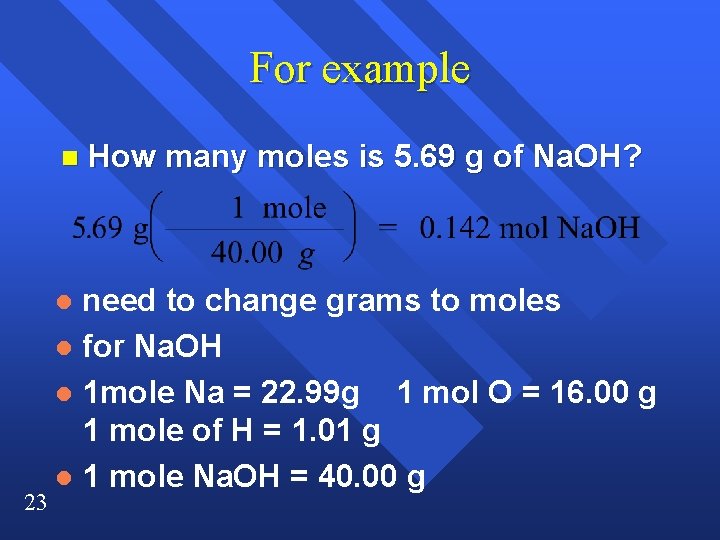
For example n need to change grams to moles l for Na. OH l 1 mole Na = 22. 99 g 1 mol O = 16. 00 g 1 mole of H = 1. 01 g l 1 mole Na. OH = 40. 00 g l 23 How many moles is 5. 69 g of Na. OH?
Gases and the Mole 24
n Many Gases of the chemicals we deal with are gases. n They are difficult to weigh, so we’ll measure volume n Need to know how many moles of gas we have. n Two things affect the volume of a gas n Temperature and pressure n Compare at the same temp. and pressure. 25
Standard Temperature and Pressure n Avogadro's Hypothesis - at the same temperature and pressure equal volumes of gas have the same number of particles. n 0ºC and 1 atmosphere pressure n Abbreviated atm n 273 K and 101. 3 k. Pa n k. Pa is kilo. Pascal 26
At Standard Temperature and Pressure n abbreviated STP n At STP 1 mole of gas occupies 22. 4 L n Called the molar volume n Used for conversion factors n Moles to Liter and L to mol 27
Examples n. What is the volume of 4. 59 mole of CO 2 gas at STP? 28
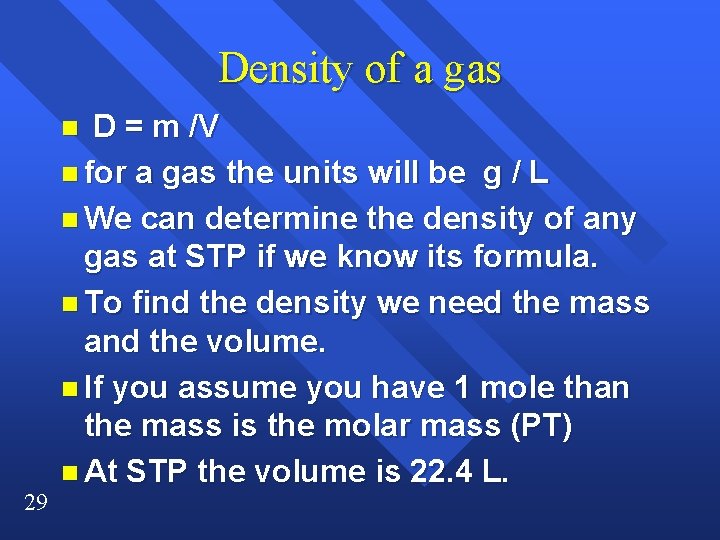
Density of a gas D = m /V n for a gas the units will be g / L n We can determine the density of any gas at STP if we know its formula. n To find the density we need the mass and the volume. n If you assume you have 1 mole than the mass is the molar mass (PT) n At STP the volume is 22. 4 L. n 29
Examples n Find 30 the density of CO 2 at STP.
Quizdom n 31 Find the density of CH 4 at STP.
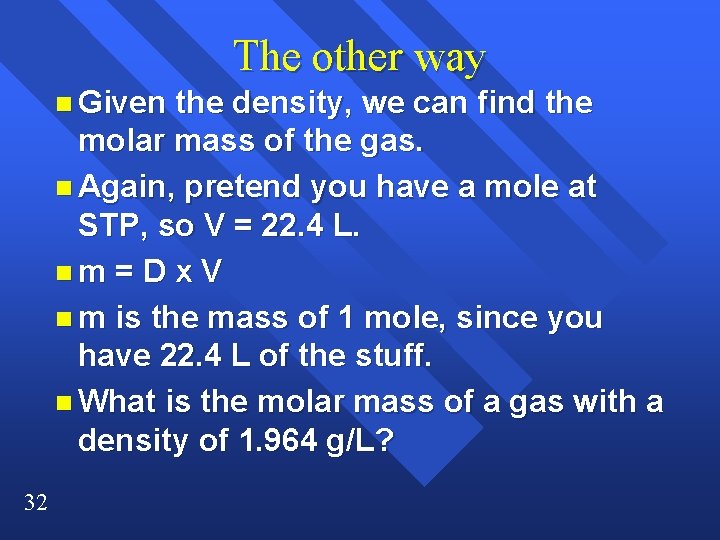
The other way n Given the density, we can find the molar mass of the gas. n Again, pretend you have a mole at STP, so V = 22. 4 L. nm = D x V n m is the mass of 1 mole, since you have 22. 4 L of the stuff. n What is the molar mass of a gas with a density of 1. 964 g/L? 32
All the things we can change 33
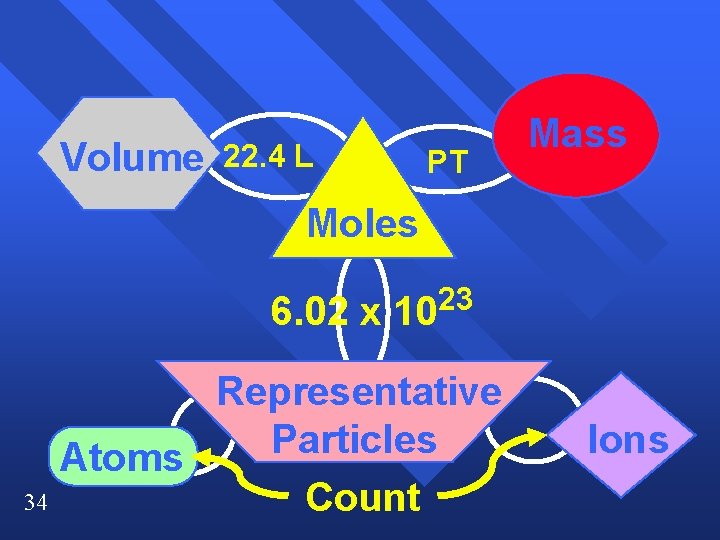
Volume 22. 4 L PT Mass Moles 6. 02 x 34 23 10 Representative Particles Atoms Count Ions
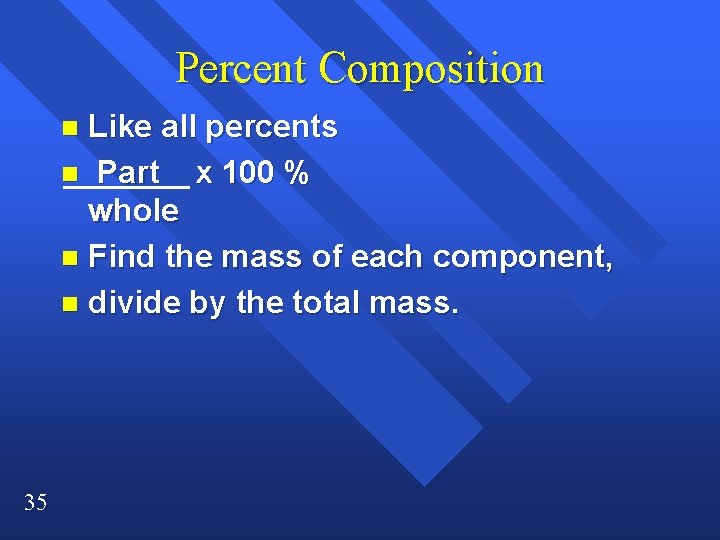
Percent Composition Like all percents n Part x 100 % whole n Find the mass of each component, n divide by the total mass. n 35
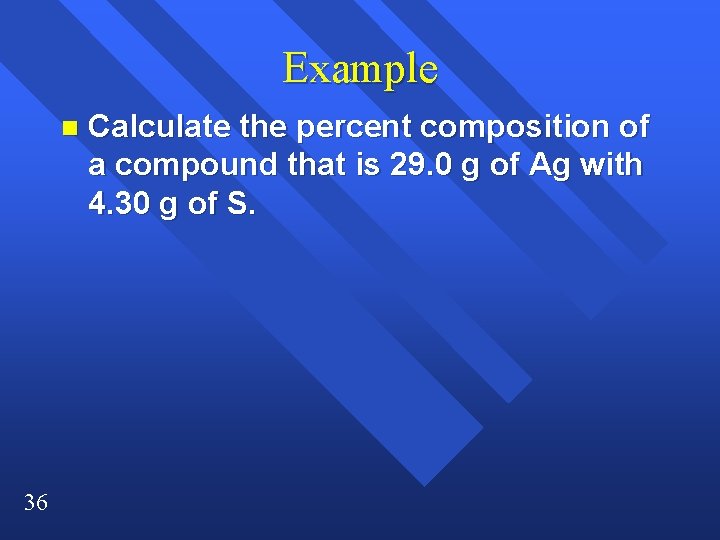
Example n 36 Calculate the percent composition of a compound that is 29. 0 g of Ag with 4. 30 g of S.
Getting it from the formula If we know the formula, assume you have 1 mole. n Then you know the pieces and the whole. n 37
Examples n 38 Calculate the percent composition of C 2 H 4?
Examples n 39 What is the percent composition of Aluminum carbonate.
Percent to Mass Multiply % by the total mass to find the mass of that component. n How much aluminum in 450 g of aluminum carbonate? n 40
Empirical Formula From percentage to formula 41
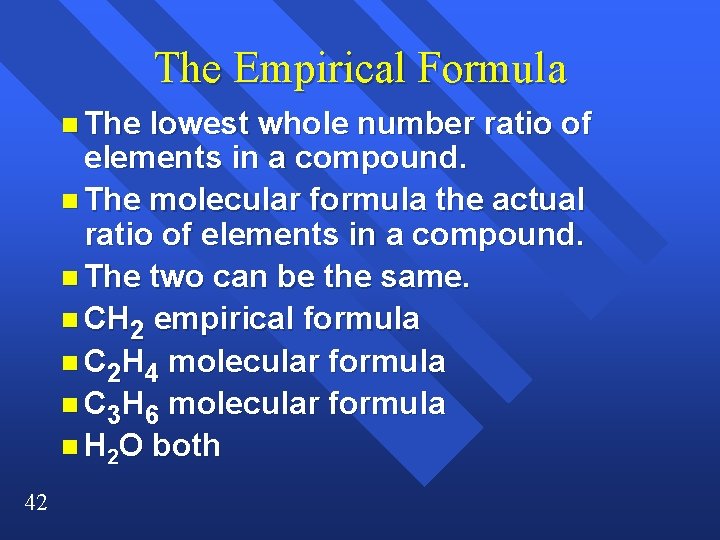
The Empirical Formula n The lowest whole number ratio of elements in a compound. n The molecular formula the actual ratio of elements in a compound. n The two can be the same. n CH 2 empirical formula n C 2 H 4 molecular formula n C 3 H 6 molecular formula n H 2 O both 42
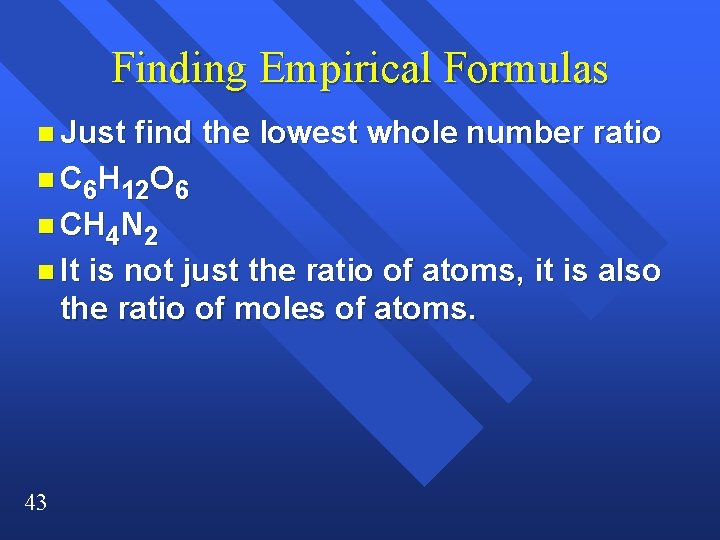
Finding Empirical Formulas n Just find the lowest whole number ratio n C 6 H 12 O 6 n CH 4 N 2 n It is not just the ratio of atoms, it is also the ratio of moles of atoms. 43
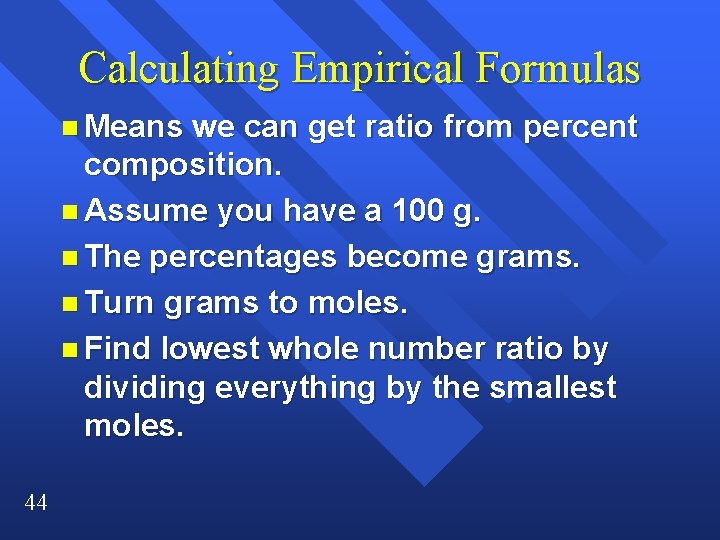
Calculating Empirical Formulas n Means we can get ratio from percent composition. n Assume you have a 100 g. n The percentages become grams. n Turn grams to moles. n Find lowest whole number ratio by dividing everything by the smallest moles. 44
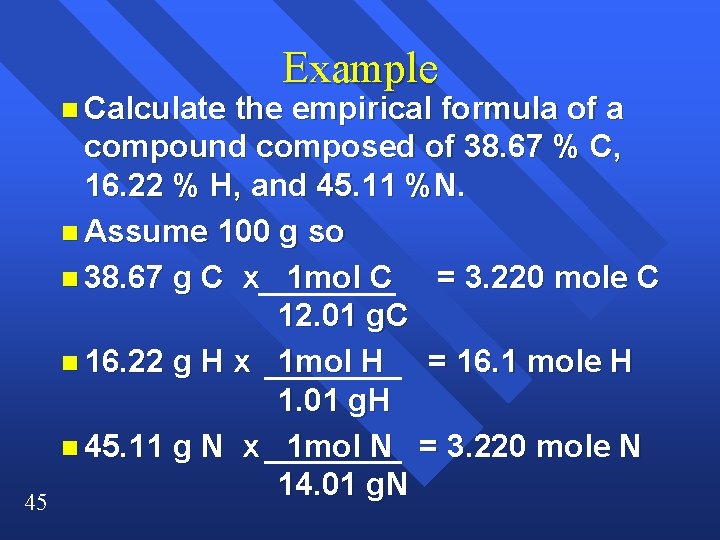
n Calculate 45 Example the empirical formula of a compound composed of 38. 67 % C, 16. 22 % H, and 45. 11 %N. n Assume 100 g so n 38. 67 g C x 1 mol C = 3. 220 mole C 12. 01 g. C n 16. 22 g H x 1 mol H = 16. 1 mole H 1. 01 g. H n 45. 11 g N x 1 mol N = 3. 220 mole N 14. 01 g. N
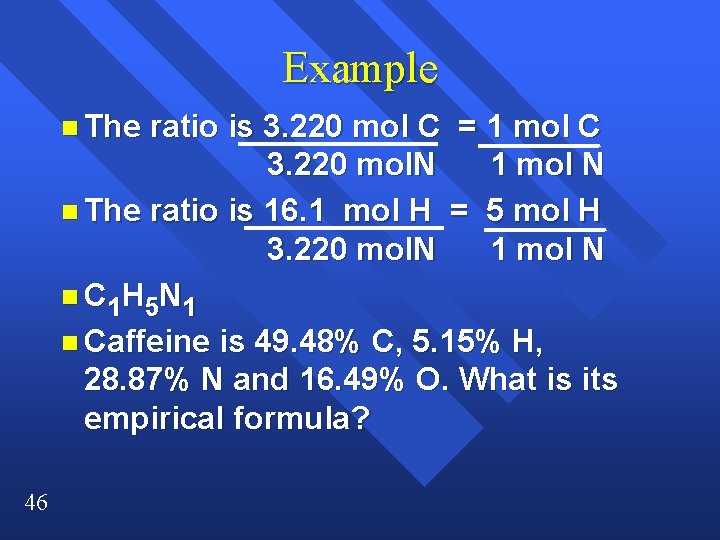
Example n The ratio is 3. 220 mol C = 1 mol C 3. 220 mol. N 1 mol N n The ratio is 16. 1 mol H = 5 mol H 3. 220 mol. N 1 mol N n C 1 H 5 N 1 n Caffeine is 49. 48% C, 5. 15% H, 28. 87% N and 16. 49% O. What is its empirical formula? 46
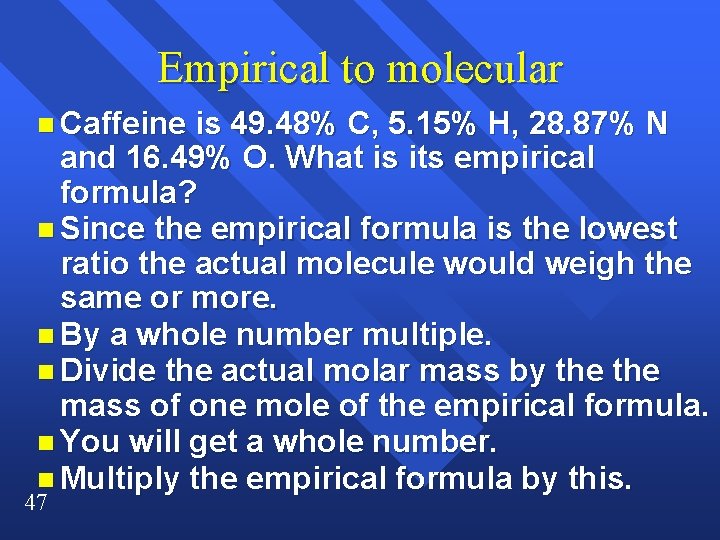
Empirical to molecular n Caffeine is 49. 48% C, 5. 15% H, 28. 87% N and 16. 49% O. What is its empirical formula? n Since the empirical formula is the lowest ratio the actual molecule would weigh the same or more. n By a whole number multiple. n Divide the actual molar mass by the mass of one mole of the empirical formula. n You will get a whole number. n Multiply the empirical formula by this. 47
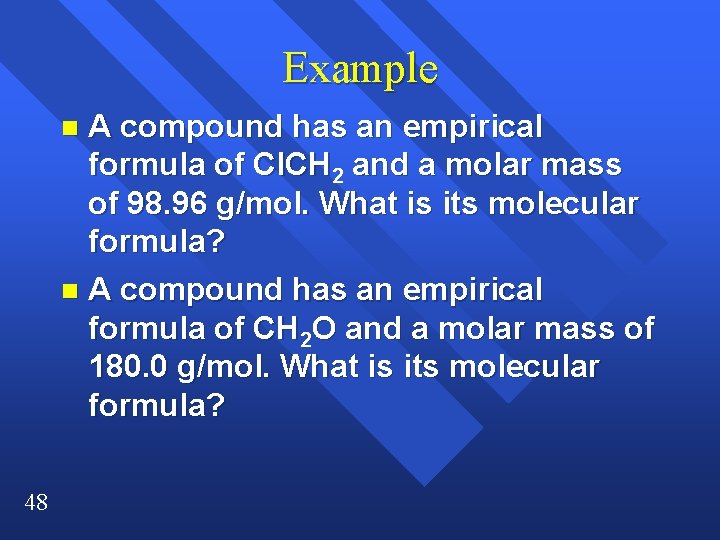
Example A compound has an empirical formula of Cl. CH 2 and a molar mass of 98. 96 g/mol. What is its molecular formula? n A compound has an empirical formula of CH 2 O and a molar mass of 180. 0 g/mol. What is its molecular formula? n 48
Percent to molecular n Take 49 the percent x the molar mass –This gives you mass in one mole of the compound n Change this to moles –You will get whole numbers –These are the subscripts n Caffeine is 49. 48% C, 5. 15% H, 28. 87% N and 16. 49% O. It has a molar mass of 194 g. What is its molecular formula?
Example n Ibuprofen is 75. 69 % C, 8. 80 % H, 15. 51 % O, and has a molar mass of about 207 g/mol. What is its molecular formula? 50