
1 Chapter 1 Inlab Quiz Next week Database

1 Chapter 1 In-lab Quiz Next week Database Systems: Design, Implementation, & Management, 7 th Edition, Rob & Coronel
1 Structural and Data Dependence • Structural dependence – Access to a file depends on its structure • Data dependence – Changes in the data storage characteristics without affecting the application program’s ability to access the data – Logical data format • How the human being views the data – Physical data format • How the computer “sees” the data Database Systems: Design, Implementation, & Management, 7 th Edition, Rob & Coronel
1 Field Definitions and Naming Conventions • Flexible record definition anticipates reporting requirements by breaking up fields into their component parts Database Systems: Design, Implementation, & Management, 7 th Edition, Rob & Coronel
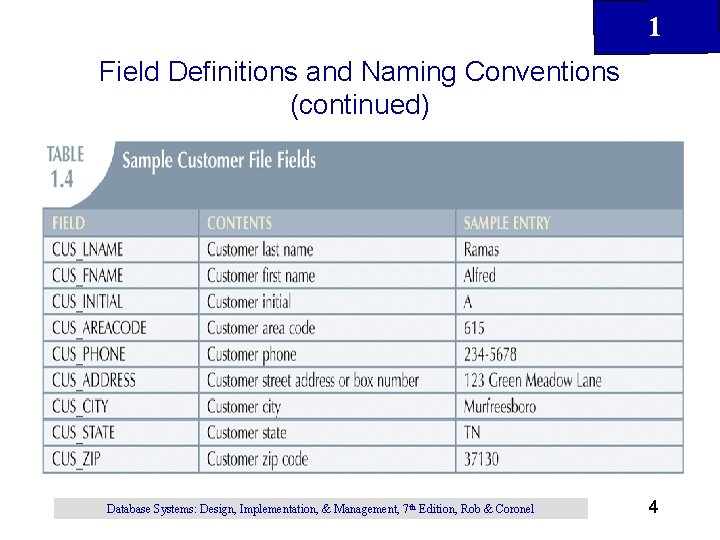
1 Field Definitions and Naming Conventions (continued) Database Systems: Design, Implementation, & Management, 7 th Edition, Rob & Coronel 4
1 Data Redundancy • Data redundancy results in data inconsistency – Different and conflicting versions of the same data appear in different places • Errors more likely to occur when complex entries are made in several different files and/or recur frequently in one or more files • Data anomalies develop when required changes in redundant data are not made successfully Database Systems: Design, Implementation, & Management, 7 th Edition, Rob & Coronel
1 Data Anomalies Types of data anomalies: • Update anomalies – Occur when changes must be made to existing records • Insertion anomalies – Occur when entering new records • Deletion anomalies – Occur when deleting records Database Systems: Design, Implementation, & Management, 7 th Edition, Rob & Coronel
1 The Database System Environment • Database system is composed of five parts: – Hardware – Software • Operating system software • DBMS software • Application programs and utility software – People – Procedures – Database Systems: Design, Implementation, & Management, 7 th Edition, Rob & Coronel main
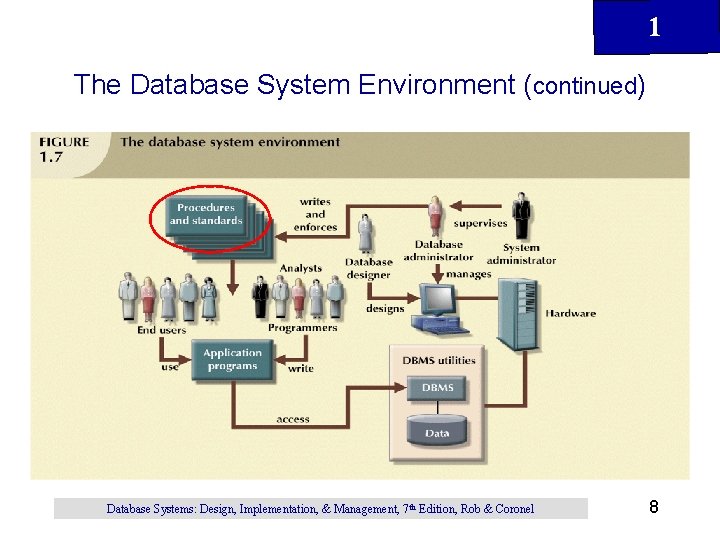
1 The Database System Environment (continued) Database Systems: Design, Implementation, & Management, 7 th Edition, Rob & Coronel 8
1 DBMS Functions • Manage DB structure and controls access • Share data among multiple users • Make data management more efficient and effective • Integrated view of organization’s operations • Promotes data consistency and integrity • Quick answers to ad hoc queries • Security Database Systems: Design, Implementation, & Management, 7 th Edition, Rob & Coronel
1 DBMS Functions • DBMS performs functions that guarantee integrity and consistency of data – Data dictionary management • defines data elements and their relationships – Data storage management • stores data and related data entry forms, report definitions, etc. Database Systems: Design, Implementation, & Management, 7 th Edition, Rob & Coronel
1 DBMS Functions (continued) – Data transformation and presentation • translates logical requests into commands to physically locate and retrieve the requested data – Security management • enforces user security and data privacy within database Database Systems: Design, Implementation, & Management, 7 th Edition, Rob & Coronel
1 DBMS Functions (continued) – Multiuser access control • uses sophisticated algorithms to ensure multiple users can access the database concurrently without compromising the integrity of the database – Backup and recovery management • provides backup and data recovery procedures – Data integrity management • promotes and enforces integrity rules Database Systems: Design, Implementation, & Management, 7 th Edition, Rob & Coronel
1 DBMS Functions (continued) – Database access languages and application programming interfaces • provide data access through a query language – Database communication interfaces • allow database to accept end-user requests via multiple, different network environments Database Systems: Design, Implementation, & Management, 7 th Edition, Rob & Coronel
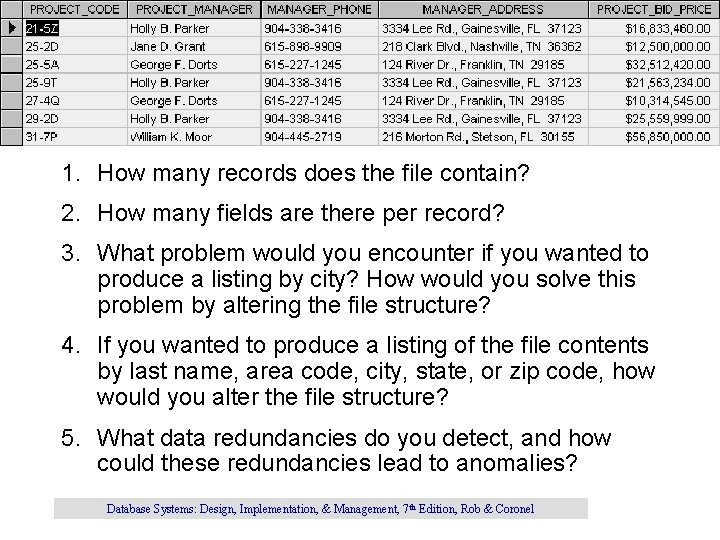
1 1. How many records does the file contain? 2. How many fields are there per record? 3. What problem would you encounter if you wanted to produce a listing by city? How would you solve this problem by altering the file structure? 4. If you wanted to produce a listing of the file contents by last name, area code, city, state, or zip code, how would you alter the file structure? 5. What data redundancies do you detect, and how could these redundancies lead to anomalies? Database Systems: Design, Implementation, & Management, 7 th Edition, Rob & Coronel
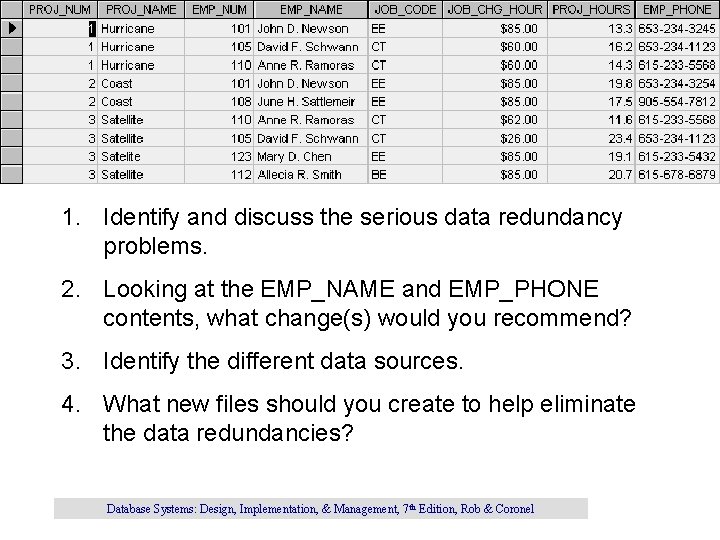
1 1. Identify and discuss the serious data redundancy problems. 2. Looking at the EMP_NAME and EMP_PHONE contents, what change(s) would you recommend? 3. Identify the different data sources. 4. What new files should you create to help eliminate the data redundancies? Database Systems: Design, Implementation, & Management, 7 th Edition, Rob & Coronel
- Slides: 15