
1 Ch 4 Electronics Signals Laboratorium Telematika ITB
1
Ch 4. Electronics & Signals Laboratorium Telematika - ITB Cisco Regional Networking Academy Semester 1 Version 2. 1. 1 Duration: 75 minutes 2
Overview n n Focus is basic theory of electricity. Provides foundation for understanding the physical layer of the OSI model. u How data is transmitted through physical media, such as cables and connectors. u Different factors that affect data transmission such as AC power line noise. 3
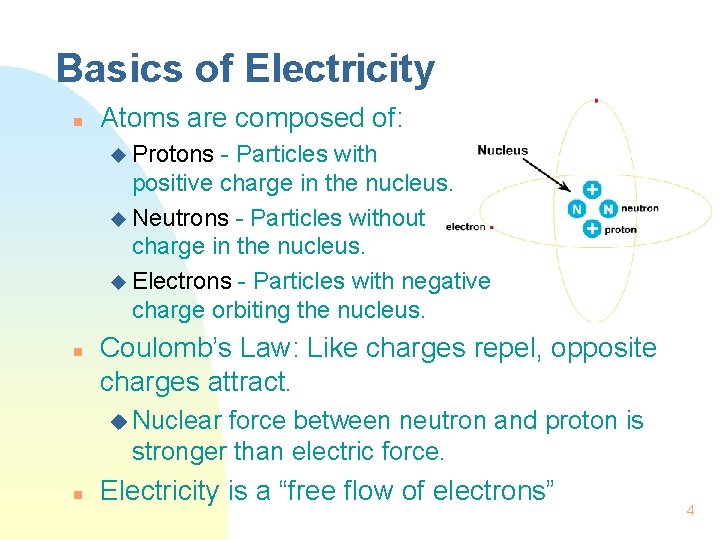
Basics of Electricity n Atoms are composed of: u Protons - Particles with positive charge in the nucleus. u Neutrons - Particles without charge in the nucleus. u Electrons - Particles with negative charge orbiting the nucleus. n Coulomb’s Law: Like charges repel, opposite charges attract. u Nuclear force between neutron and proton is stronger than electric force. n Electricity is a “free flow of electrons” 4
Static Electricity n Static Electricity is loosened electrons that stay in one place. u Charges can be separated by friction, e. g. by shuffling you feet across a carpet. u Very high voltages (thousands of volts) can be generated! n When you reach for a metal object, a spark occurs - this is current flow, as the high voltage pushes the free electrons to the metal object. u This is ESD or electro-static discharge. u Can randomly damage computer chips and/or data. 5
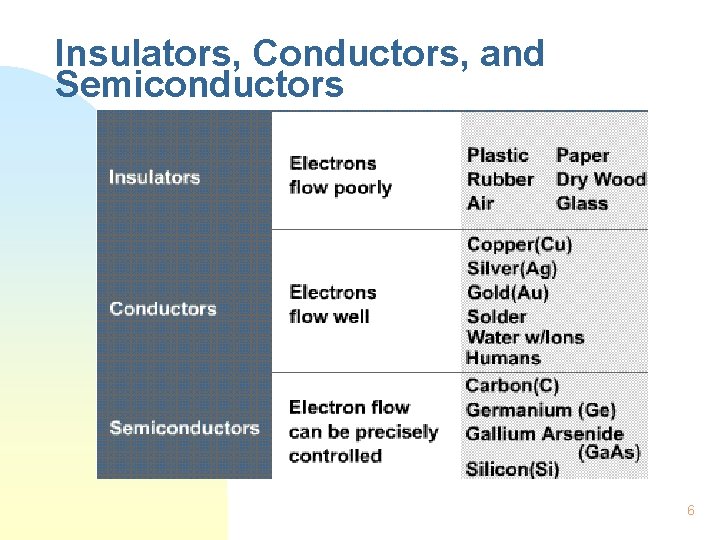
Insulators, Conductors, and Semiconductors 6
Electrical Terms (1) n Voltage or Electromotive Force (EMF): electrical force, or pressure on charges. u Represented by the letter "V” or "E”. u Unit of voltage is volt (V). n Current: flow of charges (free electrons). u Represented by the letter "I". u Unit of current is ampere (Amp or A). n Resistance: opposition to the movement of electrons. u Represented by the letter "R". u Unit of resistance is the Ohm, W. 7
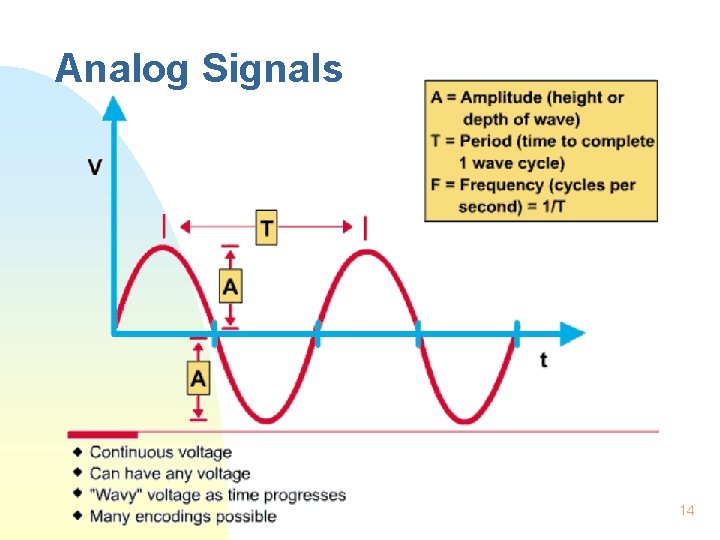
Electrical Terms (2) n Alternating Current (AC) or AC voltage. u Varies with time, periodically changes direction or polarity. n Direct Current (DC) or DC voltage u Always flow in the same direction; or always has the same polarity. n Impedance u Total opposition to current flow (for AC and DC). u Represented by the letter "Z". u Unit of impedance is the Ohm (W). 8
Electrical Terms (3) n Voltage, Current, Resistance Relationship u Currents flow in closed loops called circuits. F Network cabling contains many circuits. F Network devices contains millions of circuits. u Voltage causes current flow. u Resistance and impedance oppose current flow. n Ground u Earth potential at your location. u Zero reference level. 9
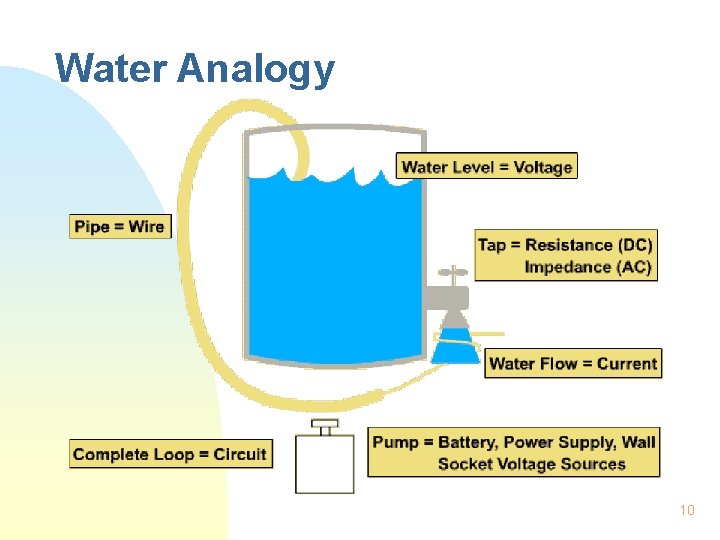
Water Analogy 10
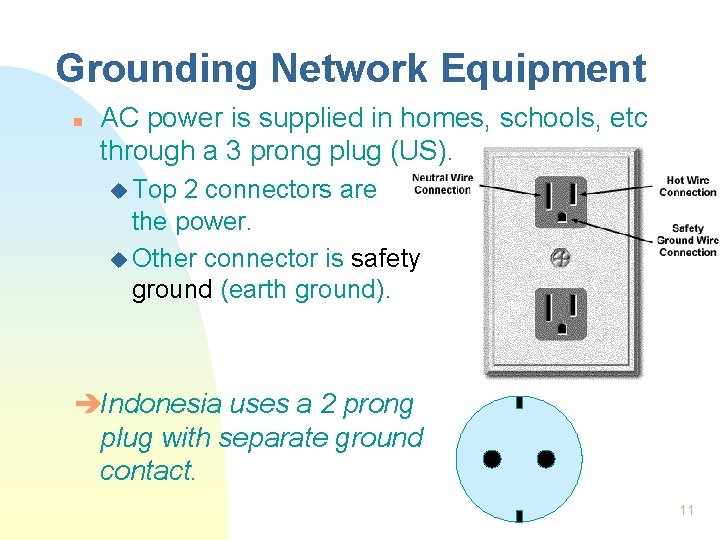
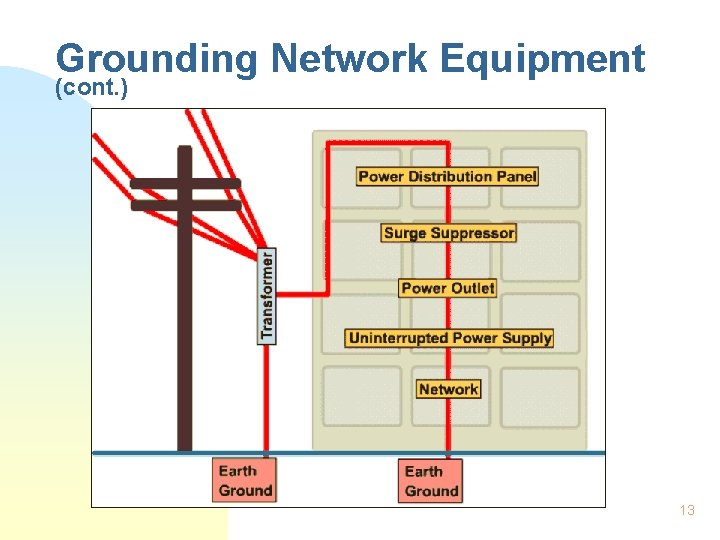
Grounding Network Equipment n AC power is supplied in homes, schools, etc through a 3 prong plug (US). u Top 2 connectors are the power. u Other connector is safety ground (earth ground). èIndonesia uses a 2 prong plug with separate ground contact. 11
Grounding Network Equipment (cont. ) n Any exposed metal is connected to safety ground. u Computer motherboard’s ground plane is connected to the chassis and safety ground. n n Ground helps dissipate static electricity. Purpose of safety ground: to prevent exposed metal parts from becoming energized should a wiring fault occur in device. u In this case, current will flow through the ground connection, and activate protective devices such as circuit breakers to disconnect the power. 12
Grounding Network Equipment (cont. ) 13
Analog Signals 14

Digital Signals 15
Fourier Synthesis of a Square Wave 16
Signals on the Physical Media n Typically electronic digital (binary) signals are represented: u Electrically: ‘ 1’ as +5 v; ‘ 0’ as 0 v. u Optically: ‘ 1’ as high-intensity light; ‘ 0’ as lowintensity light (or no light). n Zero level is signal reference ground. u Ground plane on printed circuit boards, connected to chassis, which is connected to safety ground or earth ground. n Six things can happen to 1 bit: u propagation, attenuation, reflection, noise, timing 17 problem, and collisions.
Network Signal Propagation n n Propagation means travel. It takes some time for a signal to travel through the network, from source to destination. u This is called propagation delay. u Time taken for propagation from one end of the medium and back again is called round trip time (RTT). 18
Network Attenuation n Attenuation is the loss of signal strength. u Some loss is always unavoidable due to electrical resistance, light absorption, or atmospheric scatter. n n Attenuation limits the length of the network cabling. Can resolve problem of attenuation: u By choice of networking media. F Use u Use structures with low amounts of attenuation. repeaters F There are repeaters for electrical, optical, and wireless networks. 19
Network Reflection n Reflection occurs when voltage pulses, or bits, hit a discontinuity and some energy is ‘reflected’. Reflection cause interference with later bits. For optimal network performance, it is important that the impedance of the network media matches the NICs. u For optimal signal transfer (max power transfer), we need matched impedance. u Cables have characteristic impedances: F UTP — 100 ohms F STP — 100 or 150 ohms F Coax — 50 or 75 ohms 20
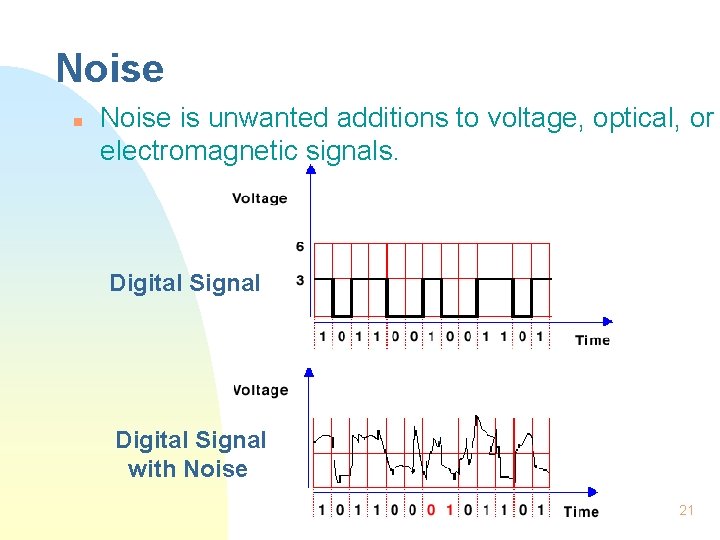
Noise n Noise is unwanted additions to voltage, optical, or electromagnetic signals. Digital Signal with Noise 21
Sources of Noise n NEXT - near end crosstalk. u From signals on other wires in the cable. u Usually due to untwisting at ends of cable. n Thermal Noise u Due to the random motion of electrons. u Usually relatively small compared to our signals. n n AC Power and reference ground noises. Electromagnetic Interference (EMI) and Radio Frequency Interference (RFI) u Caused by lighting, electrical motors, and radio systems. 22
AC Power Line Noise n n n Electricity supplied by the power company is AC voltage creates noise, due to a changing magnetic field around the power lines. AC noise, a form of EMI, can produce errors in your data. 23
Avoiding Problem of Electrical Noise n Single power transformer for your LAN. u Short neutral and ground lines. u Restrict noise creating devices like motors, heater, etc. n Use separate power panels for each work area. u Minimizes neutral and ground leads (connected together at power panel). 24
Interference n n n EMI - electromagnetic interference, from magnetic fields from motors, heavy equipment. RFI - radio frequency interference, from transmitting equipment. Two techniques in dealing with EMI and RFI are shielding and cancellation. u Shielding (a barrier to any interfering signals) increases size of the conductors and its costs. u Cancellation is the preferred technique to deal with undesirable interference. 25
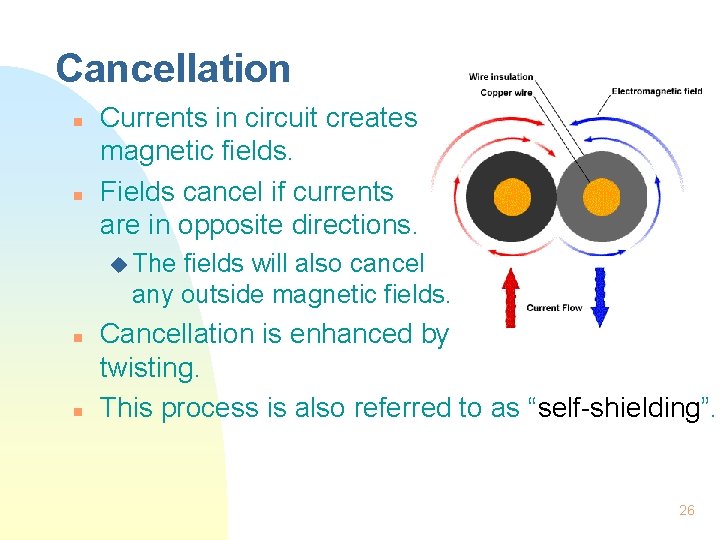
Cancellation n n Currents in circuit creates magnetic fields. Fields cancel if currents are in opposite directions. u The fields will also cancel any outside magnetic fields. n n Cancellation is enhanced by twisting. This process is also referred to as “self-shielding”. 26
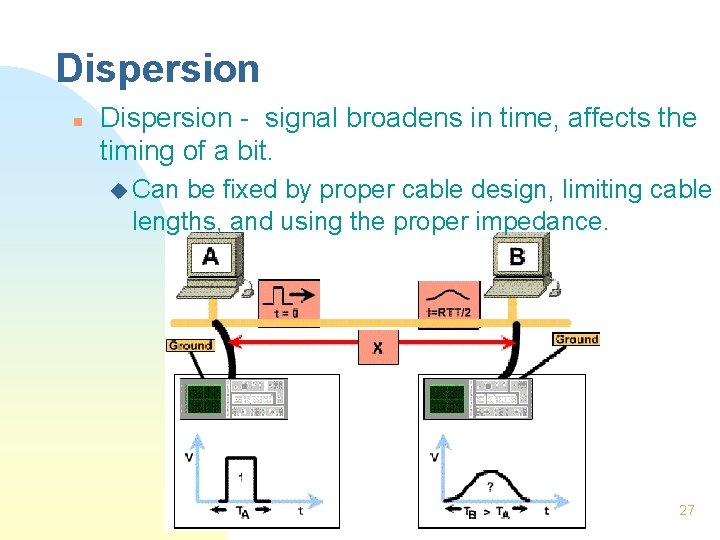
Dispersion n Dispersion - signal broadens in time, affects the timing of a bit. u Can be fixed by proper cable design, limiting cable lengths, and using the proper impedance. 27
Jitter n If the clock on source host is not synchronized with the destination, you get timing jitter. u Bits n n arrive a little earlier or later than expected. Jitter can be fixed by a series of complicated clock synchronization, including hardware and software, or protocol synchronization. Jitter can cause errors as the receiving computer tries to reassemble packets into a message 28
Latency n Latency is delay. u Signals take some time to travel thru the network, giving propagation delay. u Devices have latency, time it takes to process the signal. u It takes time to transmit a signal, giving transmission delay. n Problem of latency is solved by careful use of internetworking devices, different encoding strategies, and various layer protocols. 29
Collisions n Collision occurs when two bits from two different communicating computers are on a sharedmedium at the same time. u The n bits are corrupted, "destroyed". In some instances, collisions are a natural part of the functioning of a network. u Excessive collisions can slow the network down or bring it to a halt. n Two common ways to deal with collisions: u Have rules, such as backoff in Ethernet. u Prevent collisions, as with tokens in token-ring and FDDI. 30
Encoding and Modulation n To send a message over a long distance, need to address two problems: u How to express the message (encoding or modulation); . F Encoding means converting binary data into a form that can be sent on a physical communications link. F Modulation means using the binary data to manipulate a wave. u How to transport the message (carrier). 31
Encoding Network Signals n Computers use three technologies, encoding messages as: u voltages on copper media. u pulses of guided light on optical fibers. u modulated, radiated electromagnetic waves. 32
Encoding Network Signals (cont. ) n Encoding means converting 1 s and 0 s into a form for transmission: u An electrical pulse on a wire; u A light pulse on an optical fiber; or u A pulse of electromagnetic waves. n Two methods of encoding are: u NRZ (Non-Return to Zero) encoding - based on the signal level. u Manchester encoding - based on signal level transitions. 33
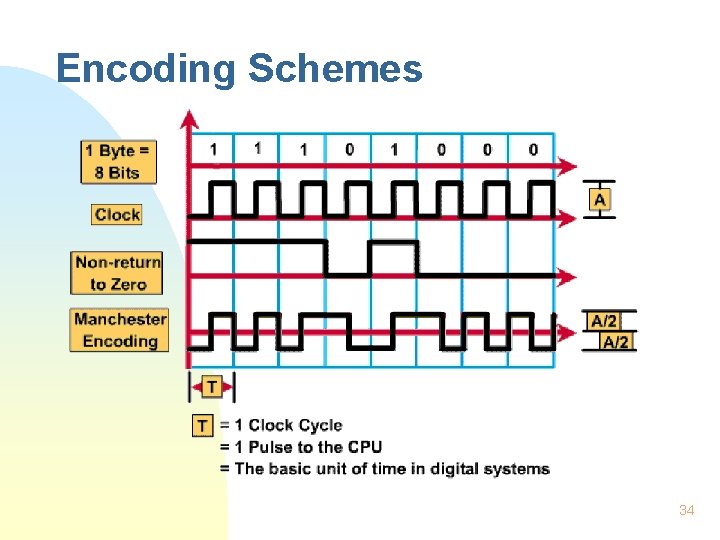
Encoding Schemes 34
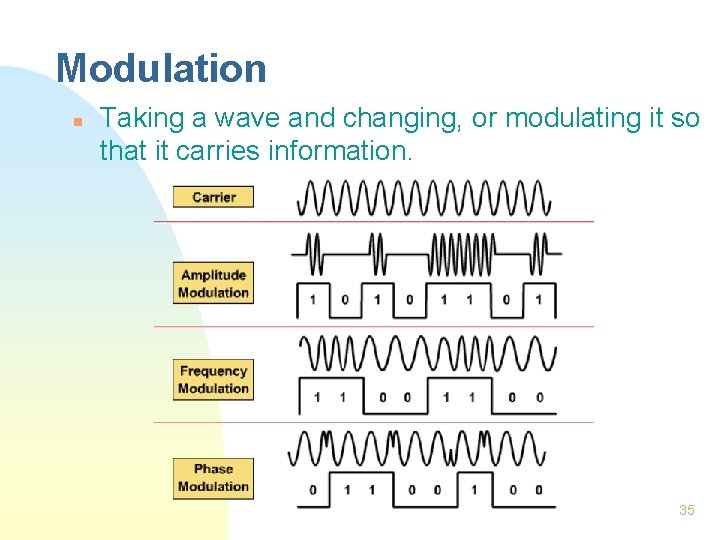
Modulation n Taking a wave and changing, or modulating it so that it carries information. 35
Summary n n Basic electricity - voltage, current, resistance, and impedance. AC and DC. Electrical grounds provide a reference from which to measure voltage. They also provide a safety mechanism to prevent hazardous shocks. Signals in a network will experience: u Propagation, Attenuation, Reflection, Noise, Timing problem (dispersion, jitter, and latency), Collision. n Encoding and Modulation. 36
The End 37
- Slides: 37