
1 Cerebellum YungYang Lin Institute of Brain Science
1 Cerebellum Yung-Yang Lin Institute of Brain Science National Yang-Ming University Reference: 20090513
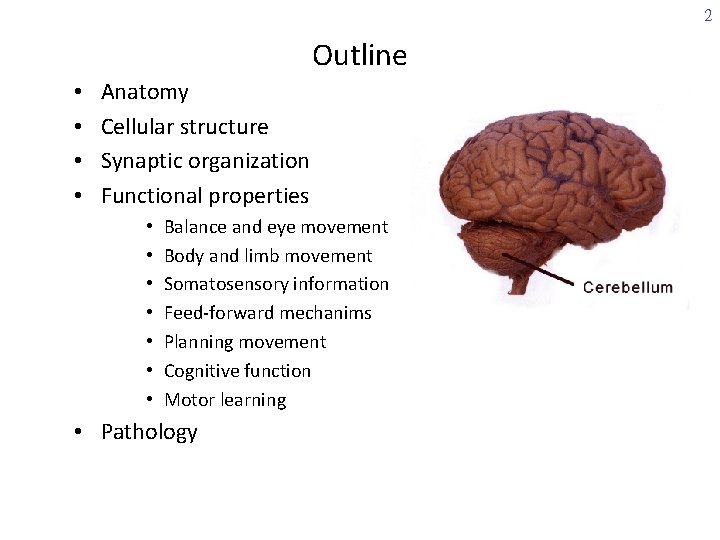
2 Outline • • Anatomy Cellular structure Synaptic organization Functional properties • • Balance and eye movement Body and limb movement Somatosensory information Feed-forward mechanims Planning movement Cognitive function Motor learning • Pathology
3 • Cerebellum 10% of the total volume of the brain More than half of all its neurons Highly regular manner Organized projection • Receiving projection from brain and spinal cord • Projecting to different motor systems – Motor system modulation • Evaluating disparities between intention and action • Adjusting the operation of motor centers – Three aspects of the cerebellum’s organization 1. Providing with extensive information 2. Focusing on the premotor and motor system 3. Modifying the synaptic transmission in the circuit modules – –
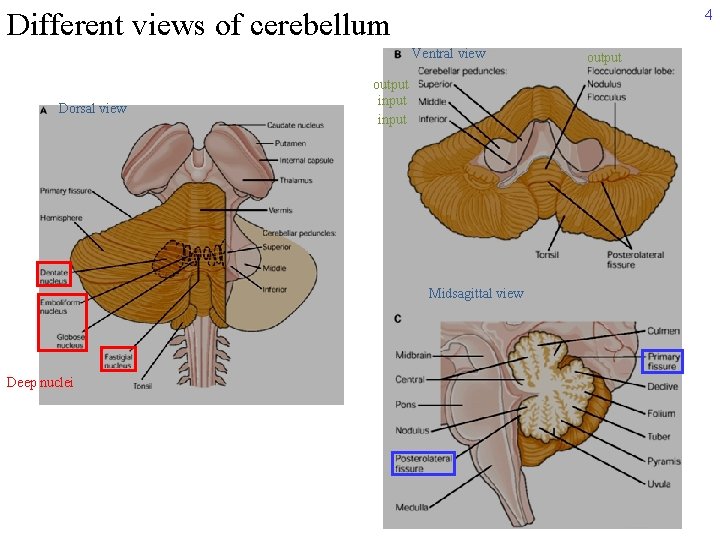
4 Different views of cerebellum Ventral view Dorsal view output input Midsagittal view Deep nuclei output
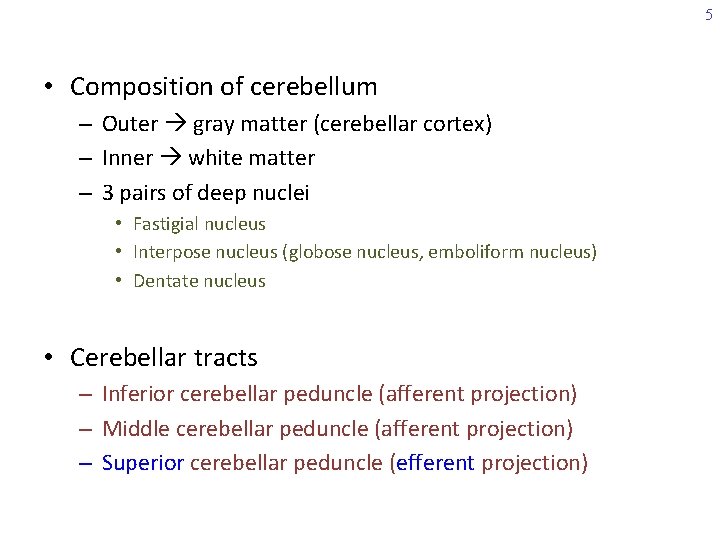
5 • Composition of cerebellum – Outer gray matter (cerebellar cortex) – Inner white matter – 3 pairs of deep nuclei • Fastigial nucleus • Interpose nucleus (globose nucleus, emboliform nucleus) • Dentate nucleus • Cerebellar tracts – Inferior cerebellar peduncle (afferent projection) – Middle cerebellar peduncle (afferent projection) – Superior cerebellar peduncle (efferent projection)

6 Anatomically distinct lobes – Distinct lobes (horizontal) • • • Anterior lobe Primary fissure Posterior lobe Posterolateral fissure Flocculonodular lobe – Distinct lobes (longitudinal) • Vermis • Intermediate part of hemisphere • Lateral part of hemisphere
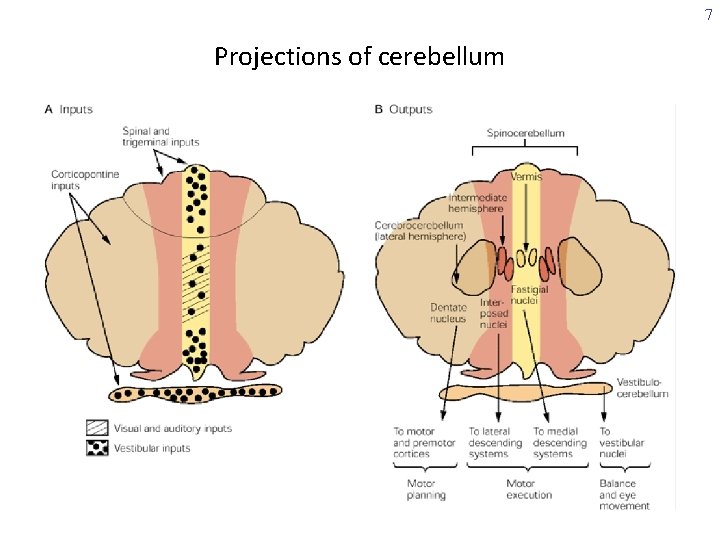
7 Projections of cerebellum
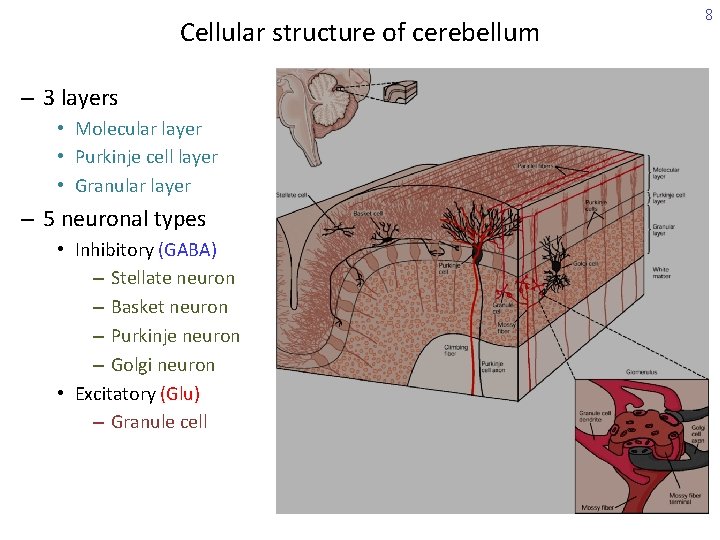
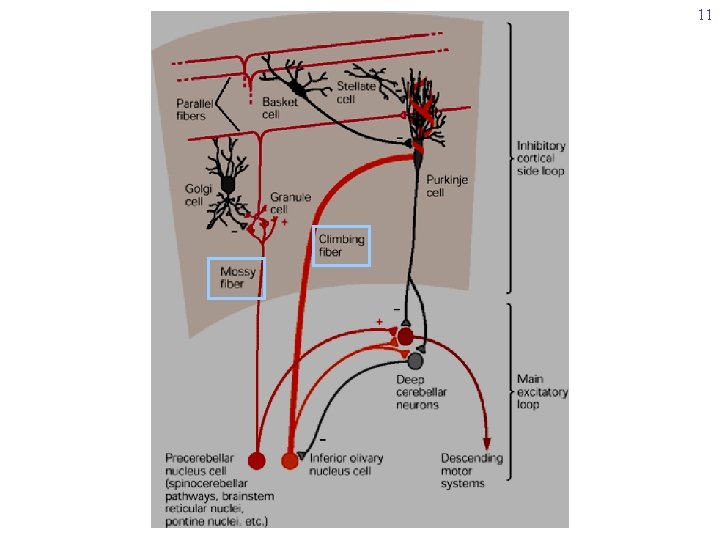
Cellular structure of cerebellum – 3 layers • Molecular layer • Purkinje cell layer • Granular layer – 5 neuronal types • Inhibitory (GABA) – Stellate neuron – Basket neuron – Purkinje neuron – Golgi neuron • Excitatory (Glu) – Granule cell 8

9 Synaptic glomerulus
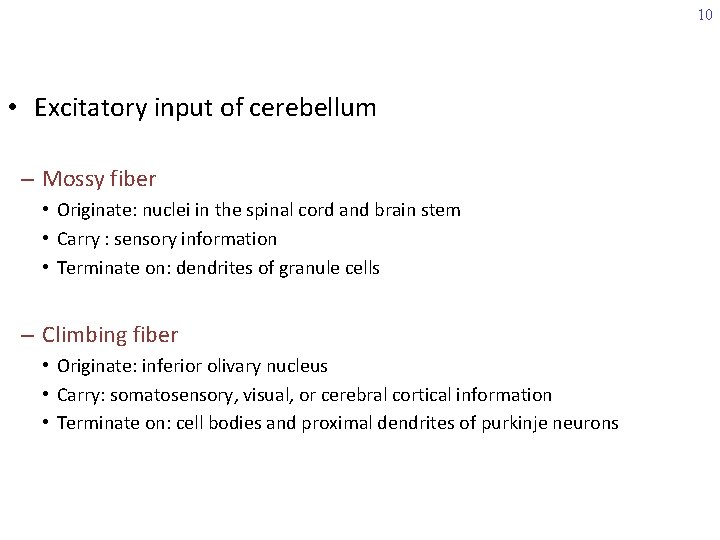
10 • Excitatory input of cerebellum – Mossy fiber • Originate: nuclei in the spinal cord and brain stem • Carry : sensory information • Terminate on: dendrites of granule cells – Climbing fiber • Originate: inferior olivary nucleus • Carry: somatosensory, visual, or cerebral cortical information • Terminate on: cell bodies and proximal dendrites of purkinje neurons
11

12 • Output of granule cell – Parallel fibers
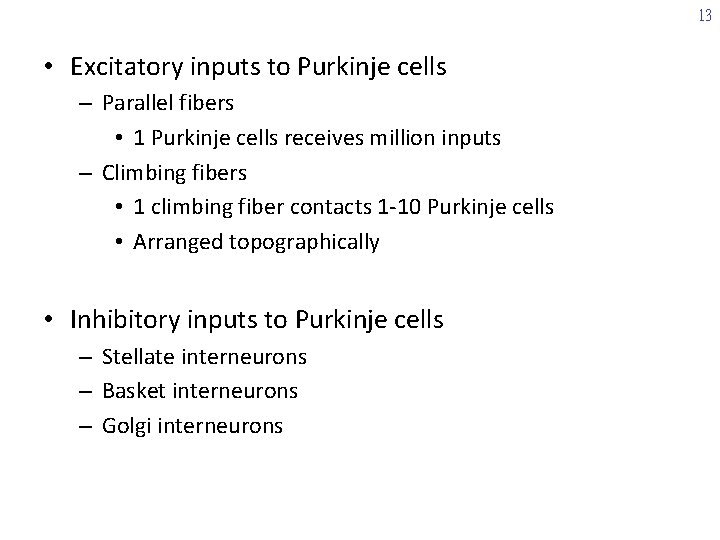
13 • Excitatory inputs to Purkinje cells – Parallel fibers • 1 Purkinje cells receives million inputs – Climbing fibers • 1 climbing fiber contacts 1 -10 Purkinje cells • Arranged topographically • Inhibitory inputs to Purkinje cells – Stellate interneurons – Basket interneurons – Golgi interneurons
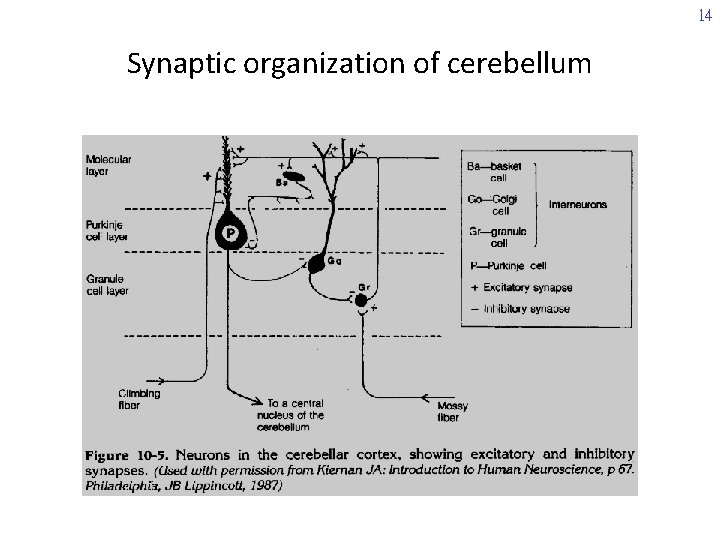
14 Synaptic organization of cerebellum

The geometry of the principal connections Purkinje cell (+) Parallel fiber Granule cell Mossy fiber (+) Climbing fiber 15
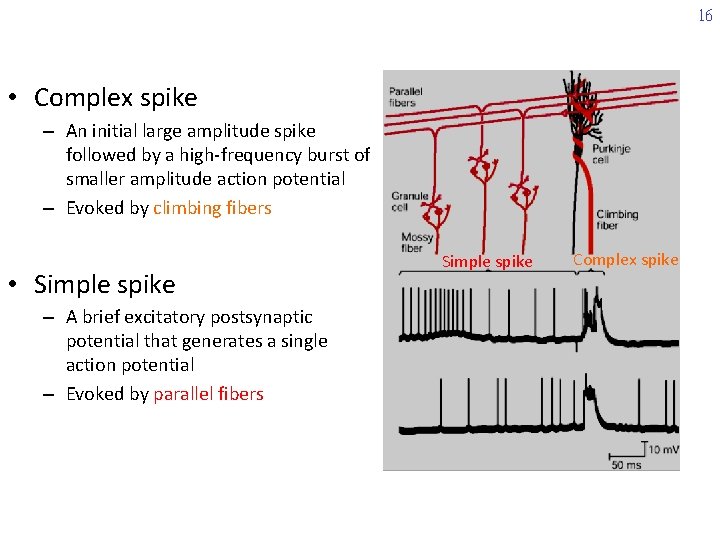
16 • Complex spike – An initial large amplitude spike followed by a high-frequency burst of smaller amplitude action potential – Evoked by climbing fibers • Simple spike – A brief excitatory postsynaptic potential that generates a single action potential – Evoked by parallel fibers Simple spike Complex spike
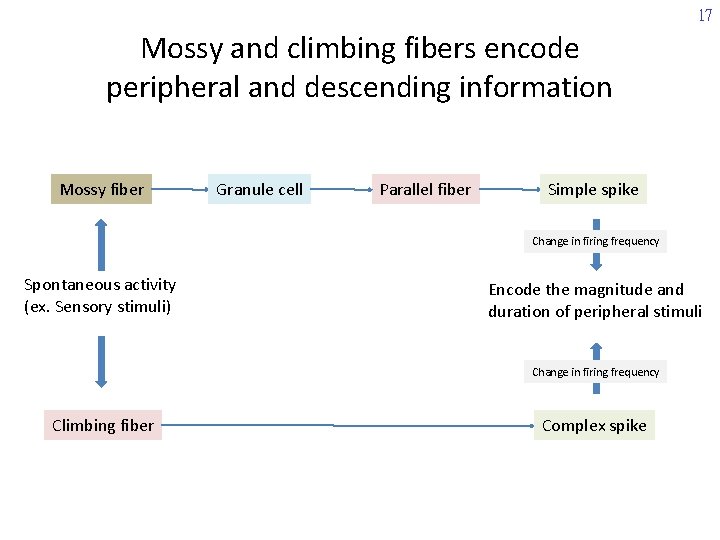
17 Mossy and climbing fibers encode peripheral and descending information Mossy fiber Granule cell Parallel fiber Simple spike Change in firing frequency Spontaneous activity (ex. Sensory stimuli) Encode the magnitude and duration of peripheral stimuli Change in firing frequency Climbing fiber Complex spike
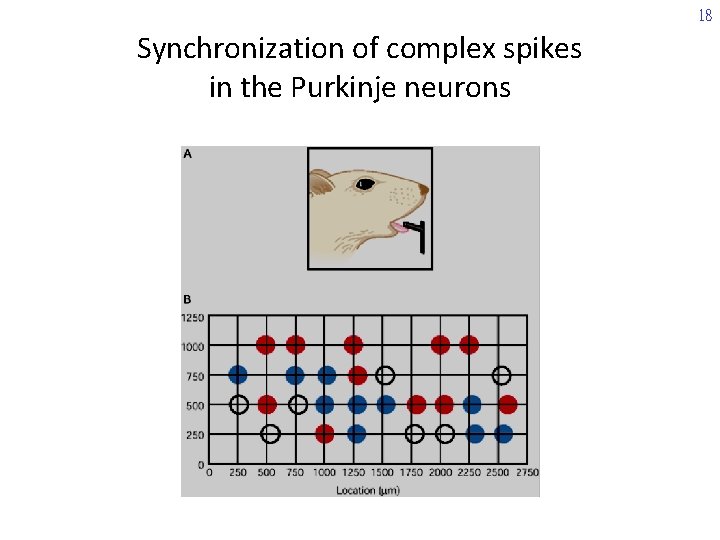
18 Synchronization of complex spikes in the Purkinje neurons
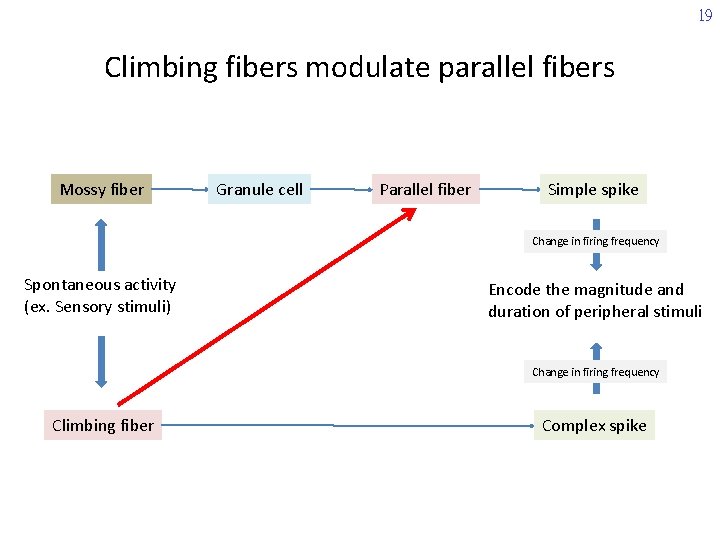
19 Climbing fibers modulate parallel fibers Mossy fiber Granule cell Parallel fiber Simple spike Change in firing frequency Spontaneous activity (ex. Sensory stimuli) Encode the magnitude and duration of peripheral stimuli Change in firing frequency Climbing fiber Complex spike
20 Climbing fiber activity produces long-lasting effects on the synaptic efficacy of parallel fibers • Climbing fiber action potentials reduce the strength of the parallel fiber input to the Purkinje neurons. • Activity in climbing fibers can induce selective longterm depression (LTD) in the synaptic strength of parallel fibers.
21 Functional properties of cerebellum • • Balance and eye movement Body and limb movement Somatosensory information Feed-forward mechanims Planning movement Cognitive function Motor learning
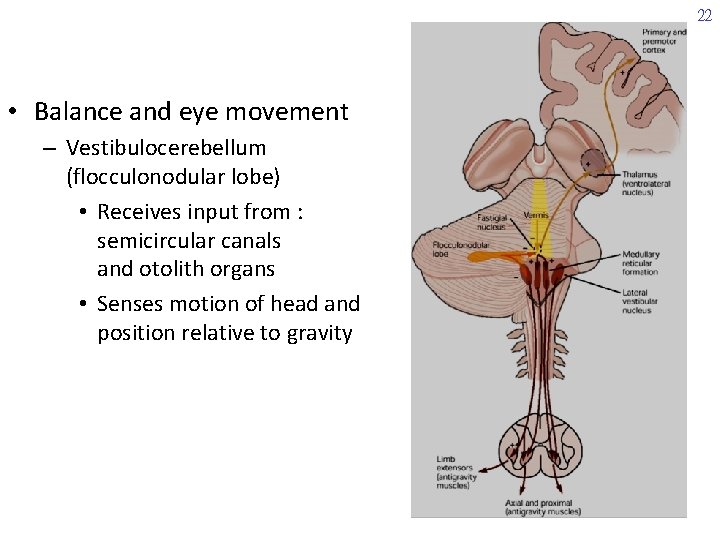
22 • Balance and eye movement – Vestibulocerebellum (flocculonodular lobe) • Receives input from : semicircular canals and otolith organs • Senses motion of head and position relative to gravity
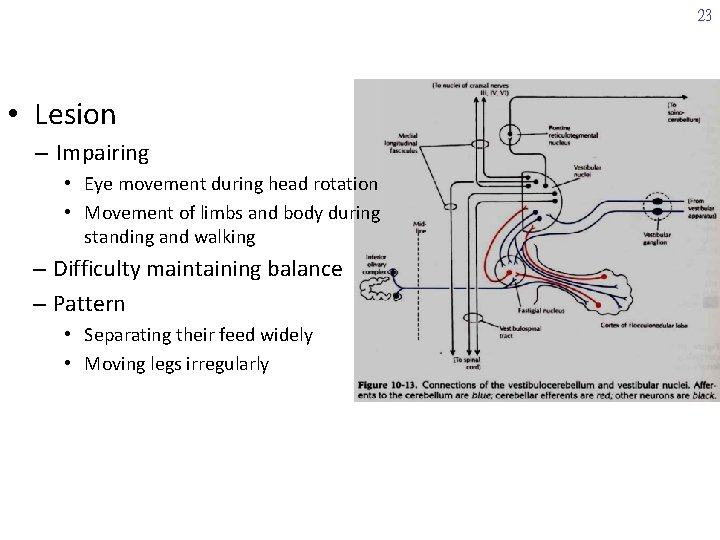
23 • Lesion – Impairing • Eye movement during head rotation • Movement of limbs and body during standing and walking – Difficulty maintaining balance – Pattern • Separating their feed widely • Moving legs irregularly
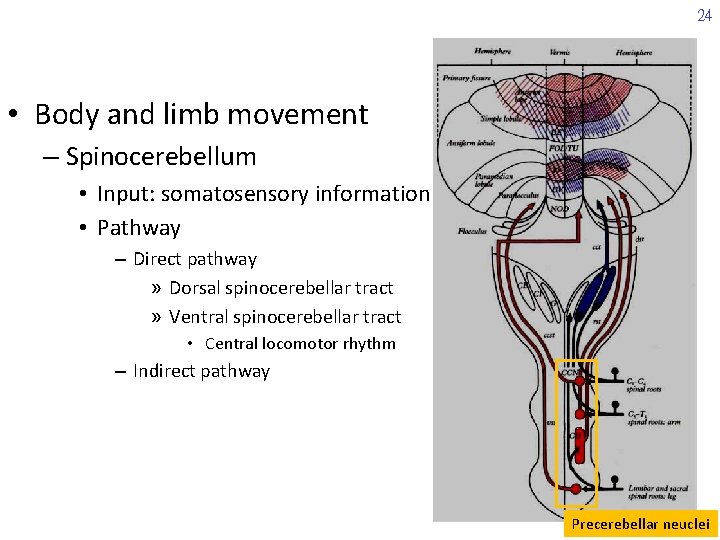
24 • Body and limb movement – Spinocerebellum • Input: somatosensory information • Pathway – Direct pathway » Dorsal spinocerebellar tract » Ventral spinocerebellar tract • Central locomotor rhythm – Indirect pathway Precerebellar neuclei
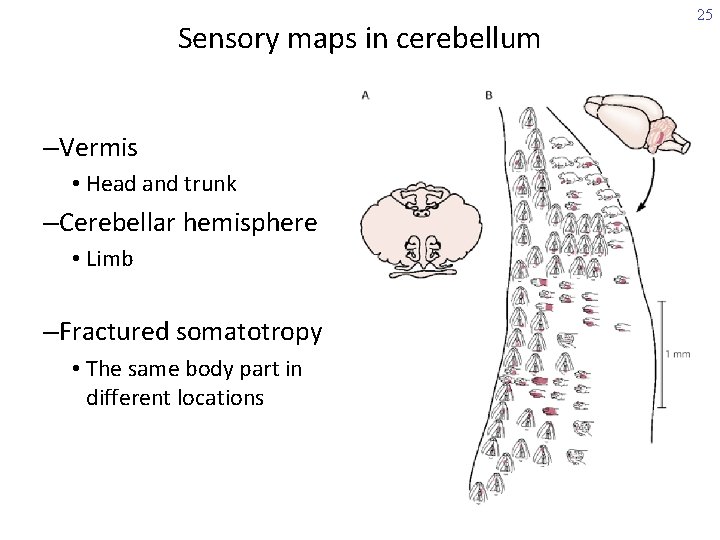
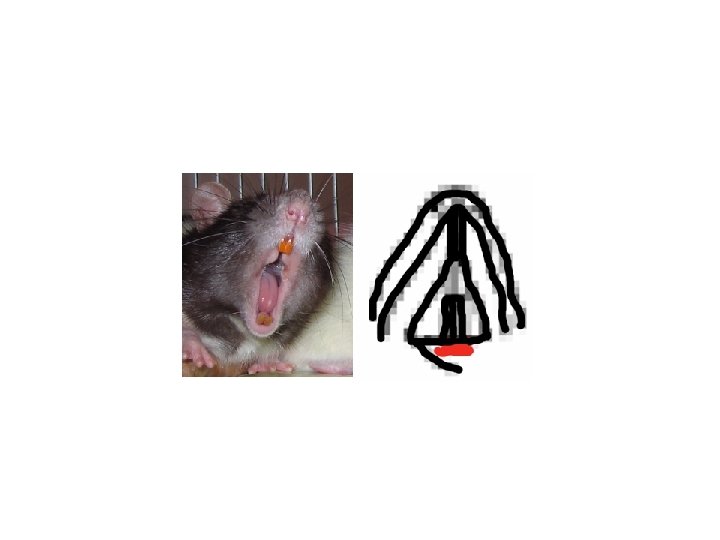
Sensory maps in cerebellum –Vermis • Head and trunk –Cerebellar hemisphere • Limb –Fractured somatotropy • The same body part in different locations 25
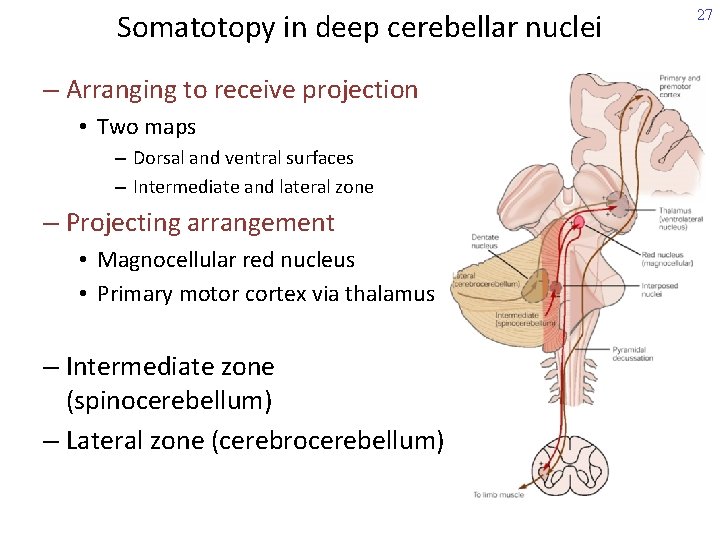
Somatotopy in deep cerebellar nuclei – Arranging to receive projection • Two maps – Dorsal and ventral surfaces – Intermediate and lateral zone – Projecting arrangement • Magnocellular red nucleus • Primary motor cortex via thalamus – Intermediate zone (spinocerebellum) – Lateral zone (cerebrocerebellum) 27
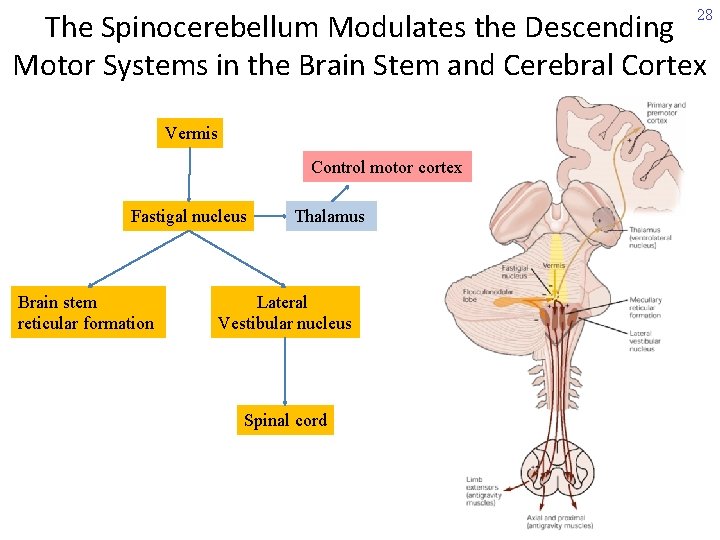
28 The Spinocerebellum Modulates the Descending Motor Systems in the Brain Stem and Cerebral Cortex Vermis Control motor cortex Fastigal nucleus Brain stem reticular formation Thalamus Lateral Vestibular nucleus Spinal cord
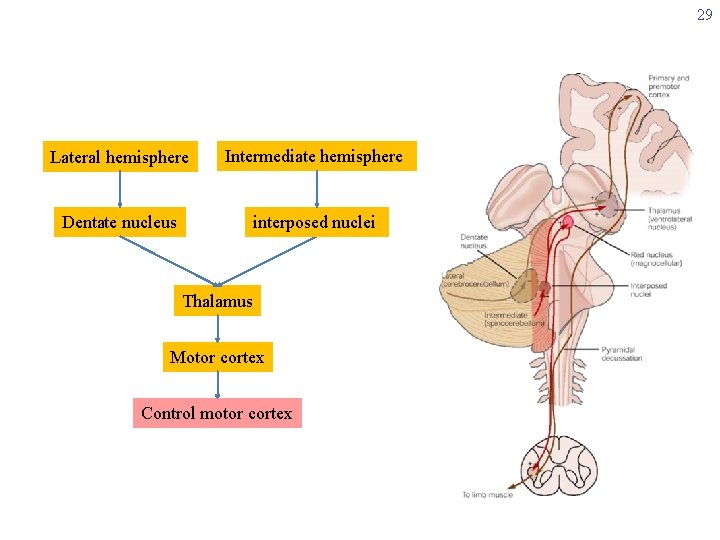
29 Lateral hemisphere Intermediate hemisphere Dentate nucleus interposed nuclei Thalamus Motor cortex Control motor cortex
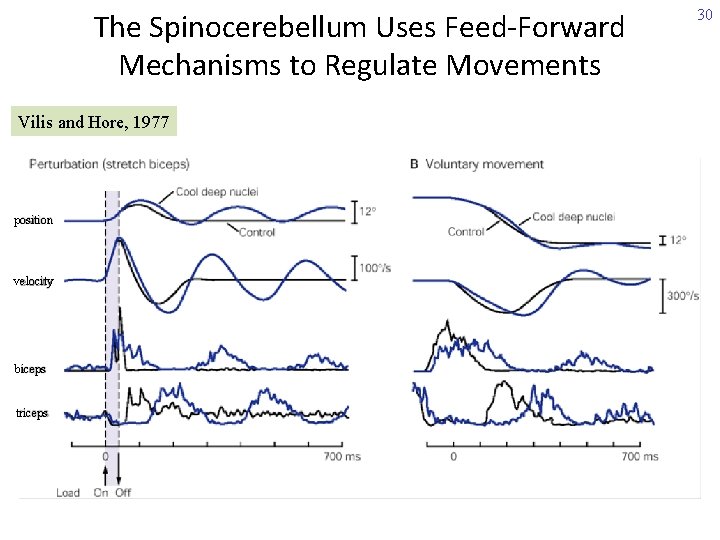
The Spinocerebellum Uses Feed-Forward Mechanisms to Regulate Movements Vilis and Hore, 1977 position velocity biceps triceps 30
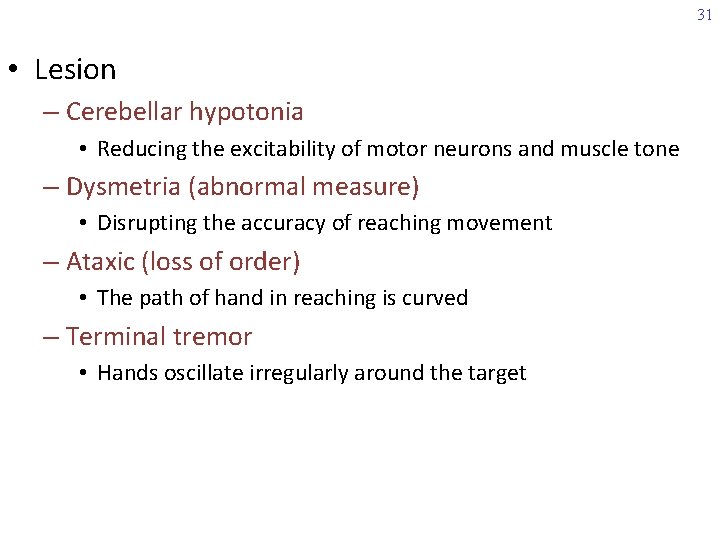
31 • Lesion – Cerebellar hypotonia • Reducing the excitability of motor neurons and muscle tone – Dysmetria (abnormal measure) • Disrupting the accuracy of reaching movement – Ataxic (loss of order) • The path of hand in reaching is curved – Terminal tremor • Hands oscillate irregularly around the target
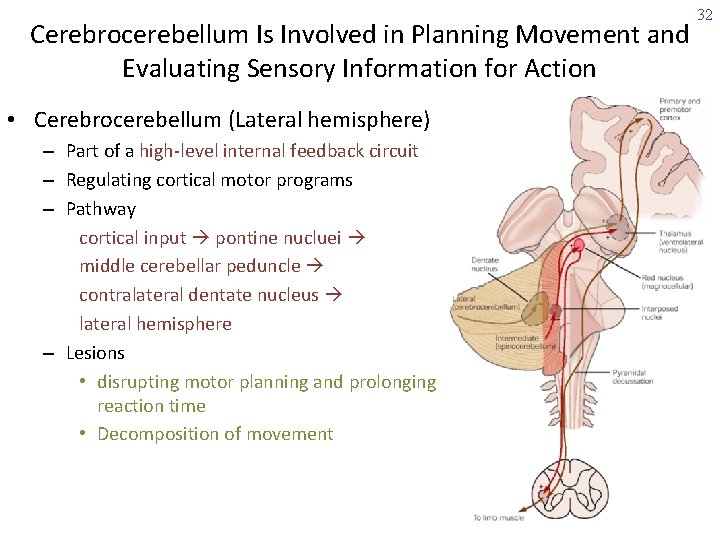
Cerebrocerebellum Is Involved in Planning Movement and Evaluating Sensory Information for Action • Cerebrocerebellum (Lateral hemisphere) – Part of a high-level internal feedback circuit – Regulating cortical motor programs – Pathway cortical input pontine nucluei middle cerebellar peduncle contralateral dentate nucleus lateral hemisphere – Lesions • disrupting motor planning and prolonging reaction time • Decomposition of movement 32
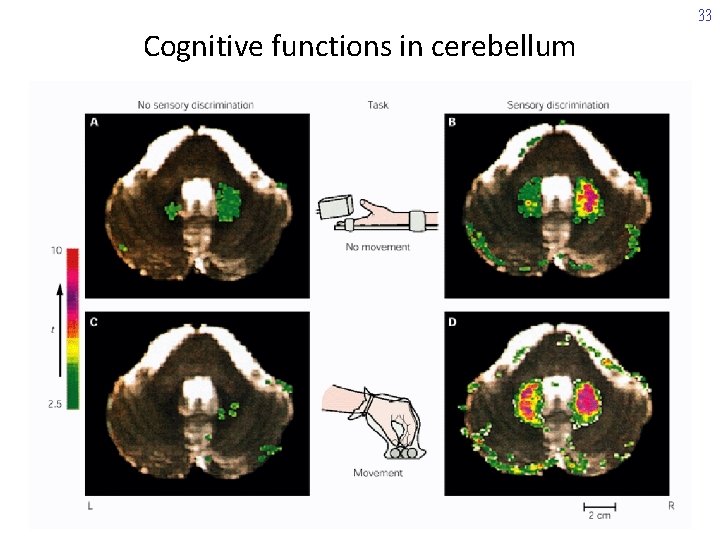
33 Cognitive functions in cerebellum
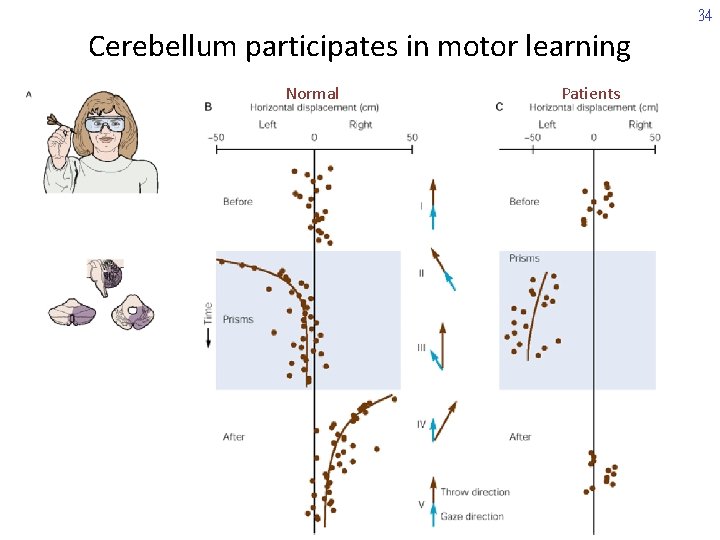
34 Cerebellum participates in motor learning Normal Patients
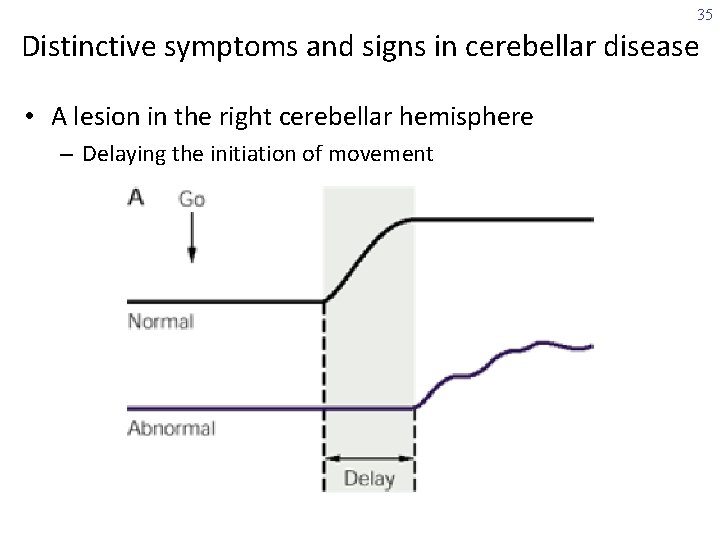
35 Distinctive symptoms and signs in cerebellar disease • A lesion in the right cerebellar hemisphere – Delaying the initiation of movement
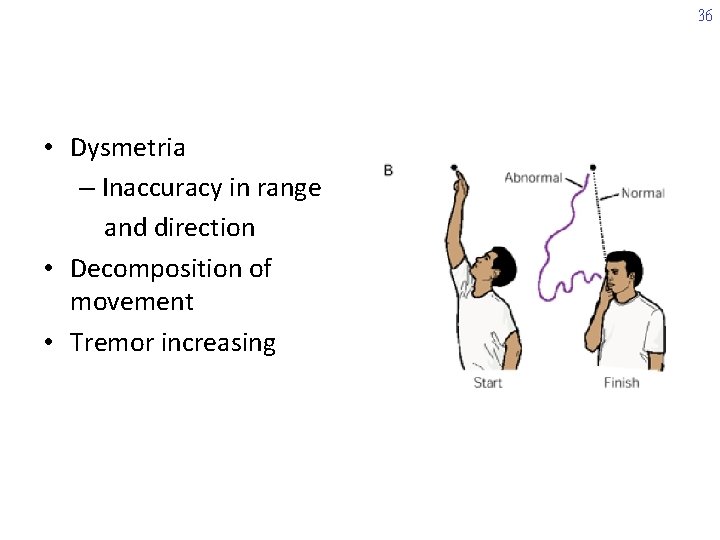
36 • Dysmetria – Inaccuracy in range and direction • Decomposition of movement • Tremor increasing
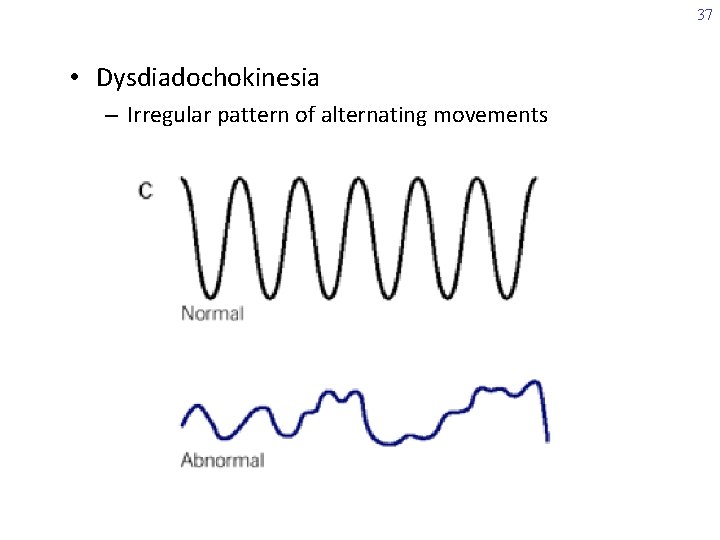
37 • Dysdiadochokinesia – Irregular pattern of alternating movements

38 Thanks for attention
Anatomy The Cerebellum Has Three Functionally Distinct Regions Cellular structure Cerebellar Circuits Consist of a Main Excitatory Loop and an Inhibitory Side-Loop Neurons in the Cerebellar Cortex Are Organized into Three Layers Synaptic organization The Purkinje Cells Receive Excitatory Input From Two Afferent Fiber Systems and Are Inhibited by Three Local Interneurons Mossy and Climbing Fibers Encode Peripheral and Descending Information Differently Climbing Fiber Activity Produces Long-Lasting Effects on the Synaptic Efficacy of Parallel Fibers Functional property The Vestibulocerebellum Regulates Balance and Eye Movements The Spinocerebellum Regulates Body and Limb Movements Somatosensory Information Reaches the Spinocerebellum Through Direct and Indirect Mossy Fiber Pathways The Spinocerebellum Contains Sensory Maps The Spinocerebellum Modulates the Descending Motor Systems in the Brain Stem and Cerebral Cortex The Spinocerebellum Uses Feed-Forward Mechanisms to Regulate Movements 39
40 The Cerebrocerebellum Is Involved in Planning Movement and Evaluating Sensory Information for Action The Cerebrocerebellum Is Part of a High-Level Internal Feedback Circuit That Regulates Cortical Motor Programs Lesions of the Cerebrocerebellum Disrupt Motor Planning and Prolong Reaction Time The Cerebrocerebellum Also Has Purely Cognitive Functions The Cerebellum Participates in Motor Learning Pathology Cerebellar Diseases Have Distinctive Symptoms and Signs
- Slides: 40