
1 CATCH Case and Termination Checking for Haskell
![Productivity [1. . ] = [1, 2, 3, 4, 5, 6, . . .](https://slidetodoc.com/presentation_image/3bb86832ab4593bc6a8bfdb70a0e980e/image-7.jpg "Productivity [1. . ] = [1, 2, 3, 4, 5, 6, . . .")
![The blame game n last [1. . ] is NT last is a useful](https://slidetodoc.com/presentation_image/3bb86832ab4593bc6a8bfdb70a0e980e/image-8.jpg "The blame game n last [1. . ] is NT last is a useful")
![last x = case x of (: ) -> case x. tl of []](https://slidetodoc.com/presentation_image/3bb86832ab4593bc6a8bfdb70a0e980e/image-11.jpg "last x = case x of (: ) -> case x. tl of []")
![And the result: (last x){*} = x{*} ^ x. tl {[]} n n x](https://slidetodoc.com/presentation_image/3bb86832ab4593bc6a8bfdb70a0e980e/image-12.jpg "And the result: (last x){*} = x{*} ^ x. tl {[]} n n x")
- Slides: 14
1 CATCH : Case and Termination Checking for Haskell Neil Mitchell (supervised by Colin Runciman) 1 Name courtesy of Mike Dodds
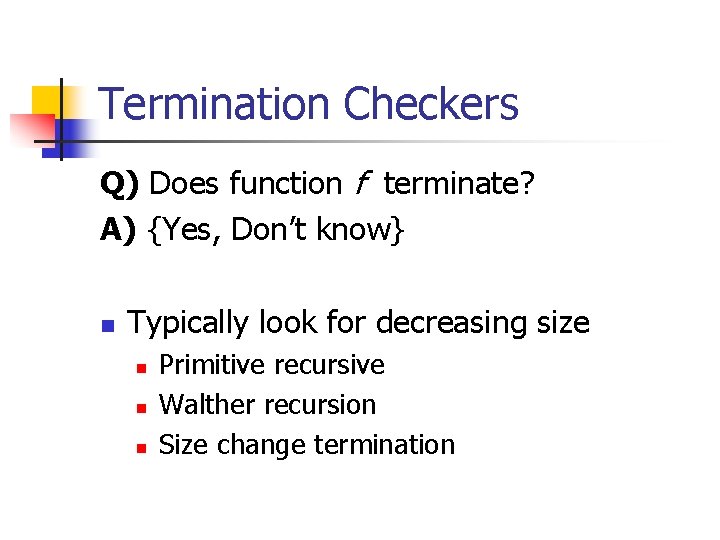
Termination Checkers Q) Does function f terminate? A) {Yes, Don’t know} n Typically look for decreasing size n n n Primitive recursive Walther recursion Size change termination
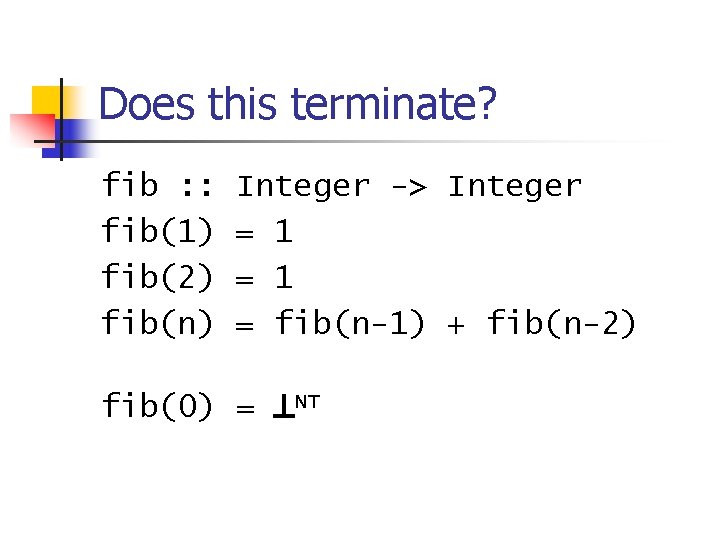
Does this terminate? fib : : fib(1) fib(2) fib(n) Integer -> Integer = 1 = fib(n-1) + fib(n-2) fib(0) = NT
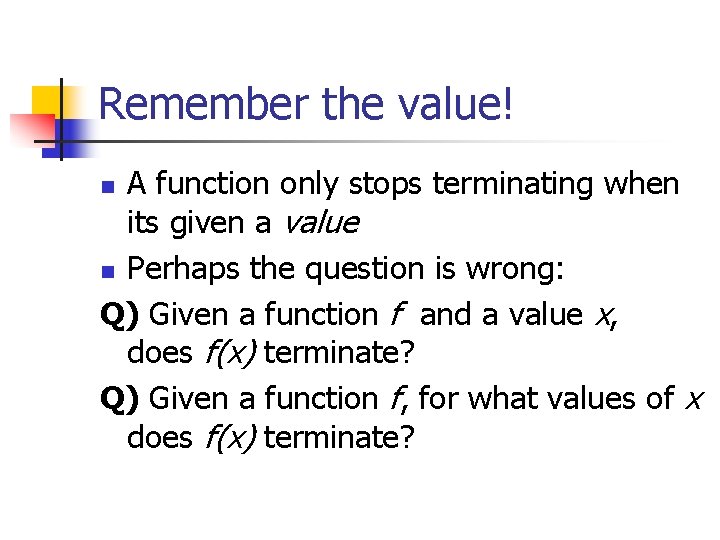
Remember the value! A function only stops terminating when its given a value n Perhaps the question is wrong: Q) Given a function f and a value x, does f(x) terminate? Q) Given a function f, for what values of x does f(x) terminate? n
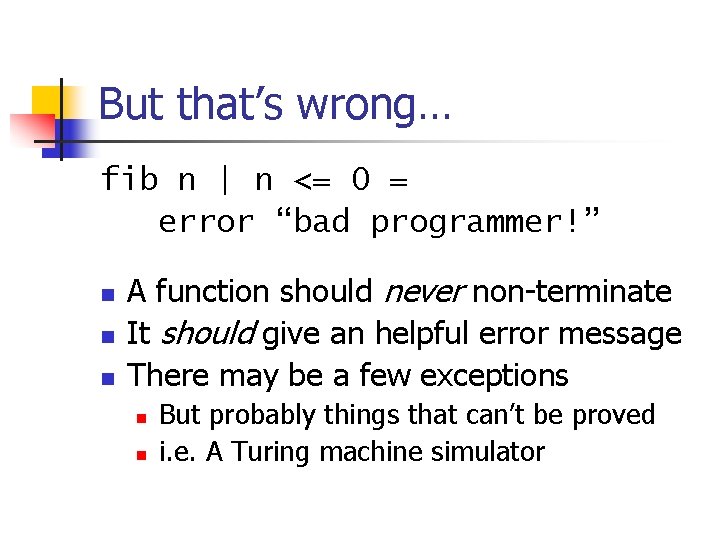
But that’s wrong… fib n | n <= 0 = error “bad programmer!” n n n A function should never non-terminate It should give an helpful error message There may be a few exceptions n n But probably things that can’t be proved i. e. A Turing machine simulator
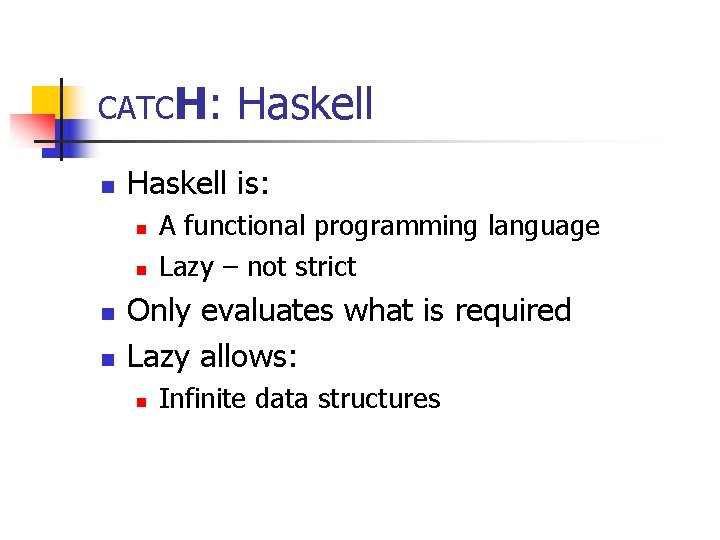
CATCH: n Haskell is: n n Haskell A functional programming language Lazy – not strict Only evaluates what is required Lazy allows: n Infinite data structures
Productivity [1. . ] = [1, 2, 3, 4, 5, 6, . . . n n Not terminating But is productive n n Always another element Time to generate “next result” is always finite
The blame game n last [1. . ] is NT last is a useful function [1. . ] is a useful value n Who is at fault? n n n The caller of last
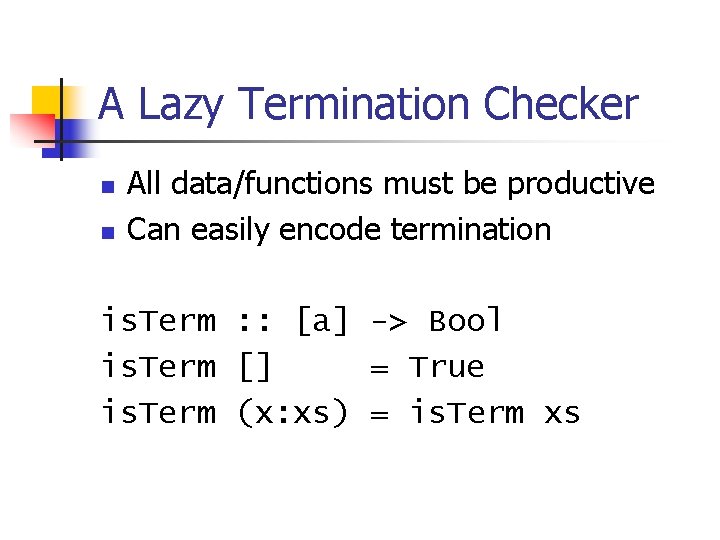
A Lazy Termination Checker n n All data/functions must be productive Can easily encode termination is. Term : : [a] -> Bool is. Term [] = True is. Term (x: xs) = is. Term xs
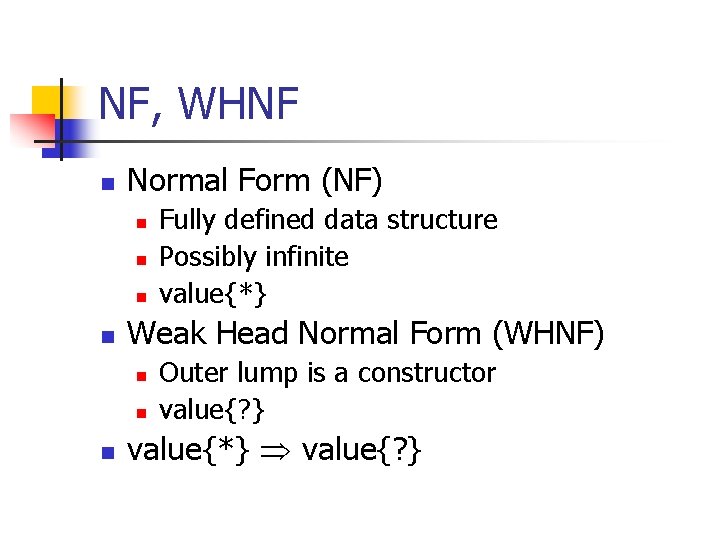
NF, WHNF n Normal Form (NF) n n Weak Head Normal Form (WHNF) n n n Fully defined data structure Possibly infinite value{*} Outer lump is a constructor value{? } value{*} value{? }
last x = case x of (: ) -> case x. tl of [] -> x. hd (: ) -> last x. tl (last x){? } = x{[]} v ( (x. tl{: } v (x. hd{? }) ^ (x. tl{[]} v (last x. tl){? }) (last x){? } = x{[]} v x. tl{[]} v (last x. tl){? } = x{[]} v x. tl. tl{[]} v … = i L(tl*), x. i{[]} = x. tl {[]} (last x){*} = (last x){? } ^ (x{[]} v x. tl{[]} v (last x. tl){*}) = x. tl {[]}
And the result: (last x){*} = x{*} ^ x. tl {[]} n n x is defined x has a [], x is finite A nice result
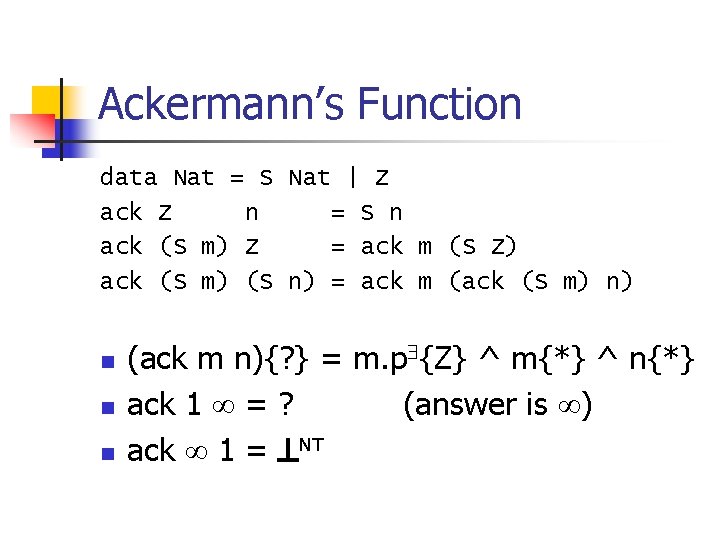
Ackermann’s Function data Nat = S Nat | Z ack Z n = S n ack (S m) Z = ack m (S Z) ack (S m) (S n) = ack m (ack (S m) n) n n n (ack m n){? } = m. p {Z} ^ m{*} ^ n{*} ack 1 = ? (answer is ) ack 1 = NT
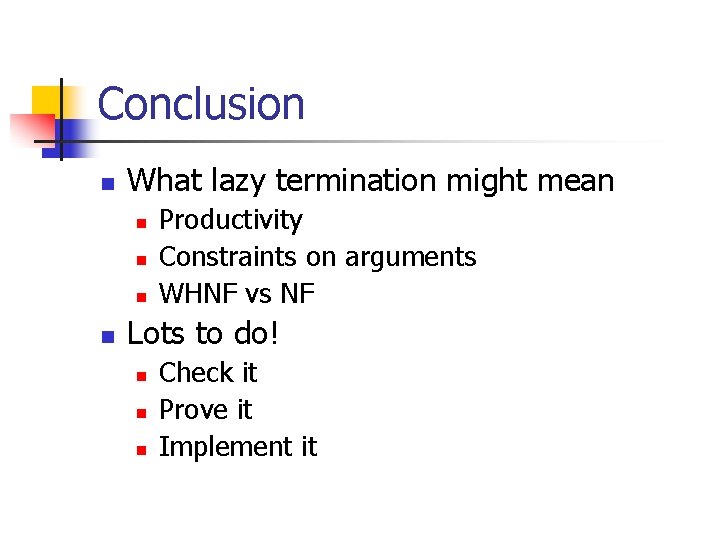
Conclusion n What lazy termination might mean n n Productivity Constraints on arguments WHNF vs NF Lots to do! n n n Check it Prove it Implement it