
1 CASH FLOW ANALYSIS 7 CHAPTER 2 What
- Slides: 23
1 CASH FLOW ANALYSIS 7 CHAPTER
2 What you will learn from this chapter Relevance of Cash Flows What cash flow statements tell you What is free cash flow The difference between the direct and indirect calculations of cash from operations Problems that arise in analyzing cash flows statements
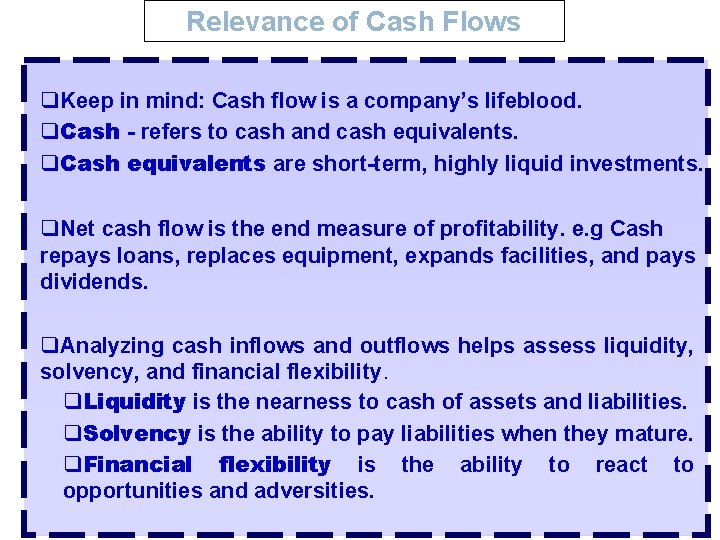
Relevance of Cash Flows 3 q. Keep in mind: Cash flow is a company’s lifeblood. q. Cash - refers to cash and cash equivalents. q. Cash equivalents are short-term, highly liquid investments. q. Net cash flow is the end measure of profitability. e. g Cash repays loans, replaces equipment, expands facilities, and pays dividends. q. Analyzing cash inflows and outflows helps assess liquidity, solvency, and financial flexibility. q. Liquidity is the nearness to cash of assets and liabilities. q. Solvency is the ability to pay liabilities when they mature. q. Financial flexibility is the ability to react to opportunities and adversities.
4 Analyzing the Statement of Cash Flows Is an important analytical tool for creditors, investors and other users of financial statement data. Indicates v. Firm’s ability to generate cash flows in the future v. Firm’s capacity to meet cash obligations v. Firm’s future external financing needs v. Firm’s success in productively managing investing activities v. Firm’s effectiveness in implementing financing and investing strategies
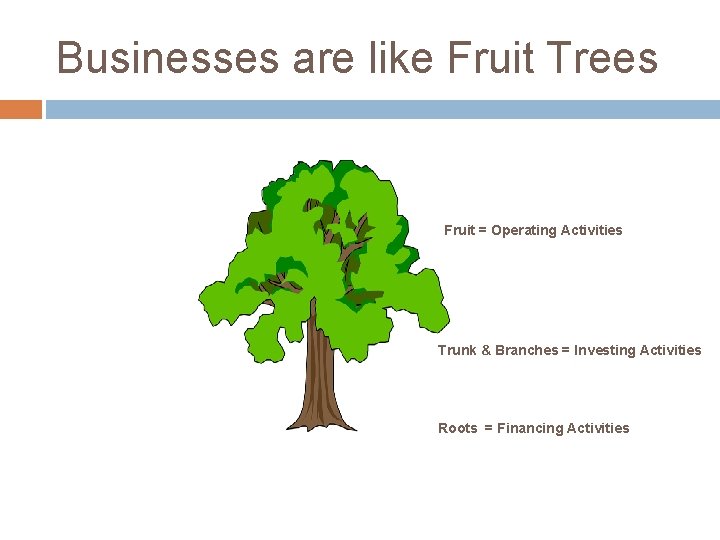
Businesses are like Fruit Trees Fruit = Operating Activities Trunk & Branches = Investing Activities Roots = Financing Activities
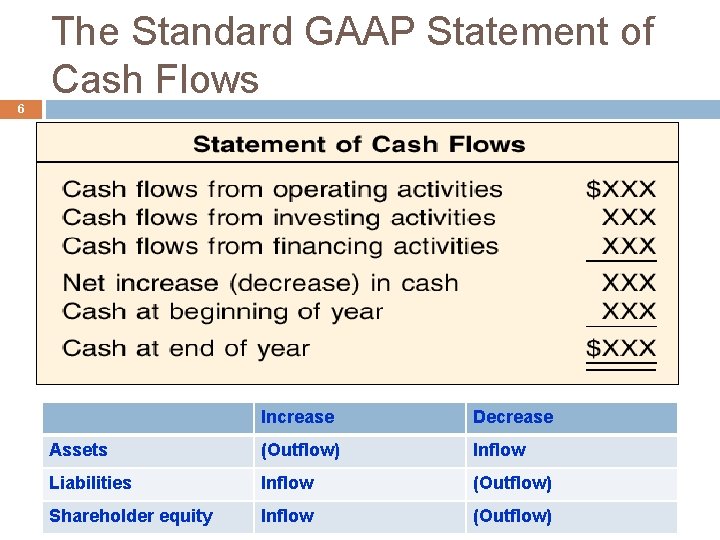
The Standard GAAP Statement of Cash Flows 6 Increase Decrease Assets (Outflow) Inflow Liabilities Inflow (Outflow) Shareholder equity Inflow (Outflow)
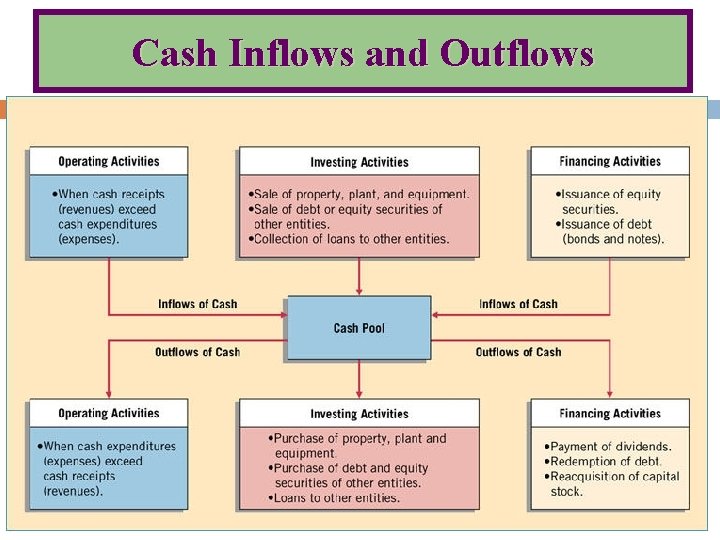
Cash Inflows and Outflows
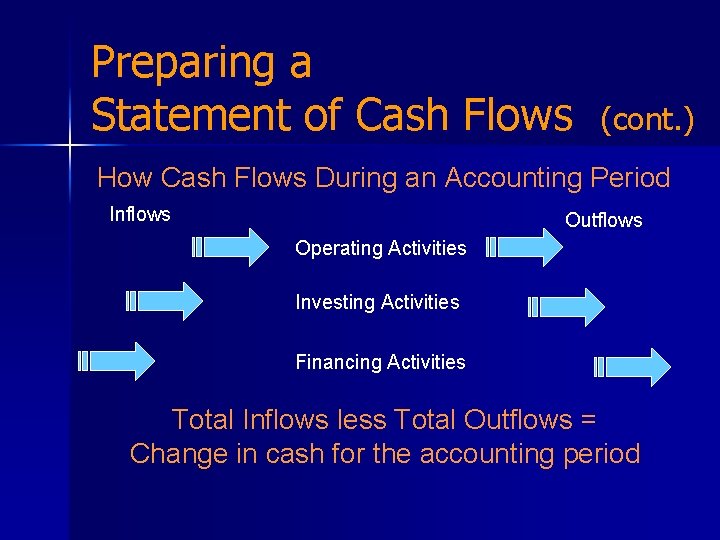
Preparing a Statement of Cash Flows (cont. ) How Cash Flows During an Accounting Period Inflows Outflows Operating Activities Investing Activities Financing Activities Total Inflows less Total Outflows = Change in cash for the accounting period
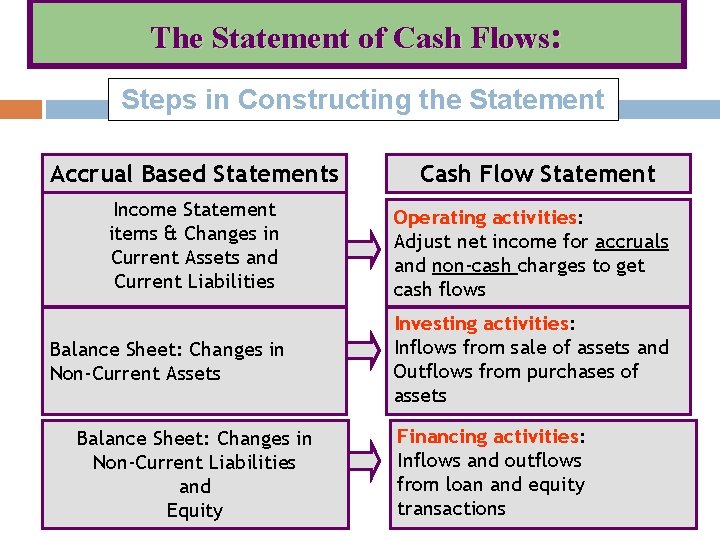
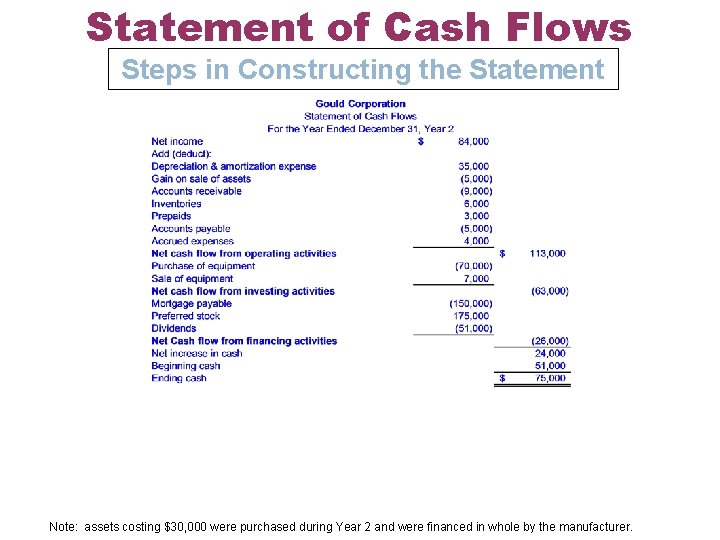
The Statement of Cash Flows: Steps in Constructing the Statement Accrual Based Statements Cash Flow Statement Income Statement items & Changes in Current Assets and Current Liabilities Operating activities: Adjust net income for accruals and non-cash charges to get cash flows Balance Sheet: Changes in Non-Current Assets Investing activities: Inflows from sale of assets and Outflows from purchases of assets Balance Sheet: Changes in Non-Current Liabilities and Equity Financing activities: Inflows and outflows from loan and equity transactions
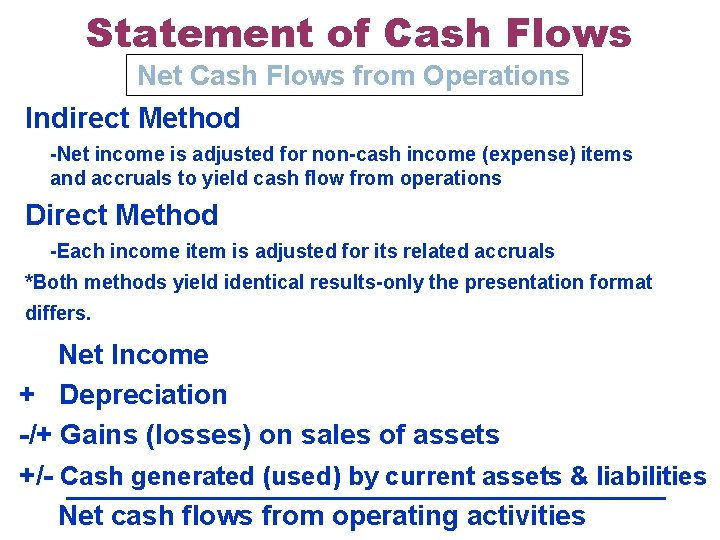
Statement of Cash Flows Net Cash Flows from Operations Indirect Method 10 -Net income is adjusted for non-cash income (expense) items and accruals to yield cash flow from operations Direct Method -Each income item is adjusted for its related accruals *Both methods yield identical results-only the presentation format differs. Net Income + Depreciation -/+ Gains (losses) on sales of assets +/- Cash generated (used) by current assets & liabilities Net cash flows from operating activities
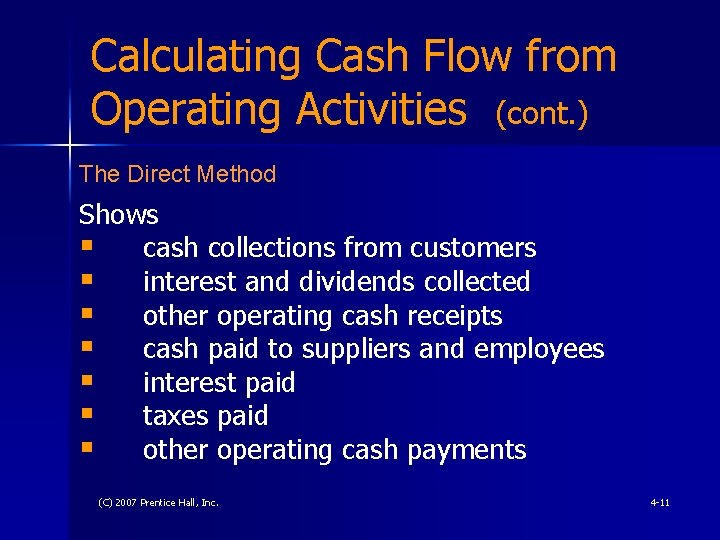
Calculating Cash Flow from Operating Activities (cont. ) The Direct Method Shows § cash collections from customers § interest and dividends collected § other operating cash receipts § cash paid to suppliers and employees § interest paid § taxes paid § other operating cash payments (C) 2007 Prentice Hall, Inc. 4 -11
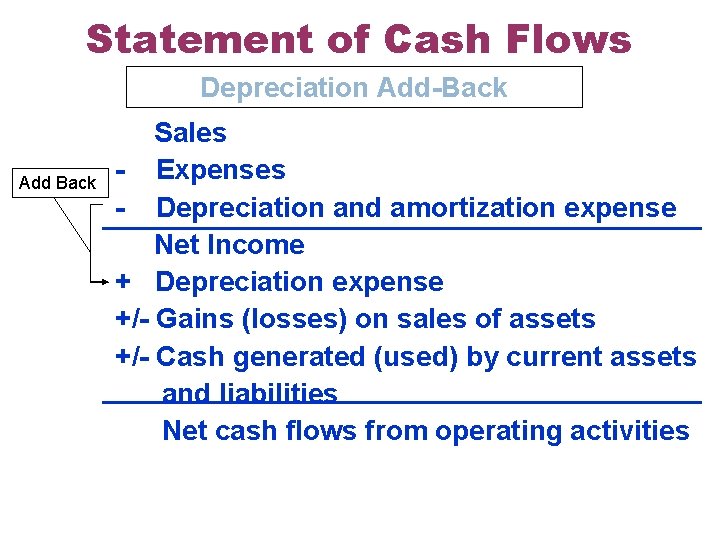
Statement of Cash Flows 12 Add Back Depreciation Add-Back Sales - Expenses - Depreciation and amortization expense Net Income + Depreciation expense +/- Gains (losses) on sales of assets +/- Cash generated (used) by current assets and liabilities Net cash flows from operating activities
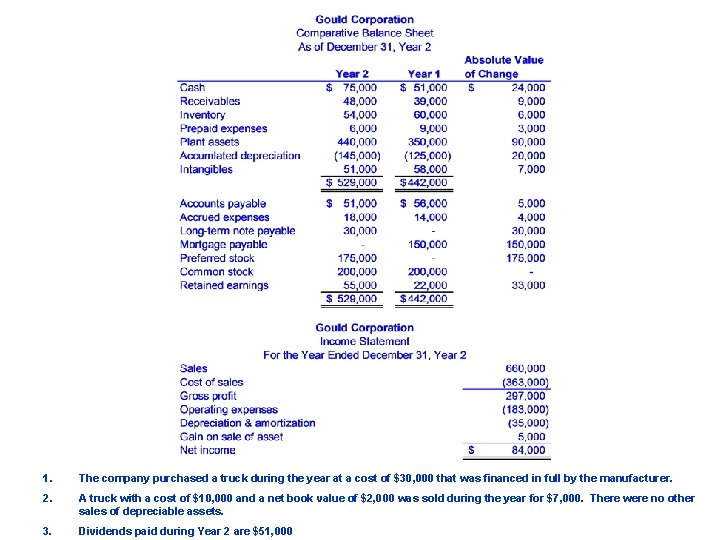
1. The company purchased a truck during the year at a cost of $30, 000 that was financed in full by the manufacturer. 2. A truck with a cost of $10, 000 and a net book value of $2, 000 was sold during the year for $7, 000. There were no other sales of depreciable assets. 3. Dividends paid during Year 2 are $51, 000
Statement of Cash Flows Steps in Constructing the Statement 14 Note: assets costing $30, 000 were purchased during Year 2 and were financed in whole by the manufacturer.
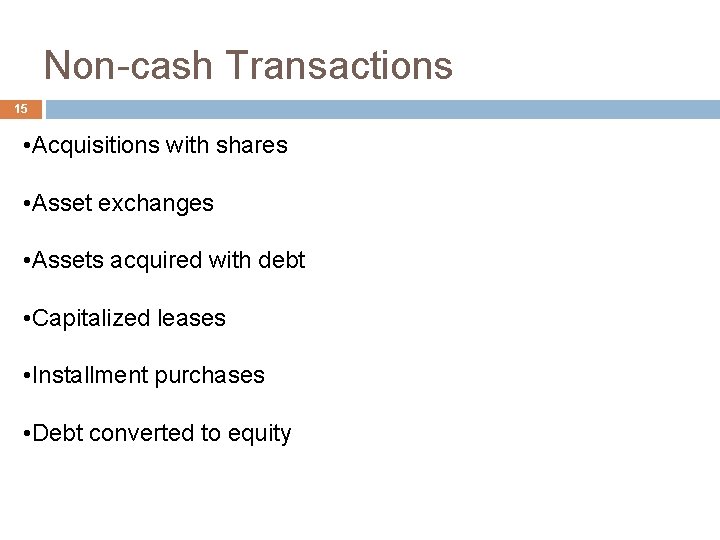
Non-cash Transactions 15 • Acquisitions with shares • Asset exchanges • Assets acquired with debt • Capitalized leases • Installment purchases • Debt converted to equity
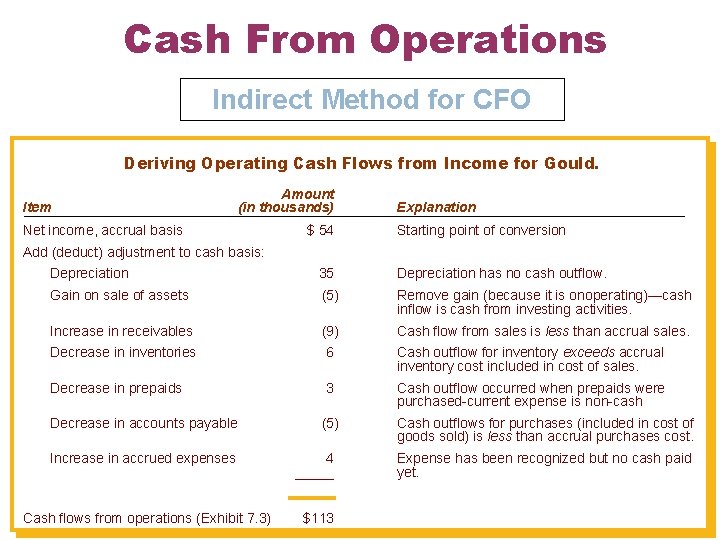
Cash From Operations Indirect Method for CFO 16 Deriving Operating Cash Flows from Income for Gould. Item Amount (in thousands) Net income, accrual basis $ 54 Explanation Starting point of conversion Add (deduct) adjustment to cash basis: Depreciation 35 Depreciation has no cash outflow. Gain on sale of assets (5) Remove gain (because it is onoperating)—cash inflow is cash from investing activities. Increase in receivables (9) Cash flow from sales is less than accrual sales. Decrease in inventories 6 Cash outflow for inventory exceeds accrual inventory cost included in cost of sales. Decrease in prepaids 3 Cash outflow occurred when prepaids were purchased-current expense is non-cash Decrease in accounts payable (5) Increase in accrued expenses 4 _____ Cash flows from operations (Exhibit 7. 3) $113 Cash outflows for purchases (included in cost of goods sold) is less than accrual purchases cost. Expense has been recognized but no cash paid yet.
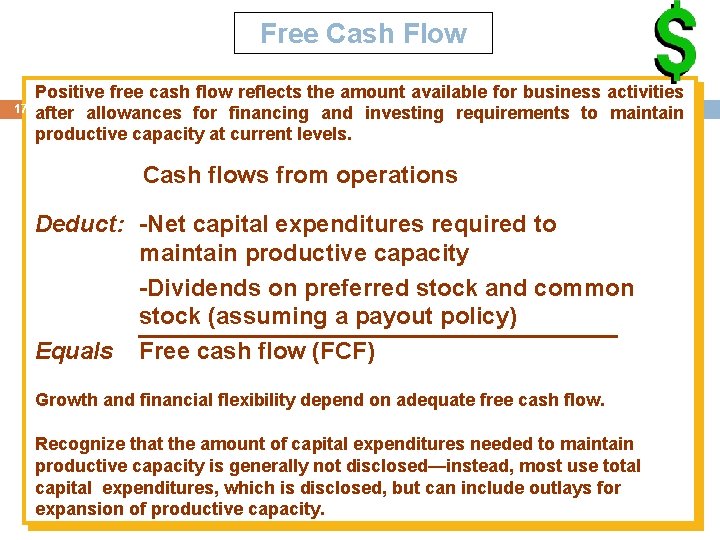
Free Cash Flow 17 Positive free cash flow reflects the amount available for business activities after allowances for financing and investing requirements to maintain productive capacity at current levels. Cash flows from operations Deduct: -Net capital expenditures required to maintain productive capacity -Dividends on preferred stock and common stock (assuming a payout policy) Equals Free cash flow (FCF) Growth and financial flexibility depend on adequate free cash flow. Recognize that the amount of capital expenditures needed to maintain productive capacity is generally not disclosed—instead, most use total capital expenditures, which is disclosed, but can include outlays for expansion of productive capacity.
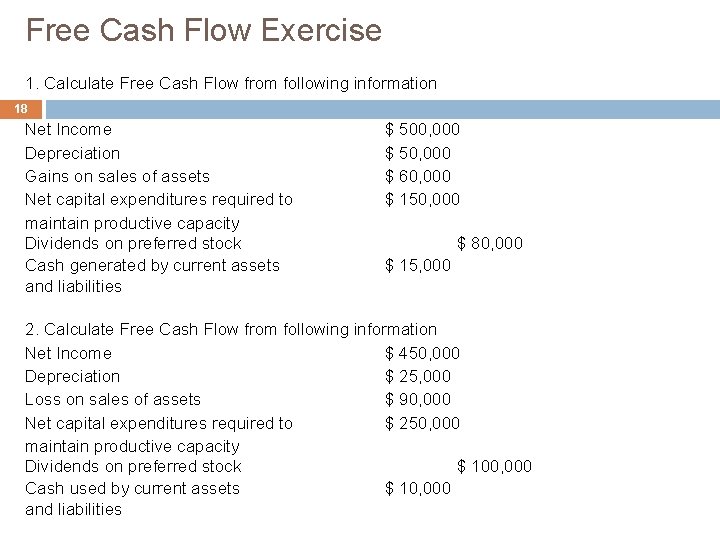
Free Cash Flow Exercise 1. Calculate Free Cash Flow from following information 18 Net Income Depreciation Gains on sales of assets Net capital expenditures required to maintain productive capacity Dividends on preferred stock Cash generated by current assets and liabilities $ 500, 000 $ 50, 000 $ 60, 000 $ 150, 000 $ 80, 000 $ 15, 000 2. Calculate Free Cash Flow from following information Net Income $ 450, 000 Depreciation $ 25, 000 Loss on sales of assets $ 90, 000 Net capital expenditures required to $ 250, 000 maintain productive capacity Dividends on preferred stock $ 100, 000 Cash used by current assets $ 10, 000 and liabilities
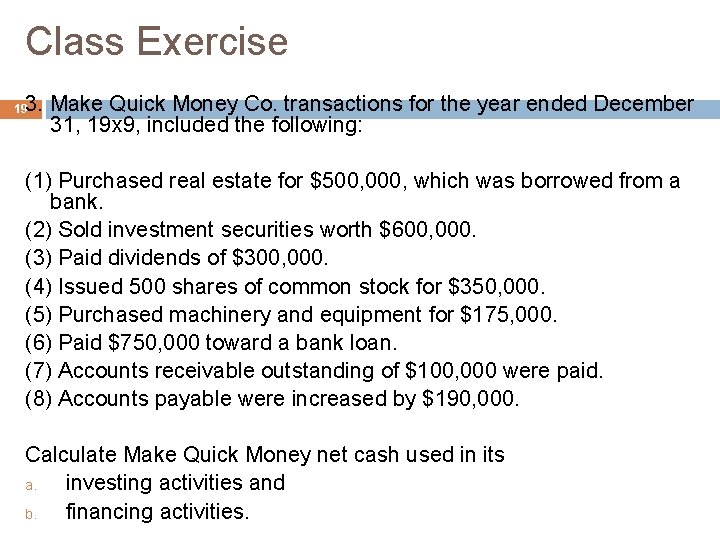
Class Exercise 3. Make Quick Money Co. transactions for the year ended December 31, 19 x 9, included the following: 19 (1) Purchased real estate for $500, 000, which was borrowed from a bank. (2) Sold investment securities worth $600, 000. (3) Paid dividends of $300, 000. (4) Issued 500 shares of common stock for $350, 000. (5) Purchased machinery and equipment for $175, 000. (6) Paid $750, 000 toward a bank loan. (7) Accounts receivable outstanding of $100, 000 were paid. (8) Accounts payable were increased by $190, 000. Calculate Make Quick Money net cash used in its a. investing activities and b. financing activities.
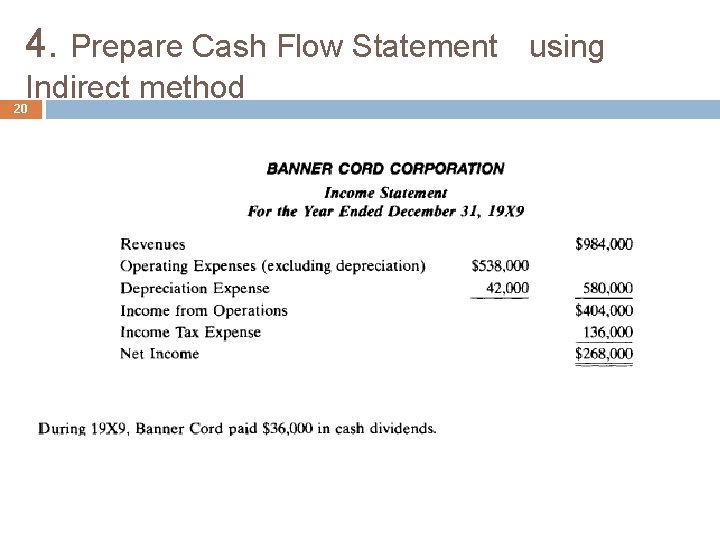
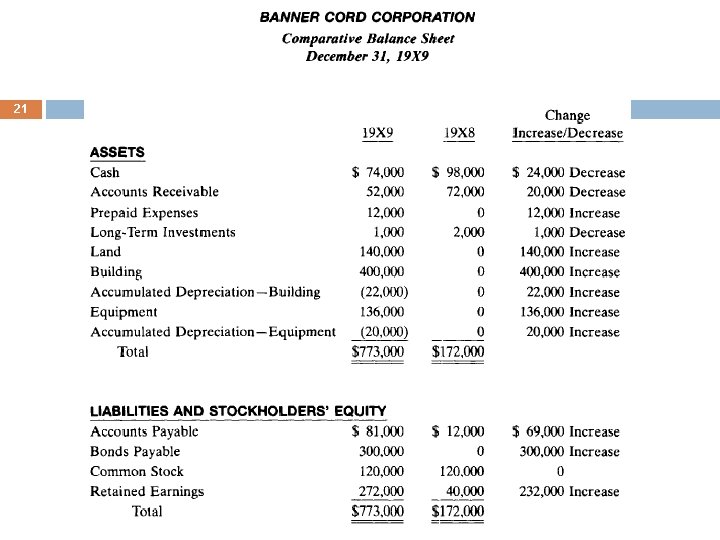
4. Prepare Cash Flow Statement Indirect method 20 using
21
22
23