
1 Carbohydrates Organic Carbon Organic compound composed of
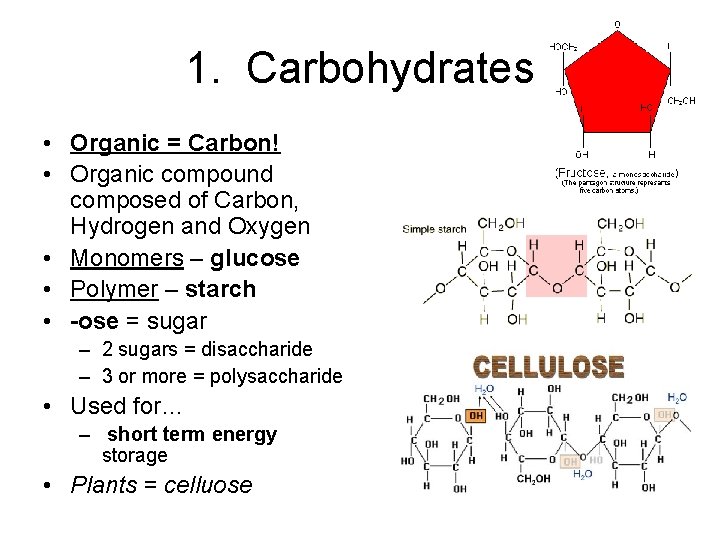
1. Carbohydrates • Organic = Carbon! • Organic compound composed of Carbon, Hydrogen and Oxygen • Monomers – glucose • Polymer – starch • -ose = sugar – 2 sugars = disaccharide – 3 or more = polysaccharide • Used for… – short term energy storage • Plants = celluose
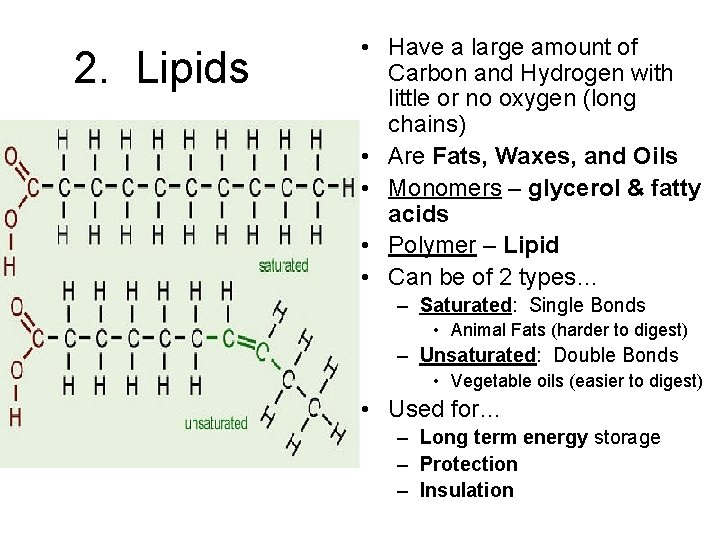
2. Lipids • Have a large amount of Carbon and Hydrogen with little or no oxygen (long chains) • Are Fats, Waxes, and Oils • Monomers – glycerol & fatty acids • Polymer – Lipid • Can be of 2 types… – Saturated: Single Bonds • Animal Fats (harder to digest) – Unsaturated: Double Bonds • Vegetable oils (easier to digest) • Used for… – Long term energy storage – Protection – Insulation
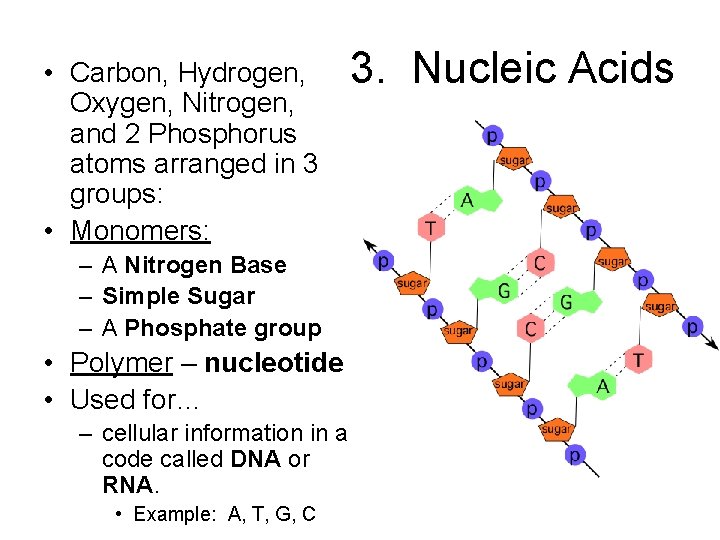
• Carbon, Hydrogen, Oxygen, Nitrogen, and 2 Phosphorus atoms arranged in 3 groups: • Monomers: – A Nitrogen Base – Simple Sugar – A Phosphate group • Polymer – nucleotide • Used for… – cellular information in a code called DNA or RNA. • Example: A, T, G, C 3. Nucleic Acids

4. Proteins • Composed of Carbon, Hydrogen, Oxygen, Nitrogen, and Sulfur • Monomers = amino acids • Polymers = proteins • Provide structure for cells, tissues and organs. • Carries out cell metabolism (enzymes) • Proteins vary the most in structure because of the variable their amino acid makeup. (20 essential) • Proteins can be destroyed by extreme heat (fever) = denature
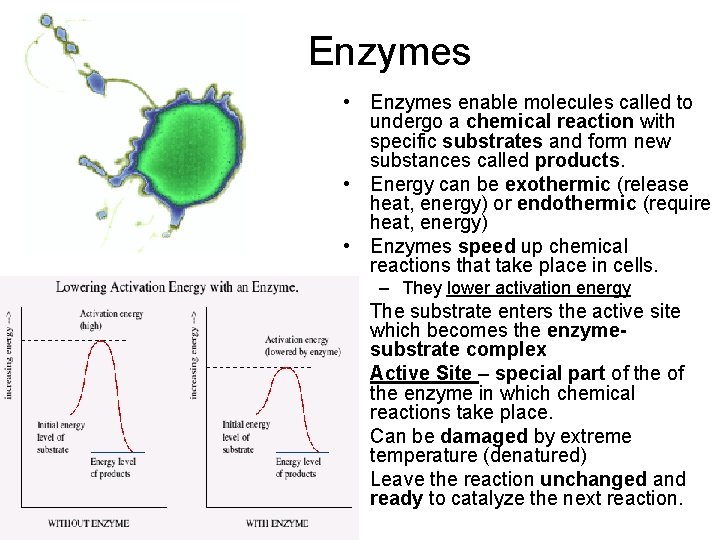
Enzymes • Enzymes enable molecules called to undergo a chemical reaction with specific substrates and form new substances called products. • Energy can be exothermic (release heat, energy) or endothermic (require heat, energy) • Enzymes speed up chemical reactions that take place in cells. – They lower activation energy • The substrate enters the active site which becomes the enzymesubstrate complex • Active Site – special part of the enzyme in which chemical reactions take place. • Can be damaged by extreme temperature (denatured) • Leave the reaction unchanged and ready to catalyze the next reaction.
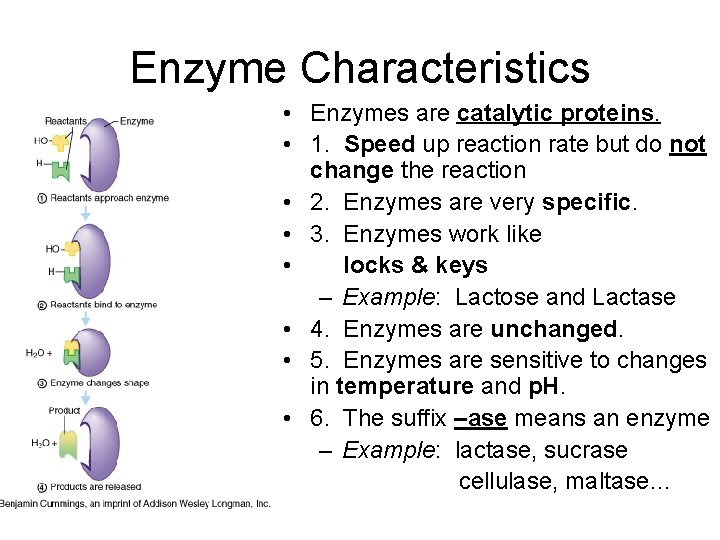
Enzyme Characteristics • Enzymes are catalytic proteins. • 1. Speed up reaction rate but do not change the reaction • 2. Enzymes are very specific. • 3. Enzymes work like • locks & keys – Example: Lactose and Lactase • 4. Enzymes are unchanged. • 5. Enzymes are sensitive to changes in temperature and p. H. • 6. The suffix –ase means an enzyme – Example: lactase, sucrase cellulase, maltase…
- Slides: 6