
1 Campylobacter 2 3 Characteristics of Campylobacter Discovered

1

Campylobacter 2

3 Characteristics of Campylobacter Discovered by Theodor Escherich in 1886 Campylobacteraceae family Gram negative curved rod, up to 5 -8 mm in length Microaerobic; some require high H 2 Non-spore-forming Highly motile (corkscrew motility) Highly susceptible to killing ~800, 000 cases (3 rd) Surface lipooligosaccharides (LOS) Poorly understood Image from Wikipedia

4 Nomenclature of Campylobacteraceae � Campylobacter (17 species) � Arcobacter (6 species) � Sulfurospirillum (6 species) C. jejuni subsp. jejuni and C. coli of most concern

5 Growth and survival characteristics Why is this a pathogen again? Temperature range for growth and survival � Thermotolerant (C. jejuni), mesophilic (C. fetus) � D 55 C ~2. 5 -6. 5 min, D 60 C < 1 min p. H range Oxygen sensitive (especially at low cell densities) Survival outside host is temperature dependent

6 Growth and survival characteristics Survival outside of the host � C. jejuni Pasteurized milk (25 d/4 C, 3 d/25 C) Stream water (1 -4 weeks/4 C, 4 d/25 C) Sensitive to oxygen � Grows in atmospheric conditions only in high cell densities � Catalases/superoxide dismutases Very tricky to work with in the lab � Transport back to the lab
Serotyping 7 Lior method (1982) � Antisera to formaldehyde killed Campylobacter � At least 21 different Lior groups Penner method (1980) � Antibodies developed to the LOS layer � At least 23 different Penner types � Heat stable, given “HS” designation (ie. HS: 1, HS: 2) Can be used as first step of characterization during an outbreak investigation
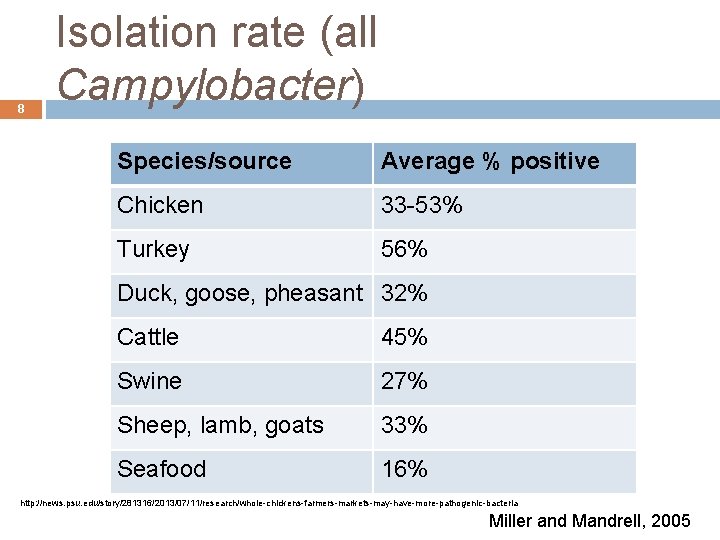
8 Isolation rate (all Campylobacter) Species/source Average % positive Chicken 33 -53% Turkey 56% Duck, goose, pheasant 32% Cattle 45% Swine 27% Sheep, lamb, goats 33% Seafood 16% http: //news. psu. edu/story/281316/2013/07/11/research/whole-chickens-farmers-markets-may-have-more-pathogenic-bacteria Miller and Mandrell, 2005
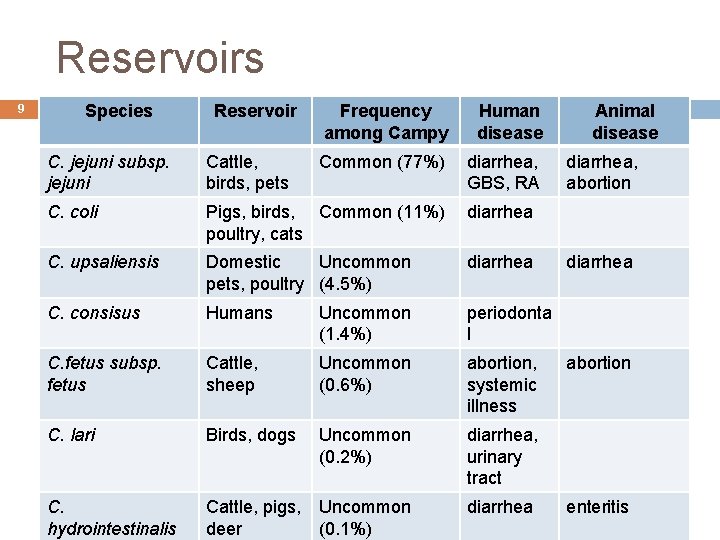
Reservoirs 9 Species Reservoir Frequency among Campy Human disease Common (77%) diarrhea, GBS, RA C. jejuni subsp. jejuni Cattle, birds, pets C. coli Pigs, birds, Common (11%) poultry, cats diarrhea C. upsaliensis Domestic Uncommon pets, poultry (4. 5%) diarrhea C. consisus Humans Uncommon (1. 4%) periodonta l C. fetus subsp. fetus Cattle, sheep Uncommon (0. 6%) abortion, systemic illness C. lari Birds, dogs Uncommon (0. 2%) diarrhea, urinary tract C. hydrointestinalis Cattle, pigs, deer Uncommon (0. 1%) diarrhea Animal disease diarrhea, abortion diarrhea abortion enteritis
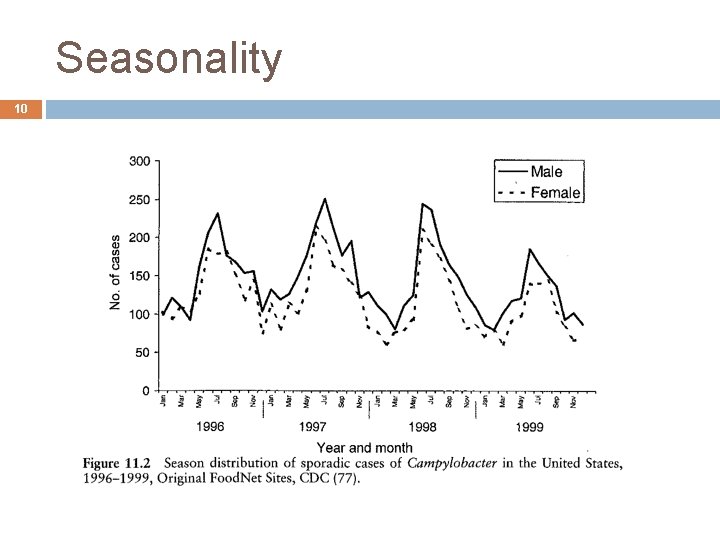
Seasonality 10
Disease 11 About 80% believed to be foodborne 3 rd most common bacterial cause (~800, 000 cases) Infectious dose ~500 -1000 cfu Mostly sporadic (vs. outbreak) Incubation period “Generic” disease � Malaise, fever, abdominal pain, diarrhea � Self-limiting � May continue to shed organisms up to 2 -3 weeks However….
Severe complications 12 Guillain-Barre syndrome Rare, ~100 -1000 cases � Ascending paralysis (most cases) muscle weakness/pain difficulty walking vision/speech � Autoimmune disease � LOS HS: 19 (especially) antigenically related to GM 1 and GD 1 a (component of motor neurons) No known cure, only alleviation of symptoms; lifetime disease � More common in men and women between 30 -50 � Reactive arthritis Swelling of joints, urethra, eyes � More common in teenagers and men under 40 � No known cure; lifetime disease �

Outbreaks 13 http: //wwwn. cdc. gov/foodborneoutbreaks/Defa ult. aspx# http: //www. marlerclark. com/news_events � See Outbreak Database at bottom of website http: //www. pritzkerlaw. com/food-litigation/
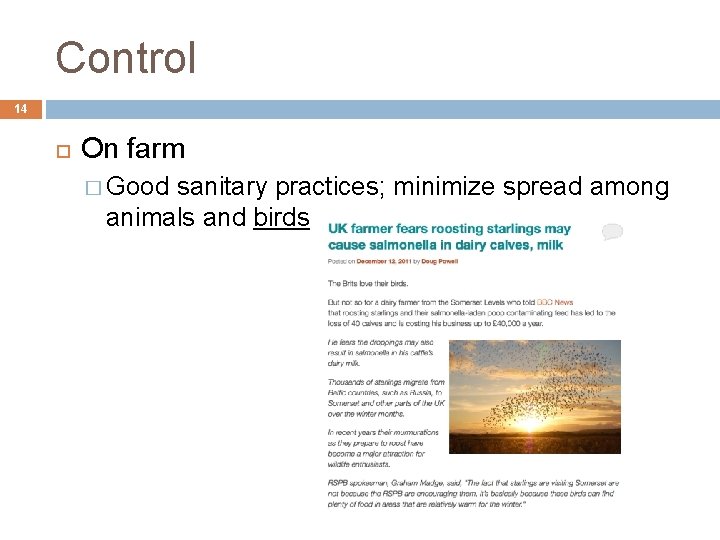
Control 14 On farm � Good sanitary practices; minimize spread among animals and birds
15 Control (Recommendations of FSIS) On farm � Good sanitary practices; minimize spread among animals and birds Plant � Minimize cross-contamination � Pasteurize Individual � Recognize prevalence � Clean (hands, cutting boards, etc), separate, cook, chill (pretty much universal)
On the horizon: Arcobacter 16 More recently recognized, emerging foodborne pathogen Related but different from Campylobacter A. butzleri, A. cryaerophilus most common A. butzleri is 4 th most common “Campylobacter -like” disease (3. 5% of cases); A. cryaerophilus isolated about 0. 5% of cases Disease Lots of unknowns
- Slides: 16