
1 C Pronk Aphorisms in Computer Science Where

![Hello World in RMI-context - 2 32 C. Pronk public static void main(String args[])](https://slidetodoc.com/presentation_image/3776cc648bace8ce8c4a5e43adf77638/image-32.jpg "Hello World in RMI-context - 2 32 C. Pronk public static void main(String args[])")
- Slides: 78
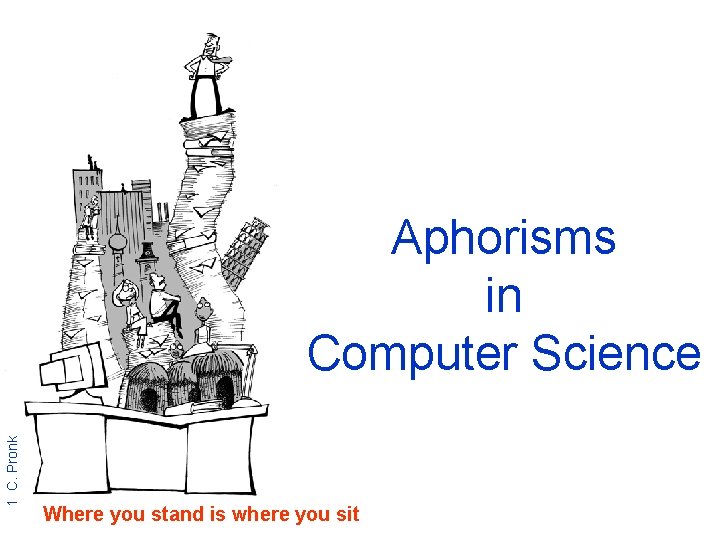
1 C. Pronk Aphorisms in Computer Science Where you stand is where you sit
2 C. Pronk Requirements Engineering • Requirements Engineering is more difficult now, because all systems that were easy to specify, have been built some time ago. • Tom De. Marco '01 • Requirements deficiencies are the primary source of project failures. • Robert Glass • There are no wrong programs. Such a program is simply a different program • W. L. van der Poel
Modularization • Every module is characterized by its knowledge of a design decision which it hides from all others. Its interface is chosen to reveal as little as possible about its inner workings. 3 C. Pronk • Only what is hidden can be changed without risk. • David L. Parnas '72
Dijkstra-isms • The goto statement as it stands is just too primitive; it is too much an invitation to make a mess of one's program • E. W. Dijkstra '68 4 C. Pronk • Testing can show the presence, but not the absence of errors • E. W. Dijkstra
On validation and static verification 5 C. Pronk • We can conclude from experience that inspections increase productivity and improve final program quality. • M. E. Fagan '76
Errors • Users don't observe errors or faults. They observe execution failures. • H. Mills '90 6 C. Pronk • Smaller changes have a higher error density than larger ones. • Basili-Möller • Error prevention is better than error removal. • Mays
Formal Methods • Formal methods significantly reduce design errors, or eliminate them early. • Bauer-Zemanek 7 C. Pronk • Proving programs solves the problems of correctness, documentation and compatibility. • C. A. R. Hoare
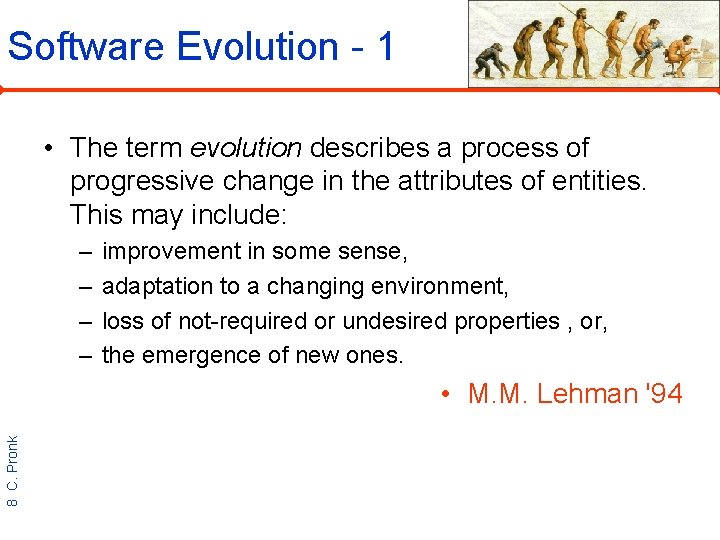
Software Evolution - 1 • The term evolution describes a process of progressive change in the attributes of entities. This may include: – – improvement in some sense, adaptation to a changing environment, loss of not-required or undesired properties , or, the emergence of new ones. 8 C. Pronk • M. M. Lehman '94
Software Evolution - 2 • A system that is used will be changed. • An evolving system increases its complexity, unless work is done to reduce it. 9 C. Pronk • System evolution is determined by a feedback process. • M. M. Lehman
Complexity - 1 • The software field is not a simple one and, if anything, it is getting more complex at a faster rate than we can put in order. • Barry W. Boehm '79 10 C. Pronk • Building software will always be hard. There is inherently no silver bullet. • F. P. Brooks, Jr '87
Complexity - 2 11 C. Pronk • Programmers are always surrounded by complexity; we cannot avoid it. Our applications are complex because we are ambitious to use our computers in ever more sophisticated ways. • C. A. R. Hoare '81 • Simple, elegant solutions are more effective, but they are much harder to find than complex ones • N. Wirth '85
Complexity - 3 • If you have a procedure with 10 parameters, you probably missed some. • Alan Perlis 12 C. Pronk • The software is done. We are just trying to get it to work. • Statement in Executive Program Review • Good, fast, cheap. Pick any two. • Old software engineering aphorism
Work power 13 C. Pronk • The best engineers or scientists do not work for a company, a university or a laboratory; they really work for themselves. • W. S. Humphrey '97
Software Architecture • Software architecture involves the description of elements from which systems are built, interactions amongst those elements, patterns that guide there composition, and constraints on these patterns • Mary Shaw '96 14 C. Pronk • Architecture wins over technology • Morris-Ferguson
Performance • The price/performance ratio of processors is halved every 18 months. • Moore 15 C. Pronk • The capacity of magnetic devices increases by a factor of ten every decade. • Hoagland • Wireless bandwidth doubles every 2. 5 years. • Cooper
16 C. Pronk
Hello World from the GNU archives 17 C. Pronk
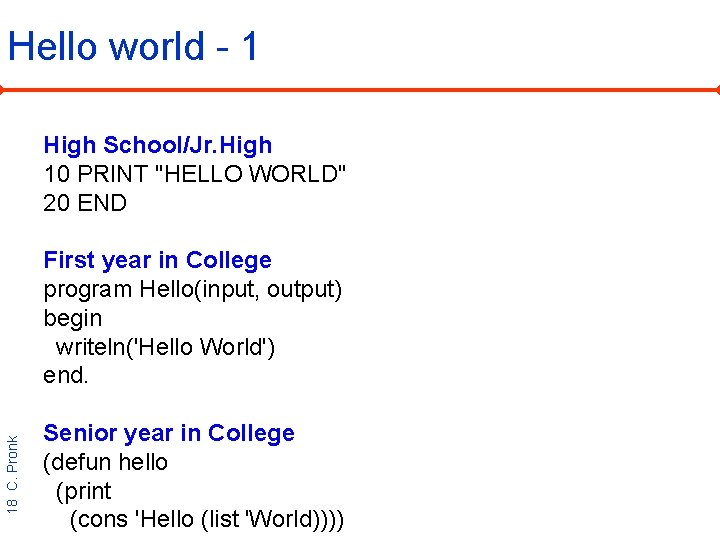
Hello world - 1 High School/Jr. High 10 PRINT "HELLO WORLD" 20 END 18 C. Pronk First year in College program Hello(input, output) begin writeln('Hello World') end. Senior year in College (defun hello (print (cons 'Hello (list 'World))))
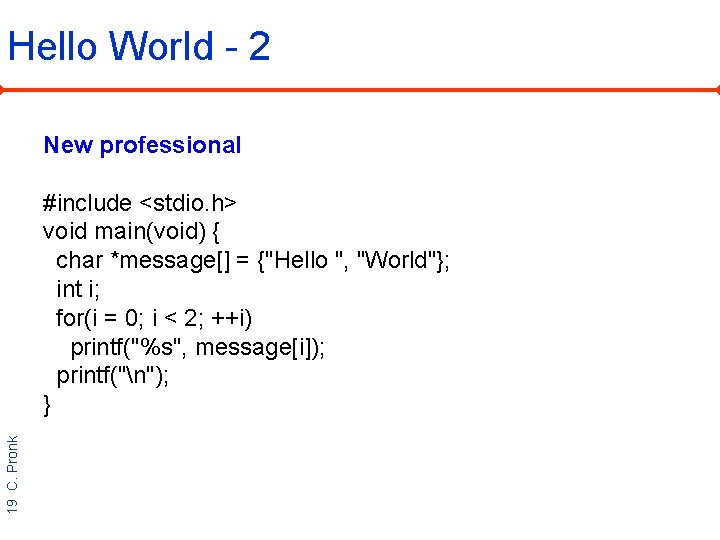
Hello World - 2 New professional 19 C. Pronk #include <stdio. h> void main(void) { char *message[] = {"Hello ", "World"}; int i; for(i = 0; i < 2; ++i) printf("%s", message[i]); printf("n"); }
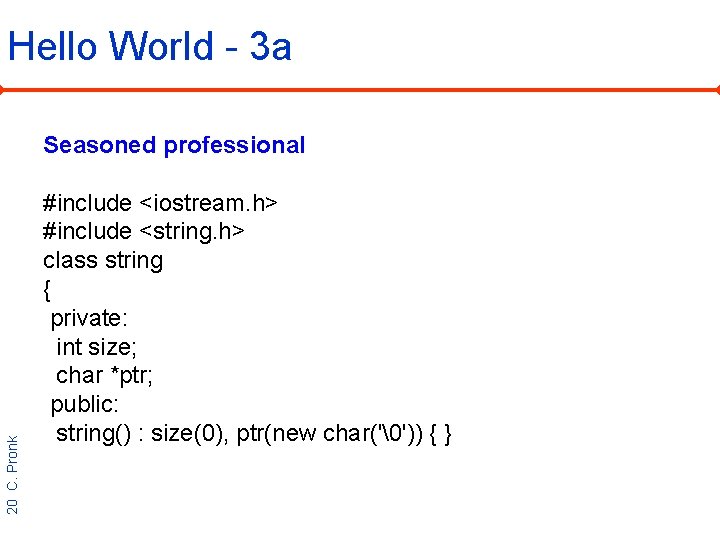
Hello World - 3 a 20 C. Pronk Seasoned professional #include <iostream. h> #include <string. h> class string { private: int size; char *ptr; public: string() : size(0), ptr(new char('')) { }
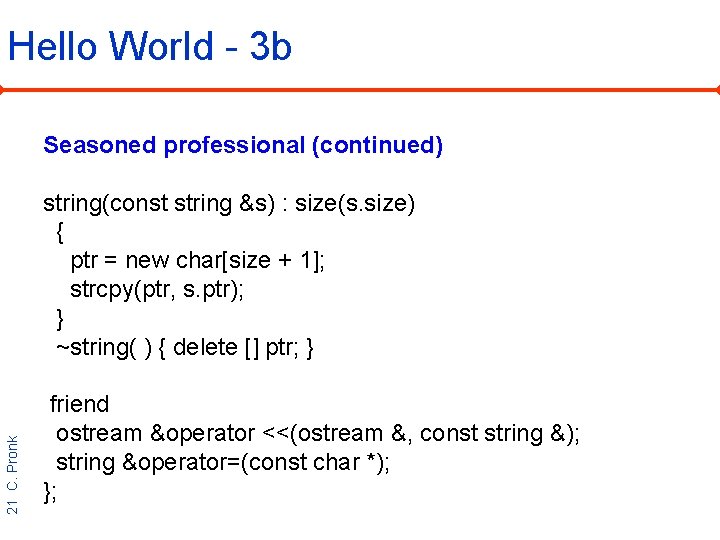
Hello World - 3 b Seasoned professional (continued) 21 C. Pronk string(const string &s) : size(s. size) { ptr = new char[size + 1]; strcpy(ptr, s. ptr); } ~string( ) { delete [] ptr; } friend ostream &operator <<(ostream &, const string &); string &operator=(const char *); };
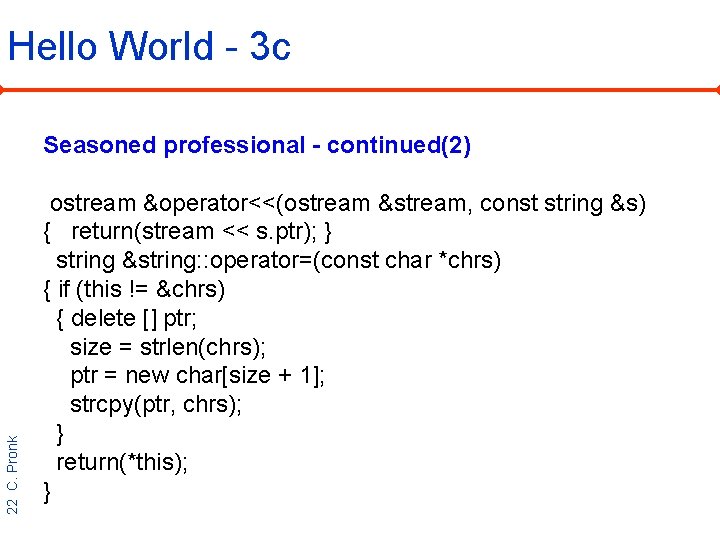
Hello World - 3 c 22 C. Pronk Seasoned professional - continued(2) ostream &operator<<(ostream &stream, const string &s) { return(stream << s. ptr); } string &string: : operator=(const char *chrs) { if (this != &chrs) { delete [] ptr; size = strlen(chrs); ptr = new char[size + 1]; strcpy(ptr, chrs); } return(*this); }
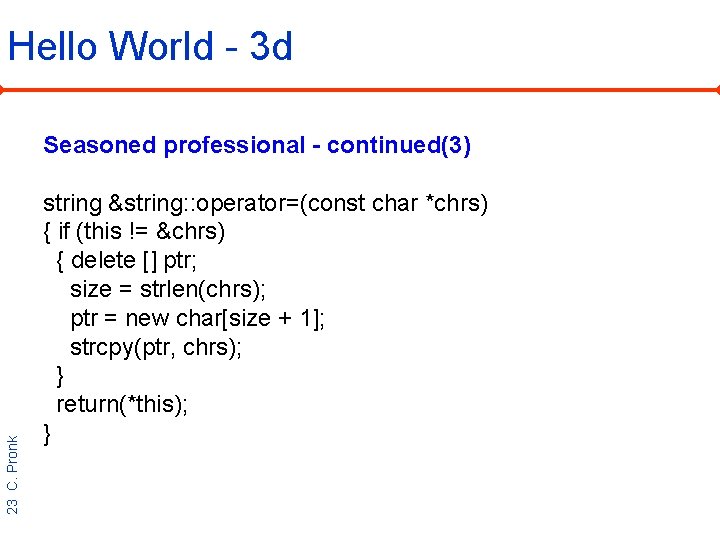
Hello World - 3 d 23 C. Pronk Seasoned professional - continued(3) string &string: : operator=(const char *chrs) { if (this != &chrs) { delete [] ptr; size = strlen(chrs); ptr = new char[size + 1]; strcpy(ptr, chrs); } return(*this); }
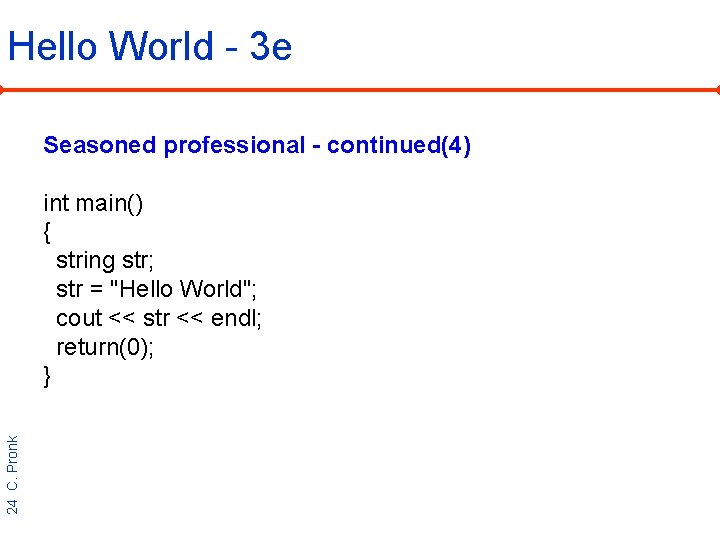
Hello World - 3 e Seasoned professional - continued(4) 24 C. Pronk int main() { string str; str = "Hello World"; cout << str << endl; return(0); }
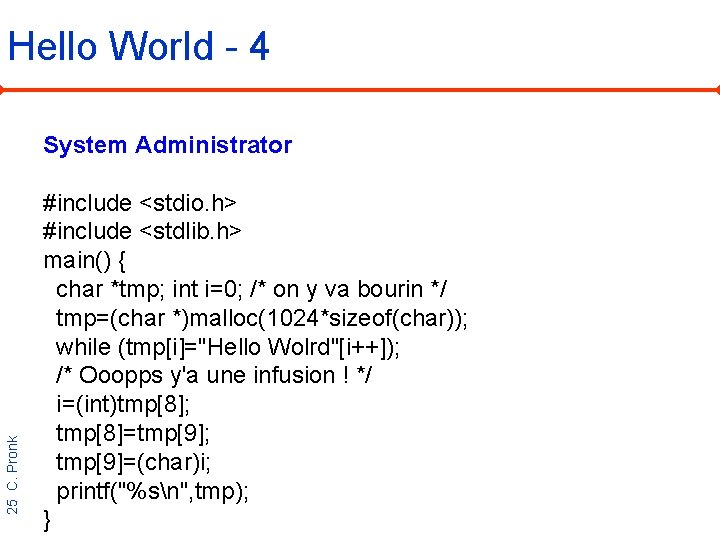
Hello World - 4 25 C. Pronk System Administrator #include <stdio. h> #include <stdlib. h> main() { char *tmp; int i=0; /* on y va bourin */ tmp=(char *)malloc(1024*sizeof(char)); while (tmp[i]="Hello Wolrd"[i++]); /* Ooopps y'a une infusion ! */ i=(int)tmp[8]; tmp[8]=tmp[9]; tmp[9]=(char)i; printf("%sn", tmp); }
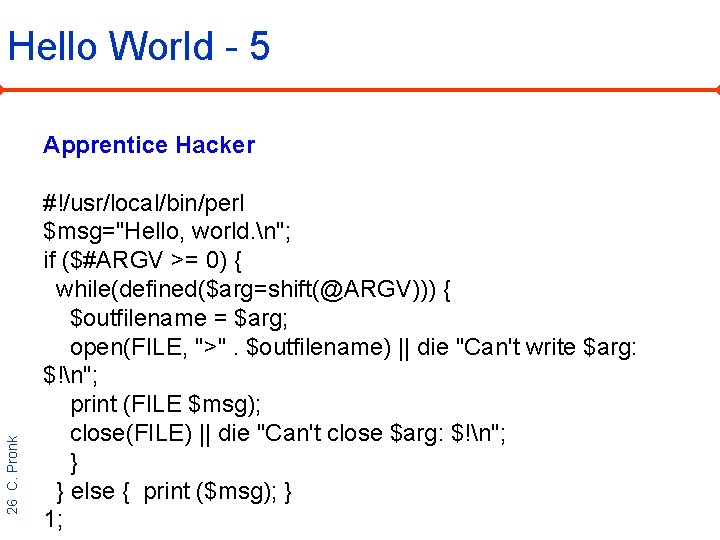
Hello World - 5 26 C. Pronk Apprentice Hacker #!/usr/local/bin/perl $msg="Hello, world. n"; if ($#ARGV >= 0) { while(defined($arg=shift(@ARGV))) { $outfilename = $arg; open(FILE, ">". $outfilename) || die "Can't write $arg: $!n"; print (FILE $msg); close(FILE) || die "Can't close $arg: $!n"; } } else { print ($msg); } 1;
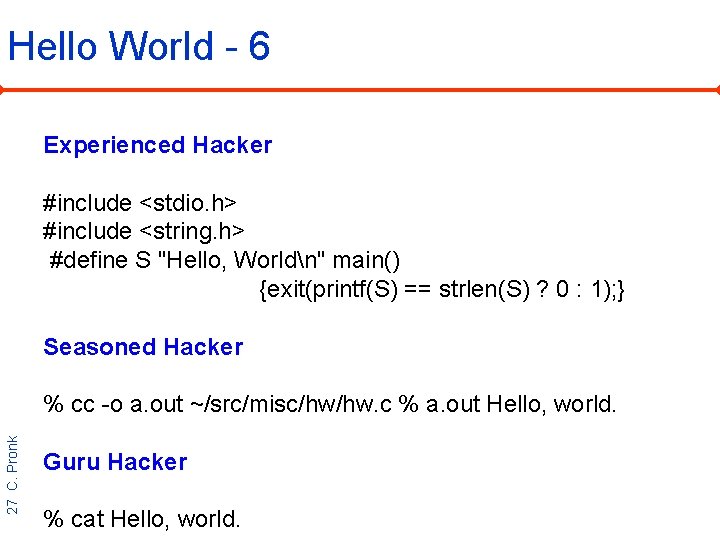
Hello World - 6 Experienced Hacker #include <stdio. h> #include <string. h> #define S "Hello, Worldn" main() {exit(printf(S) == strlen(S) ? 0 : 1); } Seasoned Hacker 27 C. Pronk % cc -o a. out ~/src/misc/hw/hw. c % a. out Hello, world. Guru Hacker % cat Hello, world.
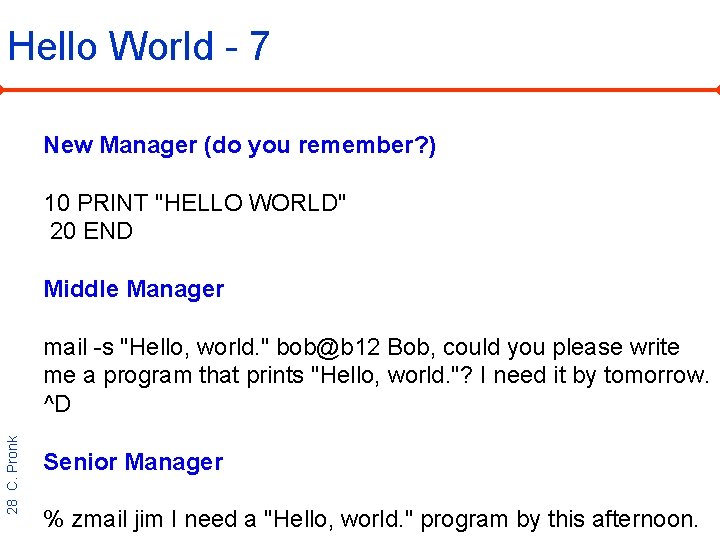
Hello World - 7 New Manager (do you remember? ) 10 PRINT "HELLO WORLD" 20 END Middle Manager 28 C. Pronk mail -s "Hello, world. " bob@b 12 Bob, could you please write me a program that prints "Hello, world. "? I need it by tomorrow. ^D Senior Manager % zmail jim I need a "Hello, world. " program by this afternoon.
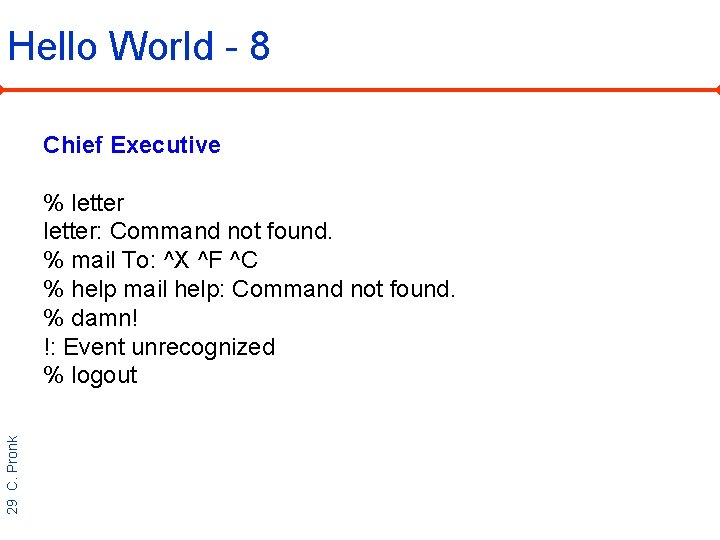
Hello World - 8 Chief Executive 29 C. Pronk % letter: Command not found. % mail To: ^X ^F ^C % help mail help: Command not found. % damn! !: Event unrecognized % logout
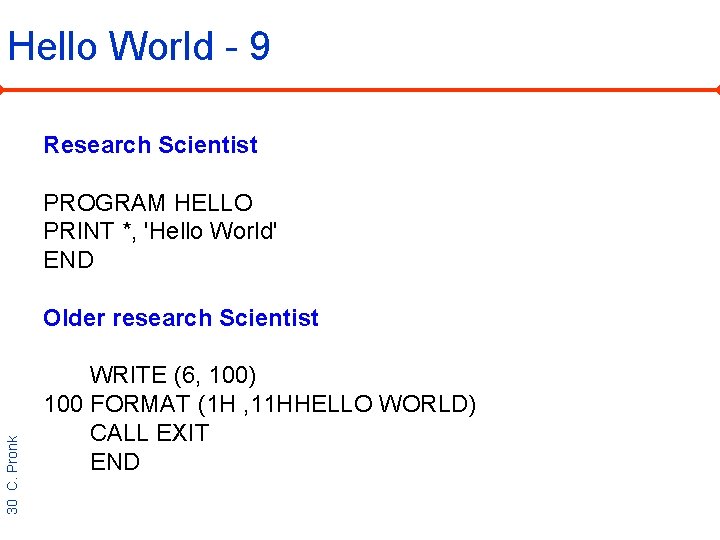
Hello World - 9 Research Scientist PROGRAM HELLO PRINT *, 'Hello World' END 30 C. Pronk Older research Scientist WRITE (6, 100) 100 FORMAT (1 H , 11 HHELLO WORLD) CALL EXIT END
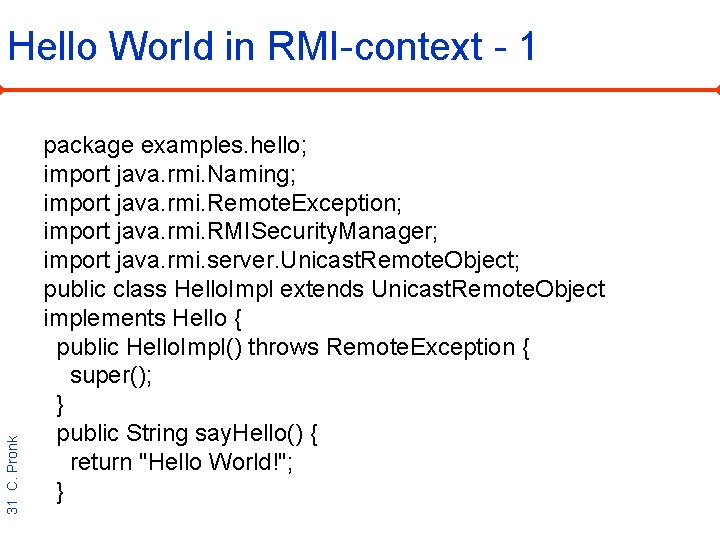
31 C. Pronk Hello World in RMI-context - 1 package examples. hello; import java. rmi. Naming; import java. rmi. Remote. Exception; import java. rmi. RMISecurity. Manager; import java. rmi. server. Unicast. Remote. Object; public class Hello. Impl extends Unicast. Remote. Object implements Hello { public Hello. Impl() throws Remote. Exception { super(); } public String say. Hello() { return "Hello World!"; }
Hello World in RMI-context - 2 32 C. Pronk public static void main(String args[]) { // Create and install a security manager if (System. get. Security. Manager() == null) { System. set. Security. Manager(new RMISecurity. Manager()); } try { Hello. Impl obj = new Hello. Impl(); // Bind this object instance to the name "Hello. Server" Naming. rebind("//myhost/Hello. Server", obj); System. out. println("Hello. Server bound in registry"); } catch (Exception e) { System. out. println("Hello. Impl err: " + e. get. Message()); e. print. Stack. Trace(); } }
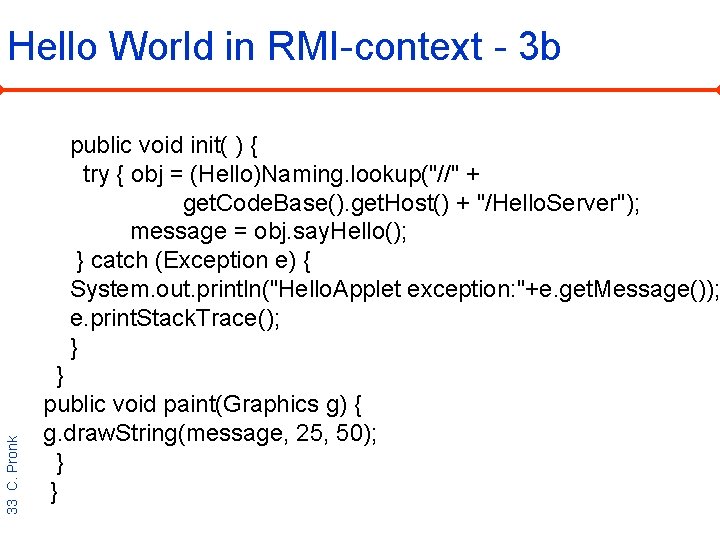
33 C. Pronk Hello World in RMI-context - 3 b public void init( ) { try { obj = (Hello)Naming. lookup("//" + get. Code. Base(). get. Host() + "/Hello. Server"); message = obj. say. Hello(); } catch (Exception e) { System. out. println("Hello. Applet exception: "+e. get. Message()); e. print. Stack. Trace(); } } public void paint(Graphics g) { g. draw. String(message, 25, 50); } }
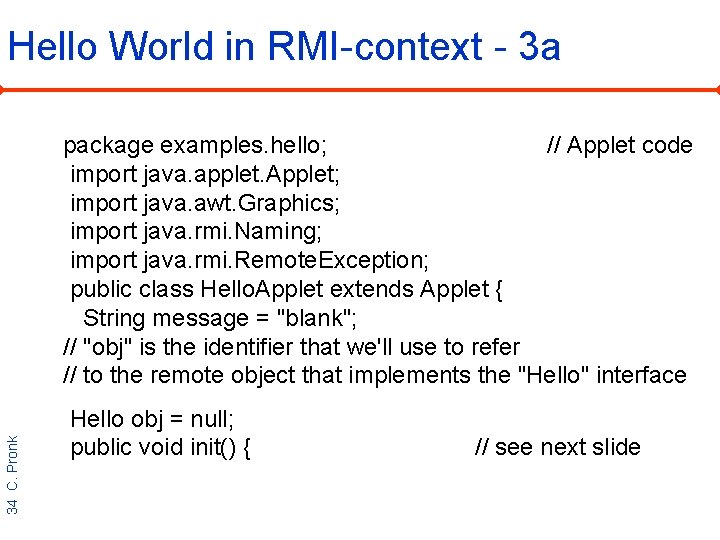
Hello World in RMI-context - 3 a 34 C. Pronk package examples. hello; // Applet code import java. applet. Applet; import java. awt. Graphics; import java. rmi. Naming; import java. rmi. Remote. Exception; public class Hello. Applet extends Applet { String message = "blank"; // "obj" is the identifier that we'll use to refer // to the remote object that implements the "Hello" interface Hello obj = null; public void init() { // see next slide
35 C. Pronk in various languages
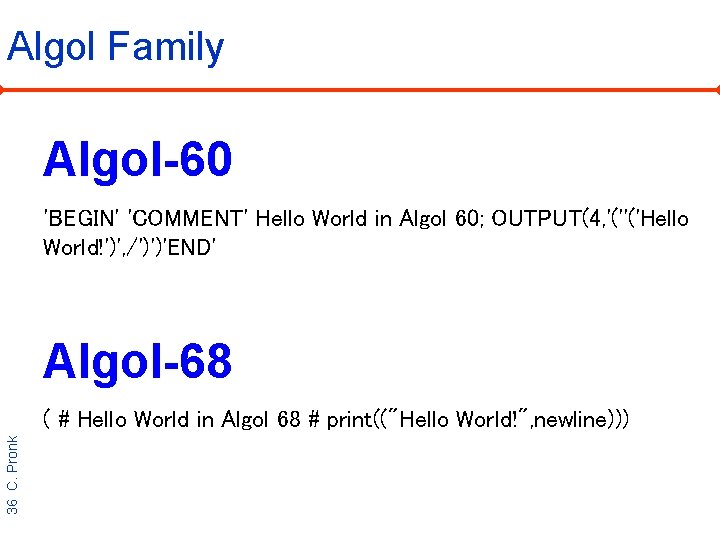
Algol Family Algol-60 'BEGIN' 'COMMENT' Hello World in Algol 60; OUTPUT(4, '(''('Hello World!')', /')')'END' Algol-68 36 C. Pronk ( # Hello World in Algol 68 # print(("Hello World!", newline)))
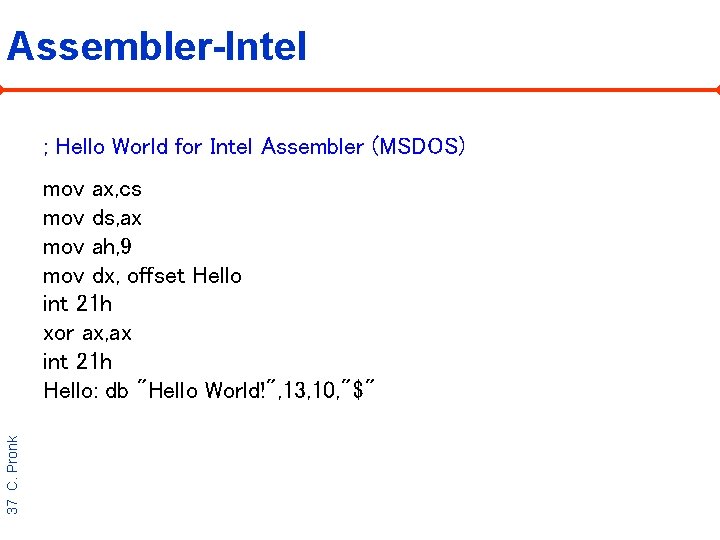
Assembler-Intel ; Hello World for Intel Assembler (MSDOS) 37 C. Pronk mov ax, cs mov ds, ax mov ah, 9 mov dx, offset Hello int 21 h xor ax, ax int 21 h Hello: db "Hello World!", 13, 10, "$"
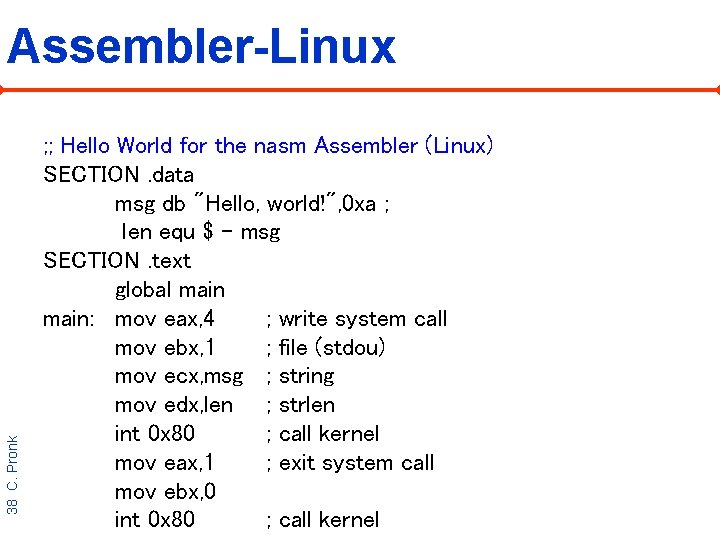
38 C. Pronk Assembler-Linux ; ; Hello World for the nasm Assembler (Linux) SECTION. data msg db "Hello, world!", 0 xa ; len equ $ - msg SECTION. text global main: mov eax, 4 ; write system call mov ebx, 1 ; file (stdou) mov ecx, msg ; string mov edx, len ; strlen int 0 x 80 ; call kernel mov eax, 1 ; exit system call mov ebx, 0 int 0 x 80 ; call kernel
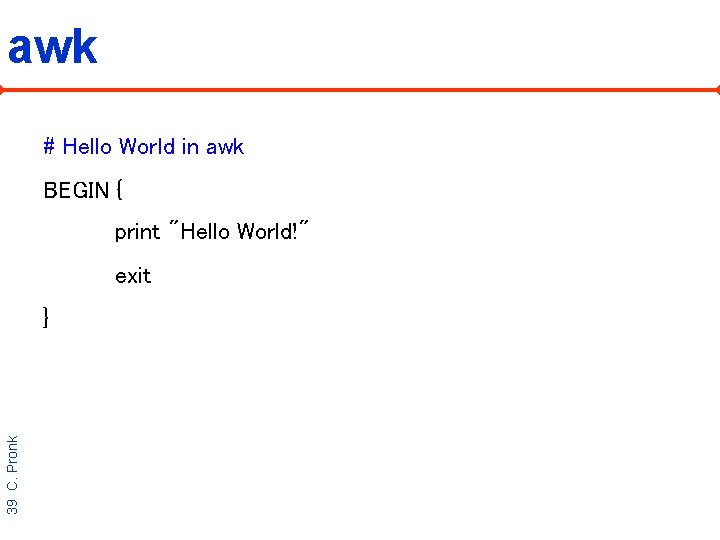
awk # Hello World in awk BEGIN { print "Hello World!" exit 39 C. Pronk }
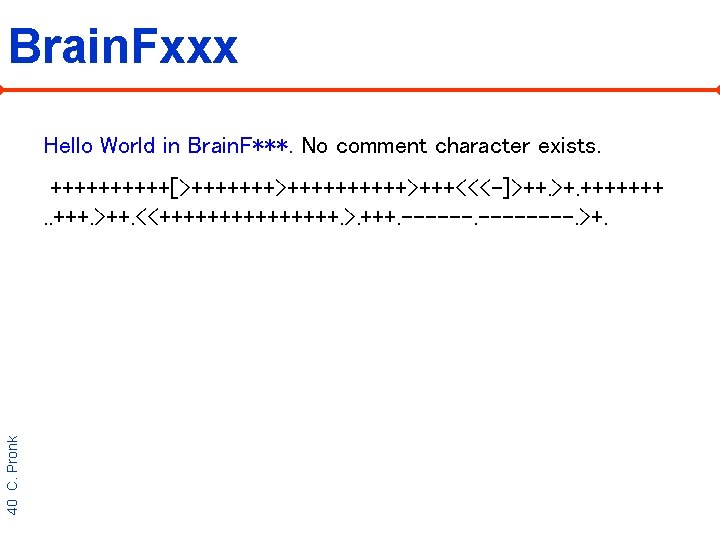
Brain. Fxxx Hello World in Brain. F***. No comment character exists. 40 C. Pronk +++++[>++++++++++>+++<<<-]>++. >+. +++++++. >++. <<++++++++. >. +++. --------. >+.
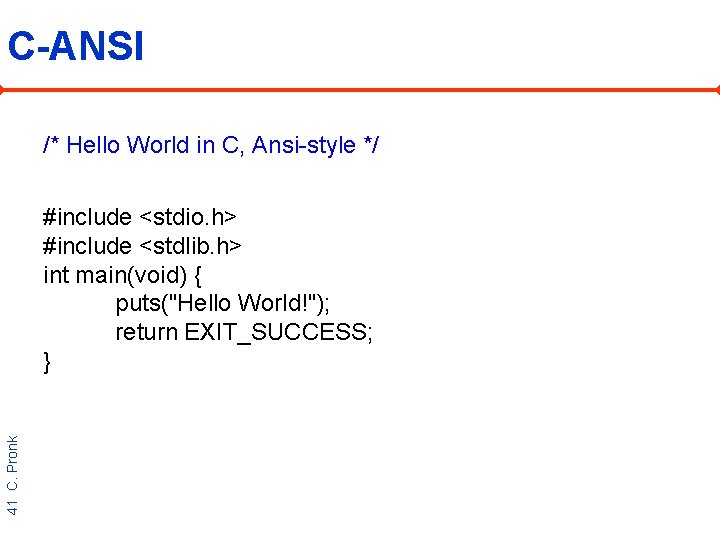
C-ANSI /* Hello World in C, Ansi-style */ 41 C. Pronk #include <stdio. h> #include <stdlib. h> int main(void) { puts("Hello World!"); return EXIT_SUCCESS; }
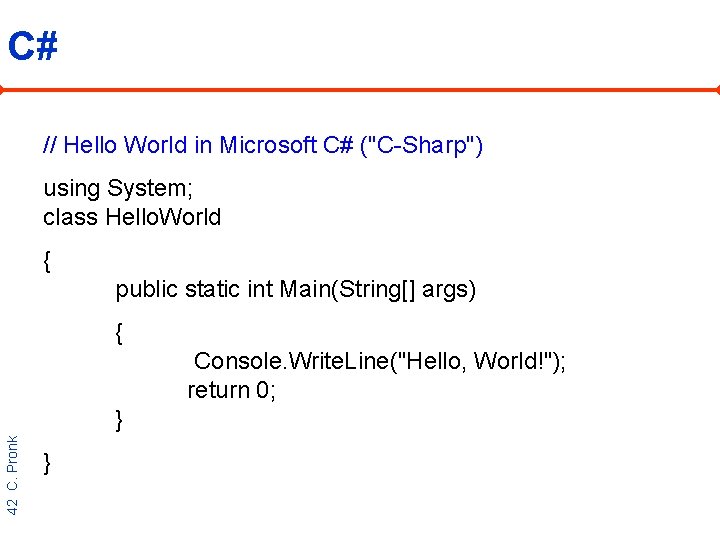
C# // Hello World in Microsoft C# ("C-Sharp") using System; class Hello. World { public static int Main(String[] args) { Console. Write. Line("Hello, World!"); return 0; 42 C. Pronk } }
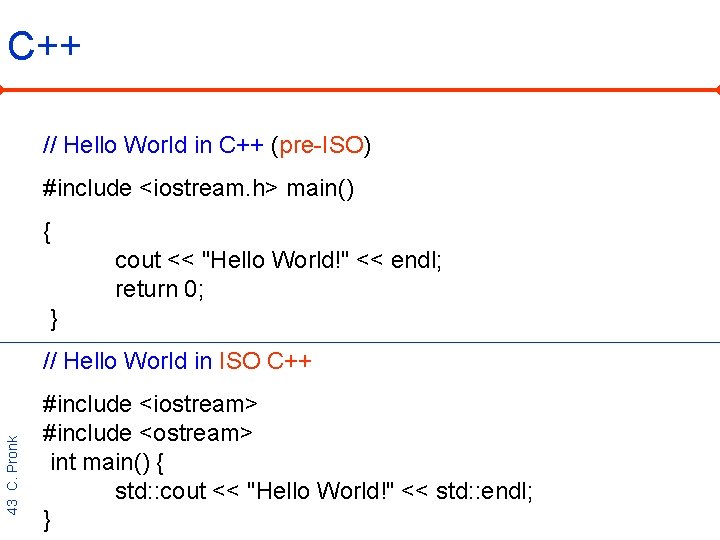
C++ // Hello World in C++ (pre-ISO) #include <iostream. h> main() { cout << "Hello World!" << endl; return 0; } 43 C. Pronk // Hello World in ISO C++ #include <iostream> #include <ostream> int main() { std: : cout << "Hello World!" << std: : endl; }
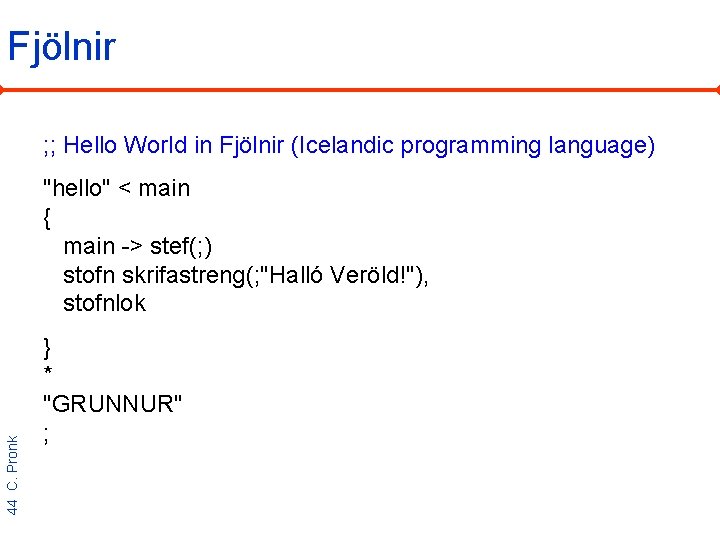
Fjölnir ; ; Hello World in Fjölnir (Icelandic programming language) 44 C. Pronk "hello" < main { main -> stef(; ) stofn skrifastreng(; "Halló Veröld!"), stofnlok } * "GRUNNUR" ;
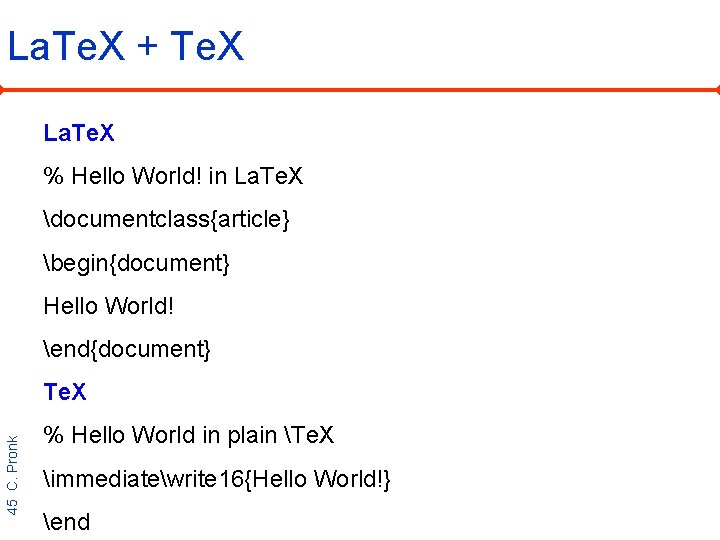
La. Te. X + Te. X La. Te. X % Hello World! in La. Te. X documentclass{article} begin{document} Hello World! end{document} 45 C. Pronk Te. X % Hello World in plain Te. X immediatewrite 16{Hello World!} end
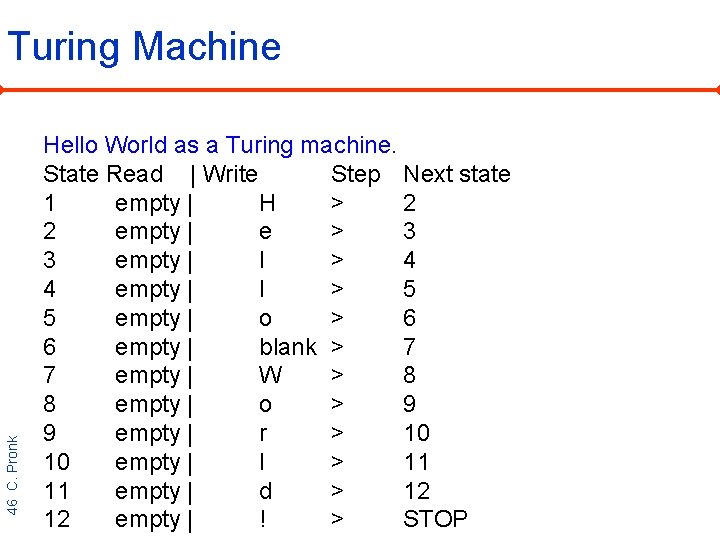
46 C. Pronk Turing Machine Hello World as a Turing machine. State Read | Write Step Next state 1 empty | H > 2 2 empty | e > 3 3 empty | l > 4 4 empty | l > 5 5 empty | o > 6 6 empty | blank > 7 7 empty | W > 8 8 empty | o > 9 9 empty | r > 10 10 empty | l > 11 11 empty | d > 12 12 empty | ! > STOP
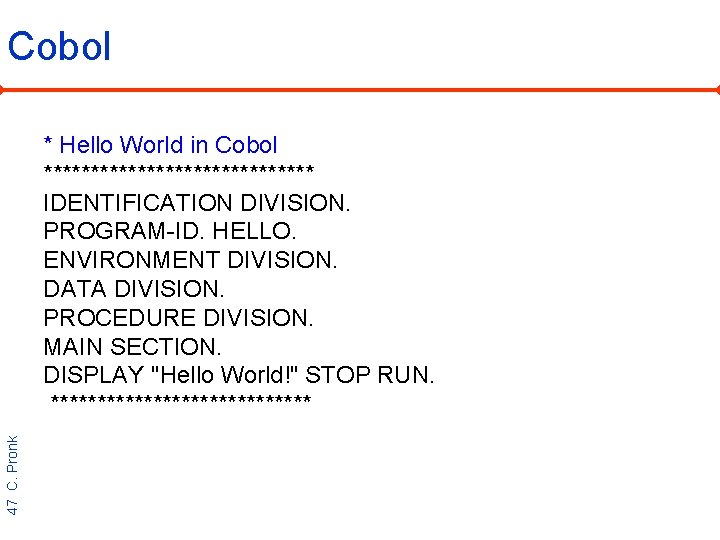
Cobol 47 C. Pronk * Hello World in Cobol *************** IDENTIFICATION DIVISION. PROGRAM-ID. HELLO. ENVIRONMENT DIVISION. DATA DIVISION. PROCEDURE DIVISION. MAIN SECTION. DISPLAY "Hello World!" STOP RUN. **************
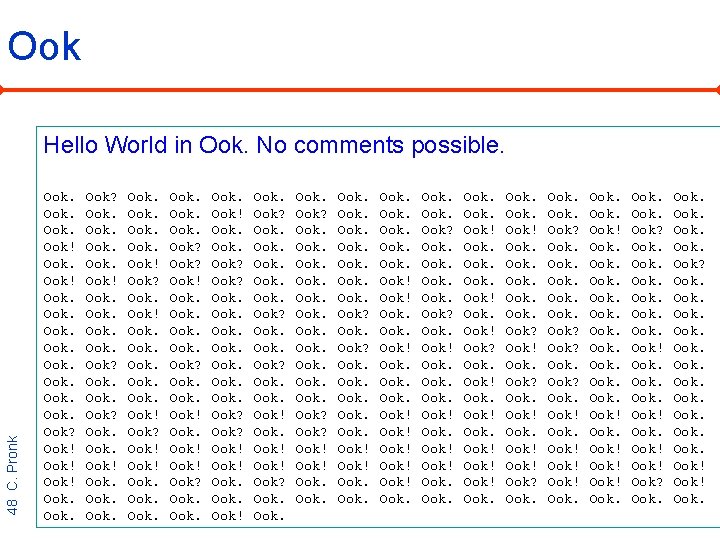
Ook 48 C. Pronk Hello World in Ook. No comments possible. Ook! Ook? Ook! Ook? Ook. Ook! Ook. Ook! Ook? Ook! Ook? Ook! Ook? Ook? Ook! Ook? Ook! Ook? Ook. Ook? Ook! Ook? Ook. Ook! Ook! Ook? Ook. Ook! Ook? Ook! Ook! Ook? Ook! Ook? Ook. Ook! Ook. Ook! Ook! Ook? Ook! Ook! Ook? Ook. Ook! Ook.
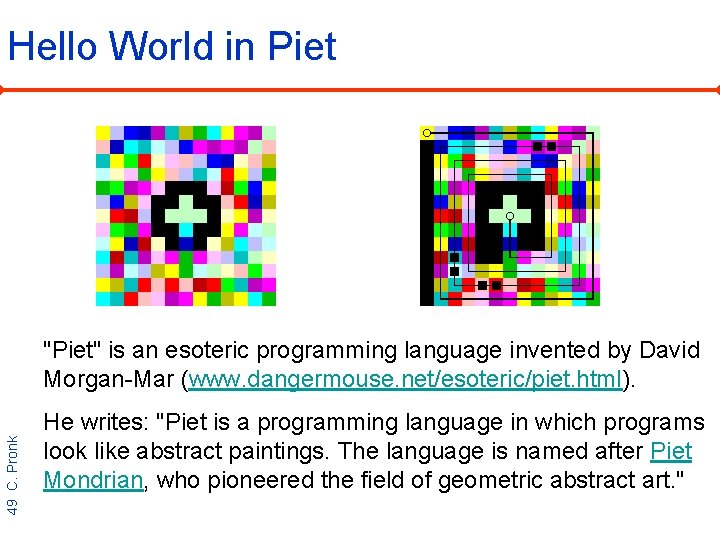
Hello World in Piet 49 C. Pronk "Piet" is an esoteric programming language invented by David Morgan-Mar (www. dangermouse. net/esoteric/piet. html). He writes: "Piet is a programming language in which programs look like abstract paintings. The language is named after Piet Mondrian, who pioneered the field of geometric abstract art. "
50 C. Pronk
51 C. Pronk Haikus instead of error messages http: //archive. salon. com/21 st/chal/1998/02/10 chal 2. html
Three things are certain: Death, taxes, and lost data. Guess which has occurred. -- David Dixon - - - 52 C. Pronk Everything is gone; Your life's work has been destroyed. Squeeze trigger (yes/no)? -- David Carlson - - -
I'm sorry, there's -- um -insufficient -- what's-it-called? The term eludes me. . . -- Owen Mathews - - - 53 C. Pronk Windows NT crashed. I am the Blue Screen of Death. No one hears your screams. -- Peter Rothman - - -
Seeing my great fault Through darkening blue windows I begin again -- Chris Walsh - - - 54 C. Pronk The code was willing, It considered your request, But the chips were weak. -- Barry L. Brumitt - - -
Printer not ready. Could be a fatal error. Have a pen handy? -- Pat Davis - - - 55 C. Pronk A file that big? It might be very useful. But now it is gone. -- David J. Liszewski - - -
Errors have occurred. We won't tell you where or why. Lazy programmers. -- Charlie Gibbs - - - 56 C. Pronk Server's poor response Not quick enough for browser. Timed out, plum blossom. -- Rik Jespersen - - -
Chaos reigns within. Reflect, repent, and reboot. Order shall return. -- Suzie Wagner - - - 57 C. Pronk Login incorrect. Only perfect spellers may enter this system. -- Jason Axley - - -
This site has been moved. We'd tell you where, but then we'd have to delete you. -- Charles Matthews - - - 58 C. Pronk wind catches lily scatt'ring petals to the wind: segmentation fault -- Nick Sweeney - - -
ABORTED effort: Close all that you have. You ask way too much. -- Mike Hagler - - - 59 C. Pronk First snow, then silence. This thousand dollar screen dies so beautifully. -- Simon Firth - - -
With searching comes loss and the presence of absence: "My Novel" not found. -- Howard Korder - - - 60 C. Pronk The Tao that is seen Is not the true Tao, until You bring fresh toner. -- Bill Torcaso - - -
The Web site you seek cannot be located but endless others exist -- Joy Rothke - - - 61 C. Pronk Stay the patient course Of little worth is your ire The network is down -- David Ansel - - -
A crash reduces your expensive computer to a simple stone. -- James Lopez - - - 62 C. Pronk There is a chasm of carbon and silicon the software can't bridge -- Rahul Sonnad - - -
Yesterday it worked Today it is not working Windows is like that -- Margaret Segall - - - 63 C. Pronk To have no errors Would be life without meaning No struggle, no joy -- Brian M. Porter - - -
You step in the stream, but the water has moved on. This page is not here. -- Cass Whittington - - - 64 C. Pronk No keyboard present Hit F 1 to continue Zen engineering? -- Jim Griffith - - -
Hal, open the file Hal, open the damn file, Hal open the, please Hal -- Jennifer Jo Lane - - - 65 C. Pronk Out of memory. We wish to hold the whole sky, But we never will. -- Francis Heaney - - -
Having been erased, The document you're seeking Must now be retyped. -- Judy Birmingham - - - 66 C. Pronk The ten thousand things How long do any persist? Netscape, too, has gone. -- Jason Willoughby - - -
Rather than a beep Or a rude error message, These words: "File not found. " -- Len Dvorkin - - - 67 C. Pronk Serious error. All shortcuts have disappeared. Screen. Mind. Both are blank. -- Ian Hughes - - -
68 C. Pronk Self reproducing programs A program that generates a copy of its own source text as its complete output.
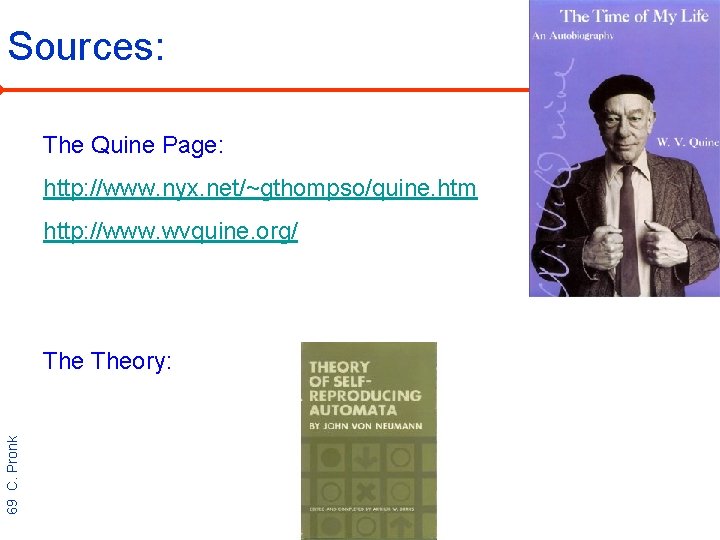
Sources: The Quine Page: http: //www. nyx. net/~gthompso/quine. htm http: //www. wvquine. org/ 69 C. Pronk Theory:
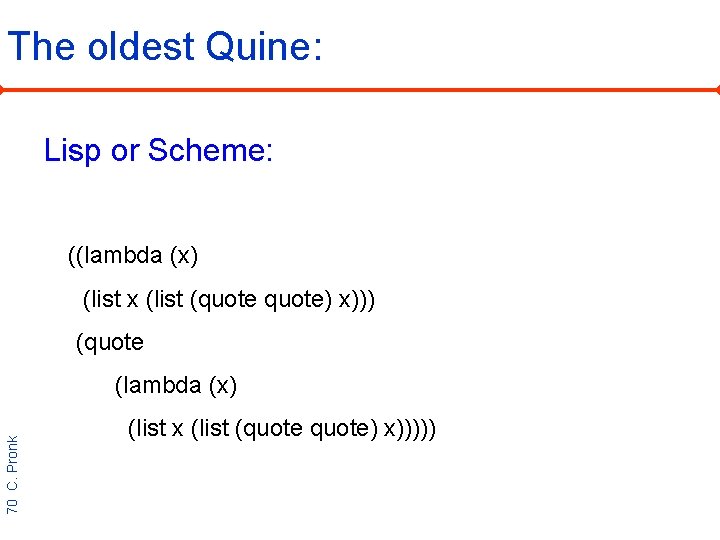
The oldest Quine: Lisp or Scheme: ((lambda (x) (list x (list (quote) x))) (quote 70 C. Pronk (lambda (x) (list x (list (quote) x)))))
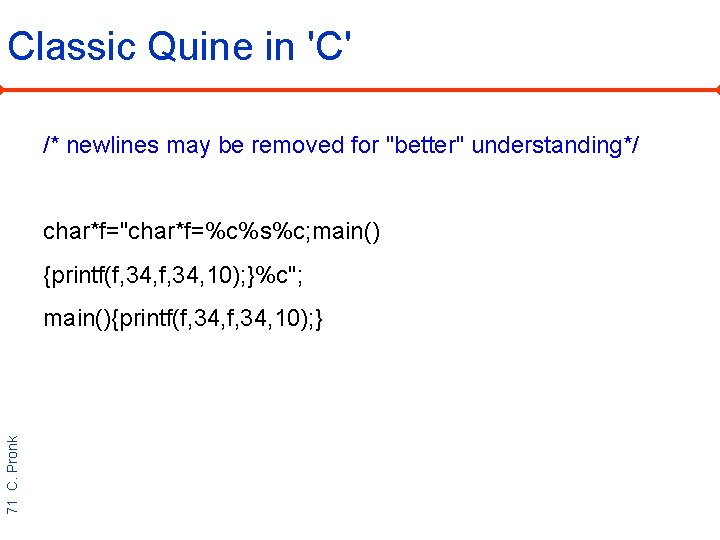
Classic Quine in 'C' /* newlines may be removed for "better" understanding*/ char*f="char*f=%c%s%c; main() {printf(f, 34, 10); }%c"; 71 C. Pronk main(){printf(f, 34, 10); }
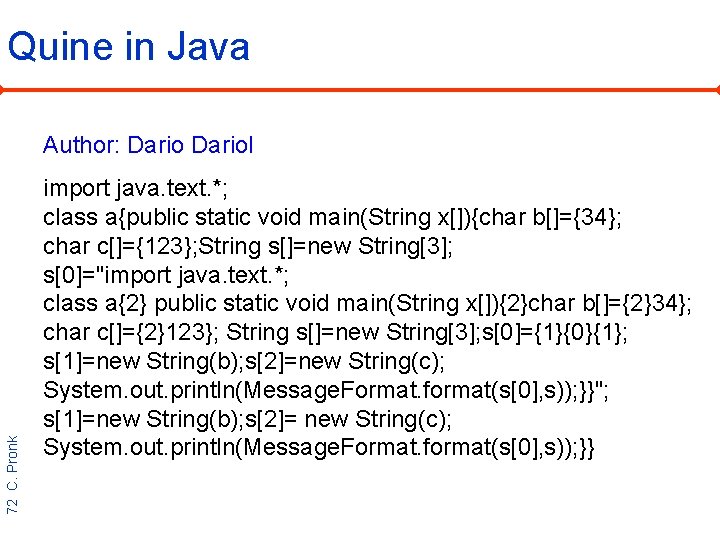
Quine in Java 72 C. Pronk Author: Dariol import java. text. *; class a{public static void main(String x[]){char b[]={34}; char c[]={123}; String s[]=new String[3]; s[0]="import java. text. *; class a{2} public static void main(String x[]){2}char b[]={2}34}; char c[]={2}123}; String s[]=new String[3]; s[0]={1}{0}{1}; s[1]=new String(b); s[2]=new String(c); System. out. println(Message. Format. format(s[0], s)); }}"; s[1]=new String(b); s[2]= new String(c); System. out. println(Message. Format. format(s[0], s)); }}
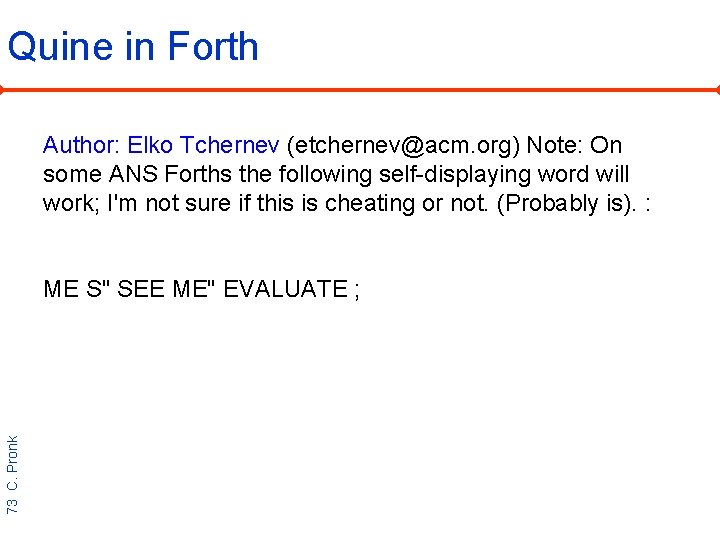
Quine in Forth Author: Elko Tchernev (etchernev@acm. org) Note: On some ANS Forths the following self-displaying word will work; I'm not sure if this is cheating or not. (Probably is). : 73 C. Pronk ME S" SEE ME" EVALUATE ;
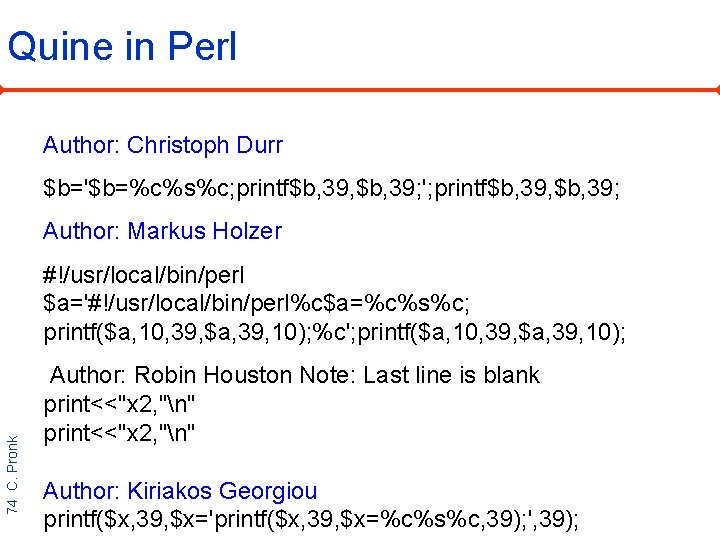
Quine in Perl Author: Christoph Durr $b='$b=%c%s%c; printf$b, 39, $b, 39; '; printf$b, 39, $b, 39; Author: Markus Holzer 74 C. Pronk #!/usr/local/bin/perl $a='#!/usr/local/bin/perl%c$a=%c%s%c; printf($a, 10, 39, $a, 39, 10); %c'; printf($a, 10, 39, $a, 39, 10); Author: Robin Houston Note: Last line is blank print<<''x 2, "n" Author: Kiriakos Georgiou printf($x, 39, $x='printf($x, 39, $x=%c%s%c, 39); ', 39);
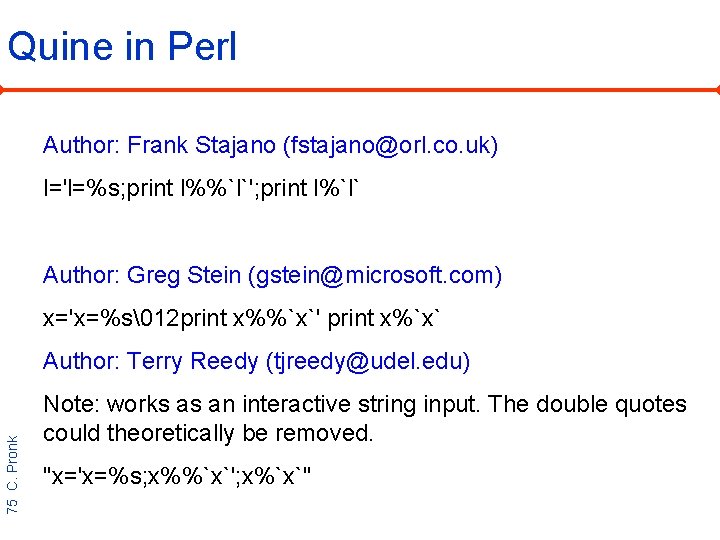
Quine in Perl Author: Frank Stajano (fstajano@orl. co. uk) l='l=%s; print l%%`l`'; print l%`l` Author: Greg Stein (gstein@microsoft. com) x='x=%s12 print x%%`x`' print x%`x` 75 C. Pronk Author: Terry Reedy (tjreedy@udel. edu) Note: works as an interactive string input. The double quotes could theoretically be removed. "x='x=%s; x%%`x`'; x%`x`"
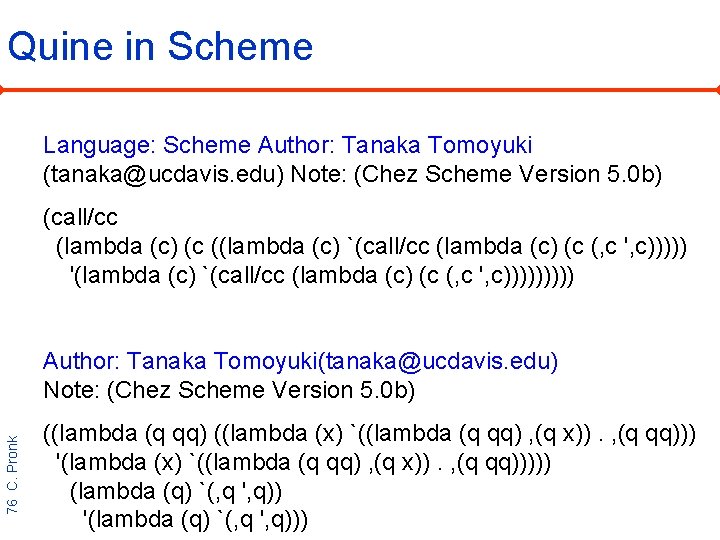
Quine in Scheme Language: Scheme Author: Tanaka Tomoyuki (tanaka@ucdavis. edu) Note: (Chez Scheme Version 5. 0 b) (call/cc (lambda (c) (c ((lambda (c) `(call/cc (lambda (c) (c (, c ', c))))) '(lambda (c) `(call/cc (lambda (c) (c (, c ', c))))) 76 C. Pronk Author: Tanaka Tomoyuki(tanaka@ucdavis. edu) Note: (Chez Scheme Version 5. 0 b) ((lambda (q qq) ((lambda (x) `((lambda (q qq) , (q x)). , (q qq))) '(lambda (x) `((lambda (q qq) , (q x)). , (q qq))))) (lambda (q) `(, q ', q)) '(lambda (q) `(, q ', q)))
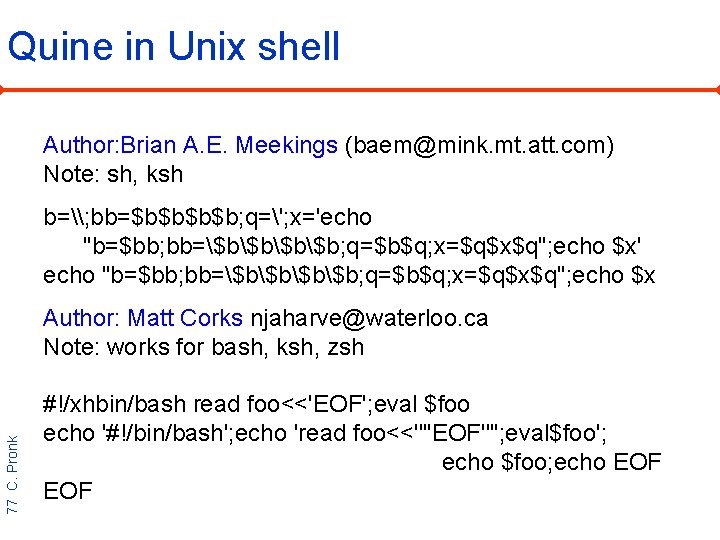
Quine in Unix shell Author: Brian A. E. Meekings (baem@mink. mt. att. com) Note: sh, ksh b=\; bb=$b$b; q='; x='echo "b=$bb; bb=$b$b; q=$b$q; x=$q$x$q"; echo $x' echo "b=$bb; bb=$b$b; q=$b$q; x=$q$x$q"; echo $x 77 C. Pronk Author: Matt Corks njaharve@waterloo. ca Note: works for bash, ksh, zsh #!/xhbin/bash read foo<<'EOF'; eval $foo echo '#!/bin/bash'; echo 'read foo<<'"'EOF'"'; eval$foo'; echo $foo; echo EOF
This museum • The 'vitrinemuseum' shows early computer hardware as used for various labs at Delft University of Technology. 78 C. Pronk • Have a look at http: //vitrinemuseum. ewi. tudelft. nl