
1 by Colleen Angel CFCS Learning Zone Xpress
1 by Colleen Angel, CFCS ©Learning Zone. Xpress
2 What was the last purchase you made? What decisions and research went into it? Were you happy with your purchase? ©Learning Zone. Xpress
Choices Who loves to shop? Who would rather just get in and get out of the stores? Do you try to get good deals? Have you ever felt ripped off? The signs say: BETTER - LOWER PRICED - LONGER LASTING! § What do these mean? ©Learning Zone. Xpress 3
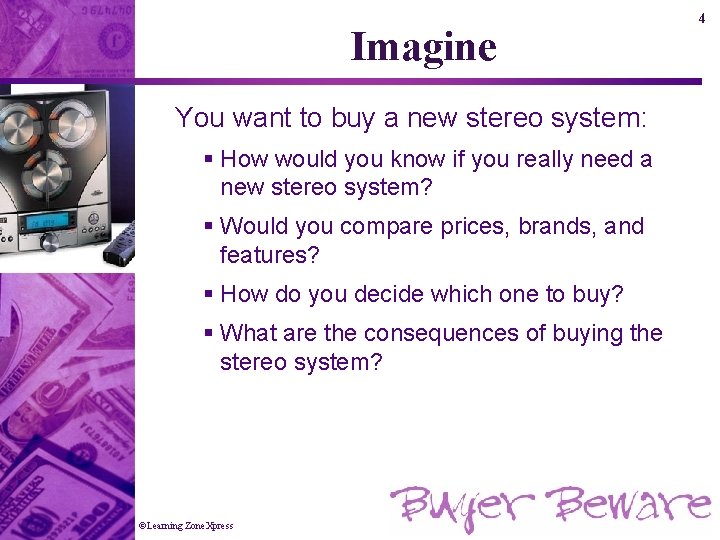
Imagine You want to buy a new stereo system: § How would you know if you really need a new stereo system? § Would you compare prices, brands, and features? § How do you decide which one to buy? § What are the consequences of buying the stereo system? ©Learning Zone. Xpress 4
What Influences Choices? You are a consumer about to purchase goods or services. Ask yourself: § Do I need it? § Why do I want it? § Can I afford it? § Which one do I buy? § Where do I buy it? § Will there be conflicts if I buy it? We are all influenced by our values, interests, peer pressure and many other factors. ©Learning Zone. Xpress 5
Getting Started Give examples of each of the following: Consumer: § Person who buys and uses goods and services produced by others. Anytime you pay for something, you are a consumer. Producer/Manufacturer: § Person or organization that creates something. Goods/Merchandise: § Products or items that a person uses. Services: § Helping or doing work for another. Marketplace: § Anywhere goods and services are bought and sold. ©Learning Zone. Xpress 6
Where to Shop Where would you buy the following: § Toilet paper & shampoo § T-shirts, jeans & shoes § CDs & DVDs § Haircut § Computer Why would you buy these items in the stores you selected? ©Learning Zone. Xpress 7
Where to Shop Give examples of each of the following: Department Store: § Carries a large variety of products, and provides more consumer services. Specialty Store: § Sells unique, high-quality products at higher prices, and provides individual service. Discount Store: § Carries a large variety of goods at lower prices and offers minimal service. Mail-Order Catalog: § Purchases selected from a catalog, an order is mailed with payment, and merchandise is shipped. Can be done from the home. ©Learning Zone. Xpress 8
Where to Shop Warehouse Club: § Carries a large variety of products, usually in large sizes/quantities, at lower prices for “club members”. Factory Outlet: § Manufacturers sell products directly to consumers. Prices may be lower priced, and may have slight flaws or defects. Shopping Online: § You can select and purchase items on the internet from your computer or television. A credit card account is required, and merchandise is shipped or delivered. Other Options: § Garage/Yard Sales, Flea Markets, Swap Meets, Bargain Basements, and Dollar Stores. Items are sold “as is”. ©Learning Zone. Xpress 9
Making Decisions Using the Decision-Making Model will help you make important buying decisions: 1. Define the problem and set a goal. 2. List your choices. 3. Define the advantages and disadvantages. of each choice. 4. Determine how each choice affects your. goals. 5. Make your decision and give reasons for. your decision. ©Learning Zone. Xpress 10

Decision-Making Chart Identify the problem: Set a Goal: List choice 1: List choice 2: Advantages Disadvantages How are my goals affected? My decision is: Reasons for my decision: Advantages Disadvantages How are my goals affected?
Making Decisions Use the Decision-Making Chart to help you make one of the following decisions: § You want to buy a new CD player. • Compare two CD players considering the features you want. Which would you buy, and why? § You have saved up money and want to buy a camera. • Should you buy a digital camera? § You have a part-time job and want a car to get to and from work. • Should you buy a new or a used car? ©Learning Zone. Xpress 12
Shopping Skills Prepare a List: § This helps you to remember everything you need to buy. • Include details that you need to remember about the products you need to buy on your list, such as sizes, part numbers, etc. § Stick to the list to avoid impulse buying. • Impulse buying is making unplanned purchases. It is a quick, often emotional decision. § If you are going to different stores, plan what you will get in each store. ©Learning Zone. Xpress 13
Shopping Skills Gather Information: § Do this to save money! § Use newspaper sales flyers or check online to pre-shop before you go. § Learn about sales times and time your purchases for sales. • End-of-season, pre-season, etc. § Consider product features as well as quality, price, brand, and warranty. • Comparison Shopping involves taking time to compare product features, prices, and services. ©Learning Zone. Xpress 14
Shopping Skills Keep Receipts for Returns: § Always keep receipts and warranty cards! § Know the store’s return policy. • Is there a time limit for returns with receipts? • Are sales final on sale or discounted items? § Know the product’s warranty. • Warranties guarantee that a product will work properly for a specified length of time unless misused or mishandled by the consumer. ©Learning Zone. Xpress 15
Shopping Skills Use Coupons & Rebates: § Coupons instantly save you money. • Clip from newspapers, magazines or sale flyers. • Have you used coupons at the following stores? – Grocery stores – Restaurants – Clothing stores § Rebates must be mailed in with the receipt and proof-of-purchase (UPC, box top, etc. ). • Check for a “rebate board” at stores. ©Learning Zone. Xpress 16
17 ©Learning Zone. Xpress
Purpose of Advertising Provide Information: § Tells you about the product. Motivate Buying: § Pictures can make products look great and get you into the store, hopefully to buy. Create Awareness: § Tells you about new products and services. Promote Emotional/Impulse Buying: § Why is the candy located by the checkout counter? ©Learning Zone. Xpress 18
Types of Advertising Give examples of each of the following types of advertising: § Informative § Brand Name § Status Appeal § Bandwagon § Plain-folk Appeal § Targeted Can you name other types of advertising? ©Learning Zone. Xpress 19
Resolving Problems 20 Sometimes a product you purchase is defective. What do you do? § Take the product, tags, and receipts to the return counter/customer service at the store. § Explain the problem and ask for a refund or replacement. § Handle yourself in a professional manner. § In some cases, you may need to contact the manufacturer’s customer service department. ©Learning Zone. Xpress
Resolving Problems Follow the instructions on the product’s warranty card to contact the manufacturer’s customer service department. § Call the toll-free number or write a letter. • They will provide instructions for returning the item for refund or repair, which often includes: – A return tracking code or number. – Special shipping instructions. • Make sure to send copies, not originals, of your receipt, the warranty or other information. ©Learning Zone. Xpress 21
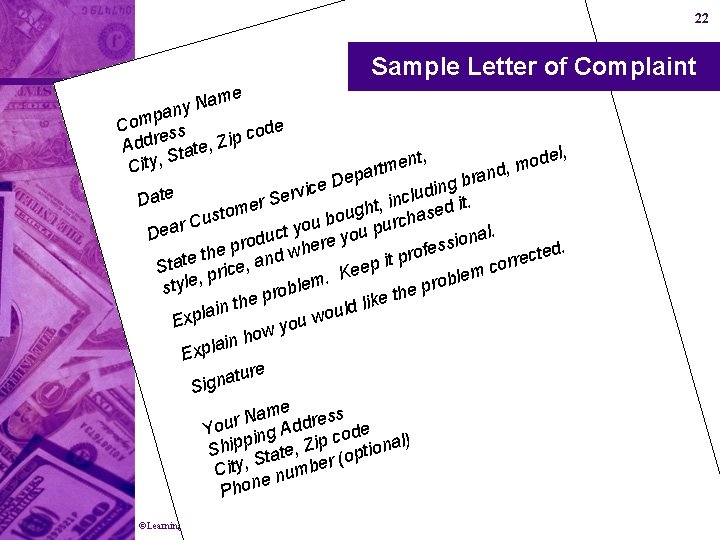
22 Sample Letter of Complaint e am N y n pa m o C ode ss c e r p i d Ad te, Z a t el, S t, d , n o y e t i m C d, artm n p a r e b ing ice D d v e r u t l e a D , inc ed it. er S t h m g o t as ou us h b c C r u t yo up c Dea al. o u n y d o i e o r s r ed. ofes he p and whe t r t c p e e t t r i cor Sta price, ep e m K e l , rob lem. p style b e o r h ike t he p l t d n l i a wou Expl u o wy o h n ai Expl ure t a n Sig ame ress N r You ing Add code l) p Ship tate, Zip (optiona S r City, numbe e Phon ©Learning Zone. Xpress
Consumer Rights Right to Safety § You have the right to safe products and services. Your responsibility is to read the labels and use the products as directed. Right to be Heard § You have the right to voice your opinion about a product or service. Consumer complaints help regulate business in a free economy. Right to Consumer Education § You have a right to information about consumer issues. ©Learning Zone. Xpress 23
Consumer Rights Right to Information § You have the right to information about the product or service so that you can make wise purchasing decisions. Right to Choose § You have the right to many different choices of products, services, and sellers, allowing you to choose. Right to Redress § You have the right to seek and obtain satisfaction when something is wrong with the product or service. ©Learning Zone. Xpress 24
Consumer Responsibilities Along with these consumer rights comes responsibilities and expectations. Consumers should: § Be Honest § Be Responsible § Report problems immediately § Keep proof-of-purchase Discussion: Describe the last time you bought a product that did not live up to your expectations. What did you do about it? ©Learning Zone. Xpress 25
Consumer Protection Laws Truth In Lending Law § Requires creditors to provide a complete account of credit costs and terms. § The law requires that you are sent regular statements showing unpaid balances and finance charges. Equal Credit Opportunity Act § Protects consumers from discrimination because of sex, marital status, race, religion, or age. § Credit can only be denied because of financial reasons. ©Learning Zone. Xpress 26
Consumer Protection Laws Fair Credit Billing § Provides rules by which consumers and creditors must settle disputes about billing. § If there is a dispute or a consumer wishes to complain, certain rules must be followed. Fair Credit Reporting Act § Protects consumers against an inaccurate credit record. § Since your credit rating is based on information in your credit file, you have a right to see the contents of your file. ©Learning Zone. Xpress 27
Summary § Use the shopping skills you learned to take charge of your purchasing decisions. § Use the Decision-Making Chart to help you make consumer decisions. § Manage your money wisely. Comparison shop and use coupons and rebates. § Keep your receipts and warranty cards. § Understand your consumer rights and responsibilities. ©Learning Zone. Xpress 28
You’re the Expert! Select one of the following activities: § Comparison shop online for one item, including their purchasing procedures and merchandise return policies. Complete a Decision-Making Chart with your decision. § Design an advertising poster, using good advertising techniques to sell a product that you use. § Create a shopping guide for teens new to your community. Include names of stores and products they sell. ©Learning Zone. Xpress 29
Test Your Knowledge 30 1. List five places to shop. 2. List the five steps in the Decision-Making Model. 3. What are your consumer rights? 4. What are your consumer responsibilities? ©Learning Zone. Xpress
Test Your Knowledge 5. List four shopping skills. 6. What is the purpose of advertising? 7. What laws protect consumers? 8. What is the benefit of saving receipts? ©Learning Zone. Xpress 31
Online Resources Suggested web sites for consumers: www. consumer. gov § Resource for consumer information from the federal government. www. consumerinternational. org § Worldwide non-profit federation of consumer organizations, dedicated to the protection and promotion of consumer interests. www. wa. gov/ago/youth § Learn how to protect yourself from consumer scams. www. ftc. gov § Federal Trade Commission works to protect consumers and a competitive marketplace. www. visabuxx. com § Shopping online is convenient anytime but follow a few tips to protect yourself. Please note that web sites are constantly changing and being updated. ©Learning Zone. Xpress 32
- Slides: 32