
1 BUSINESS ENGLISH LECTURE 32 Lecture 19 20

1 BUSINESS ENGLISH LECTURE 32
Lecture 19, 20, 21 2 Report Writing Continues… Types of Report writing 1. Preliminary Reports: Problems and need analysis 2. Comparison Reports Recommendation and Feasibility Reports 3. Audience for these reports 4. Organization and Formatting
3 Definition of Business Reports A business report is an orderly and objective communication of factual information that serves some business purpose.
Reports categorised by FUNCTION • Informational reports • Analytical reports 4
Reports categorised by TIME • Progress reports • Periodic reports • Special reports 5
Reports categorised by FORM • Memo • Letter • Manuscript 6
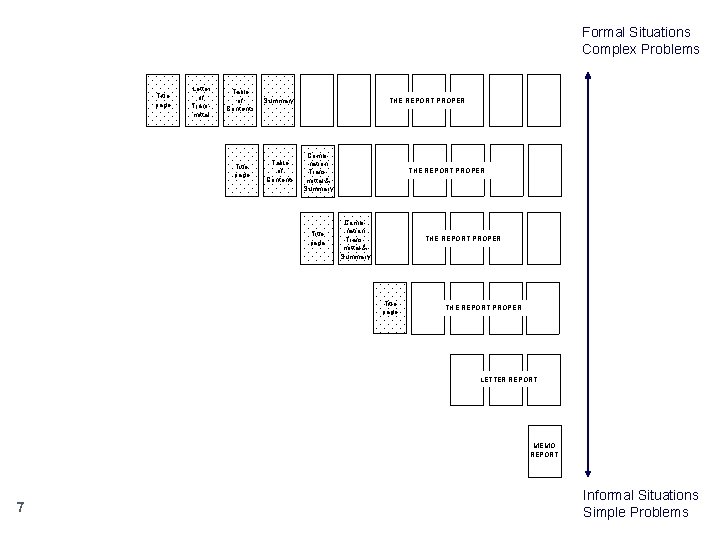
Formal Situations Complex Problems Title page Letter of Transmittal Table of Contents Summary Title page Table of Contents THE REPORT PROPER Combination Transmittal & Summary Title page THE REPORT PROPER Combination Transmittal & Summary THE REPORT PROPER Title page THE REPORT PROPER LETTER REPORT MEMO REPORT 7 Informal Situations Simple Problems
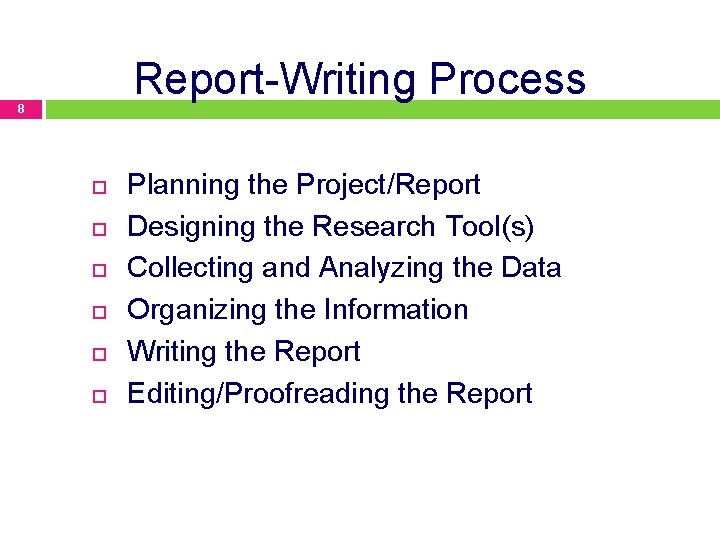
Report-Writing Process 8 Planning the Project/Report Designing the Research Tool(s) Collecting and Analyzing the Data Organizing the Information Writing the Report Editing/Proofreading the Report
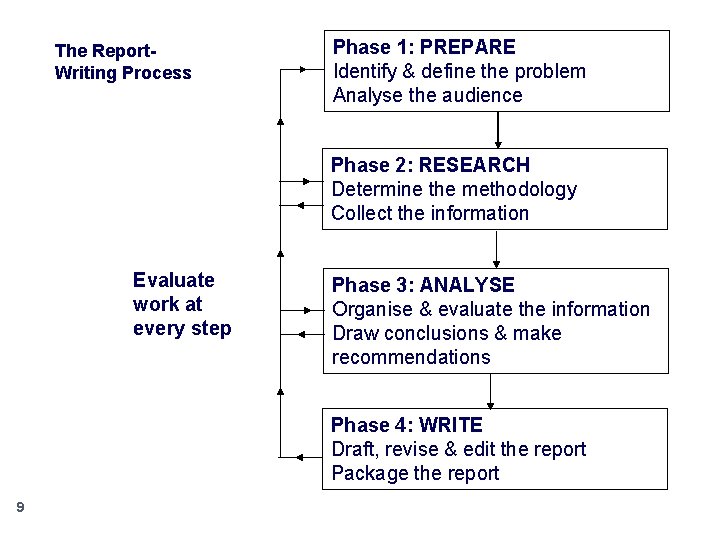
The Report. Writing Process Phase 1: PREPARE Identify & define the problem Analyse the audience Phase 2: RESEARCH Determine the methodology Collect the information Evaluate work at every step Phase 3: ANALYSE Organise & evaluate the information Draw conclusions & make recommendations Phase 4: WRITE Draft, revise & edit the report Package the report 9
10 When adjusting the report to your purpose, you should consider who will read the report, why, in what detail, with what prejudice, with what knowledge, and to make what decision.
11 • • • Keeping your audience's needs in mind will help you decide the level of formality (in structure and tone) of your report the length of the report what kinds of data to include (tables, figures, general graphs, or pictures) how much to explain what positions to defend the visual sophistication required
Preliminary Reports Problem or Needs Analyses 12 A problem or needs-analysis report—a very preliminary piece of writing— examines a particular issue that the client faces. A problem or needs analysis is particularly appropriate when the need or problem is complex or ill defined.
13 When adjusting the report to your purpose, you should consider who will read the report, why, in what detail, with what prejudice, with what knowledge, and to make what decision.
Comparison Reports 14 A comparison report examines two or more options and performs a "relative advantages" analysis to determine which option would best serve the client. Use a comparative format when there are several serious alternatives that should be considered.
Feasibility Reports 15 A feasibility report may respond to a single question or recommend a specific option. It may also apply several criteria to that option and make a judgment as to whether it would be in the client's best interest to implement the option. (Simple thumbs up or thumbs down. ) Use a feasibility format when the client has one favored alternative or plan of action and is trying to determine the effects of that one course of action.
Recommendation and Feasibility Reports 16 Both recommendation reports and feasibility reports make statements about what action should be taken to solve a problem, resolve a dilemma, or undertake a course of action. The main distinction between the two report types is dependent on their positioning in a company’'s decisionmaking process:
Proposal Requirements A proposal provides sufficient information to persuade the reviewer that the proposed work represents an innovative and profitable approach to an important problem.
The proposal will be evaluated on the technical approach having a reasonable chance of meeting the topic objective, the approach being innovative, not routine, the proposer’s capability to implement the technical approach, i. e. has or can obtain people and equipment suitable for the task.
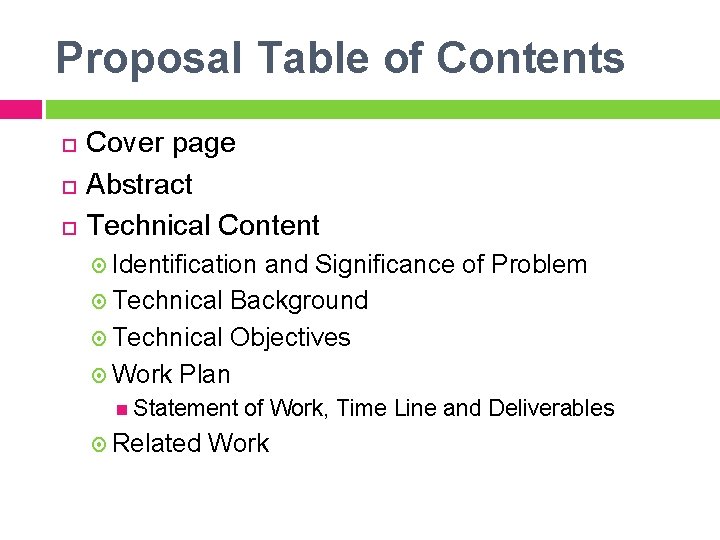
Proposal Table of Contents Cover page Abstract Technical Content Identification and Significance of Problem Technical Background Technical Objectives Work Plan Statement Related of Work, Time Line and Deliverables Work
Proposal Format Proposal Cover Sheet Title of project Date proposed Label it as a “Proposal” “Submitted to: ” name, address, phone, fax, e-mail “Submitted by: ” (as above) “Abstract” Give an abstract of the proposed project. Discuss anticipated benefits, potential for commercial applications and profit. The Abstract is often the first cut in selecting proposals for funding
Proposal Format (con’d) Layout and Format Use 1” margins all around Place name of group in header left Title in header right Page number in footer center Date in footer right Use Arial 10 pt or Times 12 point Number all pages consecutively. The technical proposal begins on page 2 or 3. Submit softcopy in MSWord (. doc) or Adobe (. pdf)
Types of proposals Internal proposal: If you write a proposal to someone within your organization, it is an internal proposal. With internal proposals, you may not have to include certain sections (such as qualifications), or you may not have to include as much information in them. External proposal: is one written from one separate, independent organization or individual to another such entity.
23 Solicited proposal: If a proposal is solicited, the recipient of the proposal in some way requested the proposal. Typically, a company will send out requests for proposals (public announcements requesting proposals for a specific project ) through the mail or publish them in some news source.
24 Unsolicited proposals: are those in which the recipient has not requested proposals. With unsolicited proposals, you sometimes must convince the recipient that a problem or need exists before you can begin the main part of the proposal.
Things to remember when writing a proposal: The proposer has a particular interests and goals, and that's why he/she writes the proposal. The recipient of the proposal, be it an organization, a person, or a group, has its own interests and goals which may or may not coincide with those of the proposer. So, the proposal should be convincing to the potential funder, and it should show that the proposed activity will be a good investment. This is especially important when there is a competition between you and other proposers. Always make sure that your proposal meets the expectations of the funder.
How to make sure that your proposal meets the expectations of a given funder: In order to write a proposal that meets the expectations of a given funder, you should try to know the funder`s goals and interests. If you are writing an unsolicited proposal to a private company, a good source of information might be the company's published reviews and annual reports. Requests for proposals are usually the best source of information when you are writing a solicited proposal. If your proposed activity and the request for proposal (RFP) don't match, try to look for another funding agency.
Lecture 22 27 Proposal Writing : Common section: title page, Abstract, Table of Contents. Introduction, Body, Conclusion Appendices Organization and format concerns Cover letter/ Memo Writing Workshop
Common Sections in Proposals The general outline of the proposal should be adapted and modified according to the needs of the readers and the demand of the topic proposed. For example, long complicated proposals might contain all the following sections. In contrast, shorter or simpler proposals might contain only some of the sections or the main ones.
ØTitle page q Specific formats for title pages vary from one proposal to another but most include the following: The title of the proposal ( as short as informative as possible) ü A reference number for the proposal ü The name of the potential funder ( the recipient of the proposal) ü The proposal's date of submission ü The signature of the project director and responsible administrator(s ) in the proposer`s institution or company ü
ØAbstract The Abstract is a very important part of the proposal because it provides a short overview and summary of the entire proposal. The Abstract of the proposal is short, often 200 words or less. In a short proposal addressed to someone within the writer's institution, the Abstract may be located on the title page. In a long proposal, the Abstract will usually occupy a page by itself following the Title page. The Abstract should briefly define the problem and its importance, the objectives of the project, the method of evaluation, and the potential impact of the project.
ØTable of contents The table of contents lists the sections and subsections of the proposal and their page numbers.
Ø Introduction Plan the introduction to your proposal carefully. Make sure it does all of the following things (but not necessarily in this order) that apply to your particular proposal : Indicate that the document to follow is a proposal. Refer to some previous contact with the recipient of the proposal or to your source of information about the project. Find one brief motivating statement that will encourage the recipient to read on and to consider doing the project. Give an overview of the contents of the proposal.
Ø Background The background section discusses what has brought about the need for the project— what problem, what opportunity there is for improving things, what the basic situation is.
ØMethod, procedure, theory In most proposals, you'll want to explain how you'll go about doing the proposed work, if approved to do it. This acts as an additional persuasive element; it shows the audience you have a sound, well-thought-out approach to the project. Also, it serves as the other form of background some proposals need. Remember that the background section (the one discussed above) focused on the problem or need that brings about the proposal. However, in this section, you discuss the technical background relating to the procedures or technology you plan to use in the proposed work.
Check List for your Proposal As you reread and revise your proposal, watch out for problems such as the following: Make sure you use the right format. Remember, the memo format is for internal proposals; the business-letter format is for proposals written from one external organization to another. (Whether you use a cover memo or cover letter is your choice. ) Write a good introduction—in it, state that this is a proposal, and provide an overview of the contents of the proposal. Make sure to identify exactly what you are proposing to do.
Check List for your Proposal Make sure that a report—a written document— is somehow involved in the project you are proposing to do. Remember that in this course we are trying to do two things: write a proposal and plan a term-report project. Make sure the sections are in a logical, natural order. For example, don't hit the audience with schedules and costs before you've gotten them interested in the project.
Check List for your Proposal Break out the costs section into specifics; include hourly rates and other such details. Don't just hit them with a whopping big final cost. For internal projects, don't omit the section on costs and qualifications: there will be costs, just not direct ones. For example, how much time will you need, will there be printing, binding costs? Include your qualifications—imagine your proposal will go to somebody in the organization who doesn't know you.
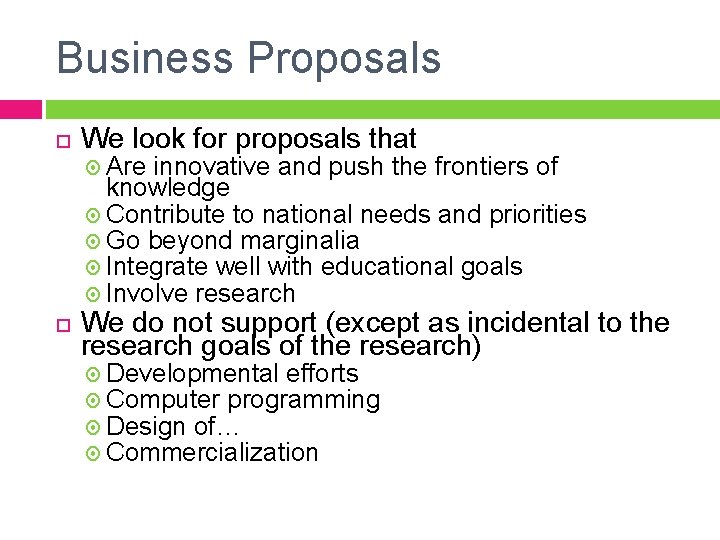
Business Proposals We look for proposals that We do not support (except as incidental to the research goals of the research) Are innovative and push the frontiers of knowledge Contribute to national needs and priorities Go beyond marginalia Integrate well with educational goals Involve research Developmental efforts Computer programming Design of… Commercialization
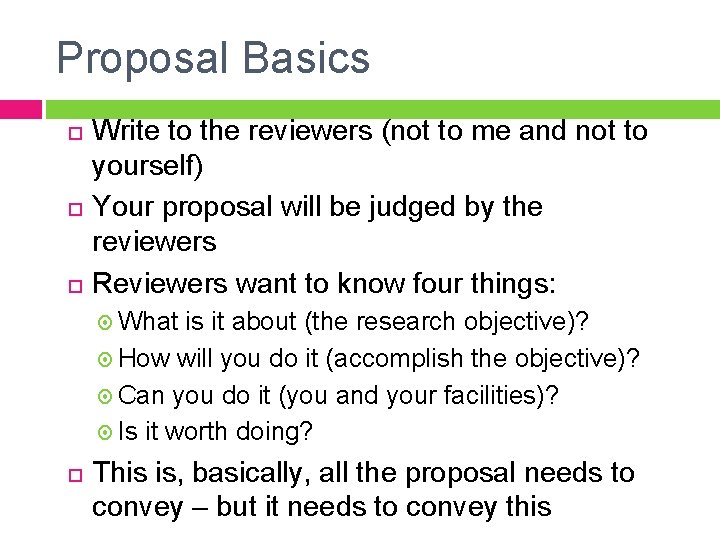
Proposal Basics Write to the reviewers (not to me and not to yourself) Your proposal will be judged by the reviewers Reviewers want to know four things: What is it about (the research objective)? How will you do it (accomplish the objective)? Can you do it (you and your facilities)? Is it worth doing? This is, basically, all the proposal needs to convey – but it needs to convey this
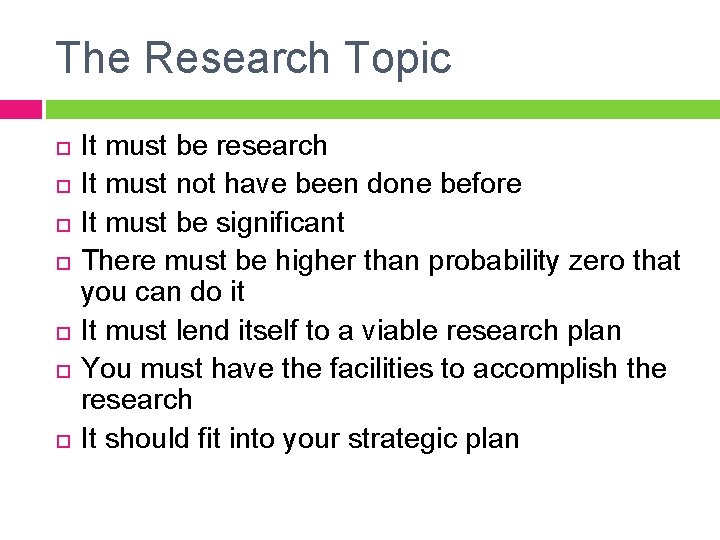
The Research Topic It must be research It must not have been done before It must be significant There must be higher than probability zero that you can do it It must lend itself to a viable research plan You must have the facilities to accomplish the research It should fit into your strategic plan
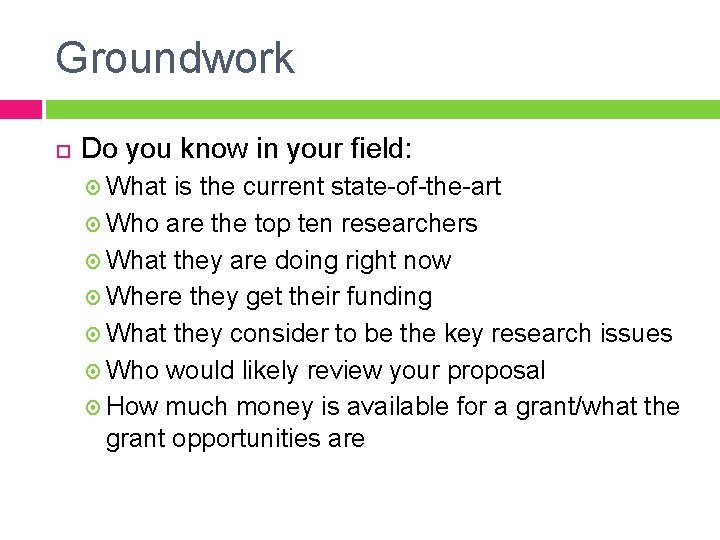
Groundwork Do you know in your field: What is the current state-of-the-art Who are the top ten researchers What they are doing right now Where they get their funding What they consider to be the key research issues Who would likely review your proposal How much money is available for a grant/what the grant opportunities are
The Research Objective The research objective is a concise statement of what you intend to find out that we don’t already know
The Research Objective This is probably the hardest part of the proposal Examples of how not to do it: The objective of my research is to provide a quantum leap in the design of anti-gravity boots. The goal of this project is to develop an integrated modeling tool for the hardening process.
44 The goal of this project is to develop innovative advances to enhance wire sawing processes. Rapid prototyping machines are an important part of the vast array of tools. This research will bridge the accuracy gap in these processes by developing theoretical and technological means to implement significant gains in accuracy.
Proposal Summary: What We Want to Know What is your research objective? This is what directs your proposal to the appropriate program What is your approach? Outline — just two or three sentences Why is your contribution important to your research community (the intellectual merit)? If successful, what will be the benefit to society (the broader impact)? Why is your project important to society?
Remember Your proposal will be returned without review if: You fail to include explicit statements of intellectual merit and broader impact (entitle them Intellectual Merit, Broader Impact) You use the wrong font or it is too small The margins are too narrow Your bio is incorrectly formatted You have an unauthorized attachment
Lecture 23 47 The steps in the writing process: Prewriting Writing Rewriting
48 The rationale for the writing process Prewriting helps you: Examine your purpose Determine your goals Consider your audience(s) Gather your data Determine how your content will be provided Writing helps you organize and format your draft Rewriting helps you polish your document
Stages of the Writing Process 49 There are several stages to the Writing Process. Each stage is essential. Prewriting Writing (Drafting) Revising Editing
I. Prewriting 50 Choose/narrow your topic Determine your Audience Purpose Tone Point-of-view Tense Explore your topic Make a plan
Choose/Narrow Your Topic 51 Your topic should pass the 3 -question test: 1. Does it interest me? 2. Do I have something to say about it? 3. Is it specific?
Determine Your Audience 52 Your Audience is composed of those who will read your writing. Ask yourself: Who are my readers? What do my readers know about my topic? What do my readers need to know about my topic? How do my readers feel about my topic?
Determine Your Purpose 53 Purpose is the reason you are writing. Whenever you write, you always have a purpose. Most writing fits into one of 3 categories: Expressive Writing Informative Writing Persuasive Writing More than one of these may be used, but one will be primary.
Explore Your Topic 54 Pre-writing Techniques: Brainstorming/Listing Freewriting Clustering/Mapping Questioning Discussing Outlining
Make a Plan 55 Before you begin drafting your essay, you should make a plan (a roadmap). Review, evaluate, and organize ideas written in your pre-writing; then make a plan for your essay’s Thesis statement Support Order Structure
Structure/Organization 56 Consider how your essay will be organized; then create an Outline. Sample Outline of standard 5 -paragraph essay: A. B. C. D. E. Introduction Body Paragraph 1 Body Paragraph 2 Body Paragraph 3 Conclusion
II. Writing 57 During the Writing Stage, you should Create your essay’s Title Compose a draft A Draft is the first whole version of all your ideas put together; it’s a “dress rehearsal. ” You should plan to revise your Draft several times throughout the writing process.
Writing a Draft 58 Basics of a good draft: Has a fully developed introduction and conclusion Has fully developed body paragraphs, each containing a topic sentence, at least two examples, and detailed support Follows standard structure and uses complete sentences
III. Revising 59 Revising is finding & correcting problems with content; changing the ideas in your writing to make them clearer, stronger, and more convincing. Revising looks at the “Big Picture”— the Idea level.
Revision Strategies 60 Look for Unity Detail and support Does everything refer back to main point? Does each topic sentence refer to thesis? Does each sentence in each BP refer back to the topic sentence? Does each BP contain at least two examples? Is each example followed by at least one supporting detail? Coherence Are all points connect to form a whole? Are transitions used to move from one idea to the next?
Revision Tips 61 Take a break from your draft before attempting to revise. Read your draft out loud and listen to your words. Imagine yourself as your reader. Look for consistent problem areas. Get feedback from peers. Get help from a tutor!
IV. Editing 62 Editing is finding and correcting problems with grammar, style, word choice & usage, and punctuation. Editing focuses on the “Little Picture”—Word level.
Editing Tips 63 Work with a clean printed copy, double-spaced to allow room to mark corrections. Read your essay backwards. Be cautious of spell-check and grammar-check. Read your essay out loud. Get feedback from peers. Work with a tutor!
Lecture 24 64 Interviews – Job Interviews Preparing for interviews The interview experience Questions to expect and to ask Different types of interview Interview resources
Interviews 65 Interview = A meeting with an objective Employer’s objective is to find the best person for the job Employer: reviews candidate’s experience and abilities Can you do the job? (skills, abilitie, qualifications) Will you do the job? (interest, attitude & motivation) How will you fit into the organisation? (personality) You: impress employer and assess position on offer What does this position offer me?
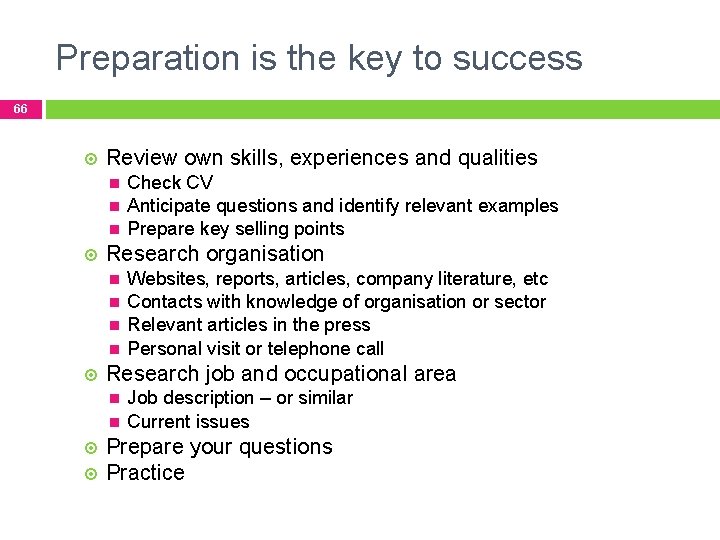
Preparation is the key to success 66 Review own skills, experiences and qualities Research organisation Websites, reports, articles, company literature, etc Contacts with knowledge of organisation or sector Relevant articles in the press Personal visit or telephone call Research job and occupational area Check CV Anticipate questions and identify relevant examples Prepare key selling points Job description – or similar Current issues Prepare your questions Practice
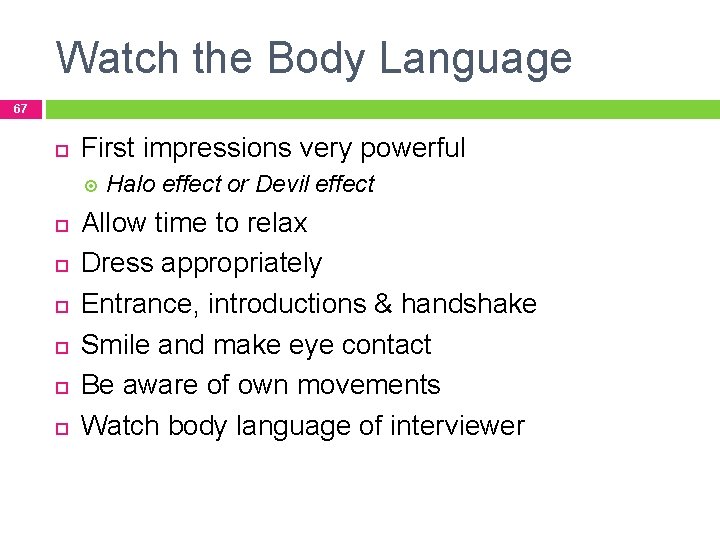
Watch the Body Language 67 First impressions very powerful Halo effect or Devil effect Allow time to relax Dress appropriately Entrance, introductions & handshake Smile and make eye contact Be aware of own movements Watch body language of interviewer
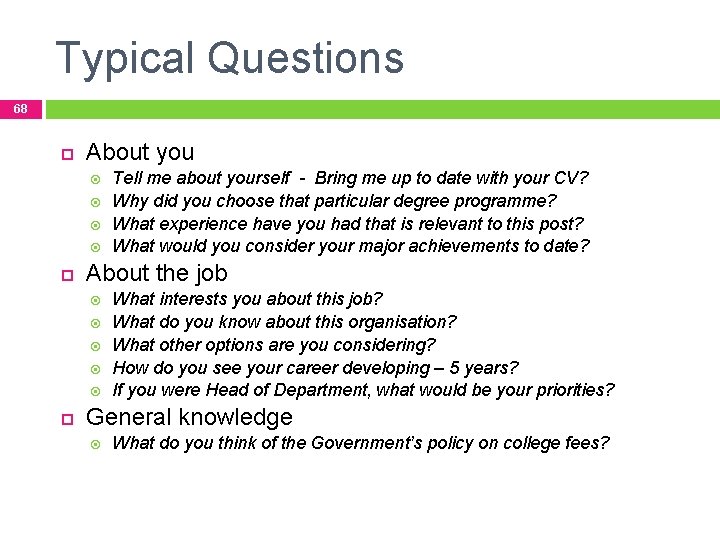
Typical Questions 68 About you About the job Tell me about yourself - Bring me up to date with your CV? Why did you choose that particular degree programme? What experience have you had that is relevant to this post? What would you consider your major achievements to date? What interests you about this job? What do you know about this organisation? What other options are you considering? How do you see your career developing – 5 years? If you were Head of Department, what would be your priorities? General knowledge What do you think of the Government’s policy on college fees?
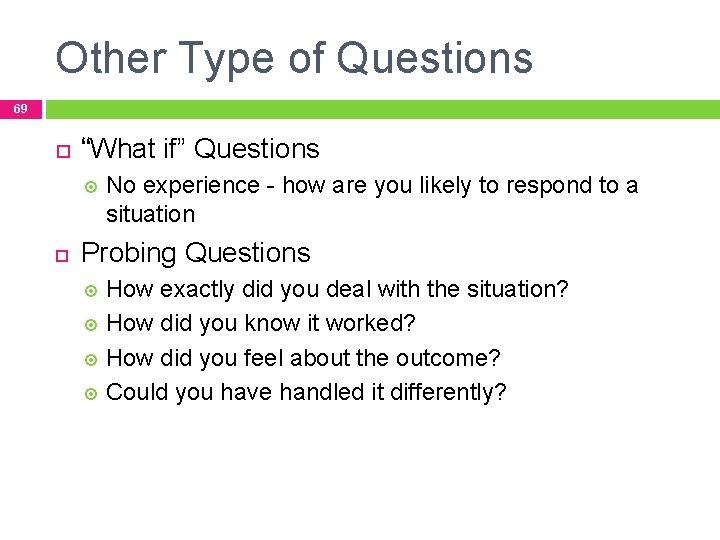
Other Type of Questions 69 “What if” Questions No experience - how are you likely to respond to a situation Probing Questions How exactly did you deal with the situation? How did you know it worked? How did you feel about the outcome? Could you have handled it differently?
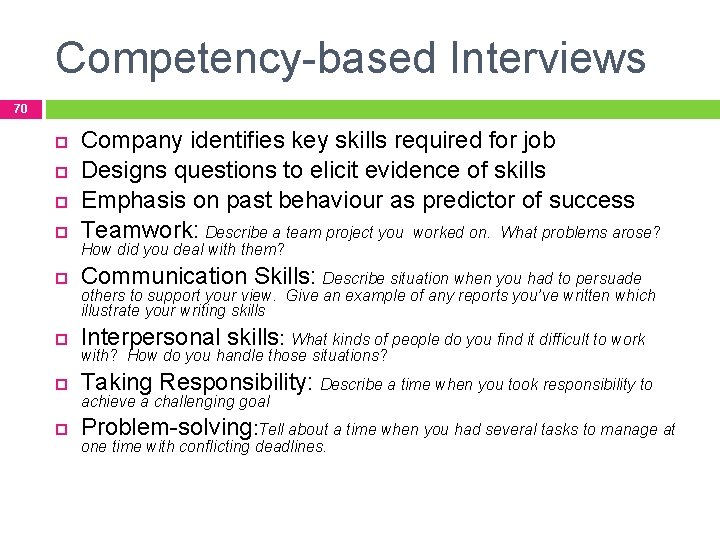
Competency-based Interviews 70 Company identifies key skills required for job Designs questions to elicit evidence of skills Emphasis on past behaviour as predictor of success Teamwork: Describe a team project you worked on. What problems arose? Communication Skills: Describe situation when you had to persuade Interpersonal skills: What kinds of people do you find it difficult to work Taking Responsibility: Describe a time when you took responsibility to Problem-solving: Tell about a time when you had several tasks to manage at How did you deal with them? others to support your view. Give an example of any reports you’ve written which illustrate your writing skills with? How do you handle those situations? achieve a challenging goal one time with conflicting deadlines.
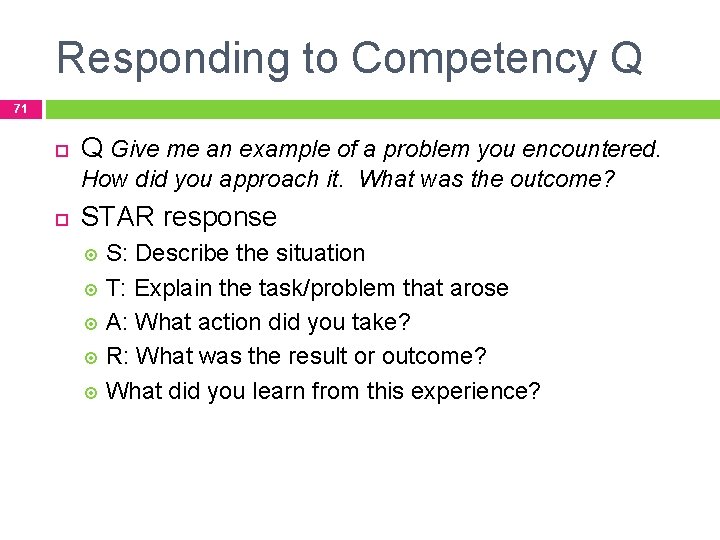
Responding to Competency Q 71 Q Give me an example of a problem you encountered. How did you approach it. What was the outcome? STAR response S: Describe the situation T: Explain the task/problem that arose A: What action did you take? R: What was the result or outcome? What did you learn from this experience?
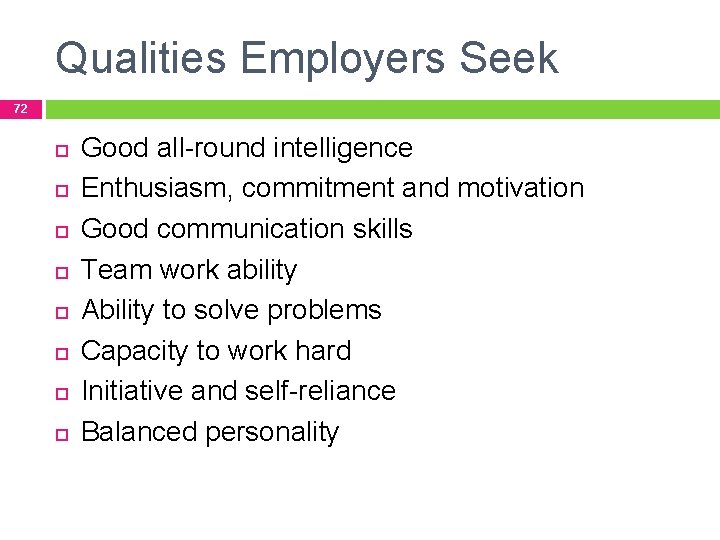
Qualities Employers Seek 72 Good all-round intelligence Enthusiasm, commitment and motivation Good communication skills Team work ability Ability to solve problems Capacity to work hard Initiative and self-reliance Balanced personality
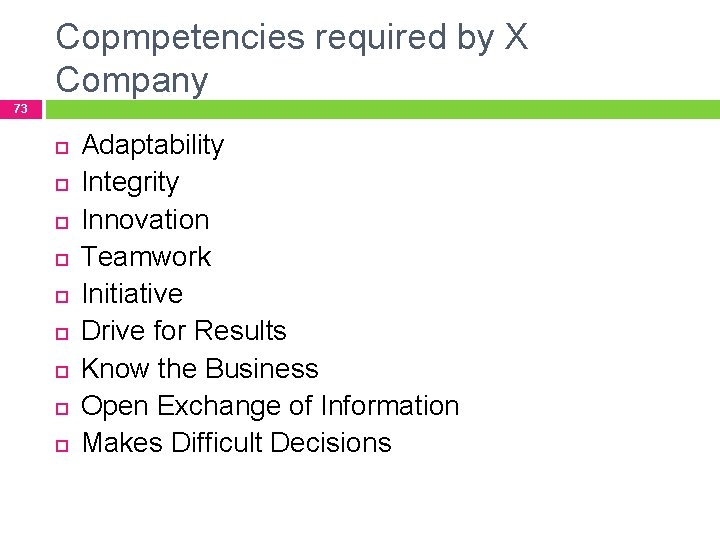
Copmpetencies required by X Company 73 Adaptability Integrity Innovation Teamwork Initiative Drive for Results Know the Business Open Exchange of Information Makes Difficult Decisions
What creates a bad impression 74 Poor personal appearance Negative attitude – evasive, using excuses Lack of interest and enthusiasm Lack of preparation Poor knowledge of role Failure to give concrete examples of skills Over emphasis on money/rewards Lack of career plan
Lecture 25 75 Job interview strategies and skills Effective Interviewing Skills : possess vs. learn Preparing to Interview Guide to interview
Know yourself Be able to articulate YOUR Skills Values Interests Abilities Long term plans Be able to give examples of them Think on your feet outside the box Use common sense 76
Preparing for the interview 77 Familiarity with business location Copy of resume updated & in folder References included Few questions prepared for interviewer at end of interview Visualize setting, positive interview Anticipate stressors What to wear
Different clothing types 78 Professional Dress Business Casual Dress Interview outfit Daily clothing for professional office setting Dress down Fridays or casual office environment Career Fair Casual Dress Company picnic Traveling for work
The interview process 79 Casual conversation “How was the traffic? , did you find us O. K. ? ” Down to business Actual interview begins Listen, buzzwords, new info. Employer will discuss company/position Proceed to ask questions about skills, etc. Behavioral questions (situation) End by asking if you have questions
The interview process 80 Closing the interview Employer initiates Standing Let up, shaking hands “Thank-you for interviewing” employer know you are interested Prepare closing statement “Thank you for taking the time to interview me, I’m very interested in this position. . . ”
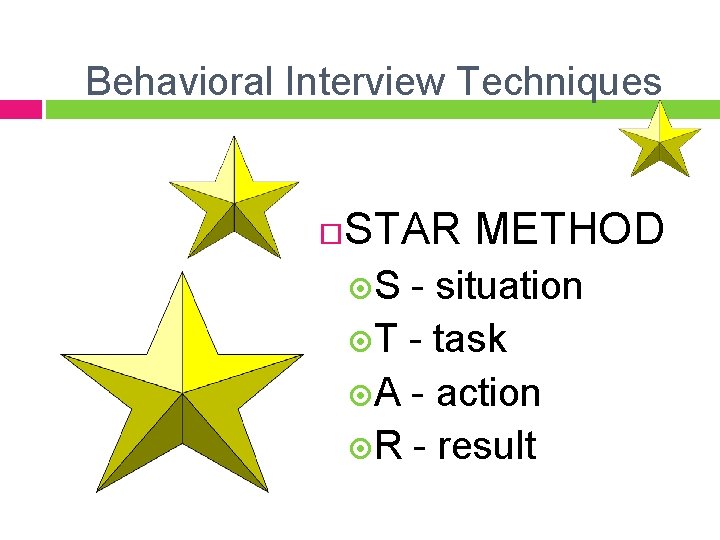
Behavioral Interview Techniques STAR METHOD S - situation T - task A - action R - result 81
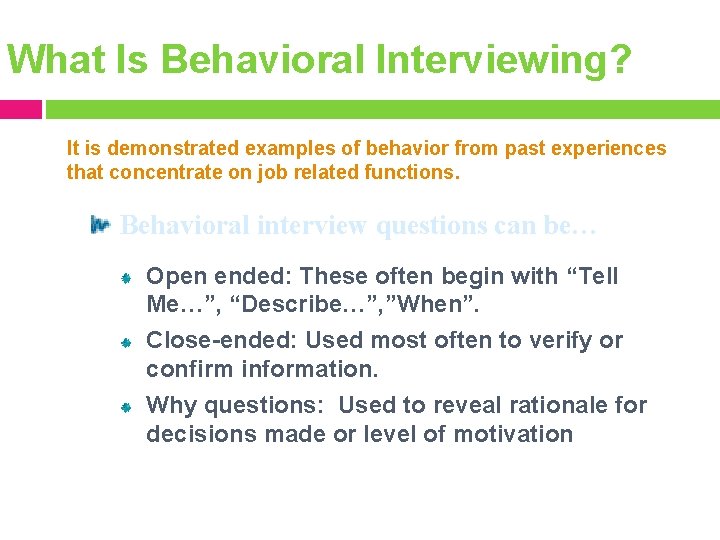
What Is Behavioral Interviewing? It is demonstrated examples of behavior from past experiences that concentrate on job related functions. Behavioral interview questions can be… Open ended: These often begin with “Tell Me…”, “Describe…”, ”When”. Close-ended: Used most often to verify or confirm information. Why questions: Used to reveal rationale for decisions made or level of motivation 82
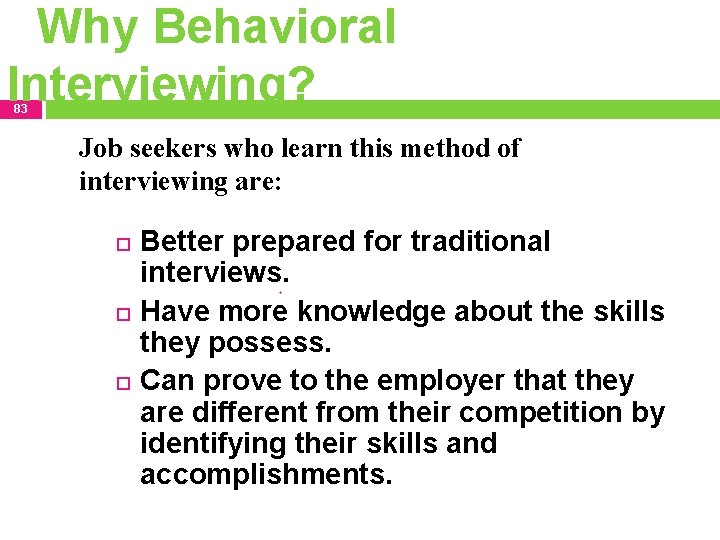
Why Behavioral Interviewing? 83 Job seekers who learn this method of interviewing are: Better prepared for traditional interviews. Have more knowledge about the skills they possess. Can prove to the employer that they are different from their competition by identifying their skills and accomplishments.
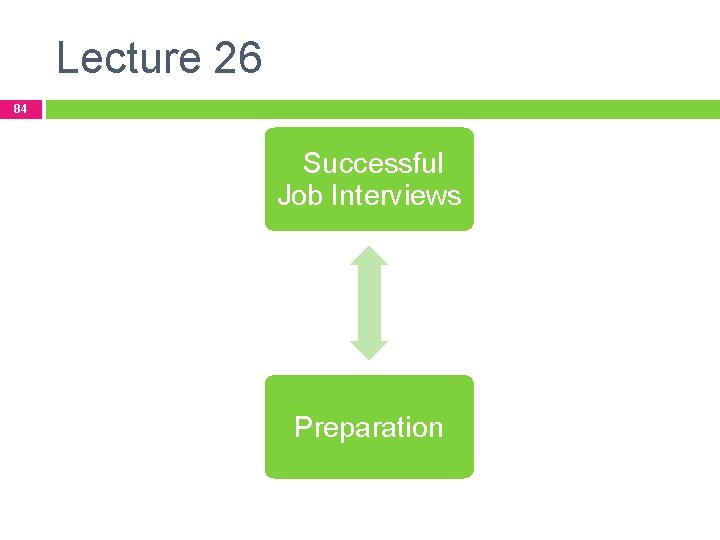
Lecture 26 84 Successful Job Interviews Preparation
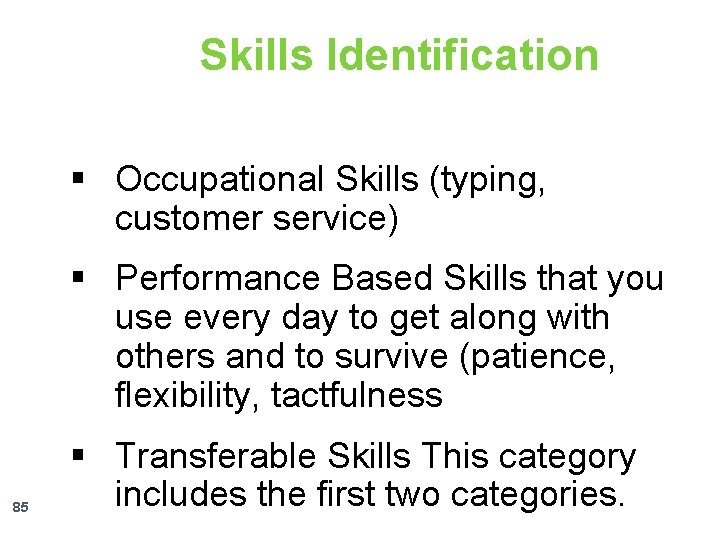
Skills Identification § Occupational Skills (typing, customer service) § Performance Based Skills that you use every day to get along with others and to survive (patience, flexibility, tactfulness 85 § Transferable Skills This category includes the first two categories.
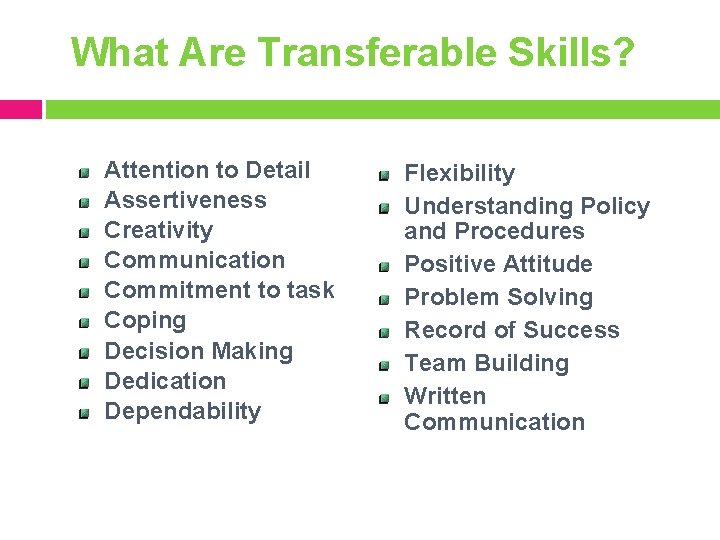
What Are Transferable Skills? Attention to Detail Assertiveness Creativity Communication Commitment to task Coping Decision Making Dedication Dependability Flexibility Understanding Policy and Procedures Positive Attitude Problem Solving Record of Success Team Building Written Communication 86
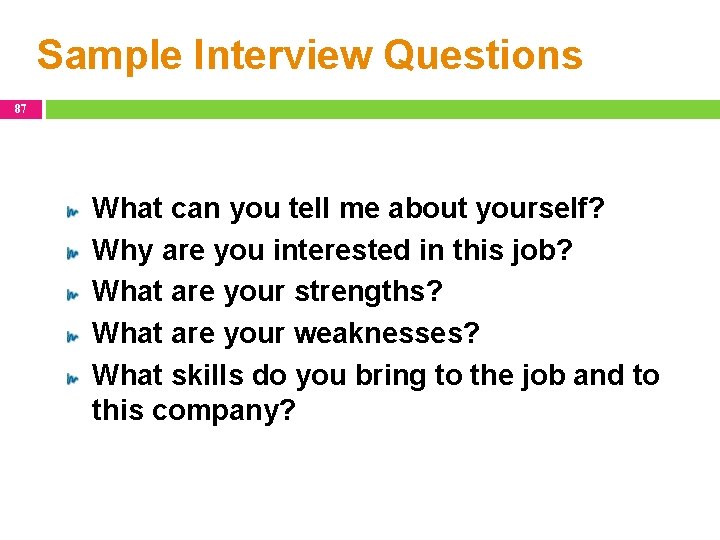
Sample Interview Questions 87 What can you tell me about yourself? Why are you interested in this job? What are your strengths? What are your weaknesses? What skills do you bring to the job and to this company?
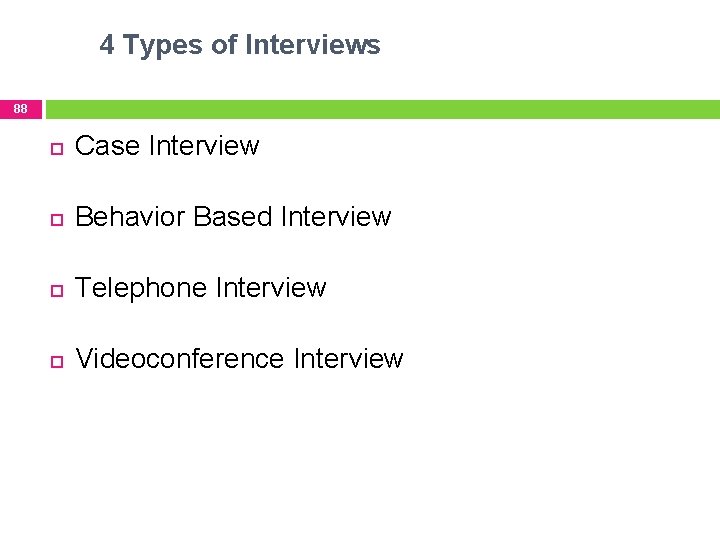
4 Types of Interviews 88 Case Interview Behavior Based Interview Telephone Interview Videoconference Interview www. mun. ca/cdel
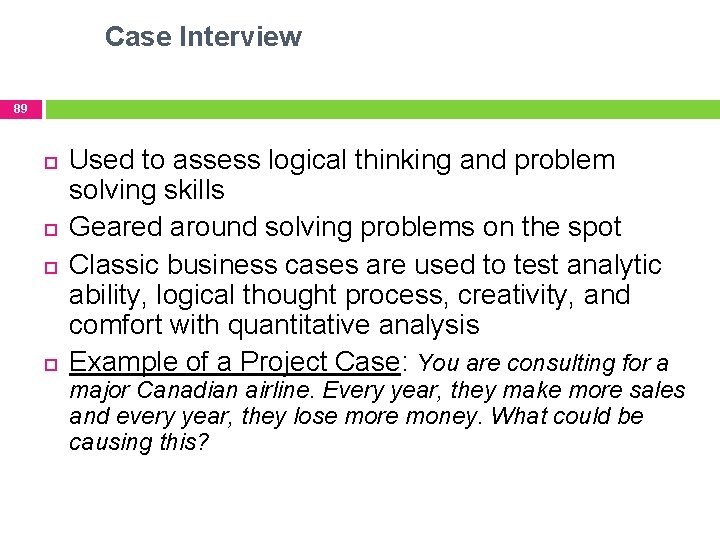
Case Interview 89 Used to assess logical thinking and problem solving skills Geared around solving problems on the spot Classic business cases are used to test analytic ability, logical thought process, creativity, and comfort with quantitative analysis Example of a Project Case: You are consulting for a major Canadian airline. Every year, they make more sales and every year, they lose more money. What could be causing this? www. mun. ca/cdel
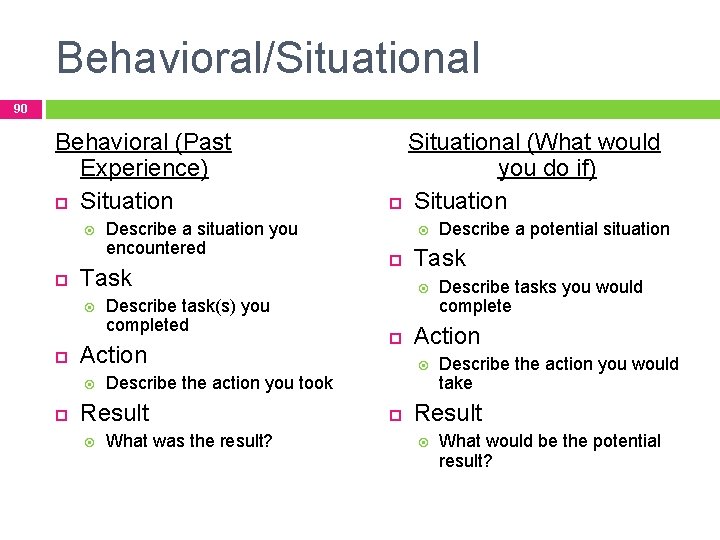
Behavioral/Situational 90 Behavioral (Past Experience) Situation Task Describe task(s) you completed Action Describe a situation you encountered What was the result? Describe tasks you would complete Action Describe a potential situation Task Describe the action you took Result Situational (What would you do if) Situation Describe the action you would take Result What would be the potential result?
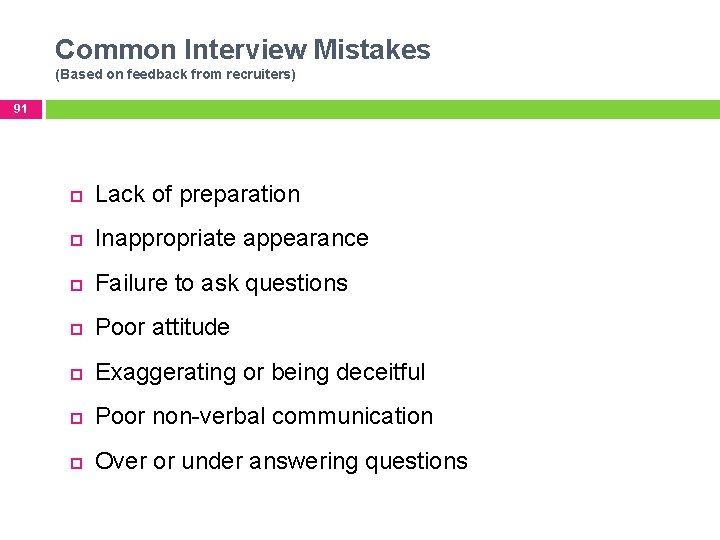
Common Interview Mistakes (Based on feedback from recruiters) 91 Lack of preparation Inappropriate appearance Failure to ask questions Poor attitude Exaggerating or being deceitful Poor non-verbal communication Over or under answering questions www. mun. ca/cdel
Lecture 27 -29 presentation skills? l. It’s time to talk about PS l. Good communication skill is key to success l. It is learnable 92
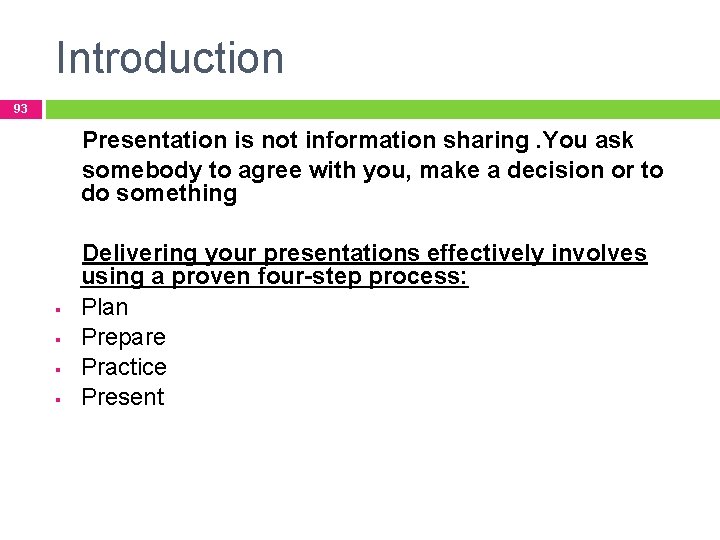
Introduction 93 Presentation is not information sharing. You ask somebody to agree with you, make a decision or to do something § § Delivering your presentations effectively involves using a proven four-step process: Plan Prepare Practice Present
Plan 94 Audience analysis (Respectful, neutral , hostile etc) “ When I get ready to talk to people , I spend two third of the time thinking what they want to hear and one third thinking about what I want to say. ” (Abraham Lincoln) Knowledge( how much the audience knows about the topic)) Experience (have they had any personal experience with your topic) Needs ( what’s in it for me) Goals (targets etc)
Prepare 95 Establish a positive Mind-Set Value your message. Visualize yourself succeeding. Visualize your audience responding. Give yourself pep talks. Physical preparation of the Room Size of room Sound needs etc
Prepare (cont’d) 96 Prepare a memorable Close Dramatize your ideas. Throw down a challenge. Use a motivating statement. Restate the key benefit. Deliver a convincing summary. (You re-energize yourself and ensure that point of view is remembered)
Practice (cont’d) 97 Practice your presentation and review your visuals for Clarity (simple, unambiguous) Relevancy (with the topic) Eye-appeal (attractive slides, do use color)) Visibility (readable, legible) Quality (each visual should make a single point) Memorability (helping your listener to remember your talk)
Practice (cont’d) 98 Practice your presentation before an audience, coach, video camera. Receive feedback and coaching on Strong opening. Clear key points. Logical flow. Credible evidence. and. . . Check out every audio-visual aid.
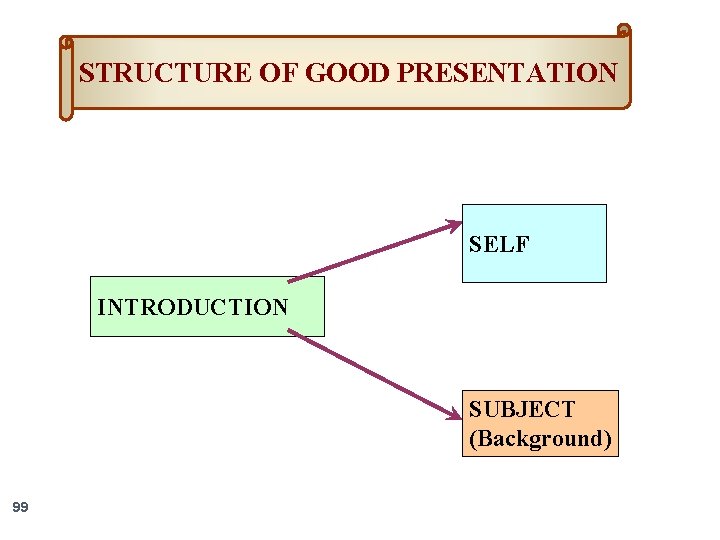
STRUCTURE OF GOOD PRESENTATION SELF INTRODUCTION SUBJECT (Background) 99
Present (cont’d) 100 Hold the attention of the audience: Be enthusiastic. (launch your rapport with energy) Express yourself clearly and concisely. ( If you are excited, notify your face) Tell a story( so that people can enjoy &relate to topic) Have an upbeat voice. ( to show excitement is important to develop trust, vocal energy) Have proper body animation.
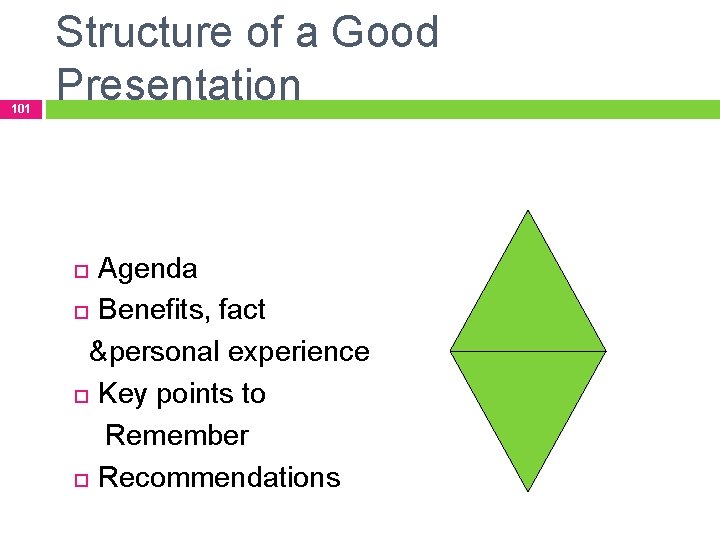
101 Structure of a Good Presentation Agenda Benefits, fact &personal experience Key points to Remember Recommendations
YOU MUST SEEK THEIR FEEDBACK Invite questions. . make notes and respond positively 102
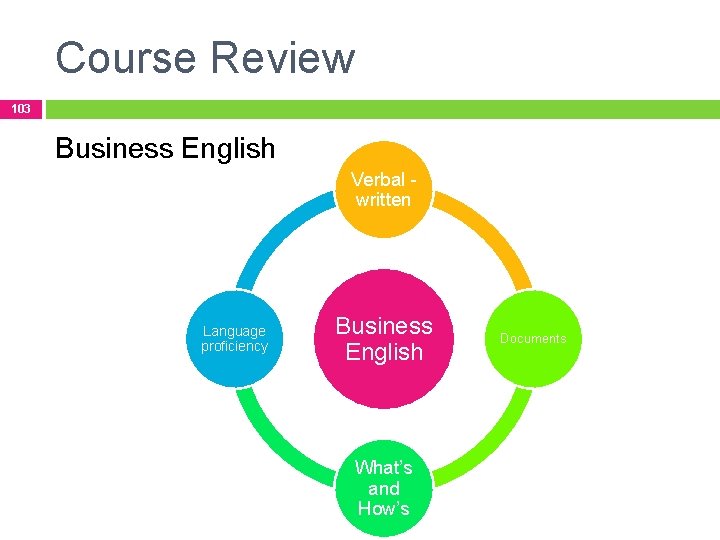
Course Review 103 Business English Verbal written Language proficiency Business English What’s and How’s Documents

104 THANKS. . GOOD LUCK!
- Slides: 104