
1 BUSINESS ENGLISH LECTURE 19 SYNOPSIS Report Writing

1 BUSINESS ENGLISH LECTURE 19
SYNOPSIS Report Writing Continues… Types of Report writing 1. Preliminary Reports: Problems and need analysis 2. Comparison Reports Recommendation and Feasibility Reports 3. Audience for these reports 4. Organization and Formatting

SYNOPSIS Structuring and discussion 6. Stating recommendation 7. Some Examples 8. Recommendation reports Proposals White papers Marketing Plans Usability Reports
SYNOPSIS Formal Report Format 1. Anatomy – Discussion Checklist
Definition of Business Reports A business report is an orderly and objective communication of factual information that serves some business purpose.

Reports categorised by FUNCTION • Informational reports • Analytical reports
Reports categorised by TIME • Progress reports • Periodic reports • Special reports
Reports categorised by FORM • Memo • Letter • Manuscript
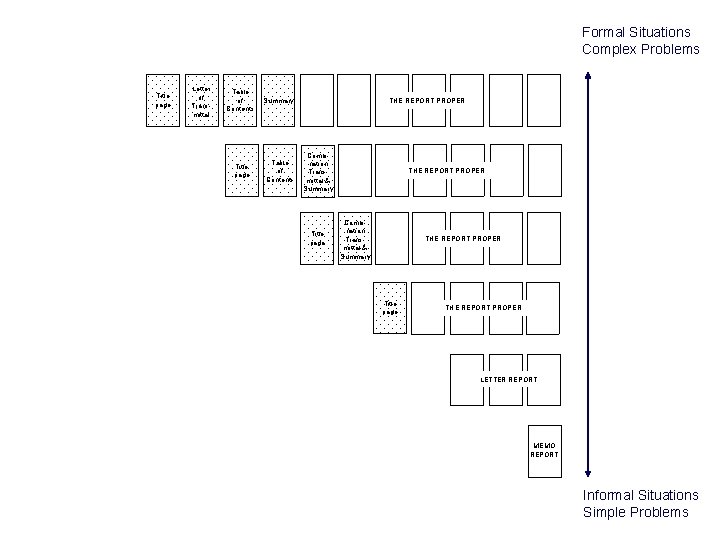
Formal Situations Complex Problems Title page Letter of Transmittal Table of Contents Title page THE REPORT PROPER Summary Table of Contents Combination Transmittal & Summary Title page THE REPORT PROPER Combination Transmittal & Summary THE REPORT PROPER Title page THE REPORT PROPER LETTER REPORT MEMO REPORT Informal Situations Simple Problems
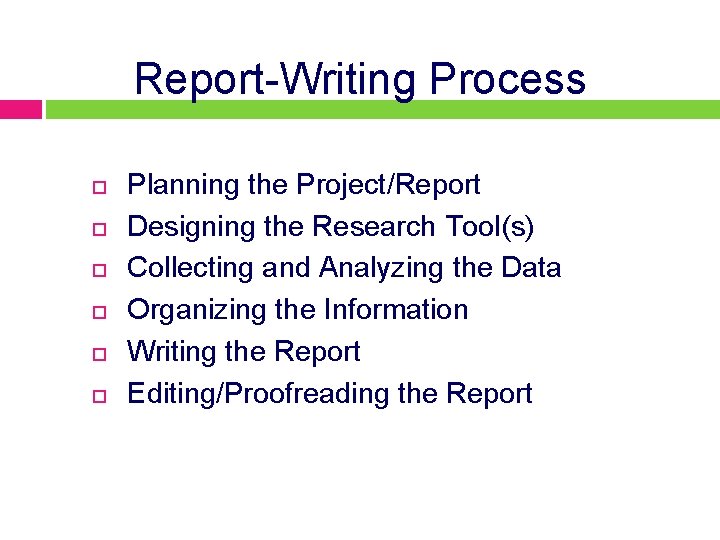
Report-Writing Process Planning the Project/Report Designing the Research Tool(s) Collecting and Analyzing the Data Organizing the Information Writing the Report Editing/Proofreading the Report
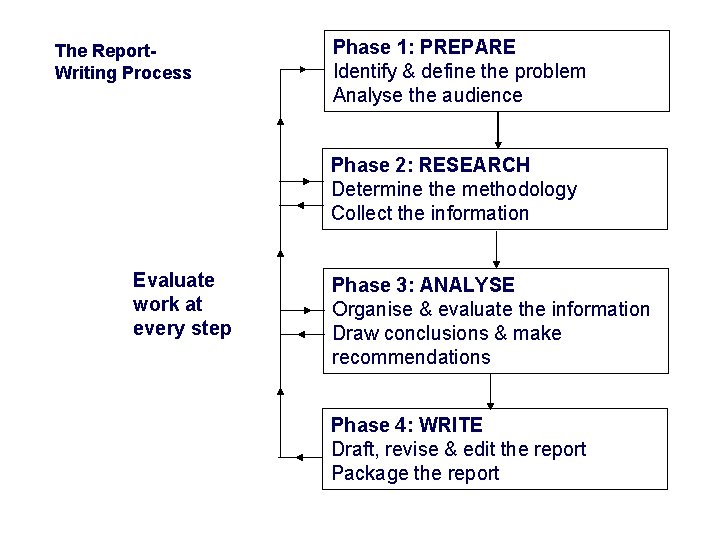
The Report. Writing Process Phase 1: PREPARE Identify & define the problem Analyse the audience Phase 2: RESEARCH Determine the methodology Collect the information Evaluate work at every step Phase 3: ANALYSE Organise & evaluate the information Draw conclusions & make recommendations Phase 4: WRITE Draft, revise & edit the report Package the report
TYPES OF REPORTS A Brief Introduction
This section describes the popular report types listed above and points to more detailed descriptions: it is a "nuts and bolts" discussion.
This will make sense in an immediately accessible context: Imagine that you want to ask a close relative (who gives you money freely) for money to support your business. Your approach would be very different than if you were to ask a venture capitalist for that same money.
While you might write a proposal in each instance, these two proposals will not be similar in length, tone, support for the argument, financial statements, and so on.
When adjusting the report to your purpose, you should consider who will read the report, why, in what detail, with what prejudice, with what knowledge, and to make what decision.
• • • Keeping your audience's needs in mind will help you decide the level of formality (in structure and tone) of your report the length of the report what kinds of data to include (tables, figures, general graphs, or pictures) how much to explain what positions to defend the visual sophistication required
Preliminary Reports Problem or Needs Analyses A problem or needs-analysis report—a very preliminary piece of writing— examines a particular issue that the client faces. A problem or needs analysis is particularly appropriate when the need or problem is complex or ill defined.
Perhaps the client is not convinced of the need for change, or personnel in the client organization have different views about the issue (which is often the case). A problem or needs analysis names the problem that you think should be addressed and provides analysis that supports your position. Such analyses are especially appropriate to a problemsolving paradigm.
Professional communication includes a variety of reports common to business and industry. many of them briefly and then point to further discussions and models available elsewhere in Professional Writing Online. We have argued that you can identify reports by differences in audience and purpose. Actually, there are even more factors to include.
• • Every discussion of report formats is complicated by the fact that reports within the same classification may vary in length complexity of audience formality purposes and functions inside and/or outside the organization. This section describes the popular report types listed above and points to more detailed descriptions: it is a "nuts and bolts" discussion. We also direct your attention to writing reports in Principles: that section addresses writing reports more generally.
To comfortably grasp the selection of report types, you need to embrace report truth # 1: Reports may be classified similarly and still function (and even appear) very differently in two different situations.
This will make sense in an immediately accessible context: Imagine that you want to ask a close relative (who gives you money freely) for money to support your business.
Your approach would be very different than if you were to ask a venture capitalist for that same money. While you might write a proposal in each instance, these two proposals will not be similar in length, tone, support for the argument, financial statements, and so on.
When adjusting the report to your purpose, you should consider who will read the report, why, in what detail, with what prejudice, with what knowledge, and to make what decision.
Keeping your audience's needs in mind will help you decide the level of formality (in structure and tone) of your report the length of the report what kinds of data to include (tables, figures, general graphs, or pictures) how much to explain what positions to defend the visual sophistication required
• • • Project Plans Here's an old maxim about projects: A project can be done fast cheap well But you only get two out of three.
• • A project plan may be part of a proposal, or it may be a report of its own. The purpose of a project plan is to conceptualize, organize, and plan a project, usually with two audiences in mind: The project participants themselves, for whom such a report acts as a guide, will be contracted to complete tasks at specific times. Supervisors or others in the organization, whom the report seeks to persuade and inform, allot support and resources for the project.
Principally, the project plan should define the shape and scope of the project: what will be produced, for whom is it intended, what is the scope of treatment. A good plan also anticipates possible problems or obstacles. A plan is persuasive (in trying to secure the reader's approval), but it should also be realistic and honest in its assessment about what can be done within a particular timeframe.
A project plan typically includes an overview (which, most importantly, includes a statement of purpose); a description of the client and their needs; a list of deliverables (documents or products to be created); a detailed schedule for a project (often in Gantt- or PERT- chart form); a budget; a list of personnel, together with an assignment of their duties and responsibilities to the project (and perhaps a discussion of their qualifications); and a methodology or procedure to be followed (e. g. , a research plan). The project plan needs to convince management that a project is well organized and feasible and that the participants listed are all necessary in order for the project to be successful.
Comparison Reports A comparison report examines two or more options and performs a "relative advantages" analysis to determine which option would best serve the client. Use a comparative format when there are several serious alternatives that should be considered.
Comparison reports are similar to recommendation reports and feasibility reports in their approach (i. e. , establishing criteria for a good option and evaluating possible options), and sometimes the reports are identical except in name. But in some technical communication situations, the comparison report only includes analysis and does not recommend a course of action. If it does not recommend an action, then the comparison report takes on some of the functions of a white paper or backgrounder.
Feasibility Reports A feasibility report may respond to a single question or recommend a specific option. It may also apply several criteria to that option and make a judgment as to whether it would be in the client's best interest to implement the option. (Simple thumbs up or thumbs down. ) Use a feasibility format when the client has one favored alternative or plan of action and is trying to determine the effects of that one course of action.
"Feasibility" in this context refers both to technical feasibility in the limited sense (can this be done? will this action solve the problem? ), as well as to a wider sense of feasibility that focuses on the desirability of a certain course of action (should this be done? is it reasonable to do this? will the benefits of doing this outweigh the ill effects? is this in the best interests of the company? )
Recommendation and Feasibility Reports Both recommendation reports and feasibility reports make statements about what action should be taken to solve a problem, resolve a dilemma, or undertake a course of action. The main distinction between the two report types is dependent on their positioning in a company’'s decisionmaking process:
A recommendation report is written when several courses of action seem possible, while a feasibility report is done after a tentative decision has been reached.
Thus when a decision needs to be made about a product or course of action, the recommendation report suggests criteria for a good decision from among a number of alternatives, The feasibility report, on the other hand, suggests criteria to determine whether a particular course of action is reasonable and appropriate.
Take the actions of a regional commission searching for county park sites as an example. Early on in the commission’'s work, the group will entertain a number of alternatives for park sites.
They will develop criteria (e. g. , number of residents, distance from other parks, cost of land, safety, natural attractions, availability, and so on) and search for sites that meet those criteria. It is during this period that the commission may entertain a recommendation report that evaluates potential sites according to the commission’'s criteria.
Later, when the commission settles on a tentative site, it will usually employ a consultant to develop a feasibility report that tests the suitability of the one favored sitefor park development.
This feasibility report will still reach a recommendation to proceed with action or to halt action
To reach that recommendation, it will consider carefully the more technical criteria and focus on any problem criteria. It will also take a wider view of the development as a way to anticipate any roadblocks.
The feasibility study will usually look at road improvements needed, costs of land improvements, utility easements, ground water toxicity, suitability of site for public recreational needs, and so on. The feasibility report written for this situation will be a formal report, and (if done by a consultant) it will include a presentation at a public meeting.
Audiences for These Reports n the ideal reporting situation, the audiences for these reports are decisionmakers who will read them because they consider solutions to organizational problems. In this ideal readers’' world, target readers will approach the report types quite differently.
Recommendation reports are written before a decision is reached (and thus it may seem the writer has more input into decision making). Feasibility studies, by contrast, seem often written to assure decision-makers that their initial decisions are workable and sound.
But these ideal reader situations do not often reflect realistic reporting situations. First of all, the government and most professional organizations, use the term "recommendation" as an advocacy term.
Recommendation reports are written to advocate a particular change in public policy, and they seldom address the range of alternatives that textbooks prescribe, nor do they maintain an analytic distance from the activity of recommending. Instead, these advocacy reports focus on building rationales for their acceptance.
Second, consultants and sales forces often develop recommendation and feasibility reports that openly advocate solutions that are most advantageous to their interests: We expect a consultant to suggest extra work, but he/she may also recommend a solution that does not seem that costly (although it will invariably be very profitable to him or her personally).
Because of the varied "agendas" forwarded in recommendation (and feasibility) reports, decision-makers are often skeptical of recommendations that are not well substantiated by research.
As the stakes rise, so too should the backing provided for these important readers who are likely to read with caution. One can be sure, however, that they will read with care because both recommendation and feasibility reports address organizational problems.
Organization and Formatting A general plan for recommendation and feasibility reports suggests that they are similar in organization.
As is true of most reports, both begin with an introduction that identifies the organizational problem, tells the scope of the report and how it will function.
Most then state the recommendations for action, though some organizations will vary that pattern by stating recommendations after each section or at the end.
The body of the reports starts similarly as they both need to discuss the criteria for solutions and the background that makes these criteria appropriate.
Both usually have a grid that summarizes the ratings alternatives received on each criteria. Then the reports diverge a bit as the goal of the recommendation report is to present all the reasonable alternatives for action and to examine their fit with the criteria, while the feasibility study is more focused on examining the one solution it addresses in detail. .
Both report types offer a conclusion and then supporting references and data
How much supporting documentation they offer depends on the scope of the decision. For instance, if the reporting situation handles recommendations for purchasing office equipment, the report will likely be written as a memo and the supporting data will be brief.
If the report addresses site selection for a low-income housing project, the report will likely be organized as a formal report and include extensive supporting documentation.
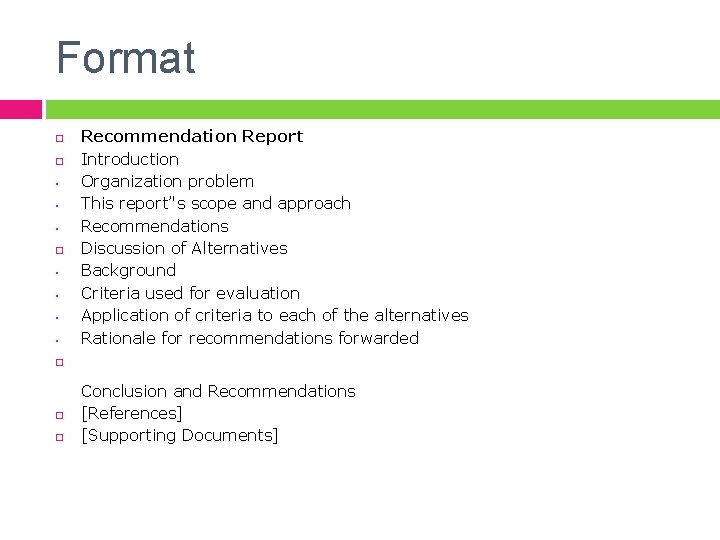
Format • • Recommendation Report Introduction Organization problem This report’'s scope and approach Recommendations Discussion of Alternatives Background Criteria used for evaluation Application of criteria to each of the alternatives Rationale for recommendations forwarded Conclusion and Recommendations [References] [Supporting Documents]
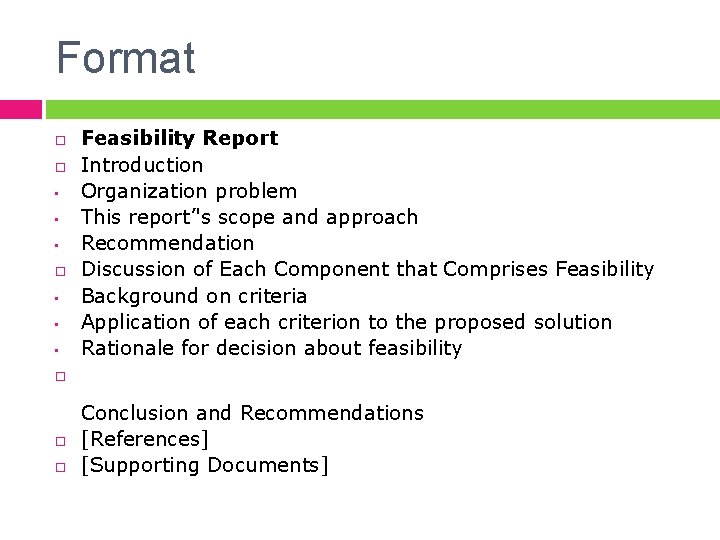
Format • • • Feasibility Report Introduction Organization problem This report’'s scope and approach Recommendation Discussion of Each Component that Comprises Feasibility Background on criteria Application of each criterion to the proposed solution Rationale for decision about feasibility Conclusion and Recommendations [References] [Supporting Documents]
Structuring the Discussion An important organizational decision for recommendation reports is how to organize the discussion of alternatives. Should you organize by alternatives or by criteria? Actually, the organization of the discussions should fit its situation. Normally, to reach a good decision, one considers a number of alternatives by comparing their performance using certain criteria.
Stating Recommendations • • Another important consideration in both recommendation and feasibility reports is the stating of recommended action. How do you pose your recommendations so that they are actionable, respectful of the decision-makers, and appropriate for the organization? I suggest you: State the content of your recommendation in a sentence. Make the organization the agent of the action you recommend. Make the verb an action. Include any qualifications in the sentence.
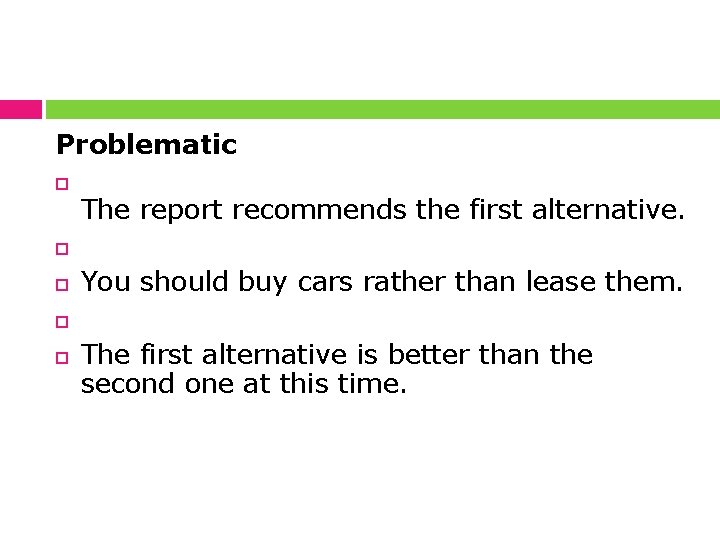
Problematic The report recommends the first alternative. You should buy cars rather than lease them. The first alternative is better than the second one at this time.
Improved This report recommends that the Area Commission make the Prohetstown Heights site its first priority for park development because of its historic character and reasonably priced land. Smith, Inc. should buy new autos for its fleet rather than lease them because of the new IRS depreciation regulations. While an all-digital film exchange is a goal, current costs make it too expensive for the Arena League, and thus we recommend that beta format be used in league film exchange.
Some EXAMPLES You can find many examples of recommendation and feasibility reports on the web. Some of the reports developed by governmental agencies can be found at: Formal Reports Census Bureau—report on whether to adjust census data with A. C. E. formula Research Reports from the Channel Islands National Marine Sanctuary Informal Reports Federal Trade Commission—response to a complaint about paid advertising in search engines http: //www. ftc. gov/os/closings/staff/commercialalertletter. htm
Some EXAMPLES Reports Formatted for Web or for General Public US Fire Administration Wildland Fire Operations Risk Management After Enron: Improving Boards in Canada Osteoporosis Screening Recommendations Report of the Surgeon General on Mental Health Recommendation Reports intended to Promote Policy American Bar Association—recommending plain language use for regulation writing US Housing and Urban Development Agency Report on how people use HUD’s programs
Recommendation Reports As their name suggests, recommendation reports advise on what specific action should be taken by an organization. They are composed at the end of a process of inquiry and notify the reader that a certain course of action should be followed. The argument of a recommendation report can be developed in numerous ways.

LANGUAGE EXPANSION AND LISTENING
Listening Activity 00: 12 – 18: 27 Listening Questions 1. What is the key concept behind the most recent Pro. Books upgrade? 2. What feature of the software does Jenny want to demonstrate? 3. What is Jenny’s solution to the technical problem?

Answers Idea of integration - Changes, new features, good business decisions Report features Plug into the monitor directly
Review Report Writing Continues… Types of Report writing 1. Preliminary Reports: Problems and need analysis 2. Comparison Reports Recommendation and Feasibility Reports 3. Audience for these reports 4. Organization and Formatting
Review Structuring and discussion 6. Stating recommendation 7. Some Examples 8. Recommendation reports Proposals White papers Marketing Plans Usability Reports
- Slides: 72