
1 Bindi Sawchuk Assistant Deputy Minister Workforce Innovation
1 Bindi Sawchuk Assistant Deputy Minister, Workforce Innovation & Division Responsible for Skills Training Ministry of Advanced Education, Skills and Training Chris Brown Assistant Deputy Minister, Employment and Labour Market Services Division Ministry of Social Development & Poverty Reduction November 9, 2018
2 PART 1: BC’s Labour Market & Future Labour Force PART 2: BC’s Priorities & Labour Market Programs PART 3: Q&A 2
3 Things are changing quickly… we must anticipate, and respond effectively to help British Columbians reach their full potential. 3
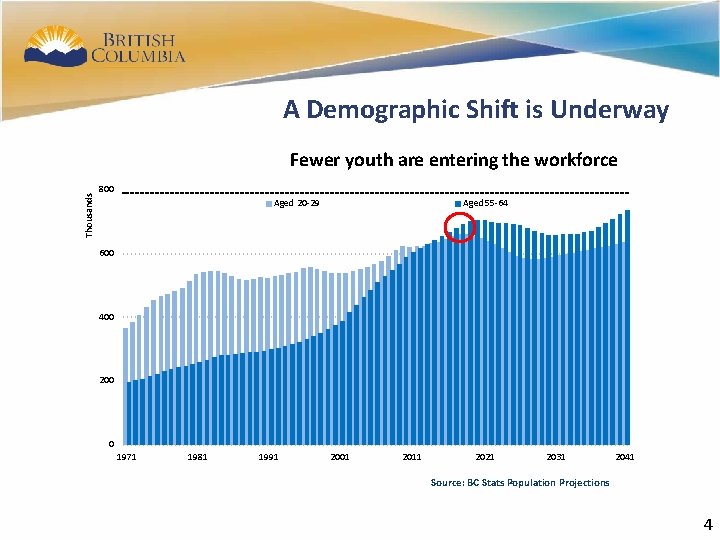
4 A Demographic Shift is Underway Thousands Fewer youth are entering the workforce 800 Aged 20 -29 Aged 55 -64 600 400 200 0 1971 1981 1991 2001 2011 2021 2031 2041 Source: BC Stats Population Projections 4
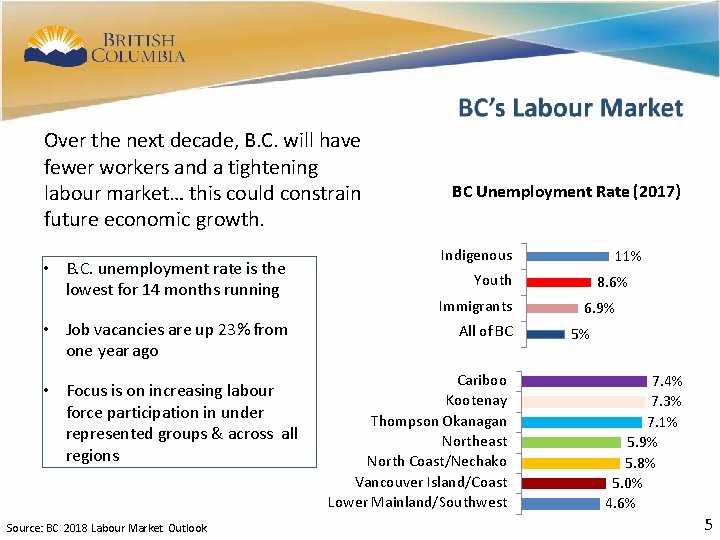
5 Over the next decade, B. C. will have fewer workers and a tightening labour market… this could constrain future economic growth. • B. C. unemployment rate is the lowest for 14 months running • Job vacancies are up 23% from one year ago • Focus is on increasing labour force participation in under represented groups & across all regions Source: BC 2018 Labour Market Outlook BC Unemployment Rate (2017) Indigenous 11% Youth Immigrants All of BC Cariboo Kootenay Thompson Okanagan Northeast North Coast/Nechako Vancouver Island/Coast Lower Mainland/Southwest 8. 6% 6. 9% 5% 7. 4% 7. 3% 7. 1% 5. 9% 5. 8% 5. 0% 4. 6% 5
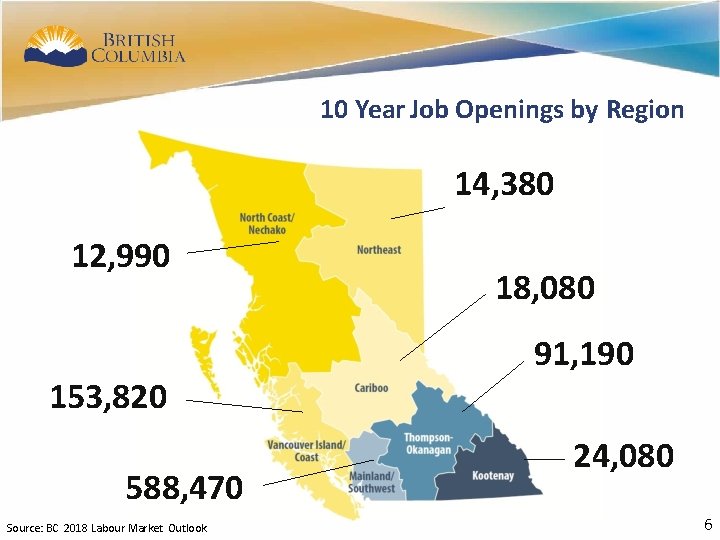
6 10 Year Job Openings by Region 14, 380 12, 990 153, 820 588, 470 Source: BC 2018 Labour Market Outlook 18, 080 91, 190 24, 080 6
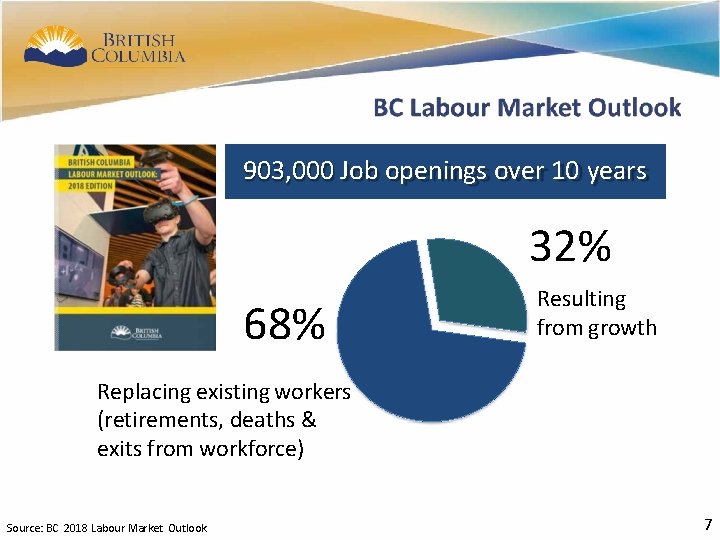
7 903, 000 Job openings over 10 years 32% 68% Resulting from growth Replacing existing workers (retirements, deaths & exits from workforce) Source: BC 2018 Labour Market Outlook 7
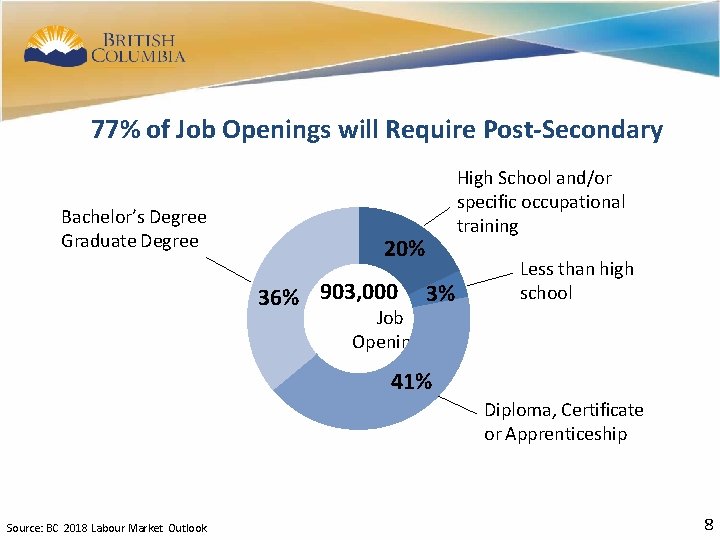
8 77% of Job Openings will Require Post-Secondary Bachelor’s Degree Graduate Degree 20% 36% 903, 000 36% High School and/or specific occupational training 3% 3% Less than high school Job Openings 41% Source: BC 2018 Labour Market Outlook Diploma, Certificate or Apprenticeship 8
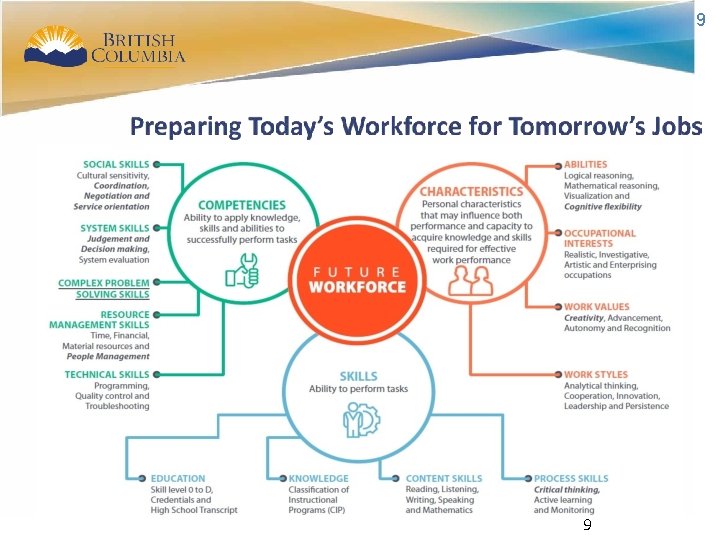
9 9
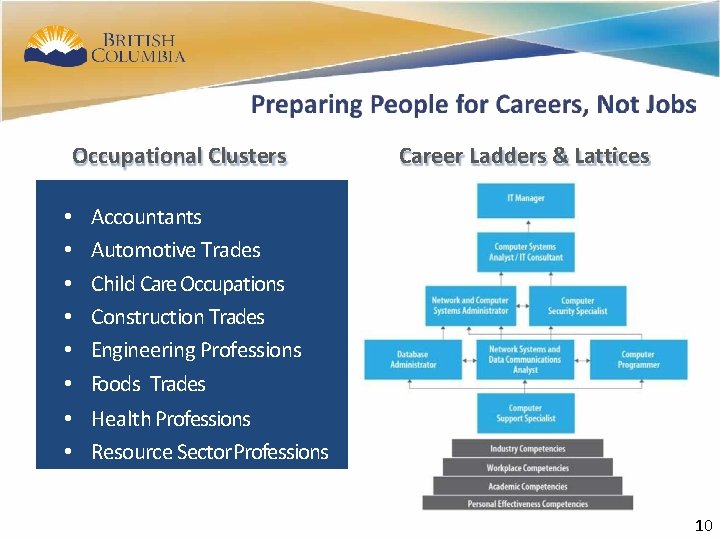
10 Occupational Clusters • • Career Ladders & Lattices Accountants Automotive Trades Child Care Occupations Construction Trades Engineering Professions Foods Trades Health Professions Resource Sector. Professions 10
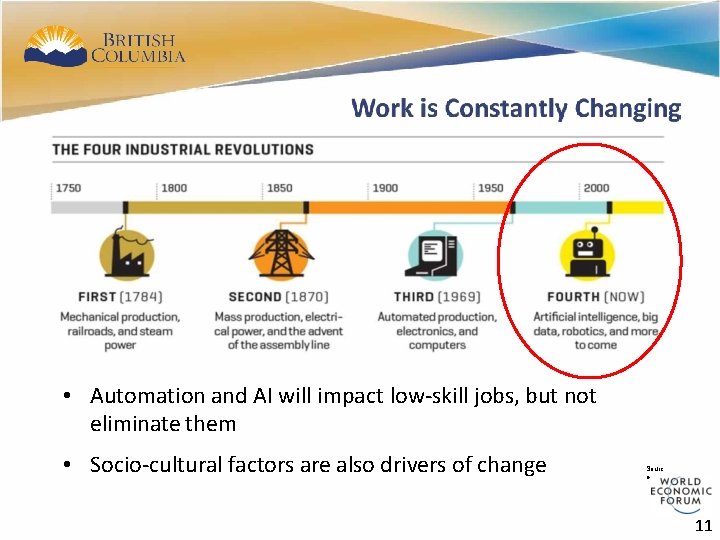
11 • Automation and AI will impact low-skill jobs, but not eliminate them • Socio-cultural factors are also drivers of change Sourc e: 11
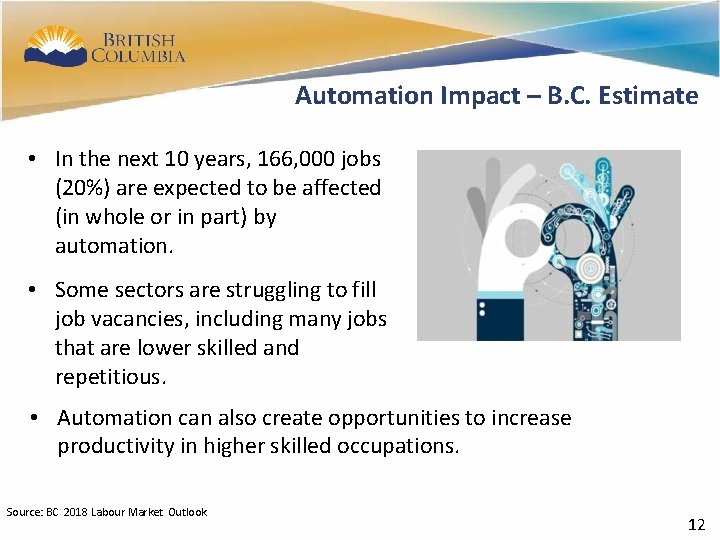
12 Automation Impact – B. C. Estimate • In the next 10 years, 166, 000 jobs (20%) are expected to be affected (in whole or in part) by automation. • Some sectors are struggling to fill job vacancies, including many jobs that are lower skilled and repetitious. • Automation can also create opportunities to increase productivity in higher skilled occupations. Source: BC 2018 Labour Market Outlook 12
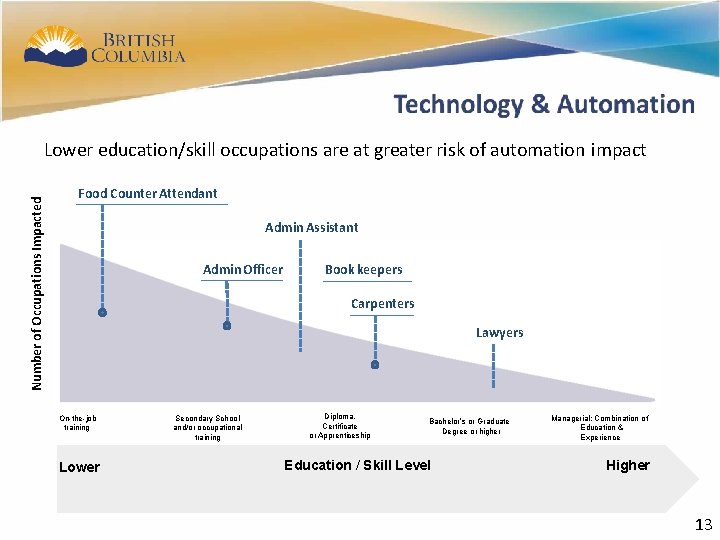
13 Number of Occupations Impacted Lower education/skill occupations are at greater risk of automation impact Food Counter Attendant Admin Assistant Admin Officer Book keepers Carpenters Lawyers On-the-job training Lower Secondary School and/or occupational training Diploma, Certificate or Apprenticeship Bachelor’s or Graduate Degree or higher Education / Skill Level Managerial: Combination of Education & Experience Higher 13
51 What’s the Urgency? Having a skilled workforce to participate fully in a dynamic economy is critical for individual British Columbians and businesses to prosper. • Skills and education are a key component to reducing poverty… and the time is now • The speed of change in the labour market requires rapid upskilling and innovation in training • This is a complex, dynamic labour market – no one party can solve it… we must work together 14
What Do We Need to Ask Ourselves? • Are we equipping people with the adaptable skills needed to enable labour market participation in rapidly changing economy? • How are we reaching populations that are vulnerable and face multiple barriers to employment? • What do we need to do to support workforce development and meet regional and occupational demands? • Other? 15
14 … How is government responding to the imperative of this rapidly changing labour market? 16
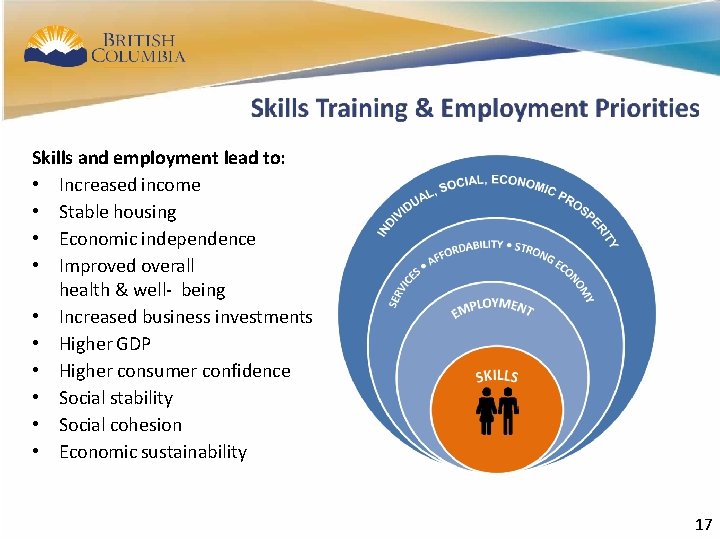
15 Skills and employment lead to: • Increased income • Stable housing • Economic independence • Improved overall health & well- being • Increased business investments • Higher GDP • Higher consumer confidence • Social stability • Social cohesion • Economic sustainability 17
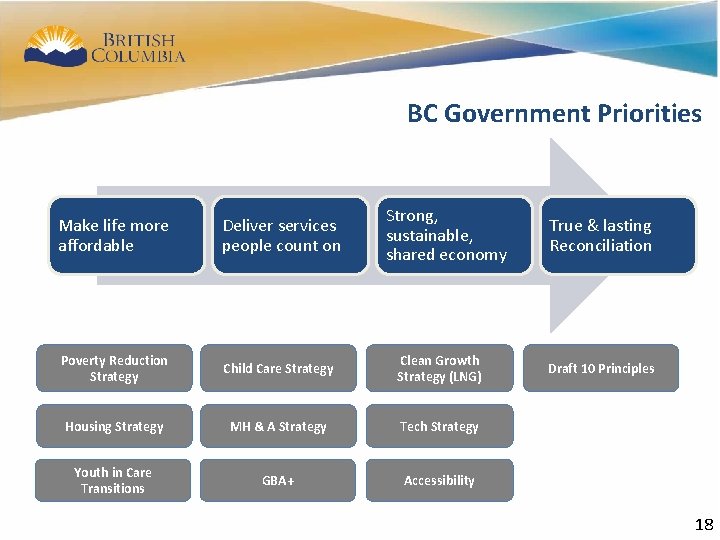
14 BC Government Priorities Strong, sustainable, shared economy Make life more affordable Deliver services people count on Poverty Reduction Strategy Child Care Strategy Clean Growth Strategy (LNG) Housing Strategy MH & A Strategy Tech Strategy Youth in Care Transitions GBA+ Accessibility True & lasting Reconciliation Draft 10 Principles 18
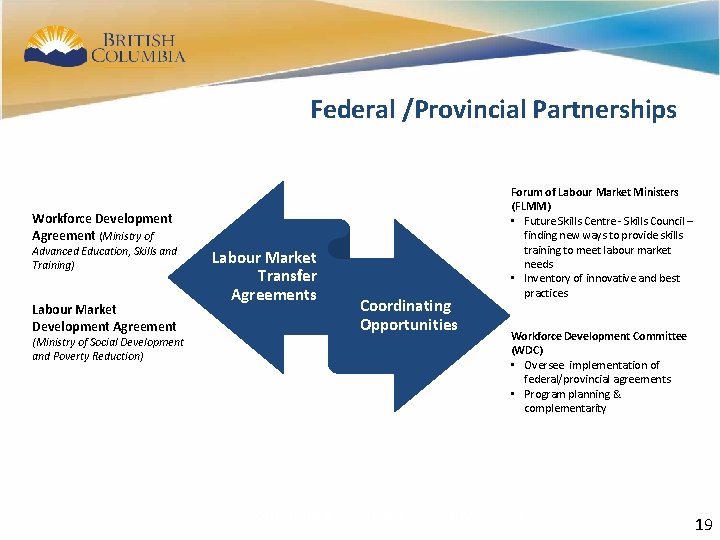
34 Federal /Provincial Partnerships Workforce Development Agreement (Ministry of Advanced Education, Skills and Training) Labour Market Development Agreement Labour Market Transfer Agreements Coordinating Opportunities (Ministry of Social Development and Poverty Reduction) Confidential: Ministry Use Only Forum of Labour Market Ministers (FLMM) • Future Skills Centre - Skills Council – finding new ways to provide skills training to meet labour market needs • Inventory of innovative and best practices Workforce Development Committee (WDC) • Oversee implementation of federal/provincial agreements • Program planning & complementarity 19 19

18 Advanced Education, Skills & Training 20
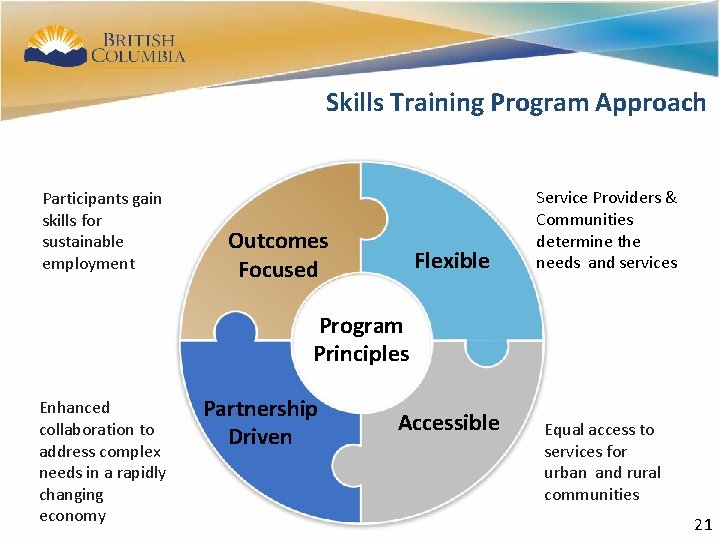
18 Skills Training Program Approach Participants gain skills for sustainable employment Outcomes Focused Flexible Service Providers & Communities determine the needs and services Program Principles Enhanced collaboration to address complex needs in a rapidly changing economy Partnership Driven Accessible Equal access to services for urban and rural communities 21
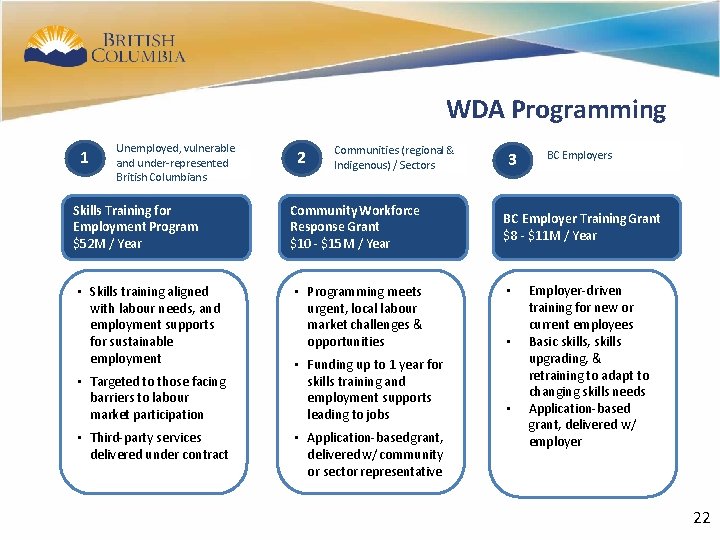
19 WDA Programming 1 Unemployed, vulnerable and under-represented British Columbians 2 Communities (regional & Indigenous) / Sectors Skills Training for Employment Program $52 M / Year Community Workforce Response Grant $10 - $15 M / Year • Skills training aligned with labour needs, and employment supports for sustainable employment • Programming meets urgent, local labour market challenges & opportunities • Targeted to those facing barriers to labour market participation • Third-party services delivered under contract • Funding up to 1 year for skills training and employment supports leading to jobs • Application-based grant, delivered w/ community or sector representative 3 BC Employers BC Employer Training Grant $8 - $11 M / Year • • • Employer-driven training for new or current employees Basic skills, skills upgrading, & retraining to adapt to changing skills needs Application-based grant, delivered w/ employer 22
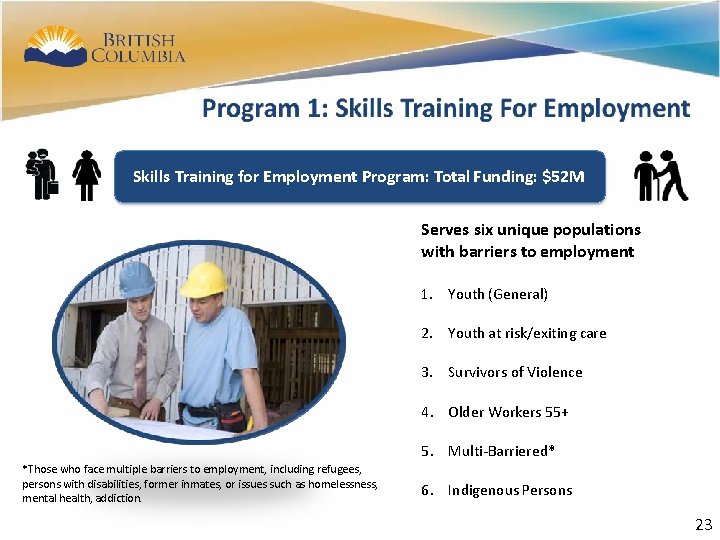
20 Skills Training for Employment Program: Total Funding: $52 M Serves six unique populations with barriers to employment 1. Youth (General) 2. Youth at risk/exiting care 3. Survivors of Violence 4. Older Workers 55+ 5. Multi-Barriered* *Those who face multiple barriers to employment, including refugees, persons with disabilities, former inmates, or issues such as homelessness, mental health, addiction. 6. Indigenous Persons 23
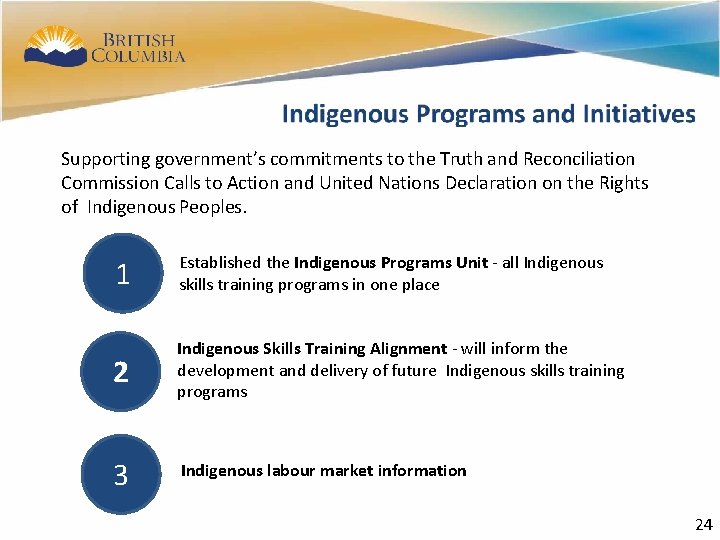
21 Supporting government’s commitments to the Truth and Reconciliation Commission Calls to Action and United Nations Declaration on the Rights of Indigenous Peoples. 1 Established the Indigenous Programs Unit - all Indigenous skills training programs in one place 2 Indigenous Skills Training Alignment - will inform the development and delivery of future Indigenous skills training programs 3 Indigenous labour market information 24
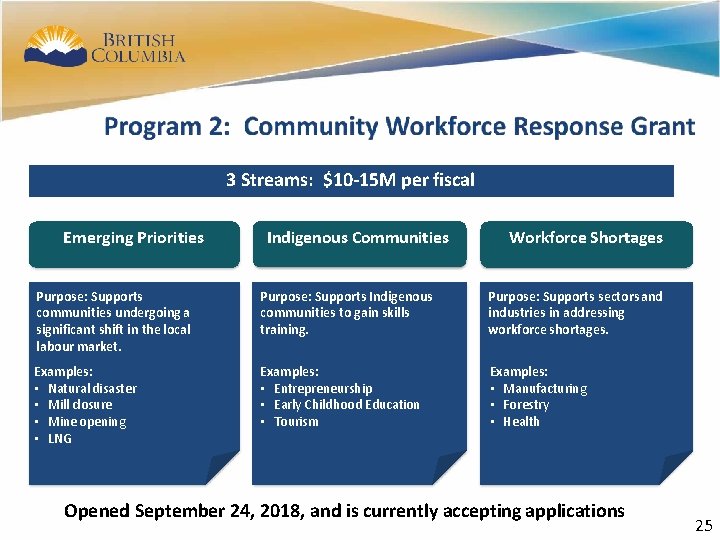
22 3 Streams: $10 -15 M per fiscal Emerging Priorities Indigenous Communities Workforce Shortages Purpose: Supports communities undergoing a significant shift in the local labour market. Purpose: Supports Indigenous communities to gain skills training. Purpose: Supports sectors and industries in addressing workforce shortages. Examples: • Natural disaster • Mill closure • Mine opening • LNG Examples: • Entrepreneurship • Early Childhood Education • Tourism Examples: • Manufacturing • Forestry • Health Opened September 24, 2018, and is currently accepting applications 25
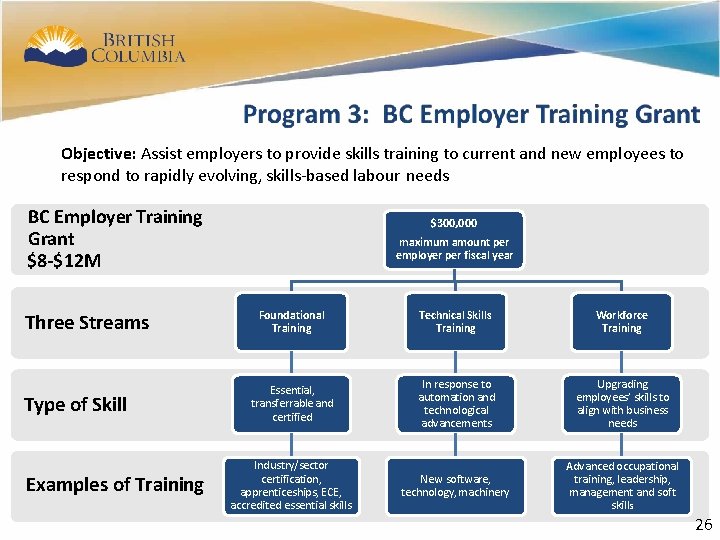
23 Objective: Assist employers to provide skills training to current and new employees to respond to rapidly evolving, skills-based labour needs BC Employer Training Grant $8 -$12 M Three Streams Type of Skill Examples of Training $300, 000 maximum amount per employer per fiscal year Foundational Training Technical Skills Training Workforce Training Essential, transferrable and certified In response to automation and technological advancements Upgrading employees’ skills to align with business needs Industry/sector certification, apprenticeships, ECE, accredited essential skills New software, technology, machinery Advanced occupational training, leadership, management and soft skills 26
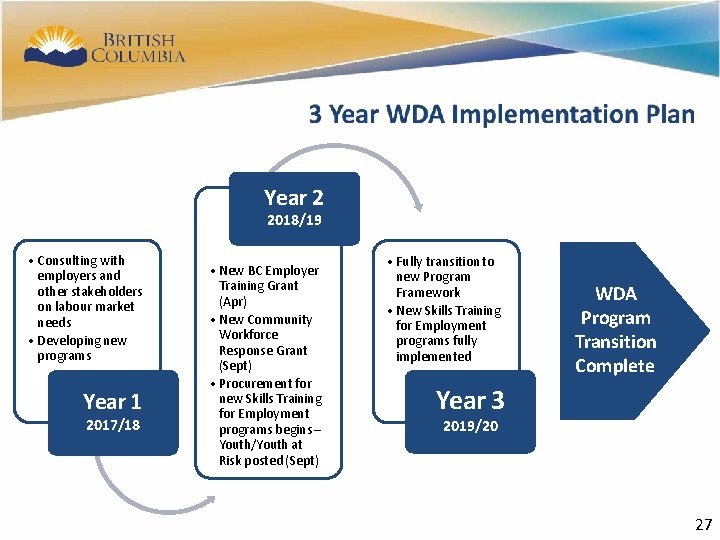
24 Year 2 2018/19 • Consulting with employers and other stakeholders on labour market needs • Developing new programs Year 1 2017/18 • New BC Employer Training Grant (Apr) • New Community Workforce Response Grant (Sept) • Procurement for new Skills Training for Employment programs begins – Youth/Youth at Risk posted (Sept) • Fully transition to new Program Framework • New Skills Training for Employment programs fully implemented WDA Program Transition Complete Year 3 2019/20 27
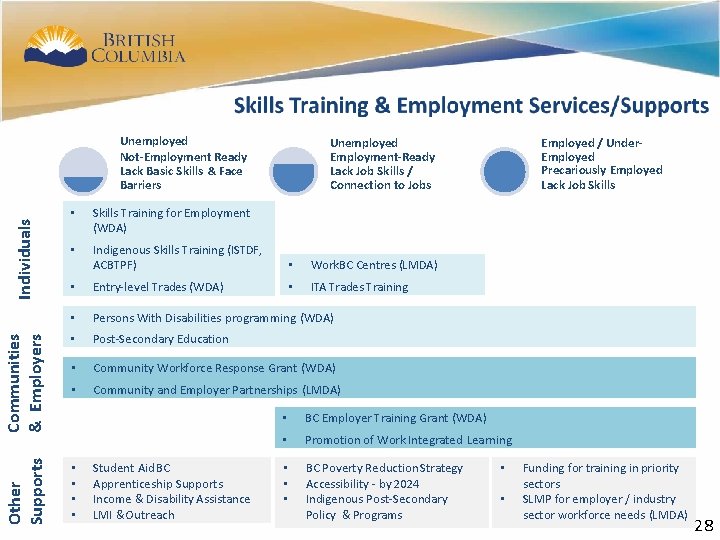
25 Unemployed Not-Employment Ready Lack Basic Skills & Face Barriers Skills Training for Employment (WDA) • Indigenous Skills Training (ISTDF, ACBTPF) • Work. BC Centres (LMDA) • Entry-level Trades (WDA) • ITA Trades Training • Persons With Disabilities programming (WDA) Communities & Employers • Post-Secondary Education • Community Workforce Response Grant (WDA) • Community and Employer Partnerships (LMDA) • • Individuals • Other Supports Unemployed Employment-Ready Lack Job Skills / Connection to Jobs Student Aid BC Apprenticeship Supports Income & Disability Assistance LMI & Outreach Employed / Under. Employed Precariously Employed Lack Job Skills • BC Employer Training Grant (WDA) • Promotion of Work Integrated Learning • • • BC Poverty Reduction Strategy Accessibility - by 2024 Indigenous Post-Secondary Policy & Programs • • Funding for training in priority sectors SLMP for employer / industry sector workforce needs (LMDA) 28

26 Social Development & Poverty Reduction 26 29

27 Year in Review Confidential: Ministry Use Only 27 30
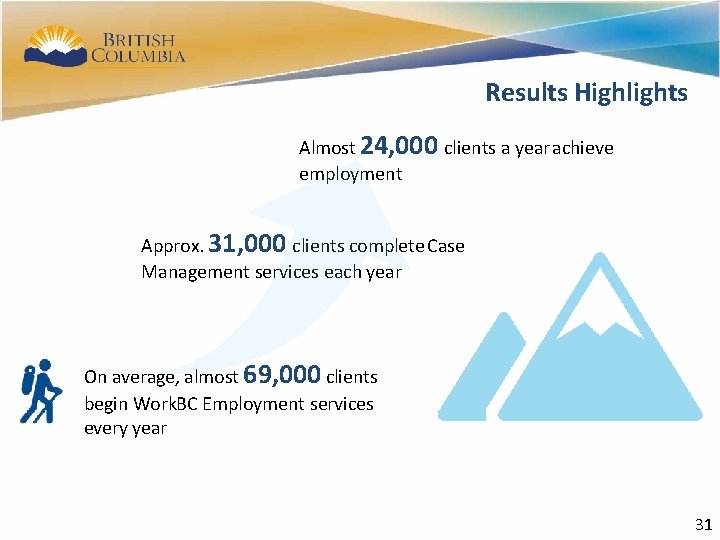
28 Results Highlights Almost 24, 000 clients a year achieve employment Approx. 31, 000 clients complete Case Management services each year On average, almost 69, 000 clients begin Work. BC Employment services every year 31 31
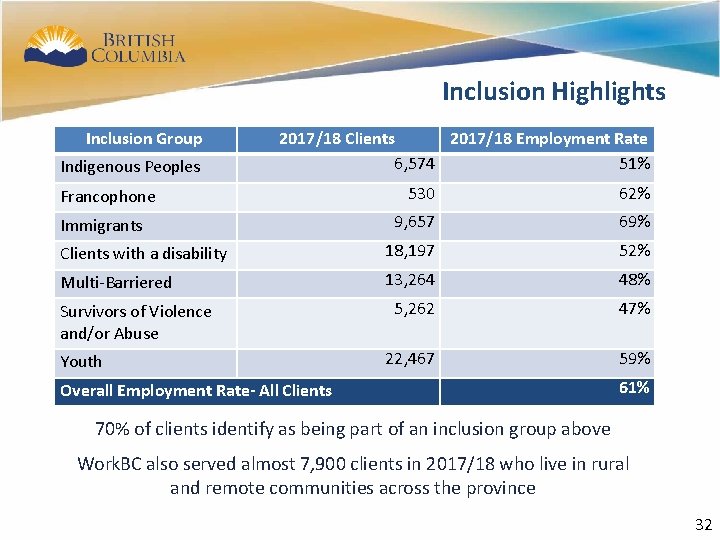
29 Inclusion Highlights Inclusion Group Indigenous Peoples 2017/18 Clients 2017/18 Employment Rate 6, 574 51% 530 62% 9, 657 69% Clients with a disability 18, 197 52% Multi-Barriered 13, 264 48% 5, 262 47% 22, 467 59% Francophone Immigrants Survivors of Violence and/or Abuse Youth 61% Overall Employment Rate- All Clients 70% of clients identify as being part of an inclusion group above Work. BC also served almost 7, 900 clients in 2017/18 who live in rural and remote communities across the province 32 32
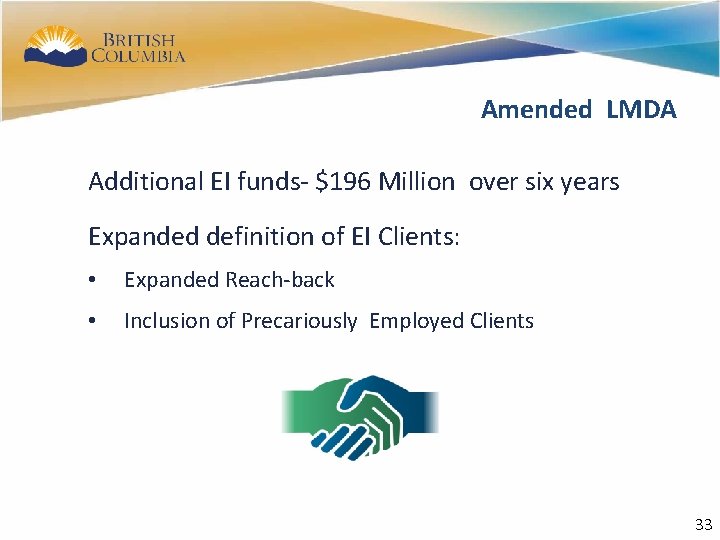
30 Amended LMDA Additional EI funds- $196 Million over six years Expanded definition of EI Clients: • Expanded Reach-back • Inclusion of Precariously Employed Clients 30 33
31 Current Priorities Confidential: Ministry Use Only 31 34
32 35 35
33 Confidential: Ministry Use Only 36 36
35 Confidential: Ministry Use Only 37 37

36 38
37 Work. BC Renewal The Ministry is looking forward to launching the new Work. BC program on April 1 st, 2019 Work. BC Assistive Technology Services Neil Squire Society Work. BC Apprentice Services Douglas College Work. BC Employment Services TBD 39 39
38 Work. BC Procurement Results The Ministry will announce results for Work. BC Employment Services in batches over the coming months The anticipated dates when all vendors in a catchment would receive their results notification letter will begin in December and end in January 40 40
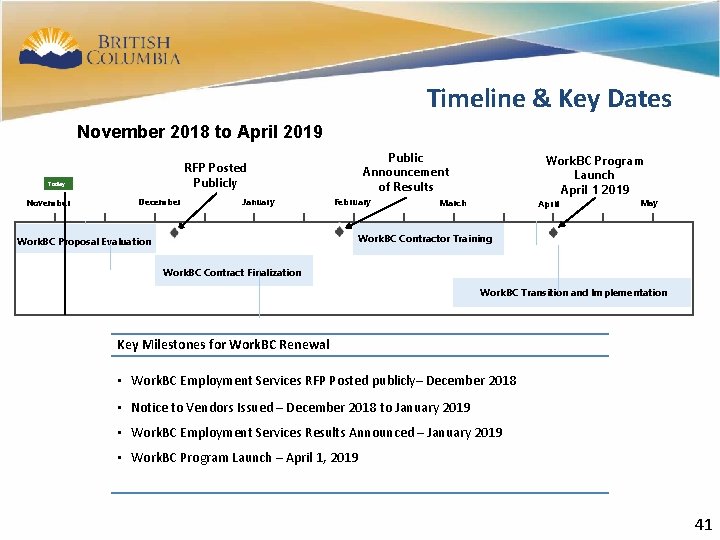
Timeline & Key Dates November 2018 to April 2019 Today November Public Announcement of Results RFP Posted Publicly December January February Work. BC Program Launch April 1 2019 March April May ' Work. BC Contractor Training Work. BC Proposal Evaluation Work. BC Contract Finalization Work. BC Transition and Implementation Key Milestones for Work. BC Renewal • Work. BC Employment Services RFP Posted publicly– December 2018 • Notice to Vendors Issued – December 2018 to January 2019 • Work. BC Employment Services Results Announced – January 2019 • Work. BC Program Launch – April 1, 2019 Confidential: Ministry Use Only 41 41

40 2019 and Beyond Opportunities 40 42
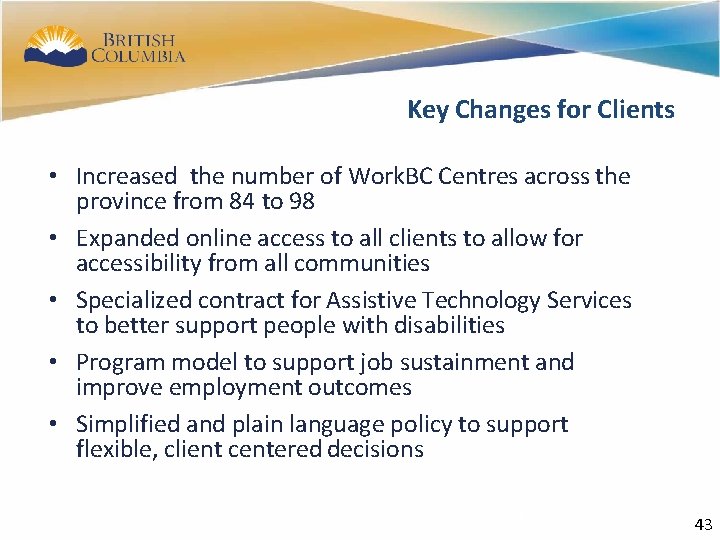
41 Key Changes for Clients • Increased the number of Work. BC Centres across the province from 84 to 98 • Expanded online access to all clients to allow for accessibility from all communities • Specialized contract for Assistive Technology Services to better support people with disabilities • Program model to support job sustainment and improve employment outcomes • Simplified and plain language policy to support flexible, client centered decisions 43 43
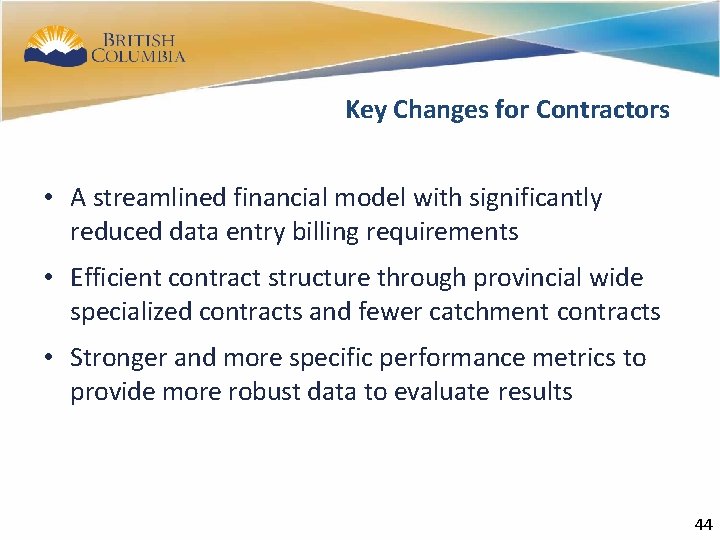
42 Key Changes for Contractors • A streamlined financial model with significantly reduced data entry billing requirements • Efficient contract structure through provincial wide specialized contracts and fewer catchment contracts • Stronger and more specific performance metrics to provide more robust data to evaluate results 44 44
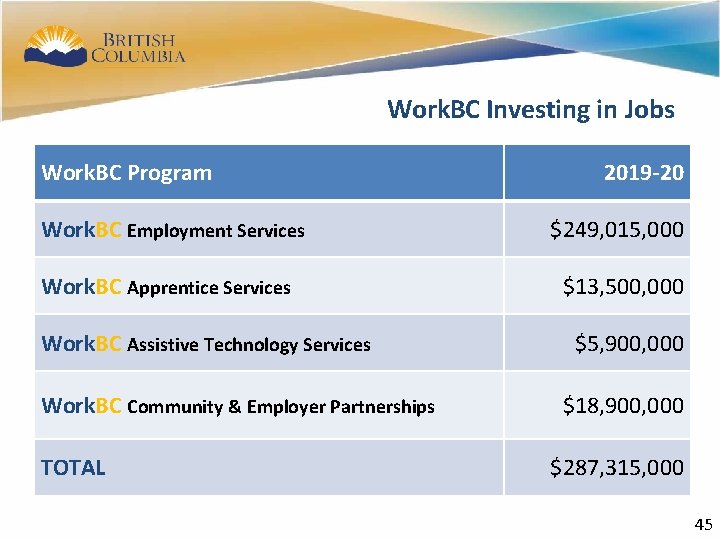
43 Work. BC Investing in Jobs Work. BC Program 2019 -20 Work. BC Employment Services $249, 015, 000 Work. BC Apprentice Services $13, 500, 000 Work. BC Assistive Technology Services $5, 900, 000 Work. BC Community & Employer Partnerships $18, 900, 000 TOTAL $287, 315, 000 45 45
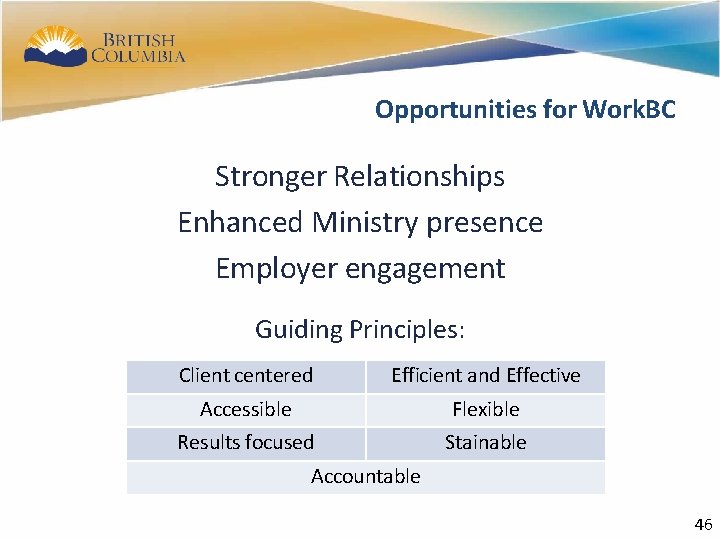
44 Opportunities for Work. BC Stronger Relationships Enhanced Ministry presence Employer engagement Guiding Principles: Client centered Efficient and Effective Accessible Flexible Results focused Stainable Accountable 46 46
45 New Approach for Work. BC The new Work. BC model creates an opportunity to enhance and improve client services by: • Taking advantage of expanded eligibility and flexibility in the LMDA to provide service to more British Columbians • Better supports to vulnerable clients and the working poor to help them get better paying jobs, reduce poverty and support BC’s growing economy 47 47
46 Community Projects Revisioning Community Employer Partnerships Leverage partnerships to address communities and labour markets in need Investigate funding partnership possibilities with other Ministries Engaged and proactive presence 48 48
47 Indigenous Relationships Strengthening & Improving relationships Significant focus of resources for government, our Ministry and our division Engaging with Indigenous communities when creating new policies and programs, and reviewing services Alignment of priorities with draft principles 47 49
48 Cross Government Engagement & Collaboration Renewed relationship through the Labour Market Transfer Agreement’s Collaboration across government Community Organizations Stakeholders 50 50
48 Connecting BC to Employment "I was able to look at things with a different perspective and was able to learn how to accept that this was a journey and with the help of Work. BC, I was able to successfully find a job that was suitable for me. ” Work. BC Client 51 51

54 Part 3 Questions? 52
- Slides: 52