
1 BFT 219 PRODUCT DESIGN APPLICATION CONCEPT GENERATION
1 BFT 219 PRODUCT DESIGN & APPLICATION CONCEPT GENERATION Ummi Noor Nazahiah bt. Abdullah P. P. K Pembuatan
CO 2: Ability to develop an appreciation for product design function throughout the product development process CO 3: Ability to describe and apply product design and development techniques for different types of products
3 6. 1 Activity of Concept Generation. 6. 2 Common Faults During concept Generation. 6. 3 Five (5) steps method.
4 6. 1 Activity of Concept Generation. Product concept Approximate description of the technology, working principles, & form of product. Expressed as a sketch / rough 3 D model + brief textual description. Concept generation is cheap & quick in compare to the rest of development process. Process begins after customer’s needs & early product design specification established.
5 6. 2 Common Faults During Concept Generation. Only consider 1 or 2 alternatives. Fail to consider carefully the usefulness of concepts employed by other firms in relation to the product or not. Only Involve 1 @ 2 people in process Lack of confidence & commitment by rest of team. Ineffective integration of promising partial solutions. Fail to consider entire categories of solutions.
6 How structured approach overcome these faults; Encourage gather information from many different information sources. Guide team in completing exploration of alternatives. Provide mechanism for integrating partial solutions. Provide a step-by-step procedure for less experience members- allow participate actively in process.
7 6. 3 Five Steps Method. The process to breaks a complex problem into simpler subproblems (Figure 5. 1). Solution concepts identified for sub-problems by external & internal search procedures. Classification Trees / Criteria Tree used to explore systematically the space of solution concepts. Concept Combination Table /Morphology Chart used to integrate sub-problems solutions into total solutions.
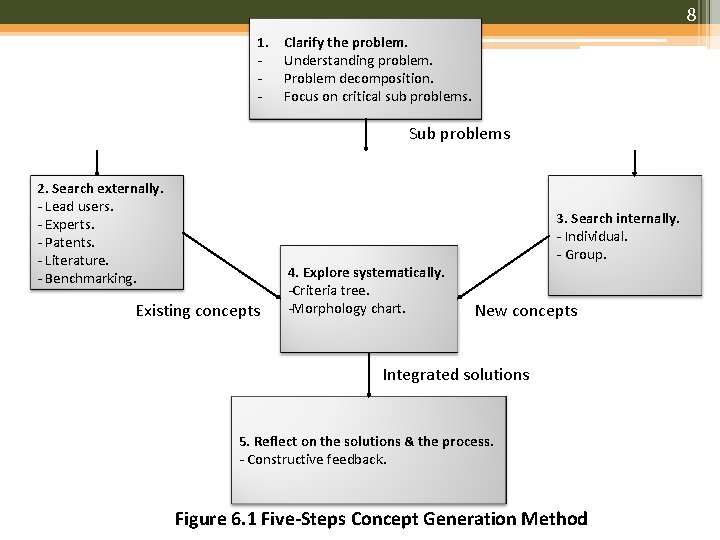
8 1. - Clarify the problem. Understanding problem. Problem decomposition. Focus on critical sub problems. Sub problems 2. Search externally. - Lead users. - Experts. - Patents. - Literature. - Benchmarking. Existing concepts 4. Explore systematically. -Criteria tree. -Morphology chart. 3. Search internally. - Individual. - Group. New concepts Integrated solutions 5. Reflect on the solutions & the process. - Constructive feedback. Figure 6. 1 Five-Steps Concept Generation Method
9 Advantages using 5 -Steps method; Focus on overall concept for a new product. Method that can be used at several different points in development process. Useful for subsystem concepts & specific components. Can be applied to nearly any product.
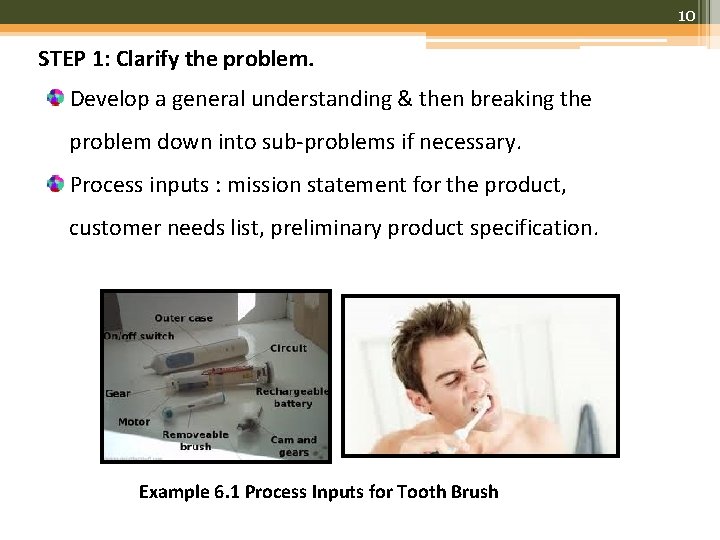
10 STEP 1: Clarify the problem. Develop a general understanding & then breaking the problem down into sub-problems if necessary. Process inputs : mission statement for the product, customer needs list, preliminary product specification. Example 6. 1 Process Inputs for Tooth Brush
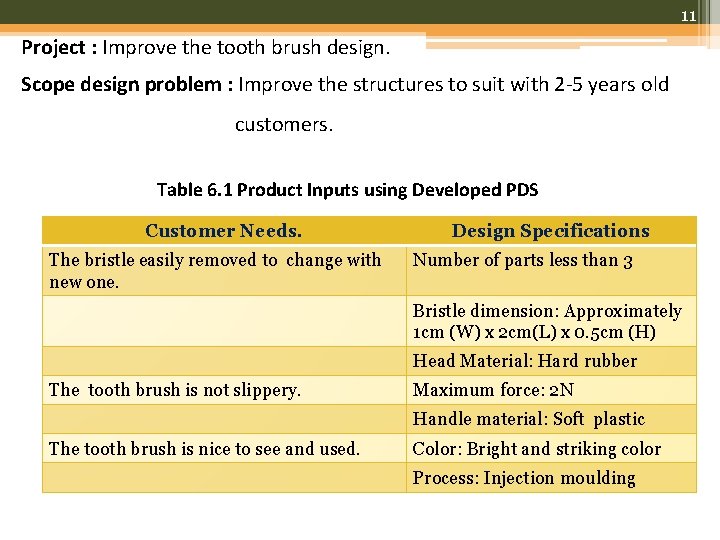
11 Project : Improve the tooth brush design. Scope design problem : Improve the structures to suit with 2 -5 years old customers. Table 6. 1 Product Inputs using Developed PDS Customer Needs. The bristle easily removed to change with new one. Design Specifications Number of parts less than 3 Bristle dimension: Approximately 1 cm (W) x 2 cm(L) x 0. 5 cm (H) Head Material: Hard rubber The tooth brush is not slippery. Maximum force: 2 N Handle material: Soft plastic The tooth brush is nice to see and used. Color: Bright and striking color Process: Injection moulding
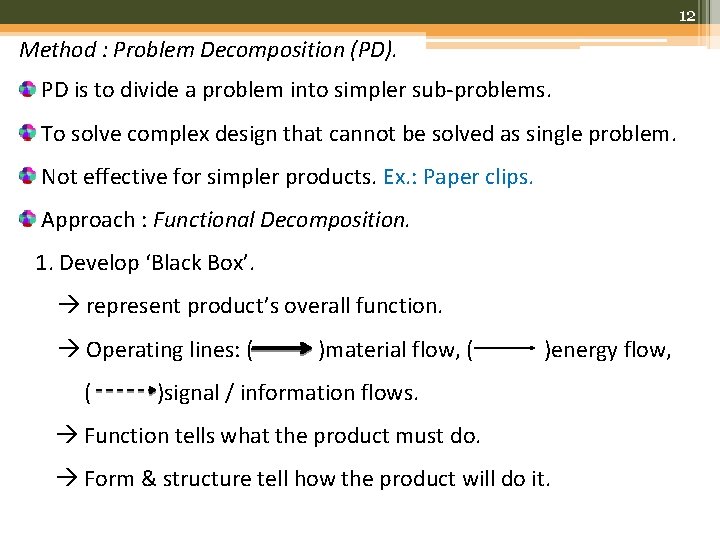
12 Method : Problem Decomposition (PD). PD is to divide a problem into simpler sub-problems. To solve complex design that cannot be solved as single problem. Not effective for simpler products. Ex. : Paper clips. Approach : Functional Decomposition. 1. Develop ‘Black Box’. represent product’s overall function. Operating lines: ( ( )material flow, ( )energy flow, )signal / information flows. Function tells what the product must do. Form & structure tell how the product will do it.
13 Function can be described in terms of logical flow of energy, material and information / signal. Energies flowing through the system are transformed, supplied, dissipated (action of components or assemblies in the system). Material flow can be: a) Through flow (material changing position or shapes). Term used: position, lift, hold, support, move, translate, rotate, guide. b) Diverging flow dividing material into two or more bodies. Term used: disassemble & separate.
14 c) Converging flow or assembling on joining material. Term used: mix match & position relative to. Information flow : mechanical signals, electrical signals, software. 2. Divide single ‘Black Box’ into sub-functions. To create more specific description of what elements of product might do. In order to implement overall function of product. Ideally 3 -10 sub-functions in one diagram. Process repeated until team agree each sub-function simple enough to work with.
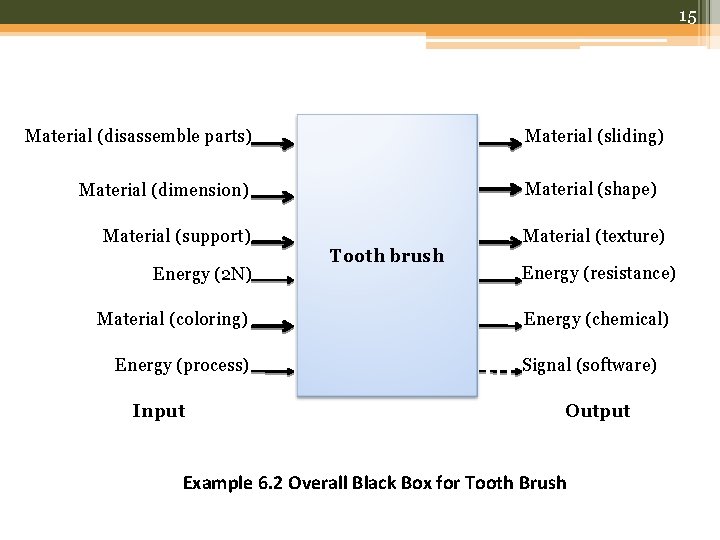
15 Material (disassemble parts) Material (sliding) Material (shape) Material (dimension) Material (support) Energy (2 N) Material (coloring) Energy (process) Input Tooth brush Material (texture) Energy (resistance) Energy (chemical) Signal (software) Output Example 6. 2 Overall Black Box for Tooth Brush
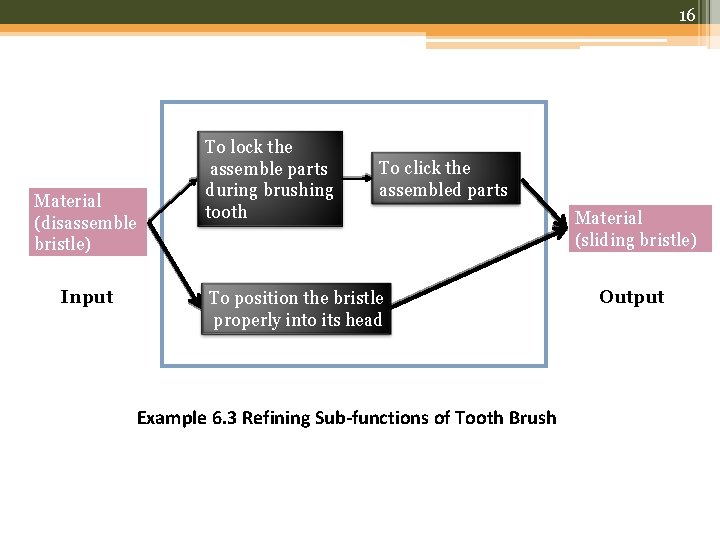
16 Material (disassemble bristle) Input To lock the assemble parts during brushing tooth To click the assembled parts To position the bristle properly into its head Example 6. 3 Refining Sub-functions of Tooth Brush Material (sliding bristle) Output
17 Reasons for decomposition: Control the search for solution (concept follow function & product follow concept). Finer functional details lead to better understanding of problem. May point out existing components that can provide some of the functionality required. Goal : describe functional elements of product without imply specific technology working principle. Ex: ‘To slide the bristle part’ not ‘To slide the bristle using automatic spring controlled by infra red’.
18 STEP 2 : Search Externally Aim: Find existing solutions to both the overall problem and to the sub-problems. Identified during the problem clarification step. This search is ongoing throughout the development process. Implementing an existing solution is usually less expensive and quicker than developing a new solution. Type information: detail evaluation & technology used.
19 Strategy: Expand : search the scope broadly by gathering information that might be related to the problem. Focus: search the scope by exploring the promising directions in more detail. 5 good ways to gather information: a) Interview Lead Users of product who experience needs in long time. Ex. : Medical product >> doctors / nurses. b) Consult Experts Professionals at firms & will expected to be paid. Ex. : Consultants, universities, technical person.
20 c) Patent Searches Sources of technical information containing drawings & explanation on how many products worked out. Disadvantage : Concepts protected. Advantage : Avoid generate similar concepts. d) Literature Searches Journals, conference proceedings, trade magazines, government reports, market, consumer, product information. Sources: electronic, handbook, magazine.
21 e) Competitive Benchmarking Study of existing product with functionality similar to product under development. ‘Detective works’. STEP 3 : Search Internally. This is the use of personal and team knowledge & creativity to generate solution concepts. The search is internal in that all of the ideas to emerge from this step are created from knowledge already in the possession of the team. This activity may be the most open-ended and creative of any in new product development.
22 Guidelines (similar to brainstorming approach). 1. Suspend judgment. Able to evaluate quickly a set of alternatives & take action. Frequently translated into the rule that during group concept generation sessions, no critics of concept is allowed. Suggest for improvements / alternative concepts. 2. Generate a lot of ideas. The more ideas a team generates, the more likely the team is to explore fully the solution space.
23 3. Welcome ideas that may seem infeasible. Infeasible ideas can be improved, ‘debugged’, ‘repaired’, by other members of the team. 4. Use graphical and physical media (sketch pads, clay, foam, etc. ) Translate physical & geometric information with words is difficult. Use sketching, foam, clay, cardboard & other 3 D dimensional media as appropriate aid.
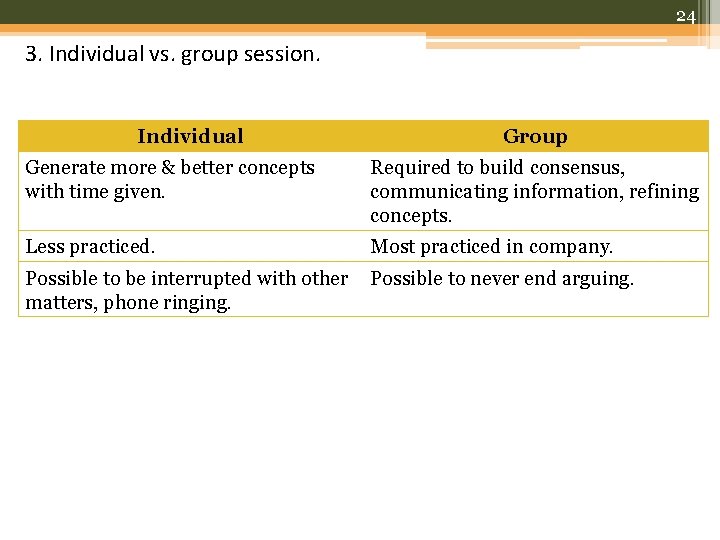
24 3. Individual vs. group session. Individual Group Generate more & better concepts with time given. Required to build consensus, communicating information, refining concepts. Less practiced. Most practiced in company. Possible to be interrupted with other matters, phone ringing. Possible to never end arguing.
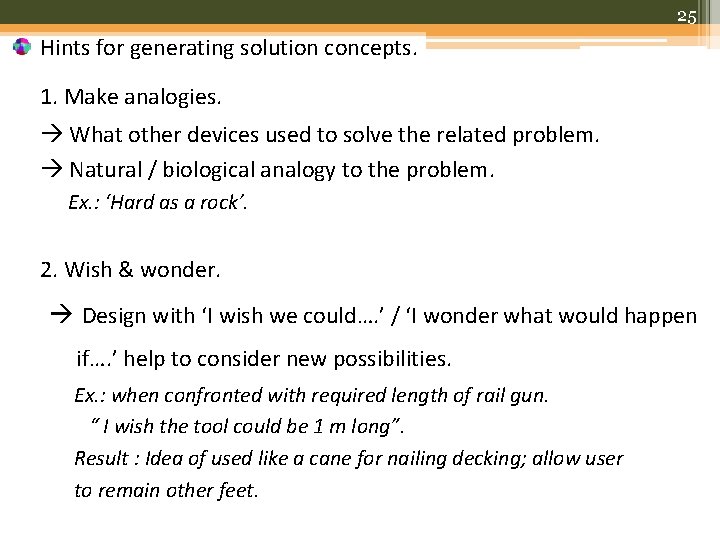
25 Hints for generating solution concepts. 1. Make analogies. What other devices used to solve the related problem. Natural / biological analogy to the problem. Ex. : ‘Hard as a rock’. 2. Wish & wonder. Design with ‘I wish we could…. ’ / ‘I wonder what would happen if…. ’ help to consider new possibilities. Ex. : when confronted with required length of rail gun. “ I wish the tool could be 1 m long”. Result : Idea of used like a cane for nailing decking; allow user to remain other feet.
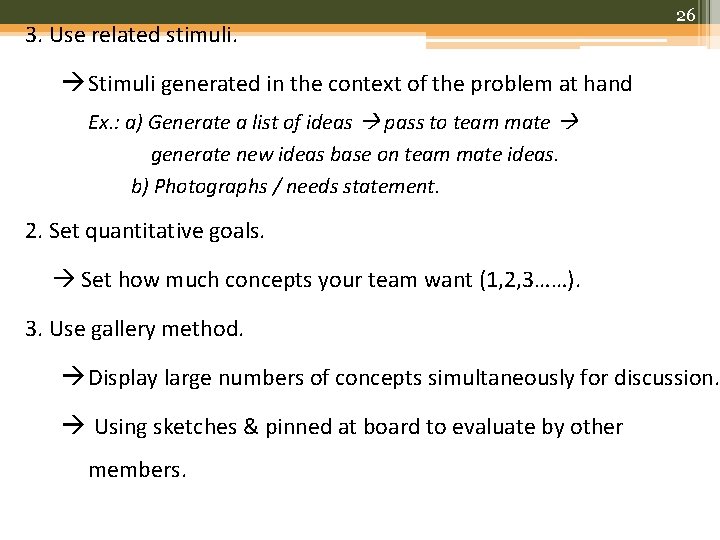
3. Use related stimuli. 26 Stimuli generated in the context of the problem at hand Ex. : a) Generate a list of ideas pass to team mate generate new ideas base on team mate ideas. b) Photographs / needs statement. 2. Set quantitative goals. Set how much concepts your team want (1, 2, 3……). 3. Use gallery method. Display large numbers of concepts simultaneously for discussion. Using sketches & pinned at board to evaluate by other members.
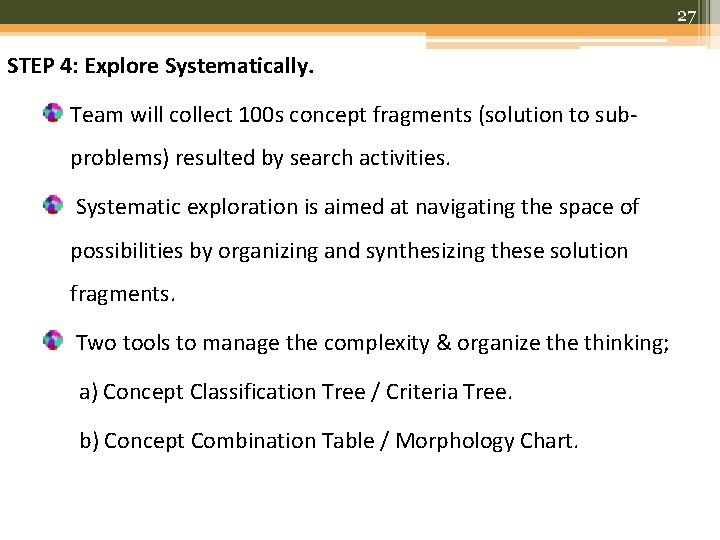
27 STEP 4: Explore Systematically. Team will collect 100 s concept fragments (solution to subproblems) resulted by search activities. Systematic exploration is aimed at navigating the space of possibilities by organizing and synthesizing these solution fragments. Two tools to manage the complexity & organize thinking; a) Concept Classification Tree / Criteria Tree. b) Concept Combination Table / Morphology Chart.

28 Concept Combination Table / Morphology Chart. A way to consider combinations of solution fragments systematically. The columns of the table correspond to the sub problems previously identified and the entries in each column correspond to the solution fragments for each of these sub-problems derived from external and internal search. Potential solutions to the overall problem are formed by combining one fragment from each column. The various combinations must usually be developed and refined before an integrated solution emerges.
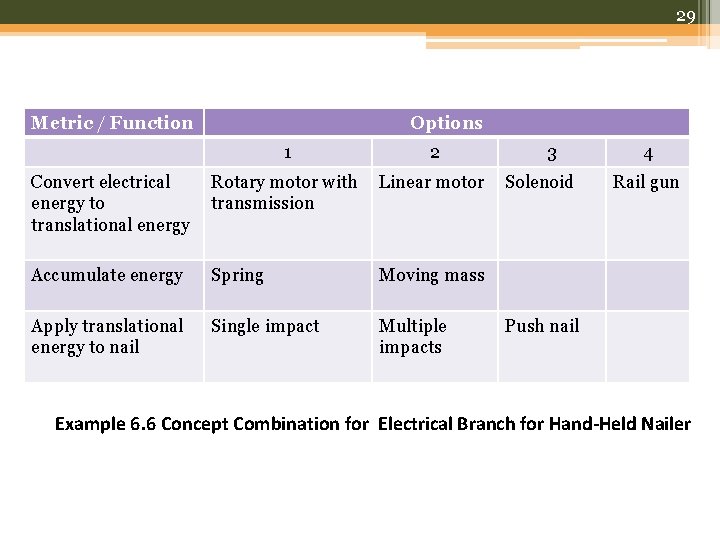
29 Metric / Function Options 1 2 Convert electrical energy to translational energy Rotary motor with transmission Linear motor Accumulate energy Spring Moving mass Apply translational energy to nail Single impact Multiple impacts 3 Solenoid 4 Rail gun Push nail Example 6. 6 Concept Combination for Electrical Branch for Hand-Held Nailer
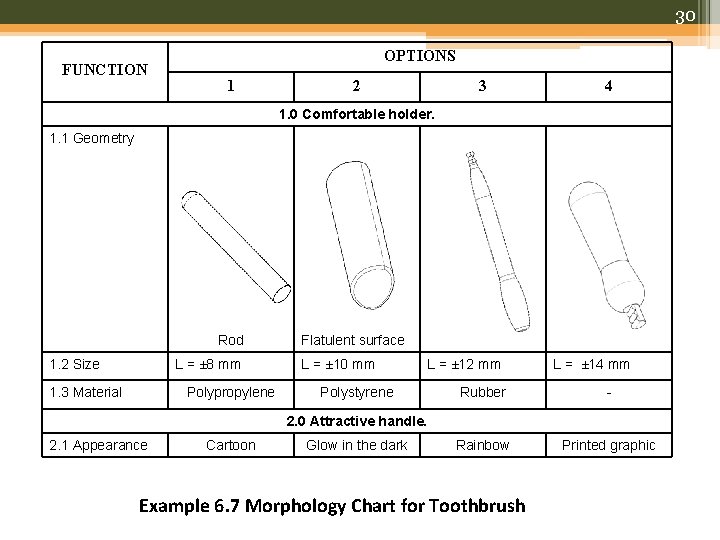
30 FUNCTION OPTIONS 1 2 3 4 1. 0 Comfortable holder. 1. 1 Geometry Rod 1. 2 Size L = ± 8 mm 1. 3 Material Polypropylene Flatulent surface L = ± 10 mm L = ± 12 mm Polystyrene L = ± 14 mm Rubber - Rainbow Printed graphic 2. 0 Attractive handle. 2. 1 Appearance Cartoon Glow in the dark Example 6. 7 Morphology Chart for Toothbrush
31 Two guidelines make the concept combination process easier: a) If a fragment can be eliminated as being infeasible before combining it with other fragments, then the number of combinations the team needs to consider may be dramatically reduced. Ex. : Rail gun not uce the combination number.
32 b) The concept combination table should be concentrated on the sub-problems that are coupled. Coupled sub-problems are those whose solutions can only really be evaluated in combination with the solutions to other sub-problems. Ex. : If choose solenoid for ‘convert electrical energy’ segment, is it suit with battery for ‘electric energy source’ segment? The use of concept combination tables not so helpful when the number of columns exceeds about four.
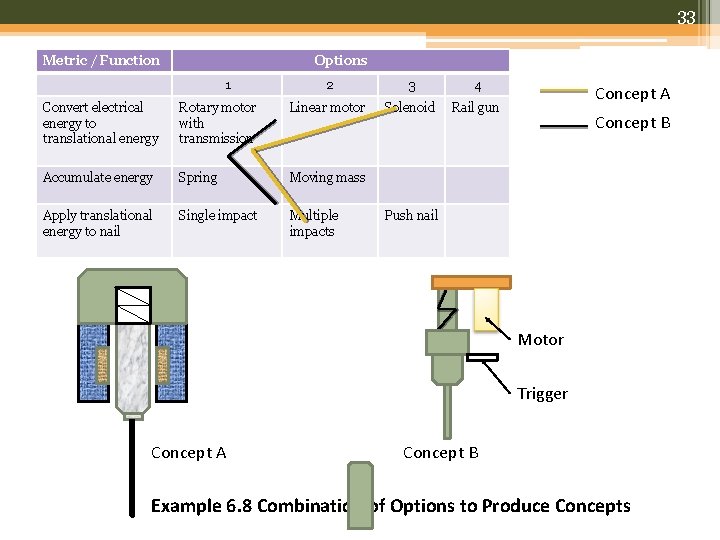
33 Metric / Function Options 1 2 3 4 Solenoid Rail gun Convert electrical energy to translational energy Rotary motor with transmission Linear motor Accumulate energy Spring Moving mass Apply translational energy to nail Single impact Multiple impacts Concept A Concept B Push nail Motor Trigger Concept A Concept B Example 6. 8 Combination of Options to Produce Concepts
34 STEP 5 : Reflect on Result & Process. Questions to ask include: 1. Is the team developing confidence that the solution space has been fully explored? 2. Have ideas from everyone been accepted and integrated in the process? 3. Are there alternative ways to decompose the problem? 4. Have external sources been completely pursued? 5. Are there alternative function diagrams?

35 THANK YOU…
- Slides: 35