
1 BEYOND ART THEORIES 2 Institutional Theory of
1 BEYOND ART THEORIES

2 Institutional Theory of Art An institutional theory of art, the approach held predominantly by an American philosopher George Dickie (1926) Widely criticized and ridiculed → the mockery is not in the place: theory is usually interpreted too narrowly The Artworld IT identified with the version from the book Art and the Aesthetic: An Institutional Analysis (1974) → institutional analysis (name)
3 IT: not only one version but several articles on this topic, without a consistent terminology One cannot identify IT with just one text Two versions of Dickie's theory: original vs revisited one Dickie: Art and Value a chapter devoted to the historical development of IT: 1) Former (original) version: 1969 -1974 (1976) 2) Later (revisited): 1984 (The Art Circle) The former version does not correspond to one text: 1969; 1971; 1974; (1976)
4 A work of art in the classificatory sense is (1) an artifact (2) a set of the aspects of which has had conferred upon it the status of candidate for appreciation by some person or persons acting on behalf of a certain social institution (the artworld). Definition: As a whole → singular conditions: Two defining conditions, but the second one consist of four parts 1) vs CD) Artefact = something manmade (understandable) (piece of music
5 The later version of the definition, The Art Circle (1984), about 100 pages; circulatiry 1) Definition as a whole 2) Examination of particular conditions, explanation of their meaning/ comparison with the former version
6 1984 An artist is a person who participates with understanding the making of a work of art. A work of art is an artifact of a kind created to be presented to an artworld public. A public is a set of persons the members of which are prepared in some degree to understand an object which is presented to them. The artworld is the totality of all artworld systems. An artworld system is a framework for the presentation of a work of art by an artist to an artworld public.
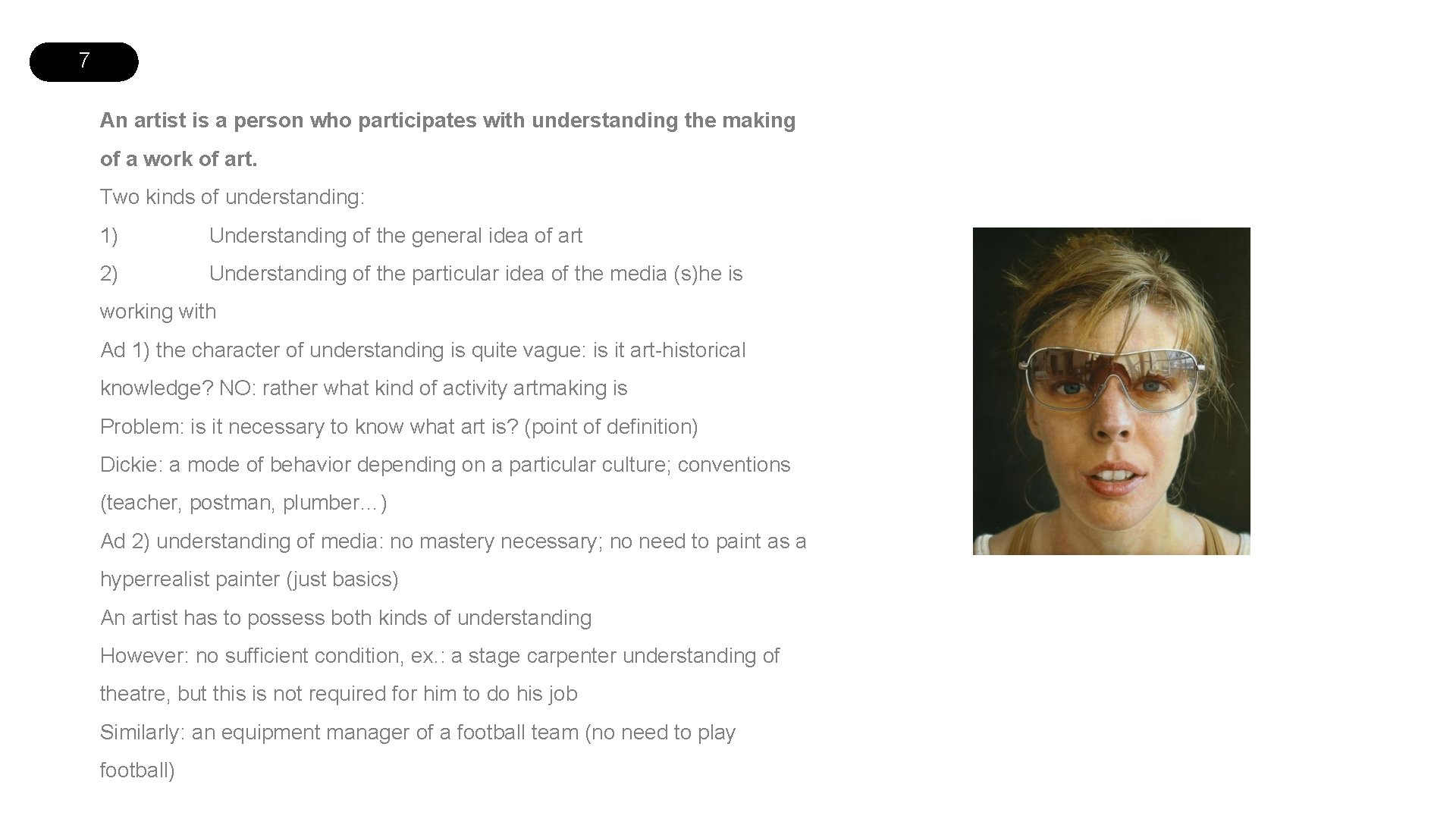
7 An artist is a person who participates with understanding the making of a work of art. Two kinds of understanding: 1) Understanding of the general idea of art 2) Understanding of the particular idea of the media (s)he is working with Ad 1) the character of understanding is quite vague: is it art-historical knowledge? NO: rather what kind of activity artmaking is Problem: is it necessary to know what art is? (point of definition) Dickie: a mode of behavior depending on a particular culture; conventions (teacher, postman, plumber…) Ad 2) understanding of media: no mastery necessary; no need to paint as a hyperrealist painter (just basics) An artist has to possess both kinds of understanding However: no sufficient condition, ex. : a stage carpenter understanding of theatre, but this is not required for him to do his job Similarly: an equipment manager of a football team (no need to play football)
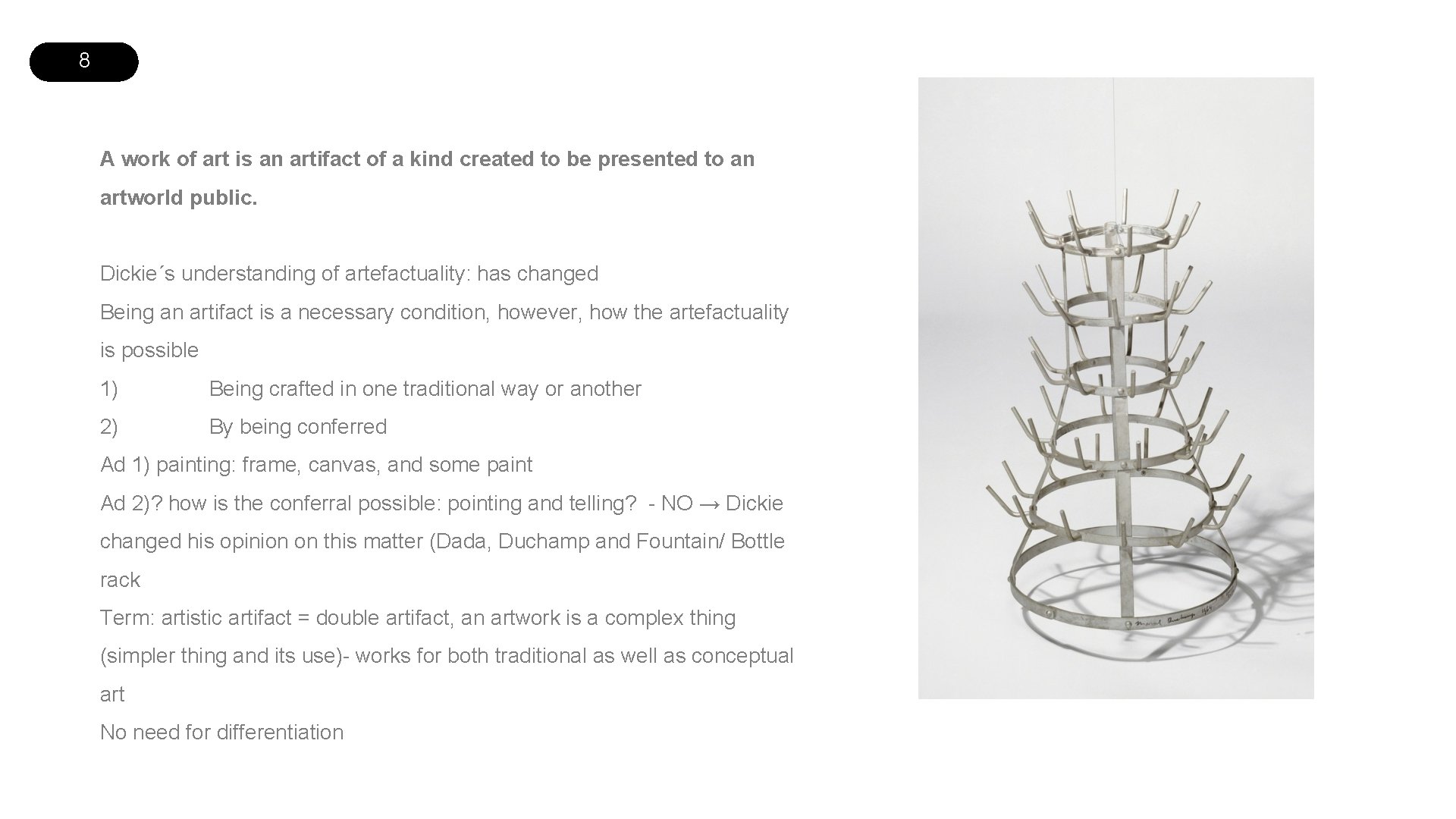
8 A work of art is an artifact of a kind created to be presented to an artworld public. Dickie´s understanding of artefactuality: has changed Being an artifact is a necessary condition, however, how the artefactuality is possible 1) Being crafted in one traditional way or another 2) By being conferred Ad 1) painting: frame, canvas, and some paint Ad 2)? how is the conferral possible: pointing and telling? - NO → Dickie changed his opinion on this matter (Dada, Duchamp and Fountain/ Bottle rack Term: artistic artifact = double artifact, an artwork is a complex thing (simpler thing and its use)- works for both traditional as well as conceptual art No need for differentiation
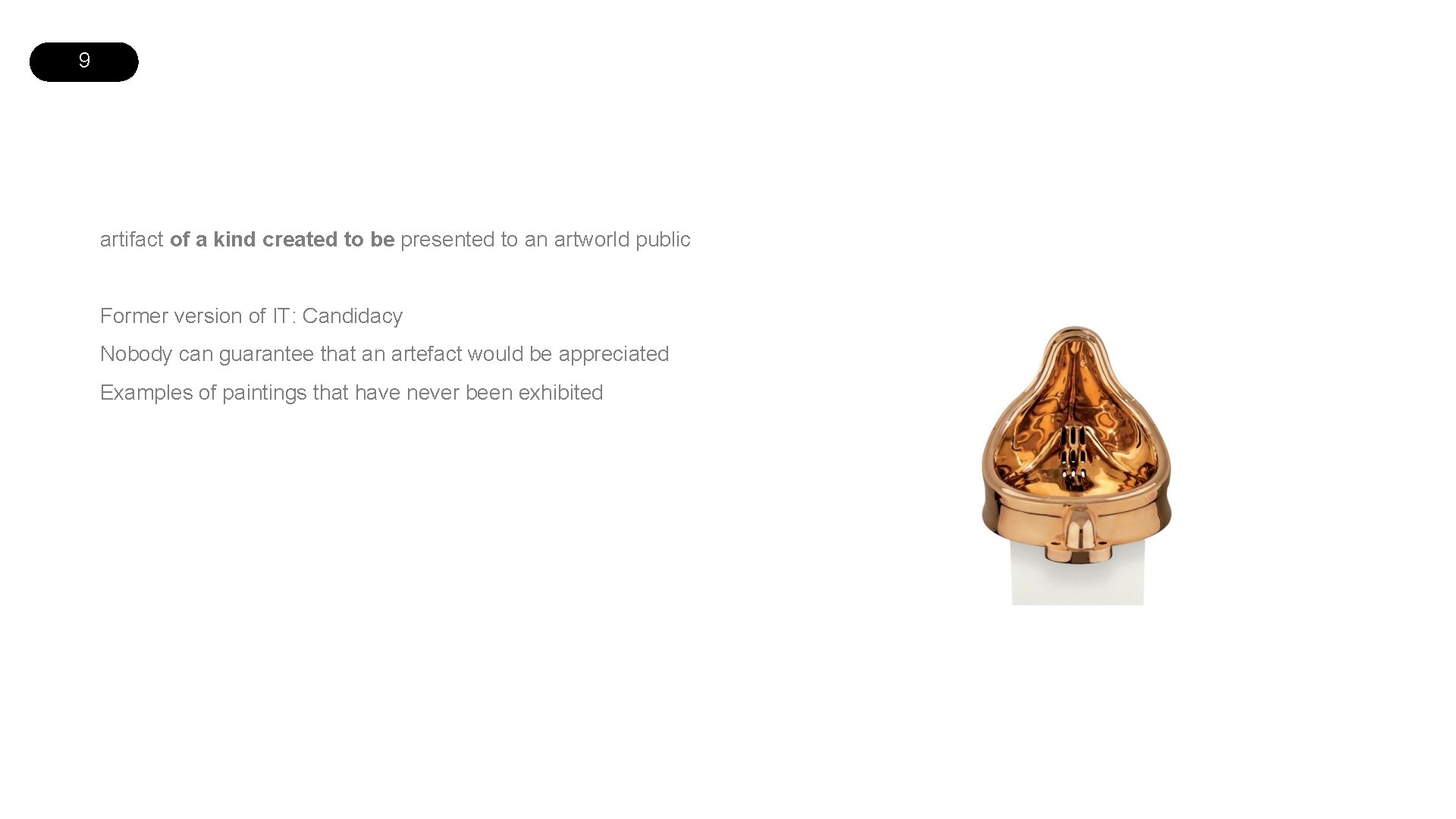
9 artifact of a kind created to be presented to an artworld public Former version of IT: Candidacy Nobody can guarantee that an artefact would be appreciated Examples of paintings that have never been exhibited
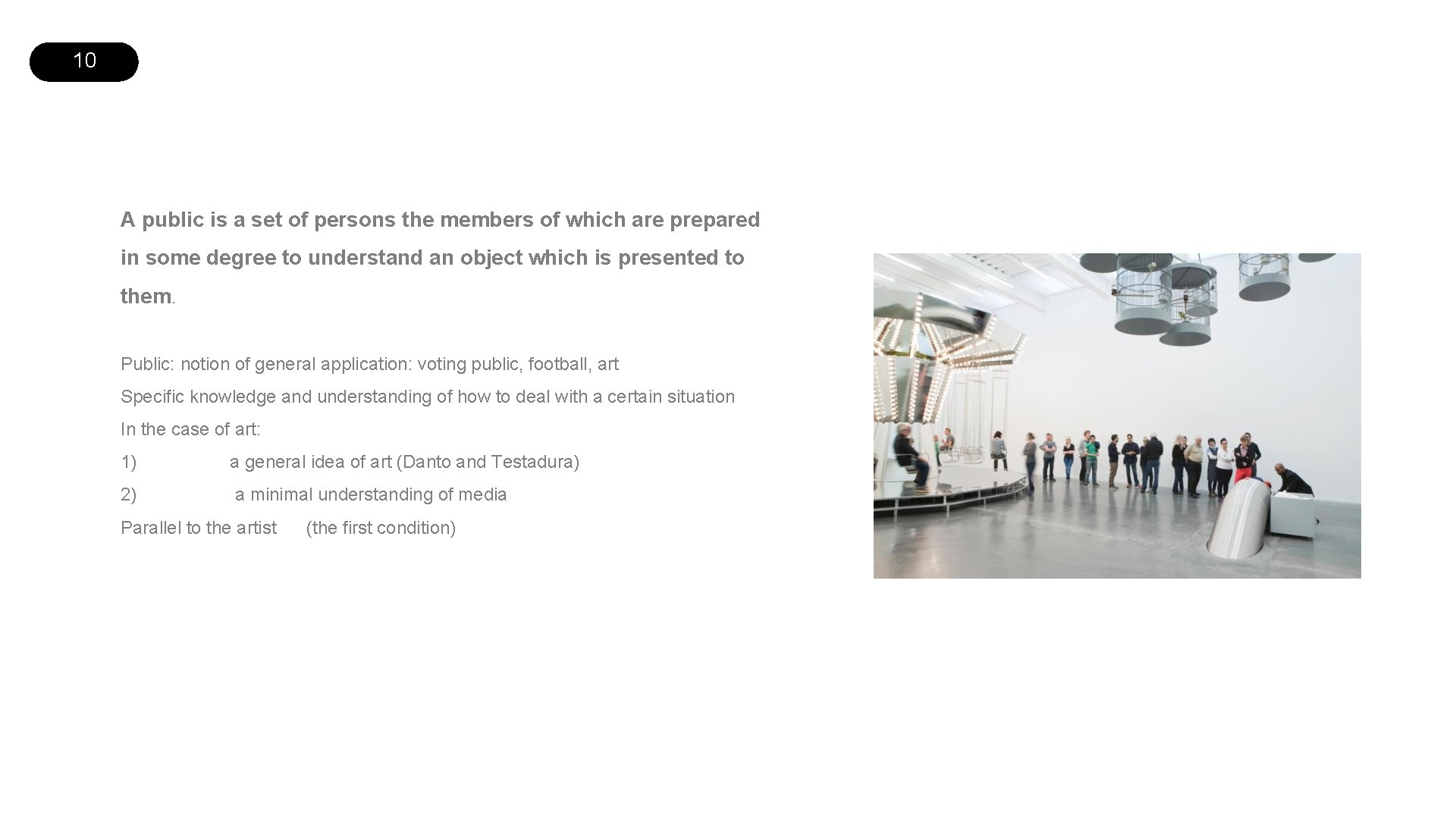
10 A public is a set of persons the members of which are prepared in some degree to understand an object which is presented to them. Public: notion of general application: voting public, football, art Specific knowledge and understanding of how to deal with a certain situation In the case of art: 1) a general idea of art (Danto and Testadura) 2) a minimal understanding of media Parallel to the artist (the first condition)
11 The artworld is the totality of all artworld systems. The former version of IT: The distinction between different artworld systems: example theatre: each system has its own origin and historical development; they have something in common: they are frameworks for the presentation of artworks Isolation vs possible connection; totality Relationships are somewhat arbitrary: depend on the historical development of a particular culture Particular genres and styles are cultural constructs: challenging to reveal a common denominator Advantage of IT: tailormade for this situation Compatible with the historical development of a given society
12 An artworld system is a framework for the presentation of a work of art by an artist to an artworld public. This defining condition significantly differs from the previous ones: Dickie treats it differently Previous cases: an explanation of singular terms involved in the condition Here: the structure of the definition Logical consequence. The last condition consists of terms that have already been defined Linear descending: next slide The last condition: circularity
13 1984 An artist s a person who participates with understanding the making of a work of art. A work of art is an artifact of a kind created to be presented to an artworld public. A public is a set of persons the members of which are prepared in some degree to understand an object which is presented to them. The artworld is the totality of all artworld systems. An artworld system is a framework for the presentation of a work of art by an artist to an artworld public.
14 Circularity as a philosophical mistake: No: an informative circle (former version of IT) Now: the circularity is a necessary consequence of the character of phenomena as art Artist, work of art, artworld, and artworld system are what I shall call “inflected concept” to designate a concept which is a member of a set of concepts which bend in on themselves, presupposing and supporting one another. No member of such a set can be understood apart from all the other concepts in the set. Consequently, in coming to understand a concept which is a member of such set, one must in some degree come to understand all the other member concepts as well. There are, I suspect, other sets of inflected concepts: law, legislature, executive, and judiciary, for example. (pp. 84)
15 Former vs. later version of IT Understanding vs. appreciation Formal vs. less formal language (informal institution, conferral) Artifact Inflected nature of art
16 A possible criticism of IT Art outside the institutional context: the argument of an isolated artist (Beardsley) (in)formal institution (Beardsley, Wieand) Rules and reasons, authority (Davies, Wollheim)
17 Thank you! See you next time!
- Slides: 17