
1 BEYOND ART THEORIES 2 Arthur C Danto
1 BEYOND ART THEORIES
2 Arthur C. Danto (1924 -2013) The structure of the lecture. 1) Summary 2) Essentialism vs. historicism 3) Danto´s real definition (After the End of Art) 4) Revision of the definition (What Art Is) 5) My interpretation of the development of Danto´s thoughts (my hypothesis)
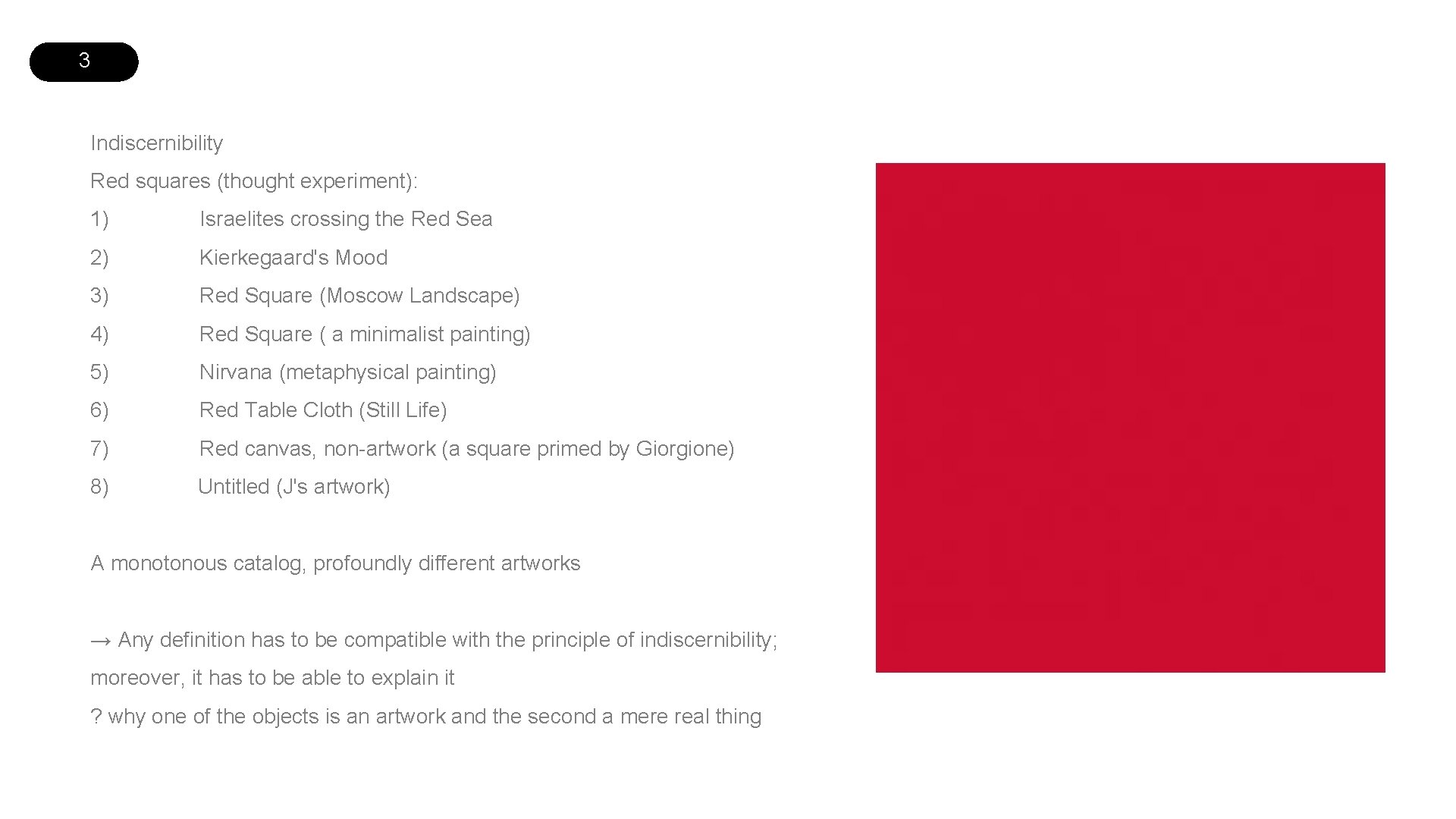
3 Indiscernibility Red squares (thought experiment): 1) Israelites crossing the Red Sea 2) Kierkegaard's Mood 3) Red Square (Moscow Landscape) 4) Red Square ( a minimalist painting) 5) Nirvana (metaphysical painting) 6) Red Table Cloth (Still Life) 7) Red canvas, non-artwork (a square primed by Giorgione) 8) Untitled (J's artwork) A monotonous catalog, profoundly different artworks → Any definition has to be compatible with the principle of indiscernibility; moreover, it has to be able to explain it ? why one of the objects is an artwork and the second a mere real thing
4 Representation and Aboutness Return to the general question about the relationship between art and reality two meanings of the term appearance as follows: "according to the first of which the thing itself appears, say as the Evening Star appears in the sky; …and according to the second of which we indeed contrast the appearance with reality. „ Appearance = Danto's understanding of representation Appear as be something (the first) Appear as seems to be something (the second) Art is thus representation in the second sense; it means it is about something (red squares)
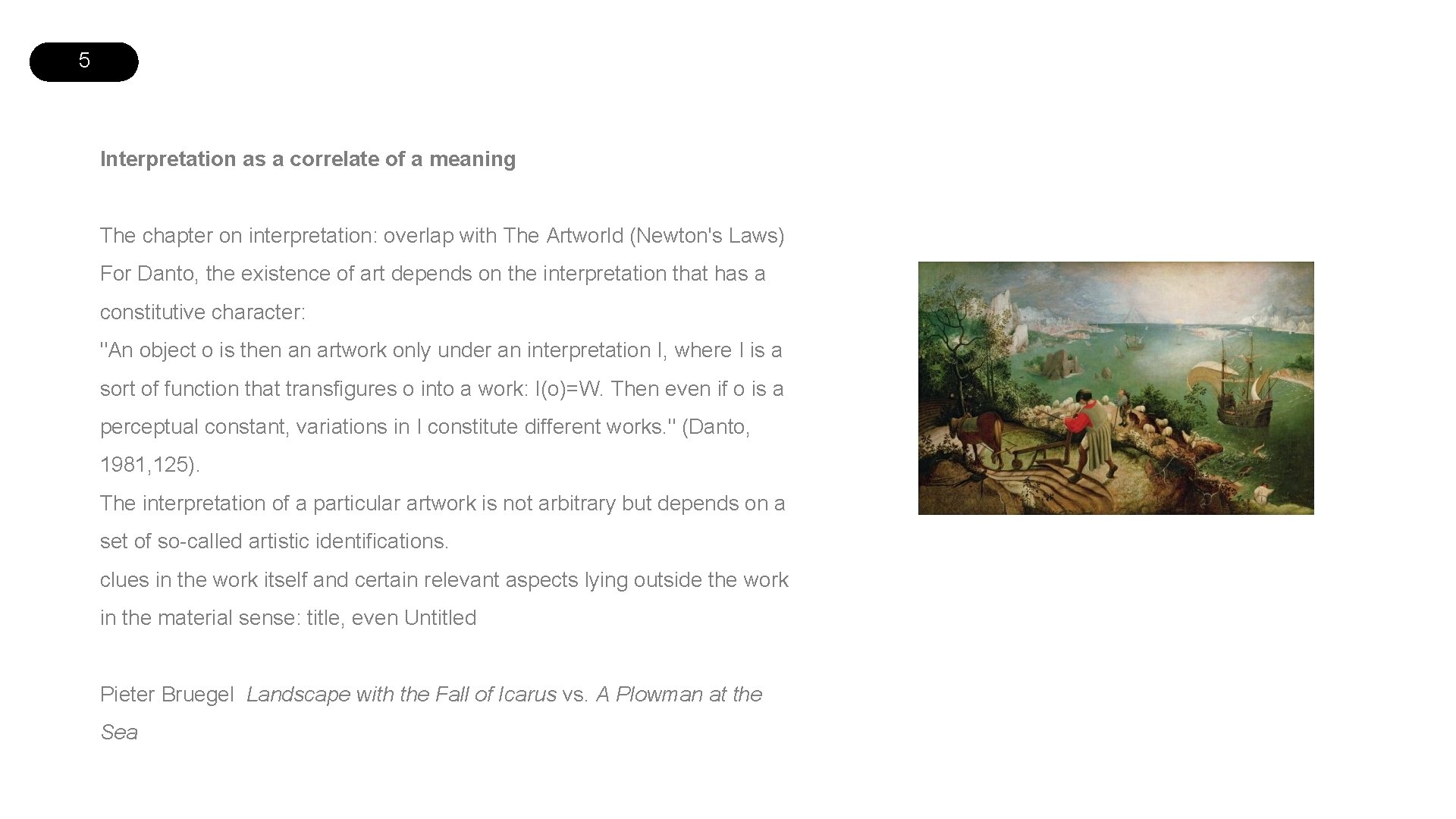
5 Interpretation as a correlate of a meaning The chapter on interpretation: overlap with The Artworld (Newton's Laws) For Danto, the existence of art depends on the interpretation that has a constitutive character: "An object o is then an artwork only under an interpretation I, where I is a sort of function that transfigures o into a work: I(o)=W. Then even if o is a perceptual constant, variations in I constitute different works. " (Danto, 1981, 125). The interpretation of a particular artwork is not arbitrary but depends on a set of so-called artistic identifications. clues in the work itself and certain relevant aspects lying outside the work in the material sense: title, even Untitled Pieter Bruegel Landscape with the Fall of Icarus vs. A Plowman at the Sea
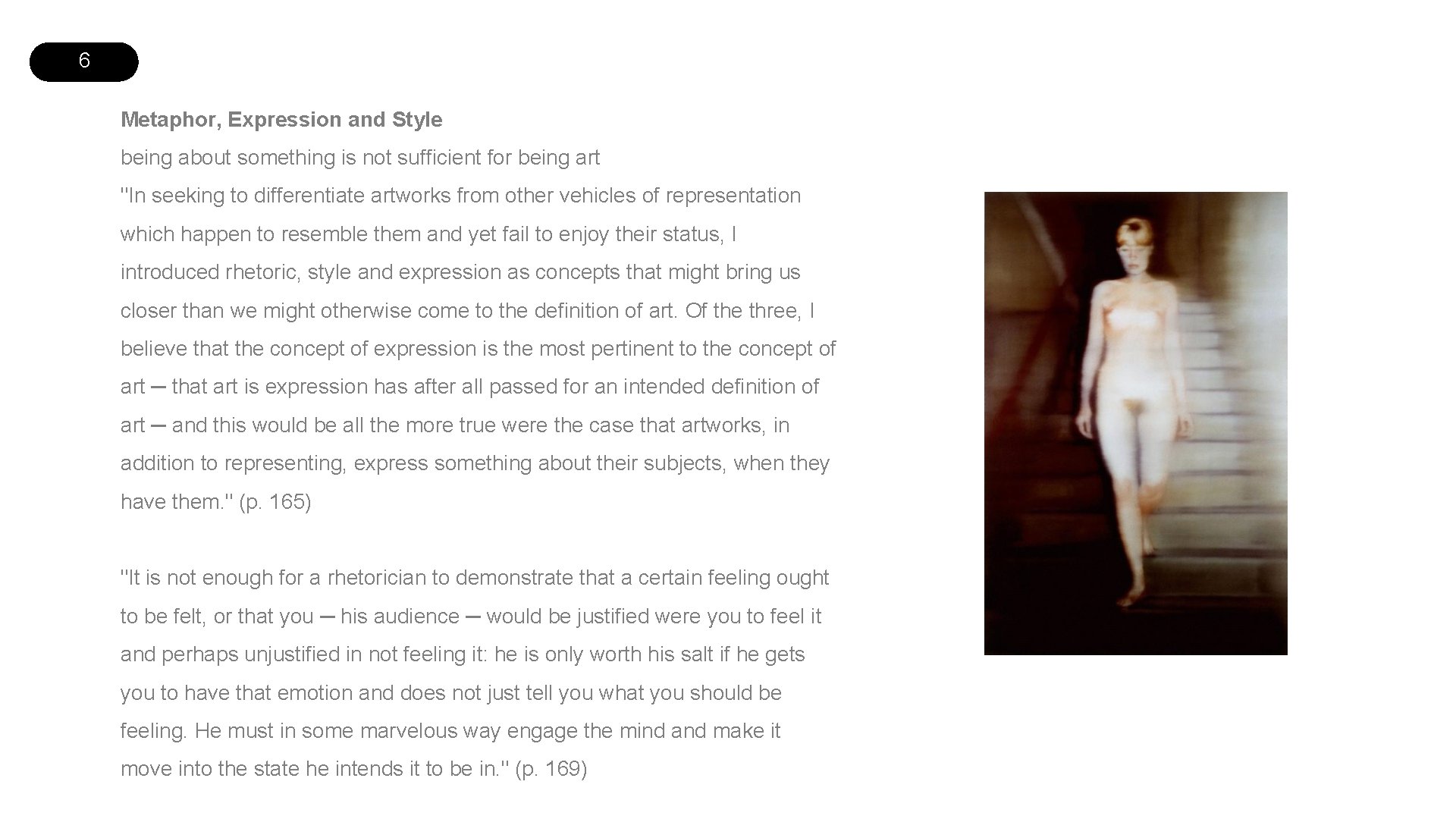
6 Metaphor, Expression and Style being about something is not sufficient for being art "In seeking to differentiate artworks from other vehicles of representation which happen to resemble them and yet fail to enjoy their status, I introduced rhetoric, style and expression as concepts that might bring us closer than we might otherwise come to the definition of art. Of the three, I believe that the concept of expression is the most pertinent to the concept of art ─ that art is expression has after all passed for an intended definition of art ─ and this would be all the more true were the case that artworks, in addition to representing, express something about their subjects, when they have them. " (p. 165) "It is not enough for a rhetorician to demonstrate that a certain feeling ought to be felt, or that you ─ his audience ─ would be justified were you to feel it and perhaps unjustified in not feeling it: he is only worth his salt if he gets you to have that emotion and does not just tell you what you should be feeling. He must in some marvelous way engage the mind and make it move into the state he intends it to be in. " (p. 169)
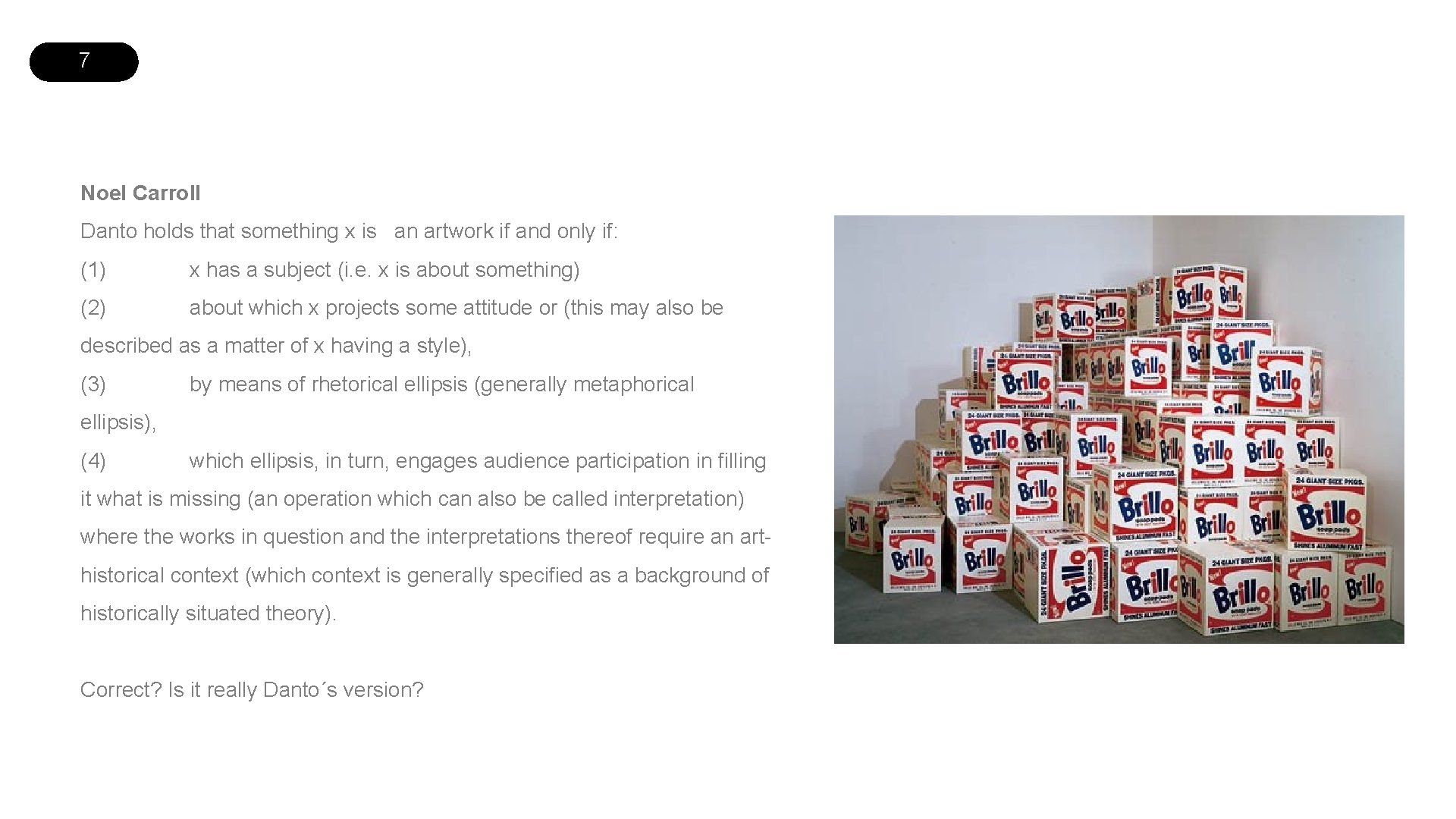
7 Noel Carroll Danto holds that something x is an artwork if and only if: (1) x has a subject (i. e. x is about something) (2) about which x projects some attitude or (this may also be described as a matter of x having a style), (3) by means of rhetorical ellipsis (generally metaphorical ellipsis), (4) which ellipsis, in turn, engages audience participation in filling it what is missing (an operation which can also be called interpretation) where the works in question and the interpretations thereof require an arthistorical context (which context is generally specified as a background of historically situated theory). Correct? Is it really Danto´s version?
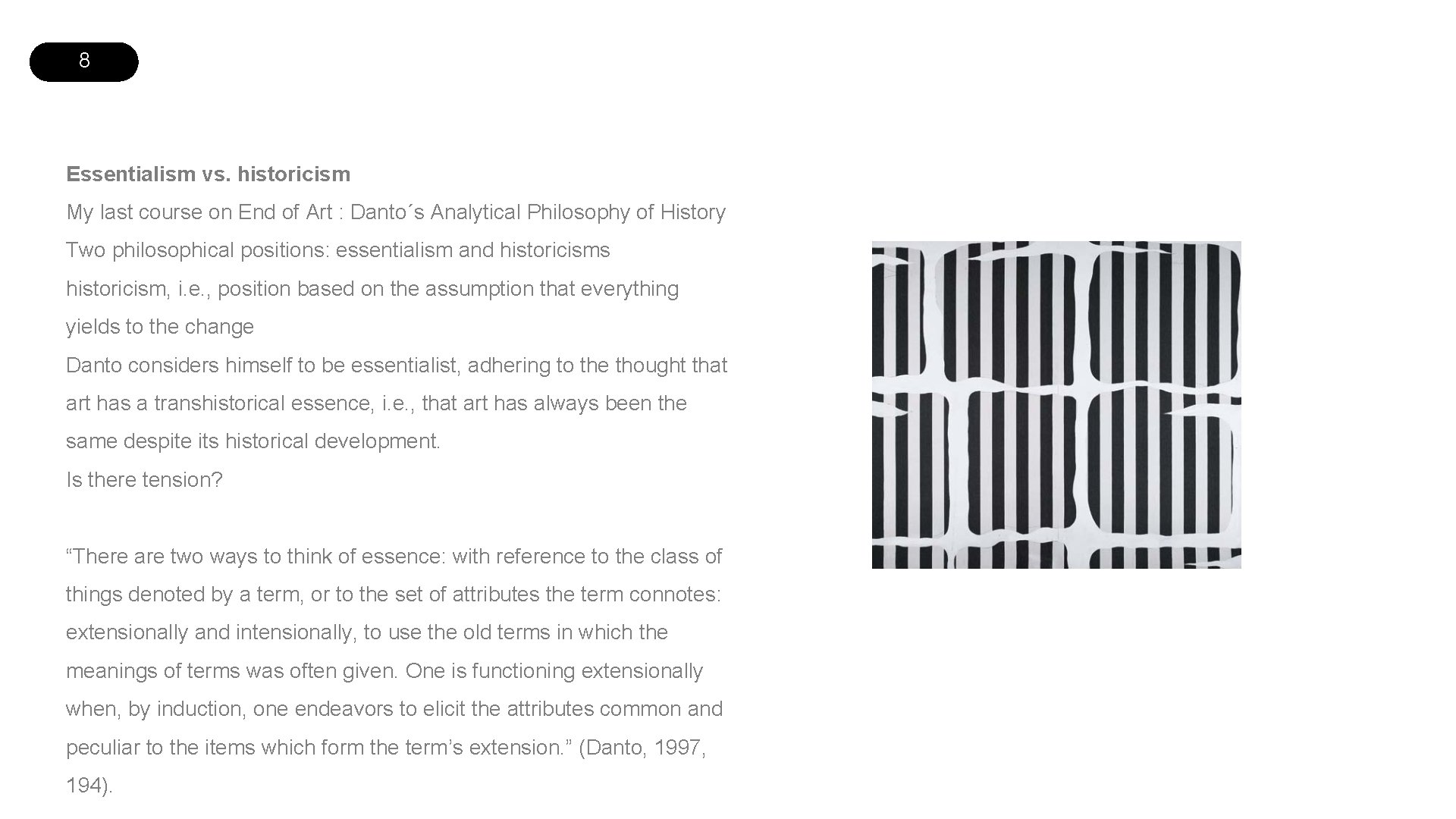
8 Essentialism vs. historicism My last course on End of Art : Danto´s Analytical Philosophy of History Two philosophical positions: essentialism and historicisms historicism, i. e. , position based on the assumption that everything yields to the change Danto considers himself to be essentialist, adhering to the thought that art has a transhistorical essence, i. e. , that art has always been the same despite its historical development. Is there tension? “There are two ways to think of essence: with reference to the class of things denoted by a term, or to the set of attributes the term connotes: extensionally and intensionally, to use the old terms in which the meanings of terms was often given. One is functioning extensionally when, by induction, one endeavors to elicit the attributes common and peculiar to the items which form the term’s extension. ” (Danto, 1997, 194).
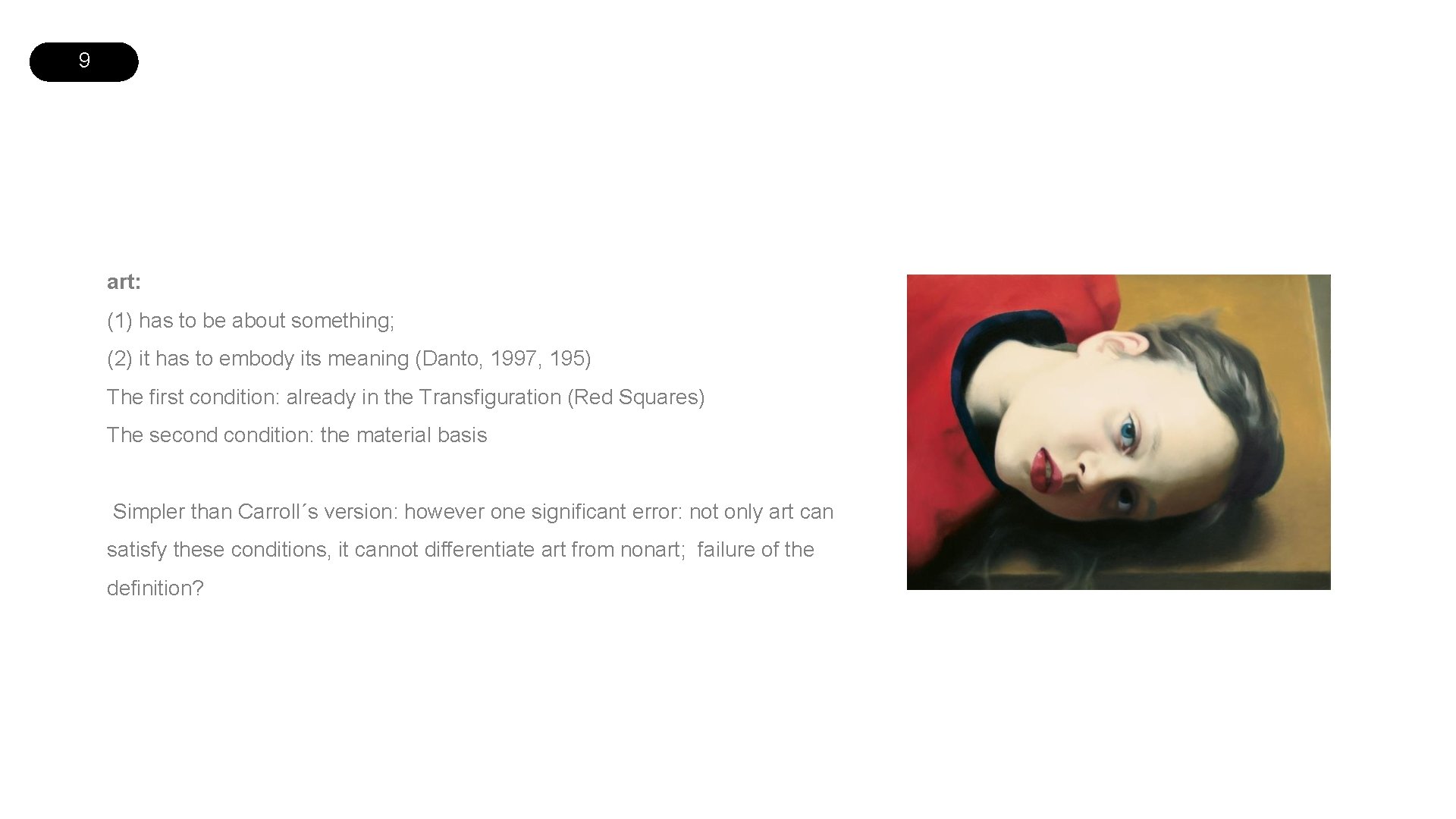
9 art: (1) has to be about something; (2) it has to embody its meaning (Danto, 1997, 195) The first condition: already in the Transfiguration (Red Squares) The secondition: the material basis Simpler than Carroll´s version: however one significant error: not only art can satisfy these conditions, it cannot differentiate art from nonart; failure of the definition?
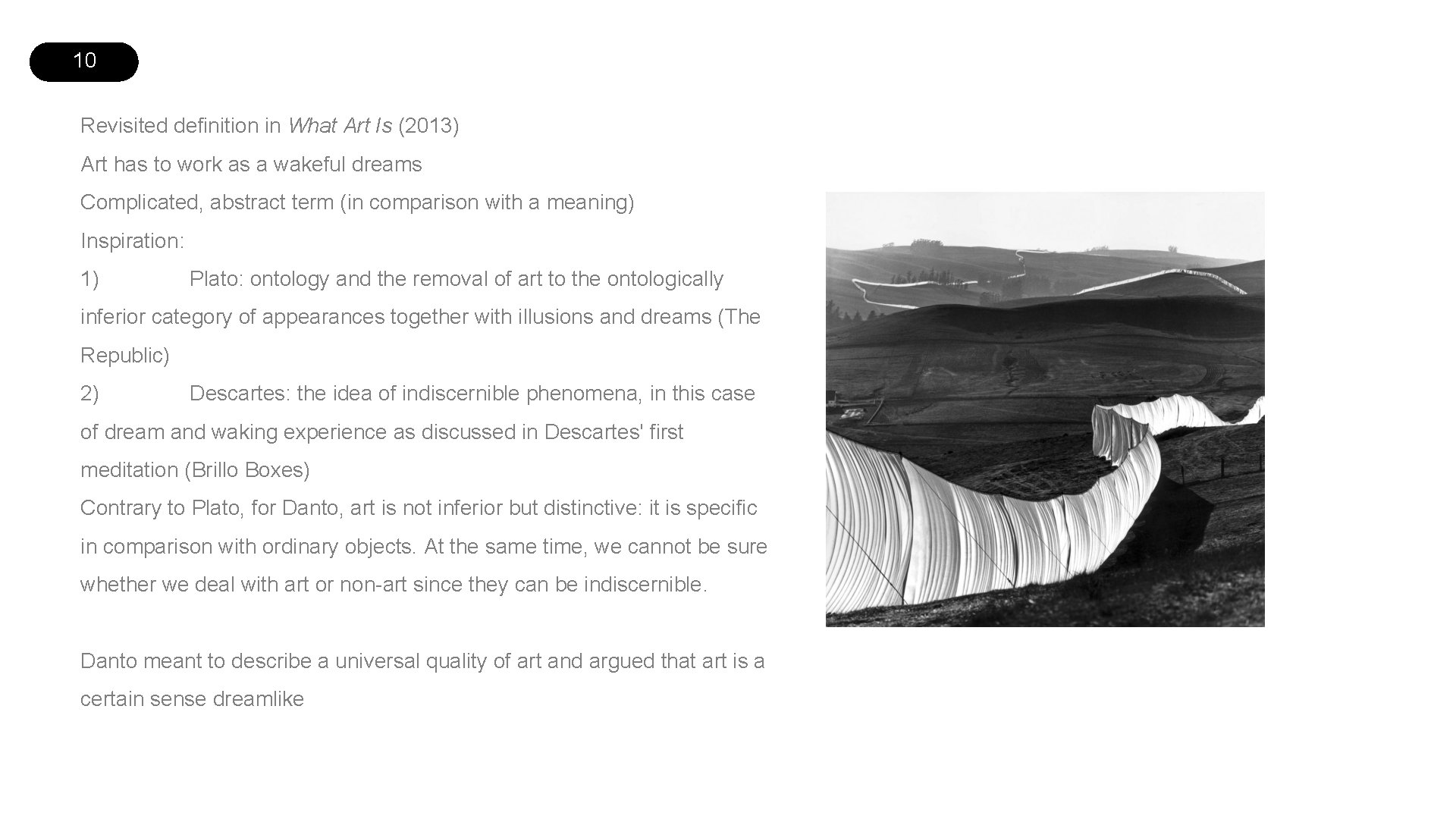
10 Revisited definition in What Art Is (2013) Art has to work as a wakeful dreams Complicated, abstract term (in comparison with a meaning) Inspiration: 1) Plato: ontology and the removal of art to the ontologically inferior category of appearances together with illusions and dreams (The Republic) 2) Descartes: the idea of indiscernible phenomena, in this case of dream and waking experience as discussed in Descartes' first meditation (Brillo Boxes) Contrary to Plato, for Danto, art is not inferior but distinctive: it is specific in comparison with ordinary objects. At the same time, we cannot be sure whether we deal with art or non-art since they can be indiscernible. Danto meant to describe a universal quality of art and argued that art is a certain sense dreamlike
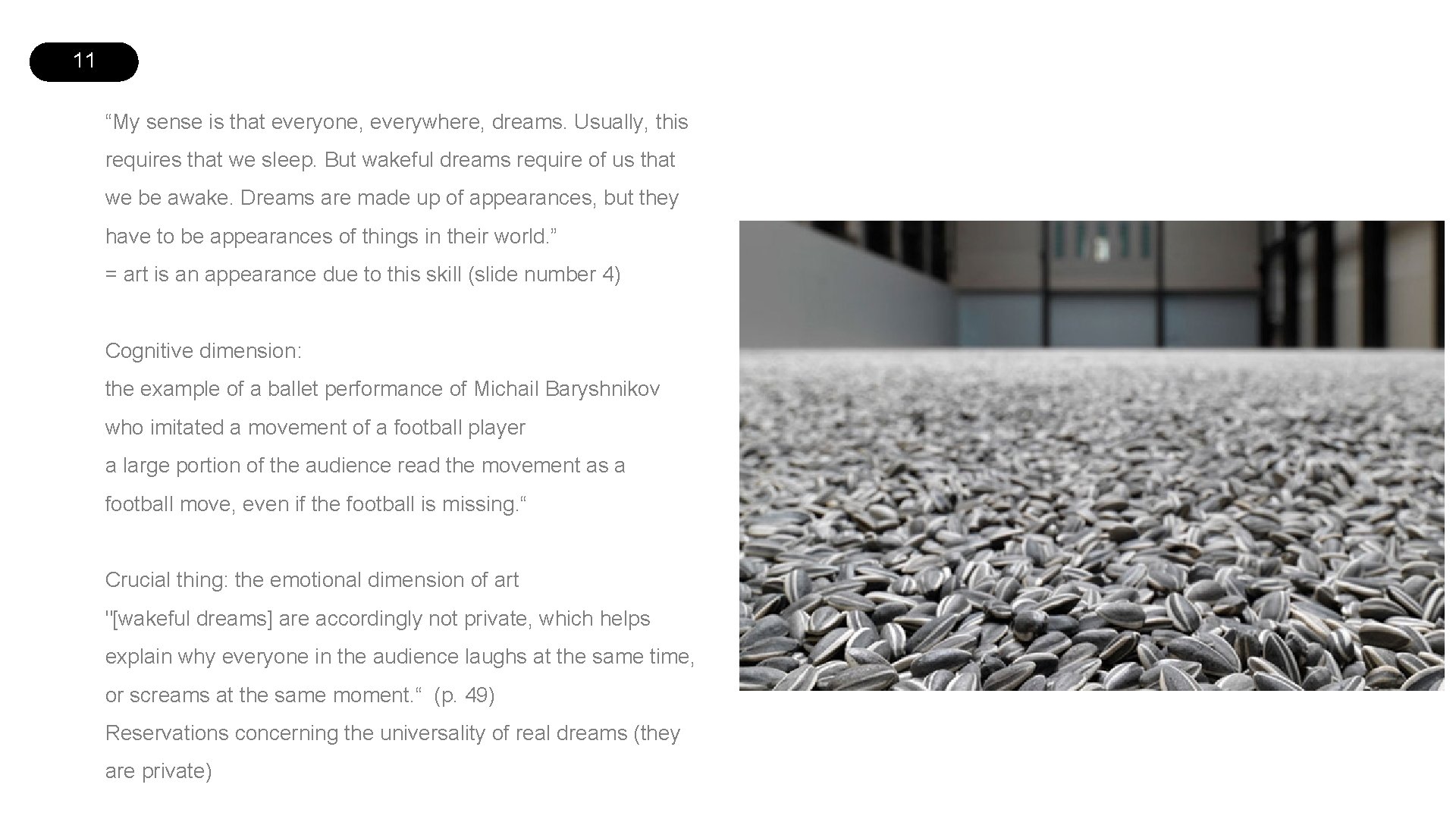
11 “My sense is that everyone, everywhere, dreams. Usually, this requires that we sleep. But wakeful dreams require of us that we be awake. Dreams are made up of appearances, but they have to be appearances of things in their world. ” = art is an appearance due to this skill (slide number 4) Cognitive dimension: the example of a ballet performance of Michail Baryshnikov who imitated a movement of a football player a large portion of the audience read the movement as a football move, even if the football is missing. “ Crucial thing: the emotional dimension of art "[wakeful dreams] are accordingly not private, which helps explain why everyone in the audience laughs at the same time, or screams at the same moment. “ (p. 49) Reservations concerning the universality of real dreams (they are private)
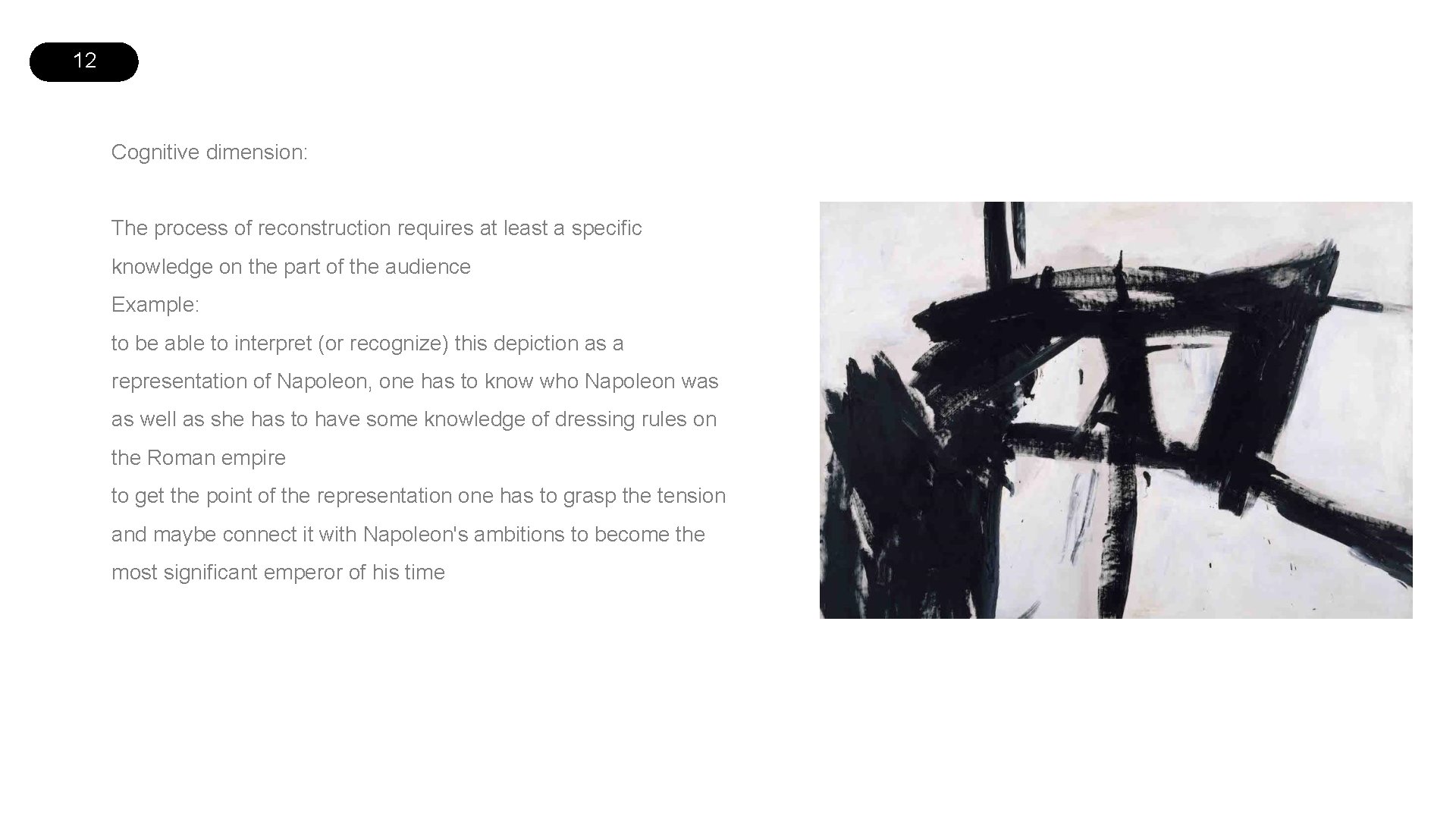
12 Cognitive dimension: The process of reconstruction requires at least a specific knowledge on the part of the audience Example: to be able to interpret (or recognize) this depiction as a representation of Napoleon, one has to know who Napoleon was as well as she has to have some knowledge of dressing rules on the Roman empire to get the point of the representation one has to grasp the tension and maybe connect it with Napoleon's ambitions to become the most significant emperor of his time
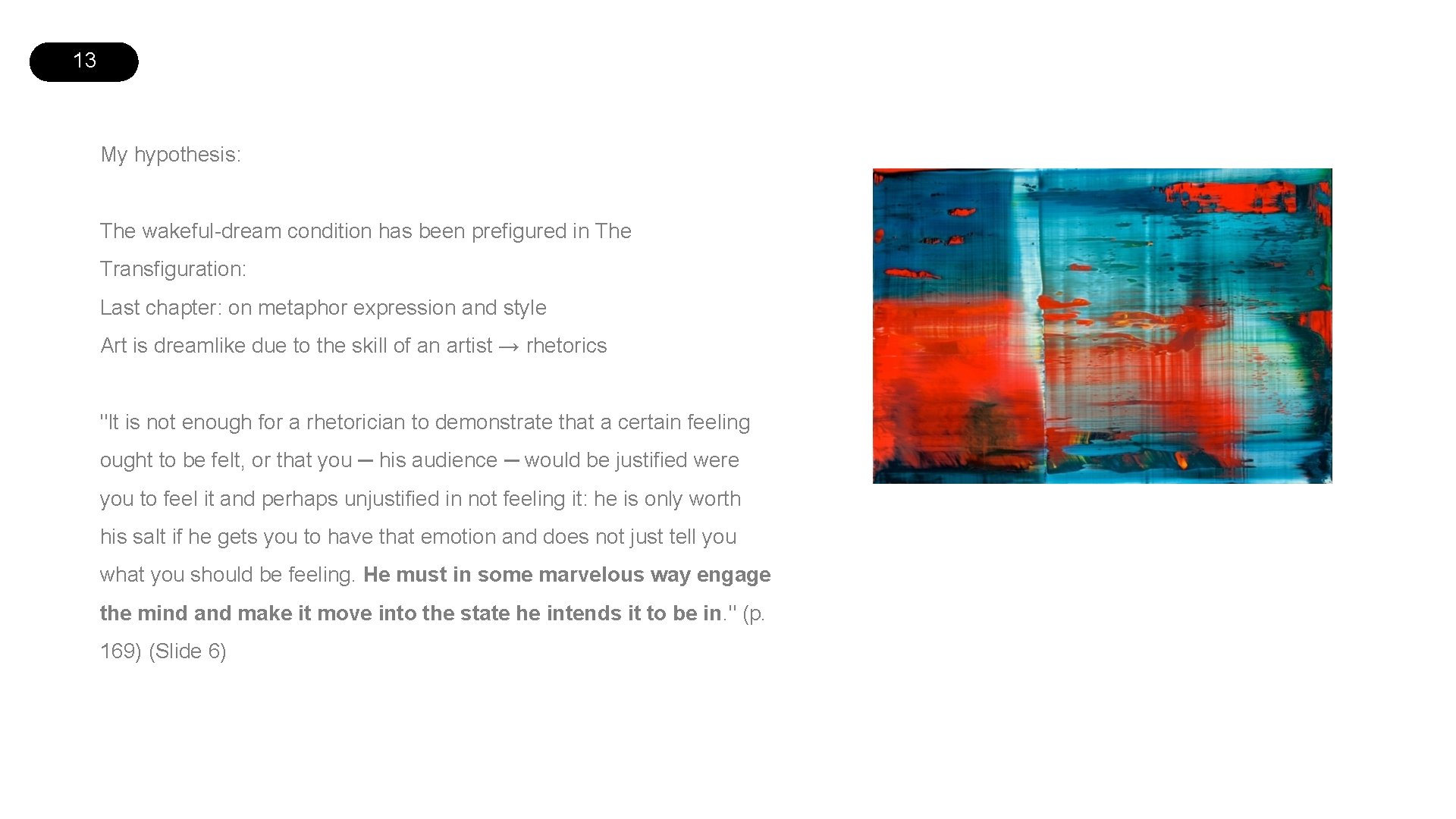
13 My hypothesis: The wakeful-dream condition has been prefigured in The Transfiguration: Last chapter: on metaphor expression and style Art is dreamlike due to the skill of an artist → rhetorics "It is not enough for a rhetorician to demonstrate that a certain feeling ought to be felt, or that you ─ his audience ─ would be justified were you to feel it and perhaps unjustified in not feeling it: he is only worth his salt if he gets you to have that emotion and does not just tell you what you should be feeling. He must in some marvelous way engage the mind and make it move into the state he intends it to be in. " (p. 169) (Slide 6)
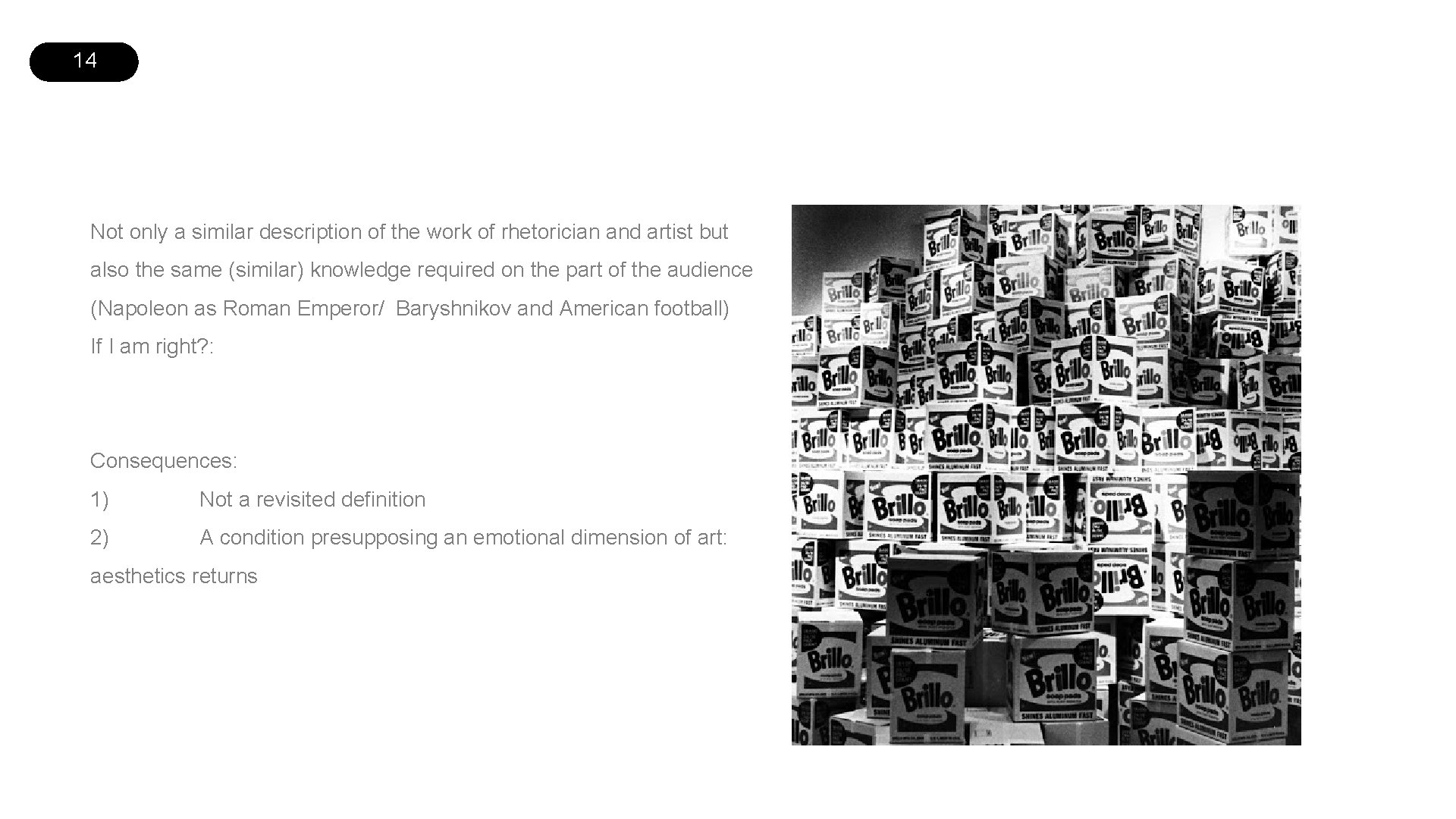
14 Not only a similar description of the work of rhetorician and artist but also the same (similar) knowledge required on the part of the audience (Napoleon as Roman Emperor/ Baryshnikov and American football) If I am right? : Consequences: 1) Not a revisited definition 2) A condition presupposing an emotional dimension of art: aesthetics returns
15 Thank you! See you next time!
- Slides: 15