
1 Associative Memory A Spiking Neural Network Robotic
1 Associative Memory: A Spiking Neural Network Robotic Implementation André Cyr, Frédéric Thériault, Matt Ross, Sylvain Chartier
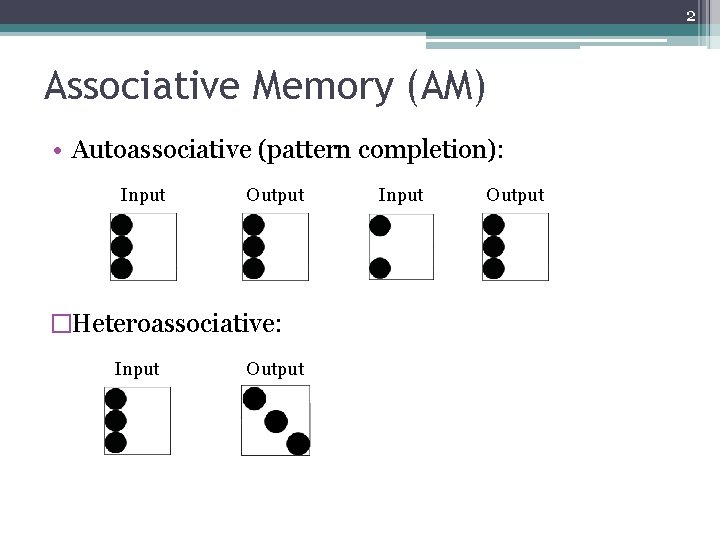
2 Associative Memory (AM) • Autoassociative (pattern completion): Input Output �Heteroassociative: Input Output

3 Associative Memory (AM) Cont. • AM usually refers to complex brain structures [1, 2]. • Generally modeled at the phenomenological level. • Why model at all? ▫ Cognitive economy for natural or artificial agents [3]. • Artificial Neural Network approach ▫ SOM maps, especially for robotic navigation [4, 5]
4 Spiking Neural Network (SNN) Model • Addition of a temporal dimension for encoding information. • Has become another approach to modeling the AM phenomenon [6, 7, 8]. • Current objective: Create a simple embodied bioinspired mechanism for the AM model, by exploiting the inherent computational and temporal features of a SNN model. Analytical description of neuronal spike model dynamics can be found at: http: //aifuture. com/res/2018 -am/
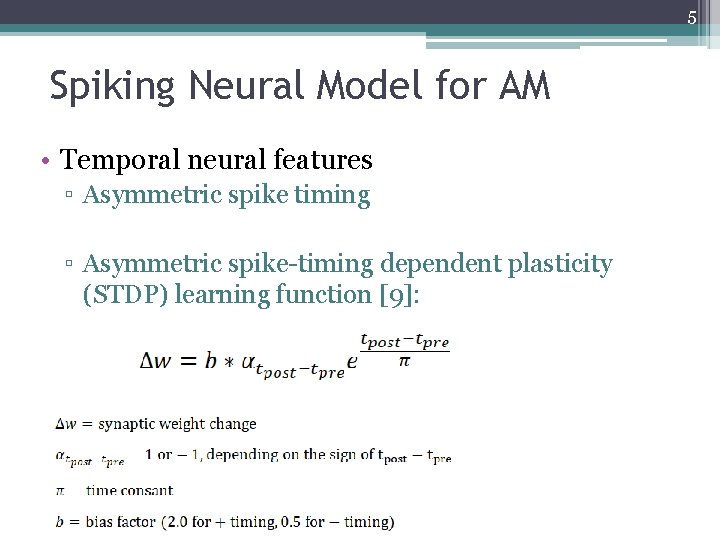
5 Spiking Neural Model for AM • Temporal neural features ▫ Asymmetric spike timing ▫ Asymmetric spike-timing dependent plasticity (STDP) learning function [9]:
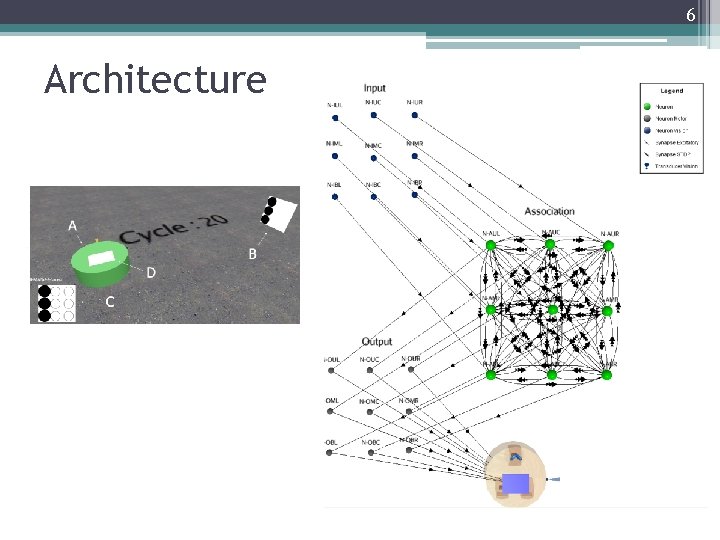
6 Architecture
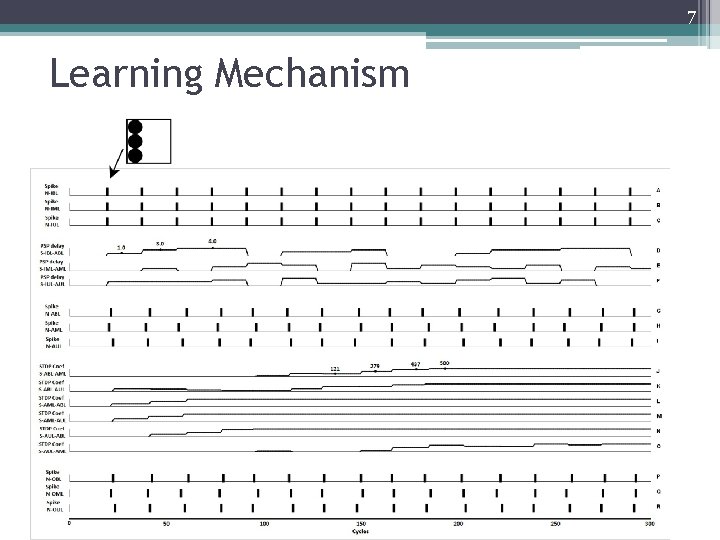
7 Learning Mechanism
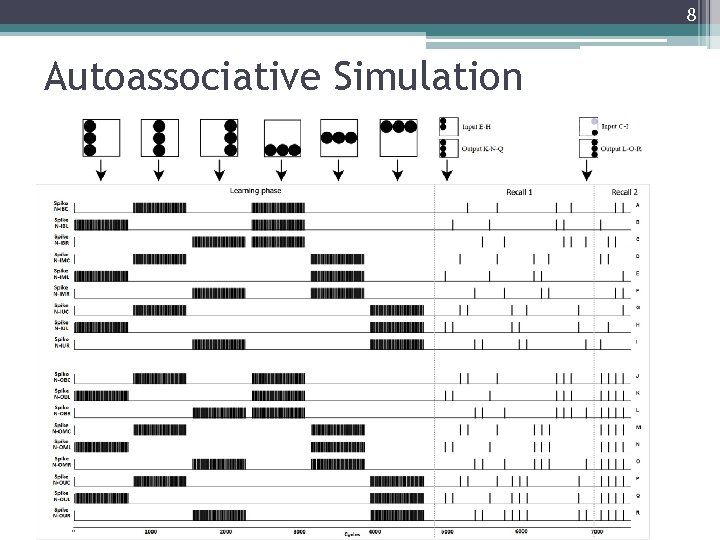
8 Autoassociative Simulation
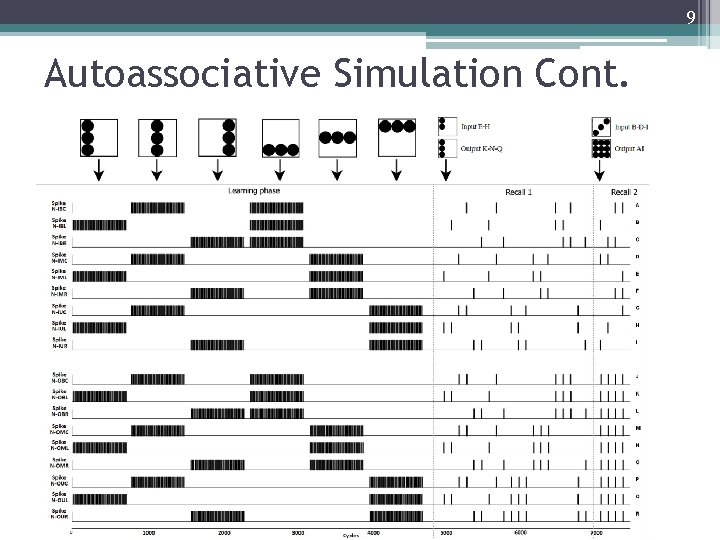
9 Autoassociative Simulation Cont.
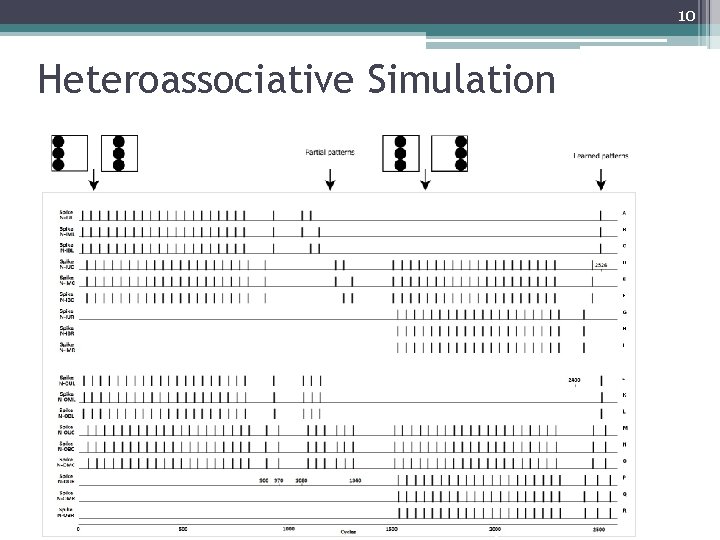
10 Heteroassociative Simulation
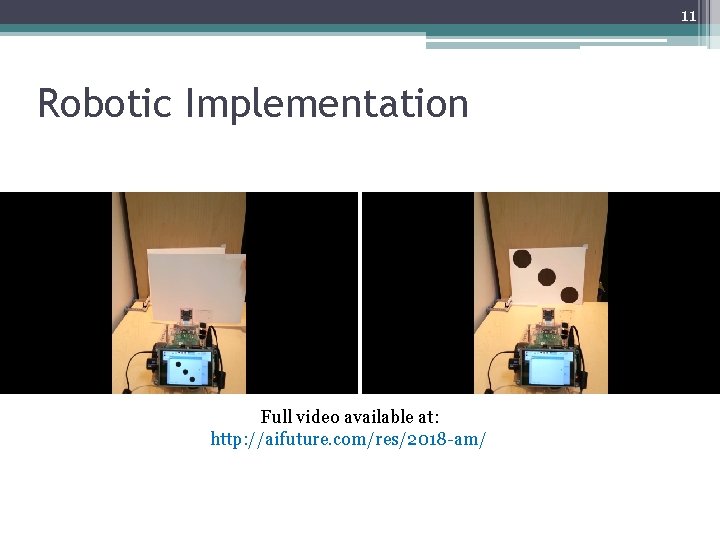
11 Robotic Implementation Full video available at: http: //aifuture. com/res/2018 -am/
12 Conclusion • With simple visual tasks and minimalist cellular circuits, it was shown that asymmetric synaptic delays and asymmetric STDP learning are sufficient conditions to achieve patterncompletion and noise tolerance for auto and heteroassociative tasks.
13 References 1. 2. 3. 4. 5. 6. 7. Rolls, E. : The mechanisms for pattern completion and pattern separation in the hippocampus. Front. Syst. Neurosci 7(74), 10 -3389 (2013) Smith, D. , Wessnitzer, J. , Webb, B. : A model of associative learning in the mushroom body. Biological cybernetics 99(2), 89 -103 (2008) Chartier, S. , Giguere, G. , Langlois, D. : A new bidirectional heteroassociative memory encompassing correlational, competitive and topological properties. Neural Networks 22(5), 568 -578 (2009) Touzet, C. : Modeling and simulation of elementary robot behaviors using associative memories. International Journal of Advanced Robotic Systems 3(2), 165 -170(2006) Tangruamsub, S. , Kawewong, A. , Tsuboyama, M. , Hasegawa, O. : Selforganizingincremental associative memory-based robot navigation. IEIC TRANSACTIONS on Information and Systems 95(10), 2415 -2425 (2012) Gerstner, W. , van Hemmen, J. : Associative memory in a network of ‘spiking’ neurons, Network. Computation in Neural Systems, 3: 2, 139 -164 (1992) Tan, C. , Tang, H. , Cheu, E. , Hu, J. : A computationally ecient associative memory model of hippocampus ca 3 by spiking neurons. In: Neural Networks (IJCNN), The 2013 International Joint Conference on. pp. 1{8. IEEE (2013) 8. Jimenez-Romero, C. , Sousa-Rodrigues, D. , Johnson, J. : Designing behaviour in bio-inspired robots using associative topologies of spiking-neural-networks. ar. Xiv preprint ar. Xiv: 1509. 07035 (2015) 9. Dan, Y. , & Poo, M. (2004). Spike Timing-Dependent Plasticity of Neural Circuits. Neuron, 44(1), 23– 30. https: //doi. org/10. 1016/J. NEURON. 2004. 09. 007
- Slides: 13