
1 ASP NET Web applications ICD 0015 Tal

1 ASP. NET Web applications – ICD 0015 Tal. Tech IT College, Andres Käver, 2018 -2019, Spring semester Web: http: //enos. Itcollege. ee/~akaver/ASP. NETCore Skype: akaver Email: akaver@itcollege. ee

State HTTP is a stateless protocol. A web server treats each HTTP request as an independent request and does not retain user values from previous requests.
Cache Do you always need live data? Or maybe few tens of seconds old data is still ok? Maybe few minutes old data is ok? ASP. NET Core supports several cache mechanisms In memory caching Local – cache is stored in the same web server All sessions should return to same server (azure supports this) Distributed Separate server for caching, all web servers share it. Web restarts, deploys, different web servers servicing requests – cache continues to work
Cache IMemory. Cache Entries are removed when server is under memory pressure Set Cache. Item. Priority to regulate this (Cache. Item. Priority. Never. Remove) IMemory. Cache stores any object (distributed cache stores only byte[])

Cache - IMemory. Cache Used with typical dependency injection pattern Microsoft. Extensions. Caching. Memory public void Configure. Services(IService. Collection services) } services. Add. Memory. Cache(); services. Add. Mvc(); { public class Home. Controller : Controller { private IMemory. Cache _cache; public Home. Controller(IMemory. Cache memory. Cache) } _cache = memory. Cache; {
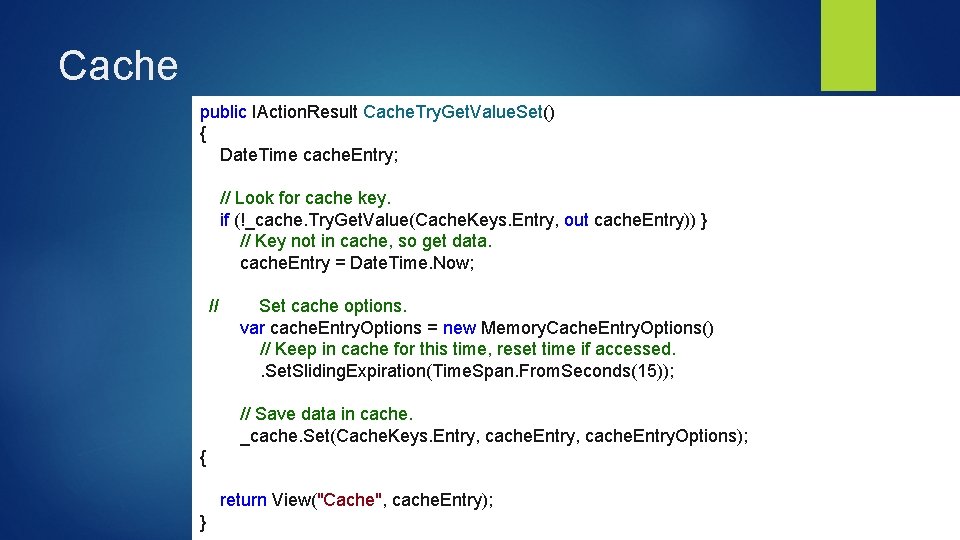
Cache public IAction. Result Cache. Try. Get. Value. Set() { Date. Time cache. Entry; // Look for cache key. if (!_cache. Try. Get. Value(Cache. Keys. Entry, out cache. Entry)) } // Key not in cache, so get data. cache. Entry = Date. Time. Now; // Set cache options. var cache. Entry. Options = new Memory. Cache. Entry. Options() // Keep in cache for this time, reset time if accessed. . Set. Sliding. Expiration(Time. Span. From. Seconds(15)); // Save data in cache. _cache. Set(Cache. Keys. Entry, cache. Entry. Options); { return View("Cache", cache. Entry); }
Cache - IMemory. Cache Create. Entry(Object) - Create or overwrite an entry in the cache Remove(Object) - Removes the object associated with the given key Try. Get. Value(Object, out Object) - Gets the item associated with this key if present.

Cache - Cache. Extensions Get(IMemory. Cache, Object) Get<TItem>(IMemory. Cache, Object) Get. Or. Create<TItem>(IMemory. Cache, Object, Func<ICache. Entry, TItem>) Get. Or. Create. Async<TItem>(IMemory. Cache, Object, Func<ICache. Entry, Task<TItem>>) Set<TItem>(IMemory. Cache, Object, TItem, Memory. Cache. Entry. Options) Set<TItem>(IMemory. Cache, Object, TItem, IChange. Token) Set<TItem>(IMemory. Cache, Object, TItem, Date. Time. Offset) Set<TItem>(IMemory. Cache, Object, TItem, Time. Span) Try. Get. Value<TItem>(IMemory. Cache, Object, out TItem)

Cache - Memory. Cache. Entry. Options Absolute. Expiration Gets or sets an absolute expiration date for the cache entry. Absolute. Expiration. Relative. To. Now Gets or sets an absolute expiration time, relative to now. Expiration. Tokens Gets the IChange. Token instances which cause the cache entry to expire. Post. Eviction. Callbacks Gets or sets the callbacks will be fired after the cache entry is evicted from the cache. Priority Gets or sets the priority for keeping the cache entry in the cache during a memory pressure triggered cleanup. The default is Normal (High, Low, Normal, Never. Remove). Sliding. Expiration Gets or sets how long a cache entry can be inactive (e. g. not accessed) before it will be removed. This will not extend the entry lifetime beyond the absolute expiration (if set).

Response caching adds cache-related headers to responses. This is not caching done by server! (Outpu. Cache is an different thing) Web. Essentials. Asp. Net. Core. Output. Caching HTTP header used for caching is Cache-Control How do you want client, proxy and middleware to cache responses Public, private, no-cache, Pragma, Vary Disable caching for content that contains information for authenticated clients. Caching should only be enabled for content that does not change based on a user's identity, or whether a user is logged in.
![Response caching Response. Cache Attribute Vary. By. Query. Keys string[] Response is cached by](http://slidetodoc.com/presentation_image_h/cd5447181ab2ec1e5ad2c9486fabbe13/image-11.jpg "Response caching Response. Cache Attribute Vary. By. Query. Keys string[] Response is cached by")
Response caching Response. Cache Attribute Vary. By. Query. Keys string[] Response is cached by middleware, based on query keys [Response. Cache(Vary. By. Query. Keys = new []{"foo", "bar"}, Duration = 30)] public IAction. Result Index(string foo, string bar) {
![Response caching Vary. By. Header [Response. Cache(Vary. By. Header = "User-Agent", Duration = 30)]](http://slidetodoc.com/presentation_image_h/cd5447181ab2ec1e5ad2c9486fabbe13/image-12.jpg "Response caching Vary. By. Header [Response. Cache(Vary. By. Header = \"User-Agent\", Duration = 30)]")
Response caching Vary. By. Header [Response. Cache(Vary. By. Header = "User-Agent", Duration = 30)] public IAction. Result About 2() {
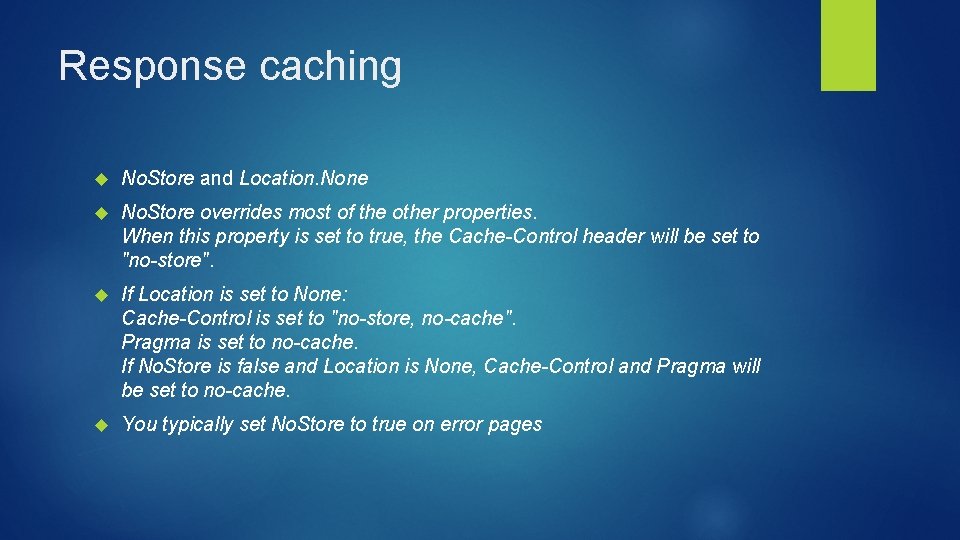
Response caching No. Store and Location. None No. Store overrides most of the other properties. When this property is set to true, the Cache-Control header will be set to "no-store". If Location is set to None: Cache-Control is set to "no-store, no-cache". Pragma is set to no-cache. If No. Store is false and Location is None, Cache-Control and Pragma will be set to no-cache. You typically set No. Store to true on error pages

Response caching Location and Duration To enable caching, Duration must be set to a positive value and Location must be either Any (the default) or Client.
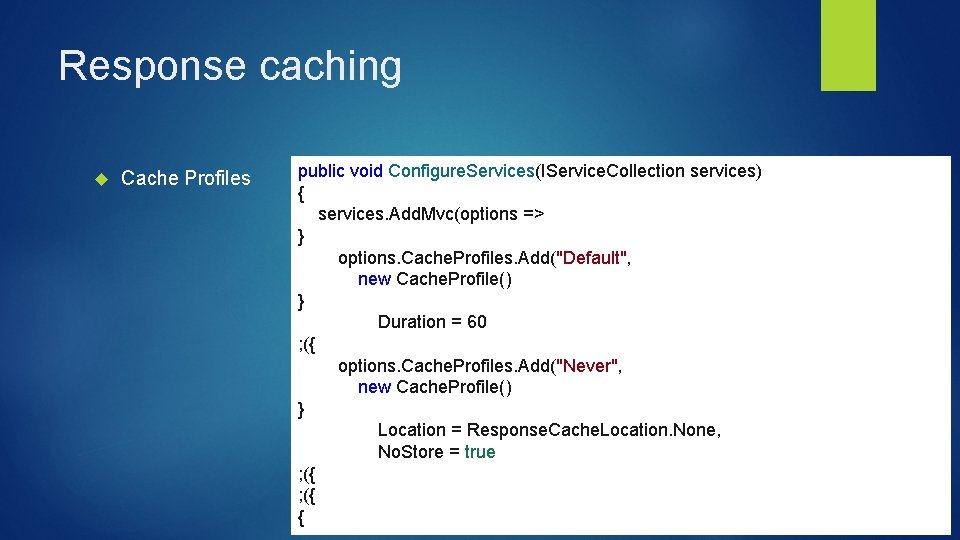
Response caching Cache Profiles public void Configure. Services(IService. Collection services) { services. Add. Mvc(options => } options. Cache. Profiles. Add("Default", new Cache. Profile() } Duration = 60 ; ({ options. Cache. Profiles. Add("Never", new Cache. Profile() } Location = Response. Cache. Location. None, No. Store = true ; ({ {
![Response caching Cache profiles [Response. Cache(Duration = 30)] public class Home. Controller : Controller](http://slidetodoc.com/presentation_image_h/cd5447181ab2ec1e5ad2c9486fabbe13/image-16.jpg "Response caching Cache profiles [Response. Cache(Duration = 30)] public class Home. Controller : Controller")
Response caching Cache profiles [Response. Cache(Duration = 30)] public class Home. Controller : Controller { [Response. Cache(Cache. Profile. Name = "Default")] public IAction. Result Index() } return View; () {
Response caching RFC 7234 - https: //tools. ietf. org/html/rfc 7234#section-3 RFC 2616 - https: //www. w 3. org/Protocols/rfc 2616 sec 14. html#sec 14. 9
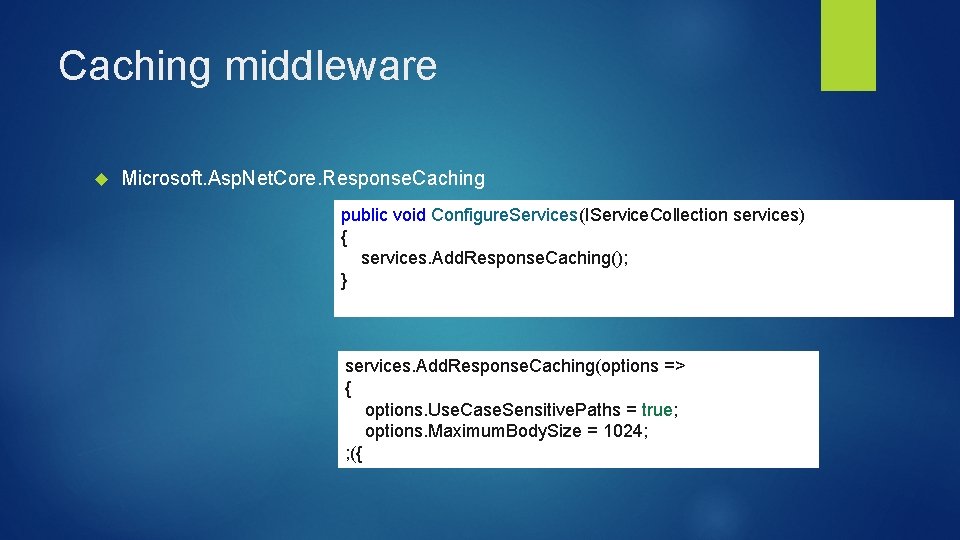
Caching middleware Microsoft. Asp. Net. Core. Response. Caching public void Configure. Services(IService. Collection services) { services. Add. Response. Caching(); } services. Add. Response. Caching(options => { options. Use. Case. Sensitive. Paths = true; options. Maximum. Body. Size = 1024; ; ({

Session User specific dictionary on webserver Backed by cache public class Startup { public void Configure. Services(IService. Collection services)}. . . // Default in-memory implementation of IDistributed. Cache. services. Add. Distributed. Memory. Cache(); services. Add. Session(options => } options. Idle. Timeout = Time. Span. From. Seconds(10); options. Cookie. Http. Only = true; ; ({ { public void Configure(IApplication. Builder app) } app. Use. Session(); . . . { {
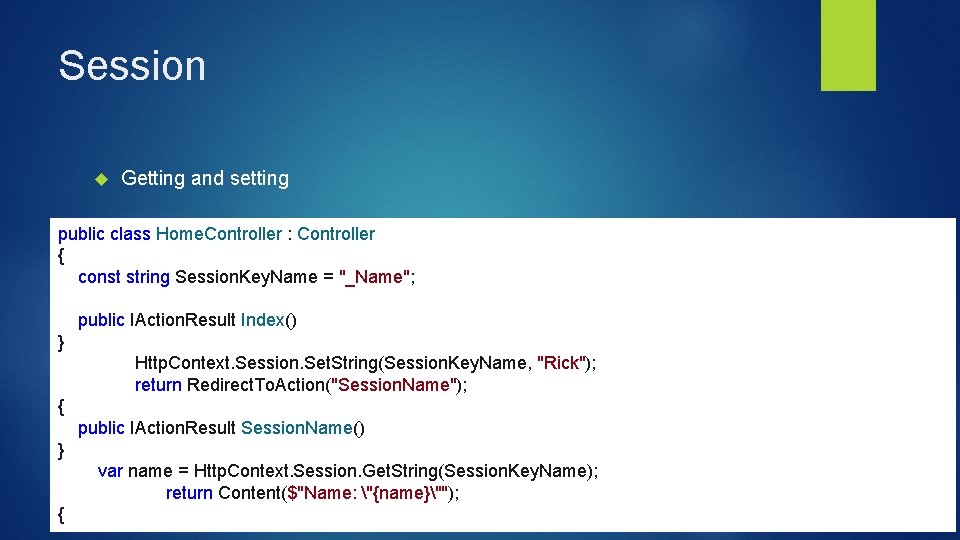
Session Getting and setting public class Home. Controller : Controller { const string Session. Key. Name = "_Name"; public IAction. Result Index() } Http. Context. Session. Set. String(Session. Key. Name, "Rick"); return Redirect. To. Action("Session. Name"); { public IAction. Result Session. Name() } var name = Http. Context. Session. Get. String(Session. Key. Name); return Content($"Name: "{name}""); {
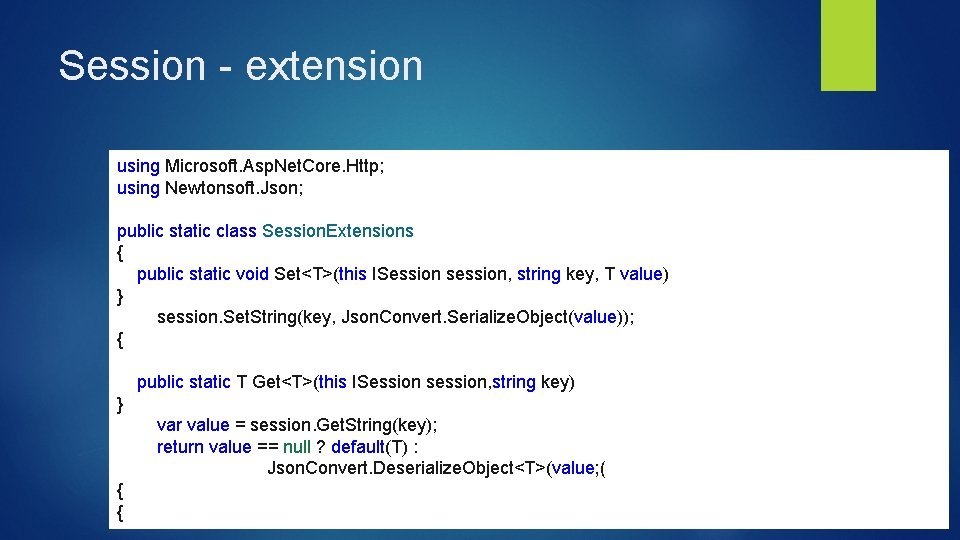
Session - extension using Microsoft. Asp. Net. Core. Http; using Newtonsoft. Json; public static class Session. Extensions { public static void Set<T>(this ISession session, string key, T value) } session. Set. String(key, Json. Convert. Serialize. Object(value)); { public static T Get<T>(this ISession session, string key) } var value = session. Get. String(key); return value == null ? default(T) : Json. Convert. Deserialize. Object<T>(value; ( { {

Session vs cache Cache – shared among all users Session – private to every user

THE END
- Slides: 23