
1 ART IS A LANGUAGE The arts are
- Slides: 11
#1 ART IS A LANGUAGE The arts are symbol systems organized by elements and principles which provide a medium for communicating information, posing and solving artistic problems, and expressing feelings. Art as a Way of Learning®
Aspects of a Language Structural Aspect - Knowledge of the elements and principles and how to combine them into sequences or compositions that conform to the structural requirements of the language. Functional Aspect -The ability to use the structural aspects of the language to communicate, think and solve problems. Aesthetic Aspect - The ability to pose new problems, to creatively express strong personal feelings or images, and to create original ways of combing the structural aspects of the language. Art as a Way of Learning®
Language/Symbol Systems Verbal/Linguistic Visual/Graphic Dramatic/Gestural Movement/Dance Mathematic Scientific Art as a Way of Learning®
Art & Language: A comparison In art a child learns • • To see lines, shapes, colors, movements, rhythms, patterns, etc. To associated visual, musical, movement images with meaning To create images using tools & bodies To use artistic conventions such as proportion and balance, character, call & response To think like an artist To create original artwork To make meaning from visual, gestural, musical symbols To respond aesthetically to visual images, music, drama, and dance Art as a Way of Learning® In language a child learns • To hear and make phonemic sounds • To associate sounds with meaning • To write words using tools • To comprehend words • To use linguistic structures such as grammar and syntax • To think like a writer • To create original writing • To make meaning from sound symbols • To respond aesthetically to written words
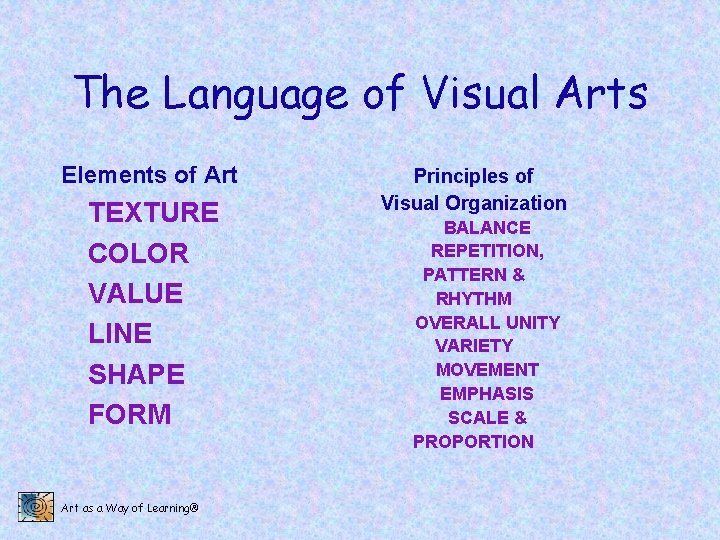
The Language of Visual Arts Elements of Art TEXTURE COLOR VALUE LINE SHAPE FORM Art as a Way of Learning® Principles of Visual Organization BALANCE REPETITION, PATTERN & RHYTHM OVERALL UNITY VARIETY MOVEMENT EMPHASIS SCALE & PROPORTION
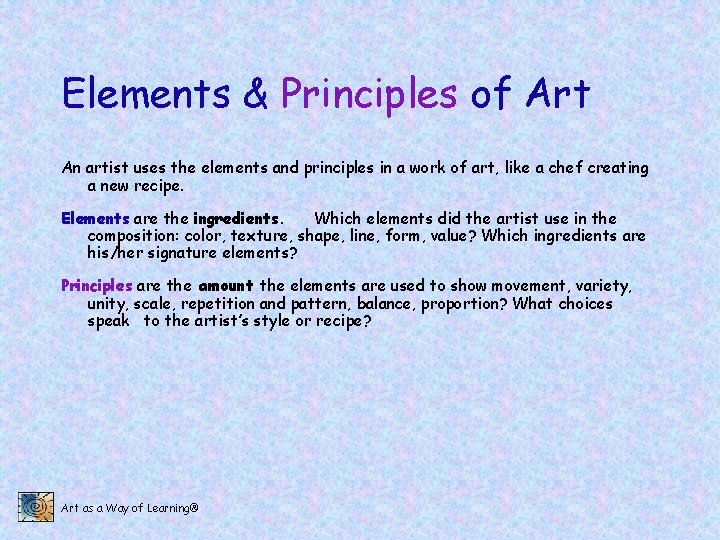
Elements & Principles of Art An artist uses the elements and principles in a work of art, like a chef creating a new recipe. Elements are the ingredients. Which elements did the artist use in the composition: color, texture, shape, line, form, value? Which ingredients are his/her signature elements? Principles are the amount the elements are used to show movement, variety, unity, scale, repetition and pattern, balance, proportion? What choices speak to the artist’s style or recipe? Art as a Way of Learning®
Thinking with our Hands Art as a Way of Learning®
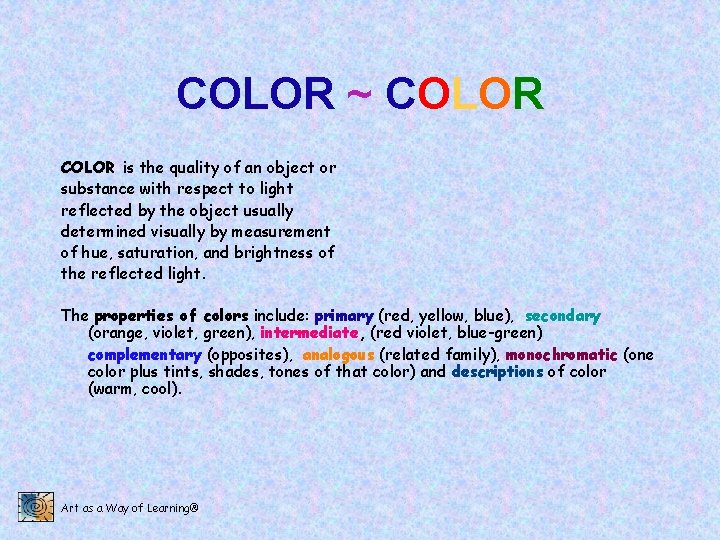
COLOR ~ COLOR is the quality of an object or substance with respect to light reflected by the object usually determined visually by measurement of hue, saturation, and brightness of the reflected light. The properties of colors include: primary (red, yellow, blue), secondary (orange, violet, green), intermediate, (red violet, blue-green) complementary (opposites), analogous (related family), monochromatic (one color plus tints, shades, tones of that color) and descriptions of color (warm, cool). Art as a Way of Learning®
TEXTURE -- visual and tactile quality of the surface of a work of art resulting from the way in which the materials are used. All surfaces have some type of texture. Texture involves height, shape, flexibility, density, uniformity, temperature and pressure Texture covers a wide range of ways an objects looks and feels. • The way a surface feels to the is considered TACTILE TEXTURE. • An effect created by the way light falls onto a surface, creating a contrast between lit and shaded areas is called VISUAL TEXTURE. Art as a Way of Learning®
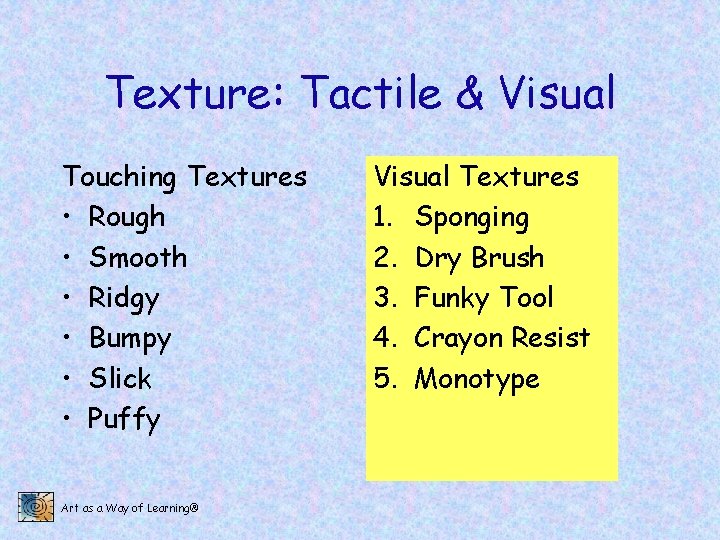
Texture: Tactile & Visual Touching Textures • Rough • Smooth • Ridgy • Bumpy • Slick • Puffy Art as a Way of Learning® Visual Textures 1. Sponging 2. Dry Brush 3. Funky Tool 4. Crayon Resist 5. Monotype
Reflection Art as a Way of Learning®