
1 Analyzing OneVariable Data Lesson 1 2 Displaying
1 Analyzing One-Variable Data Lesson 1. 2 Displaying Categorical Data Statistics and Probability with Applications, 3 rd Edition Starnes, Tabor Bedford Freeman Worth Publishers
Displaying Categorical Data Learning Targets After this lesson, you should be able to: ü Make and interpret bar charts of categorical data. ü Interpret pie charts. ü Identify what makes some graphs of categorical data deceptive. Statistics and Probability with Applications, 3 rd Edition 2

Displaying Categorical Data A frequency table or relative frequency table summarizes a variable’s distribution in numerical form. To display the distribution more clearly, use a graph. Bar Chart A bar chart shows each category as a bar. The heights of the bars show the category frequencies or relative frequencies. Pie Chart A pie chart shows each category as a slice of “pie. ” The areas of the slices are proportional to the category frequencies or relative frequencies. Statistics and Probability with Applications, 3 rd Edition 3
Displaying Categorical Data How to Make a Bar Chart 1. Draw and label the axes. Put the name of the categorical variable under the horizontal axis. To the left of the vertical axis, indicate if the graph shows the frequency (count) or relative frequency (percent or proportion) of individuals in each category. 2. “Scale” the axes. Write the names of the categories at equally spaced intervals under the horizontal axis. On the vertical axis, start at 0 and place tick marks at equal intervals until you exceed the largest frequency or relative frequency in any category. 3. Draw bars above the category names. Make the bars equal in width and leave gaps between them. Be sure that the height of each bar corresponds to the frequency or relative frequency of individuals in that category. Statistics and Probability with Applications, 3 rd Edition 4
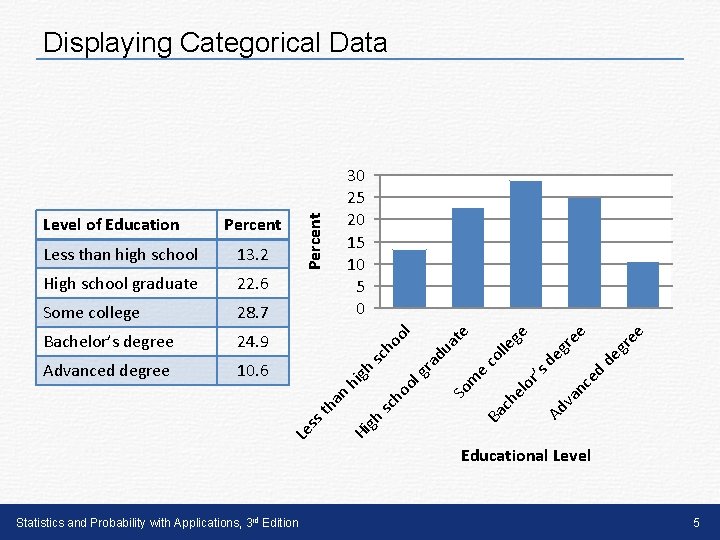
ee de ed Ad v an c r’s lo ch e gr ee gr de lle ge co e m Ba Hi gh ss Le at e 10. 6 So Advanced degree ra du 24. 9 lg Bachelor’s degree ho 28. 7 oo Some college sc 22. 6 sc h High school graduate gh 13. 2 th an Less than high school ol Percent 30 25 20 15 10 5 0 hi Level of Education Percent Displaying Categorical Data Educational Level Statistics and Probability with Applications, 3 rd Edition 5
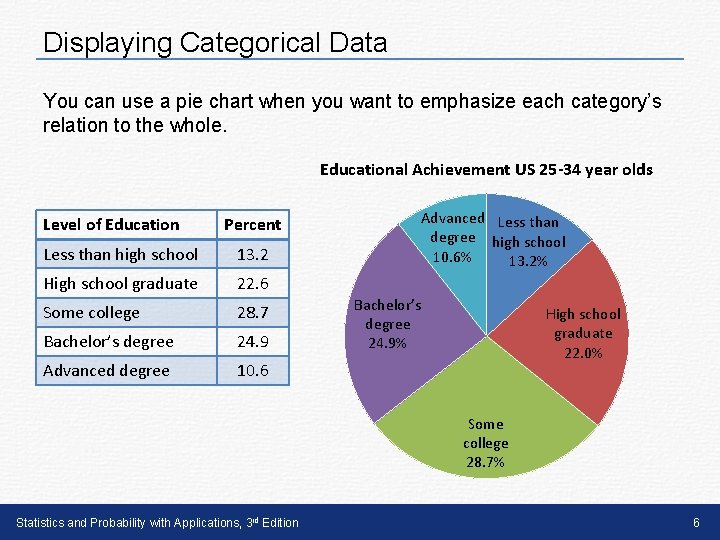
Displaying Categorical Data You can use a pie chart when you want to emphasize each category’s relation to the whole. Educational Achievement US 25 -34 year olds Level of Education Percent Less than high school 13. 2 High school graduate 22. 6 Some college 28. 7 Bachelor’s degree 24. 9 Advanced degree 10. 6 Advanced Less than degree high school 10. 6% 13. 2% Bachelor’s degree 24. 9% High school graduate 22. 0% Some college 28. 7% Statistics and Probability with Applications, 3 rd Edition 6
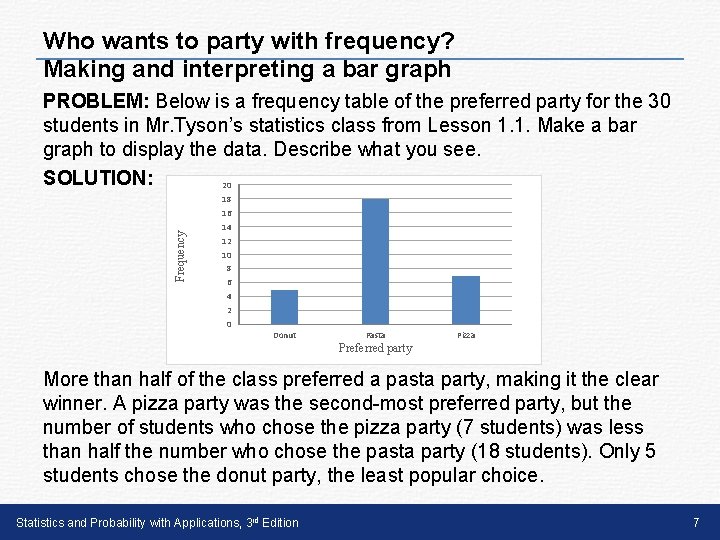
Who wants to party with frequency? Making and interpreting a bar graph PROBLEM: Below is a frequency table of the preferred party for the 30 students in Mr. Tyson’s statistics class from Lesson 1. 1. Make a bar graph to display the data. Describe what you see. SOLUTION: 20 18 Frequency 16 14 12 10 8 6 4 2 0 Donut Pasta Pizza Preferred party More than half of the class preferred a pasta party, making it the clear winner. A pizza party was the second-most preferred party, but the number of students who chose the pizza party (7 students) was less than half the number who chose the pasta party (18 students). Only 5 students chose the donut party, the least popular choice. Statistics and Probability with Applications, 3 rd Edition 7
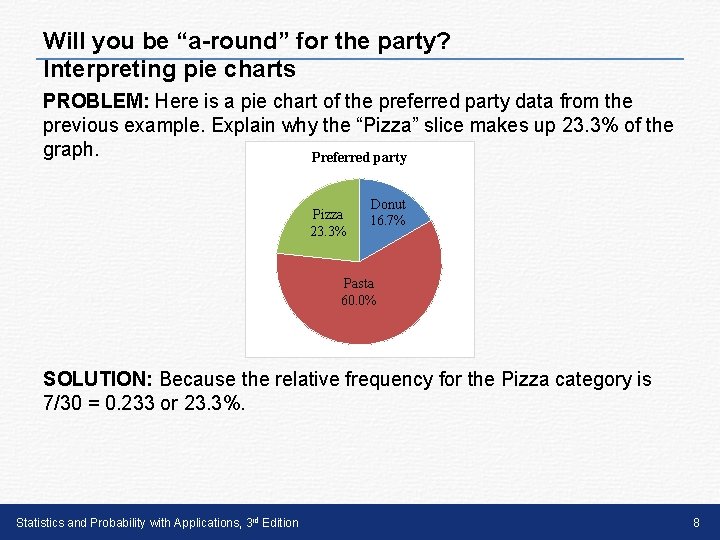
Will you be “a-round” for the party? Interpreting pie charts PROBLEM: Here is a pie chart of the preferred party data from the previous example. Explain why the “Pizza” slice makes up 23. 3% of the graph. Preferred party Pizza 23. 3% Donut 16. 7% Pasta 60. 0% SOLUTION: Because the relative frequency for the Pizza category is 7/30 = 0. 233 or 23. 3%. Statistics and Probability with Applications, 3 rd Edition 8
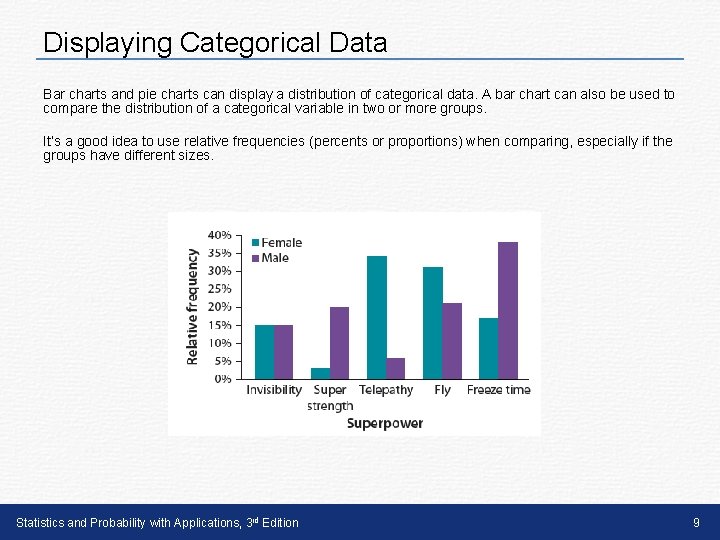
Displaying Categorical Data Bar charts and pie charts can display a distribution of categorical data. A bar chart can also be used to compare the distribution of a categorical variable in two or more groups. It’s a good idea to use relative frequencies (percents or proportions) when comparing, especially if the groups have different sizes. Statistics and Probability with Applications, 3 rd Edition 9
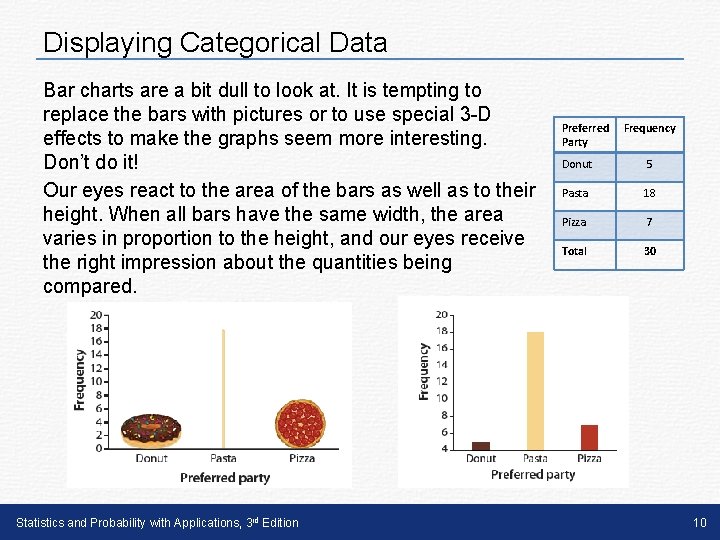
Displaying Categorical Data Bar charts are a bit dull to look at. It is tempting to replace the bars with pictures or to use special 3 -D effects to make the graphs seem more interesting. Don’t do it! Our eyes react to the area of the bars as well as to their height. When all bars have the same width, the area varies in proportion to the height, and our eyes receive the right impression about the quantities being compared. Statistics and Probability with Applications, 3 rd Edition Preferred Party Frequency Donut 5 Pasta 18 Pizza 7 Total 30 10
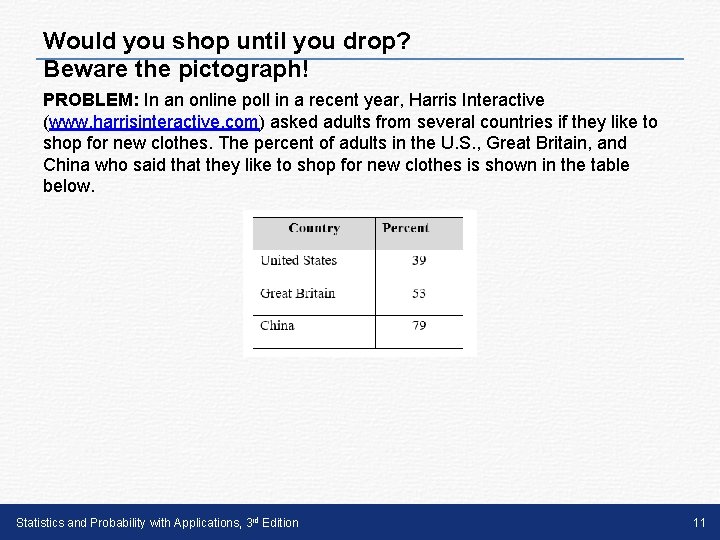
Would you shop until you drop? Beware the pictograph! PROBLEM: In an online poll in a recent year, Harris Interactive (www. harrisinteractive. com) asked adults from several countries if they like to shop for new clothes. The percent of adults in the U. S. , Great Britain, and China who said that they like to shop for new clothes is shown in the table below. Statistics and Probability with Applications, 3 rd Edition 11
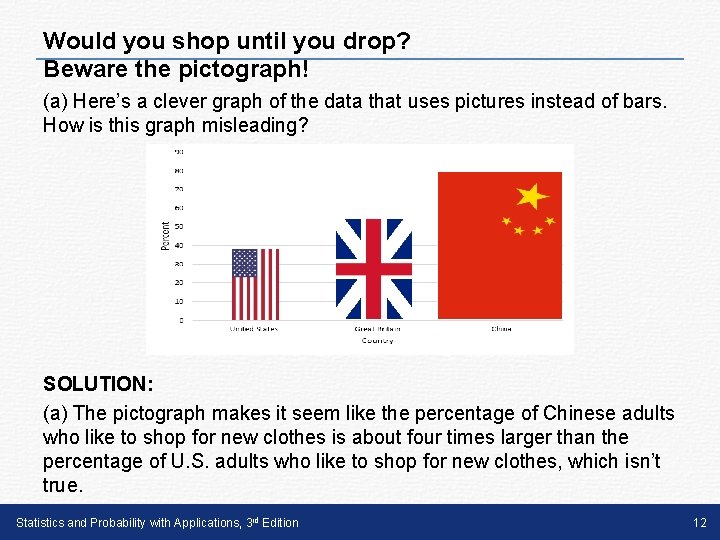
Would you shop until you drop? Beware the pictograph! (a) Here’s a clever graph of the data that uses pictures instead of bars. How is this graph misleading? SOLUTION: (a) The pictograph makes it seem like the percentage of Chinese adults who like to shop for new clothes is about four times larger than the percentage of U. S. adults who like to shop for new clothes, which isn’t true. Statistics and Probability with Applications, 3 rd Edition 12
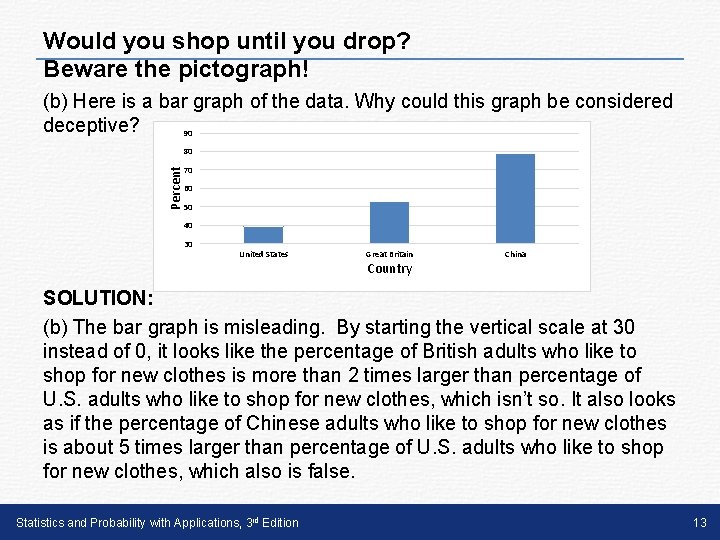
Would you shop until you drop? Beware the pictograph! (b) Here is a bar graph of the data. Why could this graph be considered deceptive? 90 Percent 80 70 60 50 40 30 United States Great Britain Country China SOLUTION: (b) The bar graph is misleading. By starting the vertical scale at 30 instead of 0, it looks like the percentage of British adults who like to shop for new clothes is more than 2 times larger than percentage of U. S. adults who like to shop for new clothes, which isn’t so. It also looks as if the percentage of Chinese adults who like to shop for new clothes is about 5 times larger than percentage of U. S. adults who like to shop for new clothes, which also is false. Statistics and Probability with Applications, 3 rd Edition 13
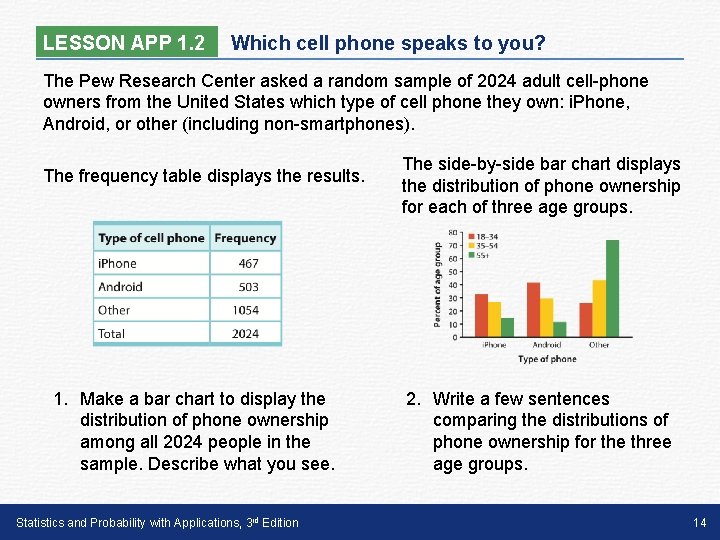
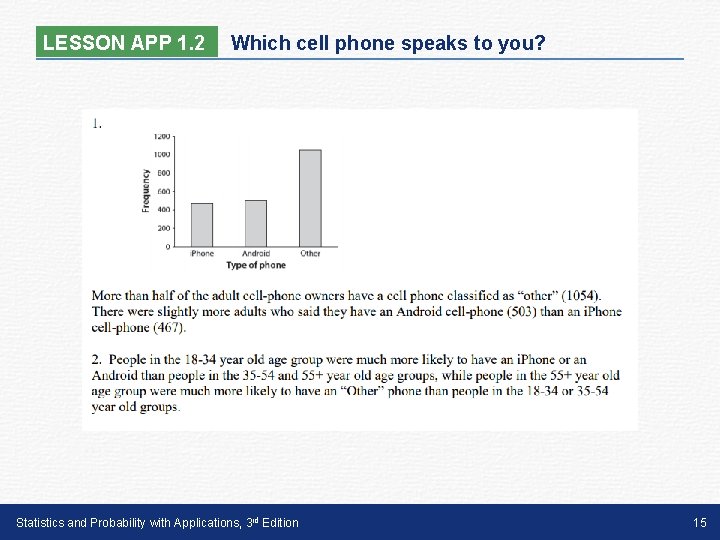
LESSON APP 1. 2 Which cell phone speaks to you? The Pew Research Center asked a random sample of 2024 adult cell-phone owners from the United States which type of cell phone they own: i. Phone, Android, or other (including non-smartphones). The frequency table displays the results. 1. Make a bar chart to display the distribution of phone ownership among all 2024 people in the sample. Describe what you see. Statistics and Probability with Applications, 3 rd Edition The side-by-side bar chart displays the distribution of phone ownership for each of three age groups. 2. Write a few sentences comparing the distributions of phone ownership for the three age groups. 14
LESSON APP 1. 2 Which cell phone speaks to you? Statistics and Probability with Applications, 3 rd Edition 15
Displaying Categorical Data Learning Targets After this lesson, you should be able to: ü Make and interpret bar charts of categorical data. ü Interpret pie charts. ü Identify what makes some graphs of categorical data deceptive. Statistics and Probability with Applications, 3 rd Edition 16
- Slides: 16