
1 ALTERNATIVE DISPUTE RESOLUTION ADR METHODS jln Murthy
![WHAT IS ARBITRATION? 3 Arbitration [a form of Alternative Dispute Resolution (ADR) ] ,](https://slidetodoc.com/presentation_image/b6950c7243f638a03fbc775256ebc576/image-3.jpg "WHAT IS ARBITRATION? 3 Arbitration [a form of Alternative Dispute Resolution (ADR) ] ,")
- Slides: 23
1 ALTERNATIVE DISPUTE RESOLUTION (ADR) METHODS jln Murthy advocate Regional Centre in-charge & secretary Icadr, regional centre
2 WHAT IS ALTERNATIVE DISPUTE RESOLUTION (ADR)? Alternative dispute resolution (ADR) is a means of addressing and settling parties’ disputes outside of court’s traditional adversarial setting. Today, alternative out-of-court mechanisms for settling disputes are so effective that courts often require parties to pursue these alternatives before litigating. Settling one’s disputes through mechanisms external to the court system may save you time and money.
WHAT IS ARBITRATION? 3 Arbitration [a form of Alternative Dispute Resolution (ADR) ] , is a technique for the resolution of disputes outside the courts, where the parties to a dispute refer it to one or more persons (the "arbitrators", or “arbitral tribunal”), by whose decision (the “award”) they agree to be bound. It is a resolution technique in which a third party reviews the evidence in the case and imposes a decision that is legally binding for both sides and enforceable.
WHAT IS MEDIATION? 4 Mediation is an ADR method where a neutral and impartial third party, the mediator, facilitates dialogue in a structured multi-stage process to help parties reach a conclusive and mutually satisfactory agreement. A mediator assists the parties in identifying and articulating their own interests, priorities, needs and wishes to each other. Mediation is a “peaceful” dispute resolution tool that is complementary to the existing court system and the practice of arbitration.
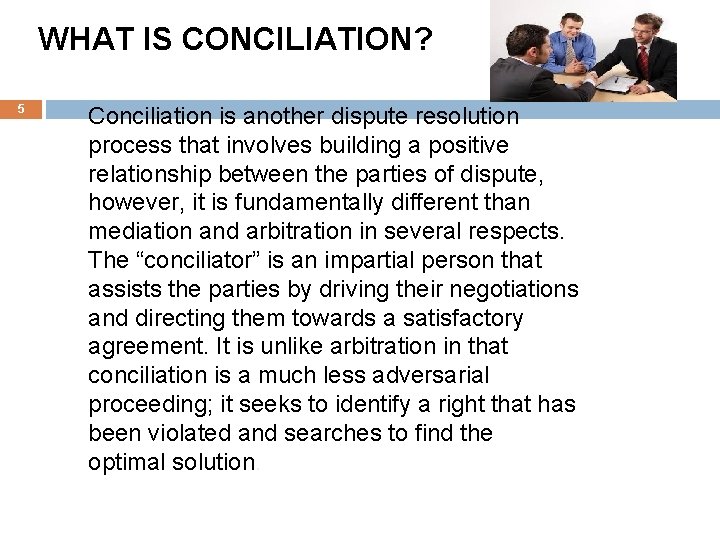
WHAT IS CONCILIATION? 5 Conciliation is another dispute resolution process that involves building a positive relationship between the parties of dispute, however, it is fundamentally different than mediation and arbitration in several respects. The “conciliator” is an impartial person that assists the parties by driving their negotiations and directing them towards a satisfactory agreement. It is unlike arbitration in that conciliation is a much less adversarial proceeding; it seeks to identify a right that has been violated and searches to find the optimal solution.
6 “A clever person solves a problem. A wise person avoids it. ” Albert Einstein
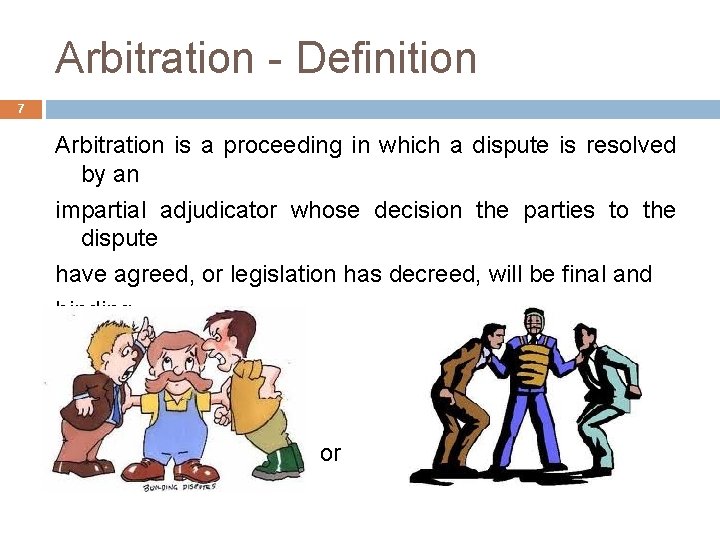
Arbitration - Definition 7 Arbitration is a proceeding in which a dispute is resolved by an impartial adjudicator whose decision the parties to the dispute have agreed, or legislation has decreed, will be final and binding. or
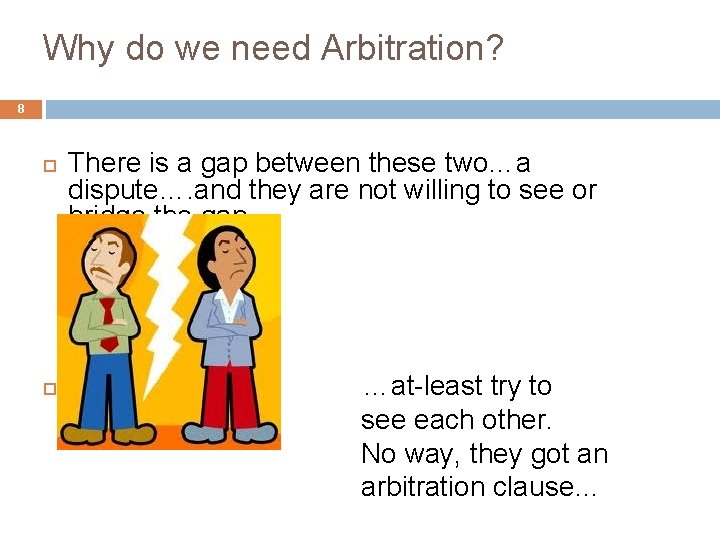
Why do we need Arbitration? 8 There is a gap between these two…a dispute…. and they are not willing to see or bridge the gap. …at-least try to see each other. No way, they got an arbitration clause…
How does the dispute arise? 9 Source - Contract… ……
“A contract is an agreement having a lawful object entered into voluntarily by two or more parties, each of whom intends to create one or more legal obligations between or among them. The elements of a contract are "offer" and "acceptance" by “competent persons" having legal capacity who exchange “consideration” to create "mutuality of obligation”. Why do we contract? 10 To achieve our goals with the help of others. To share the risks with others. To minimize the risk by outsourcing certain activities for
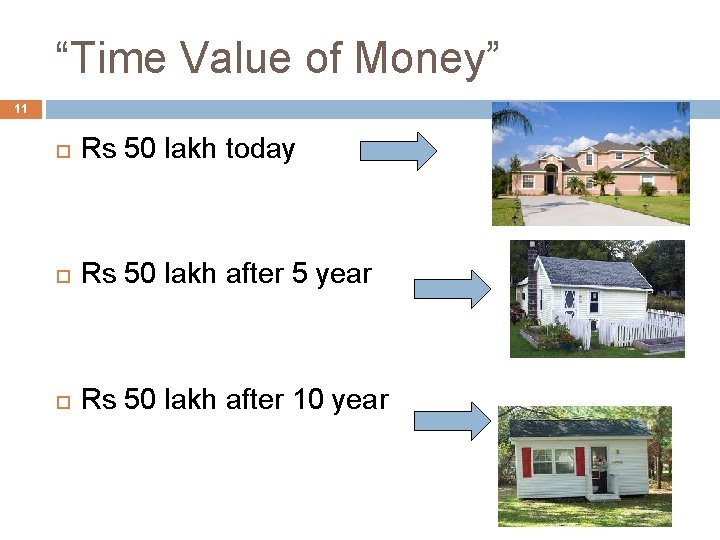
“Time Value of Money” 11 Rs 50 lakh today Rs 50 lakh after 5 year Rs 50 lakh after 10 year
Why do we need the disputes to be resolved? 12 Disputes can make damages if left unsettled immediately. Arbitration is one of the dispute settling mechanism permitted by law.
What are the other forms of ADR? 13 Arbitration Conciliation Mediation Negotiation Dispute Resolution Board (DRB)
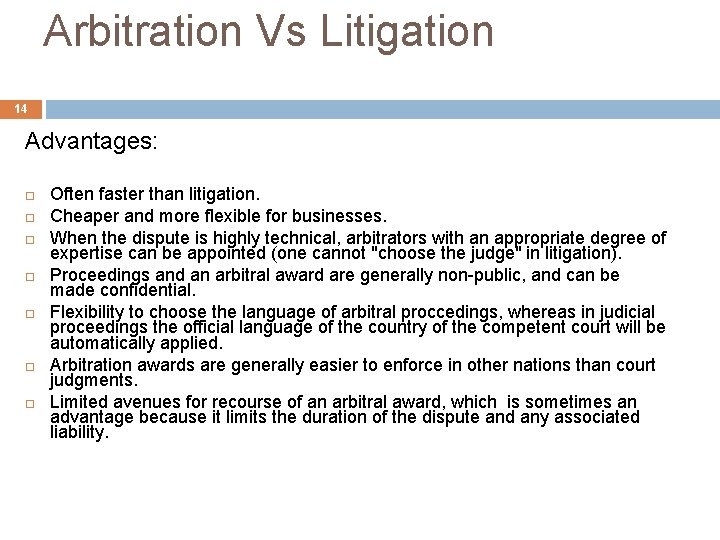
Arbitration Vs Litigation 14 Advantages: Often faster than litigation. Cheaper and more flexible for businesses. When the dispute is highly technical, arbitrators with an appropriate degree of expertise can be appointed (one cannot "choose the judge" in litigation). Proceedings and an arbitral award are generally non-public, and can be made confidential. Flexibility to choose the language of arbitral proccedings, whereas in judicial proceedings the official language of the country of the competent court will be automatically applied. Arbitration awards are generally easier to enforce in other nations than court judgments. Limited avenues for recourse of an arbitral award, which is sometimes an advantage because it limits the duration of the dispute and any associated liability.
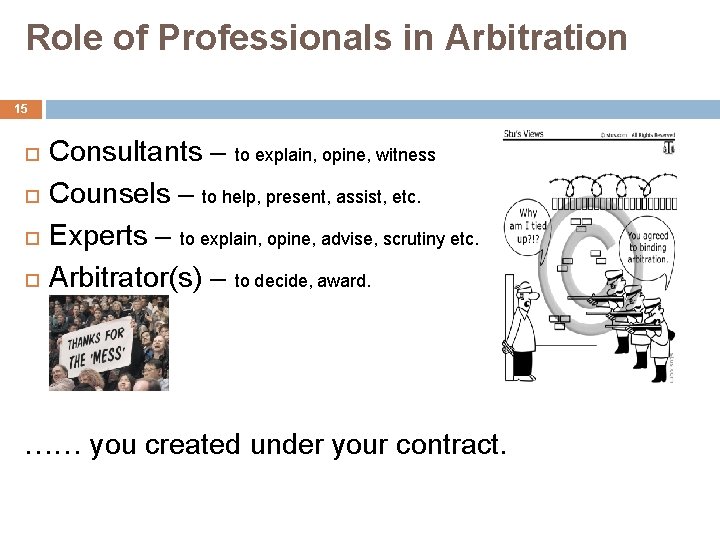
Role of Professionals in Arbitration 15 Consultants – to explain, opine, witness Counsels – to help, present, assist, etc. Experts – to explain, opine, advise, scrutiny etc. Arbitrator(s) – to decide, award. …… you created under your contract.
“You want to be clever or wise!” 16 “If you can't explain it to a six year old, you don't understand it yourself. ” (Albert Einstein)
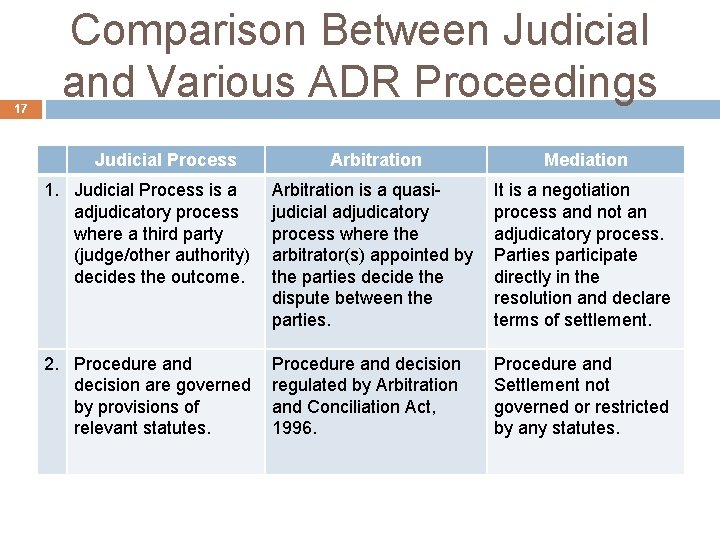
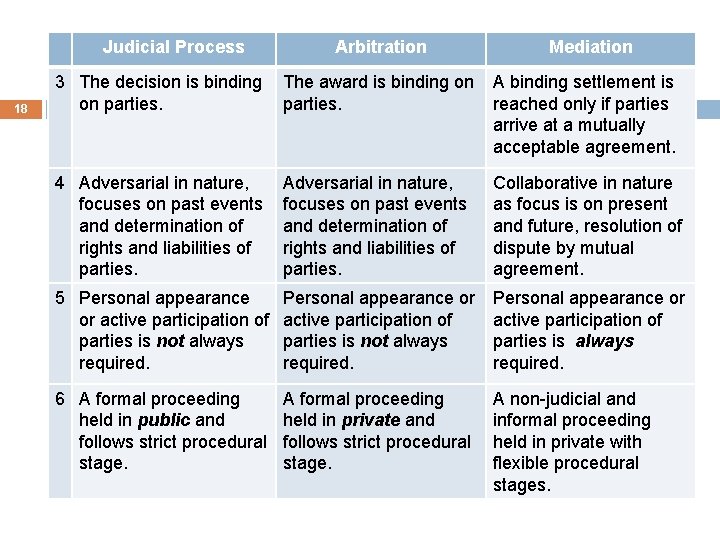
17 Comparison Between Judicial and Various ADR Proceedings Judicial Process Arbitration Mediation 1. Judicial Process is a adjudicatory process where a third party (judge/other authority) decides the outcome. Arbitration is a quasijudicial adjudicatory process where the arbitrator(s) appointed by the parties decide the dispute between the parties. It is a negotiation process and not an adjudicatory process. Parties participate directly in the resolution and declare terms of settlement. 2. Procedure and decision are governed by provisions of relevant statutes. Procedure and decision regulated by Arbitration and Conciliation Act, 1996. Procedure and Settlement not governed or restricted by any statutes.
Judicial Process 18 Arbitration Mediation 3 The decision is binding on parties. The award is binding on parties. A binding settlement is reached only if parties arrive at a mutually acceptable agreement. 4 Adversarial in nature, focuses on past events and determination of rights and liabilities of parties. Collaborative in nature as focus is on present and future, resolution of dispute by mutual agreement. 5 Personal appearance or active participation of parties is not always required. Personal appearance or active participation of parties is always required. 6 A formal proceeding held in public and follows strict procedural stage. A formal proceeding held in private and follows strict procedural stage. A non-judicial and informal proceeding held in private with flexible procedural stages.
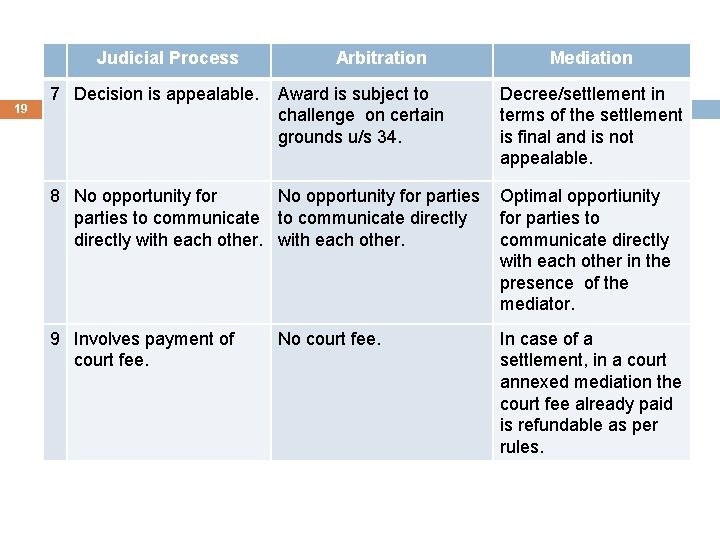
Judicial Process 19 7 Decision is appealable. Arbitration Award is subject to challenge on certain grounds u/s 34. Mediation Decree/settlement in terms of the settlement is final and is not appealable. 8 No opportunity for parties to communicate directly with each other. Optimal opportiunity for parties to communicate directly with each other in the presence of the mediator. 9 Involves payment of court fee. In case of a settlement, in a court annexed mediation the court fee already paid is refundable as per rules. No court fee.
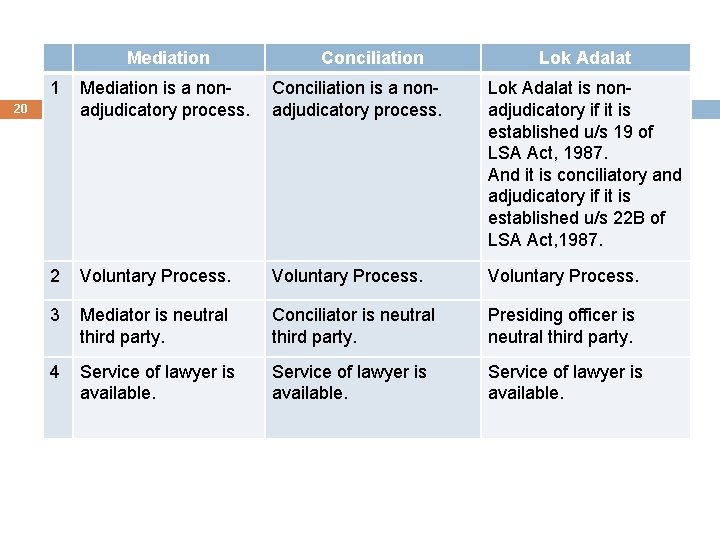
Mediation Conciliation Lok Adalat 1 Mediation is a nonadjudicatory process. Conciliation is a nonadjudicatory process. Lok Adalat is nonadjudicatory if it is established u/s 19 of LSA Act, 1987. And it is conciliatory and adjudicatory if it is established u/s 22 B of LSA Act, 1987. 2 Voluntary Process. 3 Mediator is neutral third party. Conciliator is neutral third party. Presiding officer is neutral third party. 4 Service of lawyer is available. 20
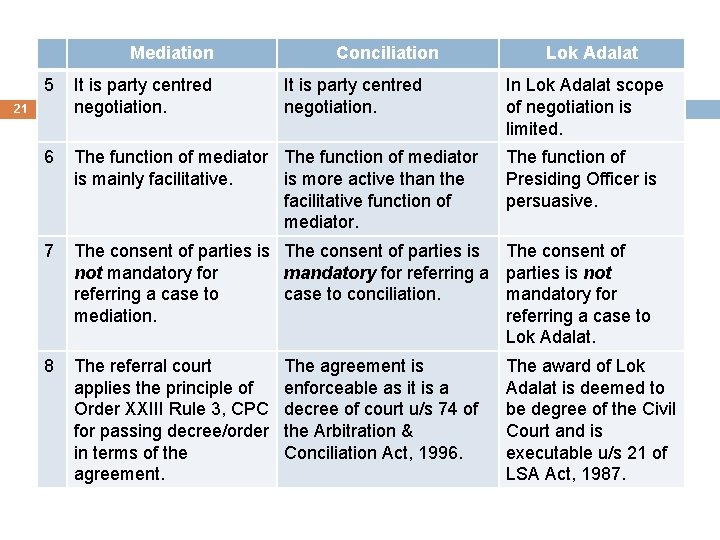
Mediation Conciliation 5 It is party centred negotiation. 6 The function of mediator is mainly facilitative. is more active than the facilitative function of mediator. The function of Presiding Officer is persuasive. 7 The consent of parties is not mandatory for referring a case to conciliation. mediation. The consent of parties is not mandatory for referring a case to Lok Adalat. 8 The referral court applies the principle of Order XXIII Rule 3, CPC for passing decree/order in terms of the agreement. The award of Lok Adalat is deemed to be degree of the Civil Court and is executable u/s 21 of LSA Act, 1987. 21 It is party centred negotiation. Lok Adalat The agreement is enforceable as it is a decree of court u/s 74 of the Arbitration & Conciliation Act, 1996. In Lok Adalat scope of negotiation is limited.
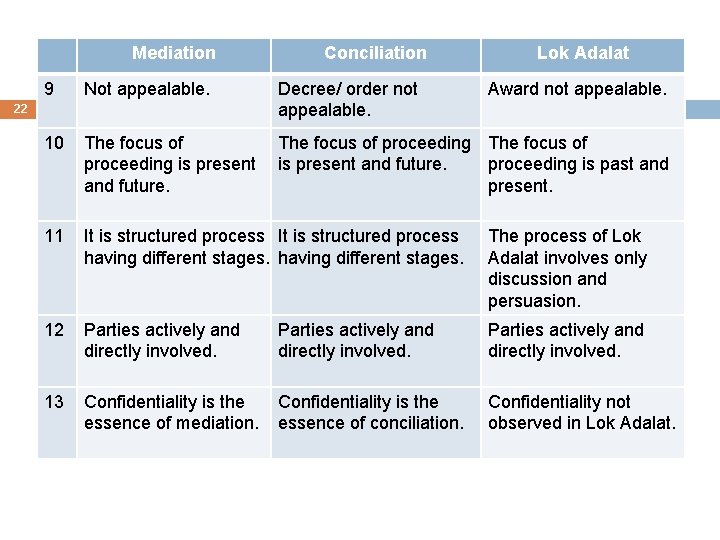
Mediation Conciliation Lok Adalat 9 Not appealable. Decree/ order not appealable. 10 The focus of proceeding is present and future. The focus of proceeding The focus of is present and future. proceeding is past and present. 11 It is structured process having different stages. The process of Lok Adalat involves only discussion and persuasion. 12 Parties actively and directly involved. 13 Confidentiality is the essence of mediation. Confidentiality is the essence of conciliation. Confidentiality not observed in Lok Adalat. 22 Award not appealable.
23 THANK Q