
1 ALFRED NZO DISTRICT MUNICIPALITY LOCAL ECONOMIC DEVELOPMENT


- Slides: 44
1
ALFRED NZO DISTRICT MUNICIPALITY LOCAL ECONOMIC DEVELOPMENT STRATEGY 2
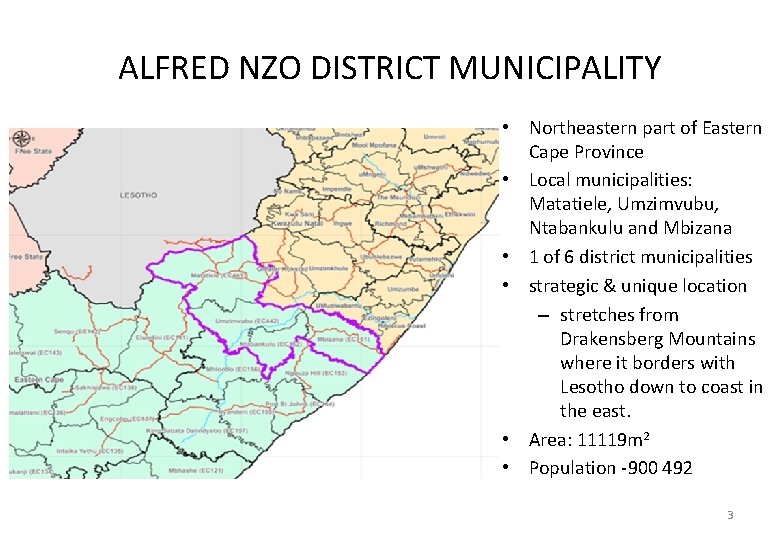
ALFRED NZO DISTRICT MUNICIPALITY • Northeastern part of Eastern Cape Province • Local municipalities: Matatiele, Umzimvubu, Ntabankulu and Mbizana • 1 of 6 district municipalities • strategic & unique location – stretches from Drakensberg Mountains where it borders with Lesotho down to coast in the east. • Area: 11119 m 2 • Population -900 492 3
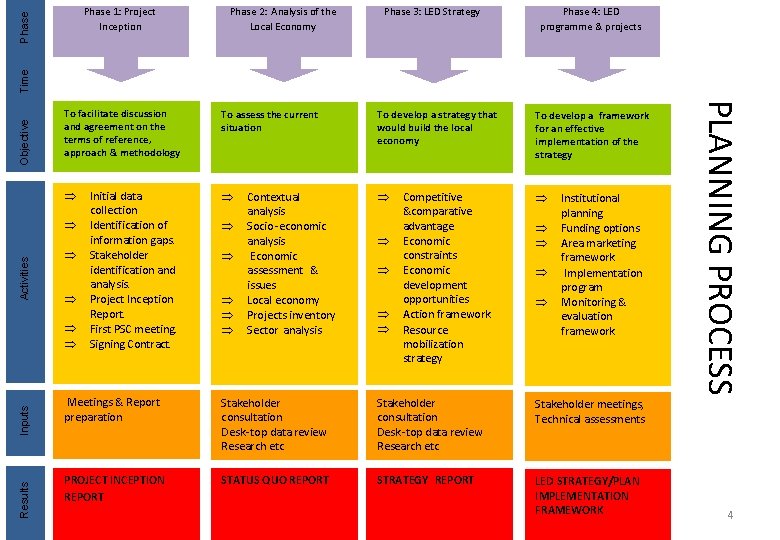
Time Phase 1: Project Inception Phase 2: Analysis of the Local Economy Objective To assess the current situation Phase 4: LED programme & projects Month 2 3 To develop a strategy that would build the local economy To develop a framework for an effective implementation of the strategy Þ Activities Þ Þ Initial data collection Identification of information gaps. Stakeholder identification and analysis. Project Inception Report. First PSC meeting. Signing Contract. Þ Þ Þ Inputs Meetings & Report preparation PROJECT INCEPTION REPORT Contextual analysis Socio -economic analysis Economic assessment & issues Local economy Projects inventory Sector analysis Þ Þ Þ Competitive &comparative advantage Economic constraints Economic development opportunities Action framework Resource mobilization strategy Þ Þ Þ Institutional planning Funding options Area marketing framework Implementation program Monitoring & evaluation framework Stakeholder consultation Desk -top data review Research etc Stakeholder meetings, Technical assessments STATUS QUO REPORT STRATEGY REPORT LED STRATEGY/PLAN IMPLEMENTATION FRAMEWORK PLANNING PROCESS To facilitate discussion and agreement on the terms of reference, approach & methodology Phase 3: LED Strategy Month 1 -2 Þ Results 4
LED MANDATE • Mandate in terms of Constitution of the Republic of SA – to promote social and economic development • White Paper on Local Government - ‘developmental local government’ – identifies local economic development -key performance areas mandate is executed, among others, in terms of the Local Government: Municipal Systems Act, 2000 (Act No. 32 of 2000) • ANDM IDP – identifies, inter alia, LED as key performance area – & strategic intervention for promoting socio-economic development, alleviating poverty and improving the quality of life 5
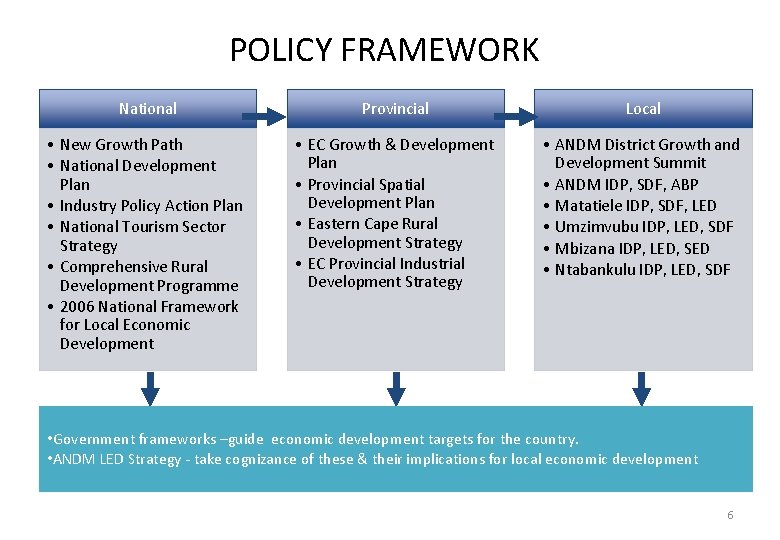
POLICY FRAMEWORK National Provincial Local • New Growth Path • National Development Plan • Industry Policy Action Plan • National Tourism Sector Strategy • Comprehensive Rural Development Programme • 2006 National Framework for Local Economic Development • EC Growth & Development Plan • Provincial Spatial Development Plan • Eastern Cape Rural Development Strategy • EC Provincial Industrial Development Strategy • ANDM District Growth and Development Summit • ANDM IDP, SDF, ABP • Matatiele IDP, SDF, LED • Umzimvubu IDP, LED, SDF • Mbizana IDP, LED, SED • Ntabankulu IDP, LED, SDF • Government frameworks –guide economic development targets for the country. • ANDM LED Strategy - take cognizance of these & their implications for local economic development 6
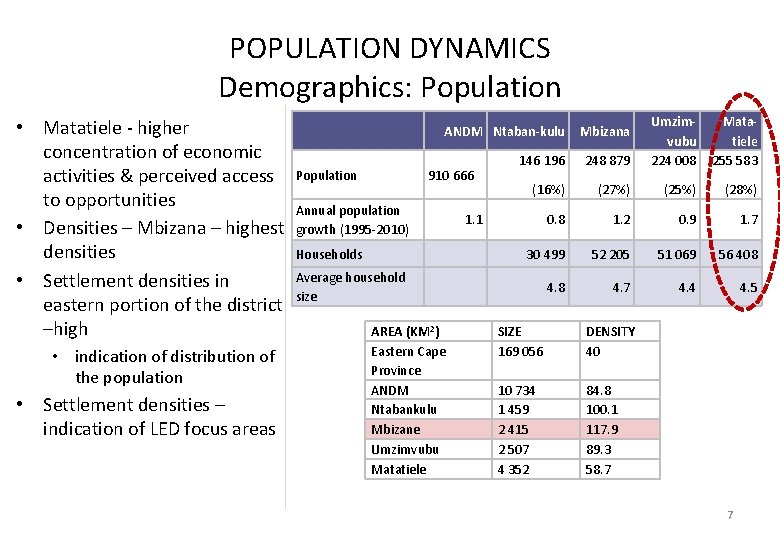
POPULATION DYNAMICS Demographics: Population • Matatiele - higher concentration of economic activities & perceived access to opportunities • Densities – Mbizana – highest densities • Settlement densities in eastern portion of the district –high • indication of distribution of the population • Settlement densities – indication of LED focus areas Population 248 879 Umzimvubu 224 008 Matatiele 255 583 (16%) (27%) (25%) (28%) 0. 8 1. 2 0. 9 1. 7 ANDM Ntaban-kulu Mbizana 146 196 910 666 Annual population growth (1995 -2010) Households 1. 1 30 499 52 205 Average household size AREA (KM 2) Eastern Cape Province ANDM Ntabankulu Mbizane Umzimvubu Matatiele 4. 8 4. 7 SIZE 169 056 DENSITY 40 10 734 1 459 2 415 2 507 4 352 84. 8 100. 1 117. 9 89. 3 58. 7 51 069 56 408 4. 4 4. 5 7
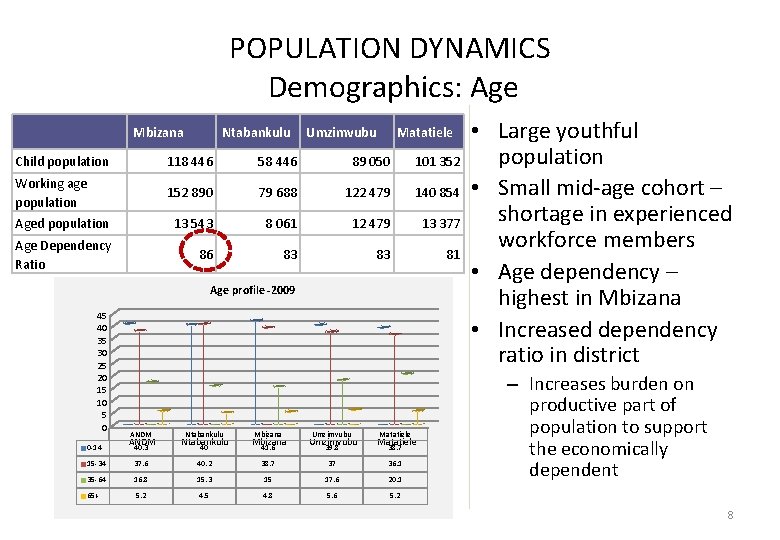
POPULATION DYNAMICS Demographics: Age Mbizana Ntabankulu Umzimvubu Child population 118 446 58 446 89 050 Working age population 152 890 79 688 122 479 13 543 8 061 12 479 86 83 Aged population Age Dependency Ratio Age profile -2009 45 40 35 30 25 20 15 10 5 0 ANDM Ntabankulu Mbizana Umzimvubu • Large youthful population 101 352 140 854 • Small mid-age cohort – shortage in experienced 13 377 workforce members 81 • Age dependency – highest in Mbizana • Increased dependency ratio in district Matatiele ANDM Ntabankulu Mbizana Umzimvubu Matatiele 15 -34 37. 6 40. 2 38. 7 37 36. 1 35 -64 16. 8 15. 3 15 17. 6 20. 1 65+ 5. 2 4. 5 4. 8 5. 6 5. 2 0 -14 40. 3 40 41. 6 39. 8 38. 7 – Increases burden on productive part of population to support the economically dependent 8
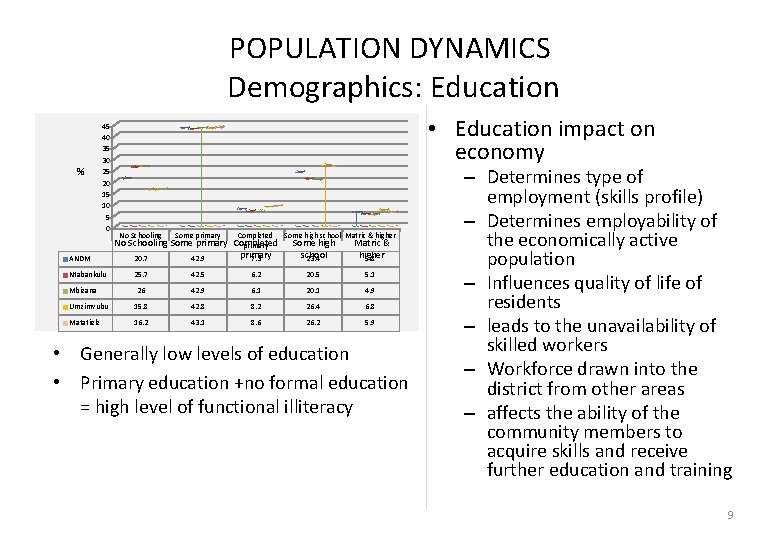
POPULATION DYNAMICS Demographics: Education % 45 40 35 30 25 20 15 10 5 0 • Education impact on economy No Schooling Some primary Completed 25. 7 42. 5 6. 2 20. 5 5. 1 26 42. 9 6. 1 20. 1 4. 9 Umzimvubu 15. 8 42. 8 8. 2 26. 4 6. 8 Matatiele 16. 2 43. 1 8. 6 26. 2 5. 9 ANDM Ntabankulu Mbizana No Schooling Some primary Completed primary 20. 7 42. 9 7. 3 Some high school Matric & higher Some high school 23. 4 Matric & higher 5. 8 • Generally low levels of education • Primary education +no formal education = high level of functional illiteracy – Determines type of employment (skills profile) – Determines employability of the economically active population – Influences quality of life of residents – leads to the unavailability of skilled workers – Workforce drawn into the district from other areas – affects the ability of the community members to acquire skills and receive further education and training 9
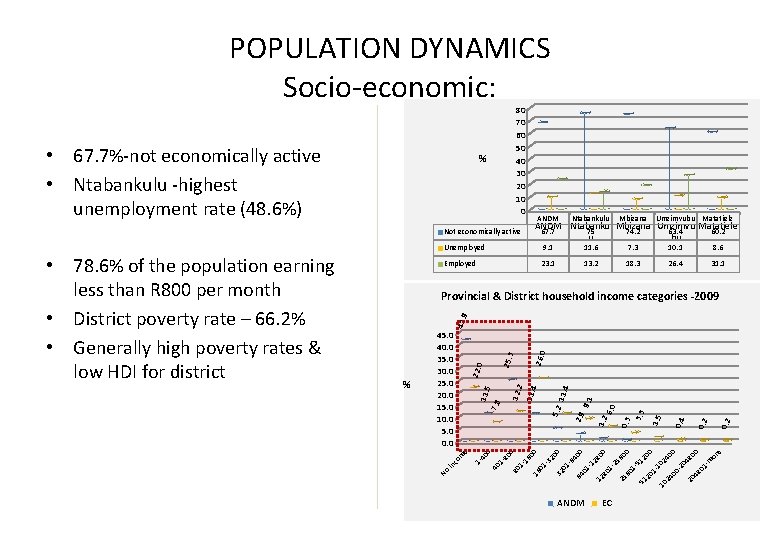
POPULATION DYNAMICS Socio-economic: • 67. 7%-not economically active • Ntabankulu -highest unemployment rate (48. 6%) 80 70 60 50 40 30 20 10 0 % Unemployed Ntabankulu Mbizana 9. 1 11. 6 7. 3 10. 1 8. 6 23. 1 13. 2 18. 3 26. 4 31. 1 Employed Umzimvubu Matatiele EC e 0. 2 48 01 -m or 0 80 20 10 24 00 -2 04 24 00 0. 4 1. 5 3. 3 0 20 110 51 20 151 60 25 80 125 60 0 0. 3 6. 0 9. 1 1. 2 00 ANDM 12 01 -1 28 40 -6 01 32 -3 20 0 0 2. 9 5. 2 11. 4 01 16 00 0 1 - 80 140 80 16 64 25. 3 12. 2 22. 0 11. 5 7. 8 0 40 1 - e m co in % 45. 0 40. 0 35. 0 30. 0 25. 0 20. 0 15. 0 10. 0 5. 0 0. 0 26. 0 41. 9 Provincial & District household income categories -2009 No • 78. 6% of the population earning less than R 800 per month • District poverty rate – 66. 2% • Generally high poverty rates & low HDI for district ANDM Ntabankul Mbizana Umzimvu Matatiele 67. 7 75 74. 2 63. 4 60. 2 u bu Not economically active 10
ACCESS TO BASIC INFRASTRUCTURE • District - weak enabling environment – Refers to availability if service delivery and infrastructure – critical to attract investment opportunities to the area • Refuse - largest number of households have own refuse dump • Sanitation – majority has pit latrines • Water disparities between urban & rural – Strong dependence on dams, springs, rivers as water source • Access to electricity remains a challenge • Road network exist – Regular upgrade & maintenance required 11
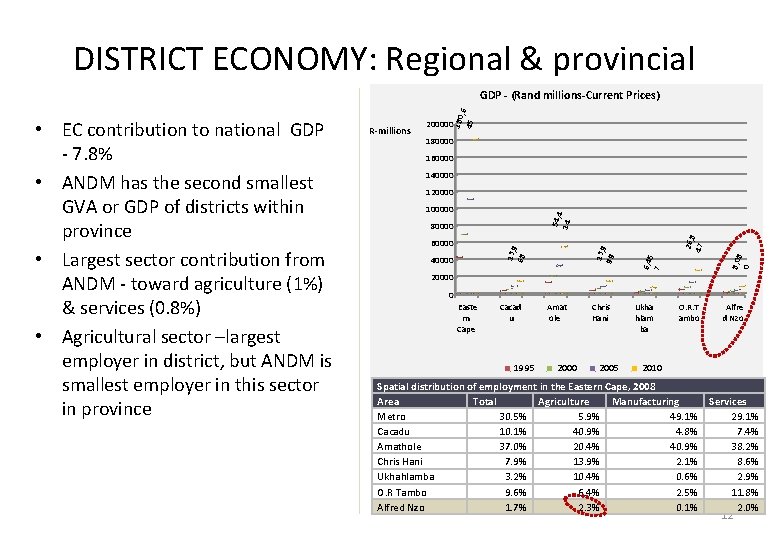
DISTRICT ECONOMY: Regional & provincial R-millions 200000 180000 160000 140000 120000 13, 9 99 40000 20000 8, 0 8 0 60000 6, 4 5 7 80000 26, 8 47 54, 4 14 100000 13, 9 68 • EC contribution to national GDP - 7. 8% • ANDM has the second smallest GVA or GDP of districts within province • Largest sector contribution from ANDM - toward agriculture (1%) & services (0. 8%) • Agricultural sector –largest employer in district, but ANDM is smallest employer in this sector in province 180 , 6 45 GDP - (Rand millions-Current Prices) 0 Easte rn Cape Cacad u 1995 Amat ole 2000 Chris Hani 2005 Ukha hlam ba O. R. T ambo Alfre d Nzo 2010 Spatial distribution of employment in the Eastern Cape, 2008 Area Total Agriculture Manufacturing Metro 30. 5% 5. 9% 49. 1% Cacadu 10. 1% 40. 9% 4. 8% Amathole 37. 0% 20. 4% 40. 9% Chris Hani 7. 9% 13. 9% 2. 1% Ukhahlamba 3. 2% 10. 4% 0. 6% O. R Tambo 9. 6% 6. 4% 2. 5% Alfred Nzo 1. 7% 2. 3% 0. 1% Services 29. 1% 7. 4% 38. 2% 8. 6% 2. 9% 11. 8% 2. 0% 12
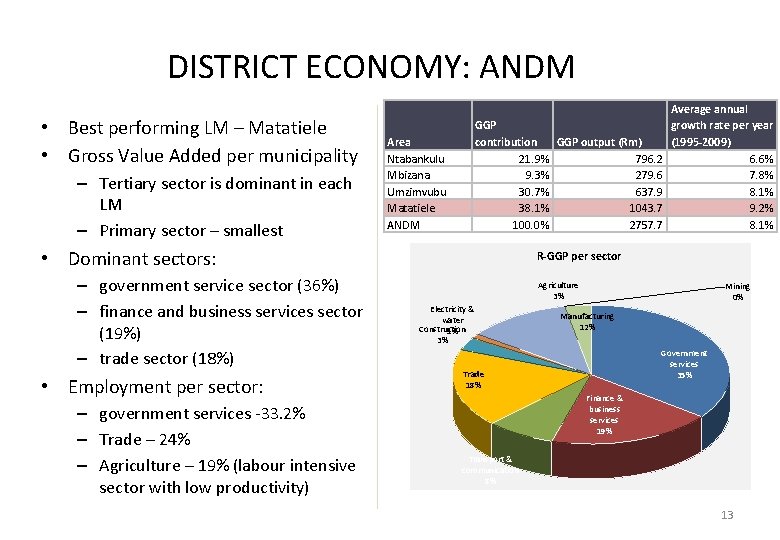
DISTRICT ECONOMY: ANDM • Best performing LM – Matatiele • Gross Value Added per municipality – Tertiary sector is dominant in each LM – Primary sector – smallest Area Ntabankulu Mbizana Umzimvubu Matatiele ANDM GGP contribution GGP output (Rm) 21. 9% 796. 2 9. 3% 279. 6 30. 7% 637. 9 38. 1% 1043. 7 100. 0% 2757. 7 • Dominant sectors: – government service sector (36%) – finance and business services sector (19%) – trade sector (18%) • Employment per sector: – government services -33. 2% – Trade – 24% – Agriculture – 19% (labour intensive sector with low productivity) Average annual growth rate per year (1995 -2009) 6. 6% 7. 8% 8. 1% 9. 2% 8. 1% R-GGP per sector Agriculture 3% Electricity & water Construction 1% 3% Mining 0% Manufacturing 12% Government services 35% Trade 18% Finance & business services 19% Transport & communication 8% 13
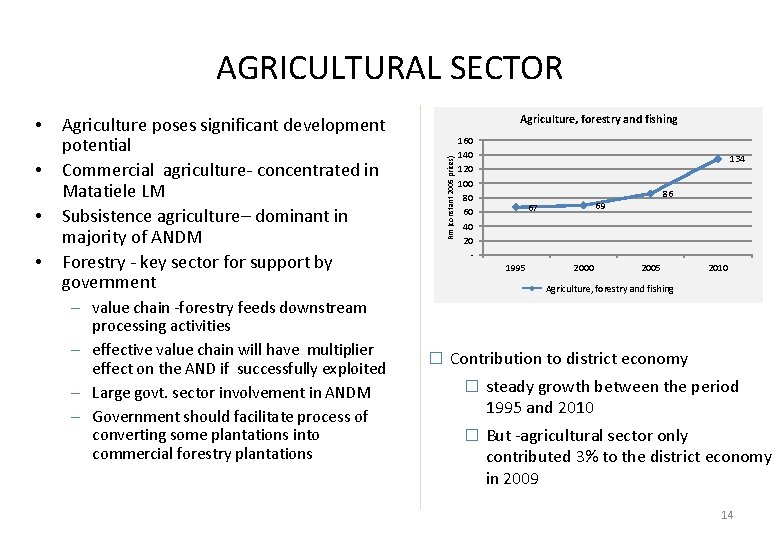
AGRICULTURAL SECTOR • • • Agriculture poses significant development potential Commercial agriculture- concentrated in Matatiele LM Subsistence agriculture– dominant in majority of ANDM Forestry - key sector for support by government – value chain -forestry feeds downstream processing activities – effective value chain will have multiplier effect on the AND if successfully exploited – Large govt. sector involvement in ANDM – Government should facilitate process of converting some plantations into commercial forestry plantations Agriculture, forestry and fishing Rm (constant 2005 prices) • 160 140 120 100 80 60 40 20 - 134 67 1995 69 2000 86 2005 2010 Agriculture, forestry and fishing � Contribution to district economy � steady growth between the period 1995 and 2010 � But -agricultural sector only contributed 3% to the district economy in 2009 14
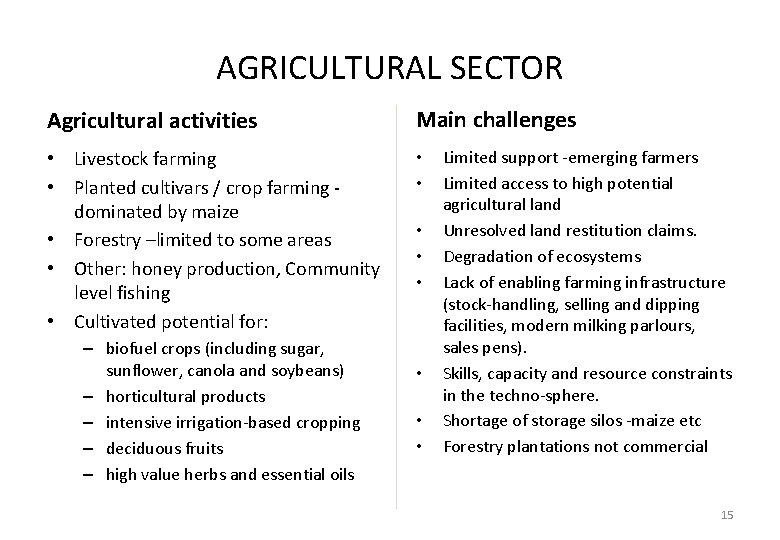
AGRICULTURAL SECTOR Agricultural activities Main challenges • Livestock farming • Planted cultivars / crop farming dominated by maize • Forestry –limited to some areas • Other: honey production, Community level fishing • Cultivated potential for: • • – biofuel crops (including sugar, sunflower, canola and soybeans) – horticultural products – intensive irrigation-based cropping – deciduous fruits – high value herbs and essential oils • • • Limited support -emerging farmers Limited access to high potential agricultural land Unresolved land restitution claims. Degradation of ecosystems Lack of enabling farming infrastructure (stock-handling, selling and dipping facilities, modern milking parlours, sales pens). Skills, capacity and resource constraints in the techno-sphere. Shortage of storage silos -maize etc Forestry plantations not commercial 15
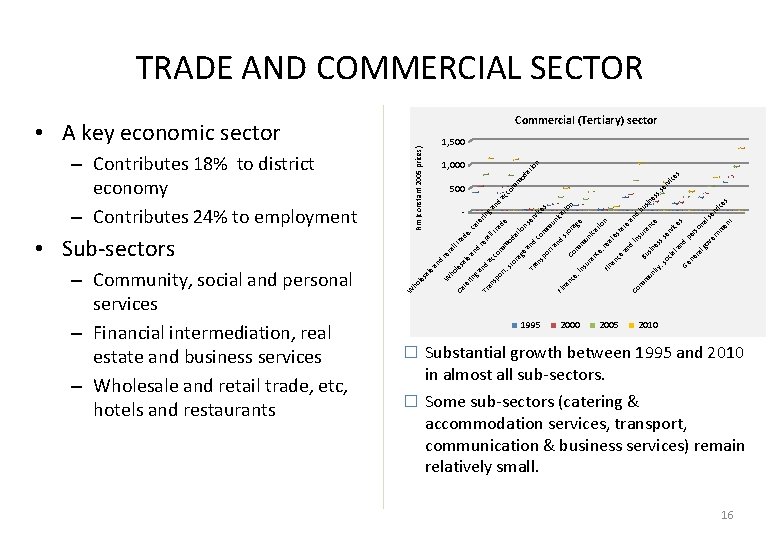
TRADE AND COMMERCIAL SECTOR Commercial (Tertiary) sector 1, 500 Rm (constant 2005 prices) – Contributes 18% to district economy – Contributes 24% to employment 1, 000 500 - W ho l es al e an • Sub-sectors – Community, social and personal services – Financial intermediation, real estate and business services – Wholesale and retail trade, etc, hotels and restaurants d re ta il t le C ra sa at de le er , c an in at g a d er re nd T in t ra ai ac g a ns l t c nd ra po om d ac rt, e m co st od m or a m tio ag od e n an at se Tr io r d v an co n ice sp m s or m t a un nd ica Fi na st tio or nc C n om ag e, in e m su un ra ica nc tio e, re n Fi al na e nc s ta e te an an d C i d ns om bu u B ra m us sin nc un in es e es ity s s , s er oc er vic v ia ice es l a s n G d pe en rs er on al go al se ve rv rn ice m en s t • A key economic sector 1995 2000 2005 2010 � Substantial growth between 1995 and 2010 in almost all sub-sectors. � Some sub-sectors (catering & accommodation services, transport, communication & business services) remain relatively small. 16
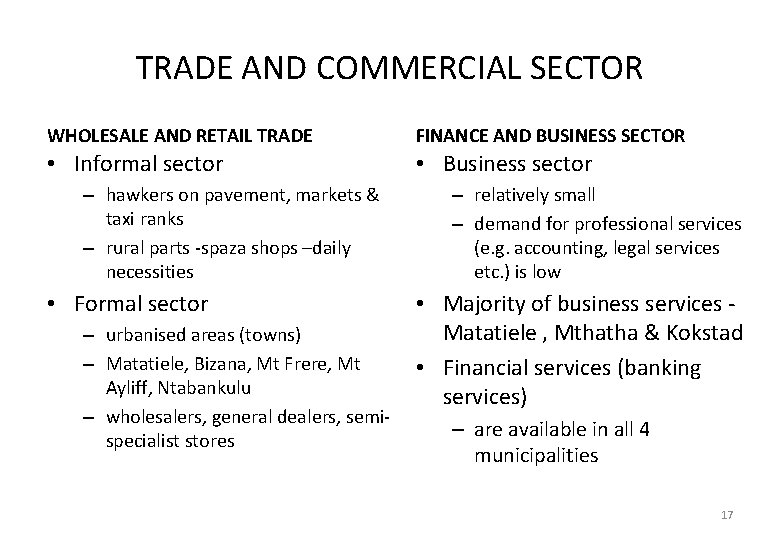
TRADE AND COMMERCIAL SECTOR WHOLESALE AND RETAIL TRADE FINANCE AND BUSINESS SECTOR • Informal sector • Business sector – hawkers on pavement, markets & taxi ranks – rural parts -spaza shops –daily necessities • Formal sector – urbanised areas (towns) – Matatiele, Bizana, Mt Frere, Mt Ayliff, Ntabankulu – wholesalers, general dealers, semispecialist stores – relatively small – demand for professional services (e. g. accounting, legal services etc. ) is low • Majority of business services Matatiele , Mthatha & Kokstad • Financial services (banking services) – are available in all 4 municipalities 17
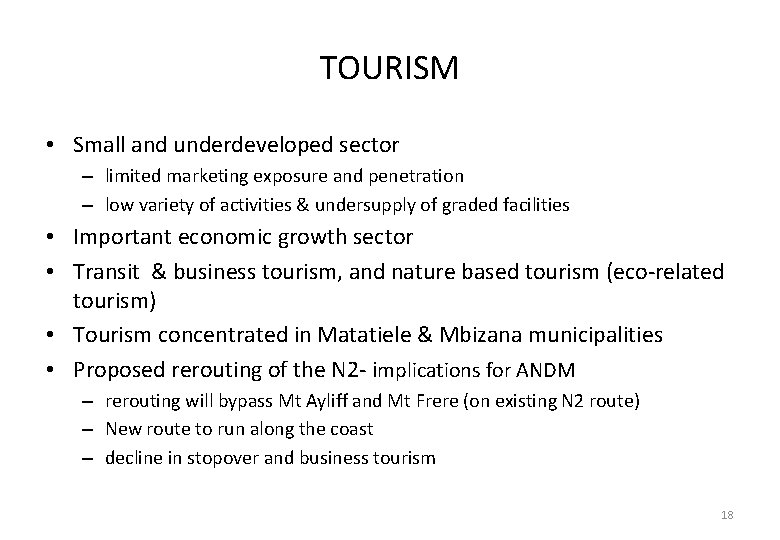
TOURISM • Small and underdeveloped sector – limited marketing exposure and penetration – low variety of activities & undersupply of graded facilities • Important economic growth sector • Transit & business tourism, and nature based tourism (eco-related tourism) • Tourism concentrated in Matatiele & Mbizana municipalities • Proposed rerouting of the N 2 - implications for ANDM – rerouting will bypass Mt Ayliff and Mt Frere (on existing N 2 route) – New route to run along the coast – decline in stopover and business tourism 18
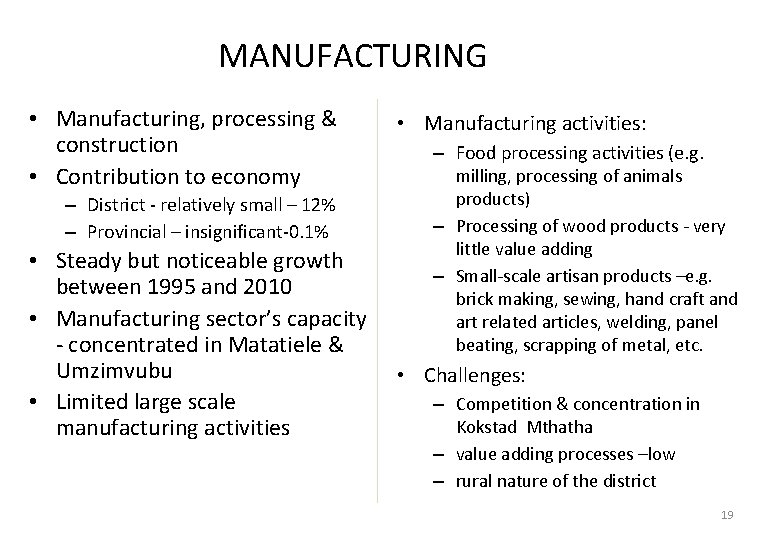
MANUFACTURING • Manufacturing, processing & construction • Contribution to economy – District - relatively small – 12% – Provincial – insignificant-0. 1% • Steady but noticeable growth between 1995 and 2010 • Manufacturing sector’s capacity - concentrated in Matatiele & Umzimvubu • Limited large scale manufacturing activities • Manufacturing activities: – Food processing activities (e. g. milling, processing of animals products) – Processing of wood products - very little value adding – Small-scale artisan products –e. g. brick making, sewing, hand craft and art related articles, welding, panel beating, scrapping of metal, etc. • Challenges: – Competition & concentration in Kokstad Mthatha – value adding processes –low – rural nature of the district 19
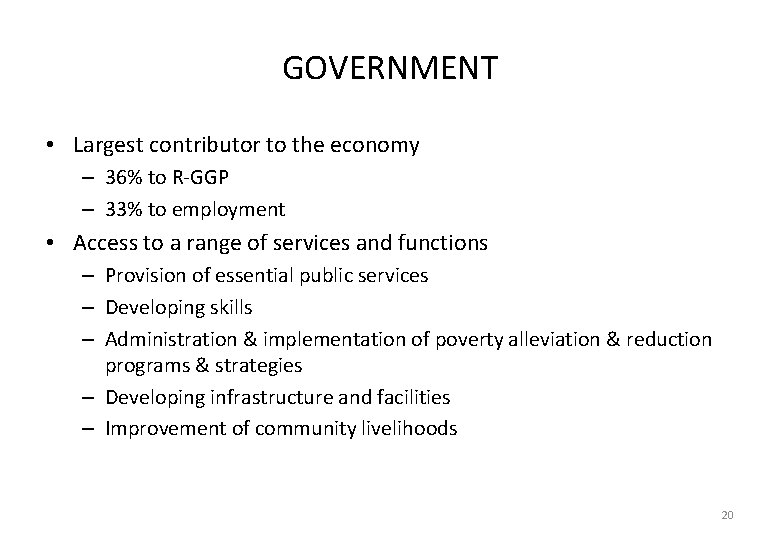
GOVERNMENT • Largest contributor to the economy – 36% to R-GGP – 33% to employment • Access to a range of services and functions – Provision of essential public services – Developing skills – Administration & implementation of poverty alleviation & reduction programs & strategies – Developing infrastructure and facilities – Improvement of community livelihoods 20
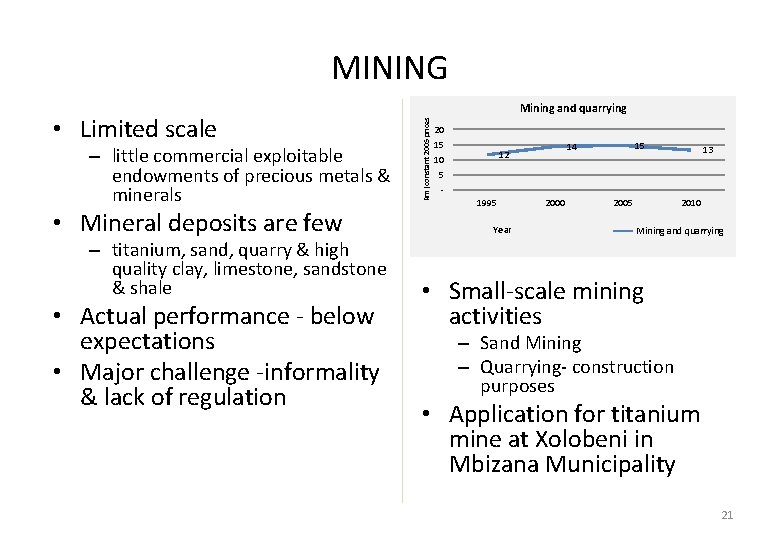
MINING – little commercial exploitable endowments of precious metals & minerals • Mineral deposits are few – titanium, sand, quarry & high quality clay, limestone, sandstone & shale • Actual performance - below expectations • Major challenge -informality & lack of regulation Rm (constant 2005 prices • Limited scale Mining and quarrying 20 15 10 12 14 15 13 5 1995 Year 2000 2005 2010 Mining and quarrying • Small-scale mining activities – Sand Mining – Quarrying- construction purposes • Application for titanium mine at Xolobeni in Mbizana Municipality 21
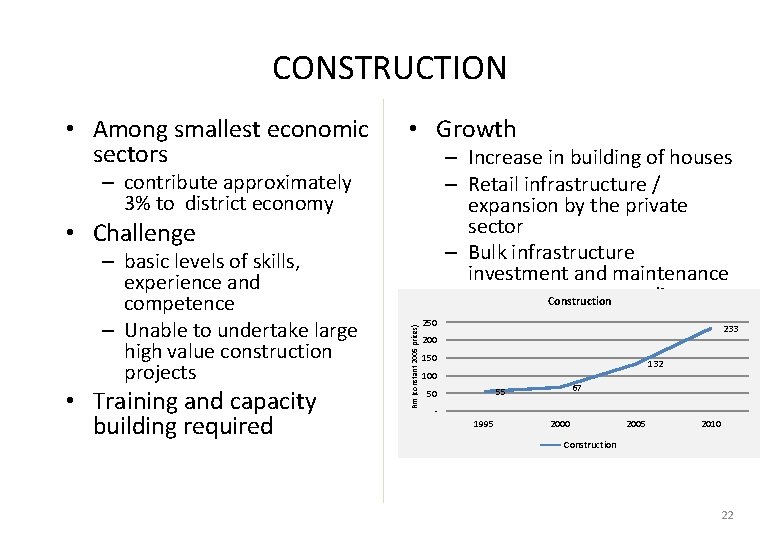
CONSTRUCTION • Among smallest economic sectors • Growth – Increase in building of houses – Retail infrastructure / expansion by the private sector – Bulk infrastructure investment and maintenance - government expenditure Construction – contribute approximately 3% to district economy – basic levels of skills, experience and competence – Unable to undertake large high value construction projects • Training and capacity building required Rm (constant 2005 prices) • Challenge 250 233 200 150 132 100 50 55 67 1995 2000 2005 2010 Construction 22
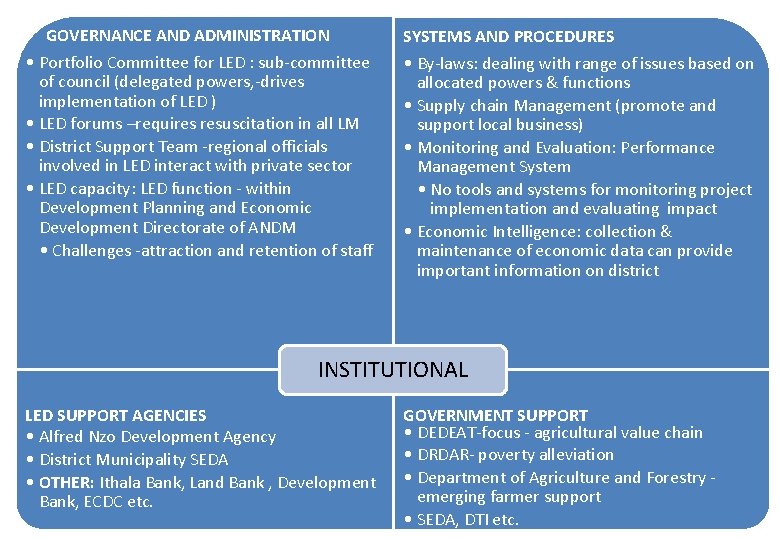
GOVERNANCE AND ADMINISTRATION • Portfolio Committee for LED : sub-committee of council (delegated powers, -drives implementation of LED ) • LED forums –requires resuscitation in all LM • District Support Team -regional officials involved in LED interact with private sector • LED capacity: LED function - within Development Planning and Economic Development Directorate of ANDM • Challenges -attraction and retention of staff SYSTEMS AND PROCEDURES • By-laws: dealing with range of issues based on allocated powers & functions • Supply chain Management (promote and support local business) • Monitoring and Evaluation: Performance Management System • No tools and systems for monitoring project implementation and evaluating impact • Economic Intelligence: collection & maintenance of economic data can provide important information on district INSTITUTIONAL LED SUPPORT AGENCIES • Alfred Nzo Development Agency • District Municipality SEDA • OTHER: Ithala Bank, Land Bank , Development Bank, ECDC etc. GOVERNMENT SUPPORT • DEDEAT-focus - agricultural value chain • DRDAR- poverty alleviation • Department of Agriculture and Forestry emerging farmer support • SEDA, DTI etc. 23
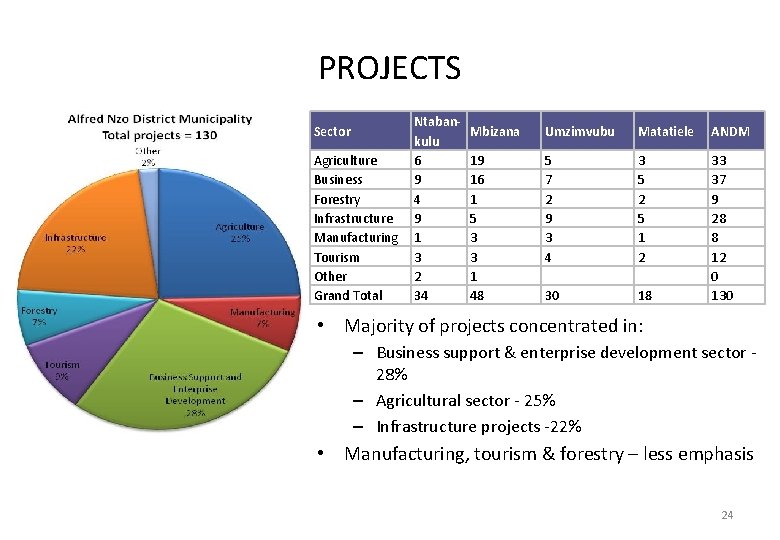
PROJECTS Sector Agriculture Business Forestry Infrastructure Manufacturing Tourism Other Grand Total Ntabankulu 6 9 4 9 1 3 2 34 Mbizana Umzimvubu Matatiele ANDM 19 16 1 5 3 3 1 48 5 7 2 9 3 4 30 3 5 2 5 1 2 18 33 37 9 28 8 12 0 130 • Majority of projects concentrated in: – Business support & enterprise development sector 28% – Agricultural sector - 25% – Infrastructure projects -22% • Manufacturing, tourism & forestry – less emphasis 24
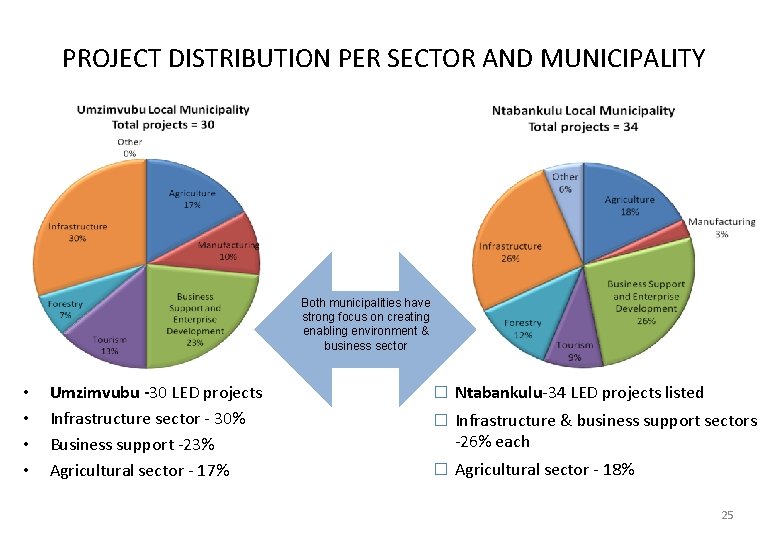
PROJECT DISTRIBUTION PER SECTOR AND MUNICIPALITY Both municipalities have strong focus on creating enabling environment & business sector • • Umzimvubu -30 LED projects Infrastructure sector - 30% Business support -23% Agricultural sector - 17% � Ntabankulu-34 LED projects listed � Infrastructure & business support sectors -26% each � Agricultural sector - 18% 25
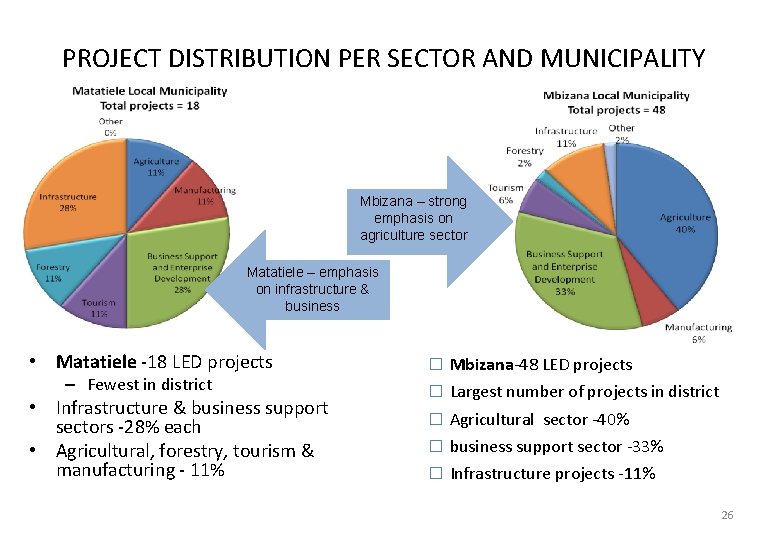
PROJECT DISTRIBUTION PER SECTOR AND MUNICIPALITY Mbizana – strong emphasis on agriculture sector Matatiele – emphasis on infrastructure & business • Matatiele -18 LED projects – Fewest in district • Infrastructure & business support sectors -28% each • Agricultural, forestry, tourism & manufacturing - 11% � Mbizana-48 LED projects � Largest number of projects in district � Agricultural sector -40% � business support sector -33% � Infrastructure projects -11% 26
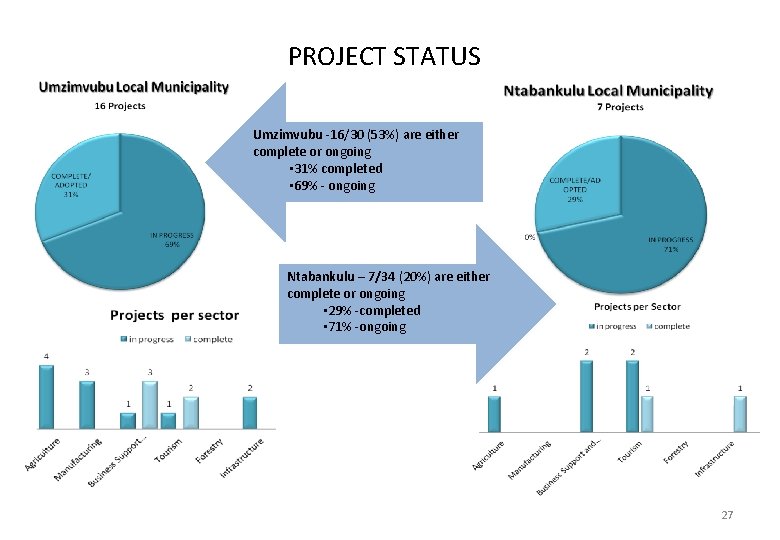
PROJECT STATUS Umzimvubu -16/30 (53%) are either complete or ongoing • 31% completed • 69% - ongoing Ntabankulu – 7/34 (20%) are either complete or ongoing • 29% -completed • 71% -ongoing 27
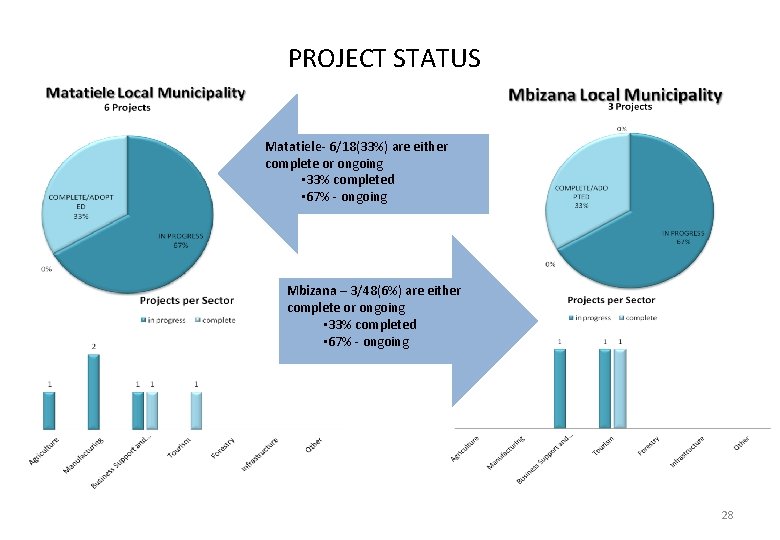
PROJECT STATUS Matatiele- 6/18(33%) are either complete or ongoing • 33% completed • 67% - ongoing Mbizana – 3/48(6%) are either complete or ongoing • 33% completed • 67% - ongoing 28
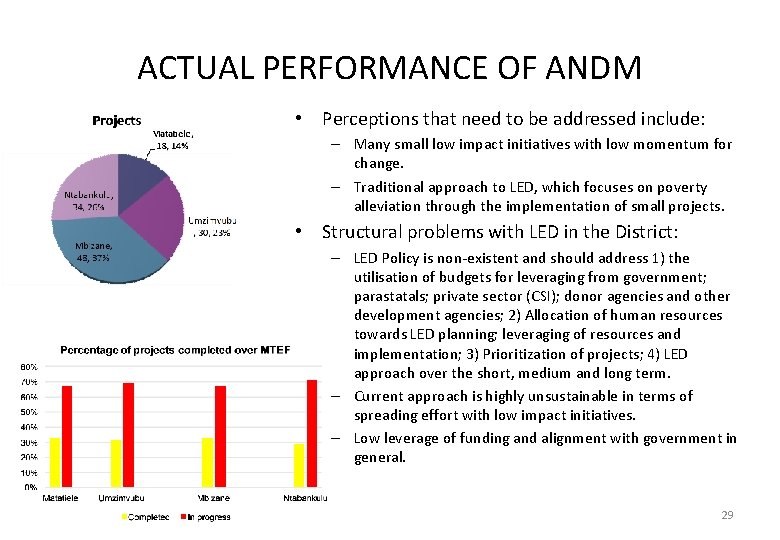
ACTUAL PERFORMANCE OF ANDM • Perceptions that need to be addressed include: – Many small low impact initiatives with low momentum for change. – Traditional approach to LED, which focuses on poverty alleviation through the implementation of small projects. • Structural problems with LED in the District: – LED Policy is non-existent and should address 1) the utilisation of budgets for leveraging from government; parastatals; private sector (CSI); donor agencies and other development agencies; 2) Allocation of human resources towards LED planning; leveraging of resources and implementation; 3) Prioritization of projects; 4) LED approach over the short, medium and long term. – Current approach is highly unsustainable in terms of spreading effort with low impact initiatives. – Low leverage of funding and alignment with government in general. 29
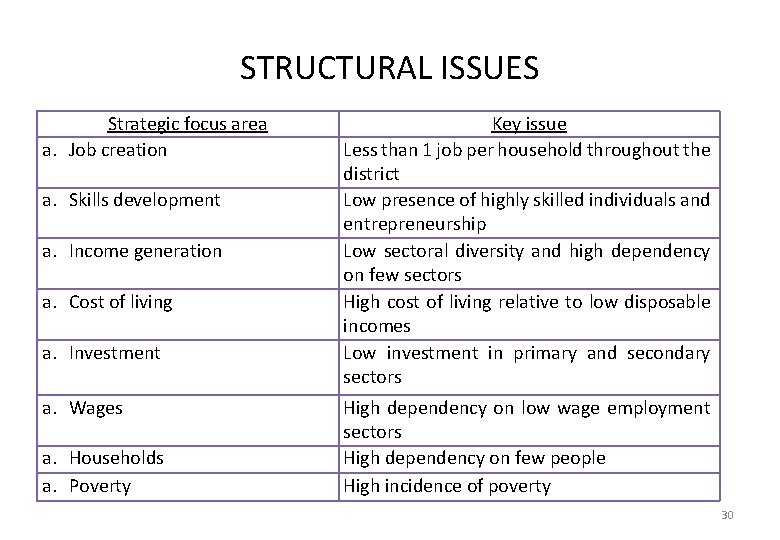
STRUCTURAL ISSUES Strategic focus area a. Job creation a. Skills development a. Income generation a. Cost of living a. Investment a. Wages a. Households a. Poverty Key issue Less than 1 job per household throughout the district Low presence of highly skilled individuals and entrepreneurship Low sectoral diversity and high dependency on few sectors High cost of living relative to low disposable incomes Low investment in primary and secondary sectors High dependency on low wage employment sectors High dependency on few people High incidence of poverty 30
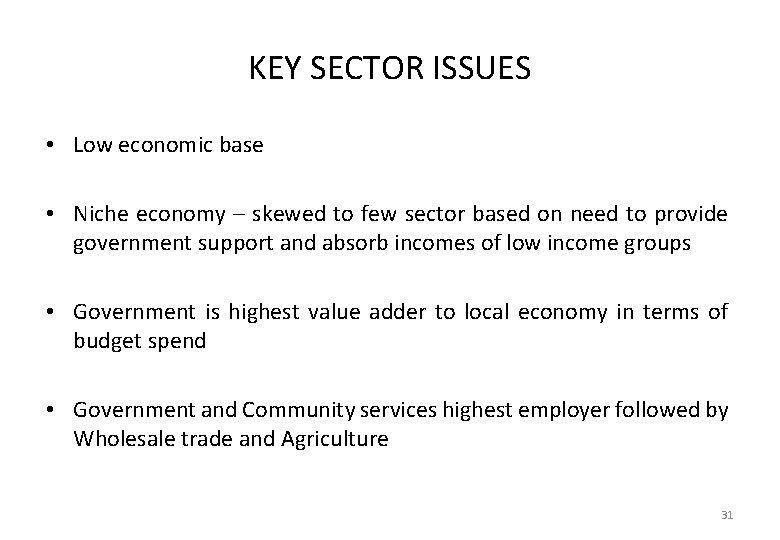
KEY SECTOR ISSUES • Low economic base • Niche economy – skewed to few sector based on need to provide government support and absorb incomes of low income groups • Government is highest value adder to local economy in terms of budget spend • Government and Community services highest employer followed by Wholesale trade and Agriculture 31
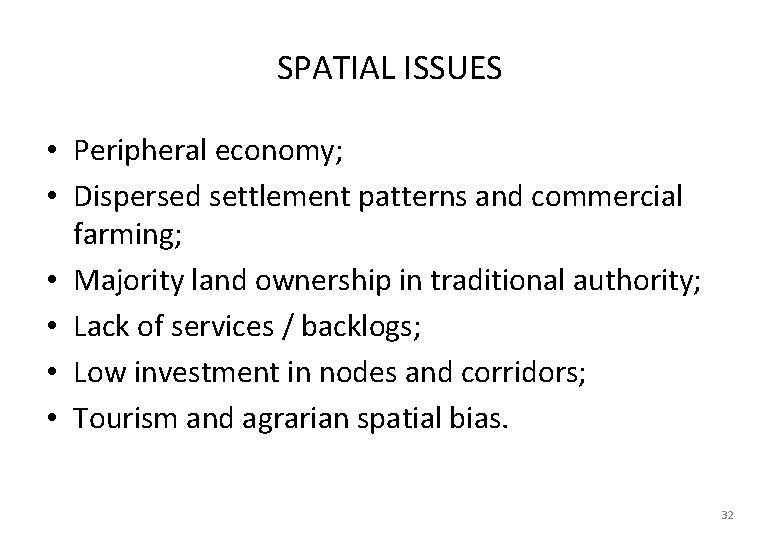
SPATIAL ISSUES • Peripheral economy; • Dispersed settlement patterns and commercial farming; • Majority land ownership in traditional authority; • Lack of services / backlogs; • Low investment in nodes and corridors; • Tourism and agrarian spatial bias. 32
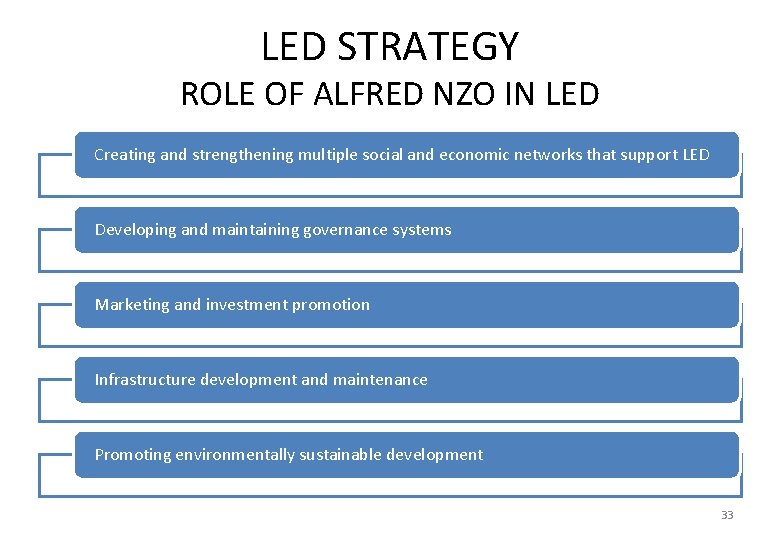
LED STRATEGY ROLE OF ALFRED NZO IN LED Creating and strengthening multiple social and economic networks that support LED Developing and maintaining governance systems Marketing and investment promotion Infrastructure development and maintenance Promoting environmentally sustainable development 33
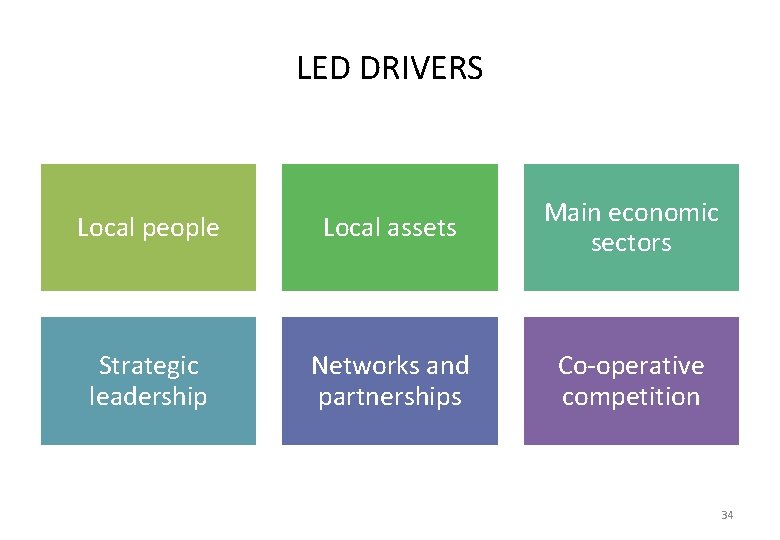
LED DRIVERS Local people Local assets Main economic sectors Strategic leadership Networks and partnerships Co-operative competition 34
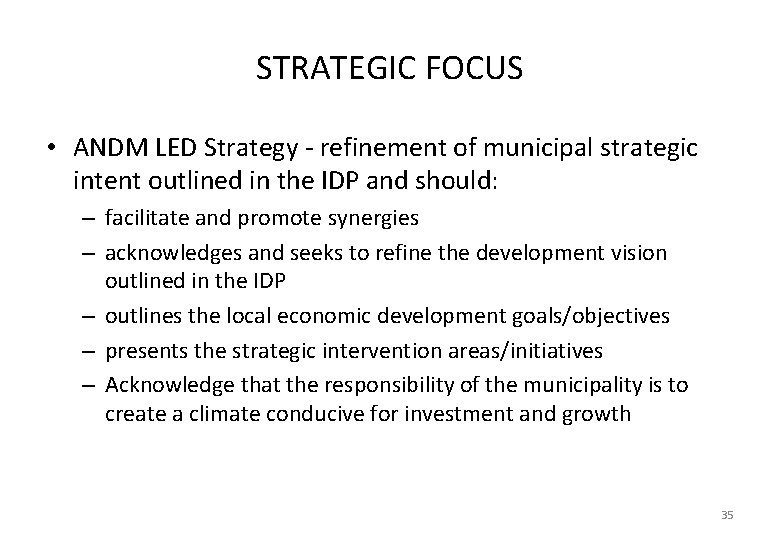
STRATEGIC FOCUS • ANDM LED Strategy - refinement of municipal strategic intent outlined in the IDP and should: – facilitate and promote synergies – acknowledges and seeks to refine the development vision outlined in the IDP – outlines the local economic development goals/objectives – presents the strategic intervention areas/initiatives – Acknowledge that the responsibility of the municipality is to create a climate conducive for investment and growth 35
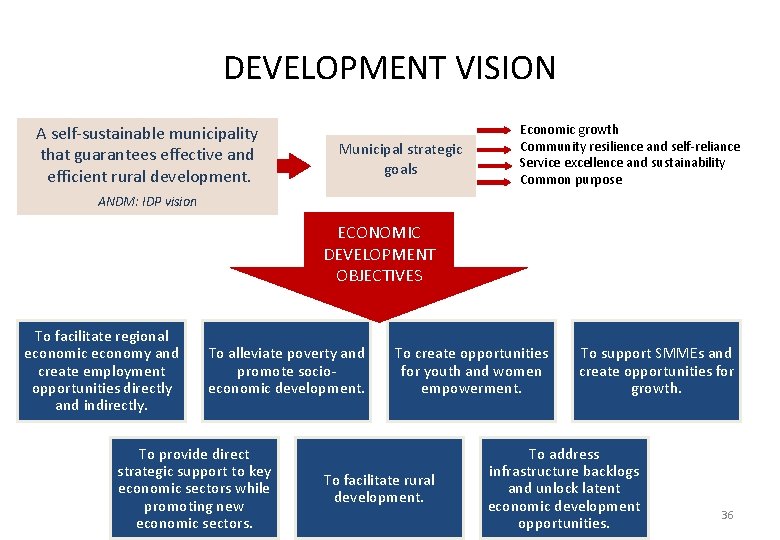
DEVELOPMENT VISION A self-sustainable municipality that guarantees effective and efficient rural development. Municipal strategic goals Economic growth Community resilience and self-reliance Service excellence and sustainability Common purpose ANDM: IDP vision ECONOMIC DEVELOPMENT OBJECTIVES To facilitate regional economic economy and create employment opportunities directly and indirectly. To alleviate poverty and promote socioeconomic development. To provide direct strategic support to key economic sectors while promoting new economic sectors. To create opportunities for youth and women empowerment. To facilitate rural development. To support SMMEs and create opportunities for growth. To address infrastructure backlogs and unlock latent economic development opportunities. 36
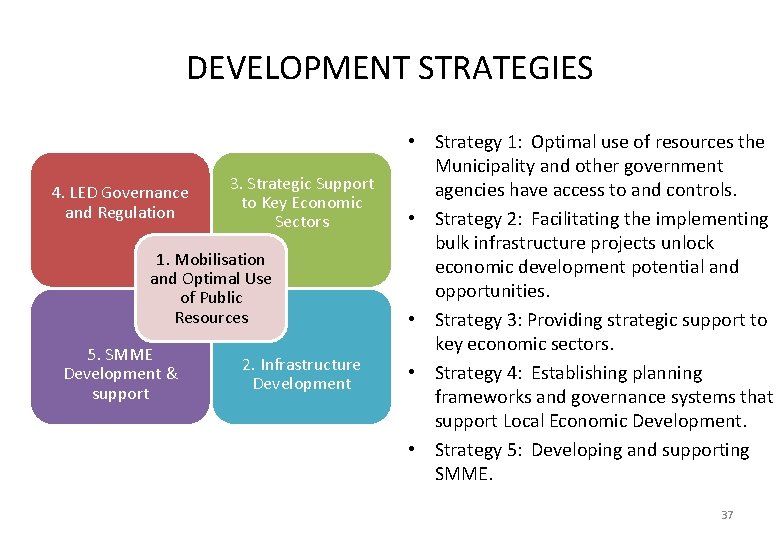
DEVELOPMENT STRATEGIES 4. LED Governance and Regulation 3. Strategic Support to Key Economic Sectors 1. Mobilisation and Optimal Use of Public Resources 5. SMME Development & support 2. Infrastructure Development • Strategy 1: Optimal use of resources the Municipality and other government agencies have access to and controls. • Strategy 2: Facilitating the implementing bulk infrastructure projects unlock economic development potential and opportunities. • Strategy 3: Providing strategic support to key economic sectors. • Strategy 4: Establishing planning frameworks and governance systems that support Local Economic Development. • Strategy 5: Developing and supporting SMME. 37
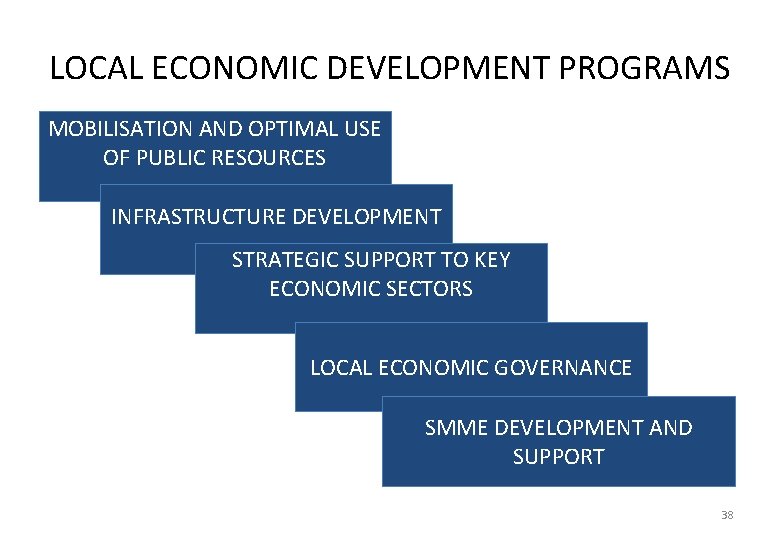
LOCAL ECONOMIC DEVELOPMENT PROGRAMS MOBILISATION AND OPTIMAL USE OF PUBLIC RESOURCES INFRASTRUCTURE DEVELOPMENT STRATEGIC SUPPORT TO KEY ECONOMIC SECTORS LOCAL ECONOMIC GOVERNANCE SMME DEVELOPMENT AND SUPPORT 38
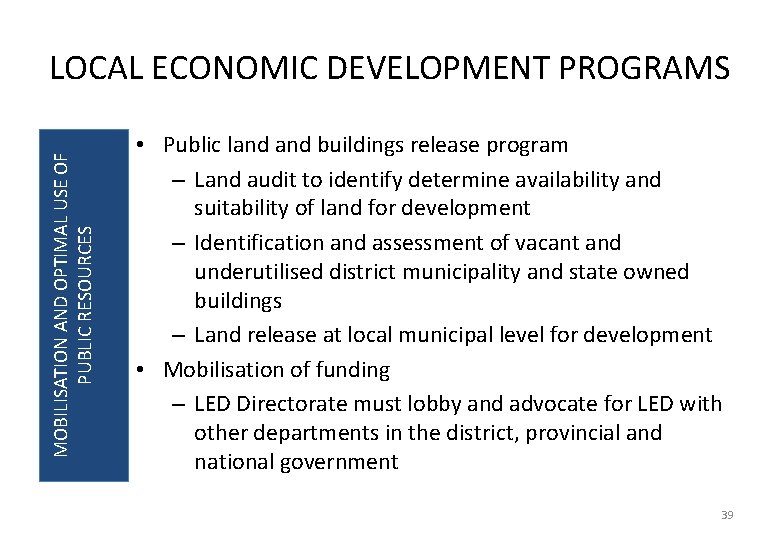
MOBILISATION AND OPTIMAL USE OF PUBLIC RESOURCES LOCAL ECONOMIC DEVELOPMENT PROGRAMS • Public land buildings release program – Land audit to identify determine availability and suitability of land for development – Identification and assessment of vacant and underutilised district municipality and state owned buildings – Land release at local municipal level for development • Mobilisation of funding – LED Directorate must lobby and advocate for LED with other departments in the district, provincial and national government 39
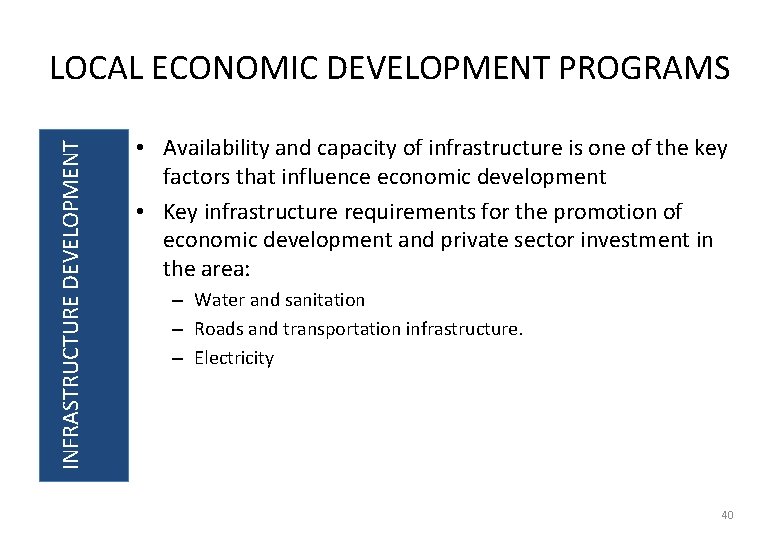
INFRASTRUCTURE DEVELOPMENT LOCAL ECONOMIC DEVELOPMENT PROGRAMS • Availability and capacity of infrastructure is one of the key factors that influence economic development • Key infrastructure requirements for the promotion of economic development and private sector investment in the area: – Water and sanitation – Roads and transportation infrastructure. – Electricity 40
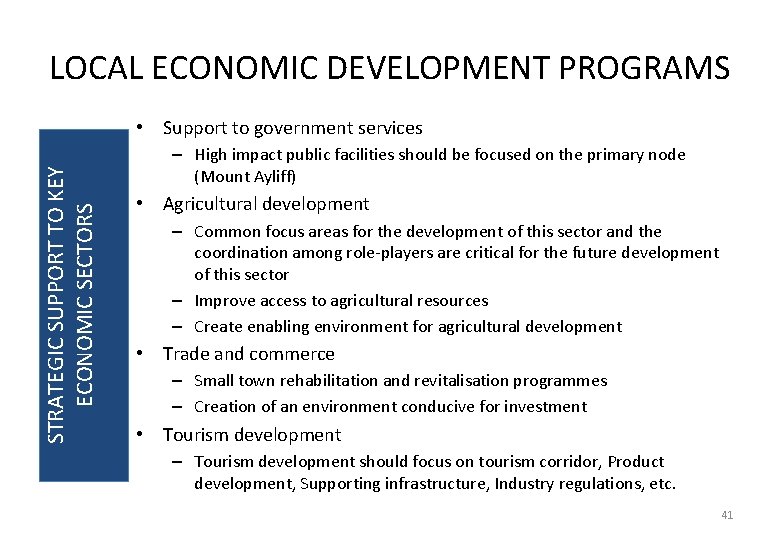
LOCAL ECONOMIC DEVELOPMENT PROGRAMS STRATEGIC SUPPORT TO KEY ECONOMIC SECTORS • Support to government services – High impact public facilities should be focused on the primary node (Mount Ayliff) • Agricultural development – Common focus areas for the development of this sector and the coordination among role-players are critical for the future development of this sector – Improve access to agricultural resources – Create enabling environment for agricultural development • Trade and commerce – Small town rehabilitation and revitalisation programmes – Creation of an environment conducive for investment • Tourism development – Tourism development should focus on tourism corridor, Product development, Supporting infrastructure, Industry regulations, etc. 41
LOCAL ECONOMIC GOVERNANCE LOCAL ECONOMIC DEVELOPMENT PROGRAMS Improving public and private sector confidence in the ability of the municipality to administer public affairs and govern effectively and efficiently is a critical step in attracting investment and building loyalty to the area: • By– laws and regulations – Preparation of effective by-laws and other regulations that affect business performance. • Forward planning – municipal spatial development vision, in respect of economic development initiatives • Rural settlement plans • Supply chain management – seeks to promote and support local business in respect of the supply of a range of goods and services. • LED mainstreaming and budgets • Coordinating government led spending • Capacity building -councilors and administration 42
SMME DEVELOPMENT AND SUPPORT LOCAL ECONOMIC DEVELOPMENT PROGRAMS Small Medium Micro Enterprises (SMMEs) represent an important component of the economy of ANDM and plays a major role in the job creation, economic growth and poverty alleviation: • Informal sector advancement programme – Informal trading policy – Informal trading management program • SMME infrastructure – SMME trading centre (incubators), market stalls, market area • Business support program – Procurement of services and goods from local smmes – Business retention and expansion program • Cooperatives – Municipality need to develop and sustain a supportive environment that allows autonomous co-operatives to grow 43
THANK YOU 44