
1 Advanced Digital Communication Prepared by Rebin Muhammad
1 Advanced Digital Communication Prepared by: Rebin Muhammad Lecture 1: Multiplexing Techniques
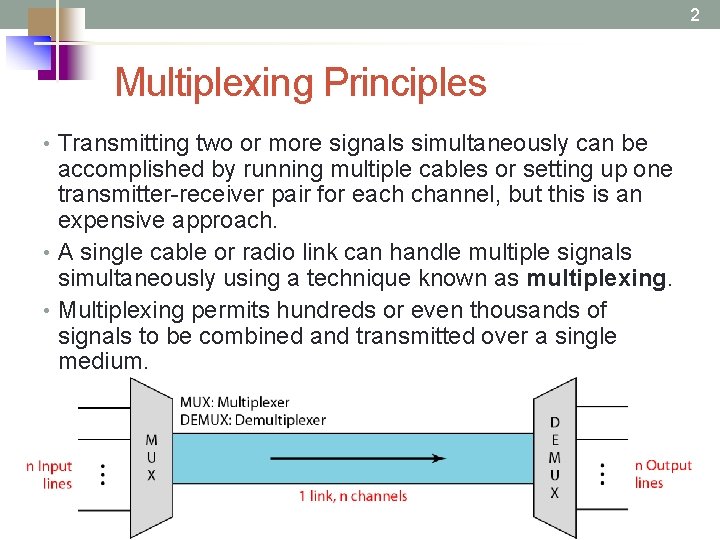
2 Multiplexing Principles • Transmitting two or more signals simultaneously can be accomplished by running multiple cables or setting up one transmitter-receiver pair for each channel, but this is an expensive approach. • A single cable or radio link can handle multiple signals simultaneously using a technique known as multiplexing. • Multiplexing permits hundreds or even thousands of signals to be combined and transmitted over a single medium.
3 Multiplexing Principles • Multiplexing is the process of simultaneously transmitting two or more individual signals over a single communication channel. • It increases the number of communication channels so that more information can be transmitted. • An application may require multiple signals. • Cost savings can be gained by using a single channel to send multiple information signals.
4 Multiplexing Principles • The two most common types of multiplexing are 1. Frequency-division multiplexing (FDM) • • 2. Generally used for analog information. Individual signals to be transmitted are assigned a different frequency within a common bandwidth. Time-division multiplexing (TDM) • • Generally used for digital information. Multiple signals are transmitted in different time slots on a single channel.

5 Multiplexing Principles • Another form of multiple access is known as code- division multiple access (CDMA). • Widely used in cell phone systems to allow many subscribers to use a common bandwidth simultaneously. • Uses special codes assigned to each user that can be identified.
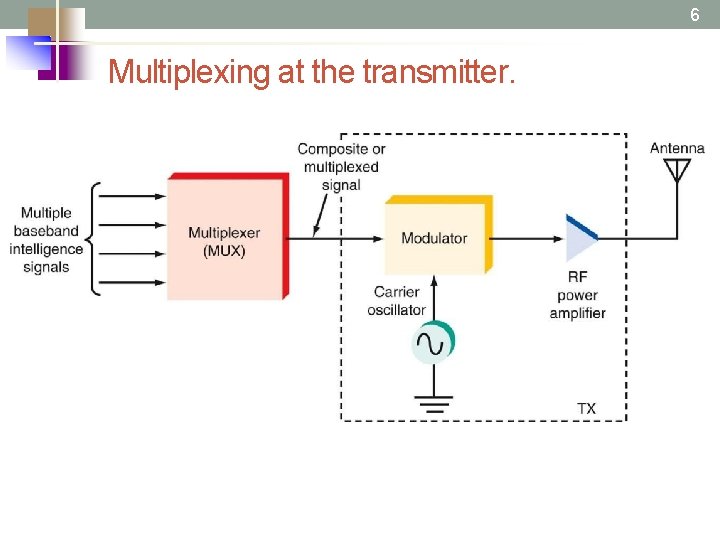
6 Multiplexing at the transmitter.
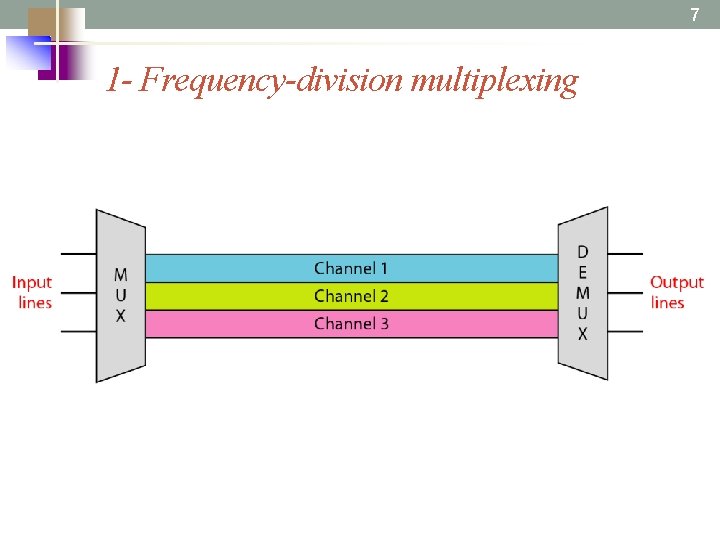
7 1 - Frequency-division multiplexing
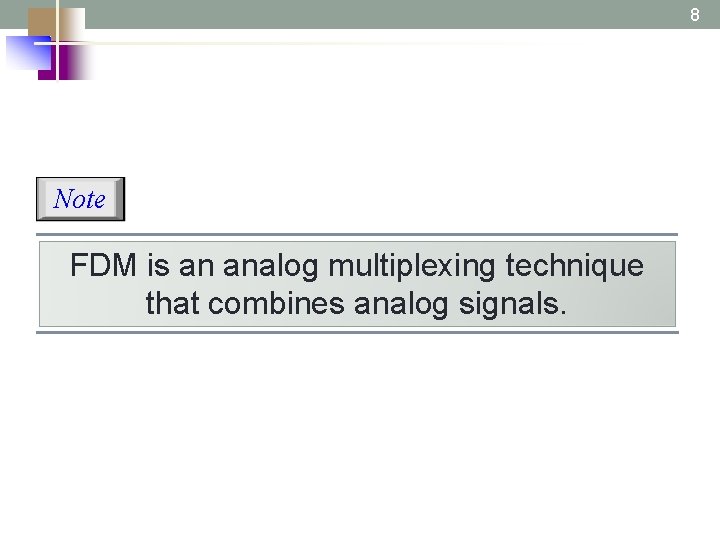
8 6. 8 Note FDM is an analog multiplexing technique that combines analog signals.
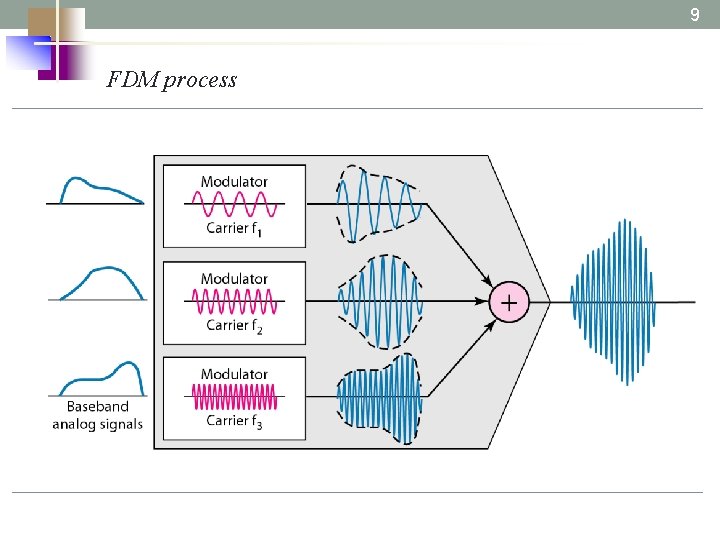
9 FDM process
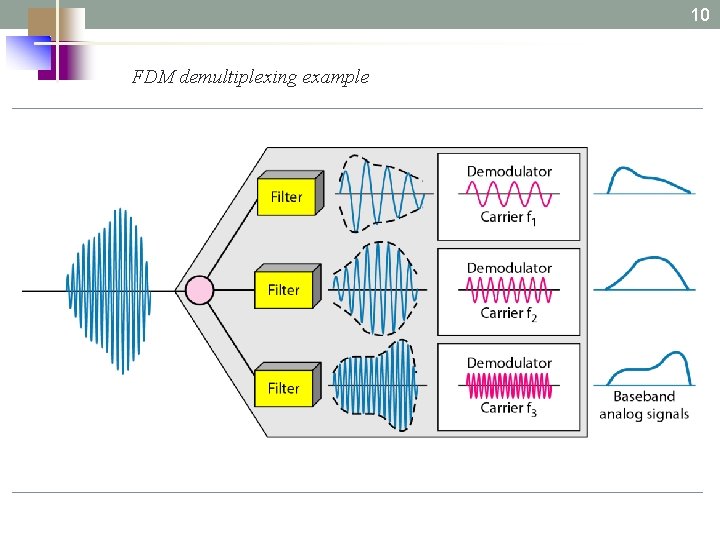
10 FDM demultiplexing example
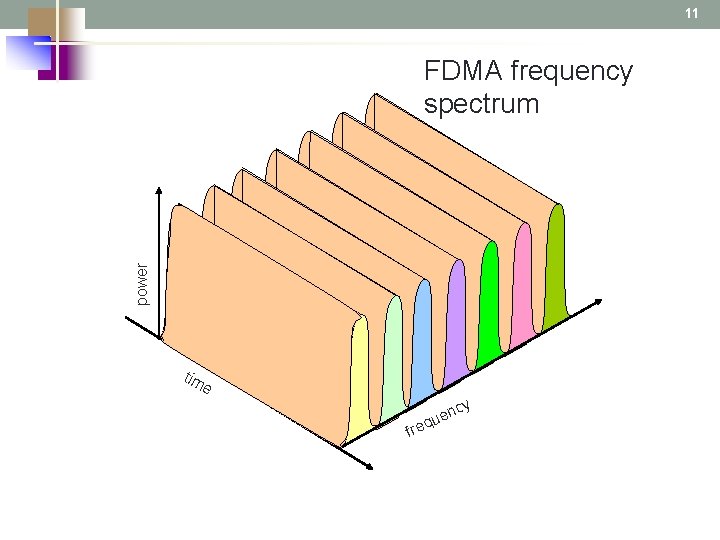
11 FDMA frequency spectrum power tim e fre cy n e qu
12 6. 12 Example 1 Assume that a voice channel occupies a bandwidth of 4 k. Hz. We need to combine three voice channels into a link with a bandwidth of 12 k. Hz, from 20 to 32 k. Hz. Show the configuration, using the frequency domain. Assume there are no guard bands. Solution 1 We shift (modulate) each of the three voice channels to a different bandwidth, as shown in Figure 1. We use the 20 to 24 -k. Hz bandwidth for the first channel, the 24 - to 28 k. Hz bandwidth for the second channel, and the 28 - to 32 k. Hz bandwidth for the third one. Then we combine them as shown in Figure 1.
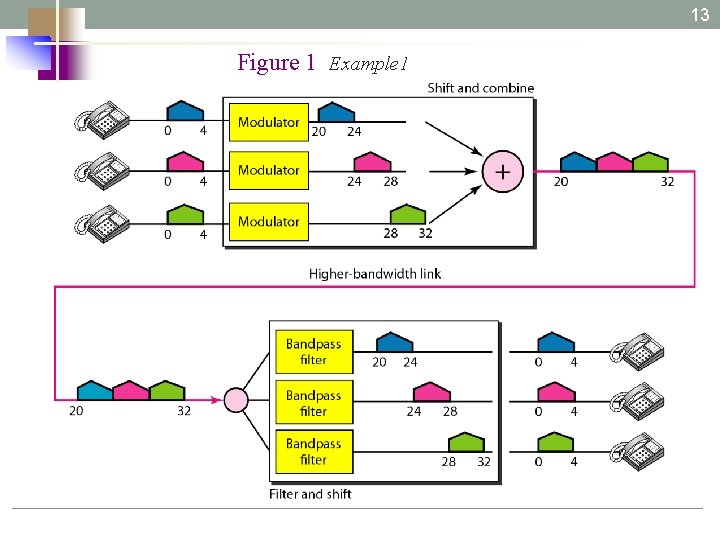
13 Figure 1 Example 1
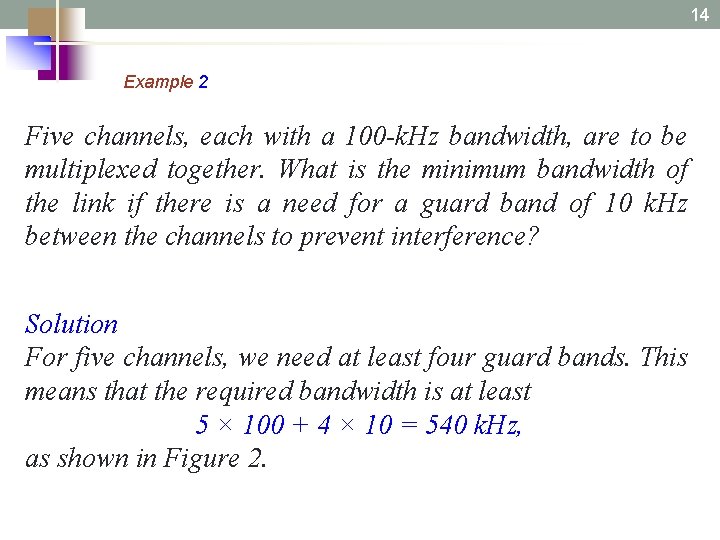
14 6. 14 Example 2 Five channels, each with a 100 -k. Hz bandwidth, are to be multiplexed together. What is the minimum bandwidth of the link if there is a need for a guard band of 10 k. Hz between the channels to prevent interference? Solution For five channels, we need at least four guard bands. This means that the required bandwidth is at least 5 × 100 + 4 × 10 = 540 k. Hz, as shown in Figure 2.
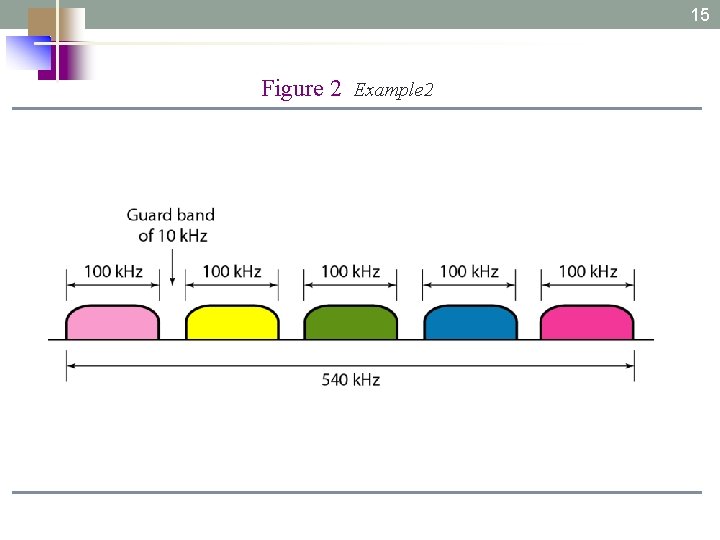
15 Figure 2 Example 2
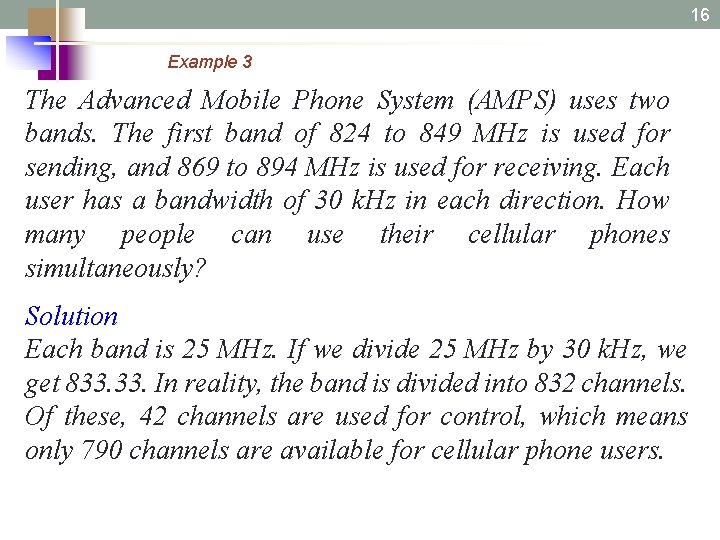
16 6. 16 Example 3 The Advanced Mobile Phone System (AMPS) uses two bands. The first band of 824 to 849 MHz is used for sending, and 869 to 894 MHz is used for receiving. Each user has a bandwidth of 30 k. Hz in each direction. How many people can use their cellular phones simultaneously? Solution Each band is 25 MHz. If we divide 25 MHz by 30 k. Hz, we get 833. In reality, the band is divided into 832 channels. Of these, 42 channels are used for control, which means only 790 channels are available for cellular phone users.
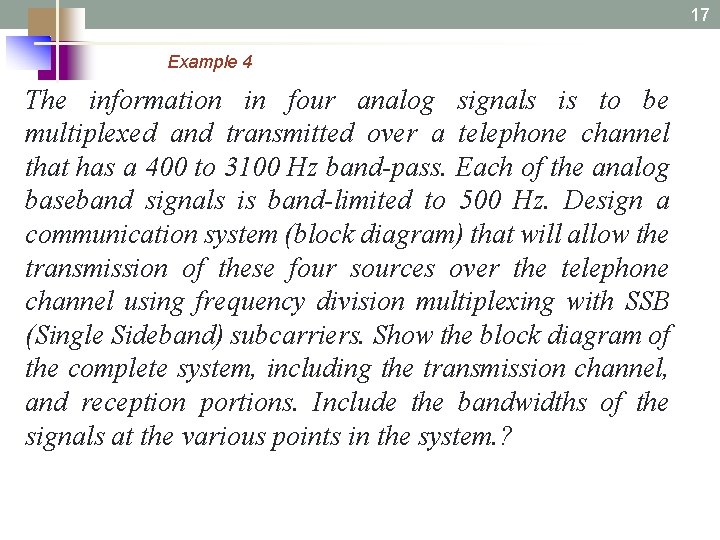
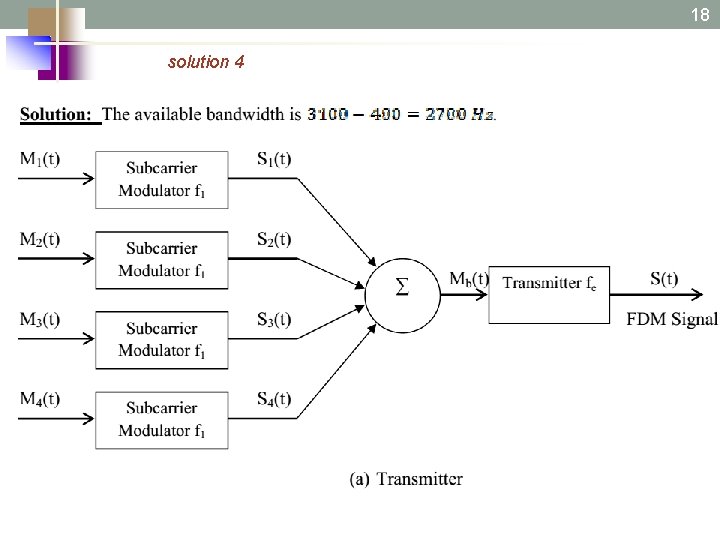
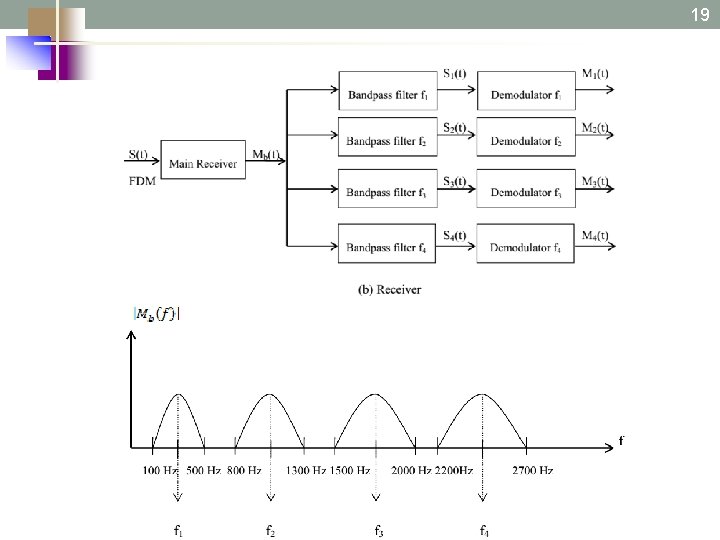
17 6. 17 Example 4 The information in four analog signals is to be multiplexed and transmitted over a telephone channel that has a 400 to 3100 Hz band-pass. Each of the analog baseband signals is band-limited to 500 Hz. Design a communication system (block diagram) that will allow the transmission of these four sources over the telephone channel using frequency division multiplexing with SSB (Single Sideband) subcarriers. Show the block diagram of the complete system, including the transmission channel, and reception portions. Include the bandwidths of the signals at the various points in the system. ?
18 6. 18 solution 4
19 6. 19 solution 4
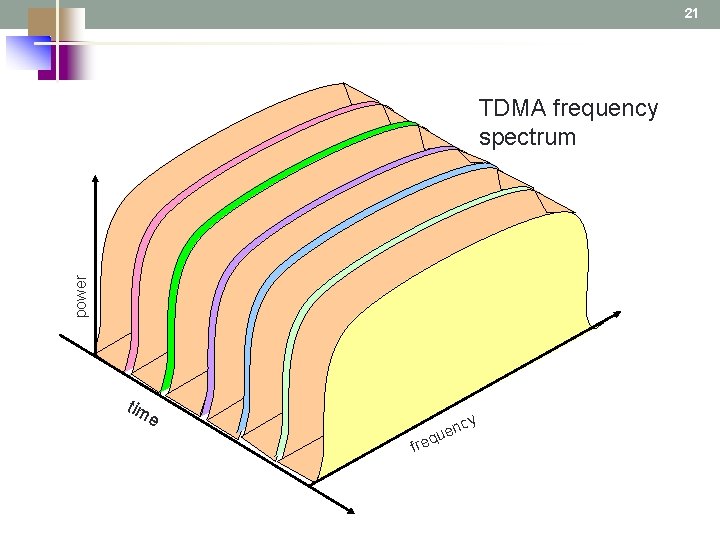
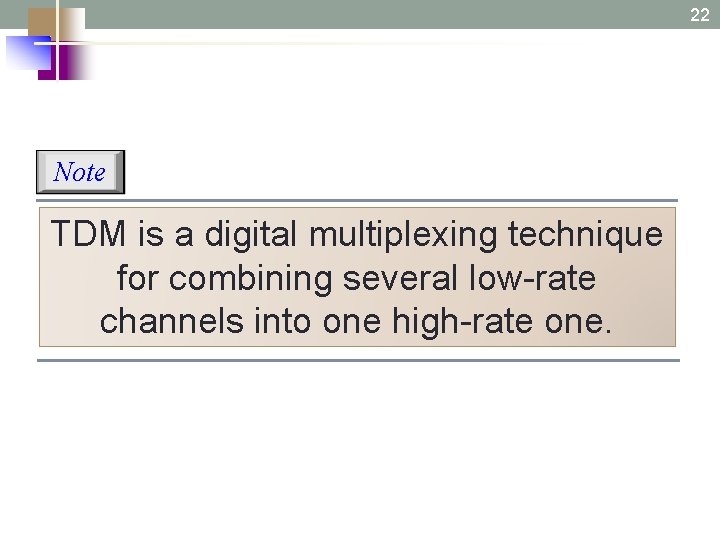
20 2. Time Division Multiplexing • • • Definition – TDM is the time interleaving of samples from several sources so that the info from these sources can be transmitted serially over a single communication channel. In brief, TDM is a digital multiplexing technique for combining several low-rate channels into one high-rate one. Can be used for analog & digital information signal. Figure gives a conceptual view of TDM. Note that the same link is used as in FDM; here the link is sectioned by time rather than frequency
21 TDMA frequency spectrum power tim e fre cy n e qu
22 Note TDM is a digital multiplexing technique for combining several low-rate channels into one high-rate one.
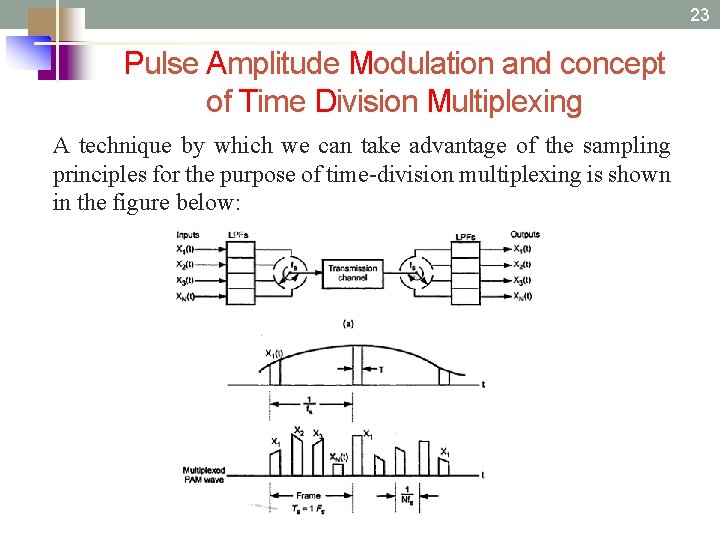
23 Pulse Amplitude Modulation and concept of Time Division Multiplexing A technique by which we can take advantage of the sampling principles for the purpose of time-division multiplexing is shown in the figure below:
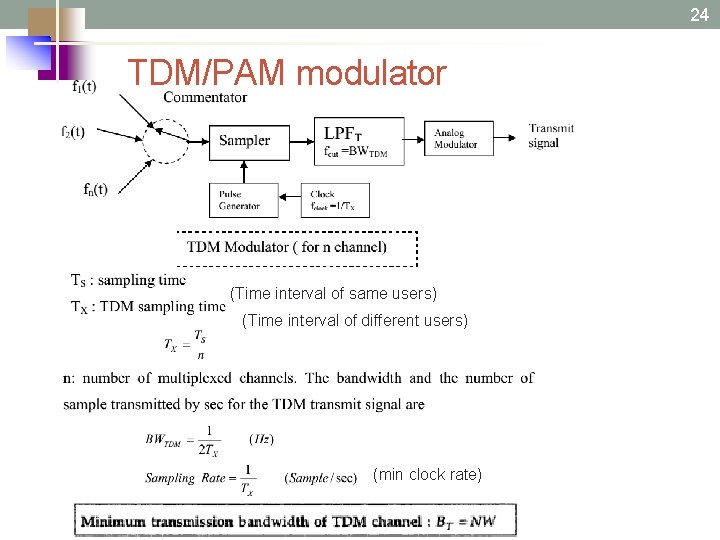
24 TDM/PAM modulator (Time interval of same users) (Time interval of different users) (min clock rate)
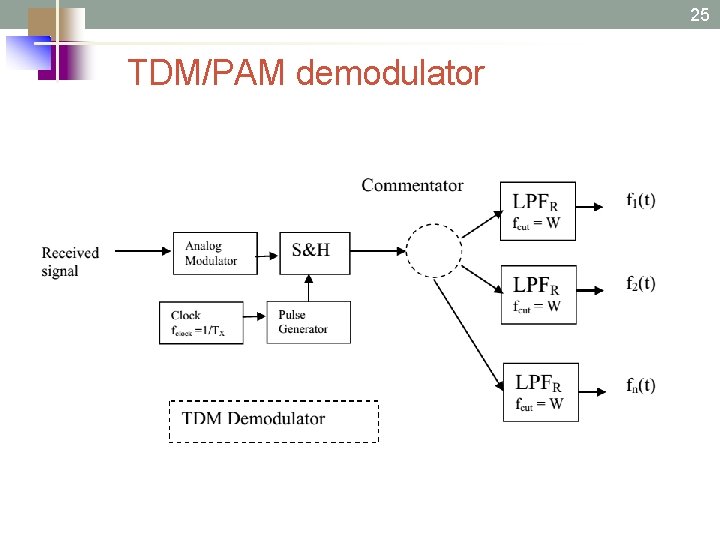
25 TDM/PAM demodulator
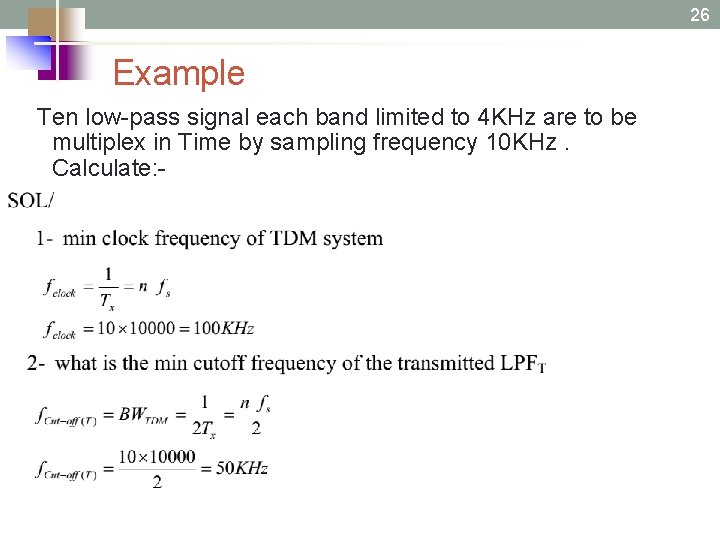
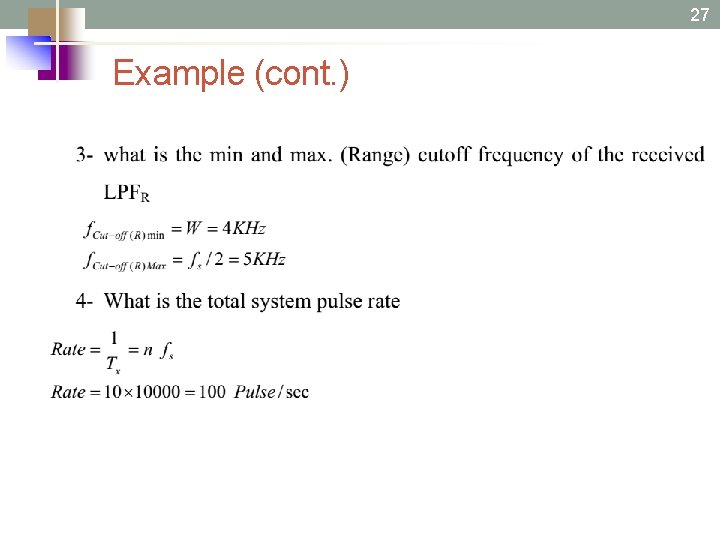
26 Example Ten low-pass signal each band limited to 4 KHz are to be multiplex in Time by sampling frequency 10 KHz. Calculate: -
27 Example (cont. )
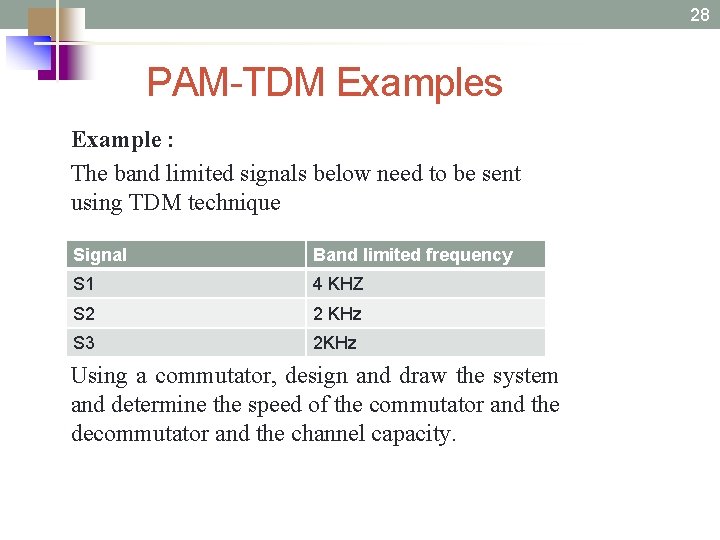
28 PAM-TDM Examples Example : The band limited signals below need to be sent using TDM technique Signal Band limited frequency S 1 4 KHZ S 2 2 KHz S 3 2 KHz Using a commutator, design and draw the system and determine the speed of the commutator and the decommutator and the channel capacity.
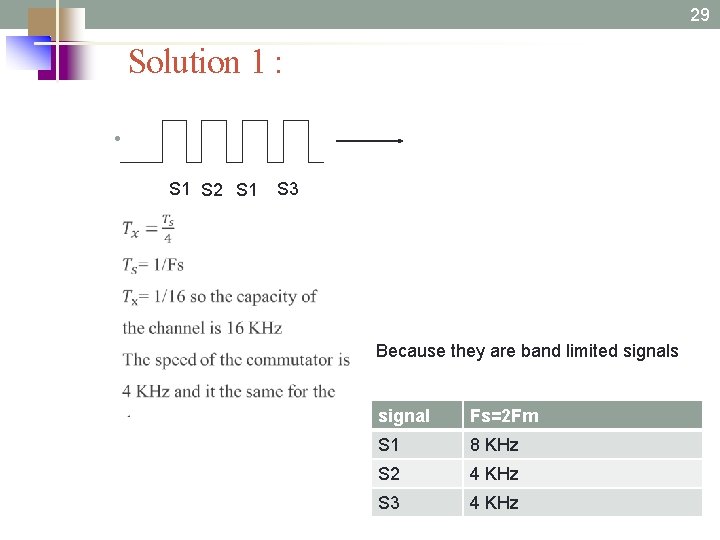
29 Solution 1 : • S 1 S 2 S 1 S 3 Because they are band limited signals signal Fs=2 Fm S 1 8 KHz S 2 4 KHz S 3 4 KHz
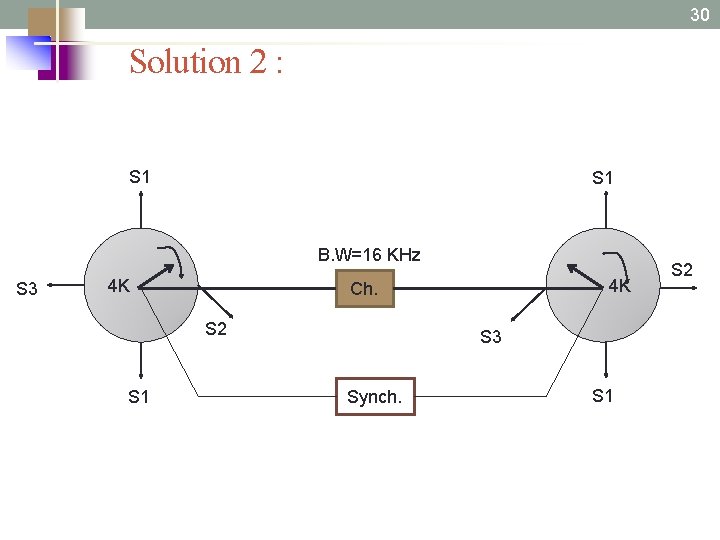
30 Solution 2 : S 1 B. W=16 KHz S 3 4 K S 2 S 1 4 K Ch. S 3 Synch. S 1 S 2
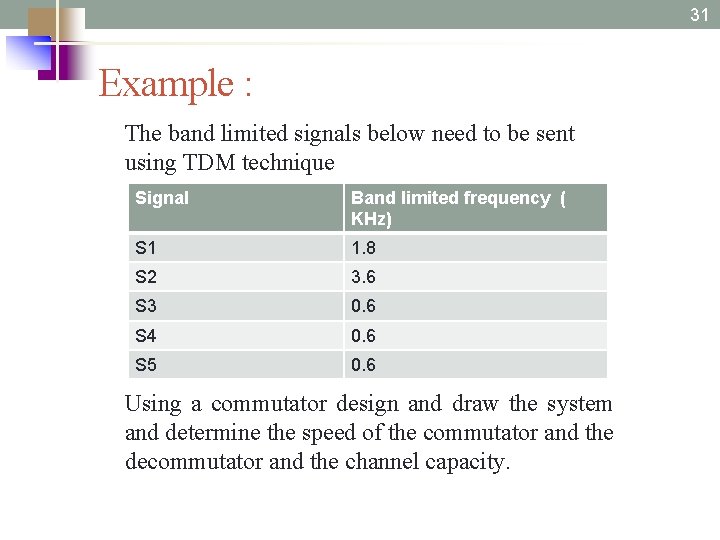
31 Example : The band limited signals below need to be sent using TDM technique Signal Band limited frequency ( KHz) S 1 1. 8 S 2 3. 6 S 3 0. 6 S 4 0. 6 S 5 0. 6 Using a commutator design and draw the system and determine the speed of the commutator and the decommutator and the channel capacity.
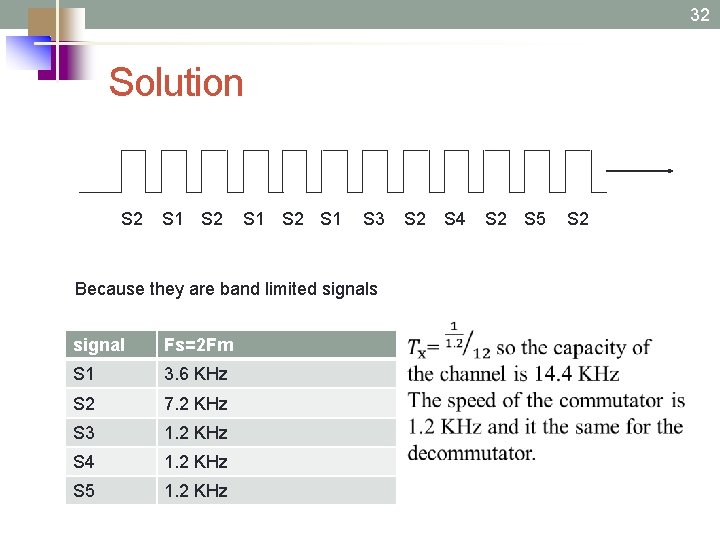
32 Solution S 2 S 1 S 3 S 2 S 4 Because they are band limited signals signal Fs=2 Fm S 1 3. 6 KHz S 2 7. 2 KHz S 3 1. 2 KHz S 4 1. 2 KHz S 5 1. 2 KHz S 2 S 5 S 2
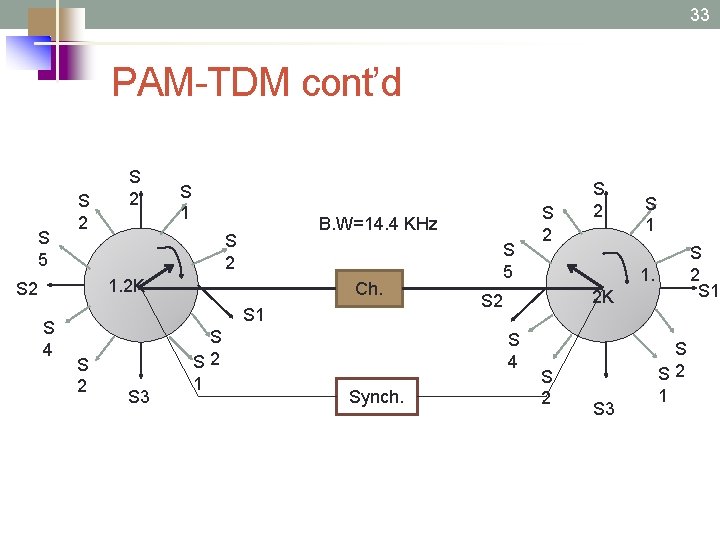
33 PAM-TDM cont’d S 5 S 2 S 1 B. W=14. 4 KHz S 2 1. 2 K S 2 S 4 Ch. S 1 S 2 S 3 S S 2 1 S 5 S 1 S 2 S 1 1. 2 K S 2 S 4 Synch. S 2 S 2 S 3 S S 2 1
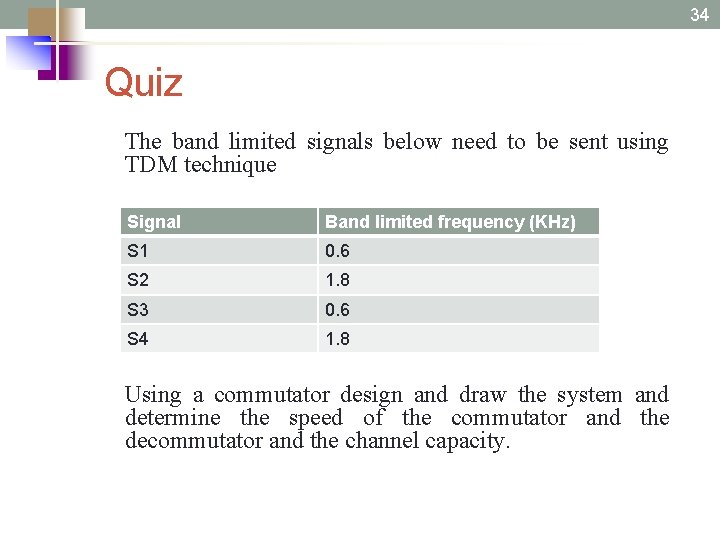
34 Quiz The band limited signals below need to be sent using TDM technique Signal Band limited frequency (KHz) S 1 0. 6 S 2 1. 8 S 3 0. 6 S 4 1. 8 Using a commutator design and draw the system and determine the speed of the commutator and the decommutator and the channel capacity.
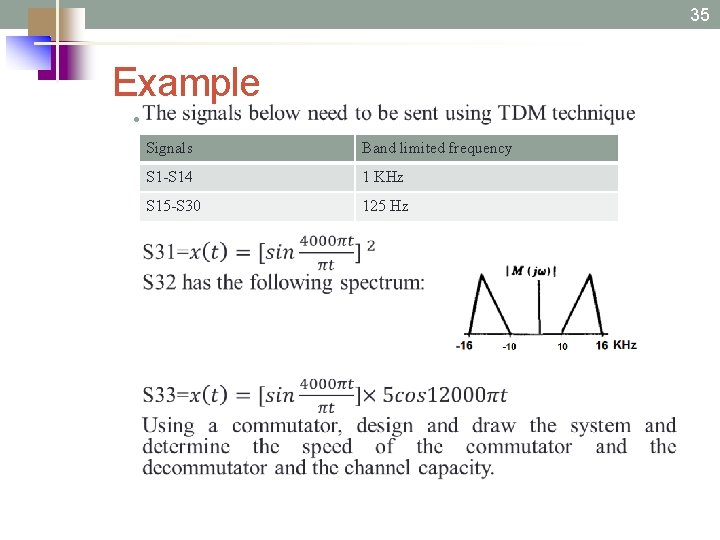
35 Example • Signals Band limited frequency S 1 -S 14 1 KHz S 15 -S 30 125 Hz
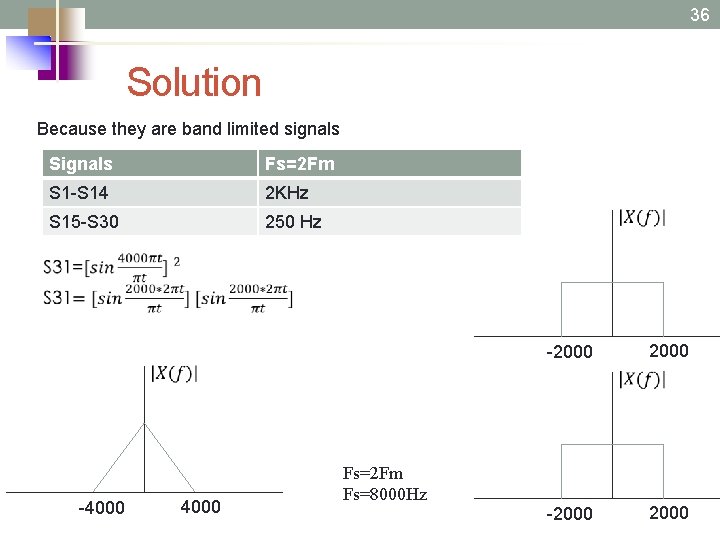
36 Solution Because they are band limited signals Signals Fs=2 Fm S 1 -S 14 2 KHz S 15 -S 30 250 Hz -4000 2000 -2000 4000 Fs=2 Fm Fs=8000 Hz -2000
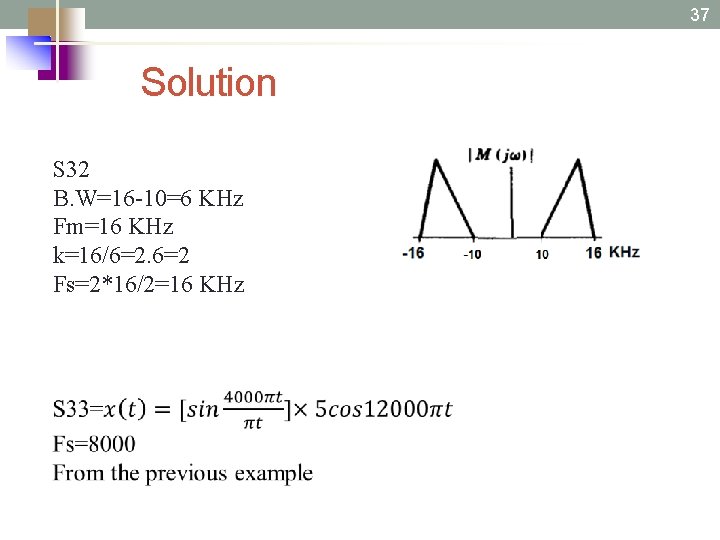
37 Solution S 32 B. W=16 -10=6 KHz Fm=16 KHz k=16/6=2. 6=2 Fs=2*16/2=16 KHz
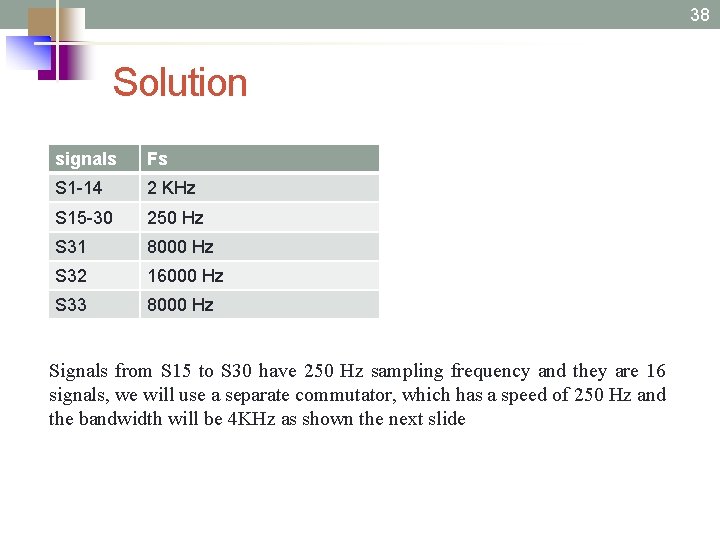
38 Solution signals Fs S 1 -14 2 KHz S 15 -30 250 Hz S 31 8000 Hz S 32 16000 Hz S 33 8000 Hz Signals from S 15 to S 30 have 250 Hz sampling frequency and they are 16 signals, we will use a separate commutator, which has a speed of 250 Hz and the bandwidth will be 4 KHz as shown the next slide
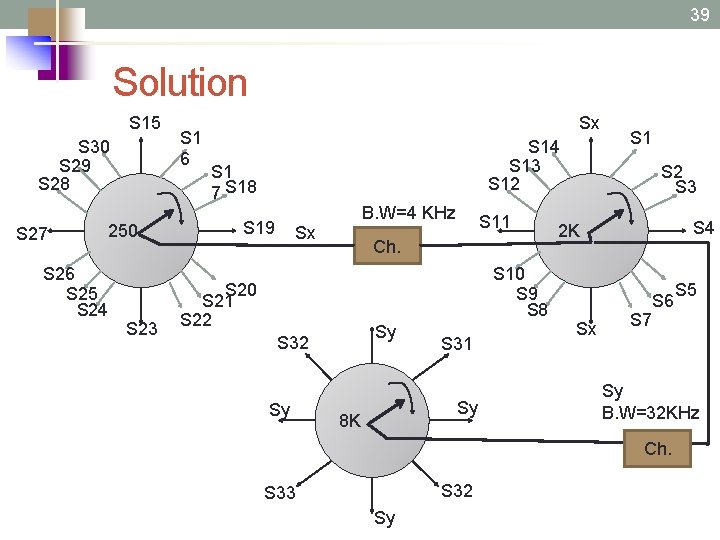
39 Solution S 15 S 30 S 29 S 28 S 27 250 S 26 S 25 S 24 S 23 S 1 6 Sx S 14 S 13 S 12 S 1 7 S 18 B. W=4 KHz S 19 Sx S 11 Ch. S 10 S 9 S 8 S 20 S 21 S 22 Sy S 31 Sy 8 K S 1 S 2 S 3 S 4 2 K Sx S 7 S 6 Sy B. W=32 KHz Ch. S 32 S 33 Sy S 5
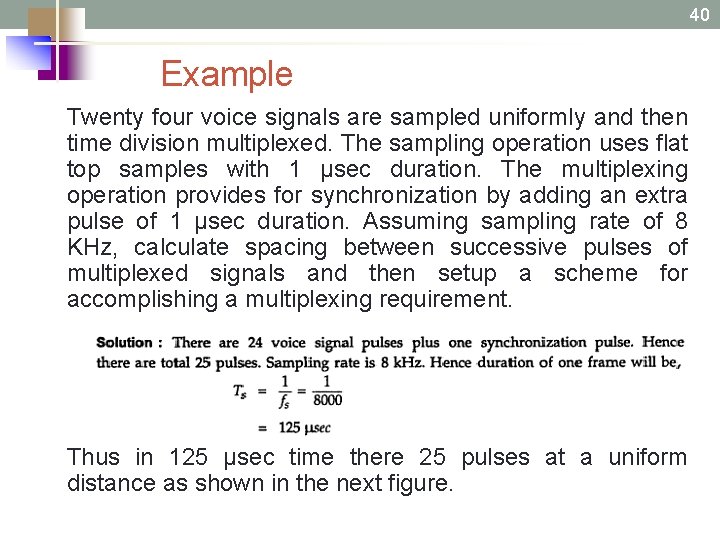
40 Example Twenty four voice signals are sampled uniformly and then time division multiplexed. The sampling operation uses flat top samples with 1 µsec duration. The multiplexing operation provides for synchronization by adding an extra pulse of 1 µsec duration. Assuming sampling rate of 8 KHz, calculate spacing between successive pulses of multiplexed signals and then setup a scheme for accomplishing a multiplexing requirement. Thus in 125 µsec time there 25 pulses at a uniform distance as shown in the next figure.
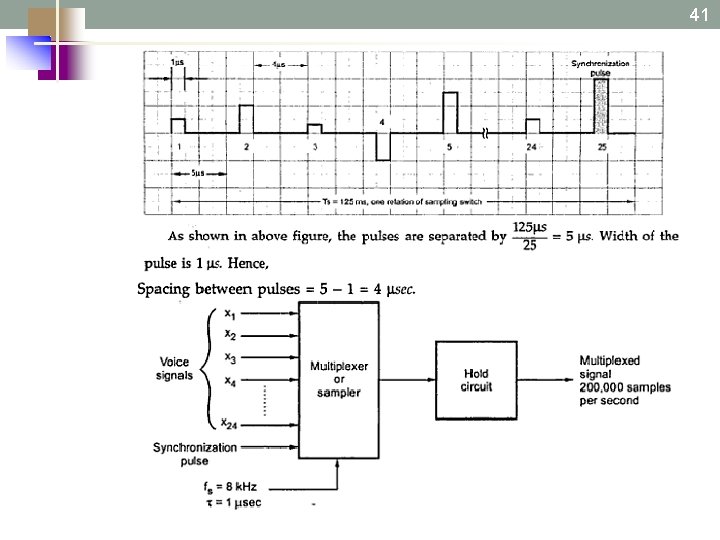
41
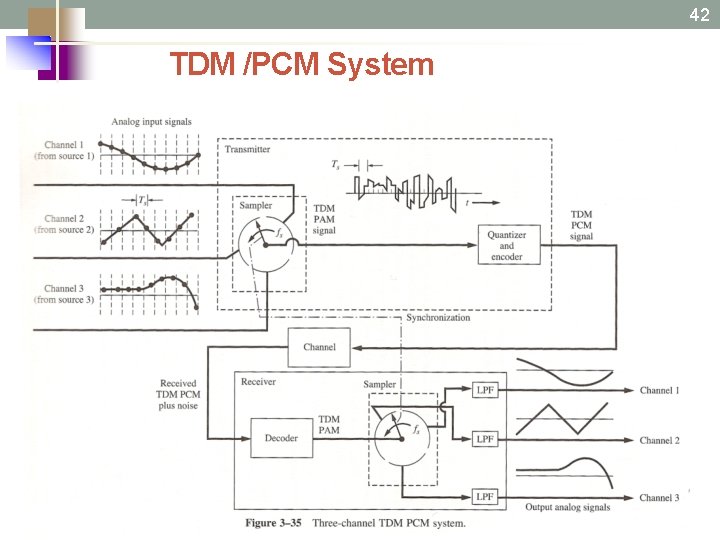
42 TDM /PCM System
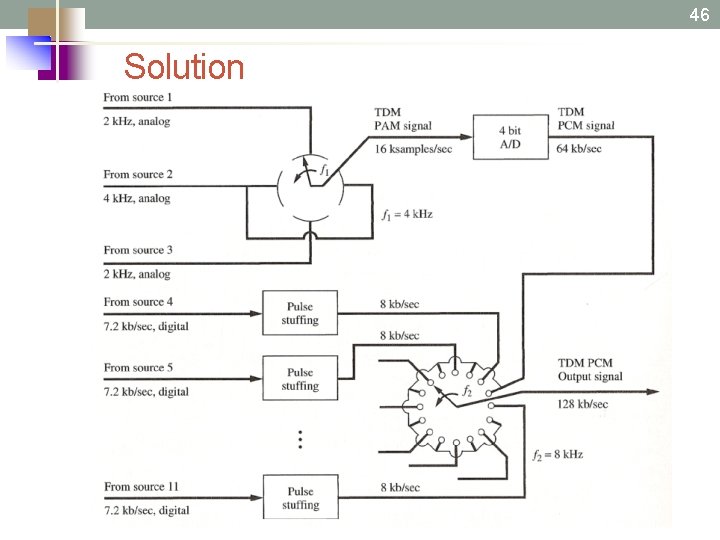
43 Example Design a TDM that will accommodate 11 sources with this specification: • Source 1: Analog, 2 k. Hz bandwidth • Source 2: Analog, 4 k. Hz bandwidth • Source 3: Analog, 2 k. Hz bandwidth • Source 4 -11: Digital, 7200 bps synchronous Suppose the analog sources are converted to digital using 4 -bit PCM words.
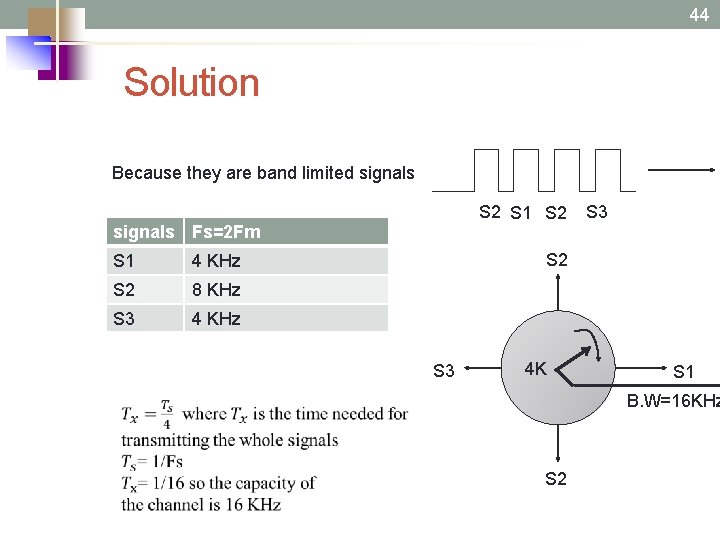
44 Solution Because they are band limited signals S 2 S 1 S 2 signals Fs=2 Fm S 1 4 KHz S 2 8 KHz S 3 4 KHz S 3 S 2 S 3 4 K S 1 B. W=16 KHz S 2
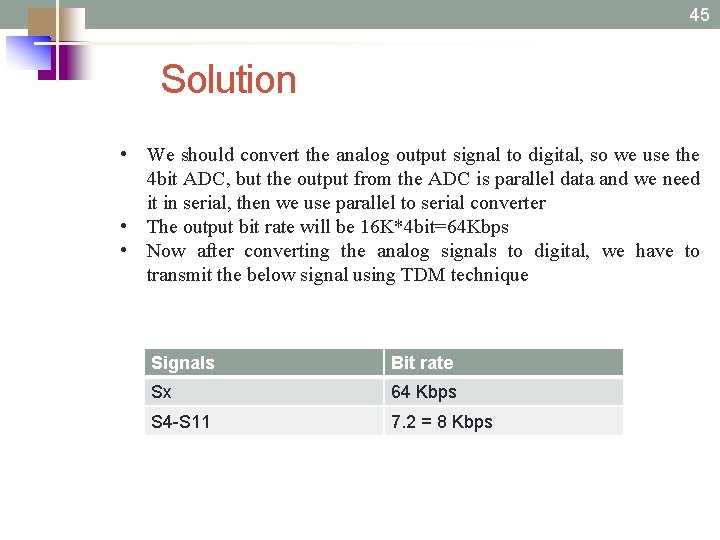
45 Solution • We should convert the analog output signal to digital, so we use the 4 bit ADC, but the output from the ADC is parallel data and we need it in serial, then we use parallel to serial converter • The output bit rate will be 16 K*4 bit=64 Kbps • Now after converting the analog signals to digital, we have to transmit the below signal using TDM technique Signals Bit rate Sx 64 Kbps S 4 -S 11 7. 2 = 8 Kbps
46 Solution
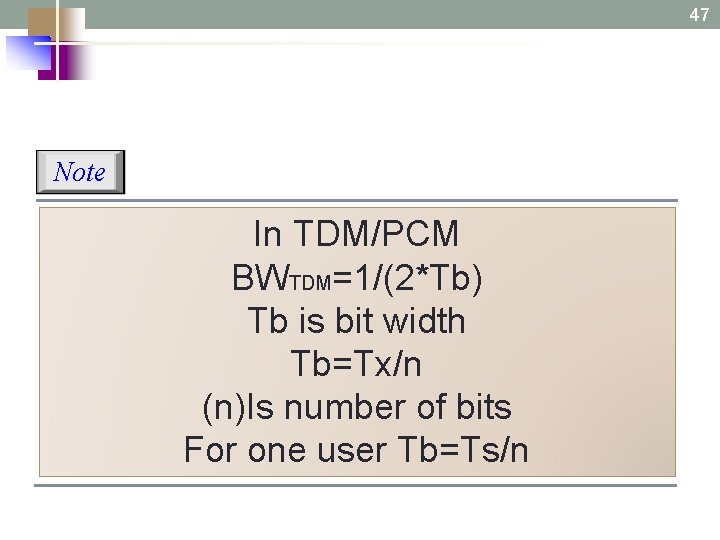
47 Note In TDM/PCM BWTDM=1/(2*Tb) Tb is bit width Tb=Tx/n (n)Is number of bits For one user Tb=Ts/n
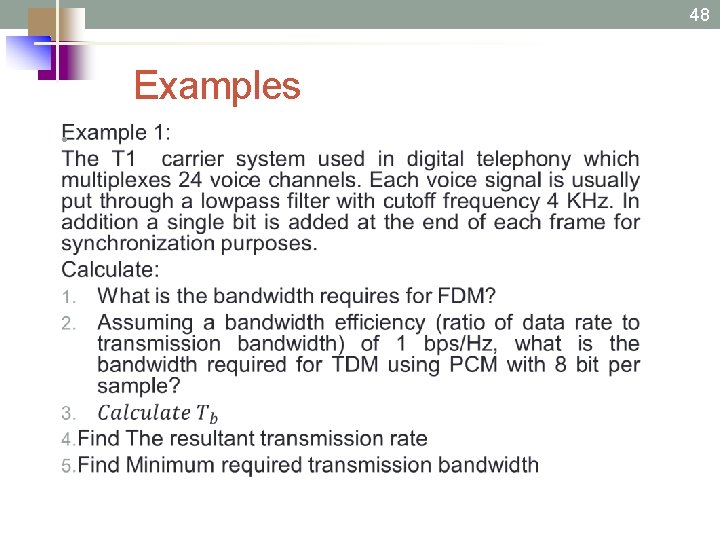
48 Examples •
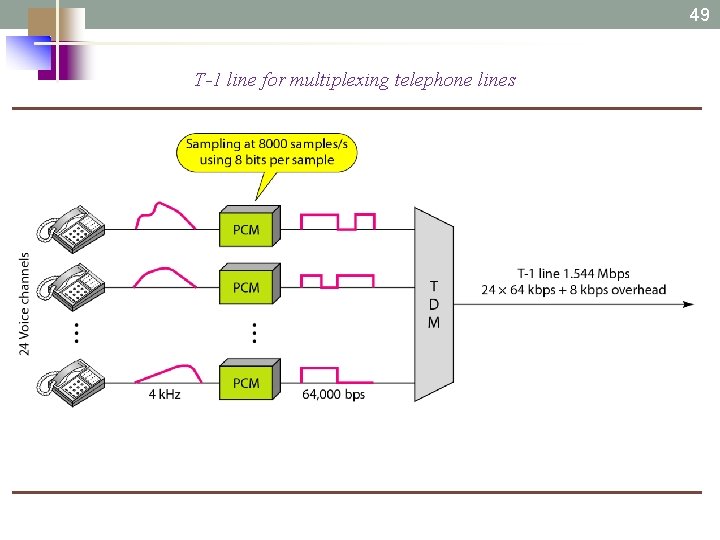
49 T-1 line for multiplexing telephone lines
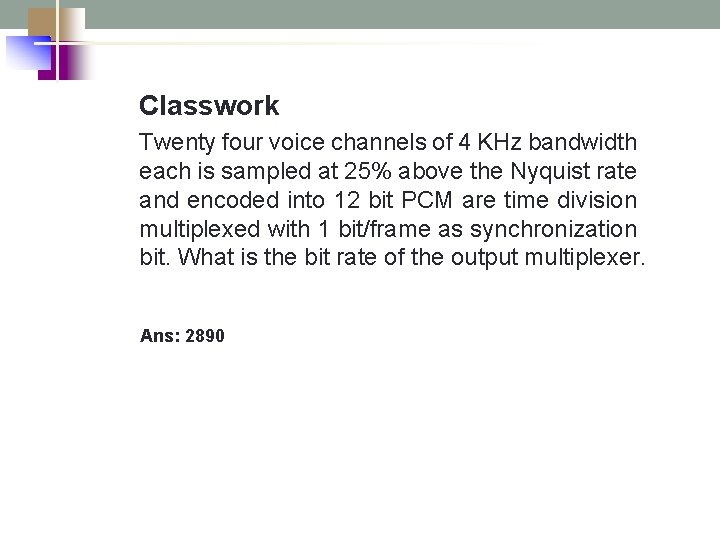
Classwork Twenty four voice channels of 4 KHz bandwidth each is sampled at 25% above the Nyquist rate and encoded into 12 bit PCM are time division multiplexed with 1 bit/frame as synchronization bit. What is the bit rate of the output multiplexer. Ans: 2890
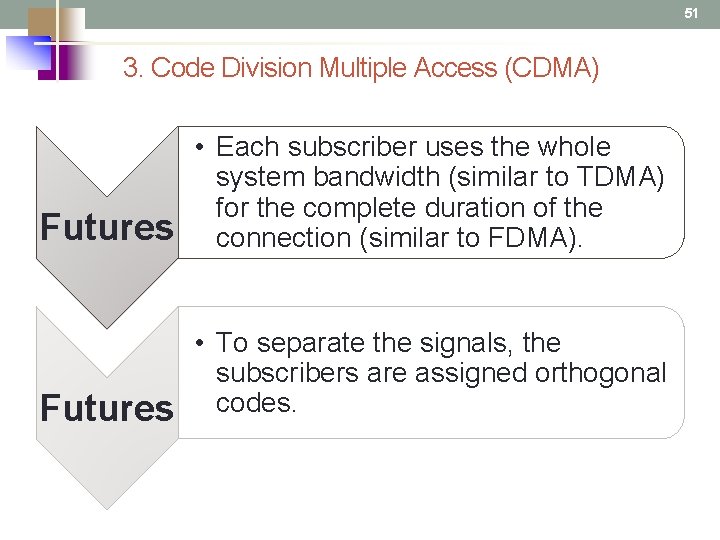
51 3. Code Division Multiple Access (CDMA) Futures • Each subscriber uses the whole system bandwidth (similar to TDMA) for the complete duration of the connection (similar to FDMA). Futures • To separate the signals, the subscribers are assigned orthogonal codes.
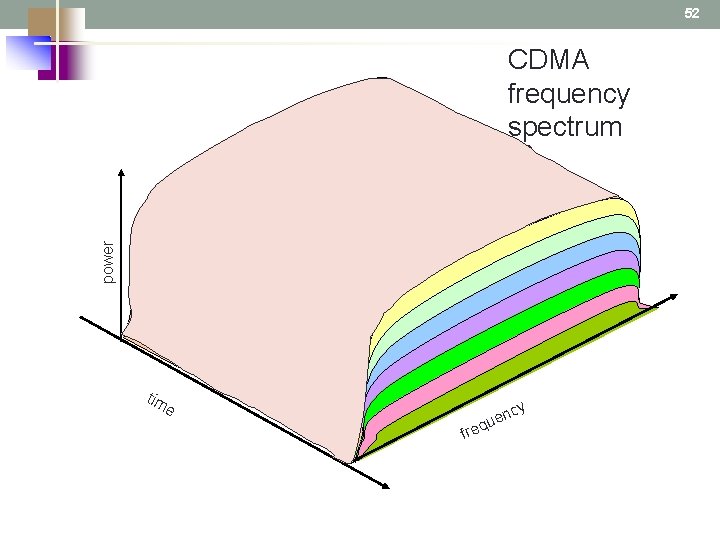
52 CDMA frequency spectrum power tim e fre cy n e qu
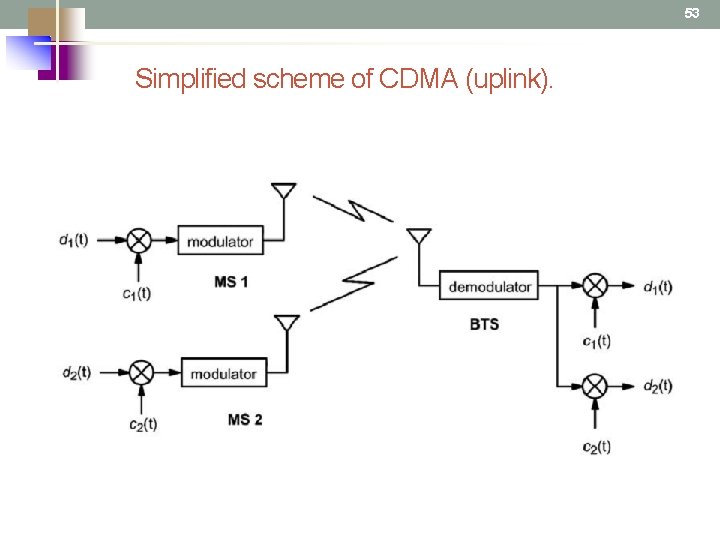
53 Simplified scheme of CDMA (uplink).
- Slides: 53