
1 Addisons Disease 2 Hypernatremia By Dr Zahoor
1. Addison’s Disease 2. Hypernatremia By Dr. Zahoor 1
Addison’s Disease What is Addison’s Disease? Ø It is primary Hypoadrenalism. Therefore, we will study adrenal gland structure and function first, then we will discuss Addison’s disease. 2
Adrenal Gland Anatomy and Function � The human adrenal glands weigh 8 -10 gram together. Each adrenal gland is situated above the kidney. � Adrenal gland has outer cortex and inner medulla. � The cortex has three zones: 1. Zona glomerulosa 2. Zona fasciculata 3. Zona reticularis � Adrenal medulla – synthesizes, stores and secrete catecholamines (epinephrine and Norepinephrine). 3
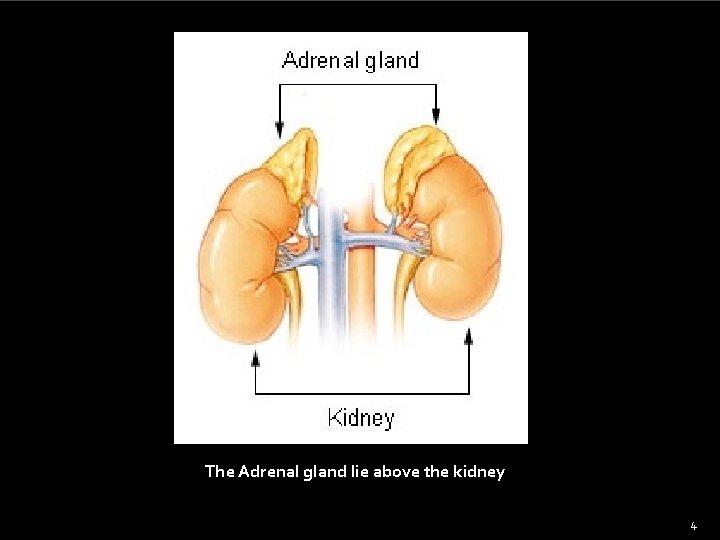
The Adrenal gland lie above the kidney 4
Adrenal Gland Adrenal Cortex – three zones 1. Zona glomerulosa – secrete aldosterone, mainly controlled by renin angiotensin aldosterone mechanism 2. 3. Zona fasciculata Zona reticularis Produce Cortisol and Androgen. Under feedback control of Hypothalamic – Pituitary – Adrenal (HPA) axis 5
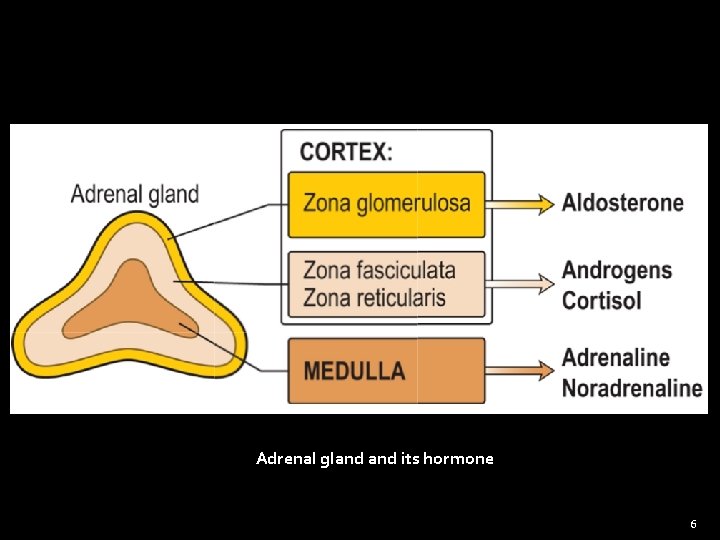
Adrenal gland its hormone 6
Adrenal Gland �We are mainly concerned with Cortisol production (Zona fasciculata and Zona reticularis) �Glucocorticoids production by Adrenals is under hypothalamic – pituitary control �Pituitary ACTH is secreted in response to hypothalamic CRH (Corticotrophin-Releasing Hormone) �ACTH stimulates the secretion of Cortisol from adrenal 7

Adrenal Gland (cont) �ACTH contain melanocyte stimulating hormone (MSH) like sequences which cause pigmentation when ACTH level is markedly raised �Cortisol when secreted (or synthetic corticosteroid when given to patient) cause negative feedback on the hypothalamus and pituitary and inhibit ACTH release 8
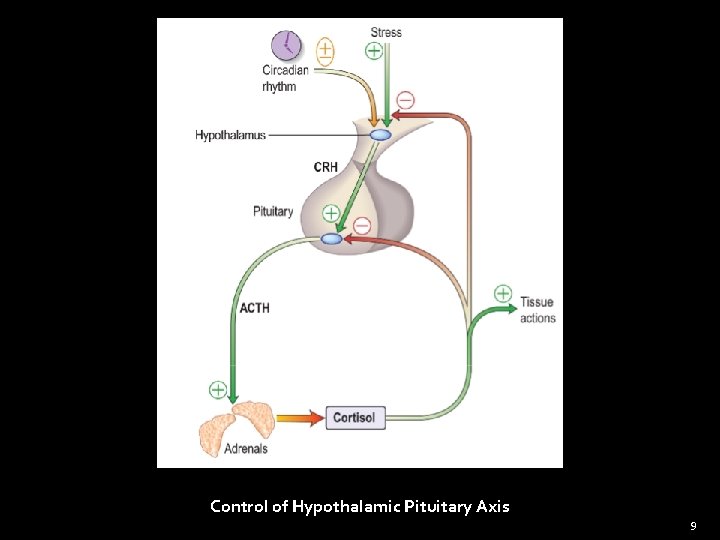
Control of Hypothalamic Pituitary Axis 9
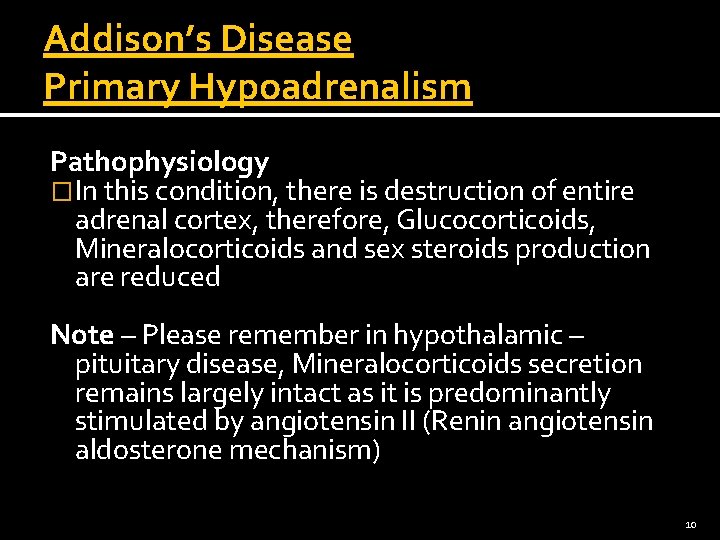
Addison’s Disease Primary Hypoadrenalism Pathophysiology �In this condition, there is destruction of entire adrenal cortex, therefore, Glucocorticoids, Mineralocorticoids and sex steroids production are reduced Note – Please remember in hypothalamic – pituitary disease, Mineralocorticoids secretion remains largely intact as it is predominantly stimulated by angiotensin II (Renin angiotensin aldosterone mechanism) 10
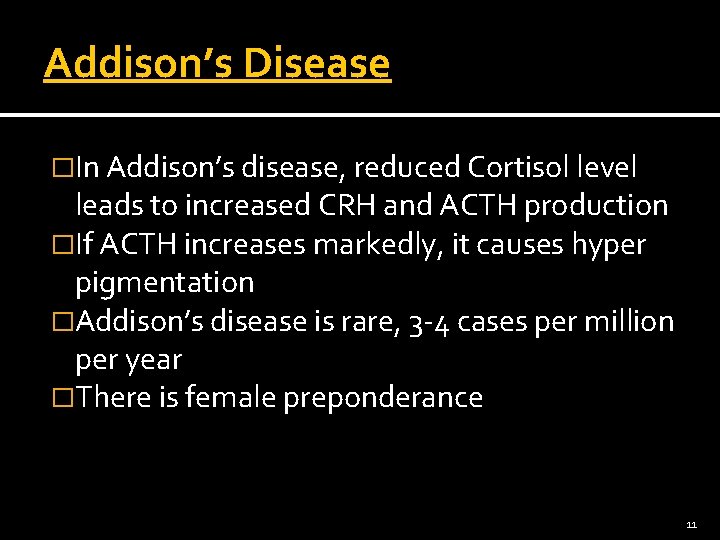
Addison’s Disease �In Addison’s disease, reduced Cortisol level leads to increased CRH and ACTH production �If ACTH increases markedly, it causes hyper pigmentation �Addison’s disease is rare, 3 -4 cases per million per year �There is female preponderance 11
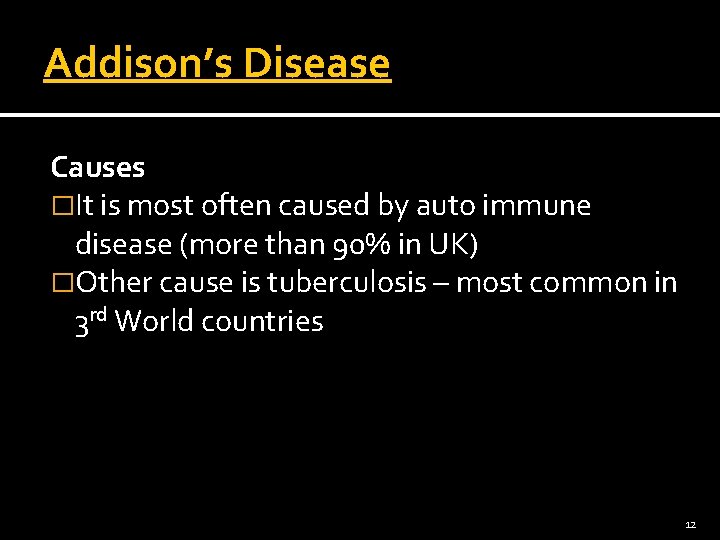
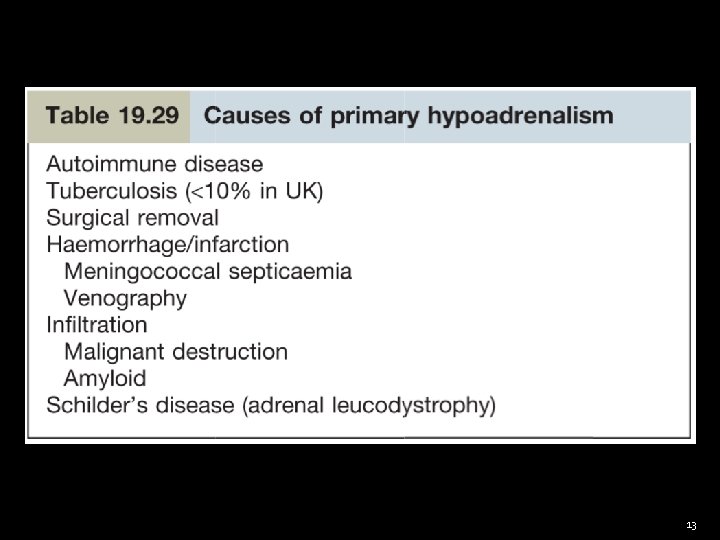
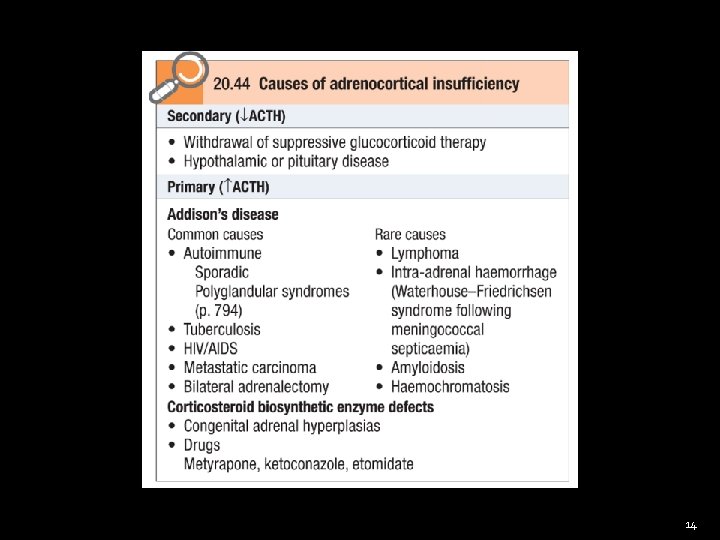
Addison’s Disease Causes �It is most often caused by auto immune disease (more than 90% in UK) �Other cause is tuberculosis – most common in 3 rd World countries 12
13
14

Addison’s Disease �Addison’s disease has association with other auto immune conditions e. g. type I DM, pernicious anemia, thyroditis, Hypoparathyroidism, premature ovarian failure 15

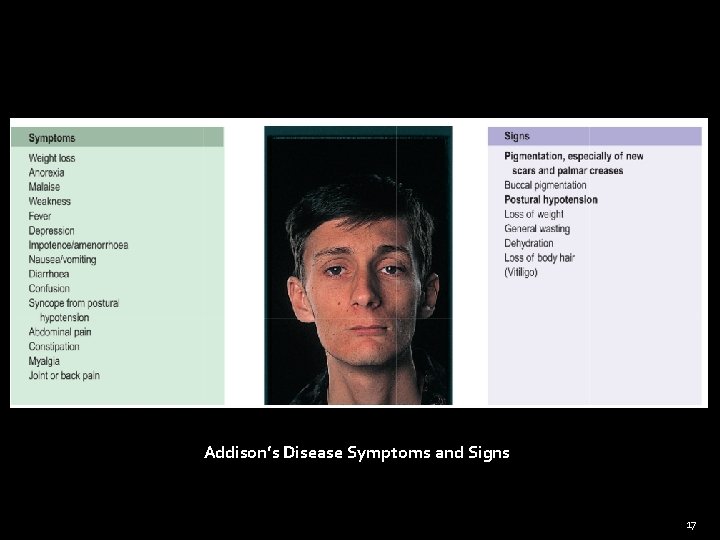
Addison’s Disease Clinical Features �Symptoms - Weight loss - Weakness - Amenorrhoea - Syncope - Abdominal pain �Signs - Pigmentation – specially of new scars, palmer creases, Buccal pigmentation - Postural hypotension 16
Addison’s Disease Symptoms and Signs 17

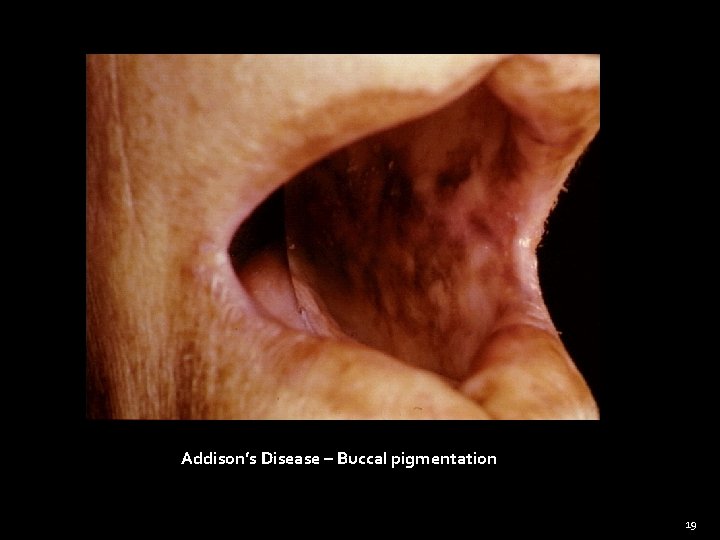
Addison’s Disease �Pigmentation (dull, slaty, grey brown) is predominant sign in over 90% of cases �Postural hypotension due to hypovolemia and Na loss is present in 80 -90% of cases. Mineralocorticoids deficiency is a cause of hypotension 18
Addison’s Disease – Buccal pigmentation 19

Addison’s Disease Investigation 1 - Single Cortisol measurement �Random Cortisol > 550 nmol/L makes the diagnosis of Addison’s unlikely (Normal Random in adult 136 - 635 nmol/L ) �Random Cortisol below 100 nmol/L during the day is highly suggestive of Addison’s 20

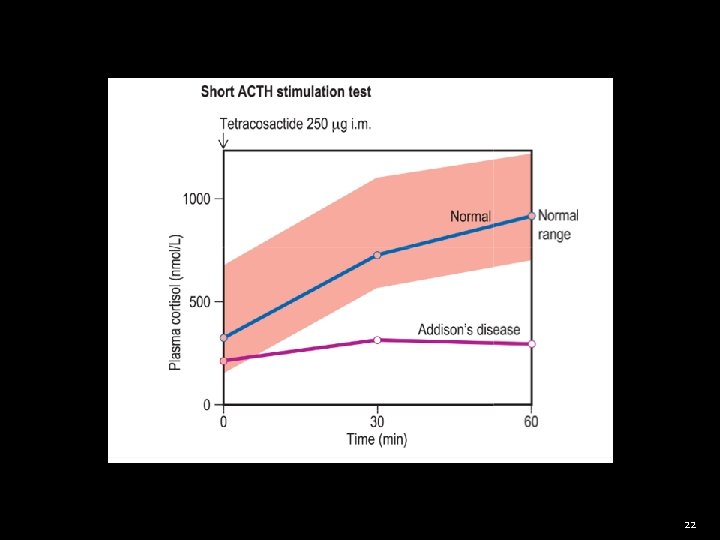
Addison’s Disease Investigation (cont) 2. Short synacthen test – short ACTH stimulation test -Draw blood for Cortisol (zero time ) - Give ACTH 250 Microgram (o. 25 mg) i. m. injection - take blood sample after 30 min for Cortisol RESULT - In Addison disease there is minimal or no response to ACTH - In normal subject plasma Cortisol > 460 nmol/L either at baseline or at 30 min 21
22

Addison’s Disease Investigations (cont) 3. High plasma ACTH with low cortisol confirms primary hypoadrenalism 4. Electrolytes and Urea �Hyponatraemia �Hyperkalemia �High urea 5. Blood Glucose – maybe low with hypoglycemia 6. Adrenal antibodies – are present in auto immune adrenalitis 23
Addison’s Disease Investigations (cont) 7. Chest and abdominal X-rays – may show evidence of tuberculosis and/or calcified adrenals 8. Plasma Renin activity is high due to low serum aldosterone 9. Hypercalcemia and anemia are seen some times 24
Addison’s Disease Treatment �Acute Hypoadrenalism (Adrenal crisis) needs urgent treatment Patient might present with hypotension, hyponatremia, hyperkalaemia, hypoglycemia, dehydration, pigmentation often with precipitating factors like infection, trauma or operation �The major deficiencies are salt, steroid and glucose 25
Addison’s Disease Treatment of Adrenal crisis (cont) � 1 liter of 0. 9% saline over 30 to 60 mins � 100 mg I/V bolus of hydro cortisone �I/V glucose �Several liters of saline are required within 24 hours and hydrocortisone 100 mg im 6 hourly until the patient is clinically stable. 26

Addison’s Disease Treatment (cont) �When patient is clinically stable, Oral replacement medication is started - Hydrocortisone 20 mg 8 hourly reducing to 20 -30 mg in divided doses over a few days Long term treatment �Replacement of Glucocorticoids and Mineralocorticoids �Tuberculosis must be treated if present 27
Addison’s Disease Treatment (cont) �Adequacy of Glucocorticoid dose is judged by - normal Cortisol level - patient clinically feeling better �Adequacy of fludrocortisones replacement is assessed by - Serum electrolytes restored to normal - Blood pressure should not fall more than 10 mm systolic after 2 minutes of standing - Plasma Renin activity restored to normal 28
Addison’s Disease Advise to patient �All patients taking replacement steroids should know - To increase steroid during intercurrent illness, infection, injury, stress, surgery - carry a steroid card - wear a Medic-Alert bracelet which gives details of their condition so that replacement therapy can be given if found unconscious - keep hydrocortisone ampule at home in case oral therapy is impossible 29
Secondary Hypoadrenalism may arise from 1 - Hypothalamic – pituitary disease – inadequate ACTH production 2 - Long term steroid therapy – leading to hypothalamic-pituitary-adrenal suppression IMPORTANT – ACTH level is low in secondary Hypoadrenalism 30

Historical Information Why we call Addison’s disease ? �Because Thomas Addison, British Physician, in year 1855 described 6 cases of Addison’s at Guy’s Hospital in London. �Cause was tuberculosis in all 6 cases �Now TB is controlled in the west so common cause is auto immune disease there 31

One of the most famous and well known President of USA, John F. Kennedy, Jan 1961 -NOV 1963, suffered from Addison's disease. 32

Thank you 33
Hypernatremia By Dr. Zahoor 34
Hypernatremia What is Hypernatremia? �Increased serum sodium level, more than 145 m. Eg/L is called Hypernatremia Important – Normal serum sodium is 135 -145 m. Eq/L 35

Hypernatremia �Hypernatremia is generally not caused by excess of Na+, but usually by related deficit of free water in the body, therefore, Hypernatremia often coincides with dehydration How water is lost? �Perspiration �In breathing �In the feces and urine 36

Hypernatremia �Normal plasma osmolality 282 - 295 mosmol/L �Normal urine osmolality 600 mosmol/L (Range 50 – 1400 mosmol/L) as kidney can concentrate urine or dilute urine 37
Hypernatremia �Hypernatremia is always associated with increase plasma osmolality, which is a potent stimulus to thirst Clinical Features Symptoms of Hypernatremia are non specific �Nausea, vomiting, fever and confusion may occur �Convulsions occur in severe Hypernatremia 38

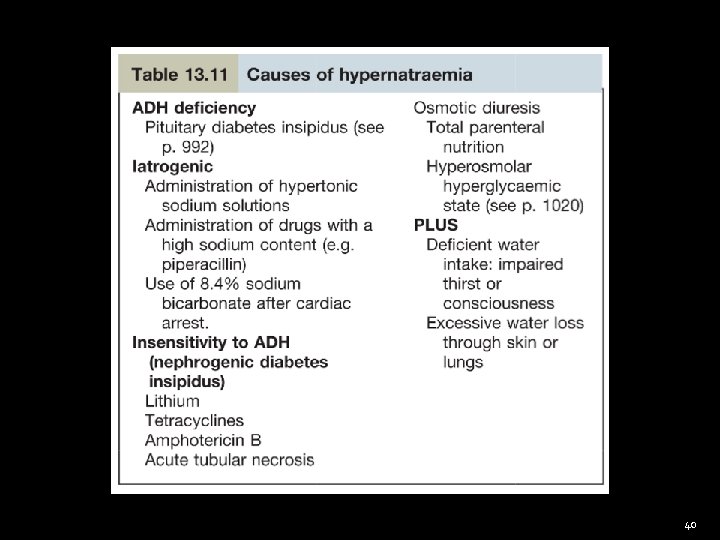
Hypernatremia Causes of Hypernatremia �Diabetes Insipidus �Administration of hypertonic sodium solutions �Drugs e. g. piperacillin �Nephrogenic Diabetes Insipidus – insensitivity to ADH caused by drugs e. g. Lithium, tetracycline, Democlocycline, amphotericin B - Acute tubular nacrosis - Osmotic diuresis e. g. total Parenteral nutrition - Deficient water intake - Increase water loss through skin or lungs 39
40

Hypernatremia Investigations � Do urine, plasma osmolality and serum sodium at the same time. EXAMPLES � In diabetes insipidus (ADH is decreased , it causes decreased water reabsorption, increased water loss by kidneys ) therefore - Plasma osmolality is high - Serum sodium is high - Urine osmolality is low ( less than plasma , 250 mosom/L) and urine volume is increased 41
Hypernatremia Examples (cont ) In DEHYDRATION � Serum sodium is increased, plasma osmolality is high � Urine osmolality is increased, urine volume is decreased 42
Hypernatremia Treatment �In ADH deficiency , replace ADH in the form of Desmopressin (analogue of ADH) � Withdraw Nephrotoxic drugs where possible � In severe Hypernatremia ( sodium > 170 mmol/l )- 0. 9% saline is given. Correct Hypernatremia over a period of 48 hours as rapid correction may lead to cerebral edema. 43
Hypernatremia Treatment (cont ) � In les sever Hypernatremia, (serum sodium > 150 mmol/L ) – treatment is 5% glucose or o. 45% saline. 44

THANK YOU 45
Case History – A tired patient with weakness and dizziness A 25 year old woman is referred to outpatients feeling tired all the time. She has lost weight and feels dizzy on standing. She also describes muscle aches and weakness. On examination, she appears suntanned. She has postural hypotension of 90/50 mm. Hg when lying, but 75/40 mm. Hg on standing. You make a clinical diagnosis of Addison’s disease. 46
Questions: 1. Laboratory investigation are likely to show which of the following? a. Hypokalaemia b. Hyperkalaemia c. Hypernatremia d. Polycythaemia 2. The appropriate diagnostic investigation is? a. Dexamethasone suppression test b. 24 hour urinary Cortisol c. Mantoux test d. Short synacthen test 3. What is the appropriate long term treatment? a. Glucocorticoid and Mineralocorticoids replacement b. Glucocorticoid replacement c. Mineralocorticoid replacement d. None of the above 47
Answer: Answer to Question 1: b. Hyperkalaemia Answer to Question 2: d. Short synacthen test Answer to Question 3: a. Glucocorticoid and Mineralocorticoids replacement 48

Thank you 49
- Slides: 49