
1 A Timeline of Labor History up to
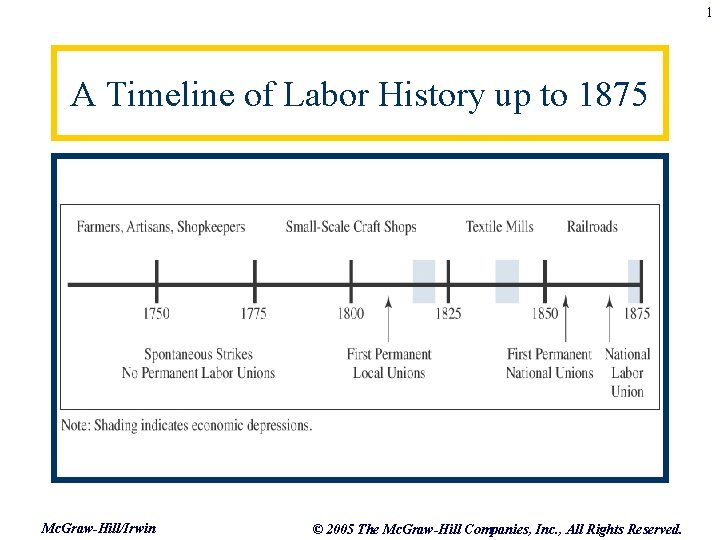
1 A Timeline of Labor History up to 1875 Mc. Graw-Hill/Irwin © 2005 The Mc. Graw-Hill Companies, Inc. , All Rights Reserved.
2 FROM LOCAL TO NATIONAL ORGANIZATIONS 1866 -National Labor Union: • Lasted only six years • Established precedent for labor movement by uniting diverse unions into single federation. • Emphasized political activity to bring about legal reform. • Campaigned for 8 hour workday, currency & banking reform. • Women’s suffrage • National labor political party Mc. Graw-Hill/Irwin © 2005 The Mc. Graw-Hill Companies, Inc. , All Rights Reserved.
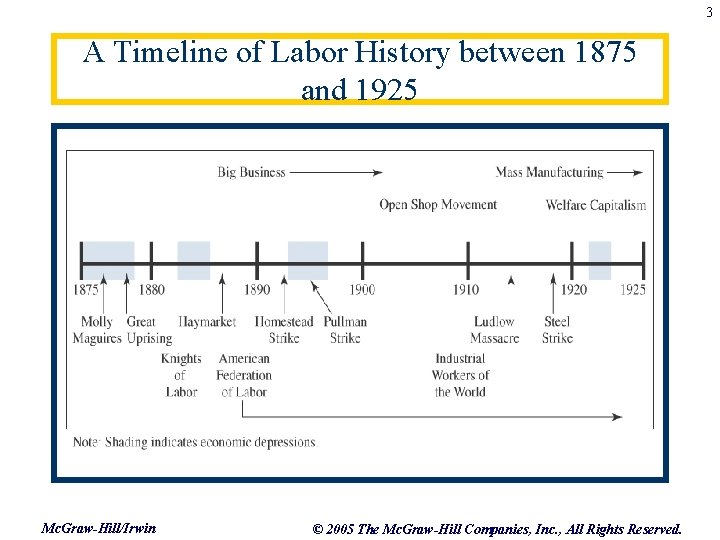
3 A Timeline of Labor History between 1875 and 1925 INSERT BOX 4. 3. Mc. Graw-Hill/Irwin © 2005 The Mc. Graw-Hill Companies, Inc. , All Rights Reserved.
4 THE GREAT UPRISING OF 1877 The Great Uprising of 1877 is more notable for what it represented than what it accomplished: • Strikes clearly reflected pent-up grievances of workers • Represented the growing struggle between industrialism, labor and capital • Shared concerns of workers • Laid the foundation of for future labor-management conflict, not cooperation. • Social implications. • With use of Federal troops, big business was more likely to confront rather than bargain with labor. Mc. Graw-Hill/Irwin © 2005 The Mc. Graw-Hill Companies, Inc. , All Rights Reserved.
5 UPLIFT UNIONISM Knights of Labor: • • • Federation of local assemblies Concern for moral worth, not material wealth Emphasized education and cooperation over conflict Broadly inclusive membership Emphasized the solidarity of all producers-including African. Americans & women • Replace capitalism with producer cooperatives • Producers-not bankers and absentee owners-own and control • End labor conflict by harmonizing interests of capital and labor Mc. Graw-Hill/Irwin © 2005 The Mc. Graw-Hill Companies, Inc. , All Rights Reserved.
6 “PURE AND SIMPLE” CRAFT UNIONISM American Federation of Labor (AFL): • Response to failure of Ko. L to address everyday working issues. • A federation, not a labor union. • Member unions pursued primary labor relations functions, AFL provided support. • Endorsed craft unionism. • Openly hostile towards unskilled workers-only represented skilled workers. • Guided by principle of exclusive jurisdiction. Mc. Graw-Hill/Irwin © 2005 The Mc. Graw-Hill Companies, Inc. , All Rights Reserved.
7 WORKERS OF THE WORLD UNITE! Industrial Workers of the World (IWW) U. S. example of revolutionary unionism: • • Both inclusive and radical Goal was to form “One Big Union” Skilled and unskilled, young and old Native-born and immigrant White and non-white Male and female Radicalism increased employer hostility towards unions Mc. Graw-Hill/Irwin © 2005 The Mc. Graw-Hill Companies, Inc. , All Rights Reserved.

8 THE OPEN SHOP MOVEMENT AND WELFARE CAPITALISM The open shop movement was concerted drive by employers and their associations to create and maintain union-free workplaces. • Emphasized an ideology of individual freedom • Unions were portrayed as violating individual liberties by denying workers the right to choose • Equated with “liberty and independence” of the employer’s “natural and constitutional rights” • Entailed well-orchestrated collective activity by business Mc. Graw-Hill/Irwin © 2005 The Mc. Graw-Hill Companies, Inc. , All Rights Reserved.
9 THE OPEN SHOP MOVEMENT AND WELFARE CAPITALISM • Welfare capitalism- more positive approach to employer resistance to unionization: • • • Improving supervisory practices. Offering protective insurance benefits. Implementing orderly hiring practices. Improving physical work environment and safety. Providing employee voice through nonunion employee representation plans (“company unions”). Mc. Graw-Hill/Irwin © 2005 The Mc. Graw-Hill Companies, Inc. , All Rights Reserved.
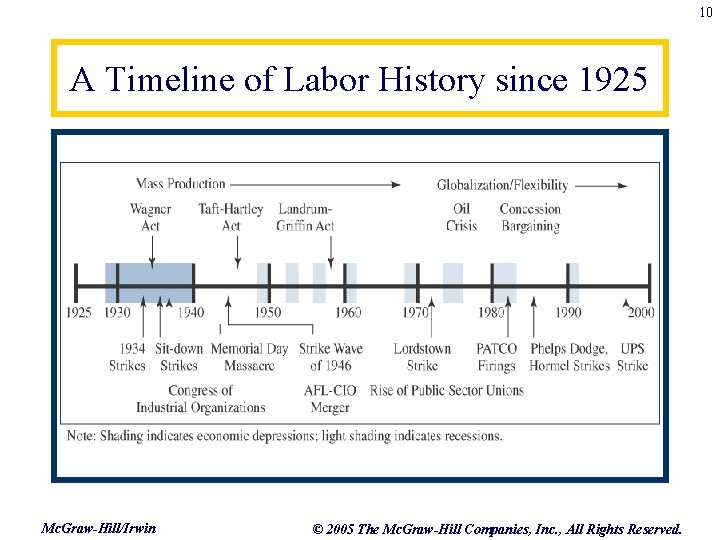
10 A Timeline of Labor History since 1925 Mc. Graw-Hill/Irwin © 2005 The Mc. Graw-Hill Companies, Inc. , All Rights Reserved.
11 A NEW DEAL FOR WORKERS: LEGAL PROTECTION & INDUSTRIAL UNIONS • Passage of Norris-La. Guardia Act in 1932 began new era in U. S. labor-mngt relations (see ch. 5) – “Yellow dog” contracts made unenforceable – Limited use of injunctions in labor disputes Mc. Graw-Hill/Irwin © 2005 The Mc. Graw-Hill Companies, Inc. , All Rights Reserved.
12 A NEW DEAL FOR WORKERS: LEGAL PROTECTION & INDUSTRIAL UNIONS • In 1933 Congress passed National Industrial Recovery Act (NIRA): • Encouraged and emboldened workers to form unions. • Employers established company unions to avoid independent unionization. • In 1934, weakness of NIRA resulted in tremendous strikes where workers clashed with employers who refused to recognize independent unions. • Minneapolis Teamsters Strike • San Francisco General Strike • East Coast Textile Strike Mc. Graw-Hill/Irwin © 2005 The Mc. Graw-Hill Companies, Inc. , All Rights Reserved.
13 A NEW DEAL FOR WORKERS: LEGAL PROTECTION & INDUSTRIAL UNIONS • NIRA ruled unconstitutional in 1935 • Same year, 1935, Congress passed the National Labor Relations Act (Wagner Act). • • Encouraged unionization Enacted legal protections for workers Outlawed company unions Established the National Labor Relations Board • By 1935, conflict between craft unionism and industrial unionism lead to the formation of the Committee for Industrial Organization (CIO). • By 1941, union membership tripled to about 8. 4 M, or 23 percent of workers. Mc. Graw-Hill/Irwin © 2005 The Mc. Graw-Hill Companies, Inc. , All Rights Reserved.
14 A NEW DEAL FOR WORKERS: LEGAL PROTECTION & INDUSTRIAL UNIONS • General Motors Sit-Down Strike (December 1936 -February 1937) was watershed event for both organized labor and the CIO. – Workers in Flint, Michigan took over two GM plants. – After the strike spread to other cities and several battles between strikers and police, General Motors finally agreed to recognize the United Auto Workers (UAW). – Industrial unionism further spread to steel and other manufacturing industries. • Though not without some intense battles, such as the Memorial Day Massacre during the Little Steel Strike. Mc. Graw-Hill/Irwin © 2005 The Mc. Graw-Hill Companies, Inc. , All Rights Reserved.
15 WARTIME AND POSTWAR LABOR RELATIONS • • • 1947 -Taft-Hartley Act. 1955 -AFL-CIO merger. 1959 -Landrum-Griffin Act. Private sector union density peaked at around 35 percent. Public sector union membership dramatically increased, beginning in 1960 s. • 1981 -Air traffic controllers fired during the illegal PATCO strike; replacement workers hired. • Number of bitter strikes in the 1980 s and 1990 s involved management use of permanent replacement workers. • Labor practices became more divergent -- some relationships became more adversarial, while others tried to create stronger union-management partnerships. Mc. Graw-Hill/Irwin © 2005 The Mc. Graw-Hill Companies, Inc. , All Rights Reserved.
16 WARTIME AND POSTWAR LABOR RELATIONS The labor movement at beginning of 21 st century is struggling, yet has pockets of vibrancy: • • Globalization continues to undermine labor’s bargaining power. Private sector union density has shrunk to <10 percent. Public sector union density stable at 35+ percent. Dunlop Commission (Clinton Administration) issued recommendations for reducing conflict and improving productivity. • General unionism has largely replaced craft unionism and industrial unionism. • 2005—disaffiliation of SEIU, Teamsters, UFCW, Unite Here from AFL-CIO (~1/3 of membership), formation of Change to Win Coalition (includes Laborers, UFW, Carpenters) Mc. Graw-Hill/Irwin © 2005 The Mc. Graw-Hill Companies, Inc. , All Rights Reserved.
- Slides: 16