
1 9 ObjectOriented Programming Inheritance 2005 Pearson Education
1 9 Object-Oriented Programming: Inheritance 2005 Pearson Education, Inc. All rights reserved.
2 OBJECTIVES § § § § In this chapter you will learn: How inheritance promotes software reusability. The notions of superclasses and subclasses. To use keyword extends to create a class that inherits attributes and behaviors from another class. To use access modifier protected to give subclass methods access to superclass members. To access superclass members with super. How constructors are used in inheritance hierarchies. The methods of class Object, the direct or indirect superclass of all classes in Java. 2005 Pearson Education, Inc. All rights reserved.
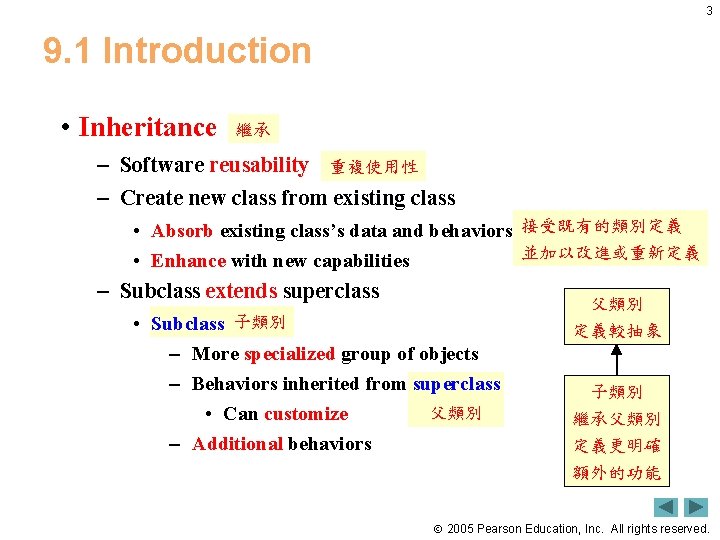
3 9. 1 Introduction • Inheritance 繼承 – Software reusability 重複使用性 – Create new class from existing class • Absorb existing class’s data and behaviors 接受既有的類別定義 並加以改進或重新定義 • Enhance with new capabilities – Subclass extends superclass • Subclass 子類別 – More specialized group of objects – Behaviors inherited from superclass 父類別 • Can customize – Additional behaviors 父類別 定義較抽象 子類別 繼承父類別 定義更明確 額外的功能 2005 Pearson Education, Inc. All rights reserved.
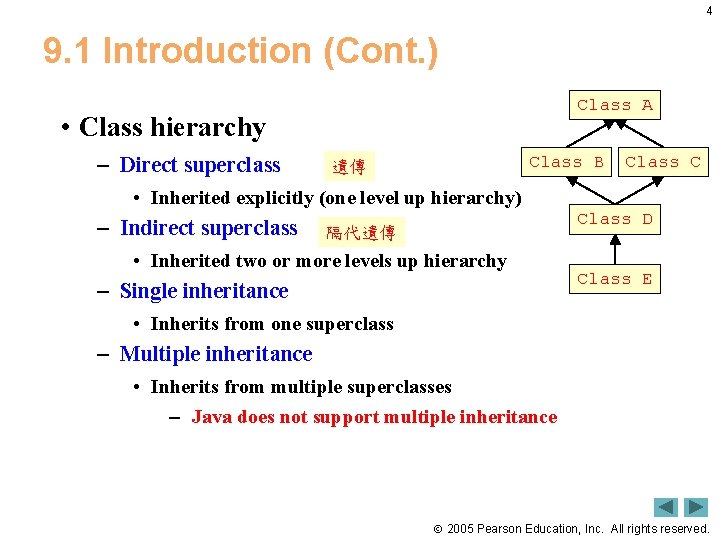
4 9. 1 Introduction (Cont. ) Class A • Class hierarchy – Direct superclass Class B 遺傳 Class C • Inherited explicitly (one level up hierarchy) – Indirect superclass Class D 隔代遺傳 • Inherited two or more levels up hierarchy – Single inheritance Class E • Inherits from one superclass – Multiple inheritance • Inherits from multiple superclasses – Java does not support multiple inheritance 2005 Pearson Education, Inc. All rights reserved.

5 9. 2 Superclasses and subclasses • Superclasses and subclasses – Object of one class “is an” object of another class • Example: Rectangle is quadrilateral. – Class Rectangle inherits from class Quadrilateral – Quadrilateral: superclass 四邊形 – Rectangle: subclass 長方形 – Superclass typically represents larger set of objects than subclasses • Example: – superclass: Vehicle 交通 具 • Cars, trucks, boats, bicycles, … – subclass: Car 車輛 • Smaller, more-specific subset of vehicles 2005 Pearson Education, Inc. All rights reserved.
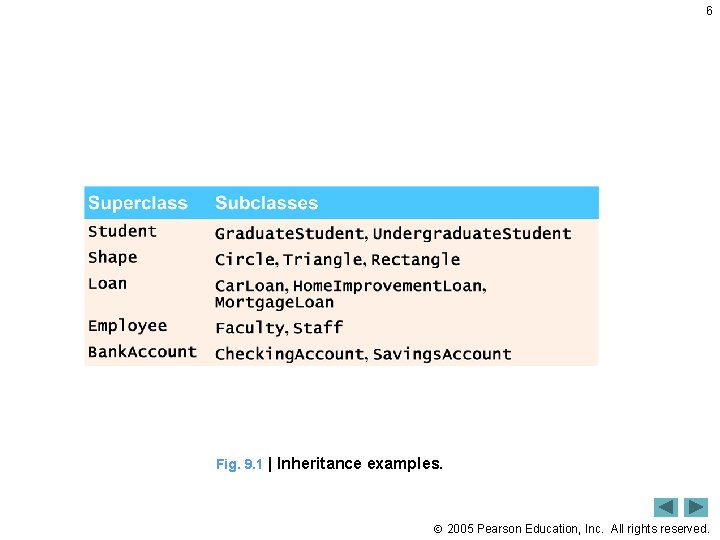
6 Fig. 9. 1 | Inheritance examples. 2005 Pearson Education, Inc. All rights reserved.
7 9. 2 Superclasses and subclasses (Cont. ) • Inheritance hierarchy 階層式繼承 – Inheritance relationships: tree-like hierarchy structure – Each class becomes • superclass – Supply members to other classes • OR • subclass – Inherit members from other classes 2005 Pearson Education, Inc. All rights reserved.
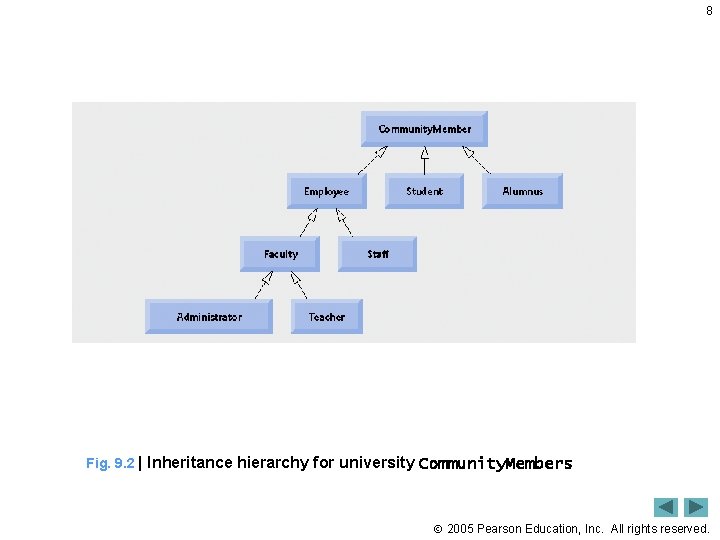
8 Fig. 9. 2 | Inheritance hierarchy for university Community. Members 2005 Pearson Education, Inc. All rights reserved.
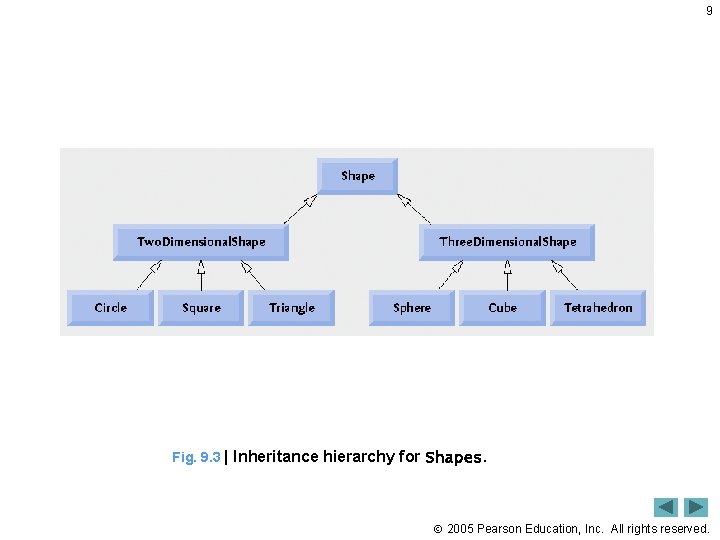
9 Fig. 9. 3 | Inheritance hierarchy for Shapes. 2005 Pearson Education, Inc. All rights reserved.
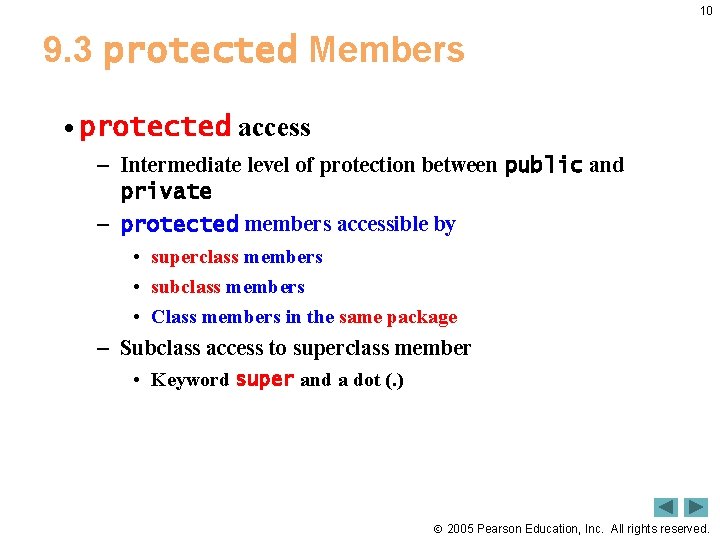
10 9. 3 protected Members • protected access – Intermediate level of protection between public and private – protected members accessible by • superclass members • subclass members • Class members in the same package – Subclass access to superclass member • Keyword super and a dot (. ) 2005 Pearson Education, Inc. All rights reserved.
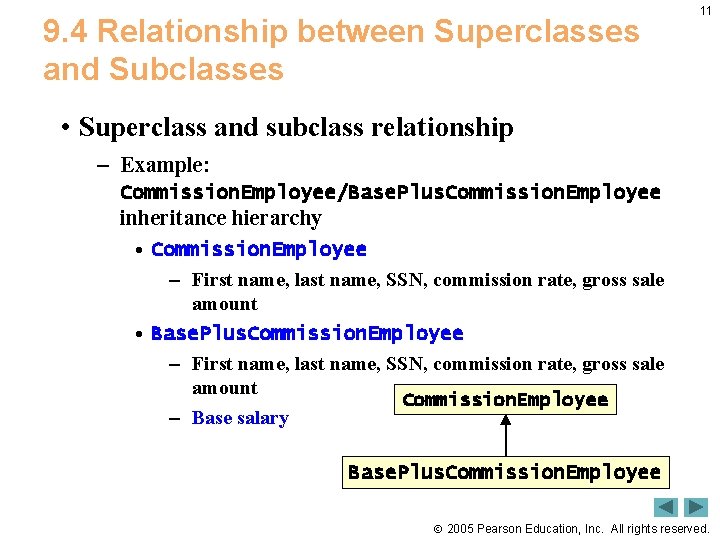
9. 4 Relationship between Superclasses and Subclasses 11 • Superclass and subclass relationship – Example: Commission. Employee/Base. Plus. Commission. Employee inheritance hierarchy • Commission. Employee – First name, last name, SSN, commission rate, gross sale amount • Base. Plus. Commission. Employee – First name, last name, SSN, commission rate, gross sale amount Commission. Employee – Base salary Base. Plus. Commission. Employee 2005 Pearson Education, Inc. All rights reserved.
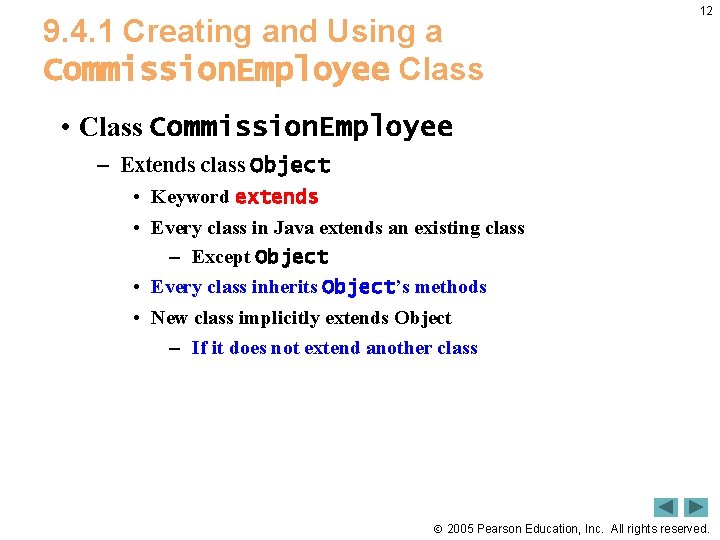
9. 4. 1 Creating and Using a Commission. Employee Class 12 • Class Commission. Employee – Extends class Object • Keyword extends • Every class in Java extends an existing class – Except Object • Every class inherits Object’s methods • New class implicitly extends Object – If it does not extend another class 2005 Pearson Education, Inc. All rights reserved.
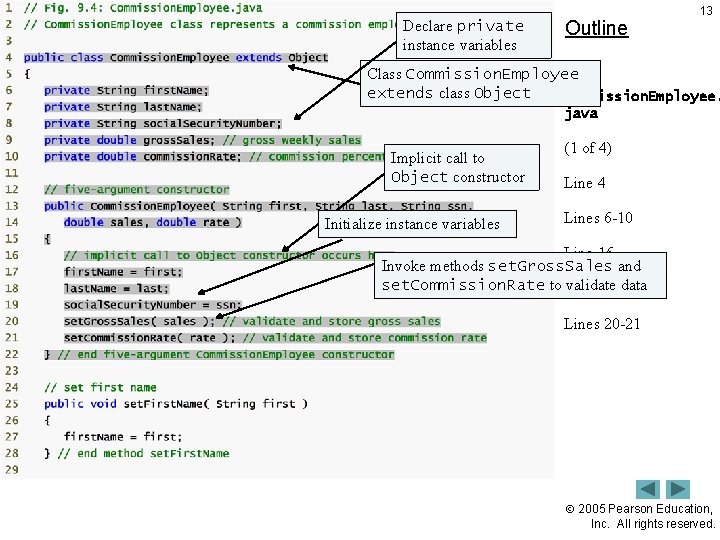
Declare private instance variables Outline 13 Class Commission. Employee extends class Object Commission. Employee. java Implicit call to Object constructor Initialize instance variables (1 of 4) Line 4 Lines 6 -10 Line 16 Invoke methods set. Gross. Sales and set. Commission. Rate to Lines validate data 17 -21 Lines 20 -21 2005 Pearson Education, Inc. All rights reserved.
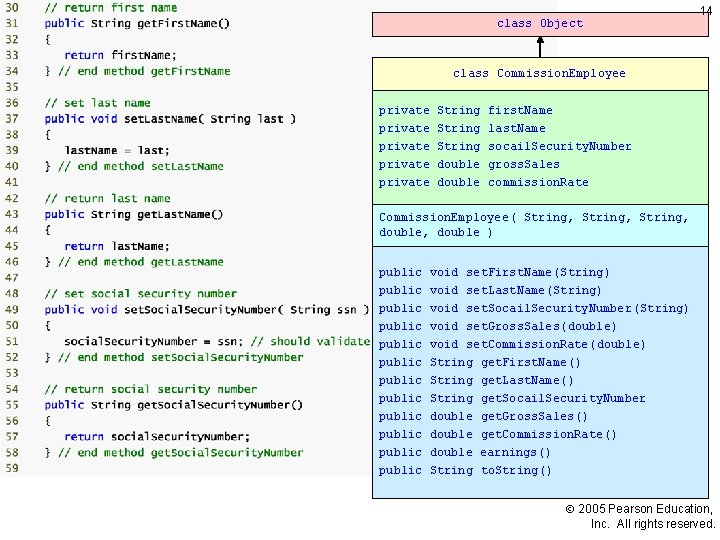
class Object 14 class Commission. Employee private String first. Name private String last. Name private String socail. Security. Number private double gross. Sales private double commission. Rate Commission. Employee( String, double ) public void set. First. Name(String) public void set. Last. Name(String) public void set. Socail. Security. Number(String) public public void set. Gross. Sales(double) void set. Commission. Rate(double) String get. First. Name() String get. Last. Name() String get. Socail. Security. Number public double get. Gross. Sales() public double get. Commission. Rate() public double earnings() public String to. String() 2005 Pearson Education, Inc. All rights reserved.
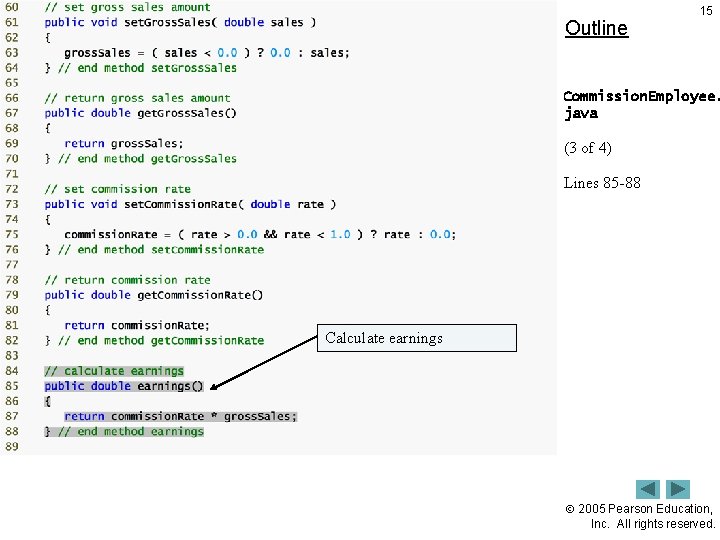
Outline 15 Commission. Employee. java (3 of 4) Lines 85 -88 Calculate earnings 2005 Pearson Education, Inc. All rights reserved.
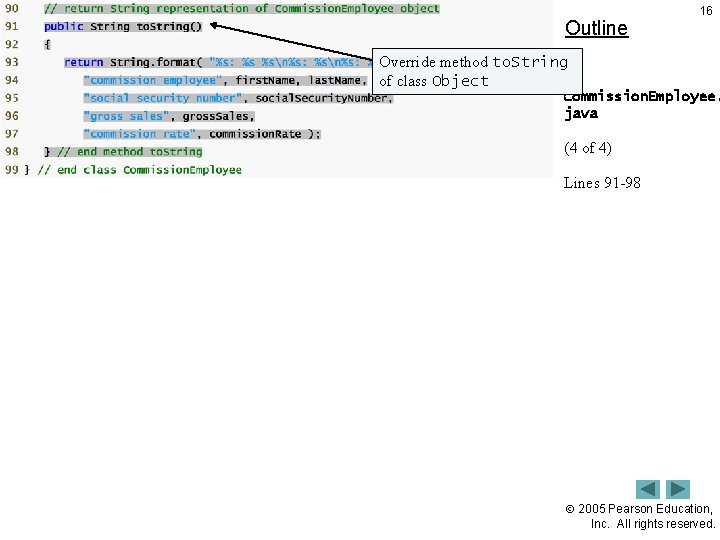
Outline 16 Override method to. String of class Object Commission. Employee. java (4 of 4) Lines 91 -98 2005 Pearson Education, Inc. All rights reserved.
17 Common Programming Error 9. 1 It is a syntax error to override a method with a more restricted access modifier—a public method of the superclass cannot become a protected or private method in the subclass; a protected method of the superclass cannot become a private method in the subclass. Doing so would break the “is-a” relationship in which it is required that all subclass objects be able to respond to method calls that are made to public methods declared in the superclass. (cont…) 2005 Pearson Education, Inc. All rights reserved.
18 Common Programming Error 9. 1 If a public method could be overridden as a protected or private method, the subclass objects would not be able to respond to the same method calls as superclass objects. Once a method is declared public in a superclass, the method remains public for all that class’s direct and indirect subclasses. 2005 Pearson Education, Inc. All rights reserved.
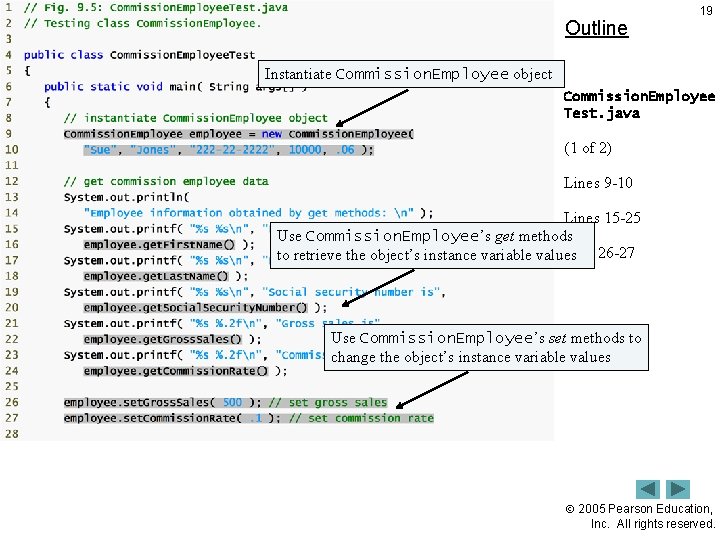
Outline 19 Instantiate Commission. Employee object Commission. Employee Test. java (1 of 2) Lines 9 -10 Lines 15 -25 Use Commission. Employee’s get methods Line 26 -27 to retrieve the object’s instance variable values Use Commission. Employee’s set methods to change the object’s instance variable values 2005 Pearson Education, Inc. All rights reserved.
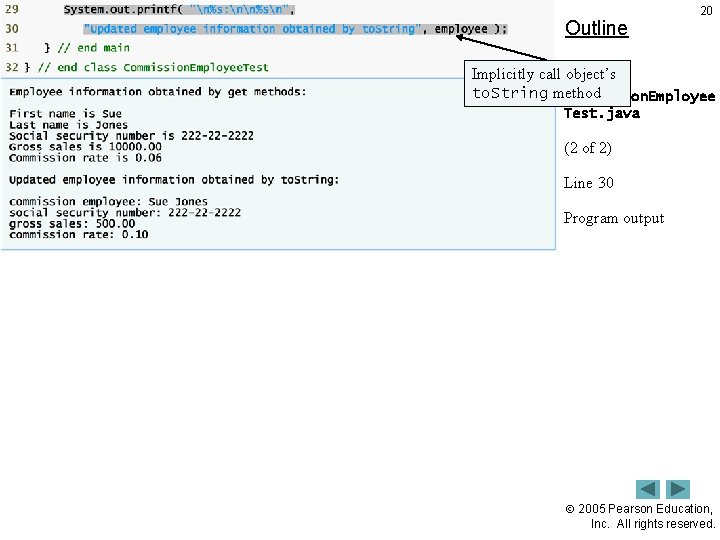
Outline 20 Implicitly call object’s to. String method Commission. Employee Test. java (2 of 2) Line 30 Program output 2005 Pearson Education, Inc. All rights reserved.
21 9. 4. 2 Creating a Base. Plus. Commission. Employee Class without Using Inheritance • Class Base. Plus. Commission. Employee – Implicitly extends Object – Much of the code is similar to Commission. Employee • private instance variables • public methods • constructor – Additions • private instance variable base. Salary • Methods set. Base. Salary and get. Base. Salary 2005 Pearson Education, Inc. All rights reserved.
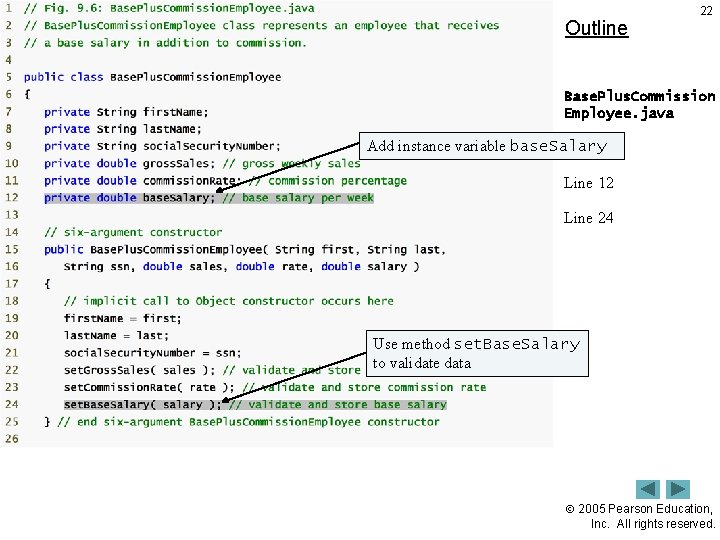
Outline 22 Base. Plus. Commission Employee. java Add instance variable base. Salary (1 of 4) Line 12 Line 24 Use method set. Base. Salary to validate data 2005 Pearson Education, Inc. All rights reserved.
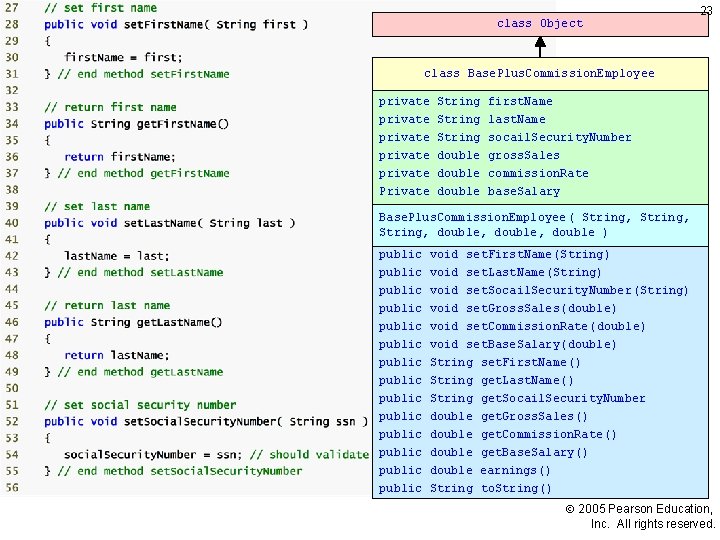
class Object 23 class Base. Plus. Commission. Employee private String first. Name private String last. Name private String socail. Security. Number private double gross. Sales private double commission. Rate Private double base. Salary Base. Plus. Commission. Employee ( String, double, double ) public void set. First. Name(String) public void set. Last. Name(String) public void set. Socail. Security. Number(String) public void set. Gross. Sales(double) void set. Commission. Rate(double) void set. Base. Salary(double) String set. First. Name() public String get. Last. Name() public String get. Socail. Security. Number public double get. Gross. Sales() public double get. Commission. Rate() public double get. Base. Salary() public double earnings() public String to. String() 2005 Pearson Education, Inc. All rights reserved.
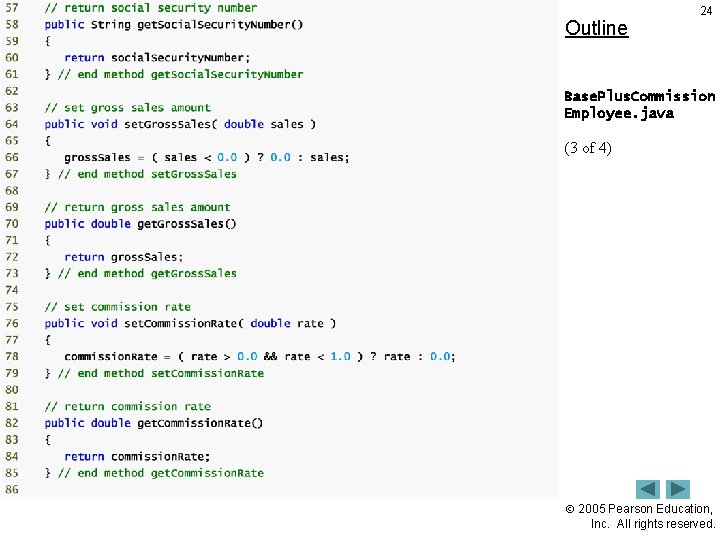
Outline 24 Base. Plus. Commission Employee. java (3 of 4) 2005 Pearson Education, Inc. All rights reserved.
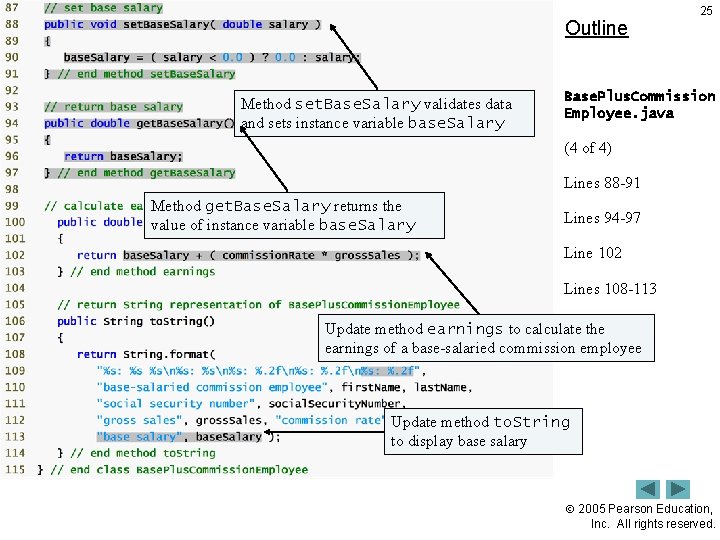
Outline Method set. Base. Salary validates data and sets instance variable base. Salary 25 Base. Plus. Commission Employee. java (4 of 4) Lines 88 -91 Method get. Base. Salary returns the value of instance variable base. Salary Lines 94 -97 Line 102 Lines 108 -113 Update method earnings to calculate the earnings of a base-salaried commission employee Update method to. String to display base salary 2005 Pearson Education, Inc. All rights reserved.
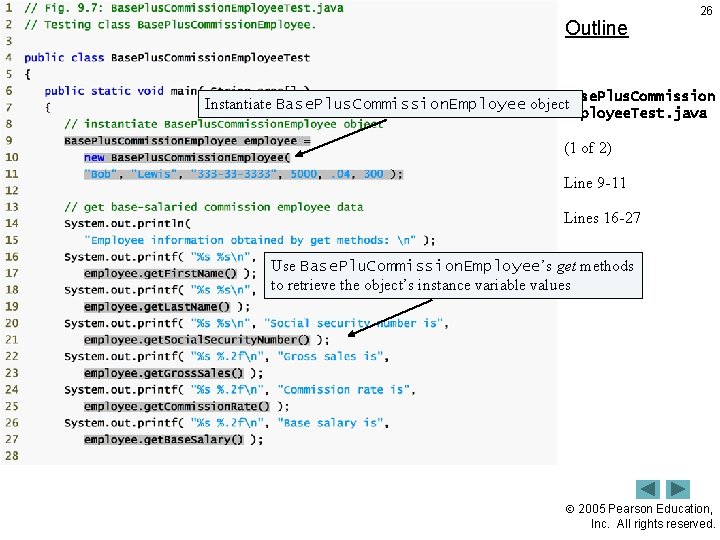
Outline 26 Instantiate Base. Plus. Commission. Employee object. Base. Plus. Commission Employee. Test. java (1 of 2) Line 9 -11 Lines 16 -27 Use Base. Plu. Commission. Employee’s get methods to retrieve the object’s instance variable values 2005 Pearson Education, Inc. All rights reserved.
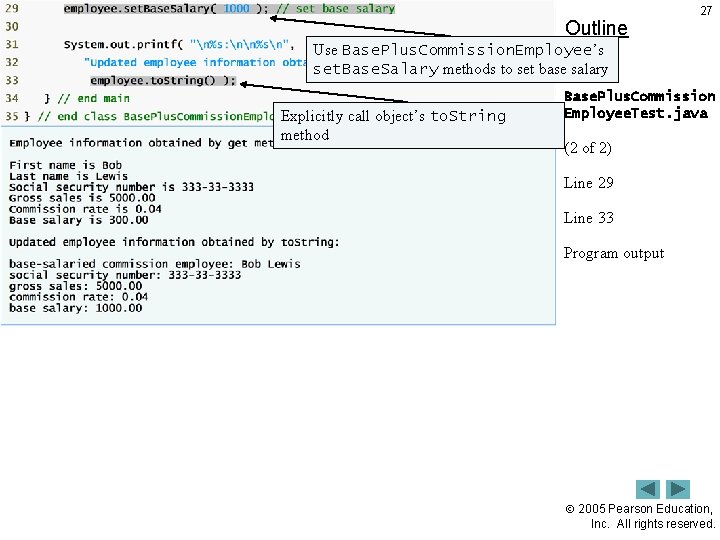
Outline 27 Use Base. Plus. Commission. Employee’s set. Base. Salary methods to set base salary Explicitly call object’s to. String method Base. Plus. Commission Employee. Test. java (2 of 2) Line 29 Line 33 Program output 2005 Pearson Education, Inc. All rights reserved.
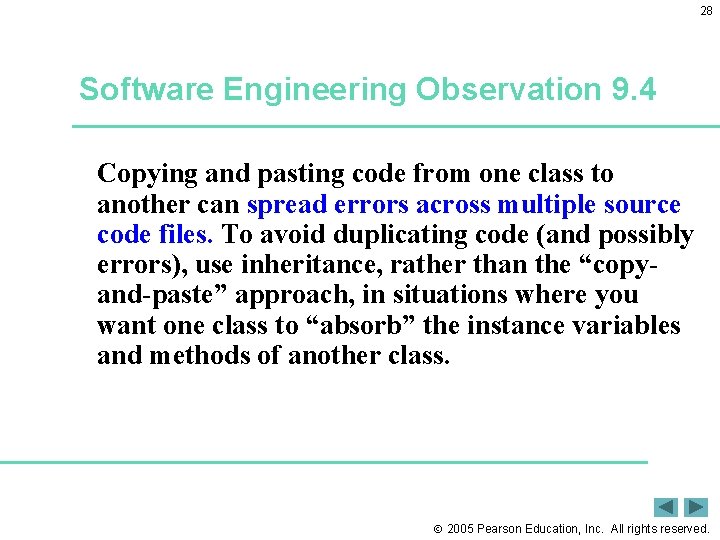
28 Software Engineering Observation 9. 4 Copying and pasting code from one class to another can spread errors across multiple source code files. To avoid duplicating code (and possibly errors), use inheritance, rather than the “copyand-paste” approach, in situations where you want one class to “absorb” the instance variables and methods of another class. 2005 Pearson Education, Inc. All rights reserved.
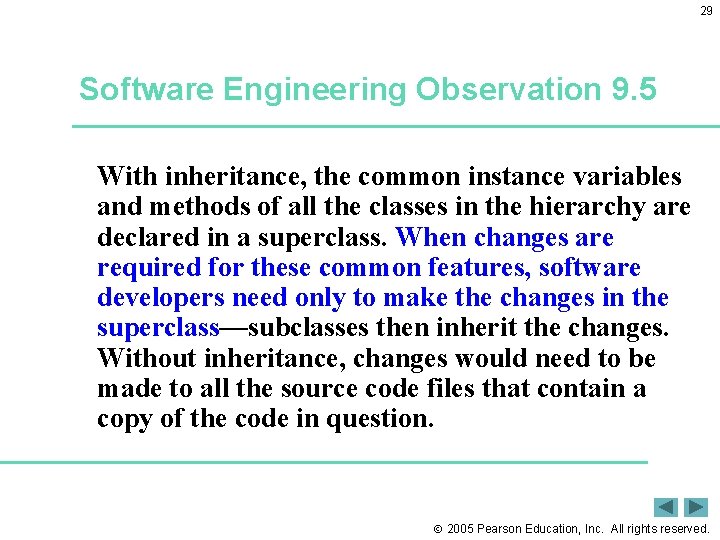
29 Software Engineering Observation 9. 5 With inheritance, the common instance variables and methods of all the classes in the hierarchy are declared in a superclass. When changes are required for these common features, software developers need only to make the changes in the superclass—subclasses then inherit the changes. Without inheritance, changes would need to be made to all the source code files that contain a copy of the code in question. 2005 Pearson Education, Inc. All rights reserved.
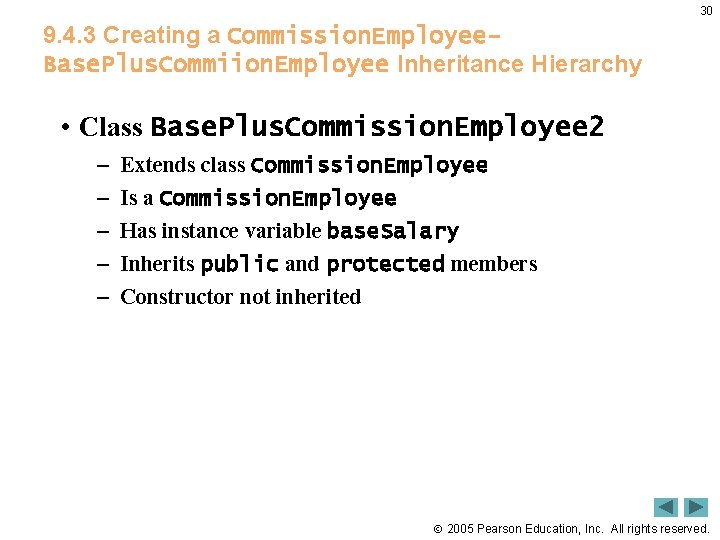
30 9. 4. 3 Creating a Commission. Employee. Base. Plus. Commiion. Employee Inheritance Hierarchy • Class Base. Plus. Commission. Employee 2 – – – Extends class Commission. Employee Is a Commission. Employee Has instance variable base. Salary Inherits public and protected members Constructor not inherited 2005 Pearson Education, Inc. All rights reserved.
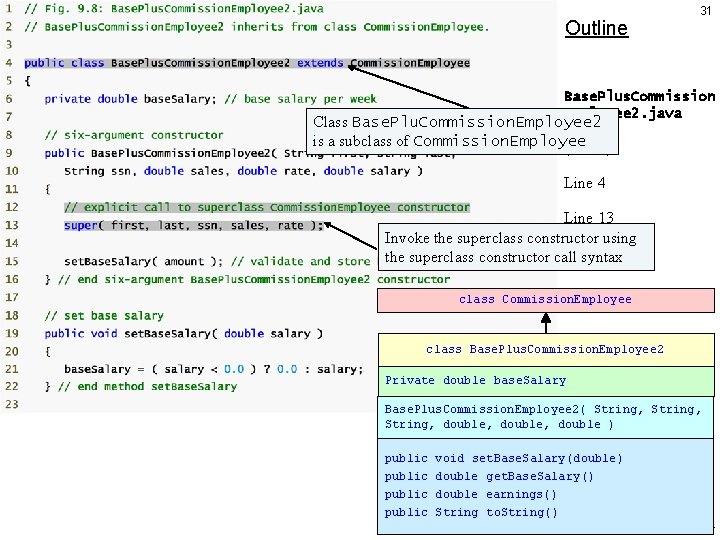
Outline 31 Base. Plus. Commission Employee 2. java Class Base. Plu. Commission. Employee 2 is a subclass of Commission. Employee (1 of 3) Line 4 Line 13 Invoke the superclass constructor using the superclass constructor call syntax class Commission. Employee class Base. Plus. Commission. Employee 2 Private double base. Salary Base. Plus. Commission. Employee 2( String, double, double ) public void set. Base. Salary(double) public double get. Base. Salary() public double earnings() public String to. String() 2005 Pearson Education, Inc. All rights reserved.
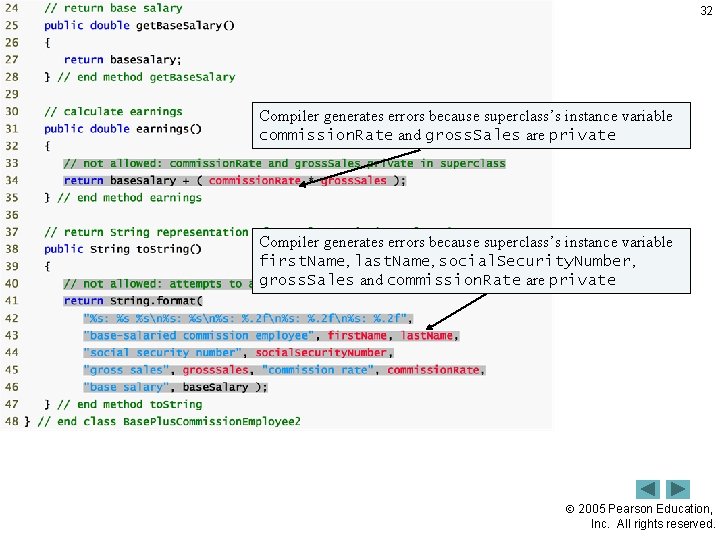
32 Compiler generates errors because superclass’s instance variable commission. Rate and gross. Sales are private Compiler generates errors because superclass’s instance variable first. Name, last. Name, social. Security. Number, gross. Sales and commission. Rate are private 2005 Pearson Education, Inc. All rights reserved.
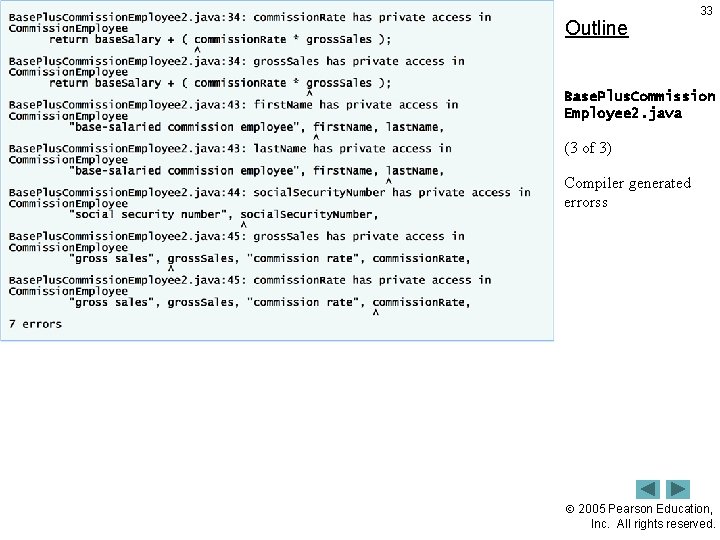
Outline 33 Base. Plus. Commission Employee 2. java (3 of 3) Compiler generated errorss 2005 Pearson Education, Inc. All rights reserved.
9. 4. 4 Commission. Employee. Base. Plus. Commission. Employee Inheritance Hierarchy Using protected Instance Variables 34 • Use protected instance variables – Enable class Base. Plus. Commission. Employee to directly access superclass instance variables – Superclass’s protected members are inherited by all subclases of that superclass 2005 Pearson Education, Inc. All rights reserved.
Outline Declare protected instance variables 35 Commission Employee 2. java (1 of 4) Line 6 -10 2005 Pearson Education, Inc. All rights reserved.
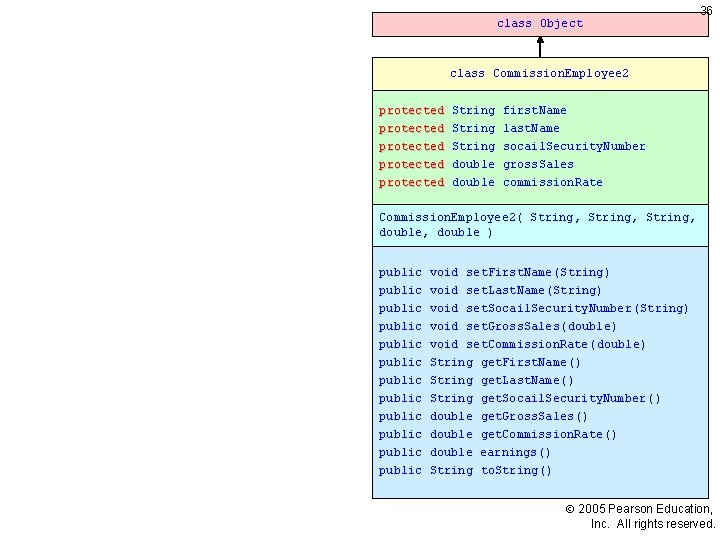
class Object 36 class Commission. Employee 2 protected String first. Name protected String last. Name protected String socail. Security. Number protected double gross. Sales protected double commission. Rate Commission. Employee 2( String, double ) public void set. First. Name(String) public void set. Last. Name(String) public void set. Socail. Security. Number(String) public public void set. Gross. Sales(double) void set. Commission. Rate(double) String get. First. Name() String get. Last. Name() String get. Socail. Security. Number() public double get. Gross. Sales() public double get. Commission. Rate() public double earnings() public String to. String() 2005 Pearson Education, Inc. All rights reserved.
Outline 37 Commission Employee 2. java (3 of 4) 2005 Pearson Education, Inc. All rights reserved.
Outline 38 Commission Employee 2. java (4 of 4) 2005 Pearson Education, Inc. All rights reserved.
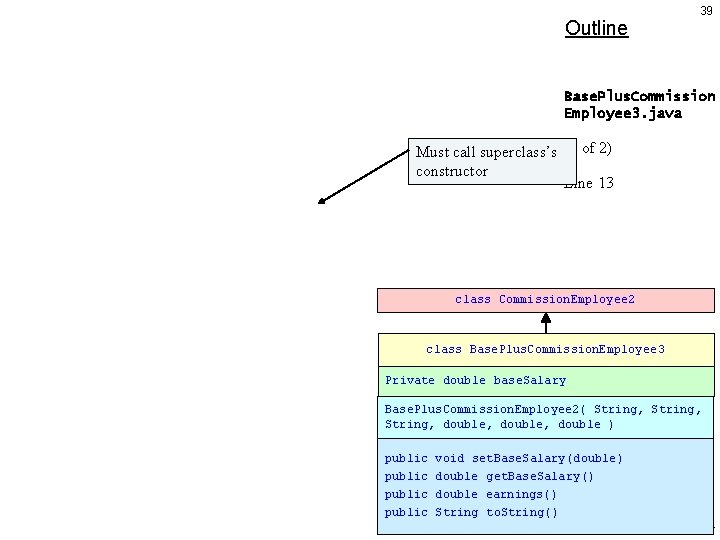
Outline 39 Base. Plus. Commission Employee 3. java Must call superclass’s (1 of 2) constructor Line 13 class Commission. Employee 2 class Base. Plus. Commission. Employee 3 Private double base. Salary Base. Plus. Commission. Employee 2( String, double, double ) public void set. Base. Salary(double) public double get. Base. Salary() public double earnings() public String to. String() 2005 Pearson Education, Inc. All rights reserved.
Outline 40 Base. Plus. Commission Employee 3. java Directly access superclass’s protected (2 of 2) instance variables Line 32 Lines 38 -43 2005 Pearson Education, Inc. All rights reserved.
Outline 41 Base. Plus. Commission Employee. Test 3. java (1 of 2) 2005 Pearson Education, Inc. All rights reserved.
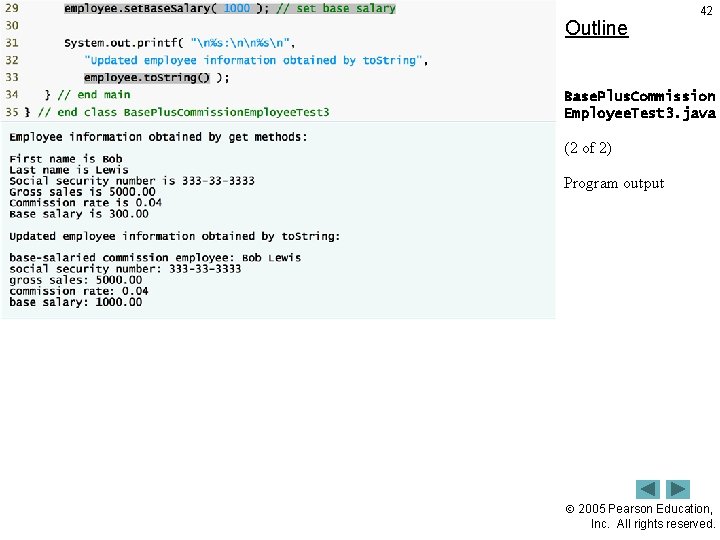
Outline 42 Base. Plus. Commission Employee. Test 3. java (2 of 2) Program output 2005 Pearson Education, Inc. All rights reserved.
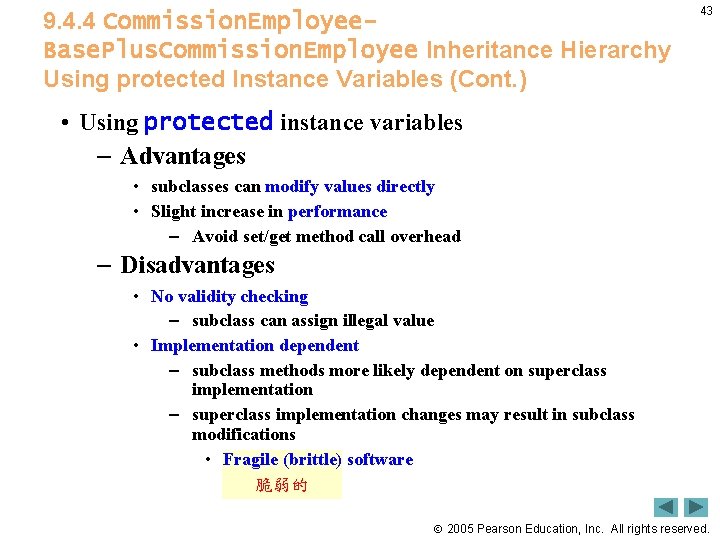
9. 4. 4 Commission. Employee. Base. Plus. Commission. Employee Inheritance Hierarchy Using protected Instance Variables (Cont. ) 43 • Using protected instance variables – Advantages • subclasses can modify values directly • Slight increase in performance – Avoid set/get method call overhead – Disadvantages • No validity checking – subclass can assign illegal value • Implementation dependent – subclass methods more likely dependent on superclass implementation – superclass implementation changes may result in subclass modifications • Fragile (brittle) software 脆弱的 2005 Pearson Education, Inc. All rights reserved.
44 Software Engineering Observation 9. 6 Use the protected access modifier when a superclass should provide a method only to its subclasses and other classes in the same package, but not to other clients. 2005 Pearson Education, Inc. All rights reserved.
45 Software Engineering Observation 9. 7 Declaring superclass instance variables private (as opposed to protected) enables the superclass implementation of these instance variables to change without affecting subclass implementations. 宣告 private 可以讓子類別與父類別具有 Implementation independent 特性 2005 Pearson Education, Inc. All rights reserved.
9. 4. 5 Commission. Employee. Base. Plus. Commission. Employee Inheritance Hierarchy Uing private Instance Variables 46 • Reexamine hierarchy – Use the best software engineering practice • Declare instance variables as private • Provide public get and set methods • Use get method to obtain values of instance variables 2005 Pearson Education, Inc. All rights reserved.
Outline Declare private instance variables 47 Commission Employee 3. java (1 of 4) Lines 6 -10 2005 Pearson Education, Inc. All rights reserved.
Outline 48 Commission Employee 3. java (2 of 4) 2005 Pearson Education, Inc. All rights reserved.
Outline 49 Commission Employee 3. java (3 of 4) 2005 Pearson Education, Inc. All rights reserved.
Outline 50 Use get methods to obtain the Commission values of instance variables Employee 3. java (4 of 4) Line 87 Lines 94 -97 2005 Pearson Education, Inc. All rights reserved.
Outline 51 Base. Plus. Commission Employee 4. java Inherits from Commission. Employee 3 (1 of 2) 2005 Pearson Education, Inc. All rights reserved.
Outline 52 Base. Plus. Commission Invoke an overridden superclass method from a. Employee 4. java subclass (2 of 2) Line 33 &the 40 Use get methods to obtain values of instance variables Line 33 Lines 40 Invoke an overridden superclass method from a subclass 2005 Pearson Education, Inc. All rights reserved.
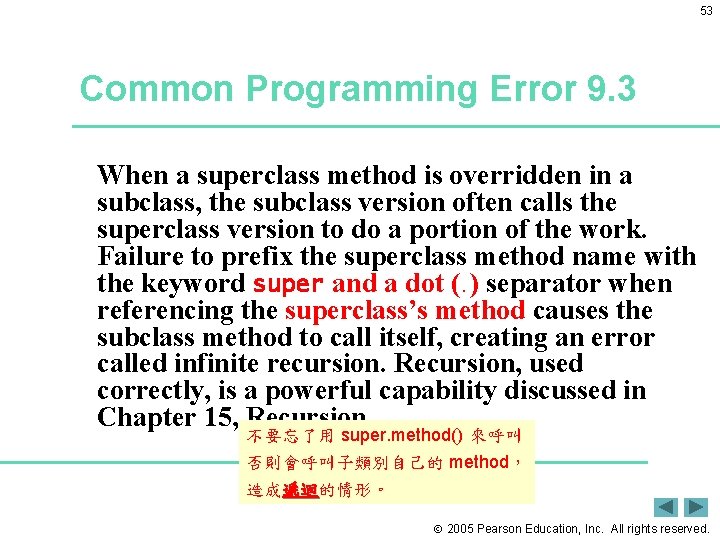
53 Common Programming Error 9. 3 When a superclass method is overridden in a subclass, the subclass version often calls the superclass version to do a portion of the work. Failure to prefix the superclass method name with the keyword super and a dot (. ) separator when referencing the superclass’s method causes the subclass method to call itself, creating an error called infinite recursion. Recursion, used correctly, is a powerful capability discussed in Chapter 15, Recursion. 不要忘了用 super. method() 來呼叫 否則會呼叫子類別自己的 method, 造成遞迴的情形。 遞迴 2005 Pearson Education, Inc. All rights reserved.
Outline 54 Base. Plus. Commission Employee. Test 4. java Base. Plus. Commission. Employee 4 Create object. (1 of 2) Lines 9 -11 Lines 16 -25 Use inherited get methods to access inherited private instance variables Use Base. Plus. Commission. Employee 4 get method to access private instance variable. 2005 Pearson Education, Inc. All rights reserved.
Outline 55 Use Base. Plus. Commission. Employee 4 set method to modify private instance variable base. Salary. Base. Plus. Commission Employee. Test 4. java (2 of 2) 2005 Pearson Education, Inc. All rights reserved.
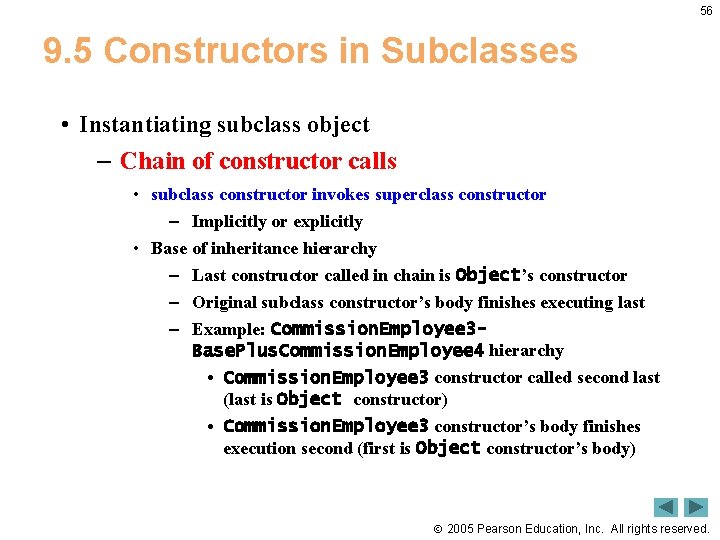
56 9. 5 Constructors in Subclasses • Instantiating subclass object – Chain of constructor calls • subclass constructor invokes superclass constructor – Implicitly or explicitly • Base of inheritance hierarchy – Last constructor called in chain is Object’s constructor – Original subclass constructor’s body finishes executing last – Example: Commission. Employee 3 Base. Plus. Commission. Employee 4 hierarchy • Commission. Employee 3 constructor called second last (last is Object constructor) • Commission. Employee 3 constructor’s body finishes execution second (first is Object constructor’s body) 2005 Pearson Education, Inc. All rights reserved.
57 Software Engineering Observation 9. 8 When a program creates a subclass object, the subclass constructor immediately calls the superclass constructor (explicitly, via super, or implicitly). The superclass constructor’s body executes to initialize the superclass’s instance variables that are part of the subclass object, then the subclass constructor’s body executes to initialize the subclass-only instance variables. (cont…) 2005 Pearson Education, Inc. All rights reserved.
58 Software Engineering Observation 9. 8 Java ensures that even if a constructor does not assign a value to an instance variable, the variable is still initialized to its default value (e. g. , 0 for primitive numeric types, false for booleans, null for references). 2005 Pearson Education, Inc. All rights reserved.
Outline 59 Commission. Employee 4. java (1 of 4) Lines 23 -24 Constructor outputs message to demonstrate method call order. 2005 Pearson Education, Inc. All rights reserved.
Outline 60 Commission. Employee 4. java (2 of 4) 2005 Pearson Education, Inc. All rights reserved.
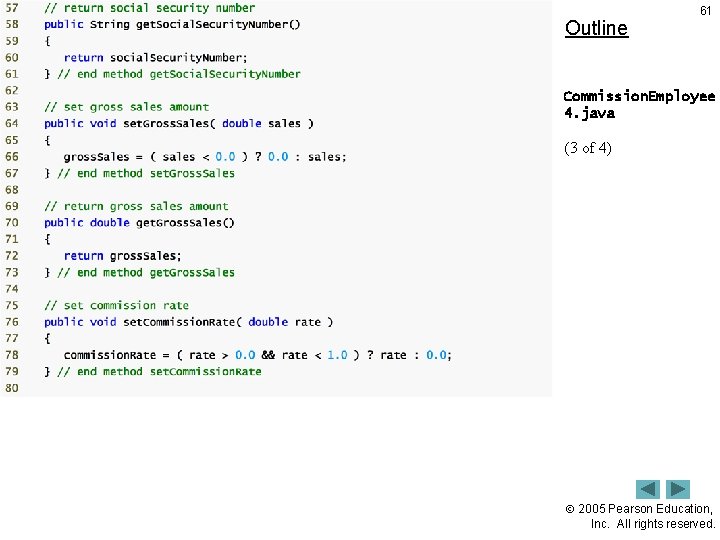
Outline 61 Commission. Employee 4. java (3 of 4) 2005 Pearson Education, Inc. All rights reserved.
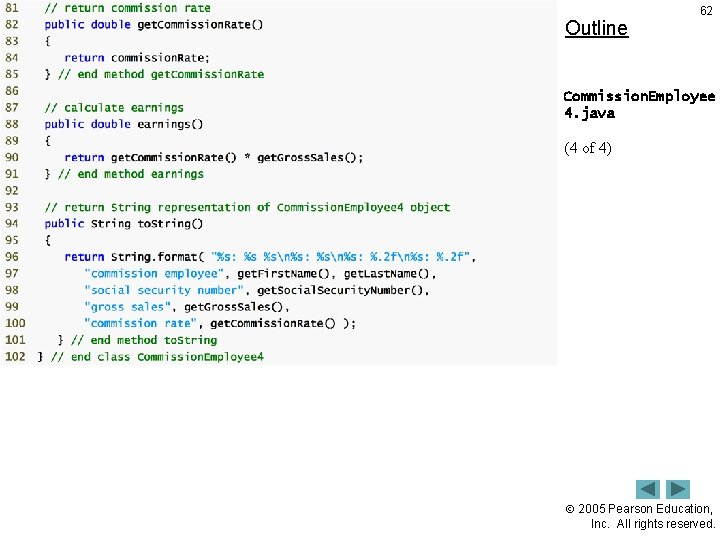
Outline 62 Commission. Employee 4. java (4 of 4) 2005 Pearson Education, Inc. All rights reserved.
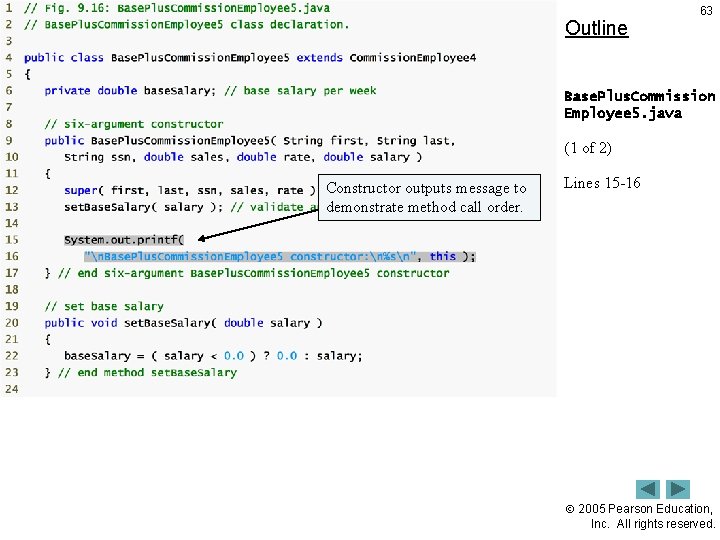
Outline 63 Base. Plus. Commission Employee 5. java (1 of 2) Constructor outputs message to demonstrate method call order. Lines 15 -16 2005 Pearson Education, Inc. All rights reserved.
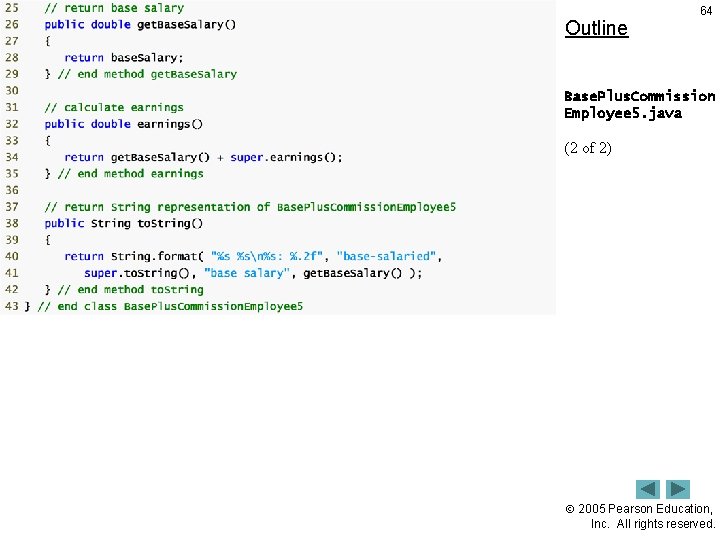
Outline 64 Base. Plus. Commission Employee 5. java (2 of 2) 2005 Pearson Education, Inc. All rights reserved.
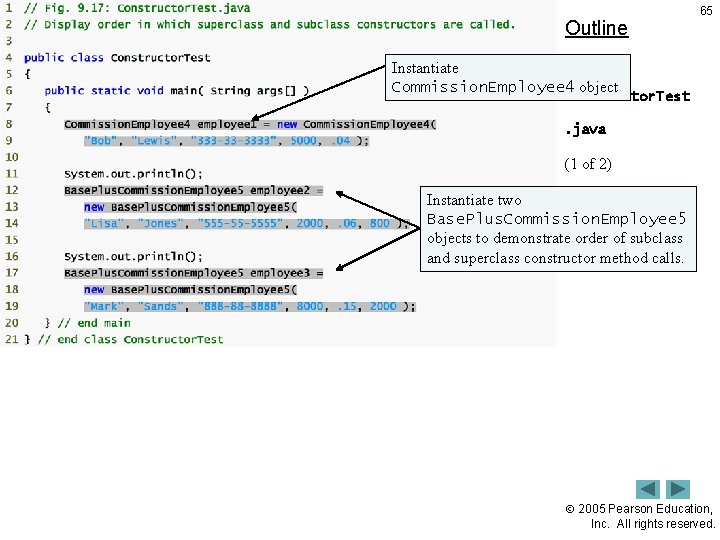
Outline 65 Instantiate Commission. Employee 4 object Constructor. Test. java (1 of 2) Lines 8 -9 Instantiate two Base. Plus. Commission. Employee 5 objects to demonstrate. Lines order 12 -19 of subclass and superclass constructor method calls. 2005 Pearson Education, Inc. All rights reserved.
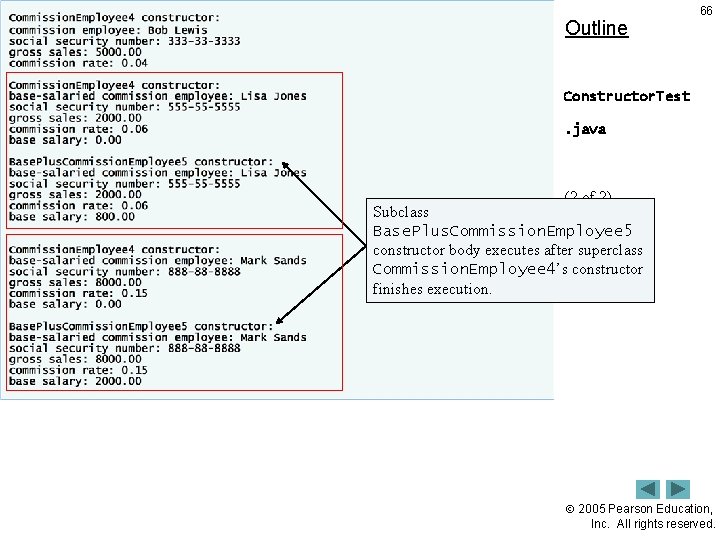
Outline 66 Constructor. Test. java (2 of 2) Subclass Base. Plus. Commission. Employee 5 constructor body executes after superclass Commission. Employee 4’s constructor finishes execution. 2005 Pearson Education, Inc. All rights reserved.
67 9. 6 Software Engineering with Inheritance • Customizing existing software – Inherit from existing classes • Include additional members • Redefine superclass members • No direct access to superclass’s source code – Link to object code – Independent software vendors (ISVs) • Develop proprietary code for sale/license – Available in object-code format • Users derive new classes – Without accessing ISV proprietary source code 2005 Pearson Education, Inc. All rights reserved.
68 Software Engineering Observation 9. 9 Despite the fact that inheriting from a class does not require access to the class’s source code, developers often insist on seeing the source code to understand how the class is implemented. Developers in industry want to ensure that they are extending a solid class—for example, a class that performs well and is implemented securely. 2005 Pearson Education, Inc. All rights reserved.
69 Software Engineering Observation 9. 10 At the design stage in an object-oriented system, the designer often finds that certain classes are closely related. The designer should “factor out” common instance variables and methods and place them in a superclass. Then the designer should use inheritance to develop subclasses, specializing them with capabilities beyond those inherited from the superclass. 物件導向分析:先找出需要哪些類別,然後找出這些類別 物件導向分析 共通的部份,形成父類別。最後逐一根據所需的功能細部 定義子類別。 2005 Pearson Education, Inc. All rights reserved.
70 Software Engineering Observation 9. 11 Declaring a subclass does not affect its superclass’s source code. Inheritance preserves the integrity of the superclass. 2005 Pearson Education, Inc. All rights reserved.
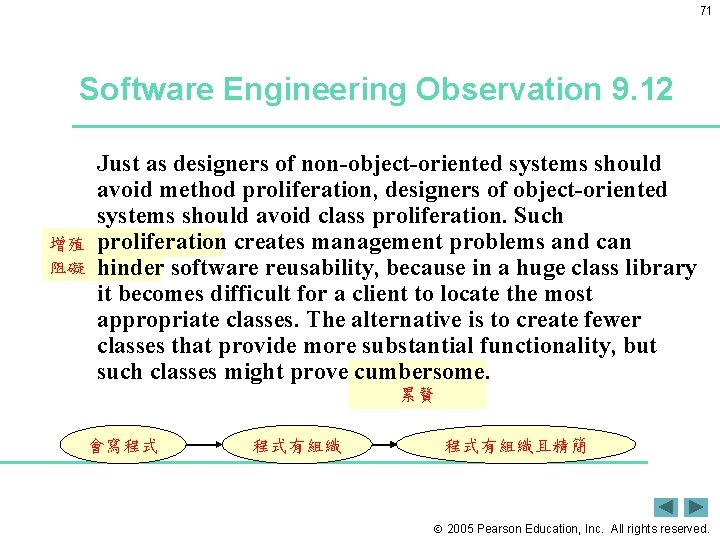
71 Software Engineering Observation 9. 12 增殖 阻礙 Just as designers of non-object-oriented systems should avoid method proliferation, designers of object-oriented systems should avoid class proliferation. Such proliferation creates management problems and can hinder software reusability, because in a huge class library it becomes difficult for a client to locate the most appropriate classes. The alternative is to create fewer classes that provide more substantial functionality, but such classes might prove cumbersome. 累贅 會寫程式 程式有組織且精簡 2005 Pearson Education, Inc. All rights reserved.
72 Performance Tip 9. 1 If subclasses are larger than they need to be (i. e. , contain too much functionality), memory and processing resources might be wasted. Extend the superclass that contains the functionality that is closest to what is needed. 2005 Pearson Education, Inc. All rights reserved.
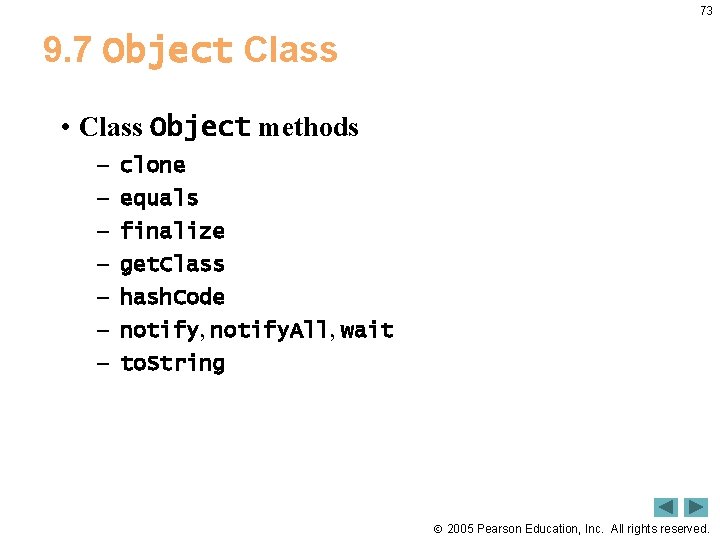
73 9. 7 Object Class • Class Object methods – – – – clone equals finalize get. Class hash. Code notify, notify. All, wait to. String 2005 Pearson Education, Inc. All rights reserved.
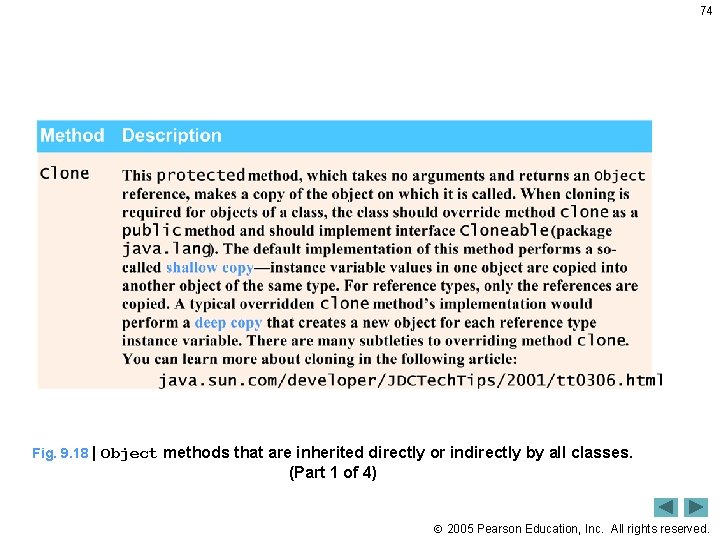
74 Fig. 9. 18 | Object methods that are inherited directly or indirectly by all classes. (Part 1 of 4) 2005 Pearson Education, Inc. All rights reserved.
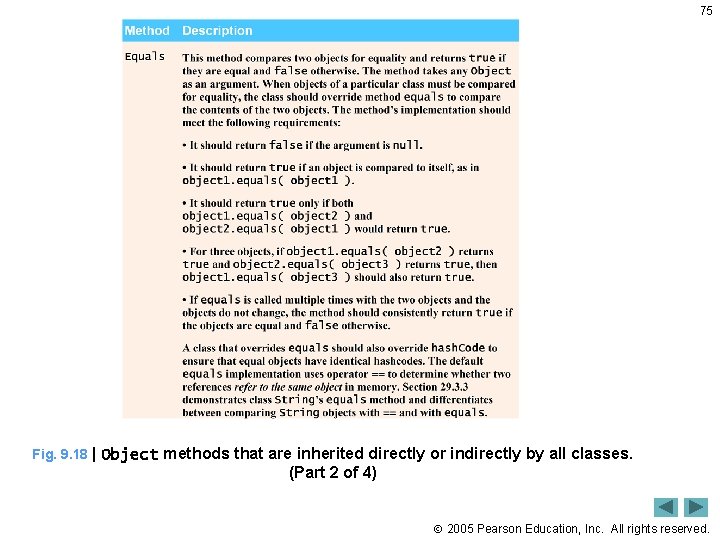
75 Fig. 9. 18 | Object methods that are inherited directly or indirectly by all classes. (Part 2 of 4) 2005 Pearson Education, Inc. All rights reserved.
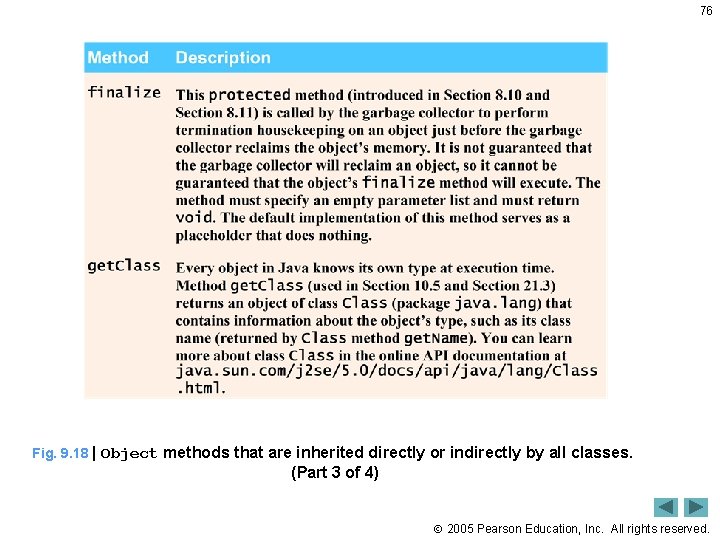
76 Fig. 9. 18 | Object methods that are inherited directly or indirectly by all classes. (Part 3 of 4) 2005 Pearson Education, Inc. All rights reserved.
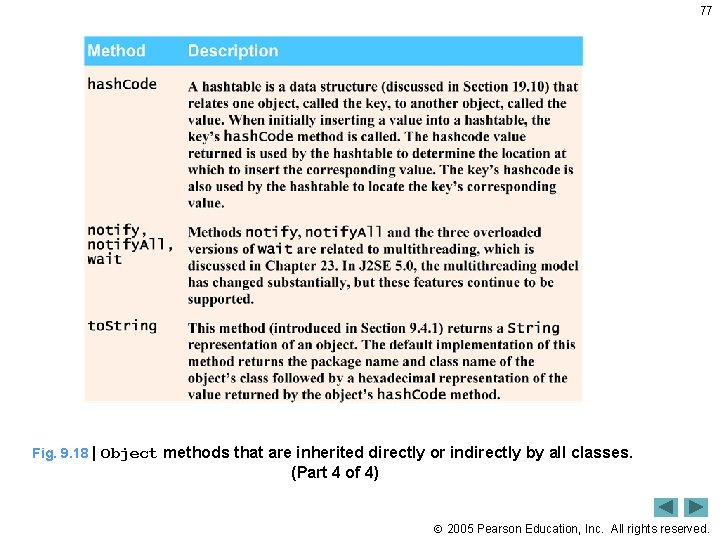
77 Fig. 9. 18 | Object methods that are inherited directly or indirectly by all classes. (Part 4 of 4) 2005 Pearson Education, Inc. All rights reserved.
- Slides: 77