
1 8 1 Proving the Vertical Angles Theorem
- Slides: 49
1. 8. 1: Proving the Vertical Angles Theorem 1
Warm-Up #12 Monday, 3/7/2016 Advanced Integrated 2 1. When two dice are tossed, what is the probability that the sum is NOT 11? 2. What is the chance of getting exactly 10 heads in 35 coin flips? 3. A family has five children, what is the probability that exactly one of them is a girl? 1. 8. 1: Proving the Vertical Angles Theorem 2
Warm-Up #12 Monday, 3/7/2016 Integrated 2 1. A company has to select 3 officers from a pool of 6 candidates. How many different ways can this be done if the officer are in different positions? 2. A coach must choose how to line up his five starters from a team of 12 players. How many different ways can the coach choose the starters? 3. In a class of 33 students, 12 have blue eyes, and 14 have brown hair. This includes 5 who have both. Create a Venn diagram. 1. 8. 1: Proving the Vertical Angles Theorem 3
Homework Monday, 3/7/2016 Vertical Angles 1. 8. 1: Proving the Vertical Angles Theorem 4
Vertical Angles 1. 8. 1: Proving the Vertical Angles Theorem 5
• Theorem: a statement or conjecture that can be proven true by given, definitions, postulates, or already proven theorems • Postulate: a statement that describes a fundamental relationship between basic terms of geometry. Postulates are accepted as true without proof. • Conjecture: an educated guess based on known information 1. 8. 1: Proving the Vertical Angles Theorem 6
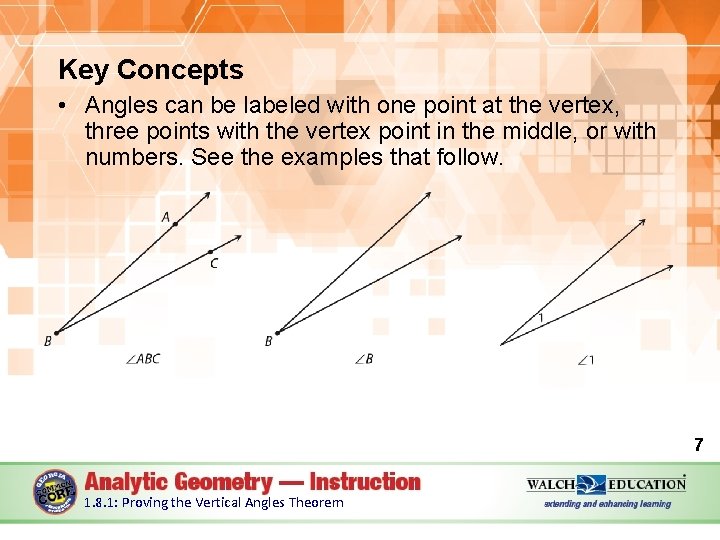
Key Concepts • Angles can be labeled with one point at the vertex, three points with the vertex point in the middle, or with numbers. See the examples that follow. 7 1. 8. 1: Proving the Vertical Angles Theorem
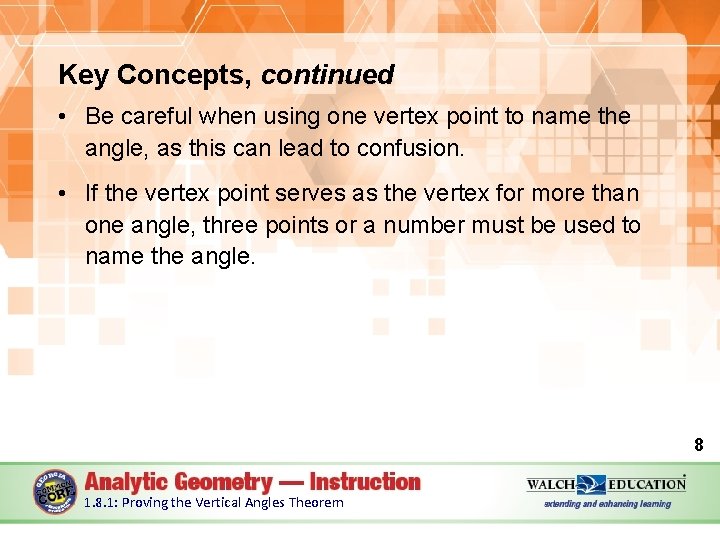
Key Concepts, continued • Be careful when using one vertex point to name the angle, as this can lead to confusion. • If the vertex point serves as the vertex for more than one angle, three points or a number must be used to name the angle. 8 1. 8. 1: Proving the Vertical Angles Theorem
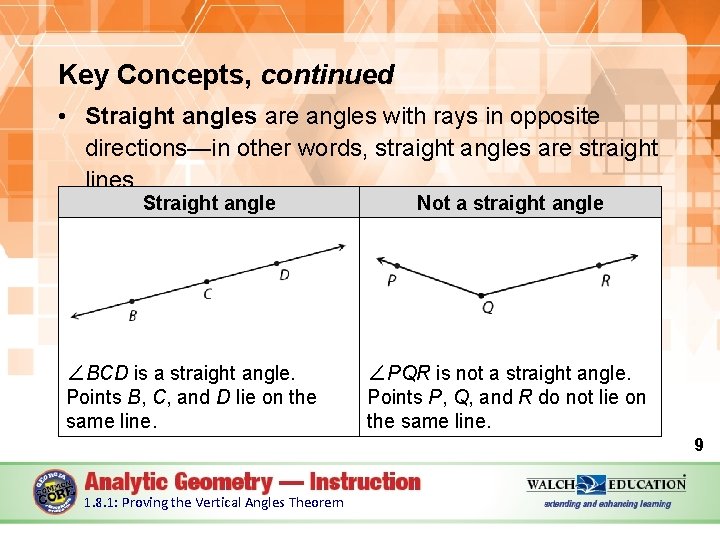
Key Concepts, continued • Straight angles are angles with rays in opposite directions—in other words, straight angles are straight lines. Straight angle ∠BCD is a straight angle. Points B, C, and D lie on the same line. Not a straight angle ∠PQR is not a straight angle. Points P, Q, and R do not lie on the same line. 9 1. 8. 1: Proving the Vertical Angles Theorem
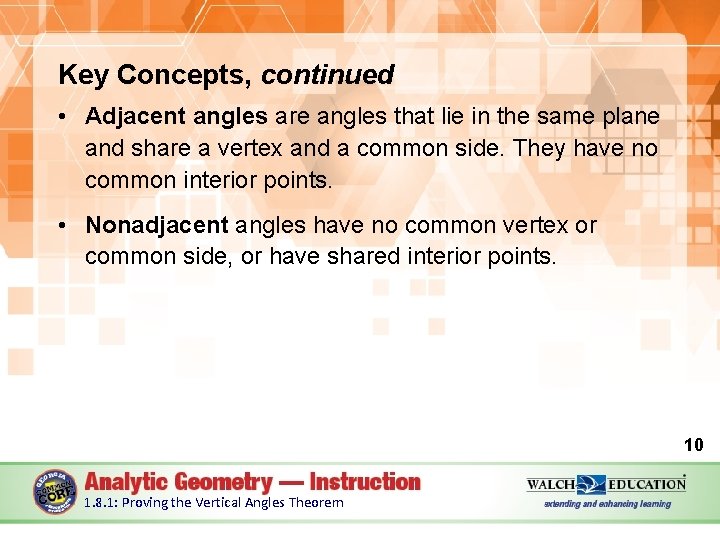
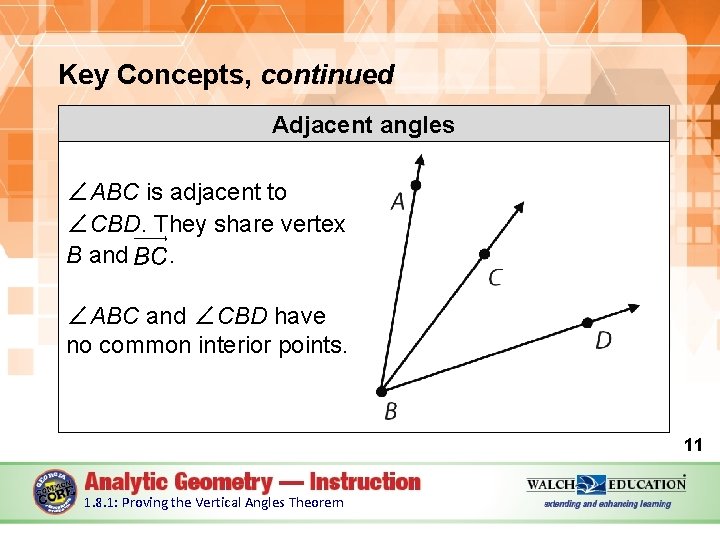
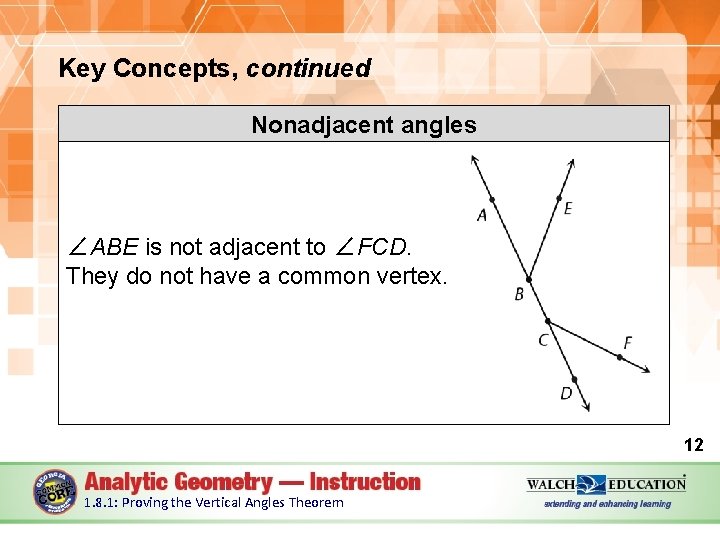
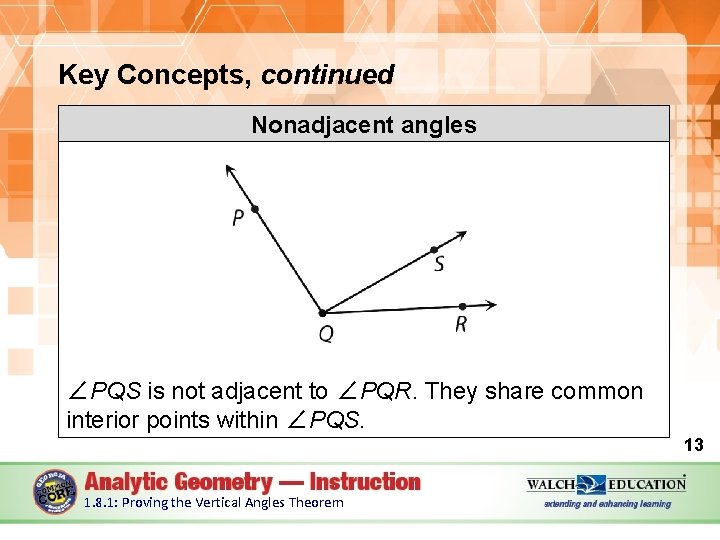
Key Concepts, continued • Adjacent angles are angles that lie in the same plane and share a vertex and a common side. They have no common interior points. • Nonadjacent angles have no common vertex or common side, or have shared interior points. 10 1. 8. 1: Proving the Vertical Angles Theorem
Key Concepts, continued Adjacent angles ∠ABC is adjacent to ∠CBD. They share vertex B and. ∠ABC and ∠CBD have no common interior points. 11 1. 8. 1: Proving the Vertical Angles Theorem
Key Concepts, continued Nonadjacent angles ∠ABE is not adjacent to ∠FCD. They do not have a common vertex. (continued) 12 1. 8. 1: Proving the Vertical Angles Theorem
Key Concepts, continued Nonadjacent angles ∠PQS is not adjacent to ∠PQR. They share common interior points within ∠PQS. 13 1. 8. 1: Proving the Vertical Angles Theorem
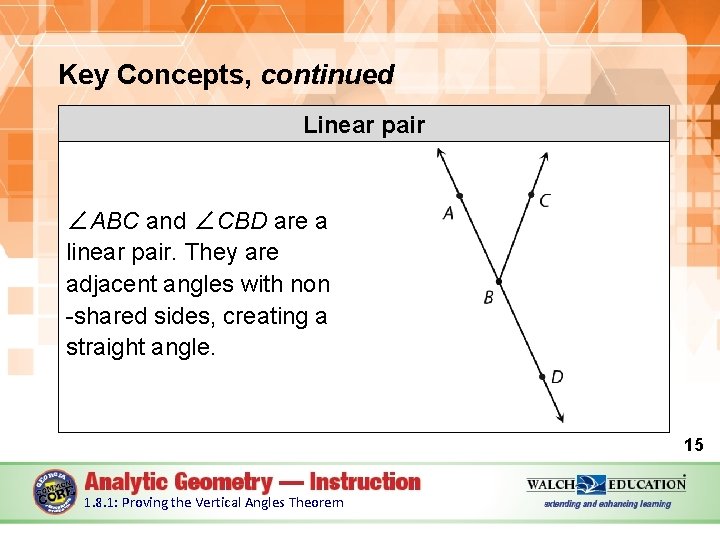
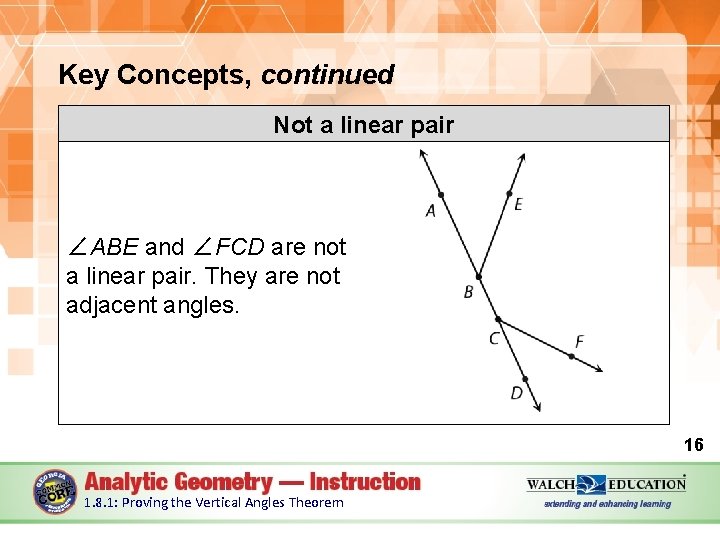
Key Concepts, continued • Linear pairs are pairs of adjacent angles whose non-shared sides form a straight angle. 14 1. 8. 1: Proving the Vertical Angles Theorem
Key Concepts, continued Linear pair ∠ABC and ∠CBD are a linear pair. They are adjacent angles with non -shared sides, creating a straight angle. 15 1. 8. 1: Proving the Vertical Angles Theorem
Key Concepts, continued Not a linear pair ∠ABE and ∠FCD are not a linear pair. They are not adjacent angles. 16 1. 8. 1: Proving the Vertical Angles Theorem
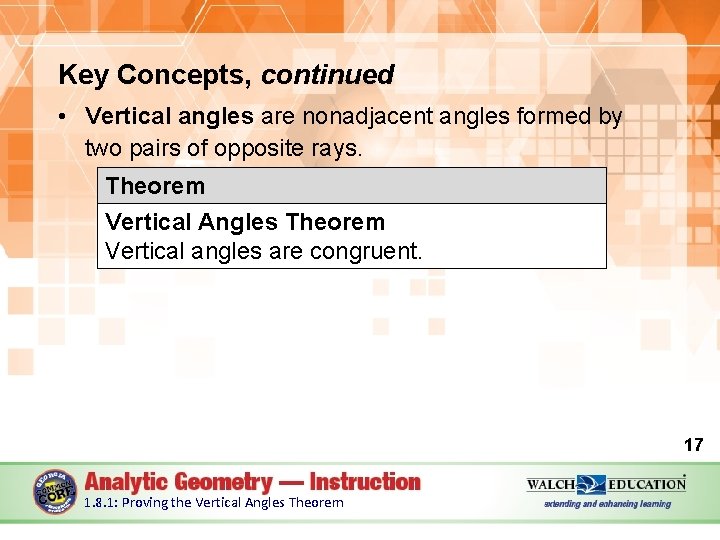
Key Concepts, continued • Vertical angles are nonadjacent angles formed by two pairs of opposite rays. Theorem Vertical Angles Theorem Vertical angles are congruent. 17 1. 8. 1: Proving the Vertical Angles Theorem
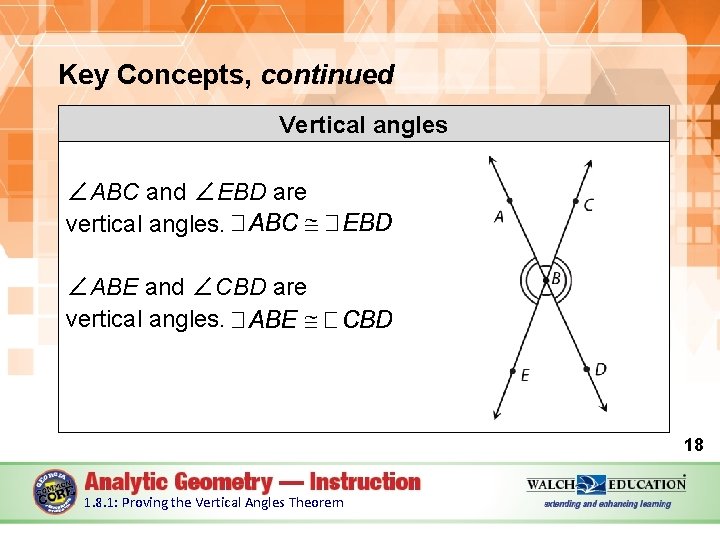
Key Concepts, continued Vertical angles ∠ABC and ∠EBD are vertical angles. ∠ABE and ∠CBD are vertical angles. 18 1. 8. 1: Proving the Vertical Angles Theorem
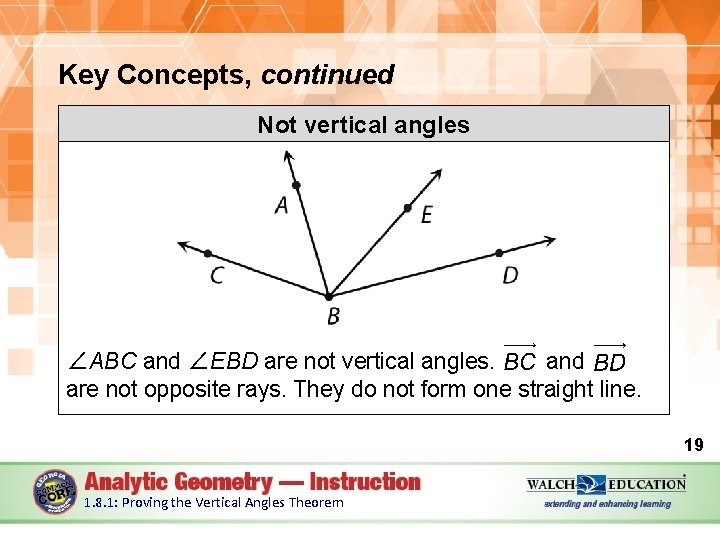
Key Concepts, continued Not vertical angles ∠ABC and ∠EBD are not vertical angles. and are not opposite rays. They do not form one straight line. 19 1. 8. 1: Proving the Vertical Angles Theorem
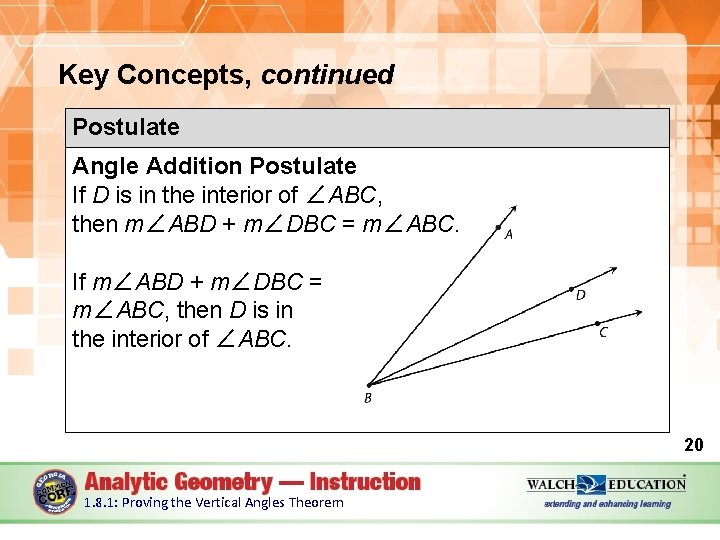
Key Concepts, continued Postulate Angle Addition Postulate If D is in the interior of ∠ABC, then m∠ABD + m∠DBC = m∠ABC. If m∠ABD + m∠DBC = m∠ABC, then D is in the interior of ∠ABC. 20 1. 8. 1: Proving the Vertical Angles Theorem
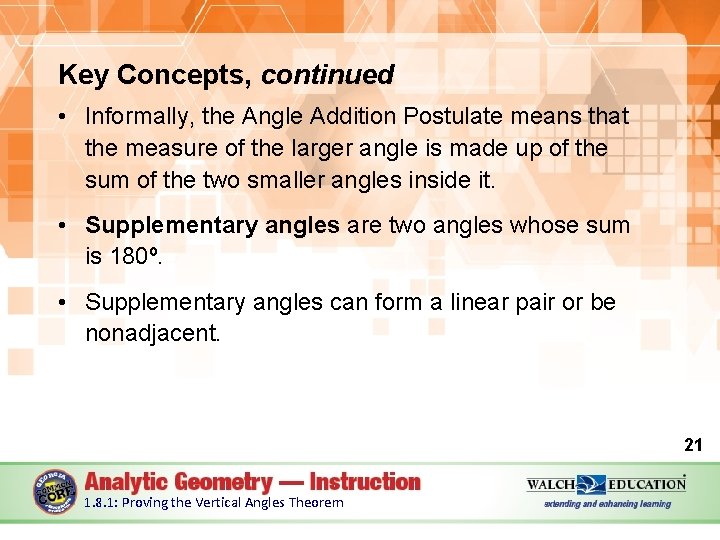
Key Concepts, continued • Informally, the Angle Addition Postulate means that the measure of the larger angle is made up of the sum of the two smaller angles inside it. • Supplementary angles are two angles whose sum is 180º. • Supplementary angles can form a linear pair or be nonadjacent. 21 1. 8. 1: Proving the Vertical Angles Theorem
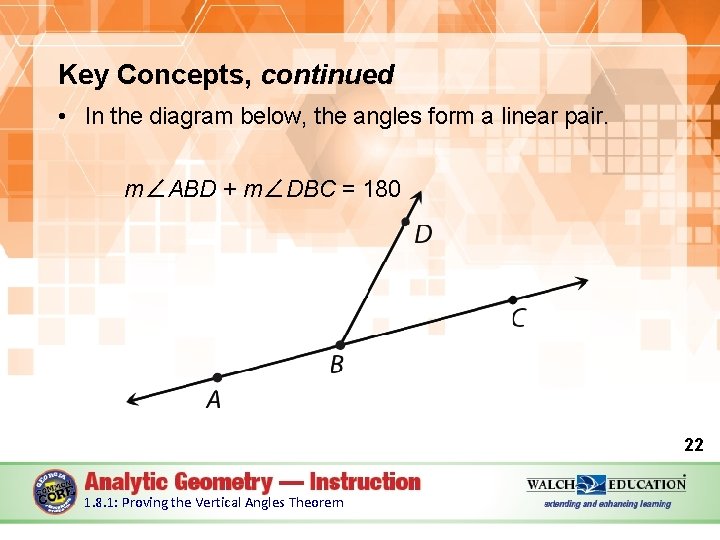
Key Concepts, continued • In the diagram below, the angles form a linear pair. m∠ABD + m∠DBC = 180 22 1. 8. 1: Proving the Vertical Angles Theorem
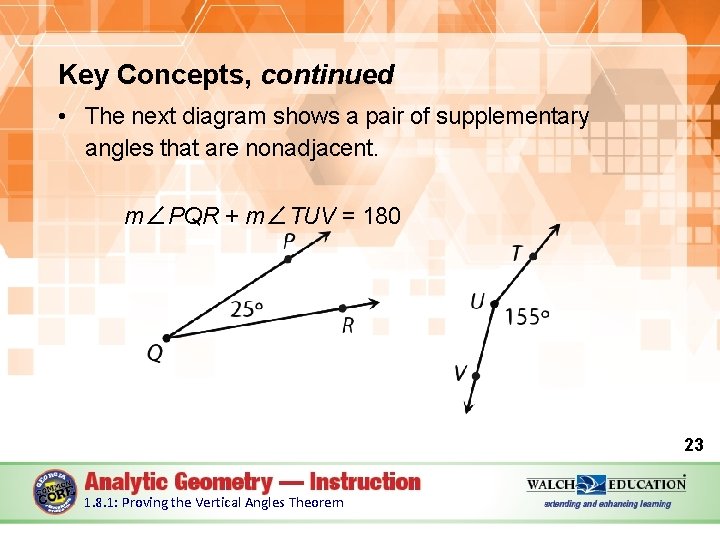
Key Concepts, continued • The next diagram shows a pair of supplementary angles that are nonadjacent. m∠PQR + m∠TUV = 180 23 1. 8. 1: Proving the Vertical Angles Theorem
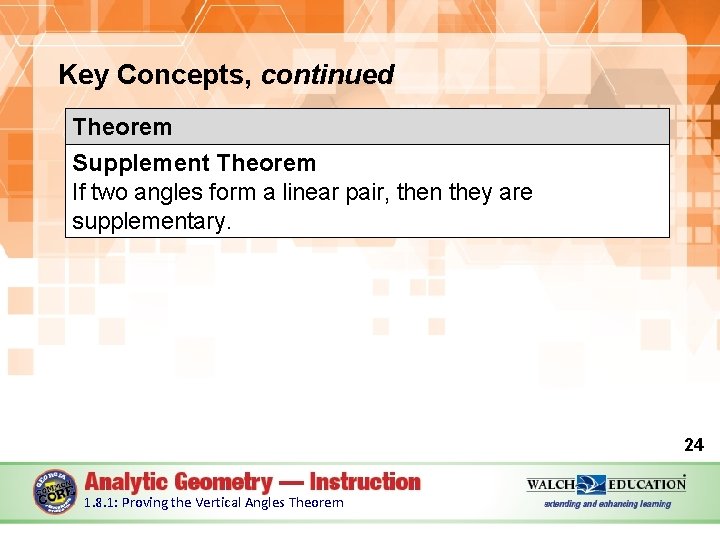
Key Concepts, continued Theorem Supplement Theorem If two angles form a linear pair, then they are supplementary. 24 1. 8. 1: Proving the Vertical Angles Theorem
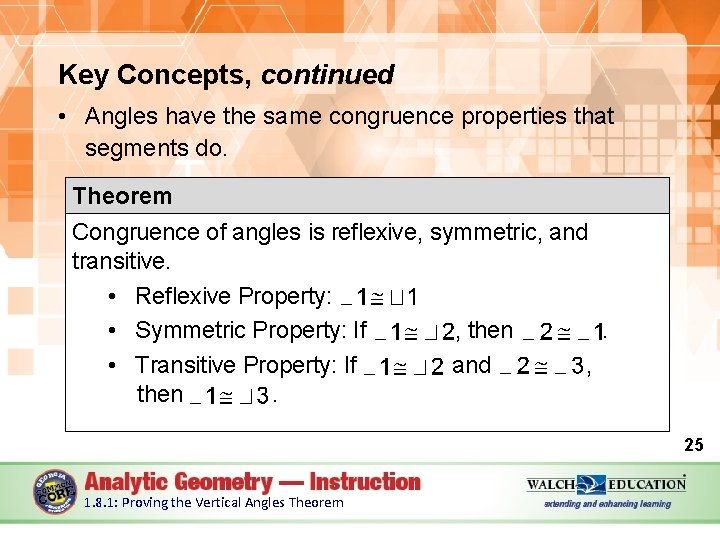
Key Concepts, continued • Angles have the same congruence properties that segments do. Theorem Congruence of angles is reflexive, symmetric, and transitive. • Reflexive Property: • Symmetric Property: If , then. • Transitive Property: If and , then. 25 1. 8. 1: Proving the Vertical Angles Theorem
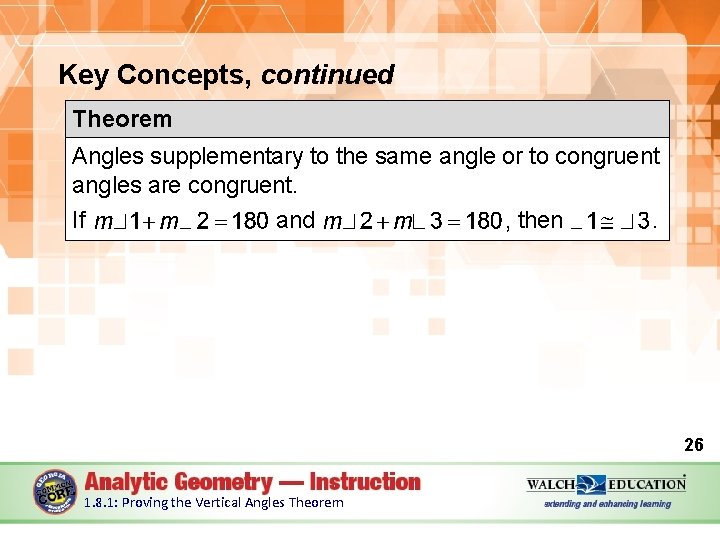
Key Concepts, continued Theorem Angles supplementary to the same angle or to congruent angles are congruent. If and , then. 26 1. 8. 1: Proving the Vertical Angles Theorem
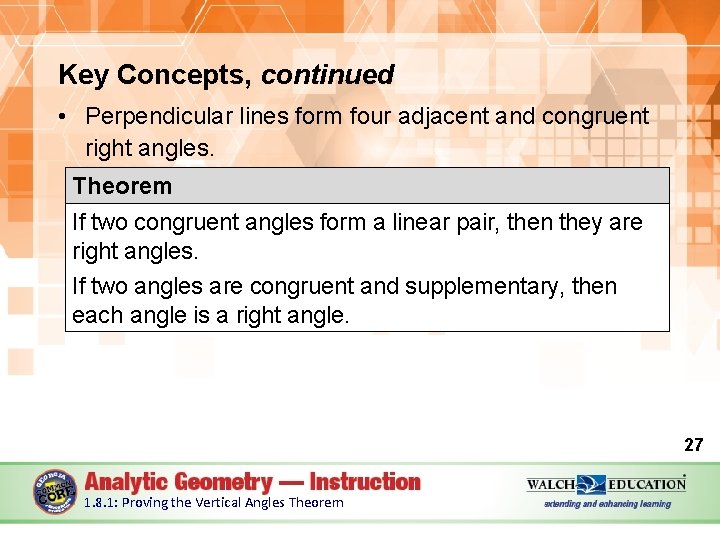
Key Concepts, continued • Perpendicular lines form four adjacent and congruent right angles. Theorem If two congruent angles form a linear pair, then they are right angles. If two angles are congruent and supplementary, then each angle is a right angle. 27 1. 8. 1: Proving the Vertical Angles Theorem
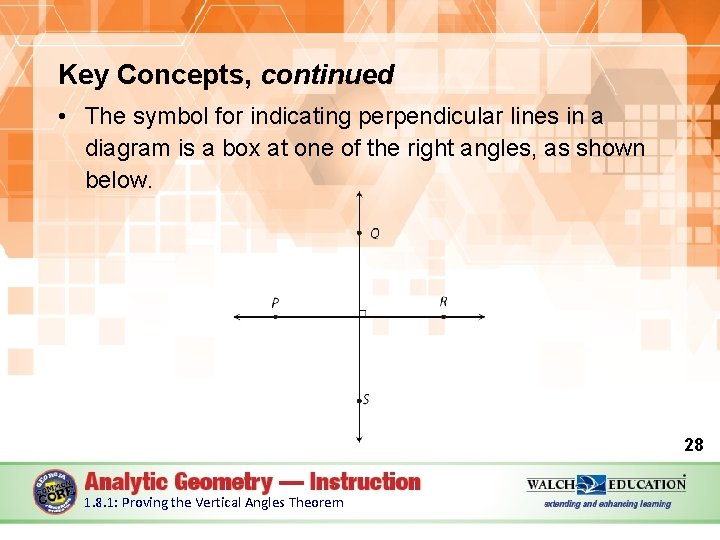
Key Concepts, continued • The symbol for indicating perpendicular lines in a diagram is a box at one of the right angles, as shown below. 28 1. 8. 1: Proving the Vertical Angles Theorem
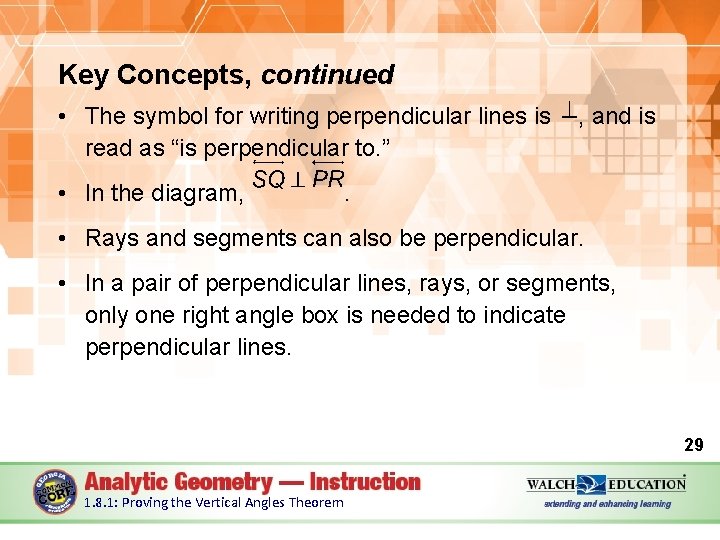
Key Concepts, continued • The symbol for writing perpendicular lines is read as “is perpendicular to. ” • In the diagram, , and is . • Rays and segments can also be perpendicular. • In a pair of perpendicular lines, rays, or segments, only one right angle box is needed to indicate perpendicular lines. 29 1. 8. 1: Proving the Vertical Angles Theorem
Key Concepts, continued • Remember that perpendicular bisectors are lines that intersect a segment at its midpoint at a right angle; they are perpendicular to the segment. • Any point along the perpendicular bisector is equidistant from the endpoints of the segment that it bisects. 30 1. 8. 1: Proving the Vertical Angles Theorem
Key Concepts, continued Theorem Perpendicular Bisector Theorem If a point lies on the perpendicular bisector of a segment, then that point is equidistant from the endpoints of the segment. If a point is equidistant from the endpoints of a segment, then the point lies on the perpendicular bisector of the segment. (continued) 31 1. 8. 1: Proving the Vertical Angles Theorem
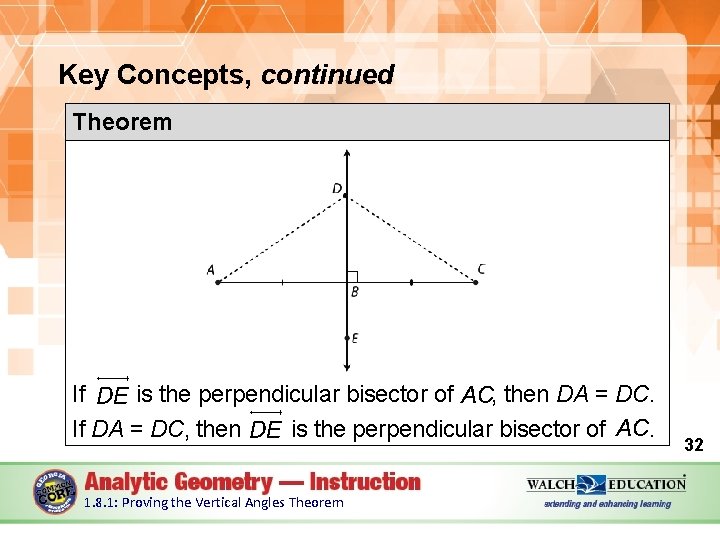
Key Concepts, continued Theorem If is the perpendicular bisector of , then DA = DC. If DA = DC, then is the perpendicular bisector of. 1. 8. 1: Proving the Vertical Angles Theorem 32
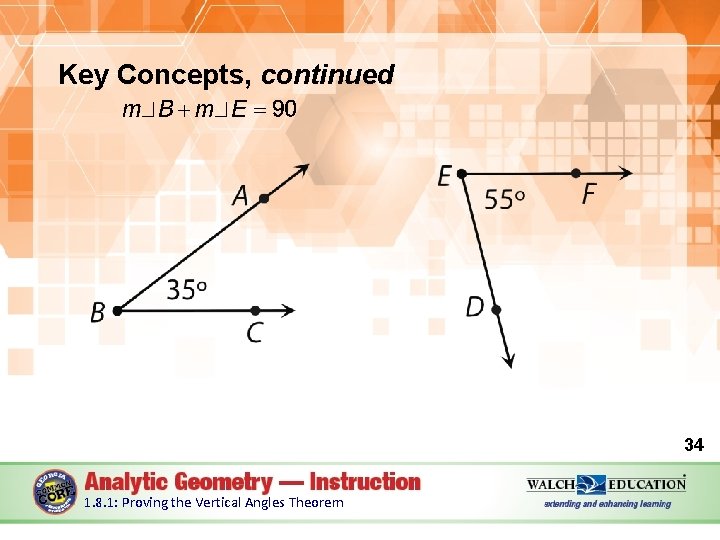
Key Concepts, continued • Complementary angles are two angles whose sum is 90º. • Complementary angles can form a right angle or be nonadjacent. • The following diagram shows a pair of nonadjacent complementary angles. 33 1. 8. 1: Proving the Vertical Angles Theorem
Key Concepts, continued 34 1. 8. 1: Proving the Vertical Angles Theorem
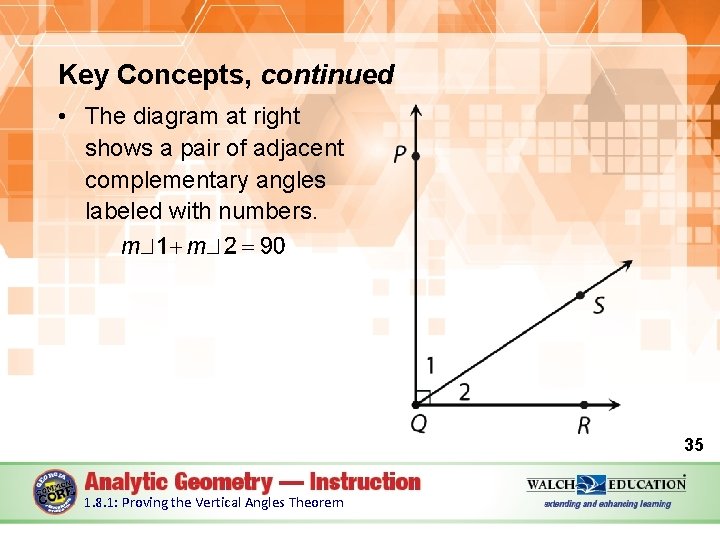
Key Concepts, continued • The diagram at right shows a pair of adjacent complementary angles labeled with numbers. 35 1. 8. 1: Proving the Vertical Angles Theorem
Key Concepts, continued Theorem Complement Theorem If the non-shared sides of two adjacent angles form a right angle, then the angles are complementary. Angles complementary to the same angle or to congruent angles are congruent. 36 1. 8. 1: Proving the Vertical Angles Theorem
Common Errors/Misconceptions • not recognizing theorem that is being used or that needs to be used • setting expressions equal to each other rather than using the Complement or Supplement Theorems • mislabeling angles with a single letter when that letter is the vertex for adjacent angles • not recognizing adjacent and nonadjacent angles 37 1. 8. 1: Proving the Vertical Angles Theorem
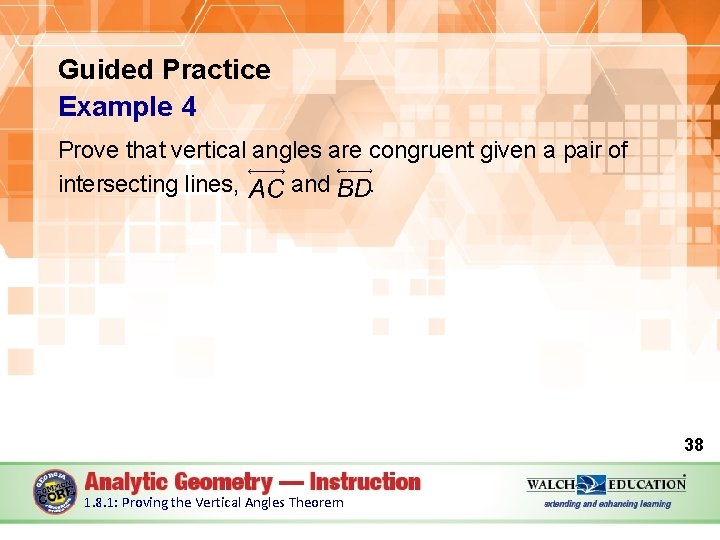
Guided Practice Example 4 Prove that vertical angles are congruent given a pair of intersecting lines, and. 38 1. 8. 1: Proving the Vertical Angles Theorem
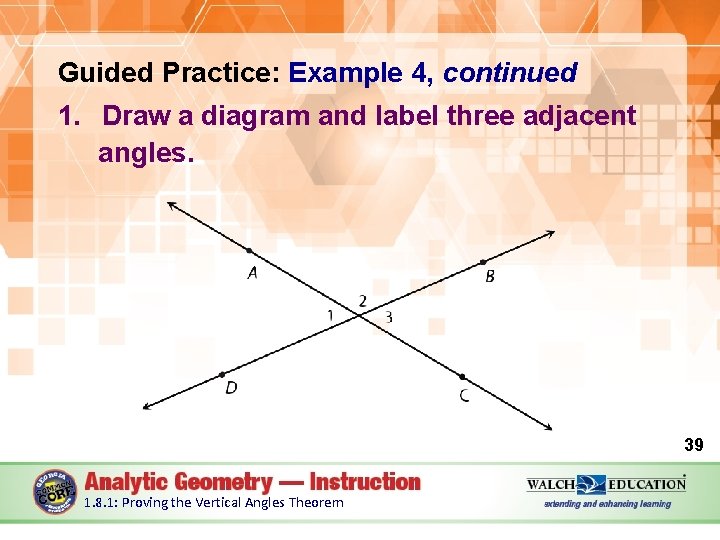
Guided Practice: Example 4, continued 1. Draw a diagram and label three adjacent angles. 39 1. 8. 1: Proving the Vertical Angles Theorem
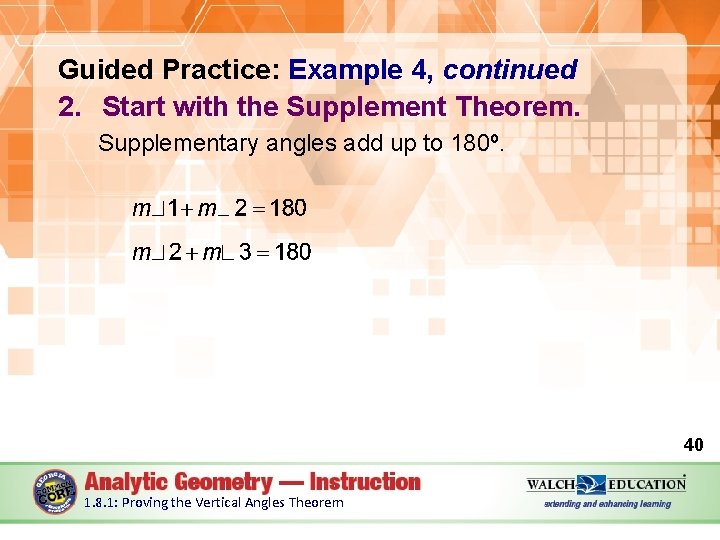
Guided Practice: Example 4, continued 2. Start with the Supplement Theorem. Supplementary angles add up to 180º. 40 1. 8. 1: Proving the Vertical Angles Theorem
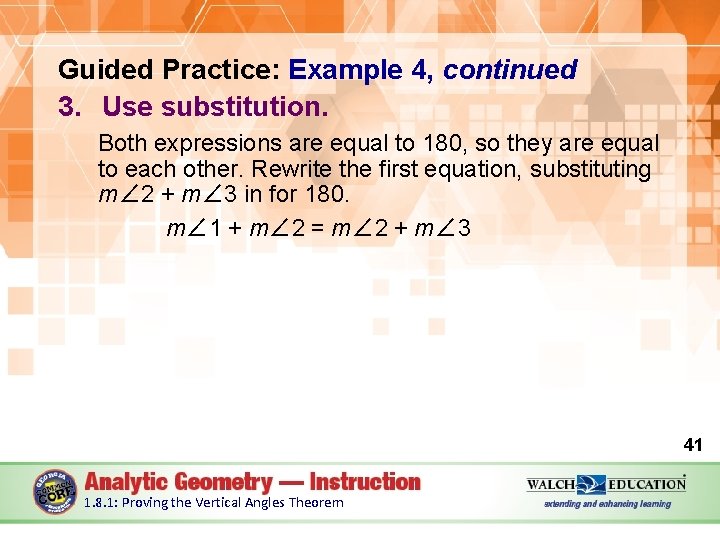
Guided Practice: Example 4, continued 3. Use substitution. Both expressions are equal to 180, so they are equal to each other. Rewrite the first equation, substituting m∠ 2 + m∠ 3 in for 180. m∠ 1 + m∠ 2 = m∠ 2 + m∠ 3 41 1. 8. 1: Proving the Vertical Angles Theorem
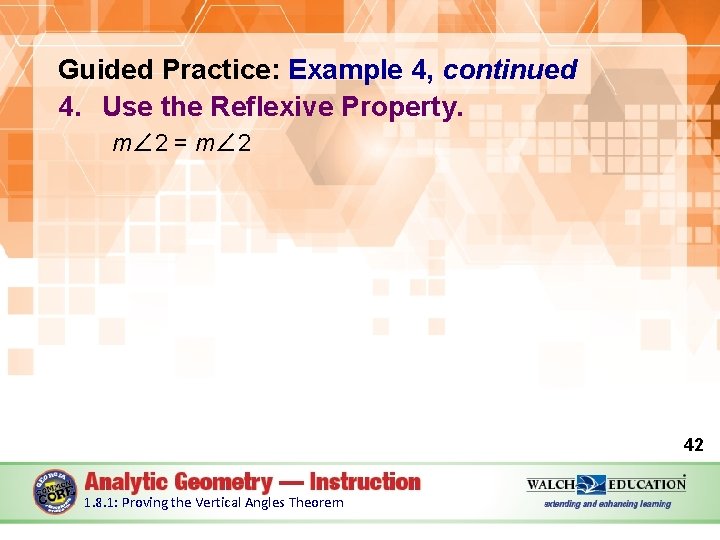
Guided Practice: Example 4, continued 4. Use the Reflexive Property. m∠ 2 = m∠ 2 42 1. 8. 1: Proving the Vertical Angles Theorem
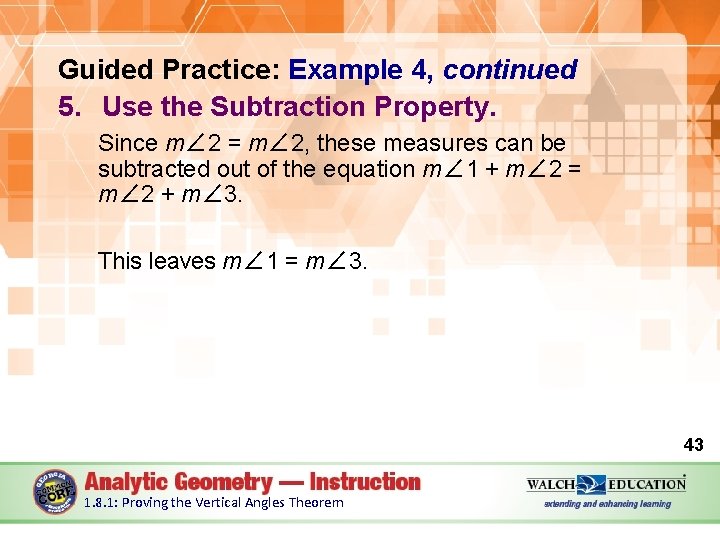
Guided Practice: Example 4, continued 5. Use the Subtraction Property. Since m∠ 2 = m∠ 2, these measures can be subtracted out of the equation m∠ 1 + m∠ 2 = m∠ 2 + m∠ 3. This leaves m∠ 1 = m∠ 3. 43 1. 8. 1: Proving the Vertical Angles Theorem
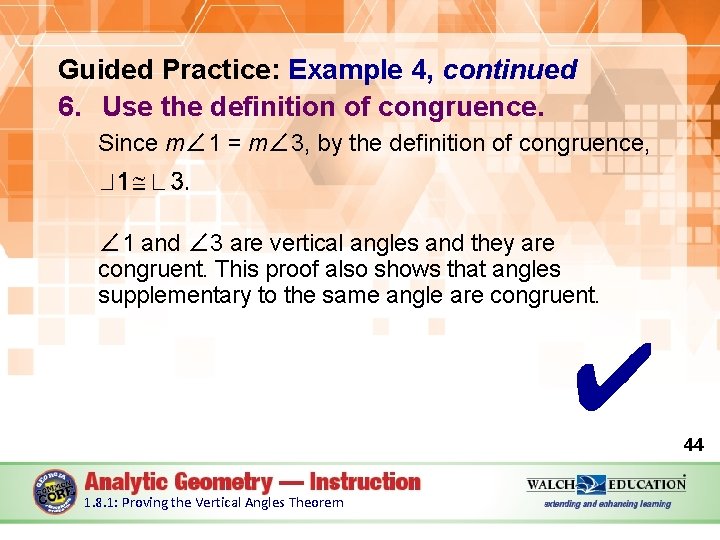
Guided Practice: Example 4, continued 6. Use the definition of congruence. Since m∠ 1 = m∠ 3, by the definition of congruence, ∠ 1 and ∠ 3 are vertical angles and they are congruent. This proof also shows that angles supplementary to the same angle are congruent. ✔ 44 1. 8. 1: Proving the Vertical Angles Theorem
Guided Practice: Example 4, continued 45 1. 8. 1: Proving the Vertical Angles Theorem
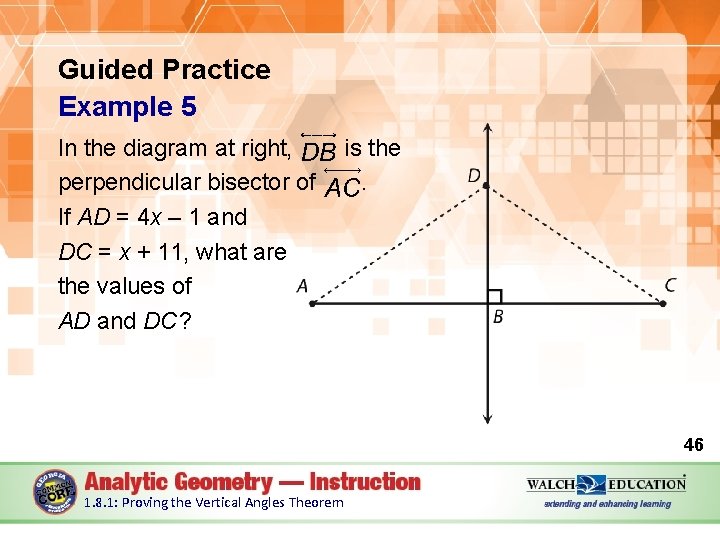
Guided Practice Example 5 In the diagram at right, perpendicular bisector of If AD = 4 x – 1 and DC = x + 11, what are the values of AD and DC ? is the. 46 1. 8. 1: Proving the Vertical Angles Theorem
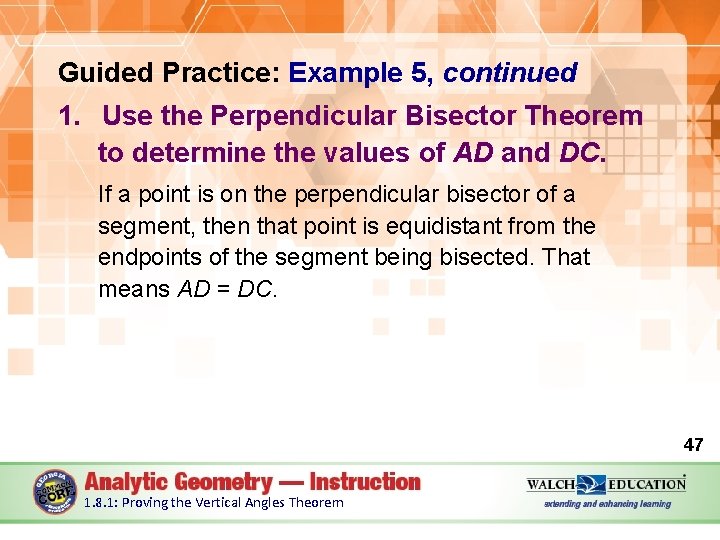
Guided Practice: Example 5, continued 1. Use the Perpendicular Bisector Theorem to determine the values of AD and DC. If a point is on the perpendicular bisector of a segment, then that point is equidistant from the endpoints of the segment being bisected. That means AD = DC. 47 1. 8. 1: Proving the Vertical Angles Theorem
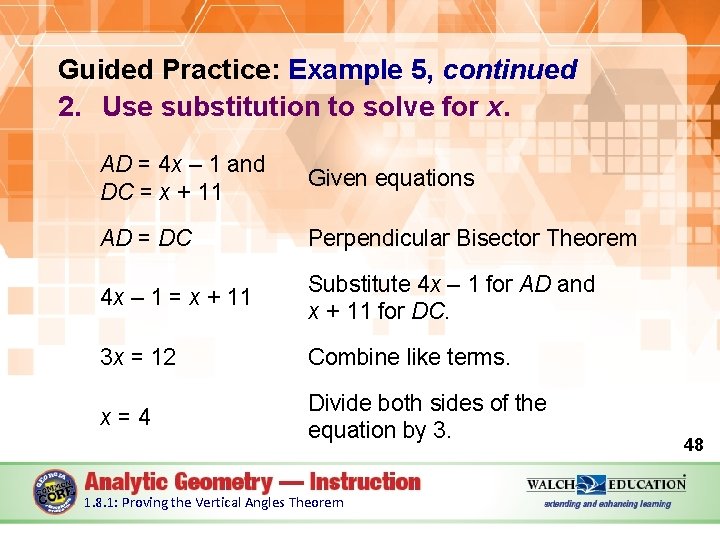
Guided Practice: Example 5, continued 2. Use substitution to solve for x. AD = 4 x – 1 and DC = x + 11 Given equations AD = DC Perpendicular Bisector Theorem 4 x – 1 = x + 11 Substitute 4 x – 1 for AD and x + 11 for DC. 3 x = 12 Combine like terms. x=4 Divide both sides of the equation by 3. 1. 8. 1: Proving the Vertical Angles Theorem 48
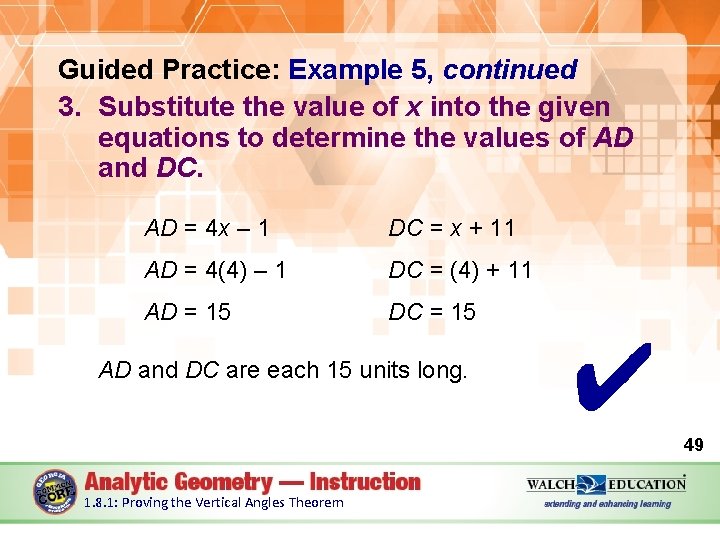
Guided Practice: Example 5, continued 3. Substitute the value of x into the given equations to determine the values of AD and DC. AD = 4 x – 1 DC = x + 11 AD = 4(4) – 1 DC = (4) + 11 AD = 15 DC = 15 AD and DC are each 15 units long. ✔ 49 1. 8. 1: Proving the Vertical Angles Theorem