
1 7 Evaluating and Rewriting Expressions 1 Evaluate




- Slides: 22
1. 7 Evaluating and Rewriting Expressions 1. Evaluate an expression. 2. Determine all values that cause an expression to be undefined. 3. Rewrite an expression using the distributive property. 4. Rewrite an expression by combining like terms.
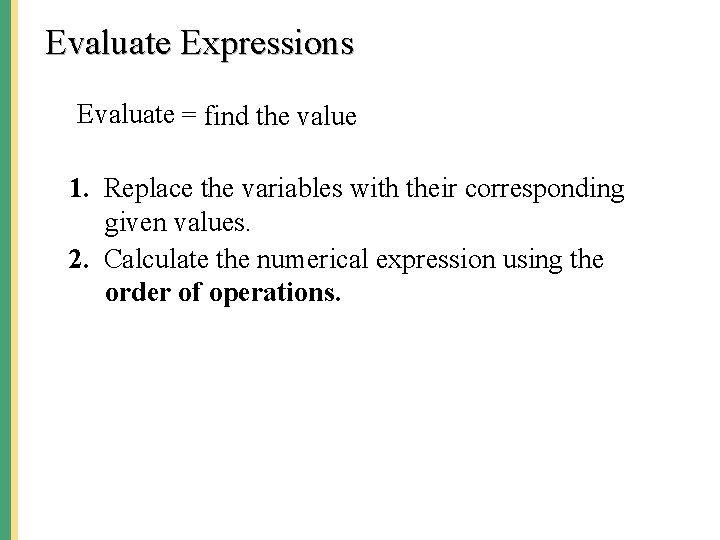
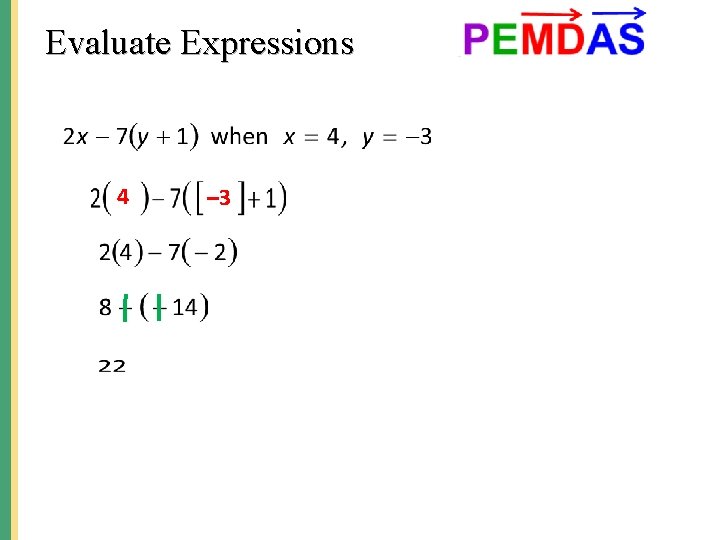
Evaluate Expressions Evaluate = find the value 1. Replace the variables with their corresponding given values. 2. Calculate the numerical expression using the order of operations.
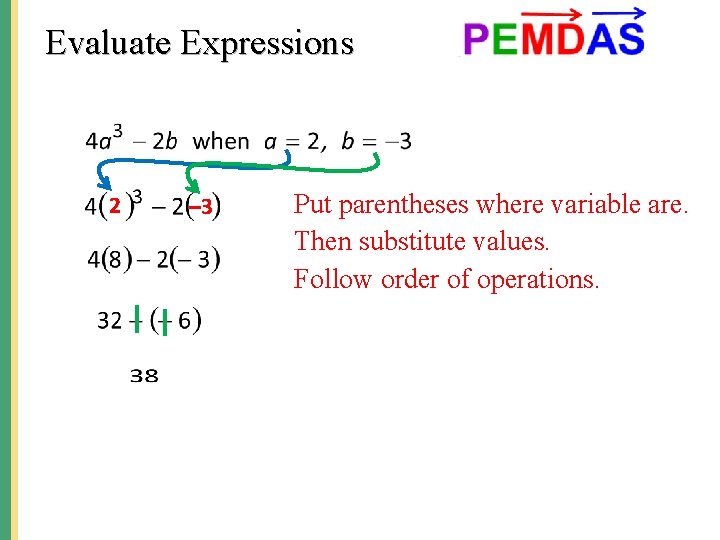
Evaluate Expressions 2 – 3 Put parentheses where variable are. Then substitute values. Follow order of operations.
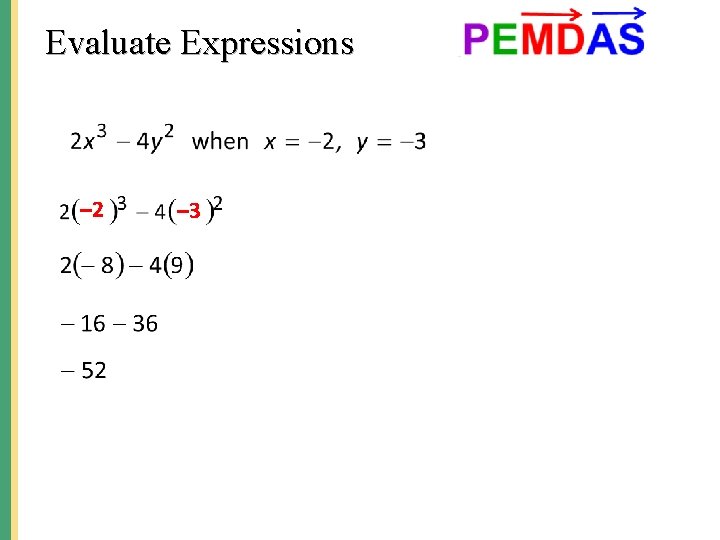
Evaluate Expressions – 2 – 3
Evaluate Expressions 4 – 3
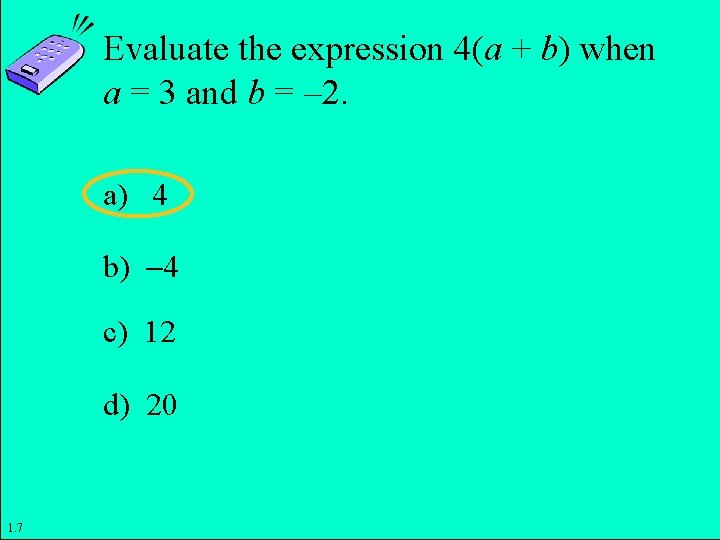
Evaluate the expression 4(a + b) when a = 3 and b = – 2. a) 4 b) 4 c) 12 d) 20 1. 7 Copyright © 2011 Pearson Education, Inc. Slide 1 - 6
Evaluate the expression 4(a + b) when a = 3 and b = – 2. a) 4 b) 4 c) 12 d) 20 1. 7 Copyright © 2011 Pearson Education, Inc. Slide 1 - 7
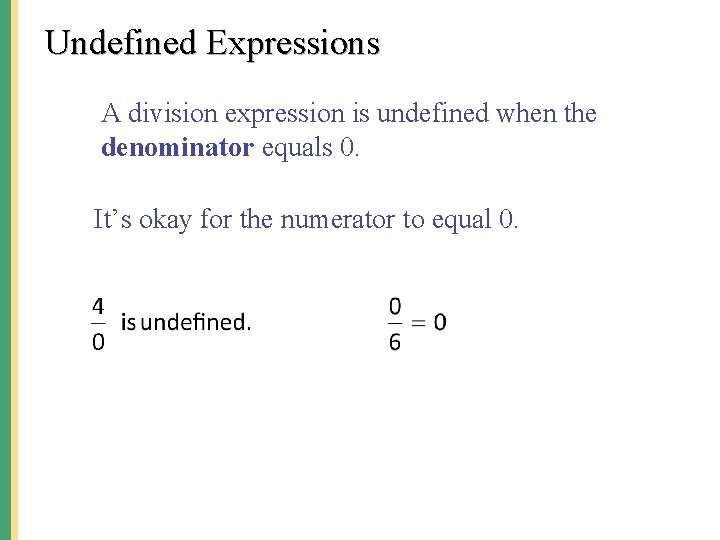
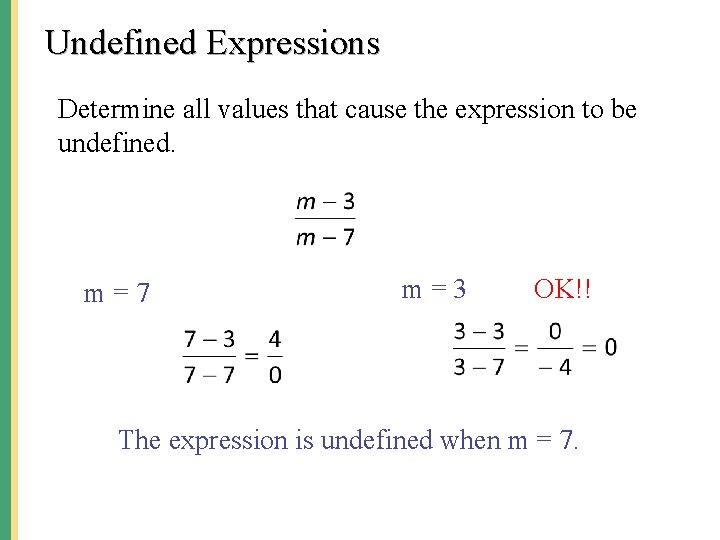
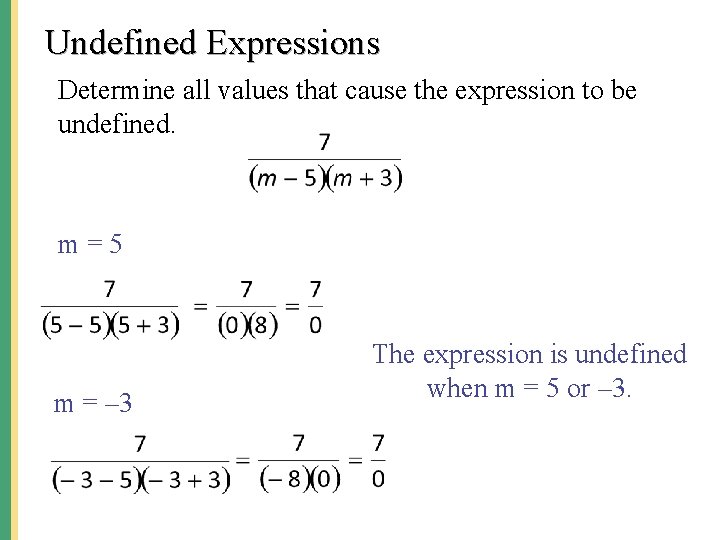
Undefined Expressions A division expression is undefined when the denominator equals 0. It’s okay for the numerator to equal 0.
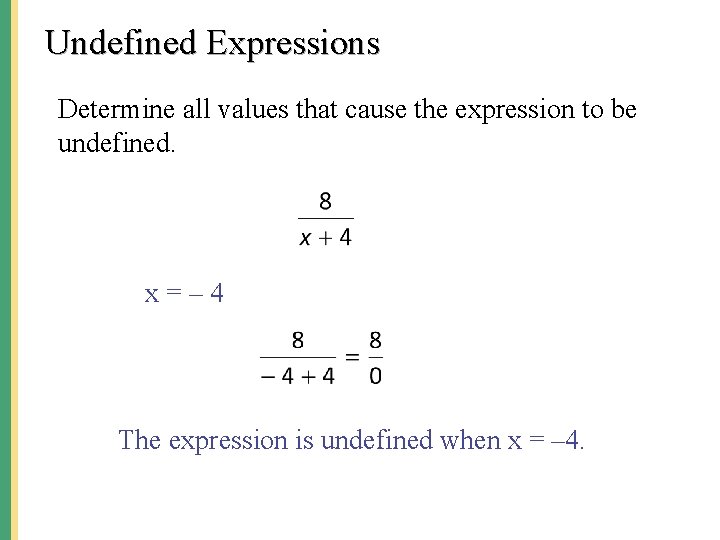
Undefined Expressions Determine all values that cause the expression to be undefined. x=– 4 The expression is undefined when x = – 4.
Undefined Expressions Determine all values that cause the expression to be undefined. m=7 m=3 OK!! The expression is undefined when m = 7.
Undefined Expressions Determine all values that cause the expression to be undefined. m=5 m = – 3 The expression is undefined when m = 5 or – 3.
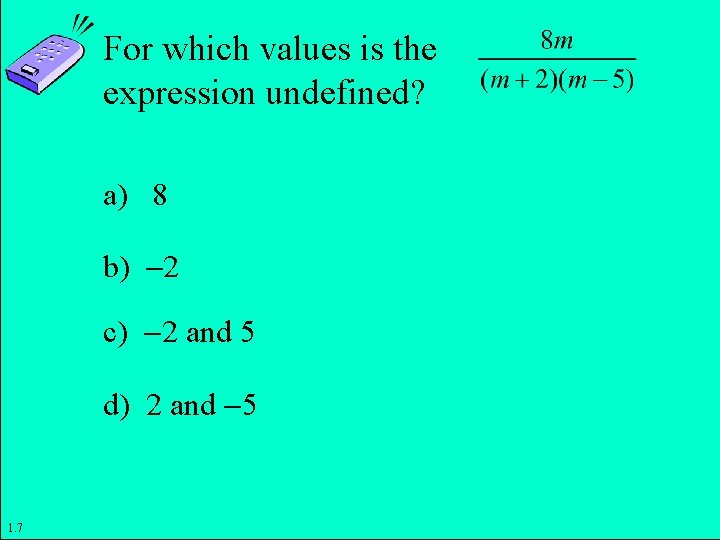
For which values is the expression undefined? a) 8 b) 2 c) 2 and 5 d) 2 and 5 1. 7 Copyright © 2011 Pearson Education, Inc. Slide 1 - 12
For which values is the expression undefined? a) 8 b) 2 c) 2 and 5 d) 2 and 5 1. 7 Copyright © 2011 Pearson Education, Inc. Slide 1 - 13
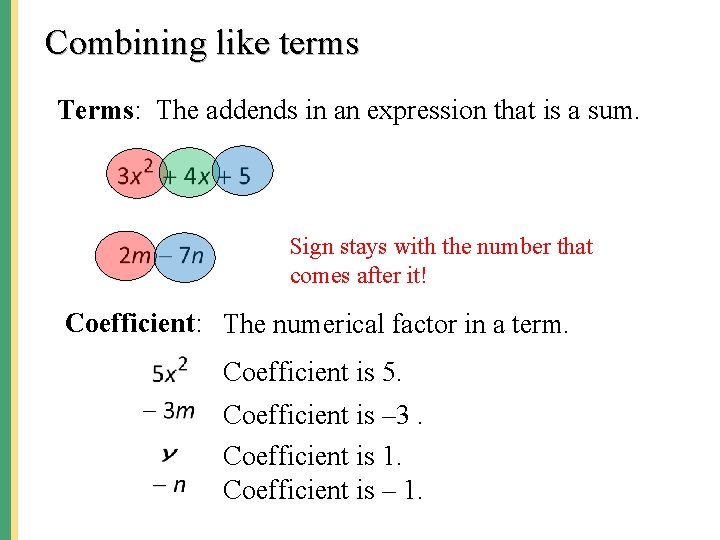
Combining like terms Terms: The addends in an expression that is a sum. Sign stays with the number that comes after it! Coefficient: The numerical factor in a term. Coefficient is 5. Coefficient is – 3. Coefficient is 1. Coefficient is – 1.
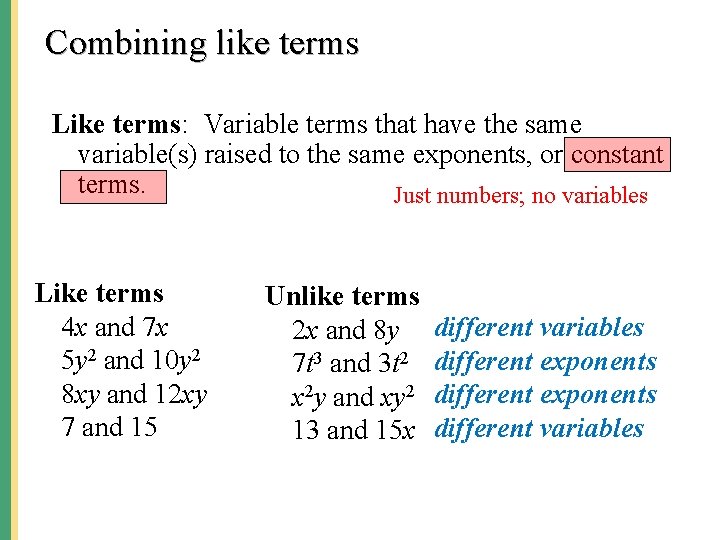
Combining like terms Like terms: Variable terms that have the same variable(s) raised to the same exponents, or constant terms. Just numbers; no variables Like terms 4 x and 7 x 5 y 2 and 10 y 2 8 xy and 12 xy 7 and 15 Unlike terms 2 x and 8 y 7 t 3 and 3 t 2 x 2 y and xy 2 13 and 15 x different variables different exponents different variables
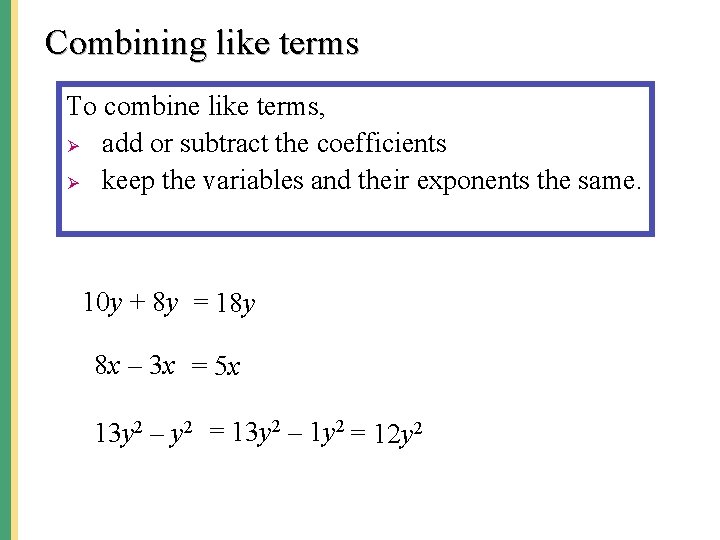
Combining like terms To combine like terms, Ø add or subtract the coefficients Ø keep the variables and their exponents the same. 10 y + 8 y = 18 y 8 x – 3 x = 5 x 13 y 2 – y 2 = 13 y 2 – 1 y 2 = 12 y 2
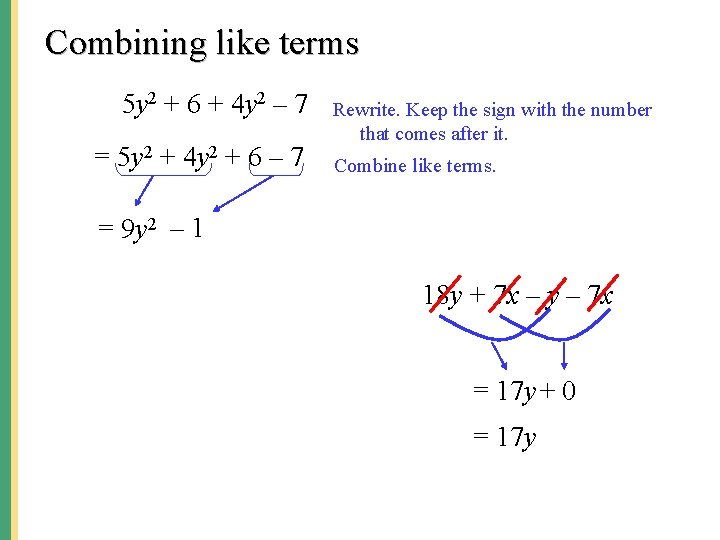
Combining like terms 5 y 2 + 6 + 4 y 2 – 7 = 5 y 2 + 4 y 2 + 6 – 7 Rewrite. Keep the sign with the number that comes after it. Combine like terms. = 9 y 2 – 1 18 y + 7 x – y – 7 x = 17 y + 0 = 17 y
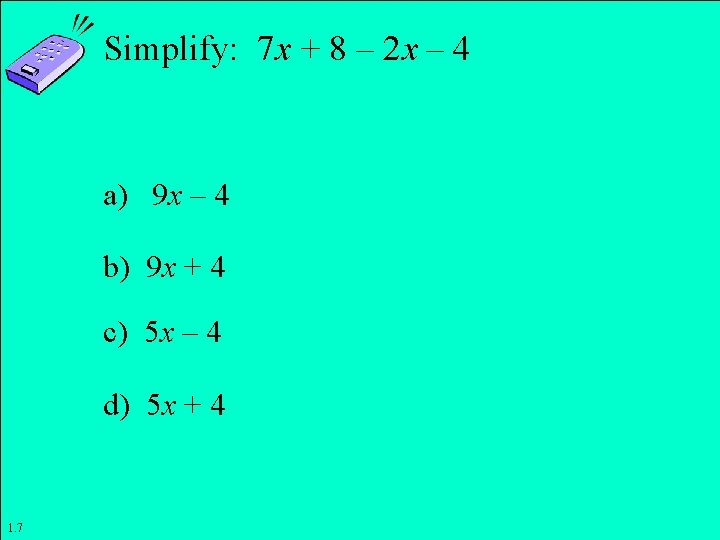
Simplify: 7 x + 8 – 2 x – 4 a) 9 x – 4 b) 9 x + 4 c) 5 x – 4 d) 5 x + 4 1. 7 Copyright © 2011 Pearson Education, Inc. Slide 1 - 18
Simplify: 7 x + 8 – 2 x – 4 a) 9 x – 4 b) 9 x + 4 c) 5 x – 4 d) 5 x + 4 1. 7 Copyright © 2011 Pearson Education, Inc. Slide 1 - 19
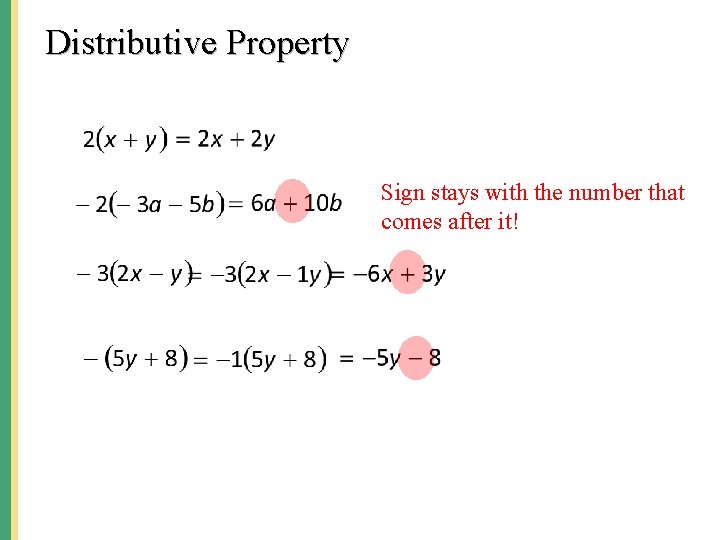
Distributive Property The Distributive Property of Multiplication over Addition a(b + c) = ab + ac 2(5 + 6) = 2(11) = 22 2(5 + 6) = 2 5 + 2 6 = 10 + 12 = 22 When evaluating, don’t use the distributive property!! Follow the order of operations.
Distributive Property Sign stays with the number that comes after it!
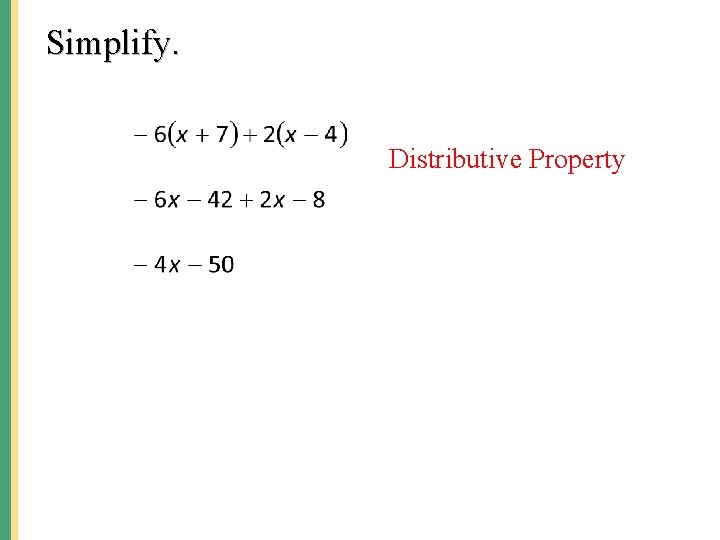
Simplify. Distributive Property