
1 7 Compositions of Transformations You drew reflections





- Slides: 30
1. 7 Compositions of Transformations You drew reflections, translations, and rotations. • Draw glide reflections and other compositions of isometries in the coordinate plane. • Draw compositions of reflections in parallel and intersecting lines.
Composite Photograph Composite photographs are made by superimposing one or more photographs.
Morphing is a popular special effect in movies. It changes one image into another.
Definition When a transformation is applied to a figure, and then another transformation is applied to its image, the result is called a composition of the transformations.
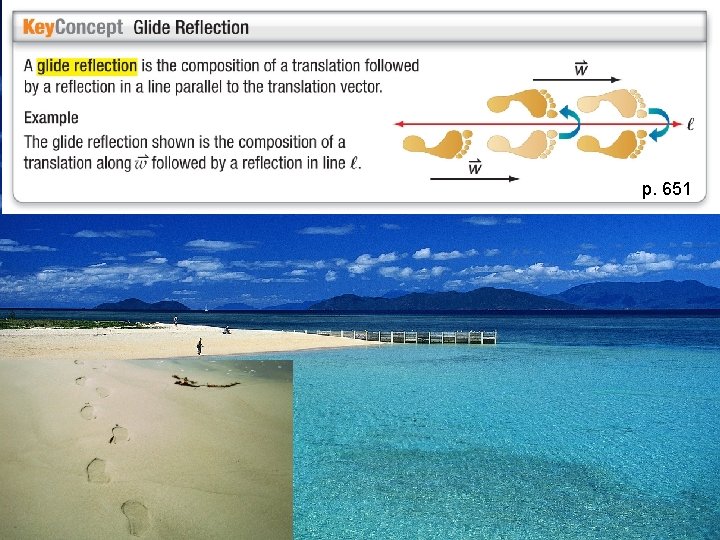
p. 651
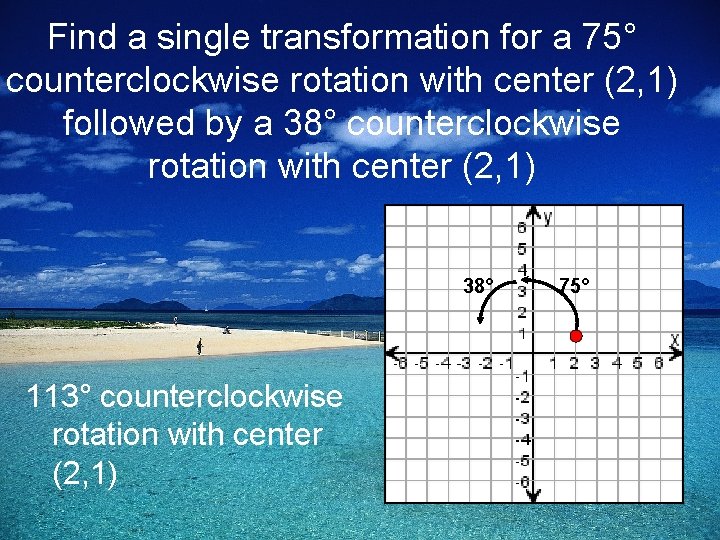
Find a single transformation for a 75° counterclockwise rotation with center (2, 1) followed by a 38° counterclockwise rotation with center (2, 1) 38° 113° counterclockwise rotation with center (2, 1) 75°
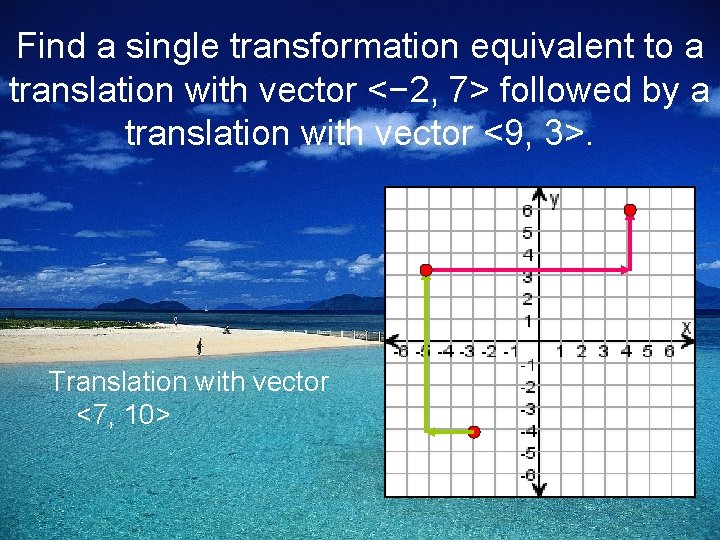
Find a single transformation equivalent to a translation with vector <− 2, 7> followed by a translation with vector <9, 3>. Translation with vector <7, 10>
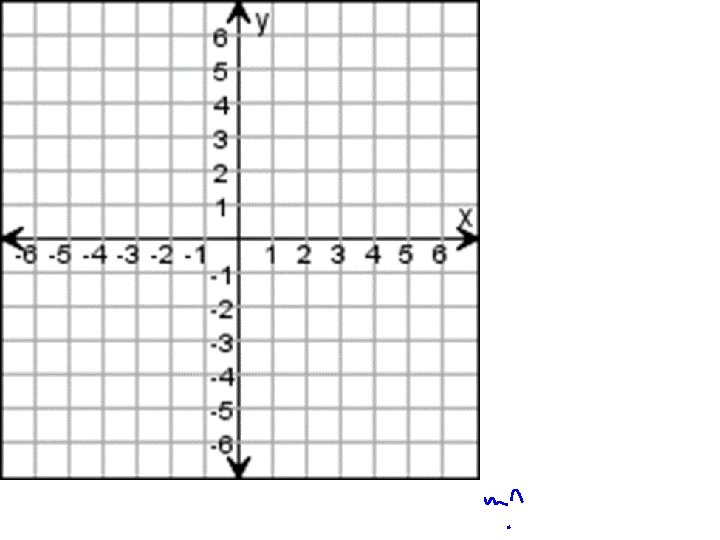
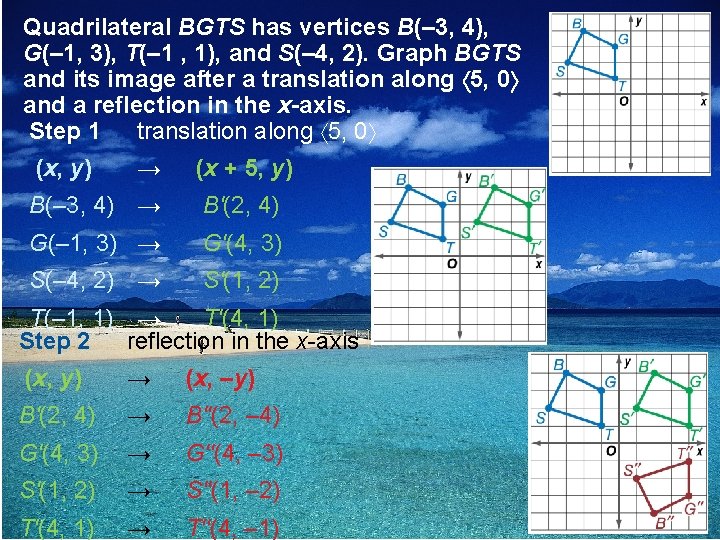
Quadrilateral BGTS has vertices B(– 3, 4), G(– 1, 3), T(– 1 , 1), and S(– 4, 2). Graph BGTS and its image after a translation along 5, 0 and a reflection in the x-axis. Step 1 translation along 5, 0 (x, y) → (x + 5, y) B(– 3, 4) → B'(2, 4) G(– 1, 3) → G'(4, 3) S(– 4, 2) → S'(1, 2) T(– 1, 1) → T'(4, 1) Step 2 reflection in the x-axis (x, y) → (x, –y) B'(2, 4) → B''(2, – 4) G'(4, 3) → G''(4, – 3) S'(1, 2) → S''(1, – 2) T'(4, 1) → T''(4, – 1)
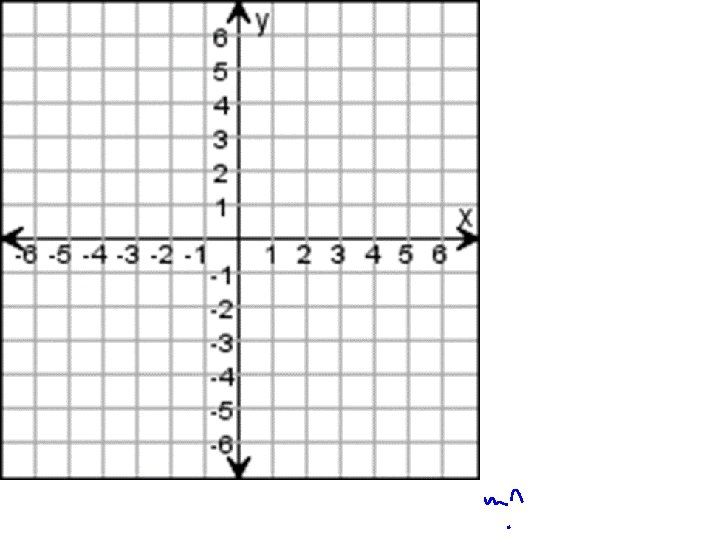
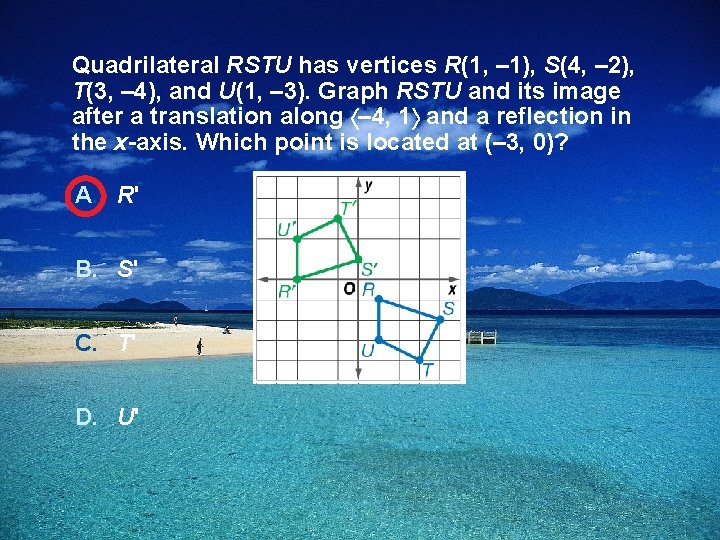
Quadrilateral RSTU has vertices R(1, – 1), S(4, – 2), T(3, – 4), and U(1, – 3). Graph RSTU and its image after a translation along – 4, 1 and a reflection in the x-axis. Which point is located at (– 3, 0)? A. R' B. S' C. T' D. U'
Definition An isometry is a transformation that preserves distance. Translations, reflections and rotations are isometries.
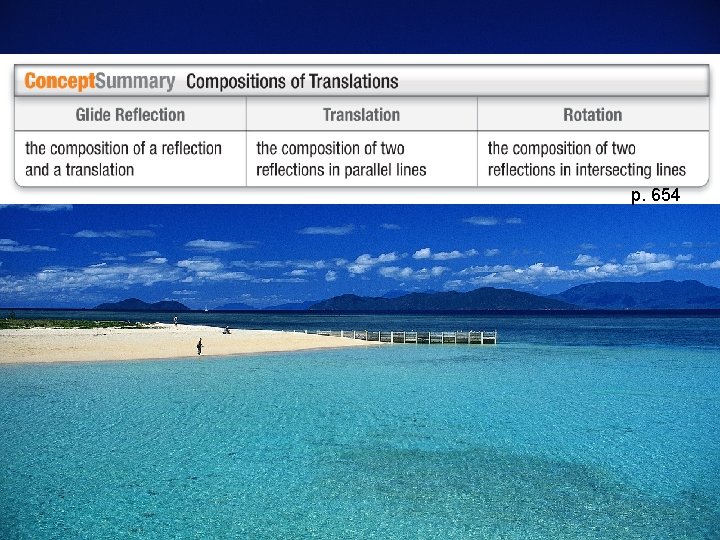
p. 652 The composition of two or more isometries – reflections, translations, or rotations results in an image that is congruent to its preimage. Glide reflections, translations, and rotations are the only four rigid motions or isometries in a plane.
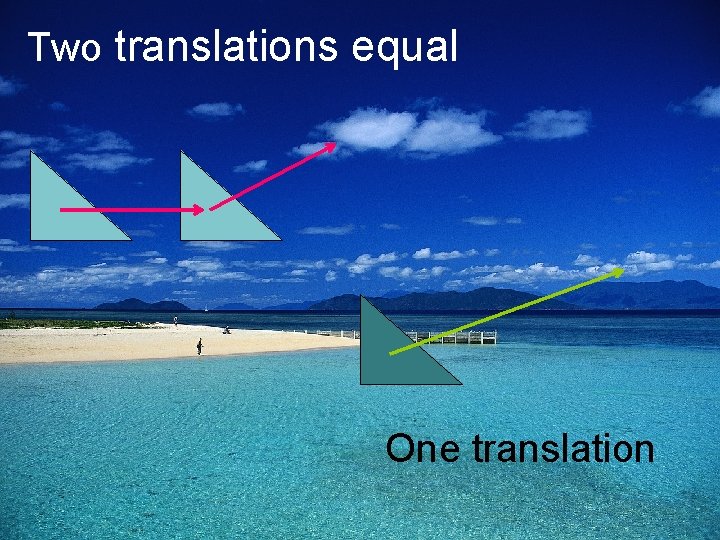
Two translations equal One translation
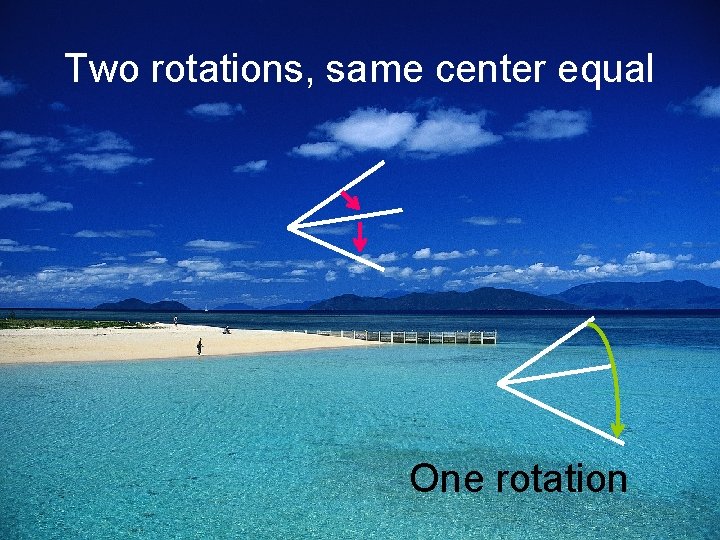
Two rotations, same center equal One rotation
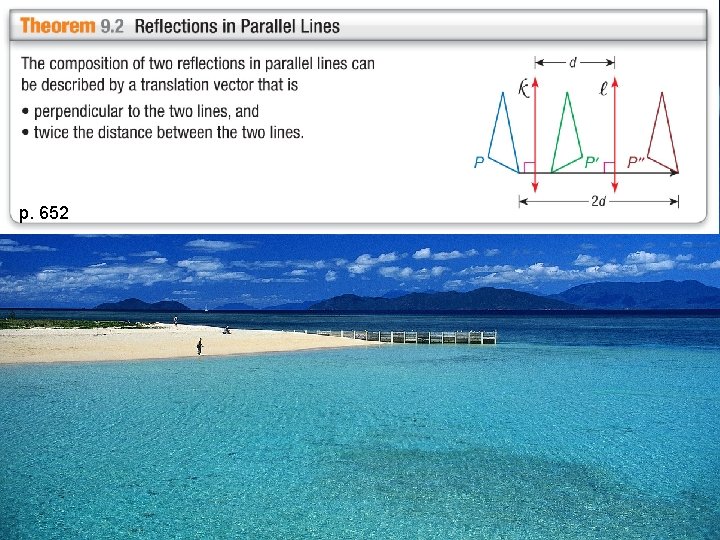
p. 652
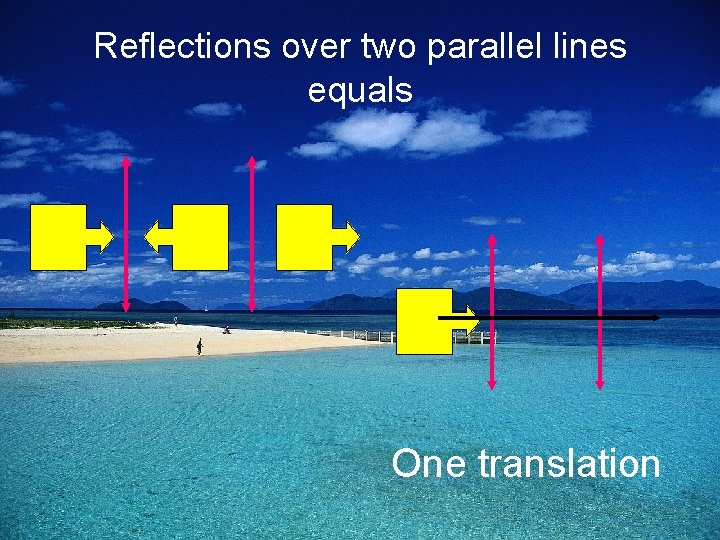
Reflections over two parallel lines equals One translation
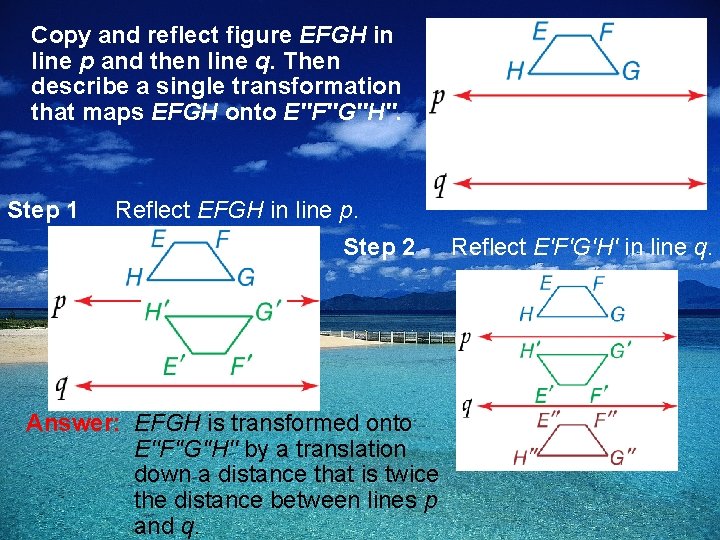
Copy and reflect figure EFGH in line p and then line q. Then describe a single transformation that maps EFGH onto E''F''G''H''. Step 1 Reflect EFGH in line p. Step 2 Answer: EFGH is transformed onto E''F''G''H'' by a translation down a distance that is twice the distance between lines p and q. Reflect E'F'G'H' in line q.
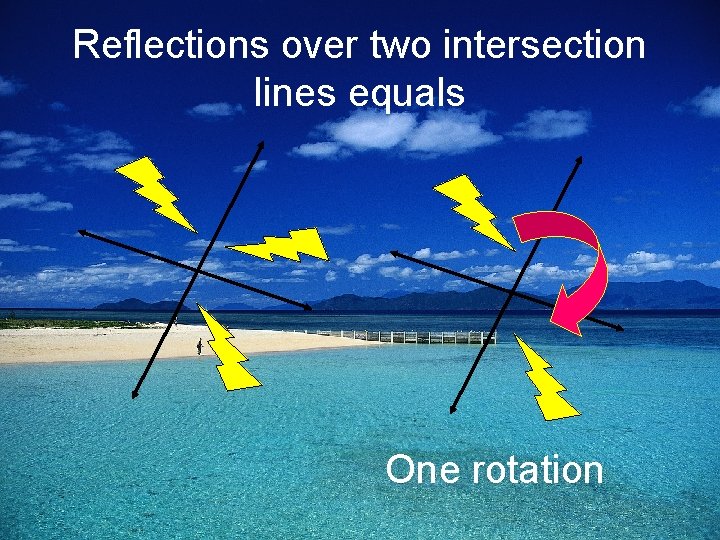
Reflections over two intersection lines equals One rotation
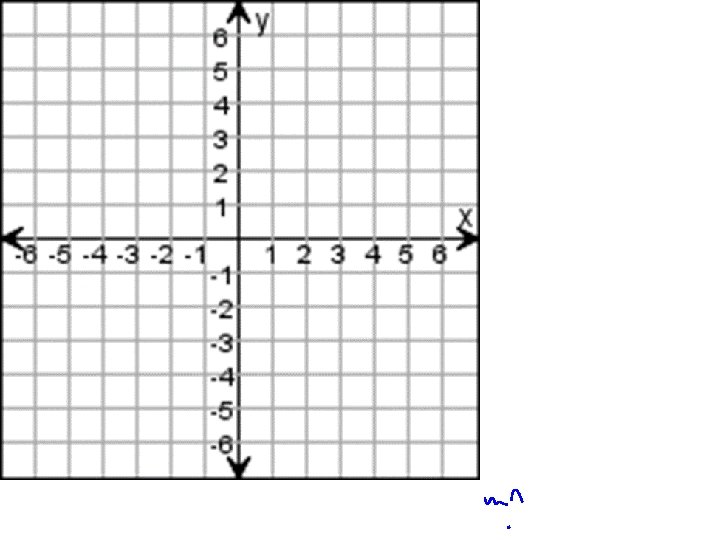
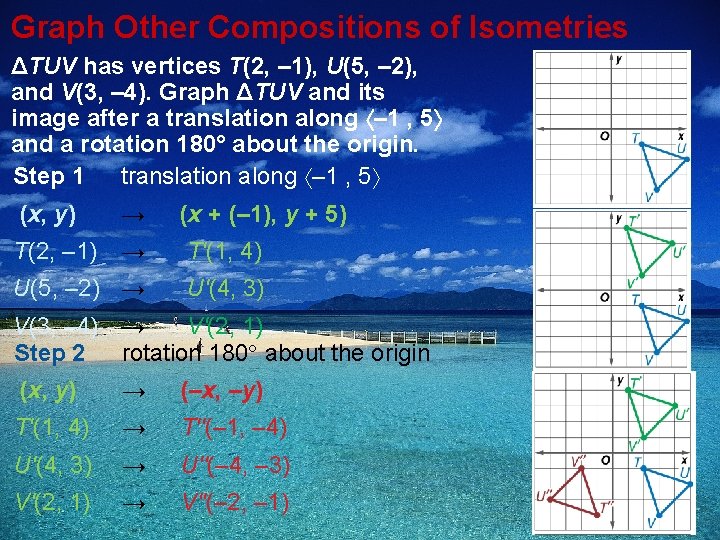
Graph Other Compositions of Isometries ΔTUV has vertices T(2, – 1), U(5, – 2), and V(3, – 4). Graph ΔTUV and its image after a translation along – 1 , 5 and a rotation 180° about the origin. Step 1 translation along – 1 , 5 (x, y) → (x + (– 1), y + 5) T(2, – 1) → T'(1, 4) U(5, – 2) → U'(4, 3) V(3, – 4) → V'(2, 1) Step 2 rotation 180 about the origin (x, y) → (–x, –y) T'(1, 4) → T''(– 1, – 4) U'(4, 3) → U''(– 4, – 3) V'(2, 1) → V''(– 2, – 1)
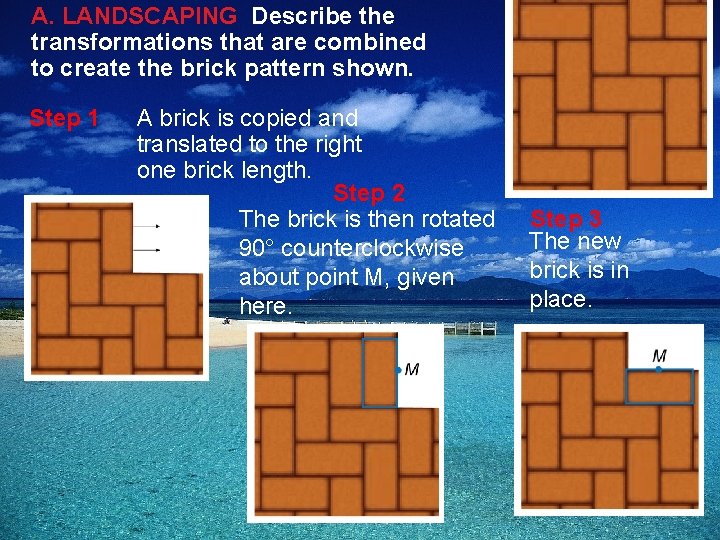
A. LANDSCAPING Describe the transformations that are combined to create the brick pattern shown. Step 1 A brick is copied and translated to the right one brick length. Step 2 The brick is then rotated 90° counterclockwise about point M, given here. Step 3 The new brick is in place.
p. 654
Pages 82 -84
Pages 82 -84