
1 7 Build a Strong Argument Unit 1
1. 7 Build a Strong Argument Unit 1: COVID-19
You may need to organize your thoughts and defend them against people who might not agree with you.
Remember that arguments stem from a claim or position supported by compelling evidence—evidence that persuades the reader or listener to accept a point of view.
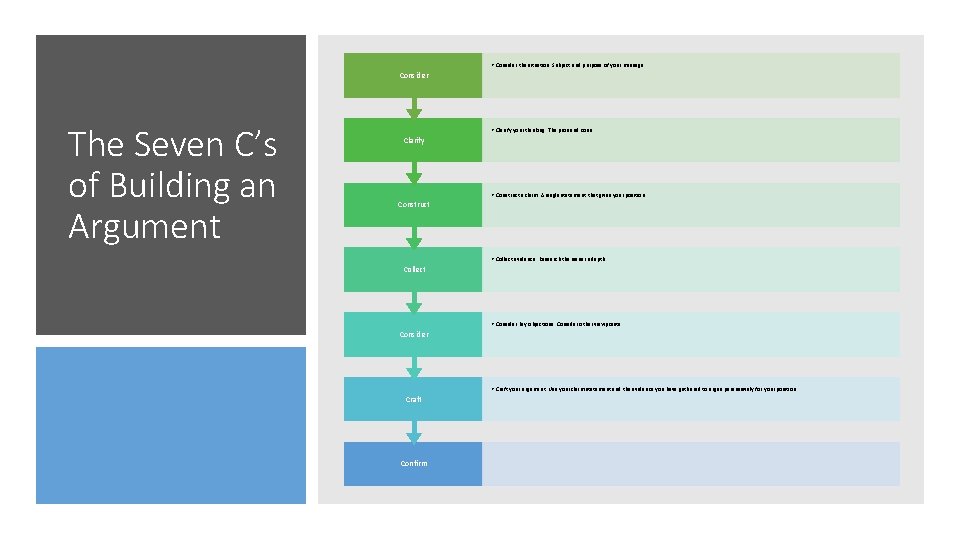
• Consider the situation. Subject and purpose of your message. Consider The Seven C’s of Building an Argument • Clarify your thinking. The pros and cons. Clarify • Construct a claim. A single statement that gives your position. Construct • Collect evidence. Research the issue in depth. Collect • Consider key objections. Consider other viewpoints. Consider • Craft your argument. Use your claim statement and the evidence you have gathered to argue persuasively for your position Craft Confirm
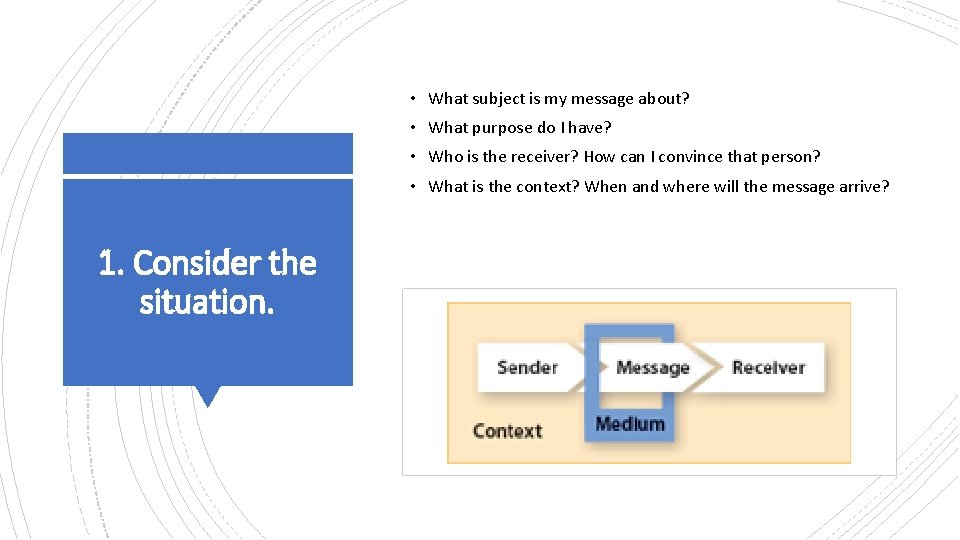
• What subject is my message about? • What purpose do I have? • Who is the receiver? How can I convince that person? • What is the context? When and where will the message arrive? 1. Consider the situation.
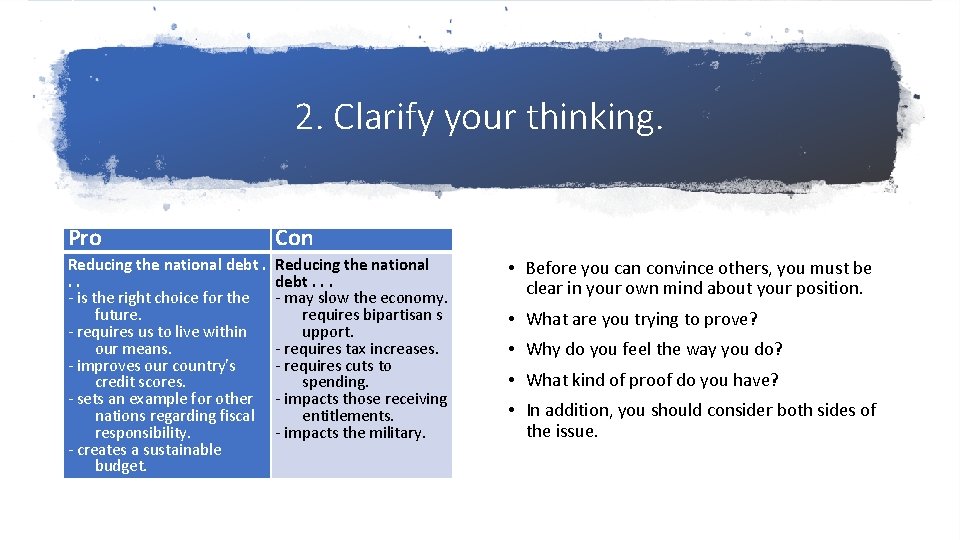
2. Clarify your thinking. Pro Con Reducing the national debt. . . - is the right choice for the future. - requires us to live within our means. - improves our country's credit scores. - sets an example for other nations regarding fiscal responsibility. - creates a sustainable budget. Reducing the national debt. . . - may slow the economy. requires bipartisan s upport. - requires tax increases. - requires cuts to spending. - impacts those receiving entitlements. - impacts the military. • Before you can convince others, you must be clear in your own mind about your position. • What are you trying to prove? • Why do you feel the way you do? • What kind of proof do you have? • In addition, you should consider both sides of the issue.
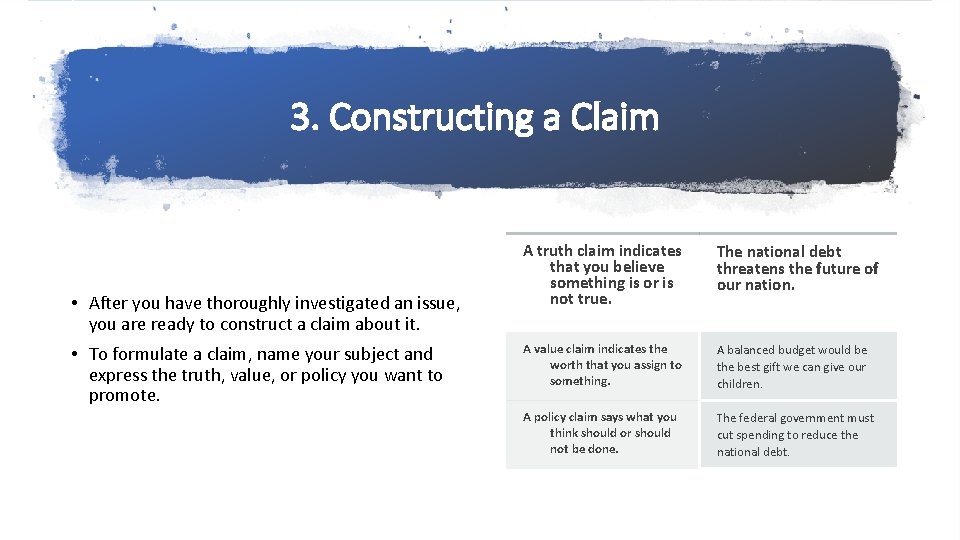
3. Constructing a Claim • After you have thoroughly investigated an issue, you are ready to construct a claim about it. • To formulate a claim, name your subject and express the truth, value, or policy you want to promote. A truth claim indicates that you believe something is or is not true. The national debt threatens the future of our nation. A value claim indicates the worth that you assign to something. A balanced budget would be the best gift we can give our children. A policy claim says what you think should or should not be done. The federal government must cut spending to reduce the national debt.
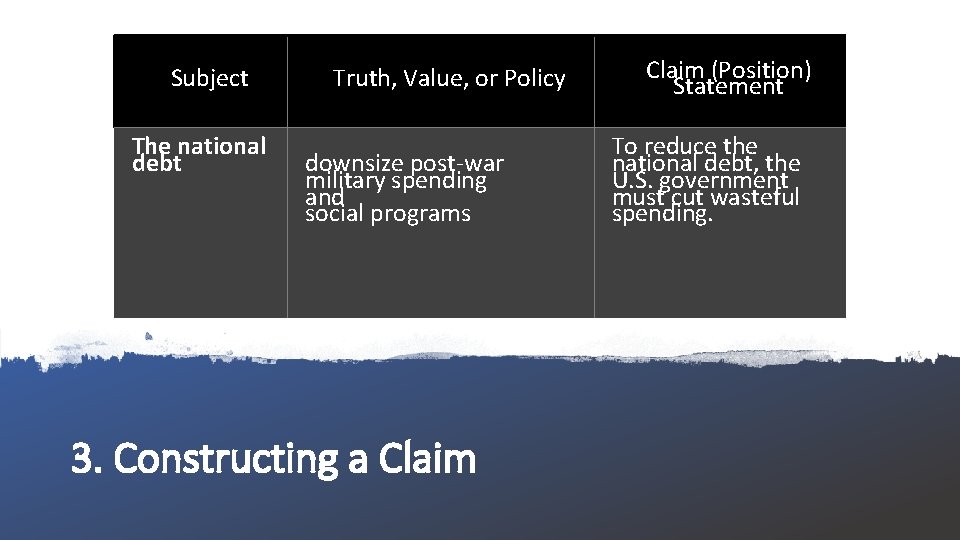
Subject The national debt Truth, Value, or Policy downsize post-war military spending and social programs 3. Constructing a Claim (Position) Statement To reduce the national debt, the U. S. government must cut wasteful spending.
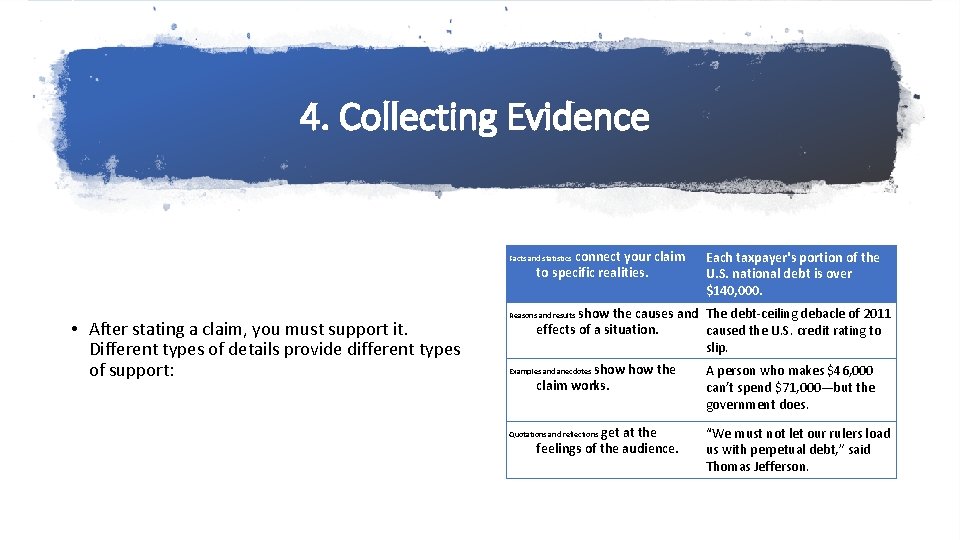
4. Collecting Evidence connect your claim to specific realities. Facts and statistics • After stating a claim, you must support it. Different types of details provide different types of support: Each taxpayer's portion of the U. S. national debt is over $140, 000. show the causes and The debt-ceiling debacle of 2011 effects of a situation. caused the U. S. credit rating to slip. Reasons and results show the claim works. A person who makes $46, 000 can’t spend $71, 000—but the government does. get at the feelings of the audience. “We must not let our rulers load us with perpetual debt, ” said Thomas Jefferson. Examples and anecdotes Quotations and reflections
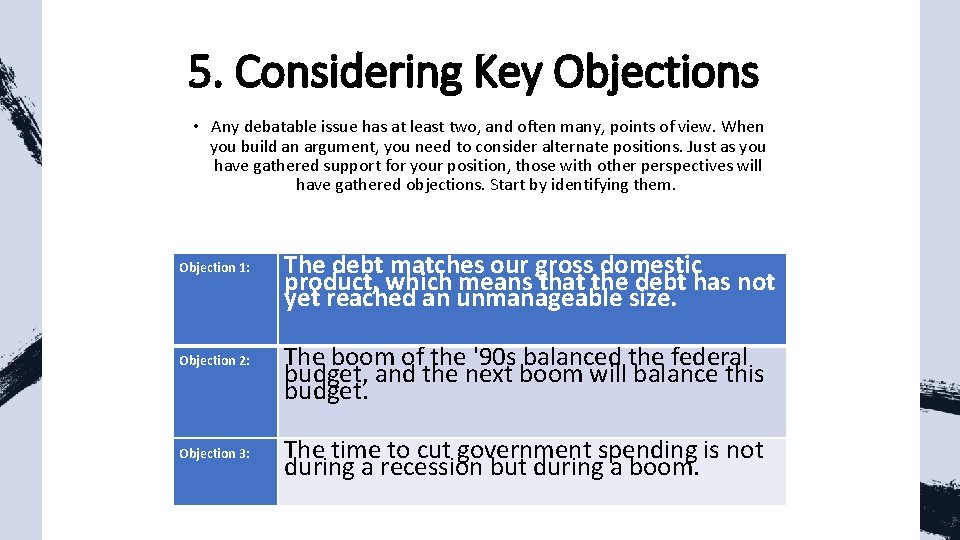
5. Considering Key Objections • Any debatable issue has at least two, and often many, points of view. When you build an argument, you need to consider alternate positions. Just as you have gathered support for your position, those with other perspectives will have gathered objections. Start by identifying them. Objection 1: Objection 2: Objection 3: The debt matches our gross domestic product, which means that the debt has not yet reached an unmanageable size. The boom of the '90 s balanced the federal budget, and the next boom will balance this budget. The time to cut government spending is not during a recession but during a boom.
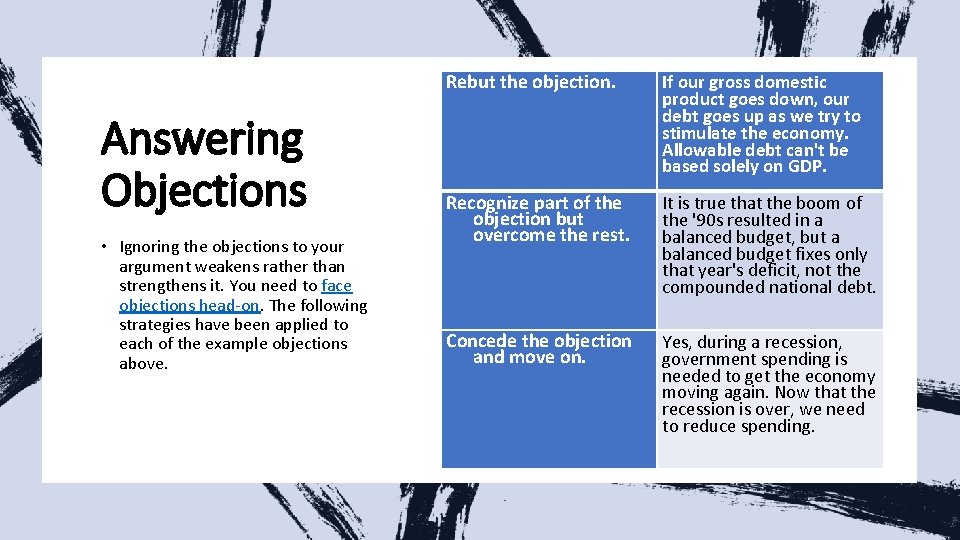
Answering Objections • Ignoring the objections to your argument weakens rather than strengthens it. You need to face objections head-on. The following strategies have been applied to each of the example objections above. Rebut the objection. If our gross domestic product goes down, our debt goes up as we try to stimulate the economy. Allowable debt can't be based solely on GDP. Recognize part of the objection but overcome the rest. It is true that the boom of the '90 s resulted in a balanced budget, but a balanced budget fixes only that year's deficit, not the compounded national debt. Concede the objection and move on. Yes, during a recession, government spending is needed to get the economy moving again. Now that the recession is over, we need to reduce spending.
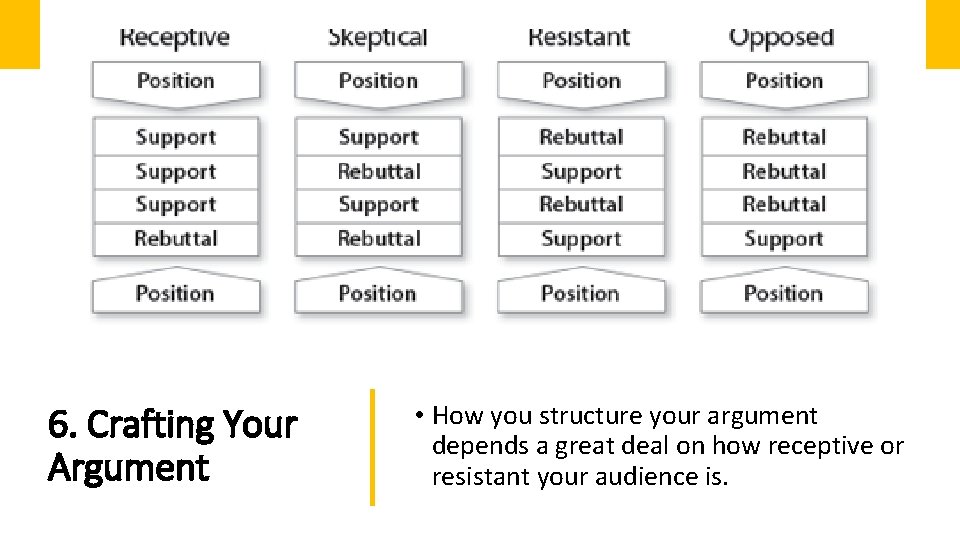
6. Crafting Your Argument • How you structure your argument depends a great deal on how receptive or resistant your audience is.
7. Confirming Your Main Point • Complete your argument by stating your main point in a new way and connecting it to the future. Leave your audience with a strong final thought.
- Slides: 13