
1 674 CHAOTIC DYNAMICS AND QUANTUM STATE PATTERNS
- Slides: 47
1 / 674 CHAOTIC DYNAMICS AND QUANTUM STATE PATTERNS IN COLLECTIVE MODELS OF NUCLEI Pavel Stránský Collaborators: Michal Macek, Pavel Cejnar Institute of Particle and Nuclear Phycics, Faculty of Mathematics and Physics, Charles University in Prague, Czech Republic Jan Dobeš Nuclear Research Institute, Řež, Czech Republic Alejandro Frank, Emmanuel Landa, Irving Morales Instituto de Ciencias Nucleares, Universidad Nacional Autónoma de México ECT* Seminar* 13 January 2012
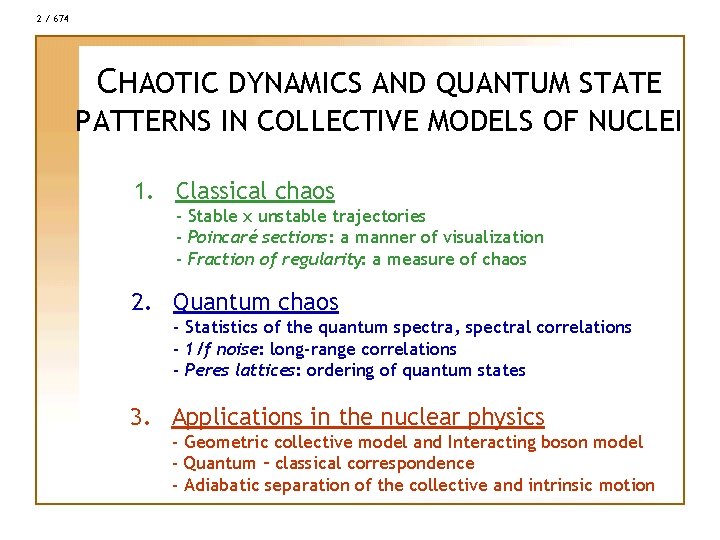
2 / 674 CHAOTIC DYNAMICS AND QUANTUM STATE PATTERNS IN COLLECTIVE MODELS OF NUCLEI 1. Classical chaos - Stable x unstable trajectories - Poincaré sections: a manner of visualization - Fraction of regularity: a measure of chaos 2. Quantum chaos - Statistics of the quantum spectra, spectral correlations - 1/f noise: long-range correlations - Peres lattices: ordering of quantum states 3. Applications in the nuclear physics - Geometric collective model and Interacting boson model - Quantum – classical correspondence - Adiabatic separation of the collective and intrinsic motion
3 / 674 1. Classical Chaos (analysis of trajectories)
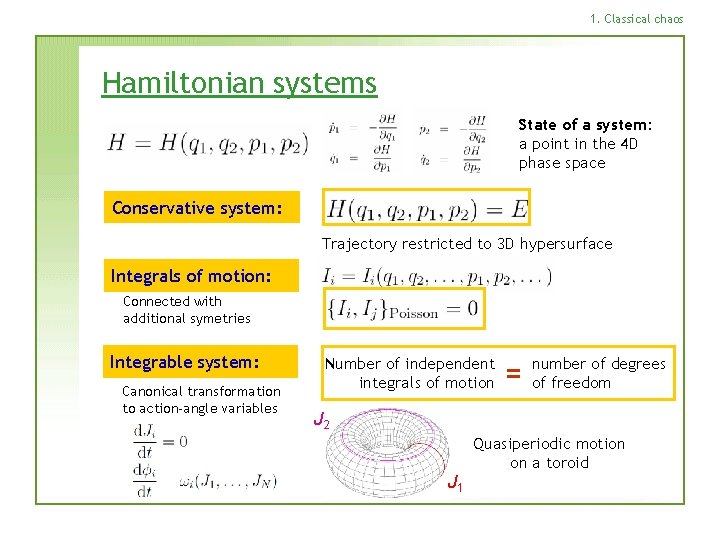
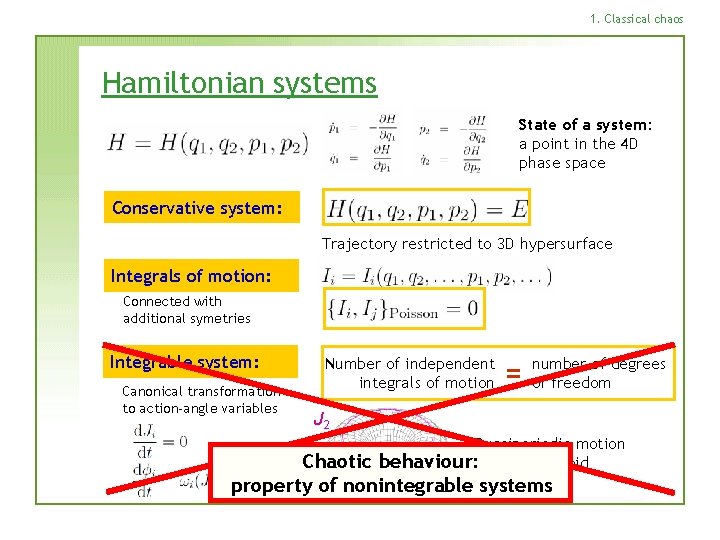
1. Classical chaos Hamiltonian systems State of a system: a point in the 4 D phase space Conservative system: Trajectory restricted to 3 D hypersurface Integrals of motion: Connected with additional symetries Integrable system: Canonical transformation to action-angle variables Number of independent integrals of motion = number of degrees of freedom J 2 J 1 Quasiperiodic motion on a toroid
1. Classical chaos Hamiltonian systems State of a system: a point in the 4 D phase space Conservative system: Trajectory restricted to 3 D hypersurface Integrals of motion: Connected with additional symetries Integrable system: Canonical transformation to action-angle variables Number of independent integrals of motion = number of degrees of freedom J 2 Quasiperiodic motion behaviour: on a toroid Chaotic J 1 systems property of nonintegrable
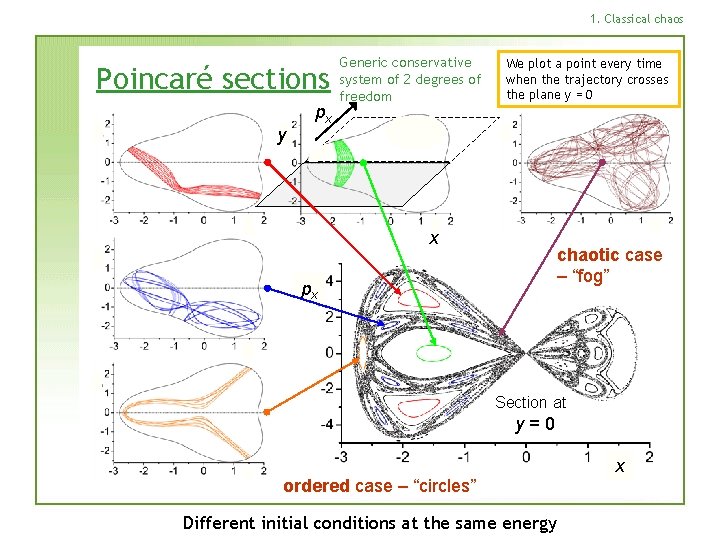
1. Classical chaos Poincaré sections y px Generic conservative system of 2 degrees of freedom We plot a point every time when the trajectory crosses the plane y = 0 x chaotic case – “fog” px Section at y=0 x ordered case – “circles” Different initial conditions at the same energy
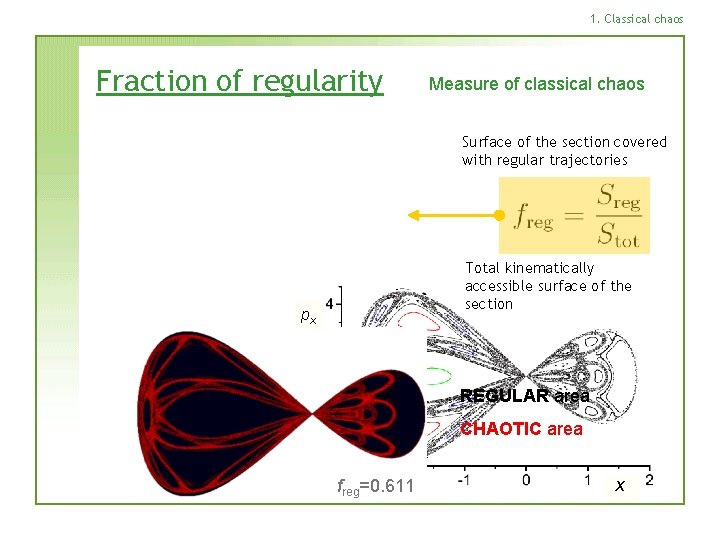
1. Classical chaos Fraction of regularity Measure of classical chaos Surface of the section covered with regular trajectories Total kinematically accessible surface of the section px REGULAR area CHAOTIC area freg=0. 611 x
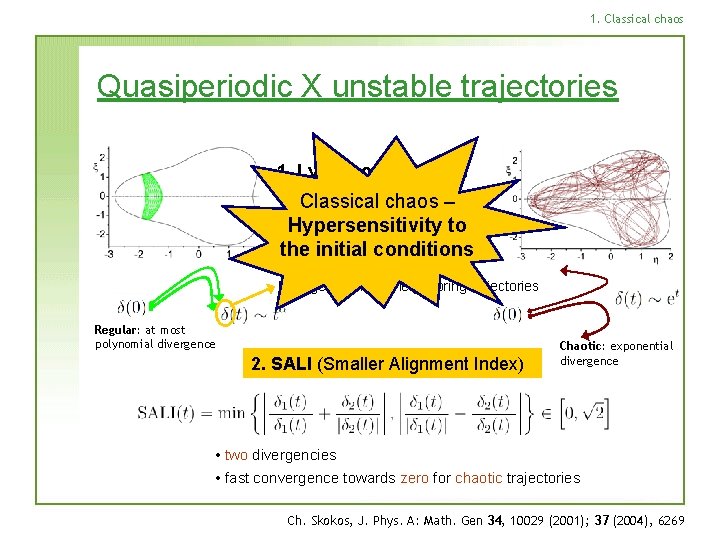
1. Classical chaos Quasiperiodic X unstable trajectories 1. Lyapunov exponent Classical chaos – Hypersensitivity to the initial conditions Divergence of two neighboring trajectories Regular: at most polynomial divergence 2. SALI (Smaller Alignment Index) Chaotic: exponential divergence • two divergencies • fast convergence towards zero for chaotic trajectories Ch. Skokos, J. Phys. A: Math. Gen 34, 10029 (2001); 37 (2004), 6269
2. Quantum Chaos (analysis of energy spectra)
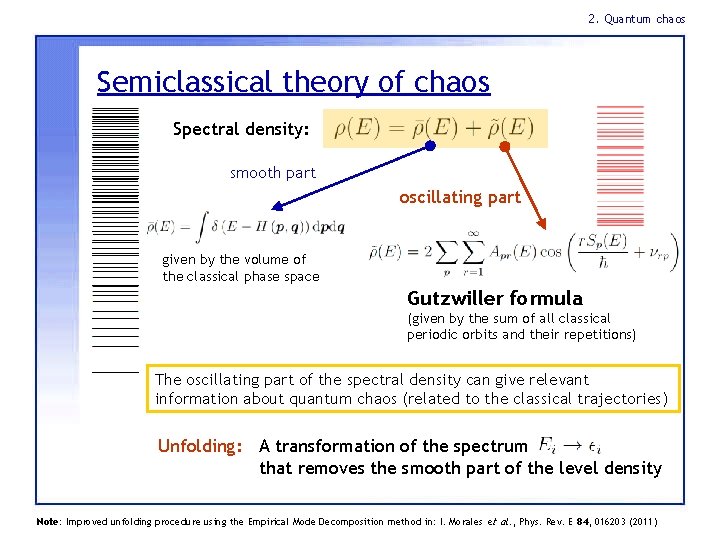
2. Quantum chaos Semiclassical theory of chaos Spectral density: smooth part oscillating part given by the volume of the classical phase space Gutzwiller formula (given by the sum of all classical periodic orbits and their repetitions) The oscillating part of the spectral density can give relevant information about quantum chaos (related to the classical trajectories) Unfolding: A transformation of the spectrum that removes the smooth part of the level density Note: Improved unfolding procedure using the Empirical Mode Decomposition method in: I. Morales et al. , Phys. Rev. E 84, 016203 (2011)
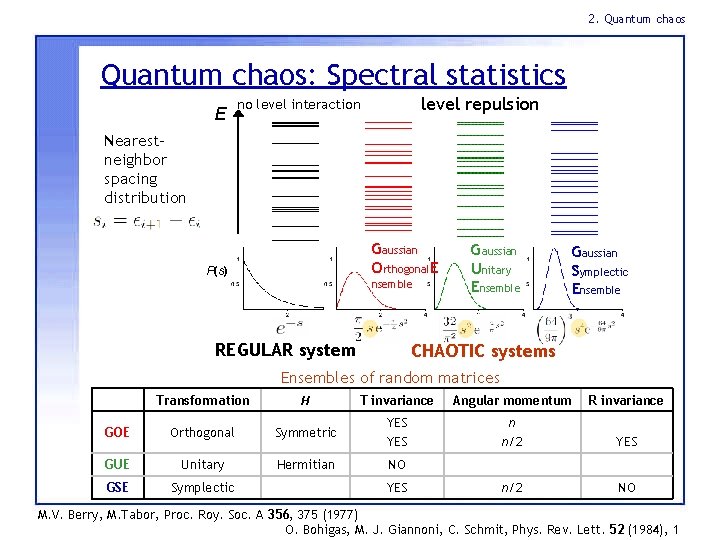
2. Quantum chaos: Spectral statistics E level repulsion no level interaction Nearestneighbor spacing distribution Gaussian Orthogonal. E P(s) nsemble REGULAR system Gaussian Unitary Ensemble Gaussian Symplectic Ensemble CHAOTIC systems Ensembles of random matrices Transformation H T invariance Angular momentum R invariance GOE Orthogonal Symmetric YES n n/2 YES GUE Unitary Hermitian NO GSE Symplectic n/2 NO YES M. V. Berry, M. Tabor, Proc. Roy. Soc. A 356, 375 (1977) O. Bohigas, M. J. Giannoni, C. Schmit, Phys. Rev. Lett. 52 (1984), 1
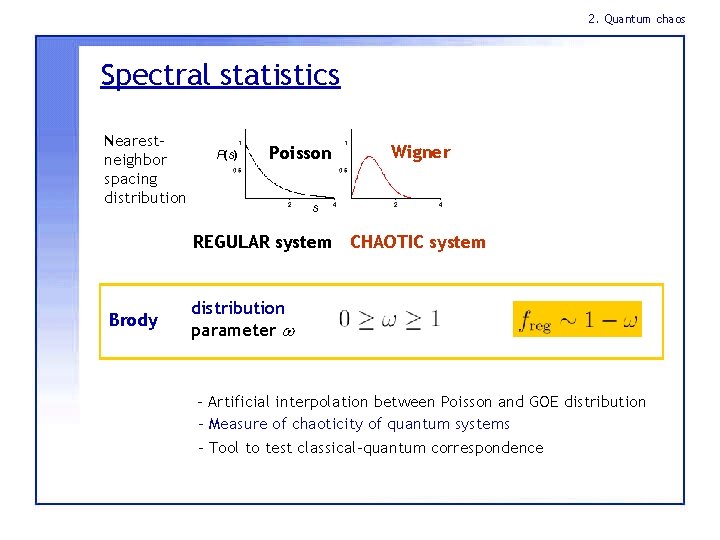
2. Quantum chaos Spectral statistics Nearestneighbor spacing distribution P(s) Poisson Wigner s REGULAR system CHAOTIC system Brody distribution parameter w - Artificial interpolation between Poisson and GOE distribution - Measure of chaoticity of quantum systems - Tool to test classical-quantum correspondence
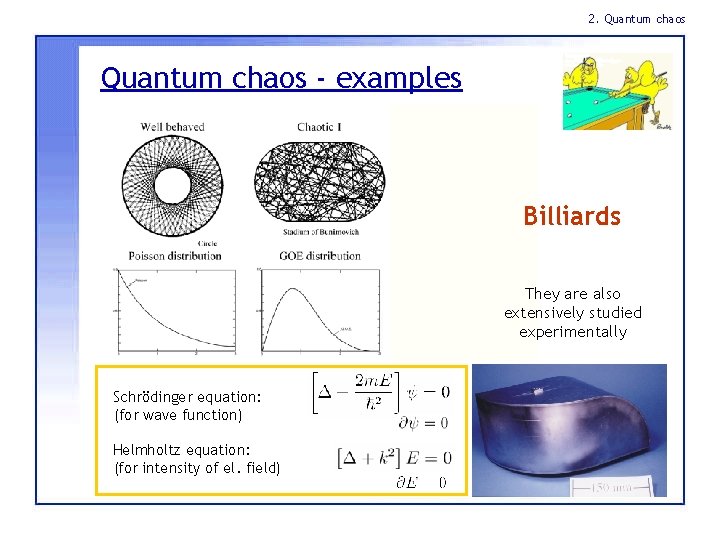
2. Quantum chaos - examples Billiards They are also extensively studied experimentally Schrödinger equation: (for wave function) Helmholtz equation: (for intensity of el. field)
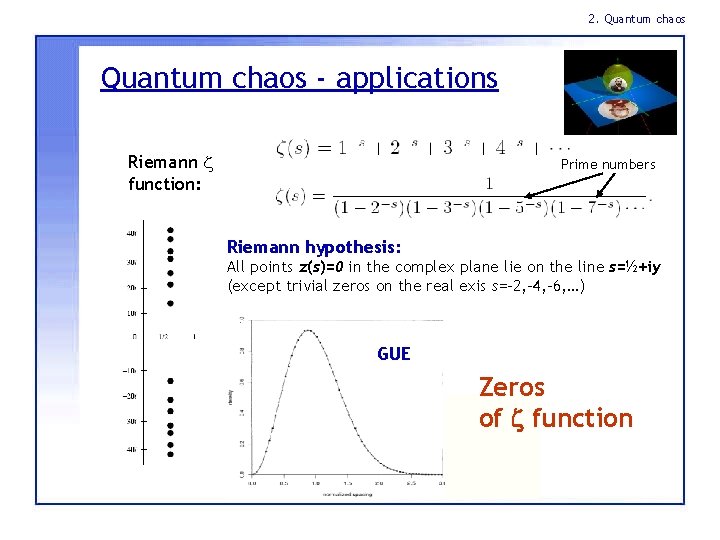
2. Quantum chaos - applications Riemann z function: Prime numbers Riemann hypothesis: All points z(s)=0 in the complex plane lie on the line s=½+iy (except trivial zeros on the real exis s=– 2, – 4, – 6, …) GUE Zeros of z function
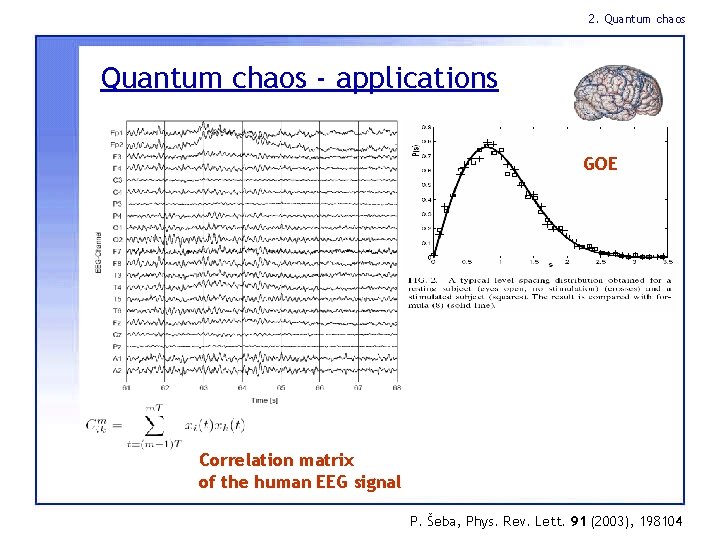
2. Quantum chaos - applications GOE Correlation matrix of the human EEG signal P. Šeba, Phys. Rev. Lett. 91 (2003), 198104
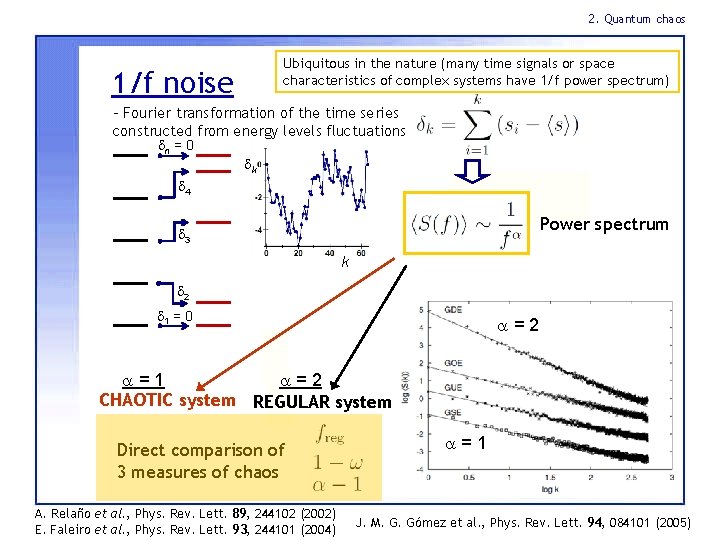
2. Quantum chaos Ubiquitous in the nature (many time signals or space characteristics of complex systems have 1/f power spectrum) 1/f noise - Fourier transformation of the time series constructed from energy levels fluctuations dn = 0 dk d 4 Power spectrum d 3 k d 2 d 1 = 0 a=2 a=1 CHAOTIC system REGULAR system Direct comparison of 3 measures of chaos A. Relaño et al. , Phys. Rev. Lett. 89, 244102 (2002) E. Faleiro et al. , Phys. Rev. Lett. 93, 244101 (2004) a=1 J. M. G. Gómez et al. , Phys. Rev. Lett. 94, 084101 (2005)
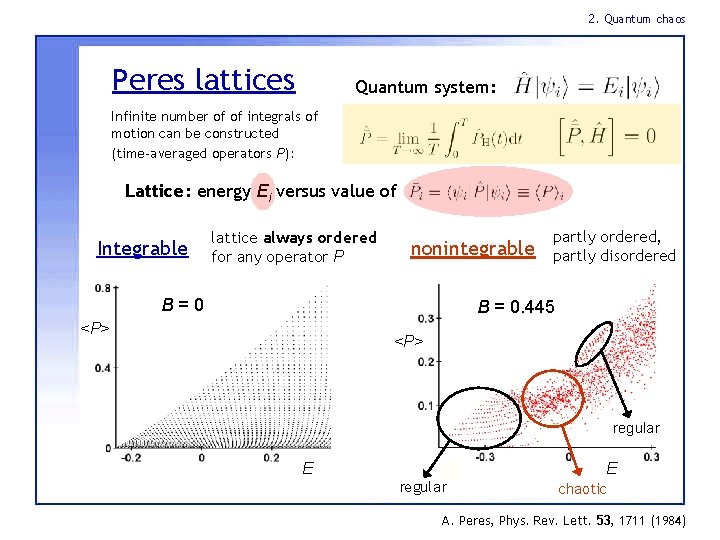
2. Quantum chaos Peres lattices Quantum system: Infinite number of of integrals of motion can be constructed (time-averaged operators P): Lattice: energy Ei versus value of Integrable lattice always ordered for any operator P nonintegrable B=0 partly ordered, partly disordered B = 0. 445 <P> regular E E regular chaotic A. Peres, Phys. Rev. Lett. 53, 1711 (1984)
3. Application to the collective models of nuclei
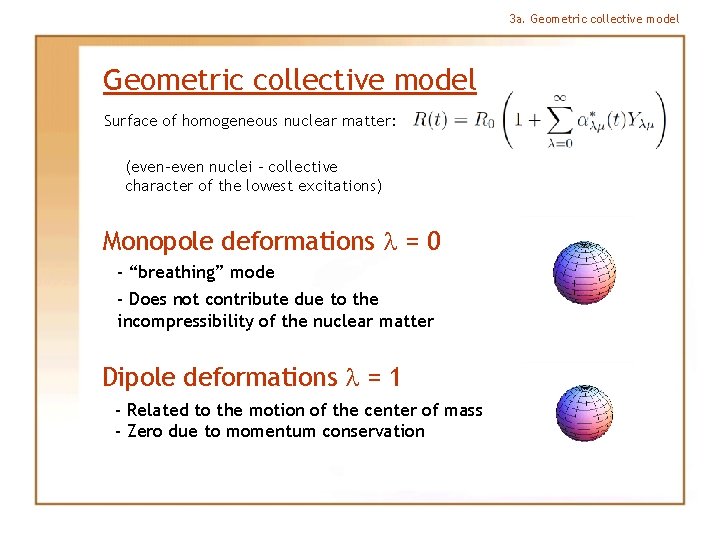
3 a. Geometric collective model Surface of homogeneous nuclear matter: (even-even nuclei – collective character of the lowest excitations) Monopole deformations l = 0 - “breathing” mode - Does not contribute due to the incompressibility of the nuclear matter Dipole deformations l = 1 - Related to the motion of the center of mass - Zero due to momentum conservation
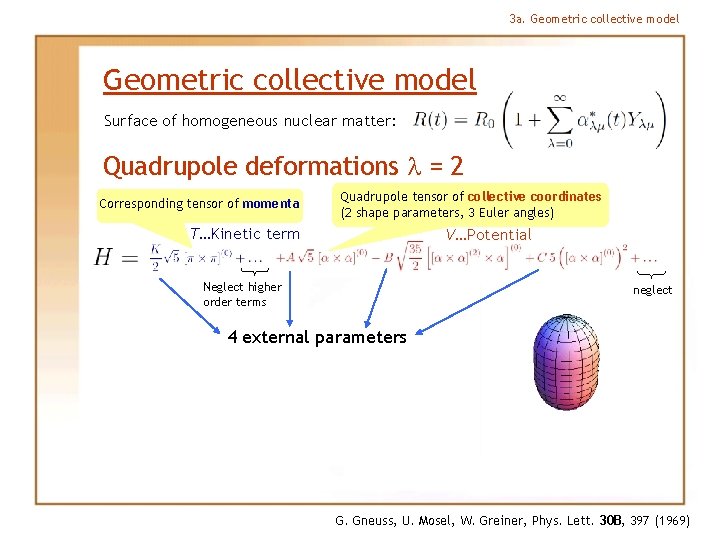
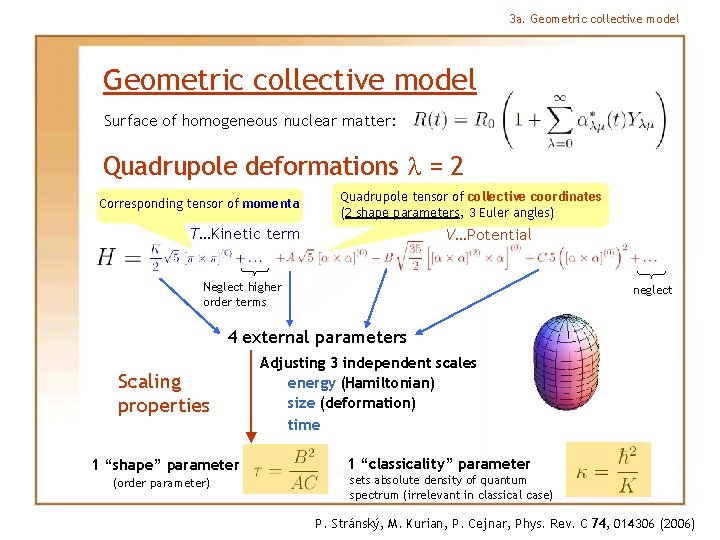
3 a. Geometric collective model Surface of homogeneous nuclear matter: Quadrupole deformations l = 2 Corresponding tensor of momenta Quadrupole tensor of collective coordinates (2 shape parameters, 3 Euler angles) T…Kinetic term V…Potential Neglect higher order terms neglect 4 external parameters G. Gneuss, U. Mosel, W. Greiner, Phys. Lett. 30 B, 397 (1969)
3 a. Geometric collective model Surface of homogeneous nuclear matter: Quadrupole deformations l = 2 Corresponding tensor of momenta Quadrupole tensor of collective coordinates (2 shape parameters, 3 Euler angles) T…Kinetic term V…Potential Neglect higher order terms neglect 4 external parameters Scaling properties 1 “shape” parameter (order parameter) Adjusting 3 independent scales energy (Hamiltonian) size (deformation) time 1 “classicality” parameter sets absolute density of quantum spectrum (irrelevant in classical case) P. Stránský, M. Kurian, P. Cejnar, Phys. Rev. C 74, 014306 (2006)
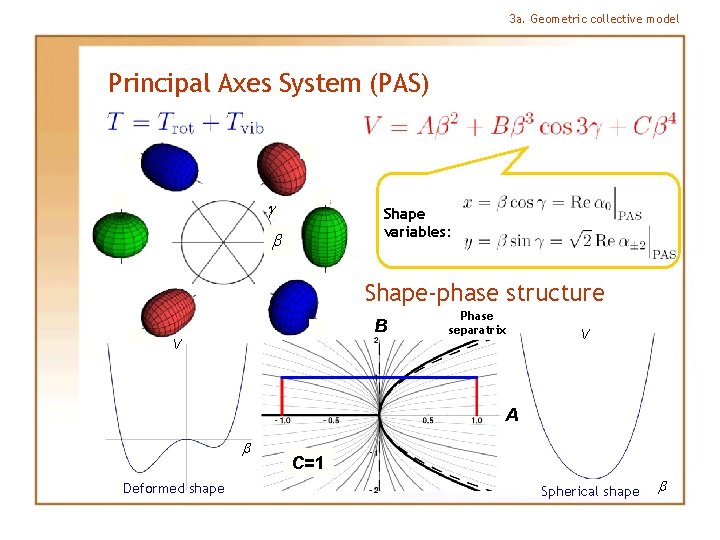
3 a. Geometric collective model Principal Axes System (PAS) g Shape variables: b Shape-phase structure B V Phase separatrix V A b Deformed shape C=1 Spherical shape b
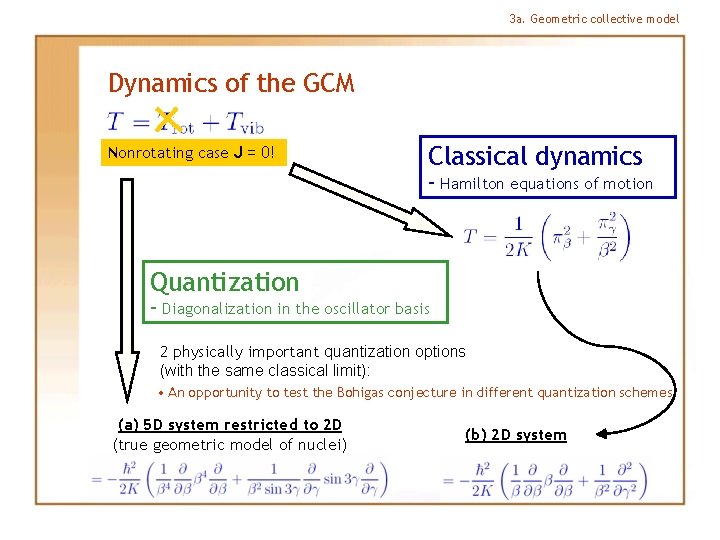
3 a. Geometric collective model Dynamics of the GCM Nonrotating case J = 0! Classical dynamics – Hamilton equations of motion Quantization – Diagonalization in the oscillator basis 2 physically important quantization options (with the same classical limit): • An opportunity to test the Bohigas conjecture in different quantization schemes (a) 5 D system restricted to 2 D (true geometric model of nuclei) (b) 2 D system
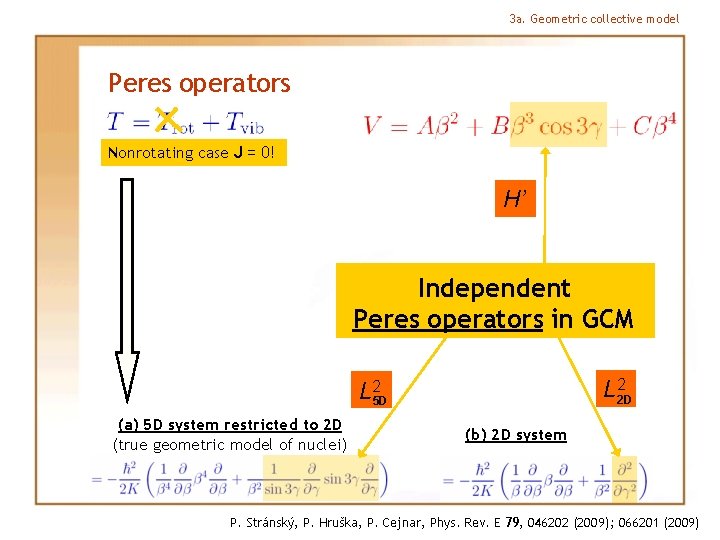
3 a. Geometric collective model Peres operators Nonrotating case J = 0! H’ Independent Peres operators in GCM L 22 D L 25 D (a) 5 D system restricted to 2 D (true geometric model of nuclei) (b) 2 D system P. Stránský, P. Hruška, P. Cejnar, Phys. Rev. E 79, 046202 (2009); 066201 (2009)
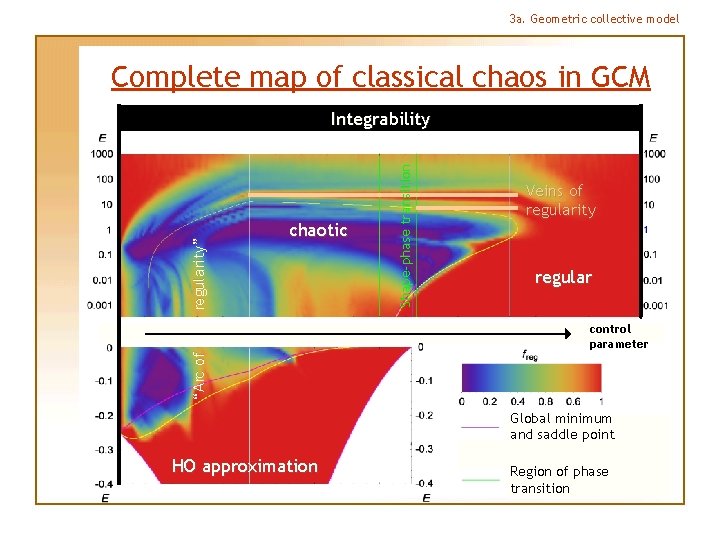
3 a. Geometric collective model Complete map of classical chaos in GCM chaotic Shape-phase transition regularity” Integrability Veins of regularity regular “Arc of control parameter Global minimum and saddle point HO approximation Region of phase transition
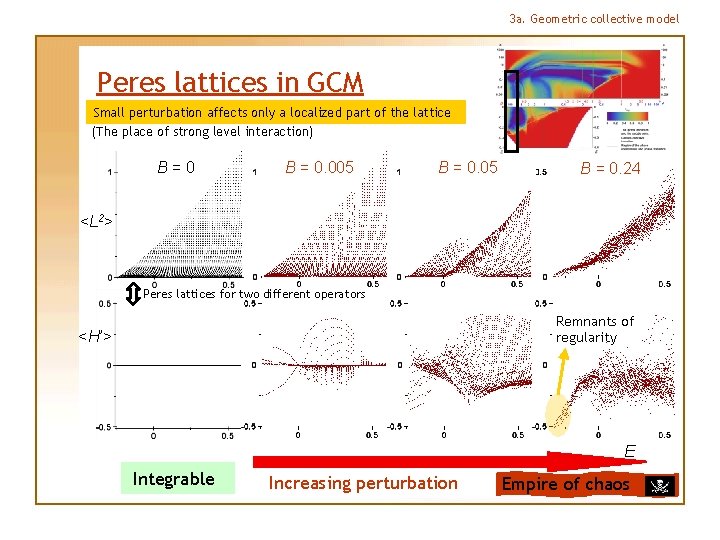
3 a. Geometric collective model Peres lattices in GCM Small perturbation affects only a localized part of the lattice (The place of strong level interaction) B=0 B = 0. 005 B = 0. 24 <L 2> Peres lattices for two different operators Remnants of regularity <H’> E Integrable Increasing perturbation Empire of chaos
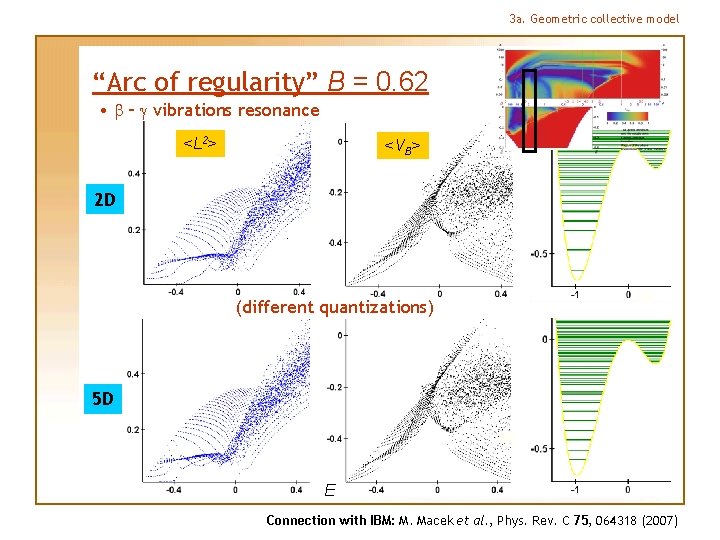
3 a. Geometric collective model “Arc of regularity” B = 0. 62 • b – g vibrations resonance <L 2> <VB> 2 D (different quantizations) 5 D E Connection with IBM: M. Macek et al. , Phys. Rev. C 75, 064318 (2007)
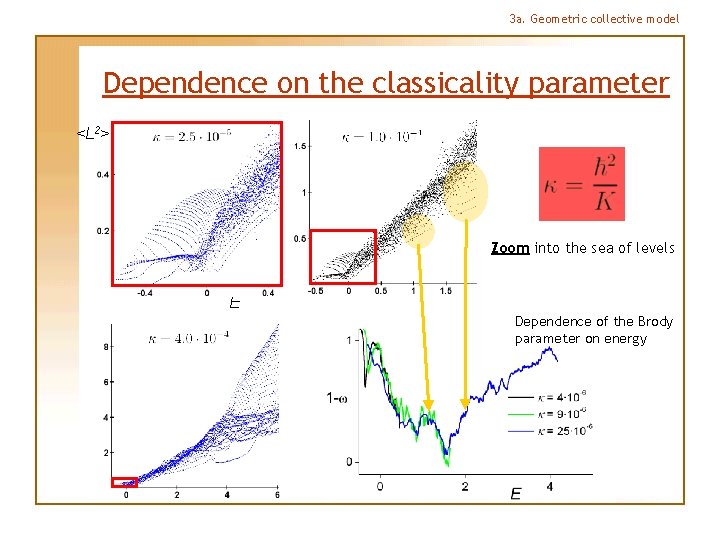
3 a. Geometric collective model Dependence on the classicality parameter <L 2> Zoom into the sea of levels E Dependence of the Brody parameter on energy
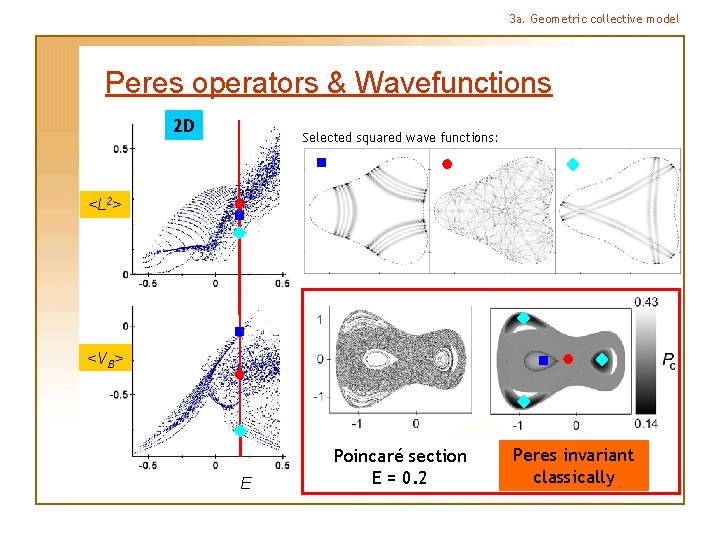
3 a. Geometric collective model Peres operators & Wavefunctions 2 D Selected squared wave functions: <L 2> <VB> E Poincaré section E = 0. 2 Peres invariant classically
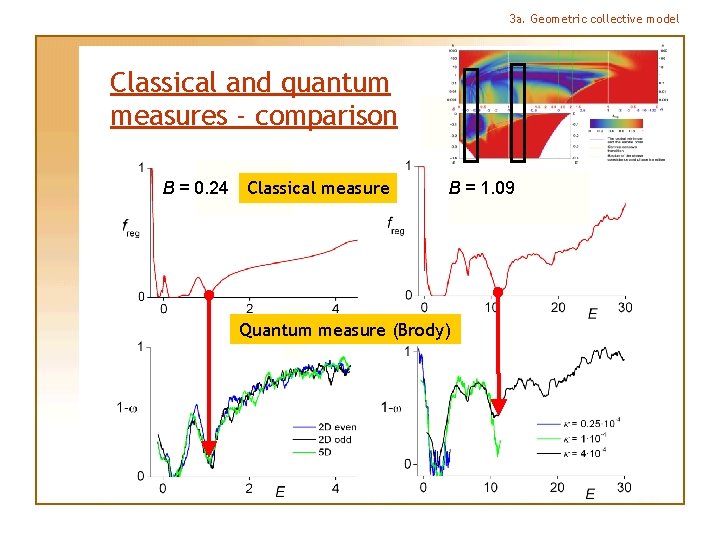
3 a. Geometric collective model Classical and quantum measures - comparison B = 0. 24 Classical measure B = 1. 09 Quantum measure (Brody)
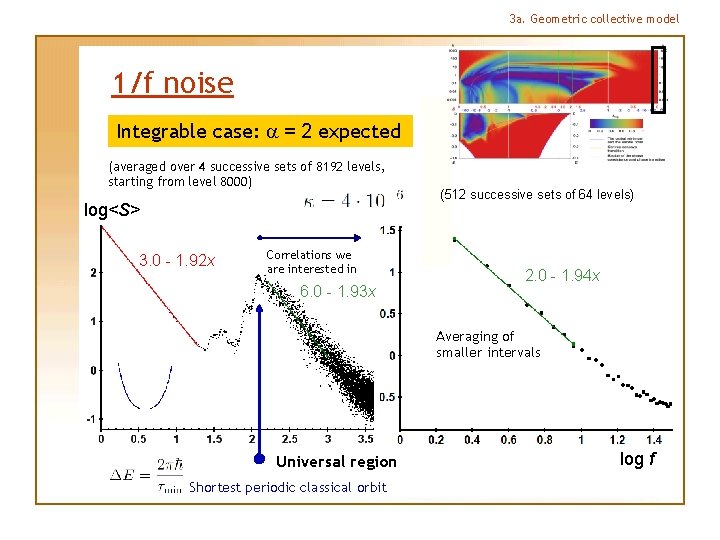
3 a. Geometric collective model 1/f noise Integrable case: a = 2 expected (averaged over 4 successive sets of 8192 levels, starting from level 8000) log<S> 3. 0 - 1. 92 x Correlations we are interested in 6. 0 - 1. 93 x (512 successive sets of 64 levels) 2. 0 - 1. 94 x Averaging of smaller intervals Universal region Shortest periodic classical orbit log f
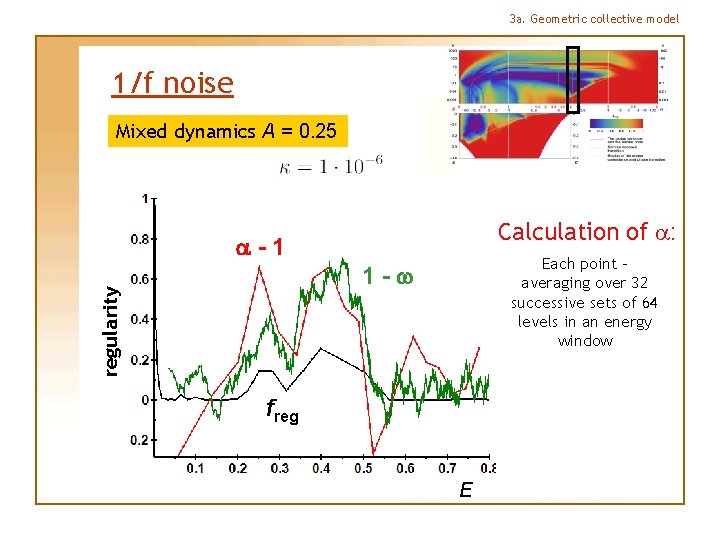
3 a. Geometric collective model 1/f noise Mixed dynamics A = 0. 25 regularity a-1 Calculation of a: Each point – averaging over 32 successive sets of 64 levels in an energy window 1 -w freg E
3 b. Interacting boson model Interacting Boson Model
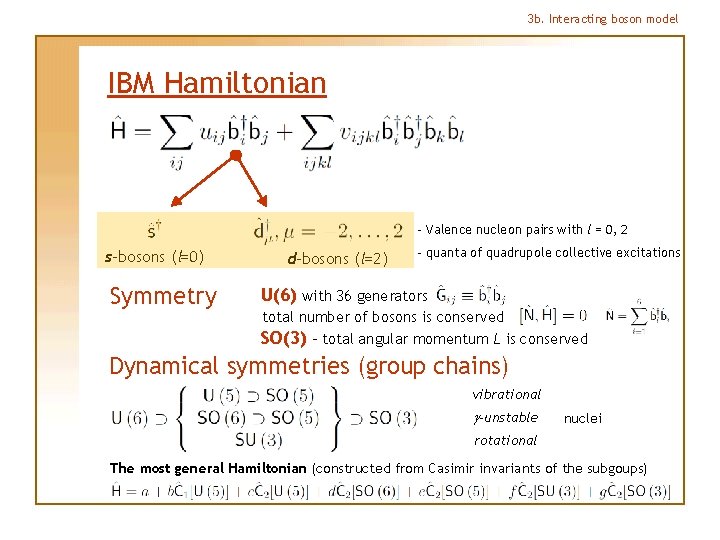
3 b. Interacting boson model IBM Hamiltonian - Valence nucleon pairs with l = 0, 2 s-bosons (l=0) Symmetry d-bosons (l=2) - quanta of quadrupole collective excitations U(6) with 36 generators total number of bosons is conserved SO(3) – total angular momentum L is conserved Dynamical symmetries (group chains) vibrational g-unstable nuclei rotational The most general Hamiltonian (constructed from Casimir invariants of the subgoups)
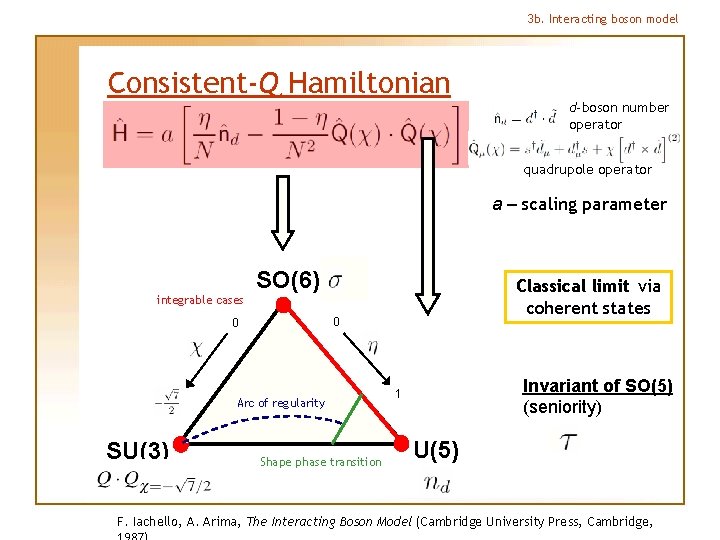
3 b. Interacting boson model Consistent-Q Hamiltonian d-boson number operator quadrupole operator a – scaling parameter SO(6) Classical limit via coherent states integrable cases 0 0 Arc of regularity SU(3) Shape phase transition Invariant of SO(5) (seniority) 1 U(5) F. Iachello, A. Arima, The Interacting Boson Model (Cambridge University Press, Cambridge,
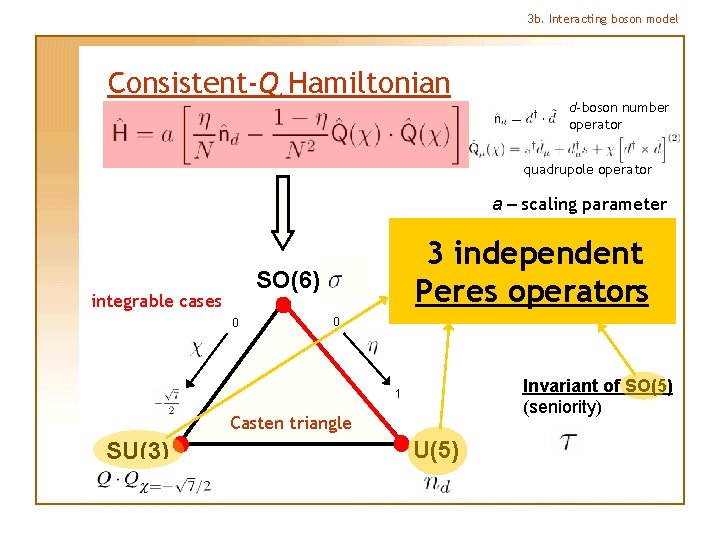
3 b. Interacting boson model Consistent-Q Hamiltonian d-boson number operator quadrupole operator a – scaling parameter 3 independent Peres operators SO(6) integrable cases 0 0 Invariant of SO(5) (seniority) 1 Casten triangle SU(3) U(5)
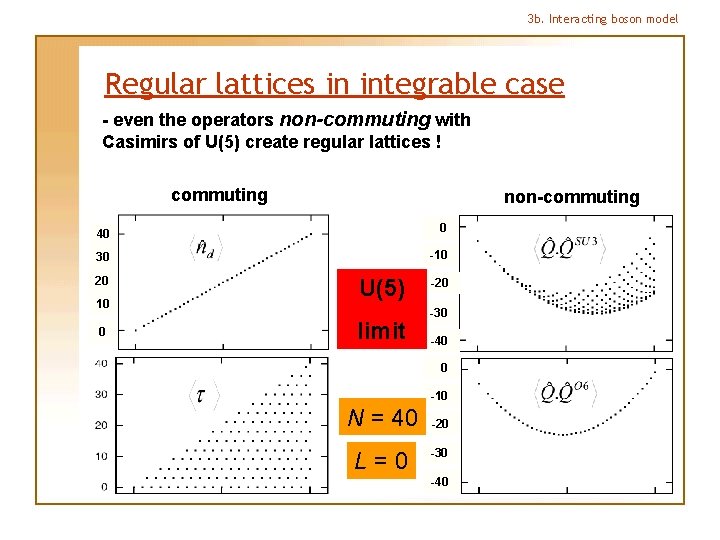
3 b. Interacting boson model Regular lattices in integrable case - even the operators non-commuting with Casimirs of U(5) create regular lattices ! commuting non-commuting 0 40 -10 30 20 10 0 U(5) limit -20 -30 -40 0 -10 N = 40 L=0 -20 -30 -40
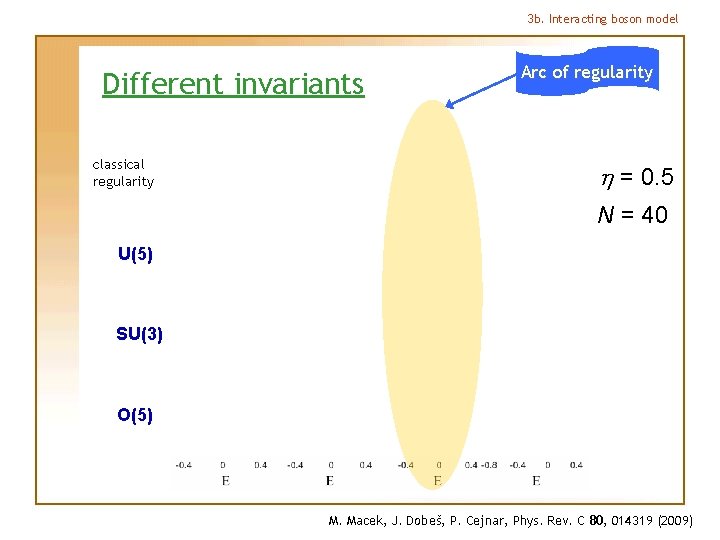
3 b. Interacting boson model Different invariants classical regularity Arc of regularity h = 0. 5 N = 40 U(5) SU(3) O(5) M. Macek, J. Dobeš, P. Cejnar, Phys. Rev. C 80, 014319 (2009)
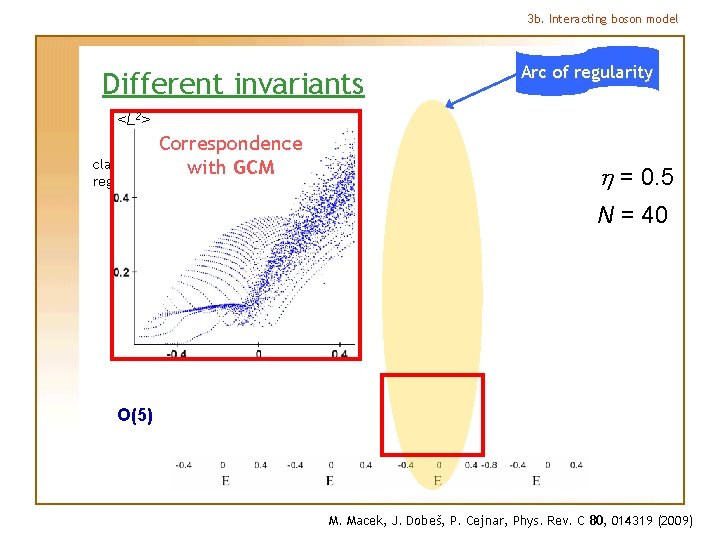
3 b. Interacting boson model Different invariants Arc of regularity <L 2> classical regularity Correspondence with GCM h = 0. 5 N = 40 U(5) SU(3) O(5) M. Macek, J. Dobeš, P. Cejnar, Phys. Rev. C 80, 014319 (2009)
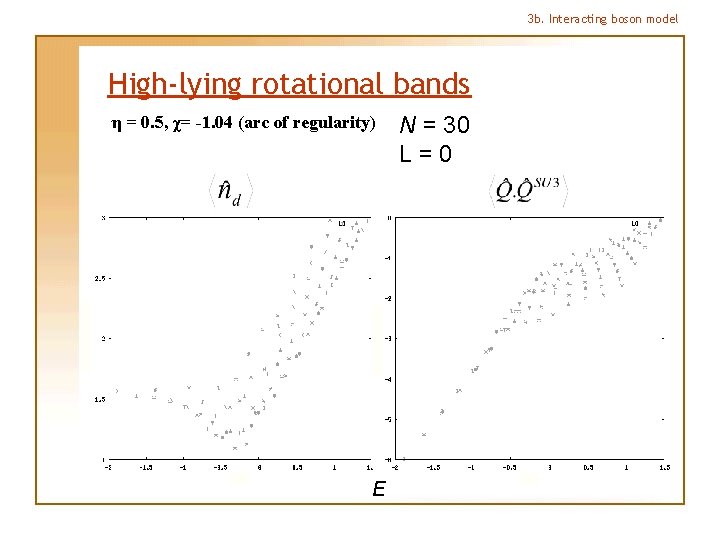
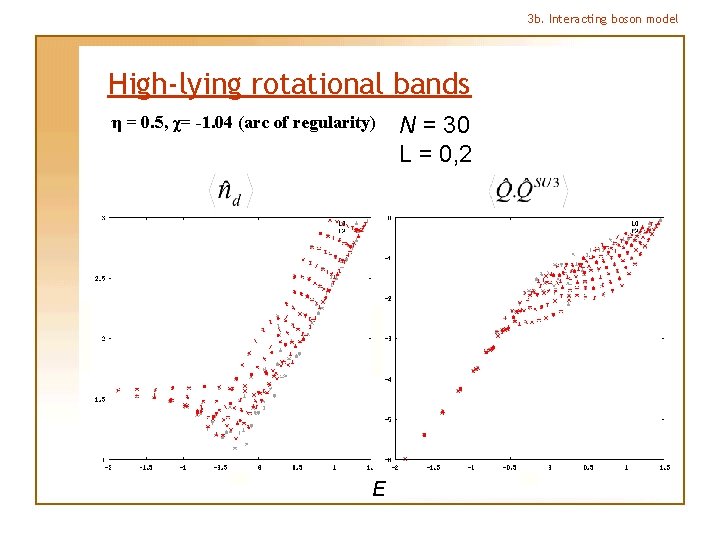
3 b. Interacting boson model High-lying rotational bands η = 0. 5, χ= -1. 04 (arc of regularity) E N = 30 L=0
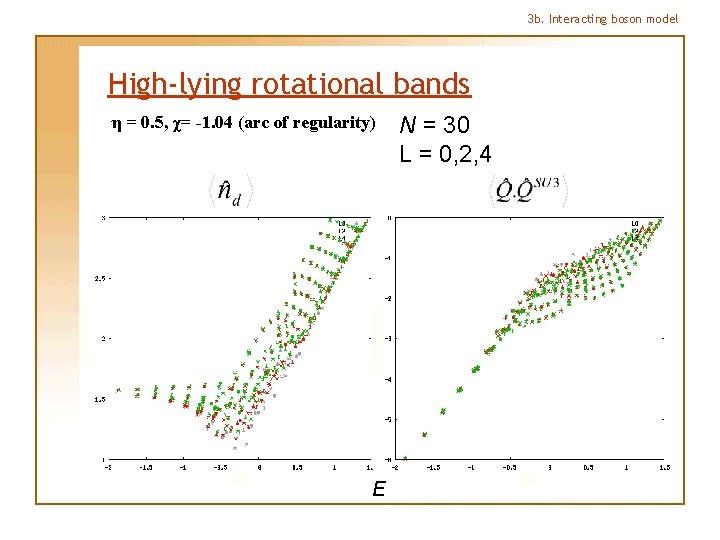
3 b. Interacting boson model High-lying rotational bands η = 0. 5, χ= -1. 04 (arc of regularity) E N = 30 L = 0, 2
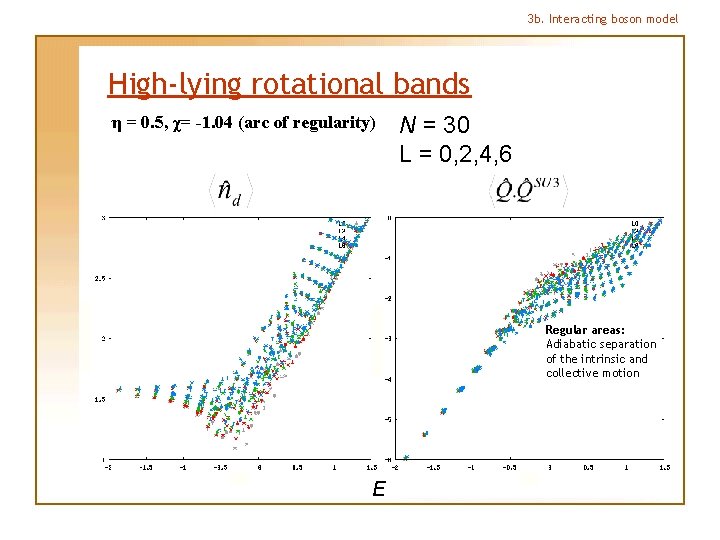
3 b. Interacting boson model High-lying rotational bands η = 0. 5, χ= -1. 04 (arc of regularity) E N = 30 L = 0, 2, 4
3 b. Interacting boson model High-lying rotational bands η = 0. 5, χ= -1. 04 (arc of regularity) N = 30 L = 0, 2, 4, 6 Regular areas: Adiabatic separation of the intrinsic and collective motion E
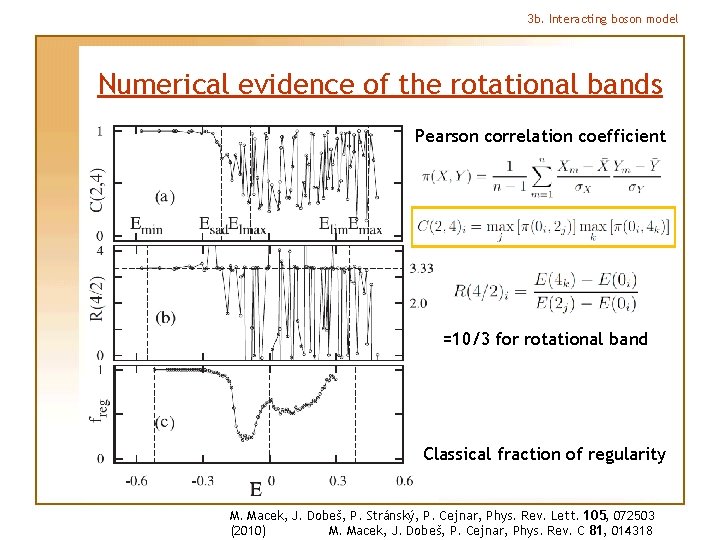
3 b. Interacting boson model Numerical evidence of the rotational bands Pearson correlation coefficient =10/3 for rotational band Classical fraction of regularity M. Macek, J. Dobeš, P. Stránský, P. Cejnar, Phys. Rev. Lett. 105, 072503 (2010) M. Macek, J. Dobeš, P. Cejnar, Phys. Rev. C 81, 014318
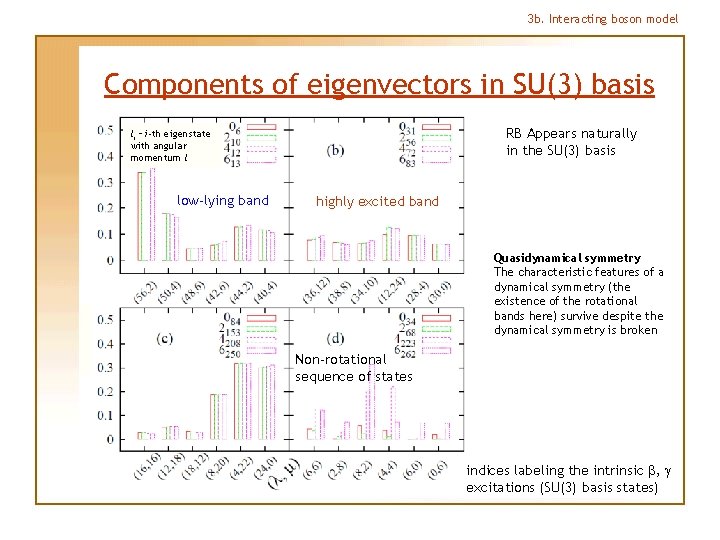
3 b. Interacting boson model Components of eigenvectors in SU(3) basis RB Appears naturally in the SU(3) basis li – i-th eigenstate with angular momentum l low-lying band highly excited band Quasidynamical symmetry The characteristic features of a dynamical symmetry (the existence of the rotational bands here) survive despite the dynamical symmetry is broken Non-rotational sequence of states indices labeling the intrinsic b, g excitations (SU(3) basis states)
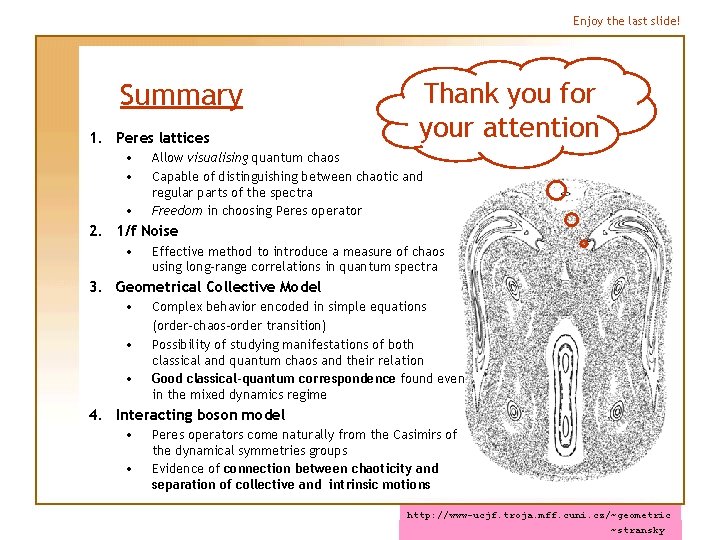
Enjoy the last slide! Summary 1. Peres lattices • • • Thank you for your attention Allow visualising quantum chaos Capable of distinguishing between chaotic and regular parts of the spectra Freedom in choosing Peres operator 2. 1/f Noise • Effective method to introduce a measure of chaos using long-range correlations in quantum spectra 3. Geometrical Collective Model • • • Complex behavior encoded in simple equations (order-chaos-order transition) Possibility of studying manifestations of both classical and quantum chaos and their relation Good classical-quantum correspondence found even in the mixed dynamics regime 4. Interacting boson model • • Peres operators come naturally from the Casimirs of the dynamical symmetries groups Evidence of connection between chaoticity and separation of collective and intrinsic motions http: //www-ucjf. troja. mff. cuni. cz/~geometric ~stransky