
1 5 Uncertainty in Measurement Summer AP Chemistry
- Slides: 10
1. 5 – Uncertainty in Measurement Summer AP Chemistry Homework Chapter 1
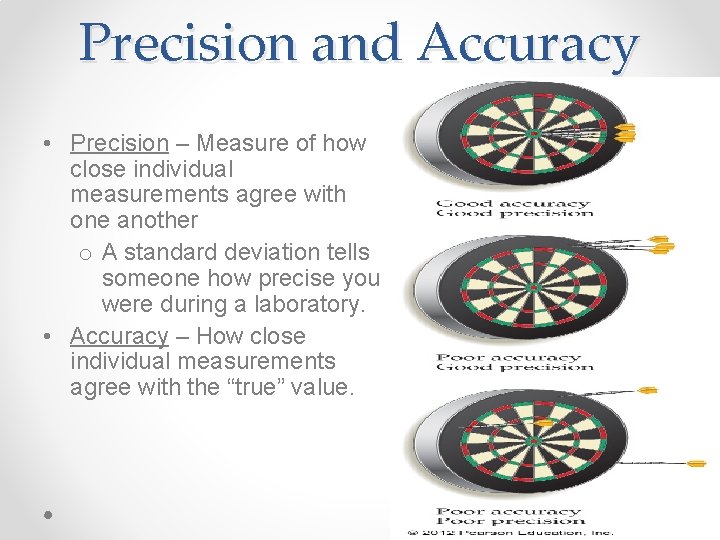
Precision and Accuracy • Precision – Measure of how close individual measurements agree with one another o A standard deviation tells someone how precise you were during a laboratory. • Accuracy – How close individual measurements agree with the “true” value.
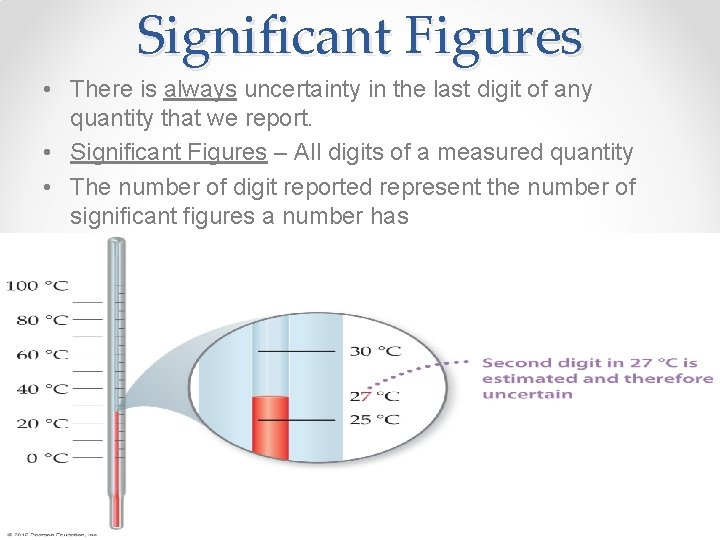
Significant Figures • There is always uncertainty in the last digit of any quantity that we report. • Significant Figures – All digits of a measured quantity • The number of digit reported represent the number of significant figures a number has
Determining the Number of Sig Figs • When looking at a number we need to determine how many sig figs it has. • The most important rule is that all nonzero digits in any measurement are significant • There are special rules for zeros: 1. Zeros between nonzero digits are always significant. For example, 1005 has 4 sig figs. 2. Zeros at the beginning of a number are never significant. For example, 0. 005 has 1 sig fig. 3. Zeros at the end of a number are significant only if there is a decimal. For example, 3. 0 has 2 sig figs, but 30 has 1 sig fig.
A Note on Scientific Notation • Recall that we can write a number like 10, 300 in scientific notation as 1. 03 x 104 • This number would have 3 sig figs • We only count the numbers. We do not count the exponential term.
Class Example • Determine the number of significant figures in the following numbers: 1. 6. 3050 cm 2. 601 kg 3. 0. 054 s 4. 0. 0105 L 5. 7. 0500 x 10 -3 m 3 6. 400 g
Sig Figs for Calculations • For any calculation, which ever measurement we are least certain about determines the number of sig figs in the answer • Determine sig figs only after a calculation is complete.
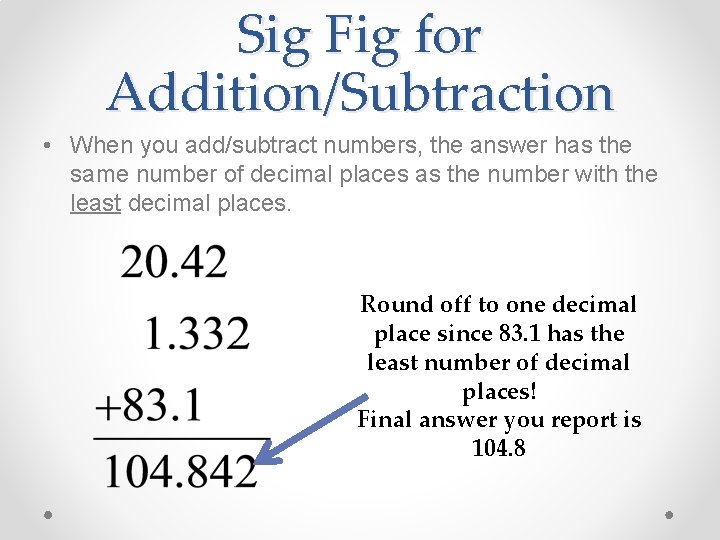
Sig Fig for Addition/Subtraction • When you add/subtract numbers, the answer has the same number of decimal places as the number with the least decimal places. Round off to one decimal place since 83. 1 has the least number of decimal places! Final answer you report is 104. 8
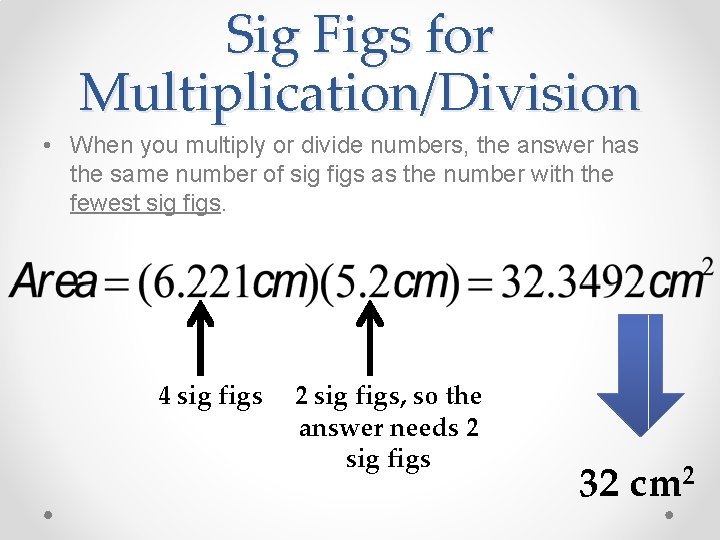
Sig Figs for Multiplication/Division • When you multiply or divide numbers, the answer has the same number of sig figs as the number with the fewest sig figs. 4 sig figs 2 sig figs, so the answer needs 2 sig figs 32 cm 2
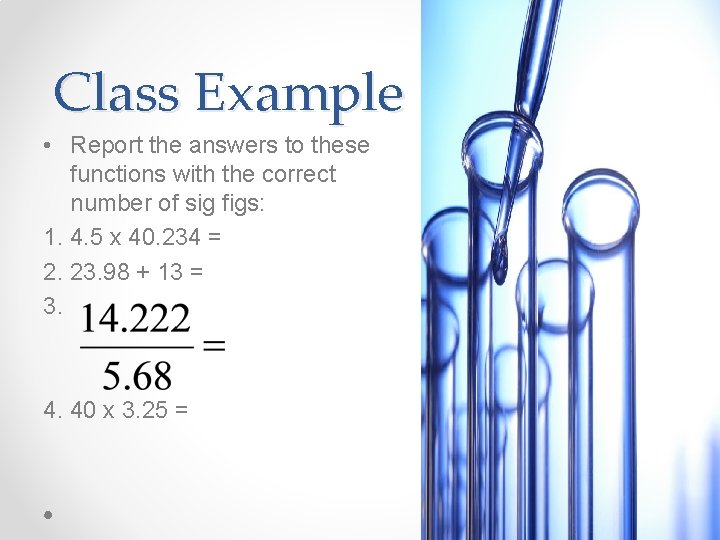
Class Example • Report the answers to these functions with the correct number of sig figs: 1. 4. 5 x 40. 234 = 2. 23. 98 + 13 = 3. 4. 40 x 3. 25 =