
1 5 NTUSTME 2008 C Functions Deitel C

- Slides: 28
1 5 (NTUST-ME 2008) C Functions Deitel- C: How to Program (5 ed) Week 01 –Brief Intro. Of C – ME 2008 ---2010 Q 1 -NTUST. ME 2007 Pearson Education, Inc. All rights reserved.
2 OBJECTIVES In this chapter you will learn: § To construct programs modularly from small pieces called functions. § The common math functions available in the C Standard Library. § To create new functions. § The mechanisms used to pass information between functions. § Simulation techniques using random number generation. 2007 Pearson Education, Inc. All rights reserved.
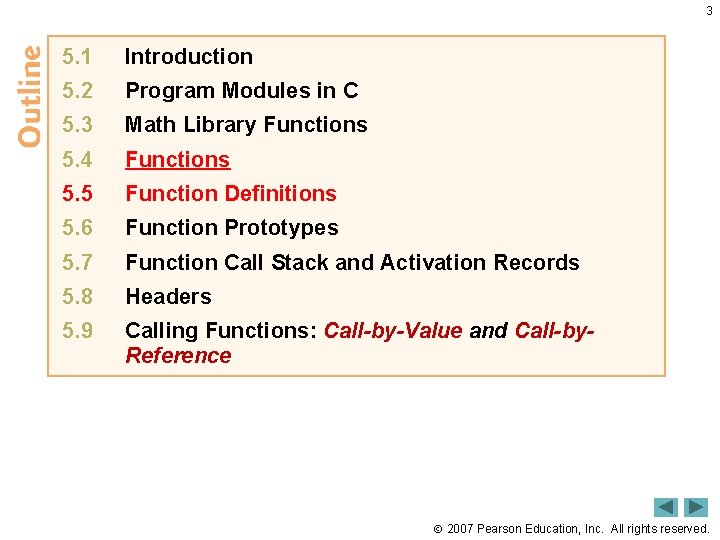
3 5. 1 Introduction 5. 2 Program Modules in C 5. 3 Math Library Functions 5. 4 Functions 5. 5 Function Definitions 5. 6 Function Prototypes 5. 7 Function Call Stack and Activation Records 5. 8 Headers 5. 9 Calling Functions: Call-by-Value and Call-by. Reference 2007 Pearson Education, Inc. All rights reserved.
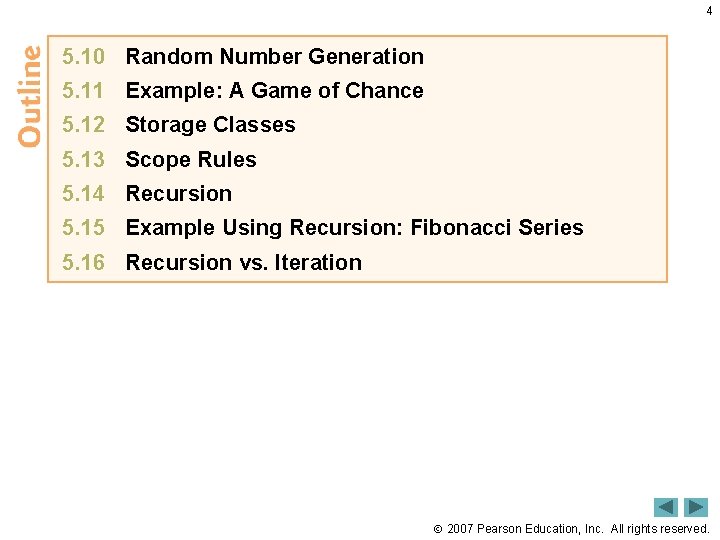
4 5. 10 Random Number Generation 5. 11 Example: A Game of Chance 5. 12 Storage Classes 5. 13 Scope Rules 5. 14 Recursion 5. 15 Example Using Recursion: Fibonacci Series 5. 16 Recursion vs. Iteration 2007 Pearson Education, Inc. All rights reserved.
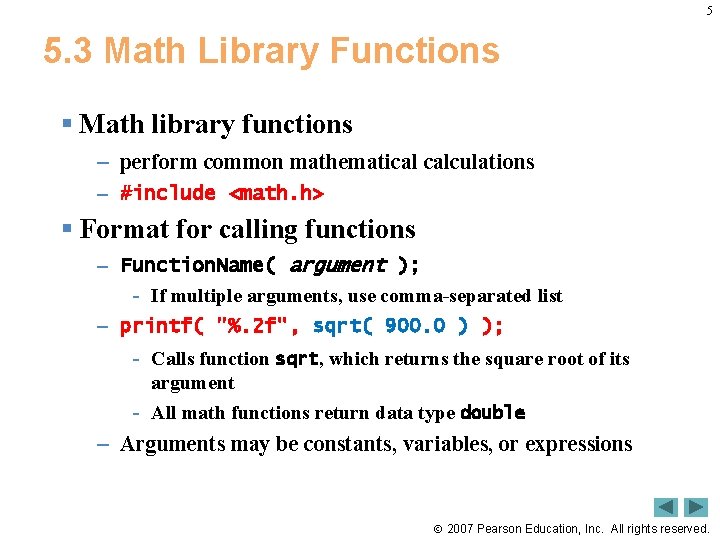
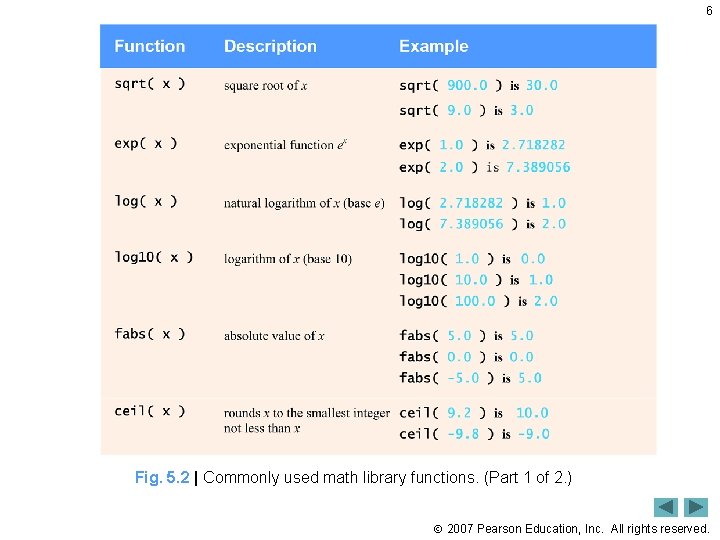
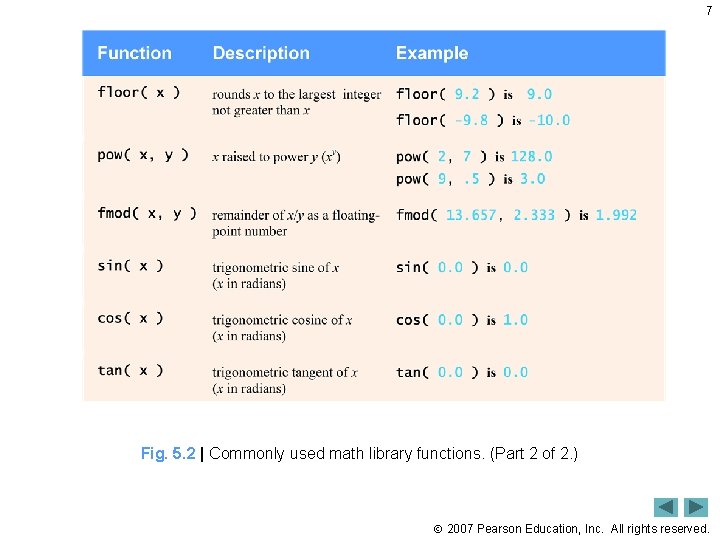
5 5. 3 Math Library Functions § Math library functions – perform common mathematical calculations – #include <math. h> § Format for calling functions – Function. Name( argument ); - If multiple arguments, use comma-separated list – printf( "%. 2 f", sqrt( 900. 0 ) ); - Calls function sqrt, which returns the square root of its argument - All math functions return data type double – Arguments may be constants, variables, or expressions 2007 Pearson Education, Inc. All rights reserved.
6 Fig. 5. 2 | Commonly used math library functions. (Part 1 of 2. ) 2007 Pearson Education, Inc. All rights reserved.
7 Fig. 5. 2 | Commonly used math library functions. (Part 2 of 2. ) 2007 Pearson Education, Inc. All rights reserved.
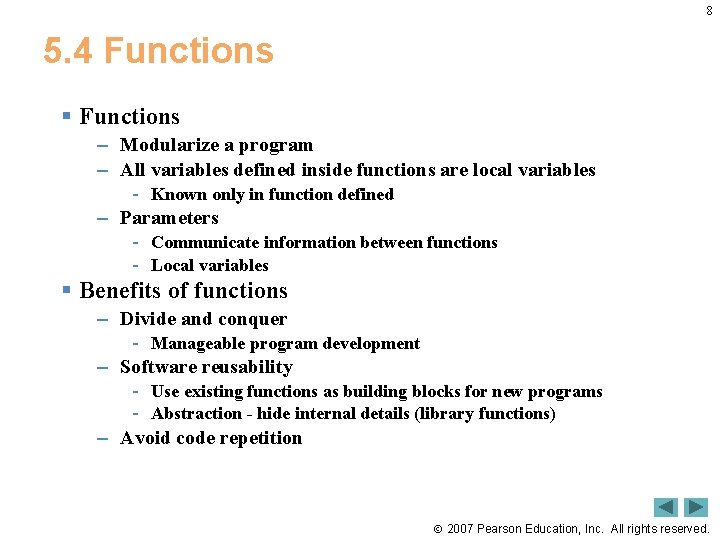
8 5. 4 Functions § Functions – Modularize a program – All variables defined inside functions are local variables - Known only in function defined – Parameters - Communicate information between functions - Local variables § Benefits of functions – Divide and conquer - Manageable program development – Software reusability - Use existing functions as building blocks for new programs - Abstraction - hide internal details (library functions) – Avoid code repetition 2007 Pearson Education, Inc. All rights reserved.
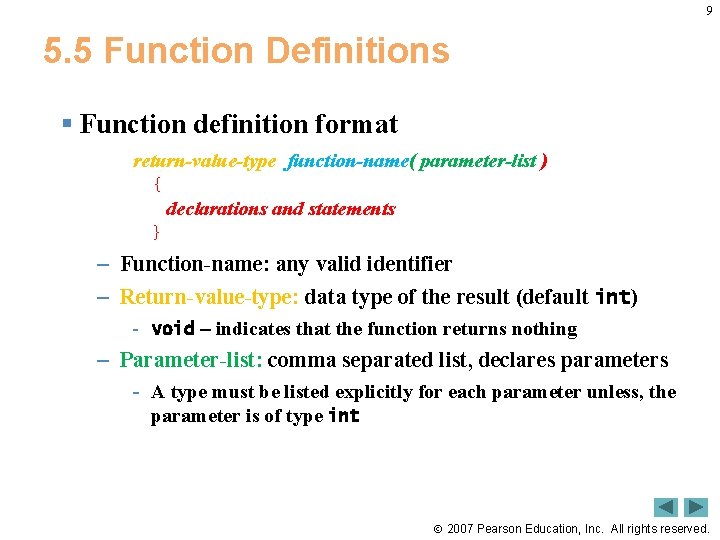
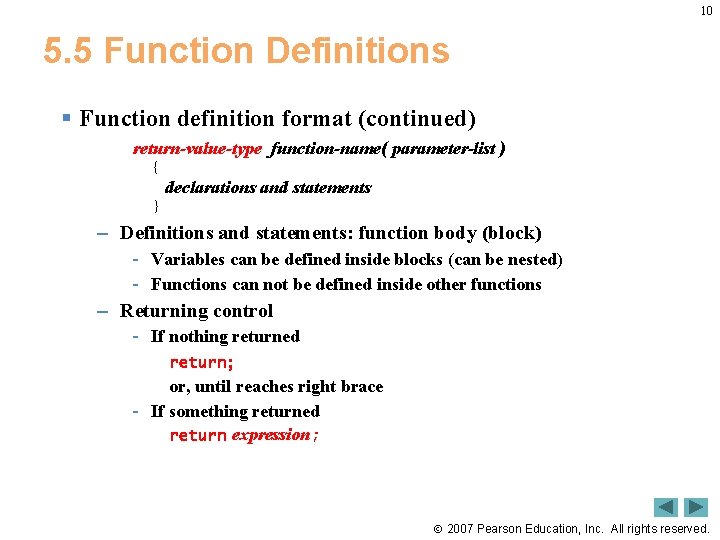
9 5. 5 Function Definitions § Function definition format return-value-type function-name( parameter-list ) { declarations and statements } – Function-name: any valid identifier – Return-value-type: data type of the result (default int) - void – indicates that the function returns nothing – Parameter-list: comma separated list, declares parameters - A type must be listed explicitly for each parameter unless, the parameter is of type int 2007 Pearson Education, Inc. All rights reserved.
10 5. 5 Function Definitions § Function definition format (continued) return-value-type function-name( parameter-list ) { declarations and statements } – Definitions and statements: function body (block) - Variables can be defined inside blocks (can be nested) - Functions can not be defined inside other functions – Returning control - If nothing returned return; or, until reaches right brace - If something returned return expression; 2007 Pearson Education, Inc. All rights reserved.
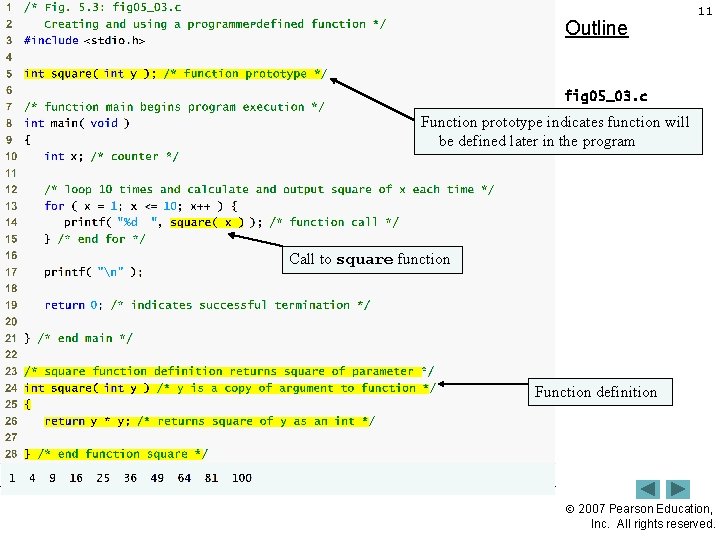
Outline 11 fig 05_03. c Function prototype indicates function will be defined later in the program Call to square function Function definition 2007 Pearson Education, Inc. All rights reserved.
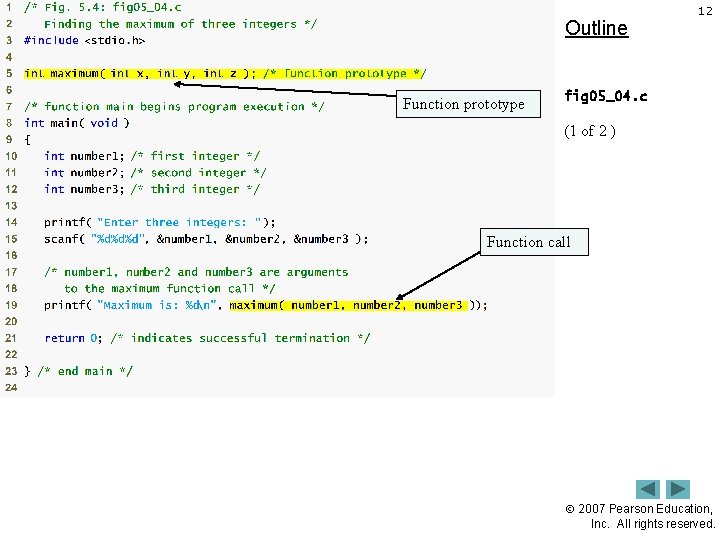
Outline Function prototype 12 fig 05_04. c (1 of 2 ) Function call 2007 Pearson Education, Inc. All rights reserved.
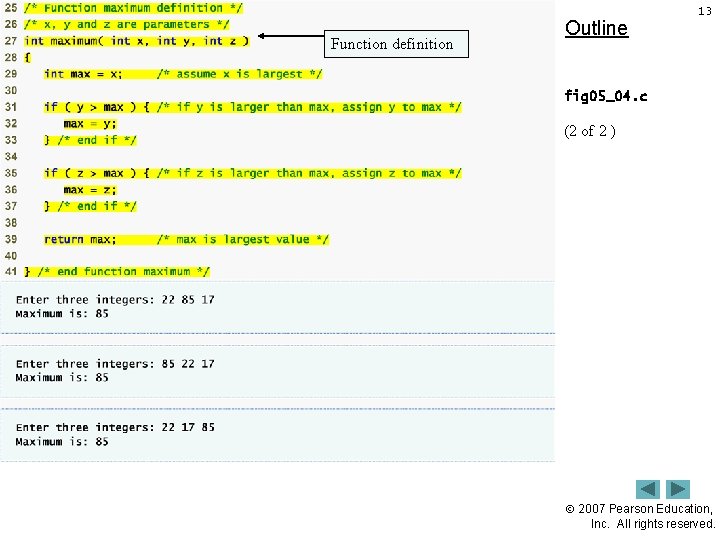
Function definition Outline 13 fig 05_04. c (2 of 2 ) 2007 Pearson Education, Inc. All rights reserved.
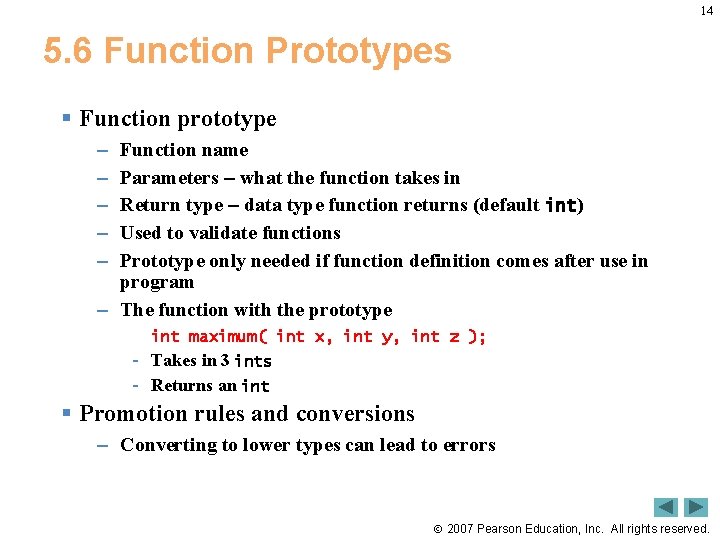
14 5. 6 Function Prototypes § Function prototype – – – Function name Parameters – what the function takes in Return type – data type function returns (default int) Used to validate functions Prototype only needed if function definition comes after use in program – The function with the prototype int maximum( int x, int y, int z ); - Takes in 3 ints - Returns an int § Promotion rules and conversions – Converting to lower types can lead to errors 2007 Pearson Education, Inc. All rights reserved.
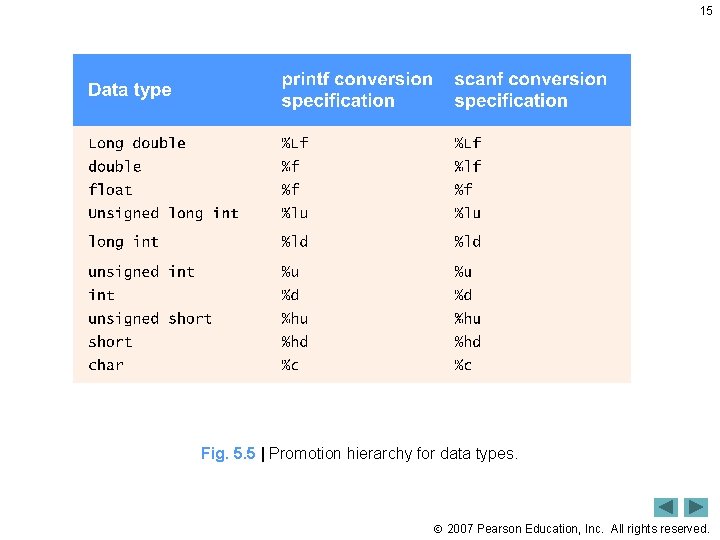
15 Fig. 5. 5 | Promotion hierarchy for data types. 2007 Pearson Education, Inc. All rights reserved.
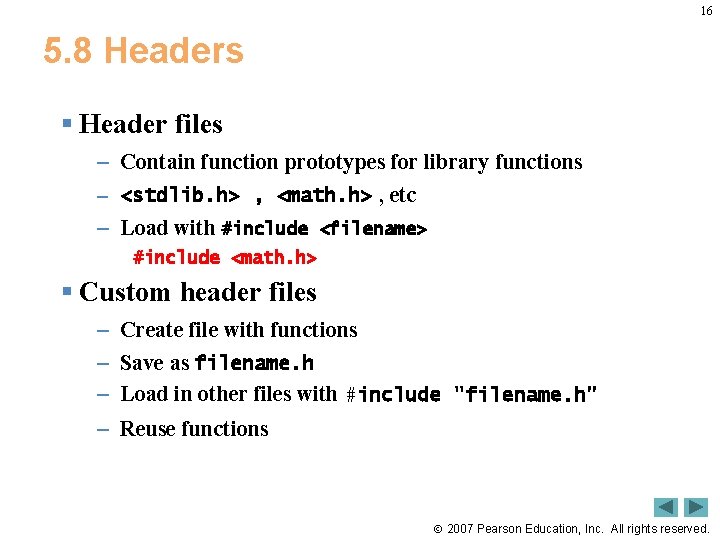
16 5. 8 Headers § Header files – Contain function prototypes for library functions – <stdlib. h> , <math. h> , etc – Load with #include <filename> #include <math. h> § Custom header files – Create file with functions – Save as filename. h – Load in other files with #include "filename. h" – Reuse functions 2007 Pearson Education, Inc. All rights reserved.
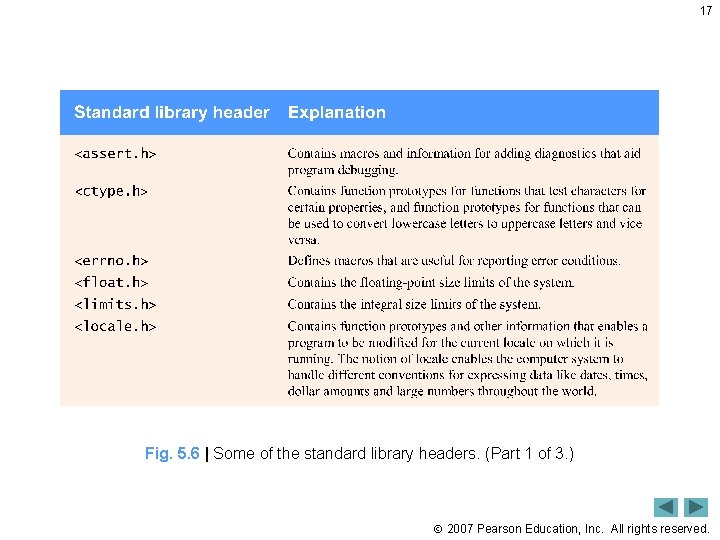
17 Fig. 5. 6 | Some of the standard library headers. (Part 1 of 3. ) 2007 Pearson Education, Inc. All rights reserved.
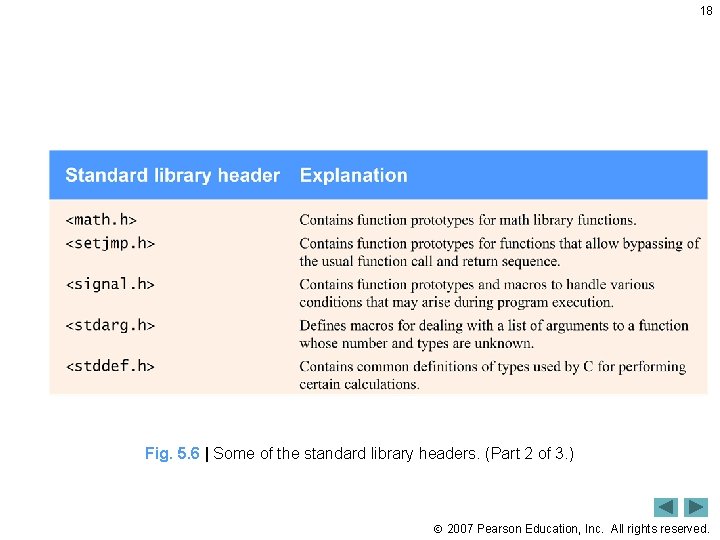
18 Fig. 5. 6 | Some of the standard library headers. (Part 2 of 3. ) 2007 Pearson Education, Inc. All rights reserved.
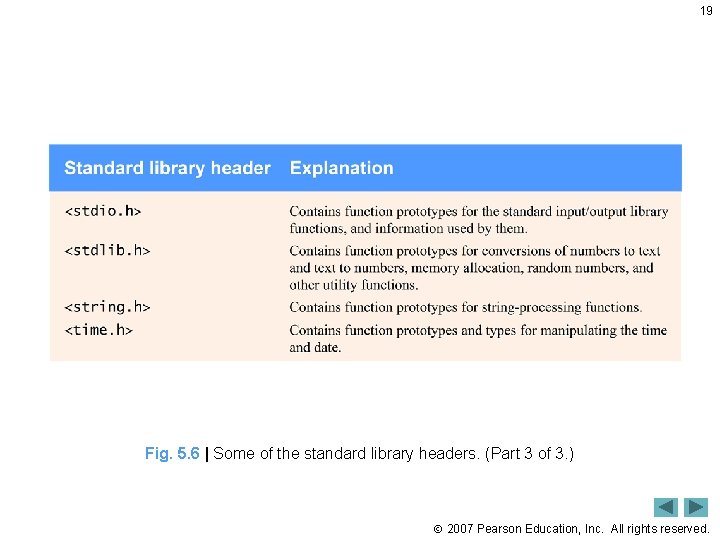
19 Fig. 5. 6 | Some of the standard library headers. (Part 3 of 3. ) 2007 Pearson Education, Inc. All rights reserved.
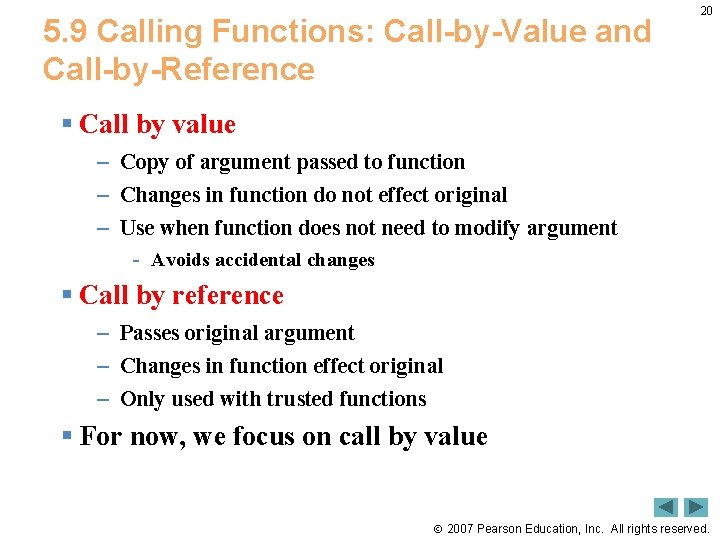
5. 9 Calling Functions: Call-by-Value and Call-by-Reference 20 § Call by value – Copy of argument passed to function – Changes in function do not effect original – Use when function does not need to modify argument - Avoids accidental changes § Call by reference – Passes original argument – Changes in function effect original – Only used with trusted functions § For now, we focus on call by value 2007 Pearson Education, Inc. All rights reserved.
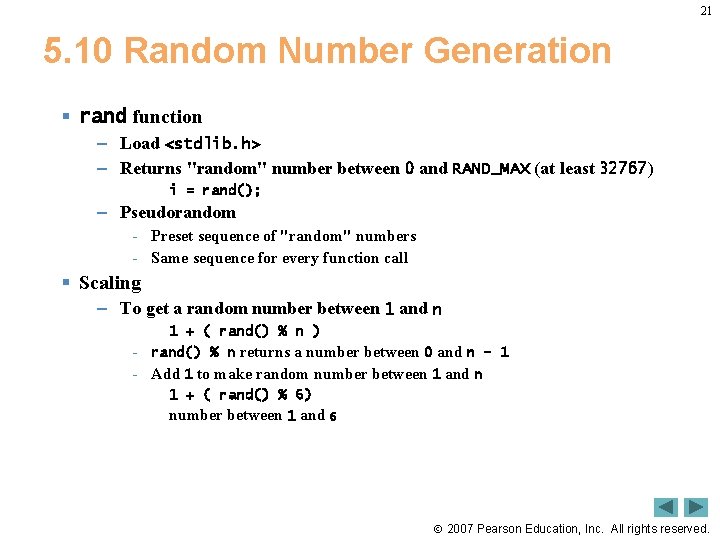
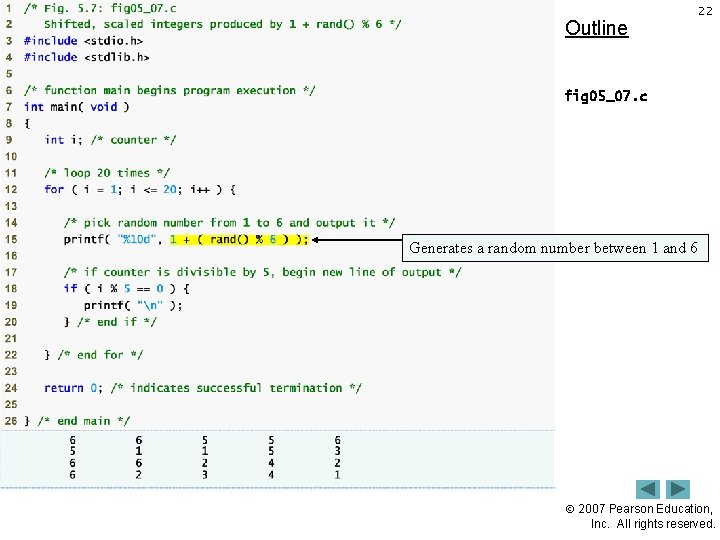
21 5. 10 Random Number Generation § rand function – Load <stdlib. h> – Returns "random" number between 0 and RAND_MAX (at least 32767) i = rand(); – Pseudorandom - Preset sequence of "random" numbers - Same sequence for every function call § Scaling – To get a random number between 1 and n 1 + ( rand() % n ) - rand() % n returns a number between 0 and n - 1 - Add 1 to make random number between 1 and n 1 + ( rand() % 6) number between 1 and 6 2007 Pearson Education, Inc. All rights reserved.
Outline 22 fig 05_07. c Generates a random number between 1 and 6 2007 Pearson Education, Inc. All rights reserved.
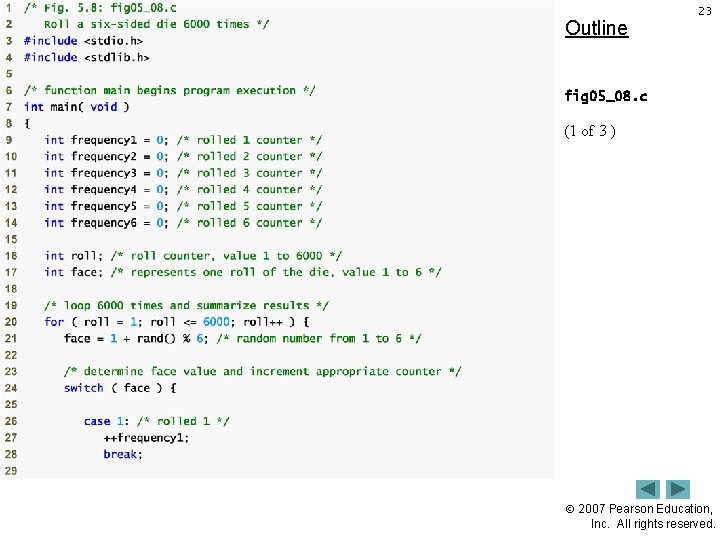
Outline 23 fig 05_08. c (1 of 3 ) 2007 Pearson Education, Inc. All rights reserved.
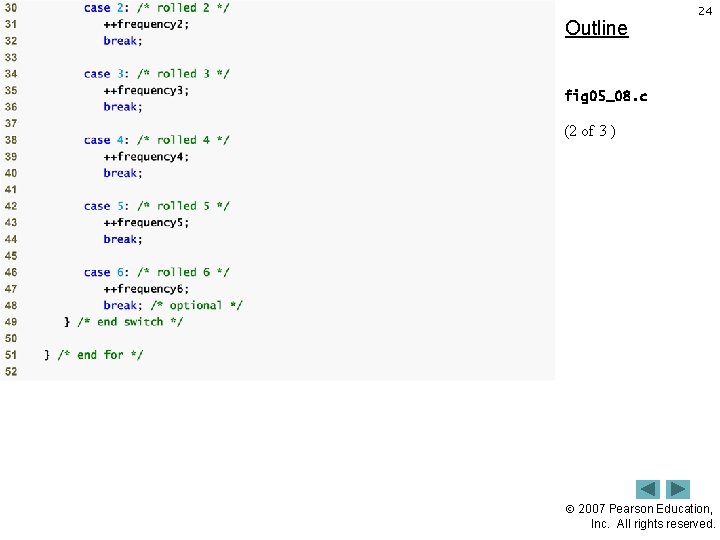
Outline 24 fig 05_08. c (2 of 3 ) 2007 Pearson Education, Inc. All rights reserved.
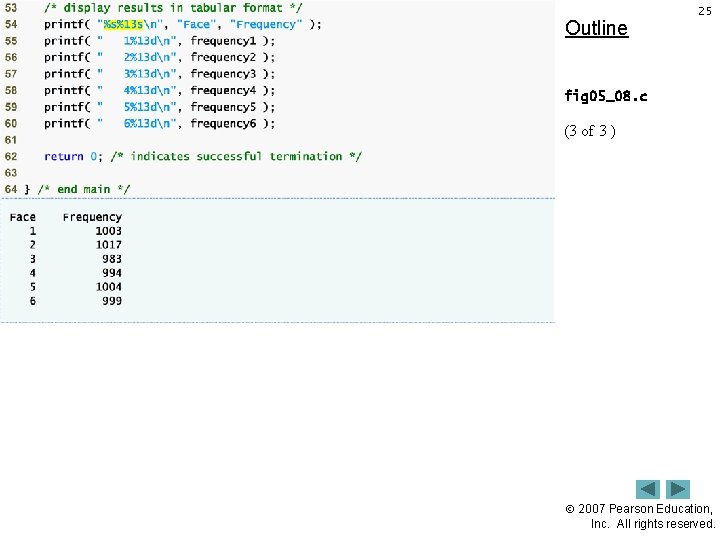
Outline 25 fig 05_08. c (3 of 3 ) 2007 Pearson Education, Inc. All rights reserved.
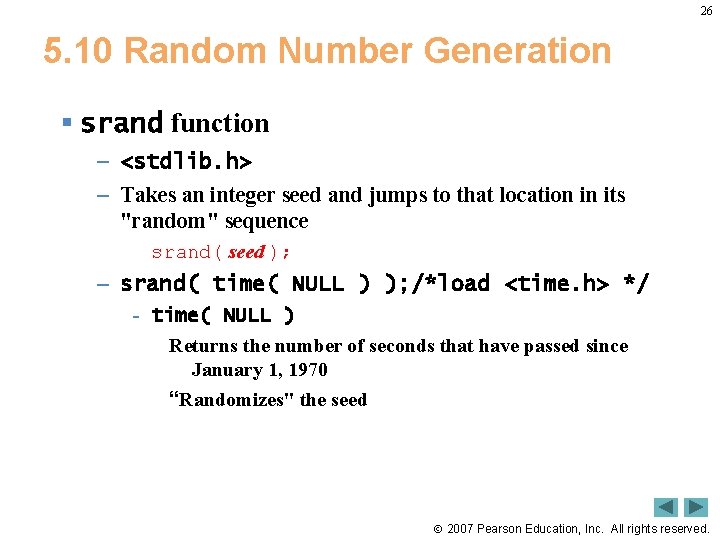
26 5. 10 Random Number Generation § srand function – <stdlib. h> – Takes an integer seed and jumps to that location in its "random" sequence srand( seed ); – srand( time( NULL ) ); /*load <time. h> */ - time( NULL ) Returns the number of seconds that have passed since January 1, 1970 “Randomizes" the seed 2007 Pearson Education, Inc. All rights reserved.
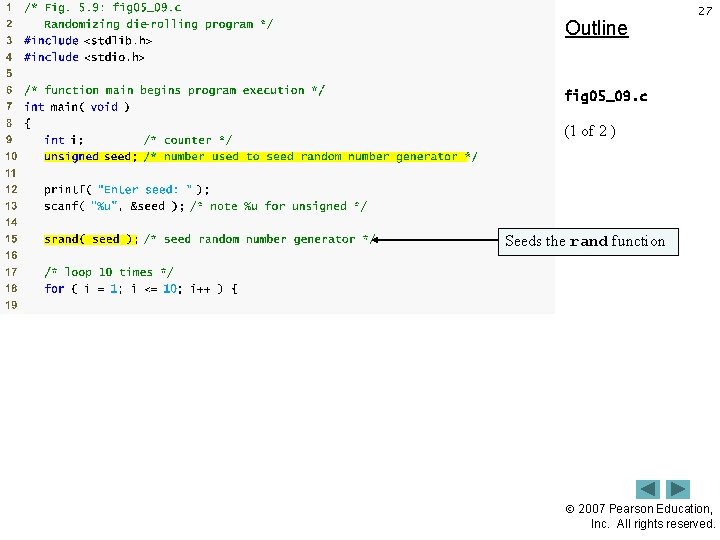
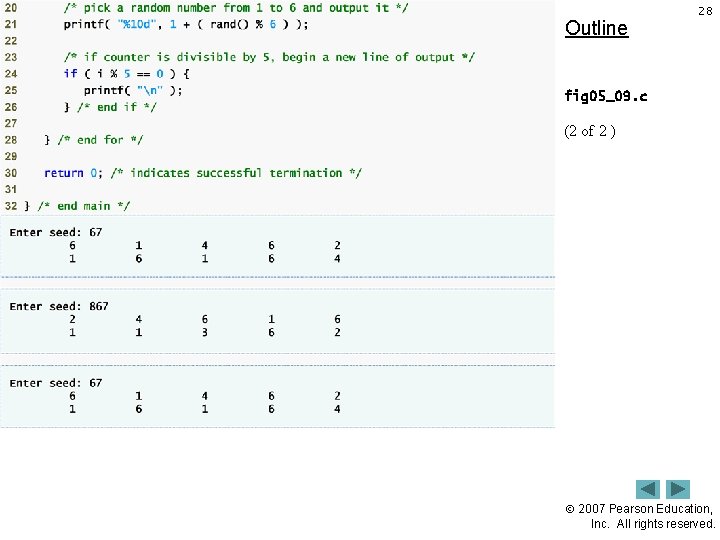
Outline 27 fig 05_09. c (1 of 2 ) Seeds the rand function 2007 Pearson Education, Inc. All rights reserved.
Outline 28 fig 05_09. c (2 of 2 ) 2007 Pearson Education, Inc. All rights reserved.