
1 5 How does the body protect us
1. 5 – How does the body protect us from pathogens? Ms. Martel
Think-Pair-Share • Most microbes are harmless to us and many are helpful. • However, some cause disease, and we are constantly exposed to them. • Why then are we not always sick? • How does the body protect us? Share & discuss your ideas. Concept 1 – The immune system helps protect us from pathogens and infection

Some pathogens enter through the respiratory system. Hair like structures in your nose and throat trap some of these and move them out of your body through sneezing or coughing The skin is a physical barrier to keep pathogens from entering the body. Sweat and natural body acids kill some pathogens on the surface of the skin. If you eat food that contains pathogens, often your stomach acid can kill them. Mucus also traps pathogens, and vomiting removes them. • The immune system has several lines of defense that help protect us from pathogens.
• The immune system has ways to attack pathogens that get by the first line of defence. • White blood cells (WBC’s) can surround and kill them. • Some WBC’s release chemicals that make it easier for others to kill pathogens. The Second and Third Lines of Defence
• If you have an injury or infection, your body responds by getting inflamed. • Inflammation causes the area to become red and swollen. • WBC’s move to the area, killing pathogens and keeping the infection from spreading. • A third line of defence uses specialized WBC’s to fight a pathogen. • If the same pathogens enter the body in the future, these cells can respond quickly so you don’t get sick again.
Think – Pair – Share • The BC Center for Disease Control tracks incidents of influenza and puts out bulletins to communicate its findings. • During the winter, when flu outbreaks are more common, this information helps inform the public of health threats. • If an outbreak were severe, health authorities would share information through the media and your school. • Have you experienced changes in your lifestyle or routine due to a flurelated illness? • When you hear about an outbreak of flu, what do you think that means? Concept 2 – Outbreaks of disease can have an impact on populations
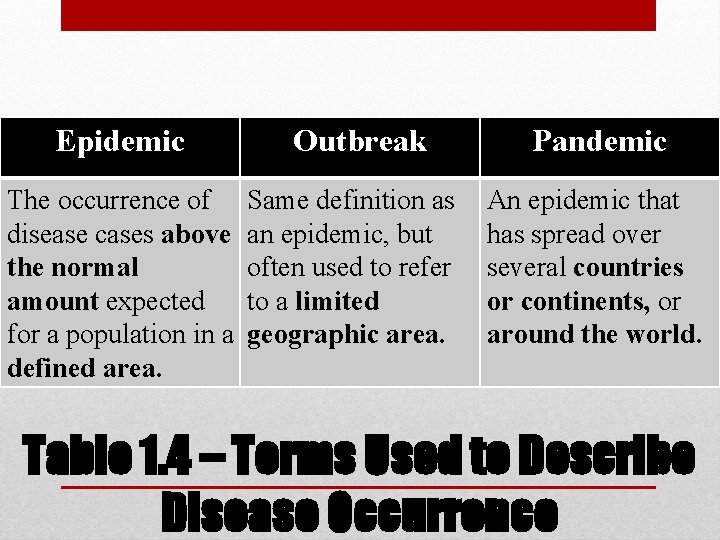
Epidemic The occurrence of disease cases above the normal amount expected for a population in a defined area. Outbreak Same definition as an epidemic, but often used to refer to a limited geographic area. Pandemic An epidemic that has spread over several countries or continents, or around the world. Table 1. 4 – Terms Used to Describe Disease Occurrence
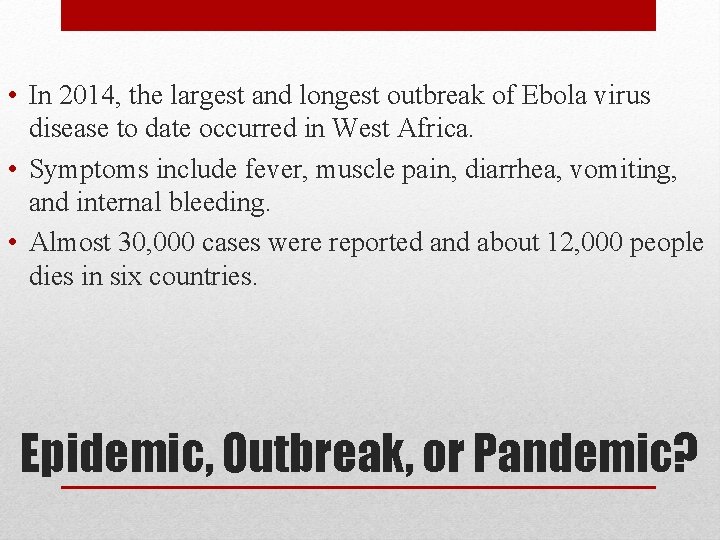
• In 2014, the largest and longest outbreak of Ebola virus disease to date occurred in West Africa. • Symptoms include fever, muscle pain, diarrhea, vomiting, and internal bleeding. • Almost 30, 000 cases were reported and about 12, 000 people dies in six countries. Epidemic, Outbreak, or Pandemic?
Epidemic
• Middle East respiratory syndrome (MERS) was first identified in 2012 in Saudi Arabia. • Symptoms include fever, cough an shortness of breath. • Approximately 35% of reported patients with MERS have died. Epidemic, Outbreak, or Pandemic?
Outbreak
• Poliomyelitis is a highly infectious disease, which mainly affects young children. • Symptoms include fever, fatigue, headache, vomiting, stiff neck, and limb pain. • In the early 1900’s polio was localized in Europe and the US. By the 1950’s it had reached Australia, New Zealand Asia. Epidemic, Outbreak, or Pandemic?
Pandemic
• In 1993 in Milwaukee, two water treatment plants became contaminated with cryptosporidium, which is a parasitic disease. • Symptoms include dehydration, fever, stomach cramps, and diarrhea. • 403 000 people got sick and 100 people died. Epidemic, Outbreak, or Pandemic?
Outbreak

• The earliest evidence of smallpox is found in Egyptian mummies 3000 years ago. • During the 20 th century, it’s estimated that it was responsible for 300 -500 millions deaths around the world. • The last known case was recorded in Somalia at the end of the 1970’s. Epidemic, Outbreak, or Pandemic?
Pandemic
• In early 2015, Brazilian Zika virus spread to other parts of South America and North America as well. • Symptoms of the illness are typical flu symptoms. • However, babies who were born to infected pregnant women, typically had severe birth defects. • The death toll was very small to those infected. Epidemic, Outbreak, or Pandemic?

Epidemic
• Epidemics and pandemics can have both social and economic impacts on human populations. • The flowing slides show some examples, with a partner classify each of these four cases as a social impact, an economic impact, or both. The Effects of Epidemics & Pandemics on Human Populations
• HIV has killed more than 25 million people since it was first identified in 1984. in just the first two decades of the 21 st century, more than 1 million people have died due to diseases such as SARS, H 1 N 1, measles, and typhoid. Economic, Social, or Both?
• Some livestock animals can pass on diseases to people. In 2015, an outbreak of bird flu forced poultry producers to kill about 50 million chickens and turkeys. The price of eggs increased, and farmers lost millions of dollars. Economic, Social, or Both?

• Sick days take their toll. Flu alone results in losses of half a billion dollars each year to the Canadian economy. Economic, Social, or Both?

• Taking extra precautions, as well as concern about fear and panic, can lead to governments to restrict travel as well as the importation of certain foods. Economic, Social, or Both?
• Deadly diseases have struck human populations throughout history all over the world. • Examples are plague, smallpox, measles, HIV/AIDS, and SARS. • There always people who will have a natural resistance to the pathogen and will survive. • Around 300 CE, there were repeated outbreaks of measles and smallpox over hundreds of years in Europe. Different Populations Have Different Immunities
• Many people died in each outbreak. • Over time, people ability to fight the pathogen increased. • Populations had built up an immunity to these diseases. • When Europeans first came to North and South America, First Peoples had never been exposed to these pathogens that caused measles and smallpox. • This meant they had no immunity to those diseases, and large numbers died as a result.
• Scientists are always searching for population that have natural immunity. • Example: in 2012, scientists learned that people in a remote part of Peru had a natural immunity to rabies. (A virus that affects the nervous system) • Example: in Gabon, scientists discovered a population with a natural immunity to Ebola. • Cases like these help scientists learn more about the diseases, how to treat them, and perhaps how to prevent them. Natural Immunity in Human Populations
- Slides: 27