
1 5 EXPLORIN G e l g An








- Slides: 24
1 -5 EXPLORIN G e l g An s r i Obj: To identify special Angle pairs and use their relationship to find angle measures.
ARCHITECTU RE Is this a single or double home? Why single? Why double?
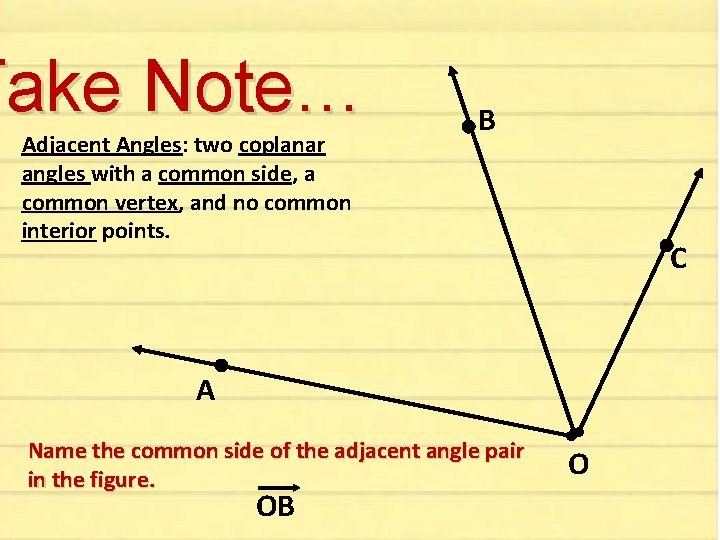
Take Note… Adjacent Angles: two coplanar angles with a common side, a common vertex, and no common interior points. B C A Name the common side of the adjacent angle pair in the figure. OB O
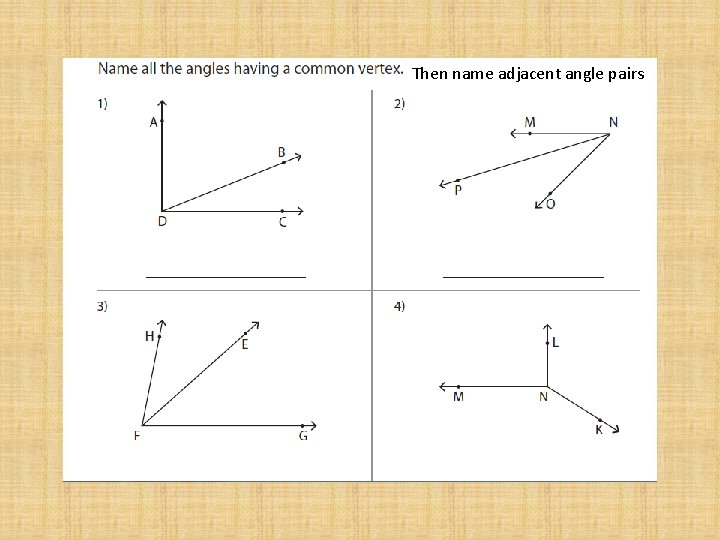
Then name adjacent angle pairs
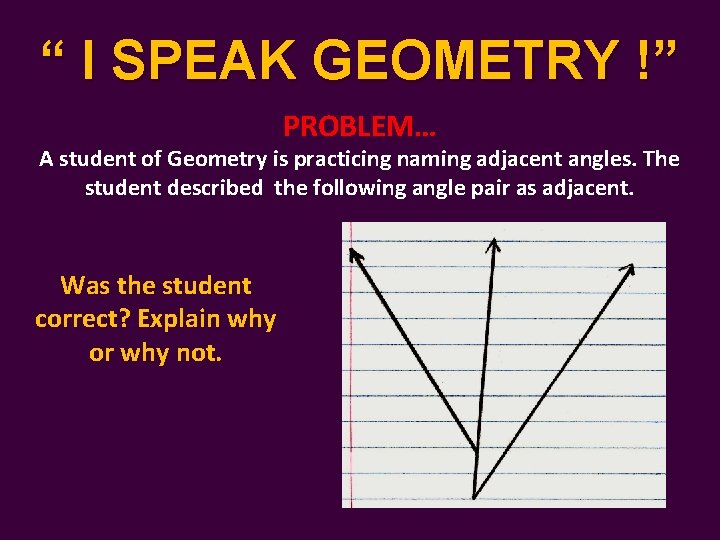
“ I SPEAK GEOMETRY !” PROBLEM… A student of Geometry is practicing naming adjacent angles. The student described the following angle pair as adjacent. Was the student correct? Explain why or why not.
BIOLOGY 1 2 ARE YOU NEAR-SIGHTED?
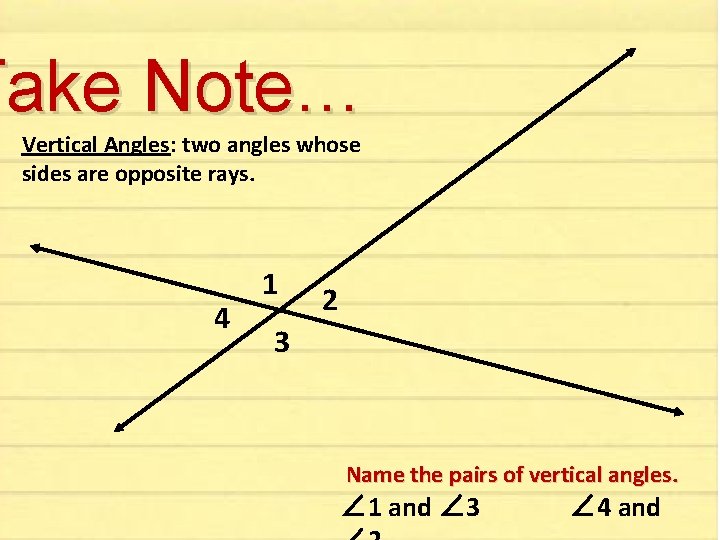
Take Note… Vertical Angles: two angles whose sides are opposite rays. 4 1 2 3 Name the pairs of vertical angles. ∠ 1 and ∠ 3 ∠ 4 and
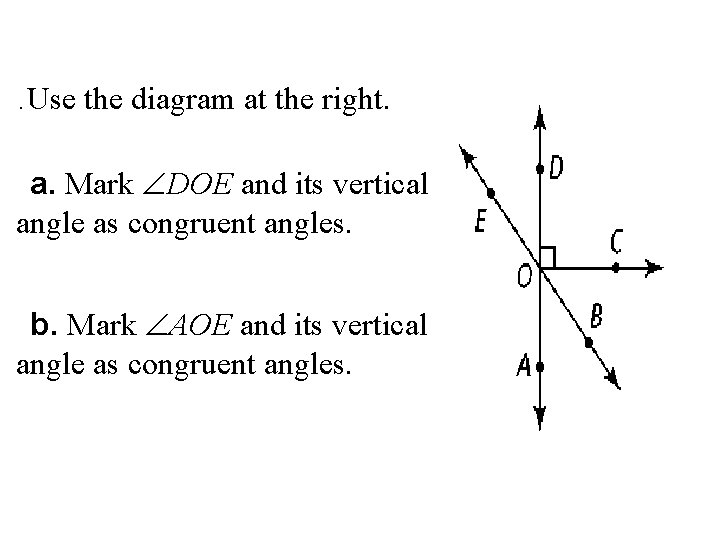
. Use the diagram at the right. a. Mark ÐDOE and its vertical angle as congruent angles. b. Mark ÐAOE and its vertical angle as congruent angles.
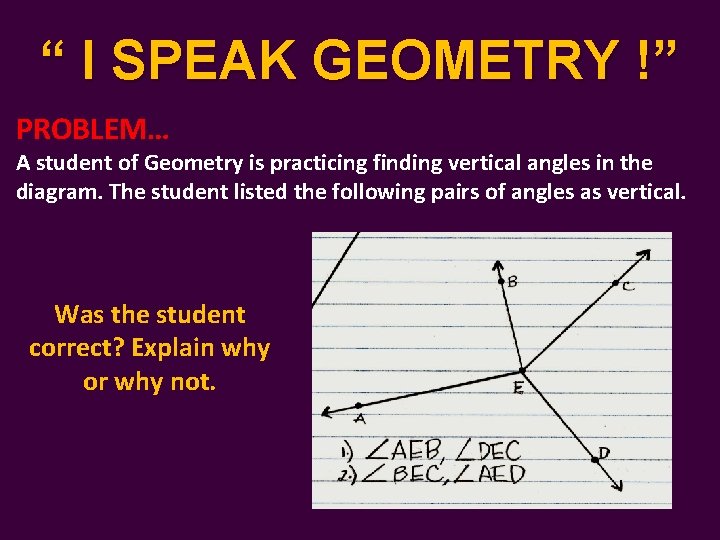
“ I SPEAK GEOMETRY !” PROBLEM… A student of Geometry is practicing finding vertical angles in the diagram. The student listed the following pairs of angles as vertical. Was the student correct? Explain why or why not.
Urban Planning Describe the pair of angles made by the intersection of the three streets in Paris?
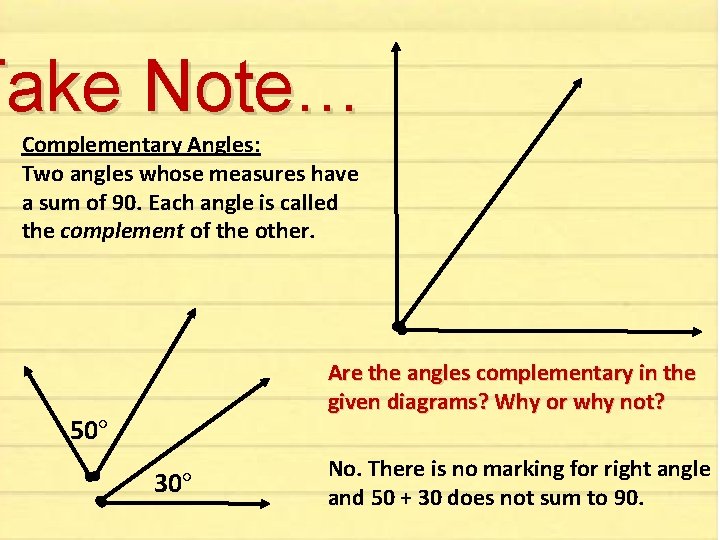
Take Note… Complementary Angles: Two angles whose measures have a sum of 90. Each angle is called the complement of the other. Are the angles complementary in the given diagrams? Why or why not? 50° 30° No. There is no marking for right angle and 50 + 30 does not sum to 90.
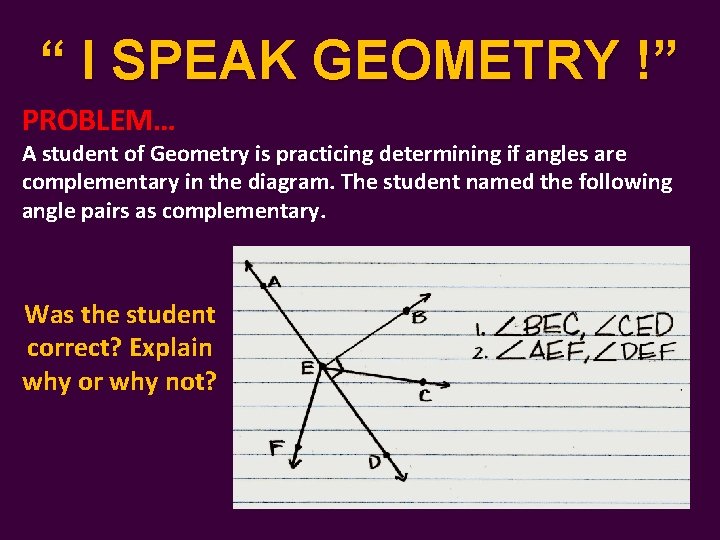
“ I SPEAK GEOMETRY !” PROBLEM… A student of Geometry is practicing determining if angles are complementary in the diagram. The student named the following angle pairs as complementary. Was the student correct? Explain why or why not?
EARTH SCIENCE HURRICANE WIND
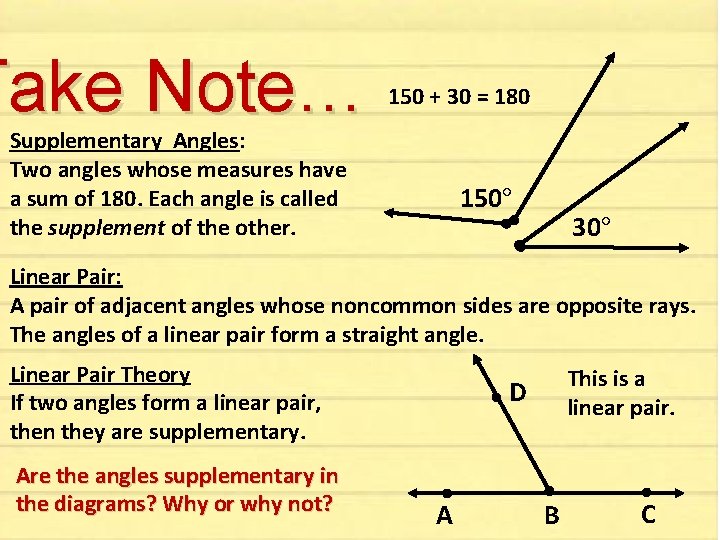
Take Note… 150 + 30 = 180 Supplementary Angles: Two angles whose measures have a sum of 180. Each angle is called the supplement of the other. 150° 30° Linear Pair: A pair of adjacent angles whose noncommon sides are opposite rays. The angles of a linear pair form a straight angle. Linear Pair Theory If two angles form a linear pair, then they are supplementary. Are the angles supplementary in the diagrams? Why or why not? This is a linear pair. D A B C
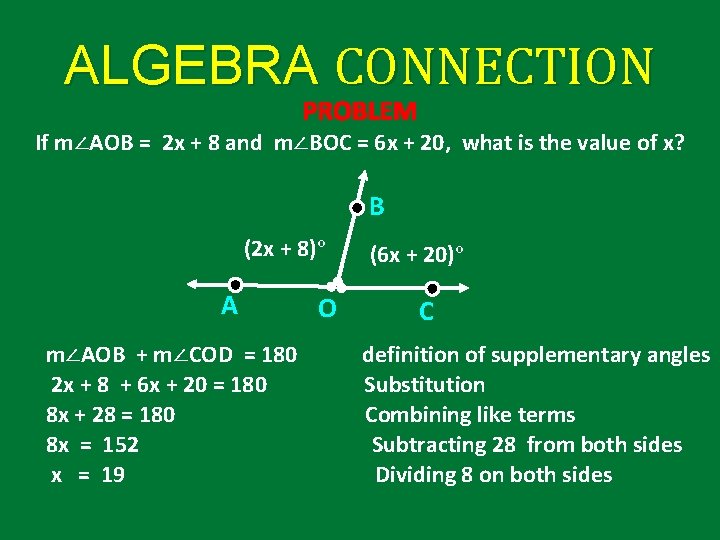
ALGEBRA CONNECTION PROBLEM If m∠AOB = 2 x + 8 and m∠BOC = 6 x + 20, what is the value of x? B (2 x + 8)° A m∠AOB + m∠COD = 180 2 x + 8 + 6 x + 20 = 180 8 x + 28 = 180 8 x = 152 x = 19 O (6 x + 20)° C definition of supplementary angles Substitution Combining like terms Subtracting 28 from both sides Dividing 8 on both sides
PHYSIC S A baby elephant is stuck in a mud hole. To help pull it out, gamekeepers use a rope to apply a single force. By itself, however, this force is insufficient. Therefore, two additional equal forces are applied. Tell me about the angles at which keepers are pulling the elephant?
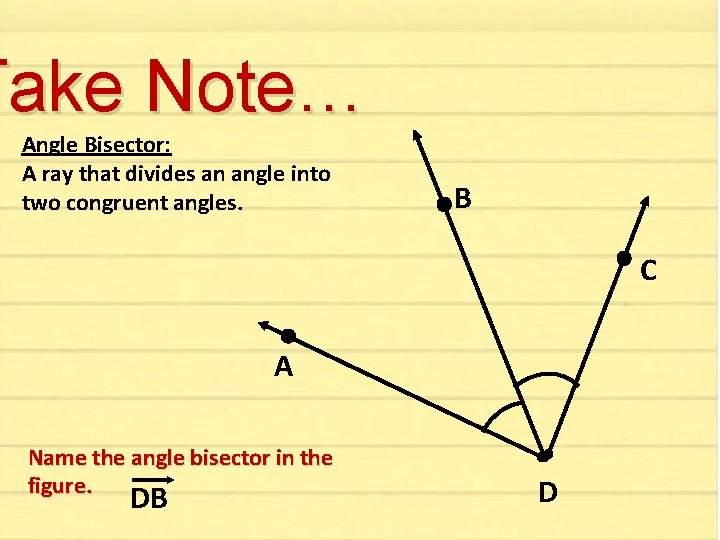
Take Note… Angle Bisector: A ray that divides an angle into two congruent angles. B C A Name the angle bisector in the figure. DB D
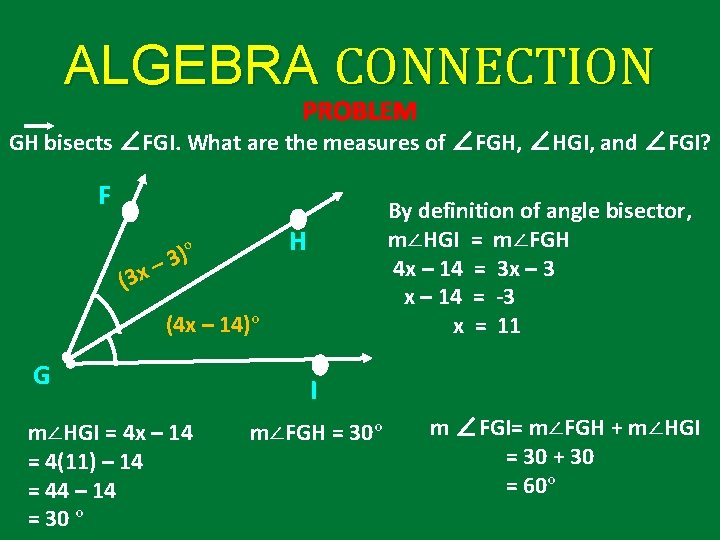
ALGEBRA CONNECTION PROBLEM GH bisects ∠FGI. What are the measures of ∠FGH, ∠HGI, and ∠FGI? F – x 3 ( By definition of angle bisector, m∠HGI = m∠FGH 4 x – 14 = 3 x – 3 x – 14 = -3 x = 11 H 3) ° (4 x – 14)° G m∠HGI = 4 x – 14 = 4(11) – 14 = 44 – 14 = 30 ° I m∠FGH = 30° m ∠FGI= m∠FGH + m∠HGI = 30 + 30 = 60°
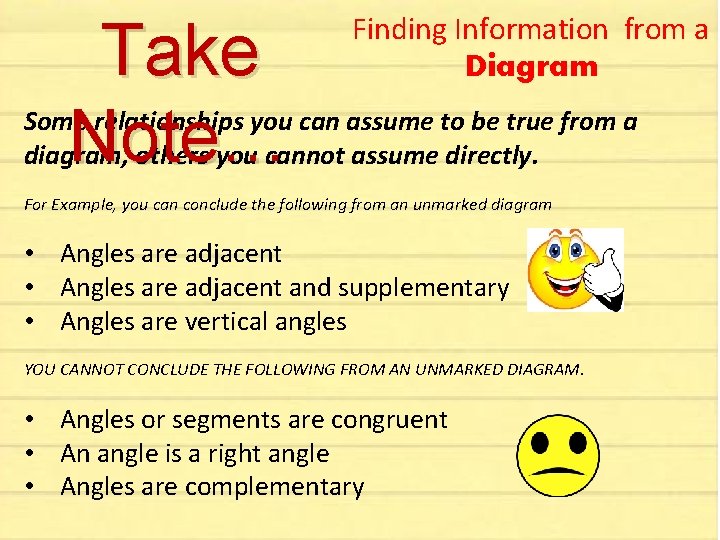
Take Note… Finding Information from a Diagram Some relationships you can assume to be true from a diagram, others you cannot assume directly. For Example, you can conclude the following from an unmarked diagram • Angles are adjacent and supplementary • Angles are vertical angles YOU CANNOT CONCLUDE THE FOLLOWING FROM AN UNMARKED DIAGRAM. • Angles or segments are congruent • An angle is a right angle • Angles are complementary
TO ASSUME OR NOT TO ASSUME… THAT IS THE QUESTION!!!!
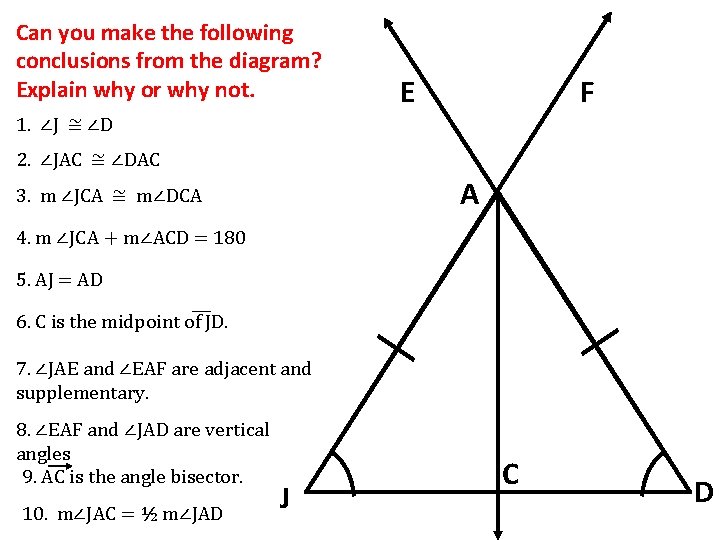
Can you make the following conclusions from the diagram? Explain why or why not. E F 1. ∠J ≅ ∠D 2. ∠JAC ≅ ∠DAC A 3. m ∠JCA ≅ m∠DCA 4. m ∠JCA + m∠ACD = 180 5. AJ = AD 6. C is the midpoint of JD. 7. ∠JAE and ∠EAF are adjacent and supplementary. 8. ∠EAF and ∠JAD are vertical angles 9. AC is the angle bisector. 10. m∠JAC = ½ m∠JAD J C D
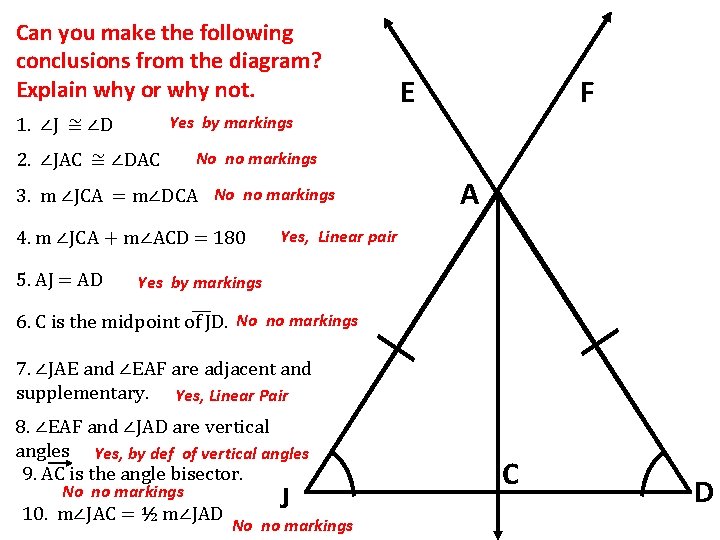
Can you make the following conclusions from the diagram? Explain why or why not. F Yes by markings 1. ∠J ≅ ∠D 2. ∠JAC ≅ ∠DAC No no markings 3. m ∠JCA = m∠DCA No no markings 4. m ∠JCA + m∠ACD = 180 5. AJ = AD E A Yes, Linear pair Yes by markings 6. C is the midpoint of JD. No no markings 7. ∠JAE and ∠EAF are adjacent and supplementary. Yes, Linear Pair 8. ∠EAF and ∠JAD are vertical angles Yes, by def of vertical angles 9. AC is the angle bisector. No no markings 10. m∠JAC = ½ m∠JAD J No no markings C D
The End