
1 5 Describing the Position of Objects in
1. 5. Describing the Position of Objects in Space
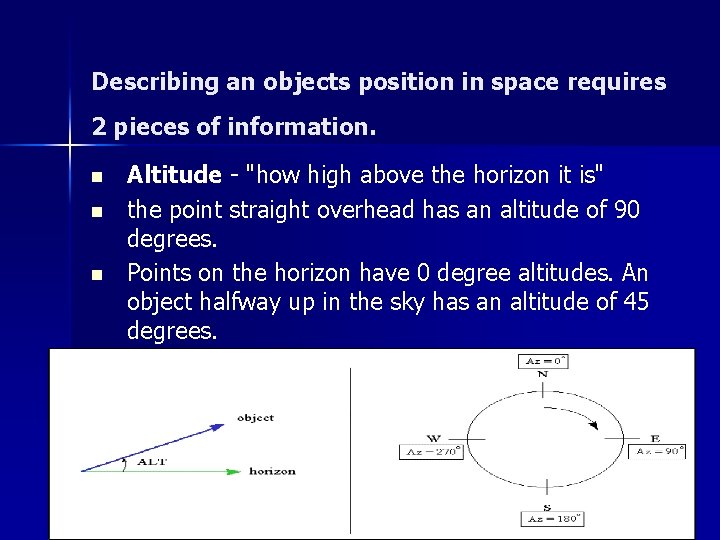
Describing an objects position in space requires 2 pieces of information. n n n Altitude - "how high above the horizon it is" the point straight overhead has an altitude of 90 degrees. Points on the horizon have 0 degree altitudes. An object halfway up in the sky has an altitude of 45 degrees.
Describing positions in space n n Azimuth determines "which compass direction it can be found in the sky. " An azimuth of zero degrees puts the object in the North. An azimuth of 90 degrees puts the object in the East. An azimuth of 180 degrees puts the object in the South, and one of 270 degrees puts the object in the west.
Describing positions in space n Zenith is the position in the sky directly overhead. n Thus, if Guide tells you that an object is at altitude 30 degrees, azimuth 80 degrees, look a little North of due East, about a third of the way from the horizon to the zenith.
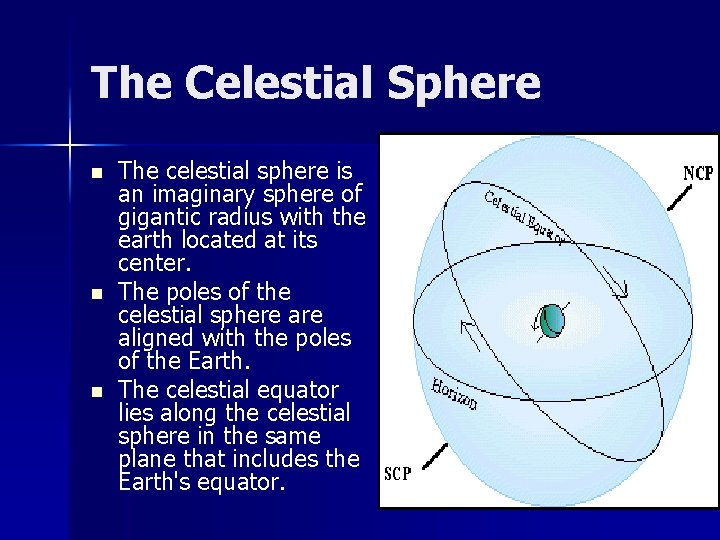
The Celestial Sphere n n n The celestial sphere is an imaginary sphere of gigantic radius with the earth located at its center. The poles of the celestial sphere aligned with the poles of the Earth. The celestial equator lies along the celestial sphere in the same plane that includes the Earth's equator.
Celestial Sphere n An astronomer can only see half the sky at a time, that is, only half the sky is above the horizon at any time. But the sky keeps moving as the earth rotates. Just as the sun rises and sets every day, so does every star in the sky each night.
- Slides: 6